Self Financial announced it has raised $50 million in additional funding.
The Austin-based fintech
company has raised $127 million to date, including $40 million in funding last
December.
The Series E round of
funding was led by Altos Ventures with participation from Meritech Capital and
Conductive Ventures.
The company plans to use
the funds to scale its business to make building credit accessible for the 100
million Americans that have no credit or low credit scores, according to the
company.
Self Financial created
the Credit Builder Account to allow its customers to build credit and savings
without a hard credit inquire or prior credit history. It also offers the Self
Visa Credit Card, a secured card. To date, Self has served more than two
million customers.
“We deeply support
Self’s mission of helping underserved customers to build credit and savings,
bringing them into the American financial mainstream,” Anthony Lee, Managing
Director of Altos Ventures said in a news release. “Since our original
investment, Self has helped millions of people build credit and this latest
round will enable them to scale their team and products to help millions
more.”
Self’s customer base has
more than doubled in the last 12 months, according to the company.
“We believe everyone
should have the opportunity to improve their financial future. That belief
shapes everything we do, so looking ahead, we will continue to invest in the
business and improve on our products to offer industry-leading solutions that
support consumers, particularly those who are new to credit or building their
credit,” Self founder and CEO James Garvey said in a news release.
Self now has nearly 200
employees, up 120 just this year.
The Austin-based fintech company, founded in 2017, allows people to use self-directed retirement accounts to make a wide variety of investments in alternative assets like real estate, startups, private equity, cryptocurrency, and more.
Park West Asset Management led the
Series A financing with participation from Hyphen Capital, Moneta Venture
Capital, Kraken Ventures, and Primetime Partners. Existing investor Sure
Ventures also participated.
The company also announced that
former T. Rowe Price Global Investment Services CEO and President Todd Ruppert
will also join Rocket Dollar’s board.
Rocket Dollar plans to use the funds
for product development, customer service, cybersecurity, and expanding investment
education and content creation.
“Modern investors expect ease,
trust, and convenience when it comes to managing their investment
portfolio,” Henry Yoshida, CEO and Co-Founder of Rocket Dollar, said in a
news release. “After studying this industry for years, we have applied new
technology to a paper-driven complex industry that instantly makes investing in
alternatives accessible and affordable. This gives control back to clients and
opens a wider range of asset classes to savvy investors, without the need for
expensive service providers.”
Rocket Dollar offers a flexible
investment IRA and Solo 401K platform that enables account holders to tap into
investment opportunities outside of stocks, bonds and mutual funds.
“In recent years, we have seen
an explosion of interest in alternatives as individuals see how much wealth is
created from private investments,” Dave Lu, Founder and Managing Partner
of Hyphen Capital. “Henry and his team are uniquely qualified and
well-positioned to revolutionize how investors leverage self-directed accounts
for alternative investments, having helped thousands of individuals unlock the
potential of their IRA funds to accelerate wealth accumulation.”
“The financial sector is in the
midst of a technological revolution,” Brandon Gath, Managing Partner at
Kraken Ventures, said in a news release. “Diversification is the only free
lunch in investing, but siloed operating systems and outdated tech stacks mean
consumers have long struggled to move their retirement savings into a wide
range of asset classes. This is what Rocket Dollar solves: they enable anyone,
from the twenty-something straight out of college, to the 60-year-old looking
to maximize their savings, to gain the same level of financial autonomy that
has historically been reserved for the ultra-wealthy. Kraken Ventures believes
technology ultimately empowers the investor and Rocket Dollar enables everyone
to add crypto – the highest performing asset class of the past decade – to
their retirement account.”
Rocket Dollar has more than $350
million in customer assets.
Loop Co-Founders and Co-CEOs John Henry and Carey Anne Nadeau
Car insurance that relies on credit scores, homeownership, and demographic data has a lot of structural bias baked into it, said John Henry, co-founder, and co-CEO of Loop.
“A lot of the pricing is based on demographic factors,” Henry said. “If you look at the rate filings of the top ten carriers, a credit score is 65 percent predictive. Your credit, your income, your occupation, all of those things predetermine your rates. When we saw that we were flabbergasted. We did not think that was at all indicative of your risk.”
Based on major insurance provider’s actual rate filings, a driver could have a DUI and two speeding tickets but live in a more affluent
area and be well educated and have a better rate than someone who lives in a
low-income area with a completely clean driving record, Henry said.
That’s why Henry launched Loop with Co-Founder and Co-CEO Carey Anne Nadeau to provide car insurance based on a person’s driving record. Henry is a serial entrepreneur and investor who sold his first business at 21 and went on to co-found Harlem Capital, which raised $40 million for women and minority entrepreneurs before he left in 2020. Nadeau is an entrepreneur and an MIT-trained city planner who formerly worked at the Brookings Institute and Urban Institute
“Loop is completely technology-enabled and it’s powered by
AI,” Henry said.
And on Saturday, Loop officially goes live in Texas to provide car insurance to drivers statewide.
The company already has a waiting list of 30,000, Henry
said. To create awareness, Henry and Nadeau drove a “mom van” around the state
to meet with potential customers in Houston, San Antonio, Austin, and Dallas-Fort
Worth.
Henry and Nadeau founded Loop in July of 2020 in the wake of
the George Floyd murder by police officers in Minneapolis. The founders wanted
to do something to bring more equity to people in under-served communities.
“We were inspired to do something big,” Henry said.
Loop closed on a $3.25 million seed-stage round of funding in January led by Freestyle VC. The company, whose founders resided in Washington, D.C. and New York, moved Loop’s headquarters to Austin earlier this year. They have also quickly grown from four employees to more than 30 employees. And they expect to be at more than 100 in the next six months and 1,000 with a year. Loop expects to close its next round of funding soon, Henry said.
Austin is a tech and insurance hub and is a particularly
attractive market for innovative startups, Henry said. Loop recently became a
member of InsureTech Austin, an organization that meets up monthly.
“We love the counterculture that exists here,” Henry said. “Here
people are talented and optimistic, and they love what comes with joining a
newcomer.”
Loop, which is a B-Corp, is a managing general agent that, unlike traditional agents and brokers, is vested with underwriting authority from an insurer. It bases its insurance rates on driver behavior which it gathers from its mobile app installed on the customer’s mobile phone. The app can detect if the person is using the phone while driving, it can also measure other factors like speed and sudden braking.
Loop also uses data to set and lower a driver’s insurance rate based on where they live and the accident rate for that area. Loop taps into databases of traffic accidents, weather, road conditions, and more. The app also uses artificial intelligence and machine learning to recommend safer routes for drivers to avoid accidents, Henry said. It has a partnership with TomTom to provide traffic alerts and mapping in real-time.
Loop is aiming its product at Millennials and Generation Z
who are avid mobile phone users and are comfortable with sharing data on their
driving behavior for discounts on rates. It’s also going to be popular with
renters, Henry said. Because a lot of insurance companies give a 15 percent
discount to people who bundle home and auto insurance, he said. That doesn’t
mean homeowners are 15 percent less risky than renters, he said.
By making the car insurance rate based on behavior and not any
other demographic factors or extraneous factors, Loop is creating a fairer
system for everyone, Henry said.
“When you are rated on the things that matter, you end up
saving a ton of money,” Henry said. “If your credit score is fair, that shouldn’t
matter. If you work a blue-collar job, that shouldn’t matter. If you didn’t go
Ivy league and you can’t get that discount, that also shouldn’t matter at least
according to our program.”
For many structural reasons, a lot of communities don’t have
great credit ratings, Henry said.
“I reflect on my own experience,” Henry said. “I grew up below
the poverty line. My parents immigrated from the Dominican Republic. We were
poor but my mom and dad are really good people. But they didn’t have careers.
They had jobs. They didn’t learn the language. My mom was a custodian, and my
pops was a presser in a dry cleaner. And so, we always lived in lower-income
areas.”
But they were also super safe drivers, Henry said.
“And it’s nuts to me that the communities that would need
the breaks the most and often times have good driving records are often
penalized and paying the most,” Henry said.
On average, a lot of these communities are paying 70 percent
above average rates, according to the data Loop examined, Henry said.
People need insurance for everything from getting a car, to a
house to renting and it’s conveniently invisible, Henry said.
Loop plans to roll out first in Texas and then launch in additional markets like Illinois, Pennsylvania, and Ohio this year, followed by New York, Connecticut, Maryland, Washington, D.C., Virginia, North Carolina, and Washington state in 2022.
Walmart may soon be delivering groceries in
Austin via a driverless car.
The grocery store giant announced Wednesday that it is teaming up with Ford Motor Co. and Argo AI to launch an autonomous vehicle delivery service in Austin, Miami and Washington, D.C.
Walmart will use Ford self-driving test
vehicles equipped with Argo AI self-driving system to deliver Walmart orders to
customers.
“Our focus on the testing and development of
self-driving technology that operates in urban areas where customer demand is
high really comes to life with this collaboration,” Bryan Salesky, founder and
CEO of Argo AI, said in a news release. “Working together with Walmart and Ford
across three markets, we’re showing the potential for autonomous vehicle
delivery services at scale.”
With the service, Walmart customers can place
an order online and have it delivered to their door via an autonomous vehicle.
“We’re excited to expand our autonomous
delivery efforts in three new markets alongside Argo and Ford,” Tom Ward,
senior vice president of last mile delivery, Walmart U.S. said in a news release.
“This collaboration will further our mission to get products to the homes of
our customers with unparalleled speed and ease, and in turn, will continue to
pave the way for autonomous delivery.”
Walmart plans to initially offer the service
in the three test markets and eventually roll it out to other markets
nationwide. The service is scheduled to start later this year.
“Argo and Ford are aggressively preparing for
large-scale autonomous vehicle operations across a broad footprint of U.S.
cities,” Scott Griffith, CEO, Ford Autonomous Vehicles & Mobility
Businesses said in a news release. “Pairing Walmart’s retail and e-commerce
leadership with Argo and Ford’s self-driving operations across these multiple
cities marks a significant step toward scaling a commercial goods delivery
service that will ultimately power first-to-scale business efficiencies and
enable a great consumer experience.”
Since 2019, Ford has been testing self-driving technology in Austin. Its also operating in Miami, Washington, D.C., Pittsburgh, Detroit and Palo Alto. Ford has been working on building autonomous ride-hailing and delivery services in those markets. It has been establishing a commercial fleet management capabilities, including fueling, servicing, and cleaning of self-driving vehicles, to support the customer and keep fleets running. Walmart previously tested with Ford in Miami in 2018.
Ryan Ginard, Director of Development for UT’s Computer Science Department, photo courtesy of UT.
Philanthropy has received increased press and interest in the last few months, be it the news that MacKenzie Scott has donated over $6.9 billion of her personal fortune to charity since the beginning of 2020 or the fact that 204 billionaires have now signed Warren Buffet’s “Giving Pledge”, including our very own Elon Musk.
Academics have also begun to draw closer
correlations between giving and success, helping validate what we already knew;
some of the most successful people, in life and business, are “givers” –
Professor Adam Grant (at the Wharton School of the University of Pennsylvania).
Here in Austin, Ryan Ginard (Director of
Development for UT’s Computer Science Department), is at the center of this
growing trend. We connected with him to get his insights on the future of
Philanthropy but also how technology will play an increasingly critical role.
Ryan is a civic connector and fundraiser with
over 15 years of experience in government, higher education, nonprofits, and
organized philanthropy, leveraging over $2.5bn in infrastructure funding and
directly raising over $15m for charities. Ryan moved to the United States from
Brisbane, Australia, where he spent five years as a policy and media adviser in
the federal government on the portfolios of financial services, industry and
innovation.
1. What
brought you to Austin and how did you first get into the world of Philanthropy?
My wife works as a Technical Recruiter and her
company was acquiring a number of transportation and cyber security start-ups
here in Austin and was given the opportunity to move. Austin has been on my
radar ever since I spoke at SXSW in 2015, and I was given the opportunity to
come work at Texas Computer Science which was the perfect backdrop to my work
in philanthropy & my passion for securing research funding that can advance
society. While the timing for the move wasn’t fantastic having got here 3 weeks
prior to everything shutting down due to COVID, it has ended up being a truly
transformative chapter in my career and to be honest, gave me the insight &
optimism needed to complete my upcoming book.
I moved to the States in 2011 and after
hitching a ride on some Congressional campaigns, I was offered the opportunity
to lead the Civic Leadership Fund at a large community foundation which was a
refreshing change to the cyclical nature of campaigns. In this role I had the
opportunity to connect with society in innovative new ways to drive impact and
I haven’t looked back since.
2. What
are the top trends you are seeing in Philanthropy and how is Technology helping
accelerate those trends?
We are starting to see the democratization of philanthropy and at a real opportune time in our history, given that a near $60 trillion transfer of generational wealth is to occur over the coming decades. Traditional grantmaking is being turned on its head in favor of a more dynamic place-based approach such as giving circles and impact investing. The social sector is finally realizing that a 501c3 is just a tax designation and not a business model and therefore are being more strategic in their fundraising. No longer will you see capital campaigns purely achieved by philanthropic dollars, with boards finally starting to greenlight a more creative mix of things like New Market Tax Credits and social impact bonds to ensure their success.
Technology is going to accelerate this
evolution of the sector in a range of exciting ways. Firstly automation is
going to make organizations more efficient & effective, AI is going to help
identify donors in your systems that have either been overlooked or
undervalued, smart contracts are going to save hours of time in grant writing
& reporting and make the grantmaking process more fair and equitable. The
list goes on and on. I’m a big proponent of ‘feeding the machines’ with the
hope that machine learning will help inform new solutions to some of society’s
biggest social issues such as homelessness and poverty.
3. What
are some of the early-stage companies from Austin in this space you have on
your radar?
There is some amazing work going on right now in Austin. I know this publication is called SiliconHillsNews but I’m really getting some ‘Silicon City Hall’ vibes which has me hopeful for some of our local start-ups. Civitech is definitely going places as there is a real appetite for data tools in community organizing and down-ballot political campaigns. It’s companies like this that will empower new voices and ideas to push back against the current status quo we see in legislatures across the country.
PILYTIX is another one. They have been working with UT Development for a while now using AI to focus on better donor leads and opportunities. I use the platform regularly and there is a lot of potential for them to grow into one of the leading companies in this space. The best thing about this platform though is that they use X.A.I. (Explainable AI) to demystify the tech and the modeling. By ensuring that users understand exactly how the output is generated, senior leadership will always feel more confident in their projections and understand what levers can be pulled to impact results.
I also like what InLieu is doing. It’s kind of like the Venmo of charitable giving and is super simple to use. I’m using it for gifting from now on and excited to finally leave the ‘thank you hampers’ that are extremely expensive and impersonal behind.
4. What
can larger, more established companies do to improve their social impact?
I would encourage a two-step process. Focus internally first with your own people, build a strong culture, and have giving as that one shared value in what will hopefully be a diverse workforce. Give bonuses & actively seek opportunities for them to grow professionally. Provide a corporate match and incentivize giving on their terms. Have a day of giving (or even a month like Microsoft does!) Give time for folks to volunteer or join a board, lots of companies are starting to give two hours of time-off a month for their employees to participate in community leadership. We have some amazing CEO’s here in town that are really showing us how it’s done – Whitney Wolfe Herd from Bumble and Kendra Scott being the leading lights here.
Once your own house is in order, my one word of advice is to not get caught in the trap of giving in a confetti-like approach. Focus on one issue that aligns with the mission of the company and stay the course. Find a select few groups to support and be their partner, not just their benefactor and watch your impact compound over time. Pro bono services are also just as important as funding and if you actually create tech products, share them & help build their capacity. CSR is going to evolve quickly given all the recent societal upheaval and your customers & users are going to expect more, and most importantly to be more.
5. If anyone reading this would like to connect with you directly or order your book, how can they contact you?
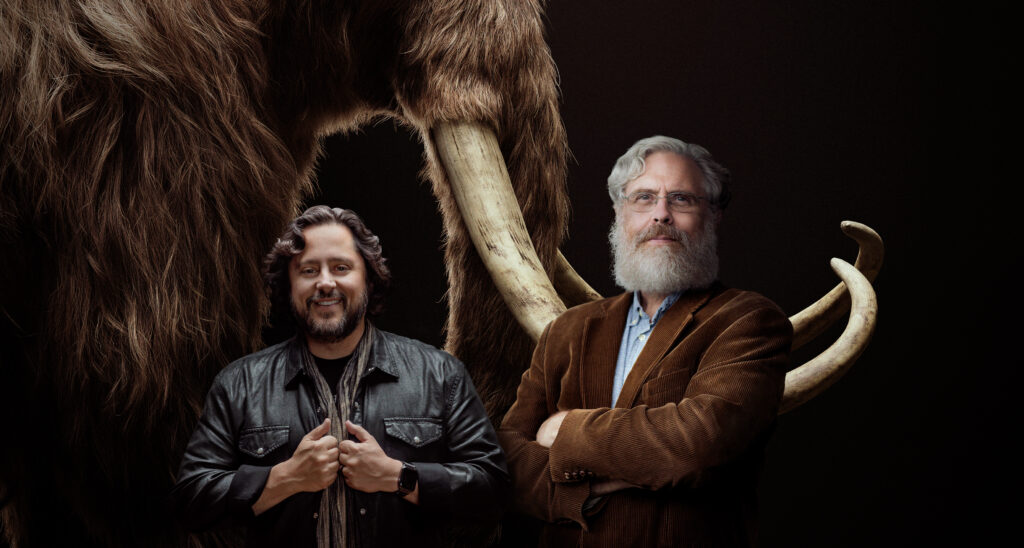
Co-Founders of Colossal, Ben Lamm (L), CEO and Dr. George Church (R), PhD
Thousands of years ago, amid a warming climate, the woolly mammoth vanished into extinction.
Now, serial entrepreneur Ben Lamm is teaming up with world-renowned geneticist and serial biotech entrepreneur George Church, Ph.D., to bring the woolly mammoth back to life.
That’s the mission behind Colossal, a bioscience and genetics company co-founded by Church and Lamm and a handful of other entrepreneurs that launched Monday.
And they are not stopping with the woolly mammoth. They plan to apply genetic engineering to save other species from extinction or to bring back to life those that have already died off.
Lamm, an Austin native
who splits his time between Austin and Dallas, has a track record of tackling
big problems. Lamm, 39, most recently co-founded Hypergiant Technologies, an
artificial intelligence company based in Austin. In May, he stepped aside as
CEO to focus on his new venture. Previously, Lamm founded and served as CEO of
Conversable acquired by LivePerson and co-founder and CEO of Chaotic Moon
Studios acquired by Accenture and Team Chaos, acquired by Zynga.
Colossal plans to use CRISPR technology to apply advanced gene-editing techniques to restore the woolly mammoth to the Arctic tundra. The company is based out of Austin, Dallas, and Boston. It has 19 employees. Software operations reside in Austin. Hardware, wetware, and genetic rescue and species restoration departments are in Dallas. And the research lab is in Boston.
“Never before has humanity been able to harness the power of this technology to rebuild ecosystems, heal our Earth and preserve its future through the repopulation of extinct animals,” Lamm, CEO and Co-Founder of Colossal, said in a news release. “In addition to bringing back ancient extinct species like the woolly mammoth, we will be able to leverage our technologies to help preserve critically endangered species that are on the verge of extinction and restore animals where humankind had a hand in their demise.”
“Colossal leverages the
exponential progress made in technologies for reading and writing DNA and
applies it to iconic ecological conservation and carbon sequestration issues,” Colossal
Co-Founder Church said in a news release.
Restoring the woolly mammoth will lead to the restoration of the Arctic Tundra, according to Colossal.
Church, who is the Robert Winthrop Professor of Genetics at Harvard Medical School (HMS) and a Core Faculty member at the Wyss Institute for Biologically Inspired Engineering at Harvard University, has pioneered several breakthroughs that have progressed the field of genomics, including CRISPR.
“A former researcher in Dr. Church’s lab, Eriona Hysolli, will oversee the new company’s efforts to edit elephant DNA, adding genes for mammoth traits like dense hair and thick fat for withstanding cold,” according to the New York Times. “The researchers hope to produce embryos of these mammoth-like elephants in a few years, and ultimately produce entire populations of the animals.”
The elephant-mammoth hybrid will be genetically engineered with traits to help it survive in the Arctic.
“Technologies discovered
in pursuit of this grand vision – a living, walking proxy of a woolly mammoth –
could create very significant opportunities in conservation and beyond, not
least of which include inspiring public interest in STEM, prompting timely
discussions in bioethics, and raising awareness of the vital importance of
biodiversity,” Church said.
Colossal is backed by
$15 million in seed-stage funding led by Thomas Tull with participation from
Draper Associates, Animal Capital, At One Ventures, Jazz Ventures, Bold
Capital, Global Space Ventures, Climate Capital, Winklevoss Capital, Liquid2
Ventures, Capital Factory, Tony Robbins and First Light Capital.
Lamm will serve as Colossal’s CEO, Andrew Busey will serve as Chief Product Officer, and is also a co-founder. Kent Wakeford is also co-founder and Chief Operating Officer, Brian Beard is co-founder and Chief Legal Officer, and Peter Phillips is co-founder and Chief Business Officer and Head of Biological Sciences Hysolli, Ph.D., a former postdoctoral fellow in the Church Lab from 2015 to 2021.
Colossal has licensed
the technology from Harvard to commercialize the research from the Church Lab,
in a range of defined fields, excluding use in humans.
GenXComm, a telecommunications startup spun out of the
University of Texas at Austin, announced it has raised $20 million in funding.
Motive
Companies led the Series B round with participation from Rain Next-Gen
Communications and existing investor BMW iVentures.
The
Austin-based company plans to use the funding to accelerate its product
development and commercial launch of its private 4G LTE and 5G network
solutions.
To
date, the company has raised more than $29 million, including $7 million in
Series A funding led by Intel Capital. Its other investors include Azure
Capital Partners, Bandgap Ventures, Capital Factory, FAM Capital Partners,
Lip-Bu Tan, UT Horizon Fund and WS Investment Co.
UT Electrical and Computer Engineering Professor
Sriram Vishwawath founded GenXComm in 2016 along with Hardik Jain and Stephen
Gartside.
The company is solving the problem of wireless networks that can’t handle a lot of traffic. GenXComm’s technology combines radiofrequency and photonics to solve the problems associated with today’s wireless connectivity infrastructure. Its mesh technology network technology breaks through the limits of conventional wireless capabilities, allowing for faster, more reliable, and more affordable networking solutions.
GenXComm’s technology optimizes communication by allowing
wireless channels to transmit and receive simultaneously – on the same
frequencies.
“Enterprise and Industrial customers worldwide are investing
in the digital transformation and full automation of business processes and
decision systems,” Jain, CTO of GenXComm
said in a news release. “GenXComm’s 4G LTE and 5G cellular mesh systems will
provide the enterprise WAN with the coverage, reliability, agility, and secure
connectivity required to make this transformation a reality.”
“The true advantage
of GenXComm is their technology’s ability to significantly reduce costs while
increasing the speed of communications and remaining inference-free,” said
Robert Istwan, chief executive officer of Motive Companies said in a news
release.
“We believe GenXComm’s solutions enable enterprises to own
and operate their own private cellular networks,” Chris Donini, Managing
Director at Raine said in a news release. “The market for private wireless
networks is exploding, and we are excited to partner with a company at the
forefront of the innovation required to service Industry 4.0.”
GenXComm’s technology gives companies and organizations the ability to evolve from enterprise Wi-Fi, cabled, or public wireless carrier solutions to their own private cellular network easily and cost-effectively.
Eventus Systems, an Austin-based trade surveillance provider for major digital asset exchanges, announced it has closed on a $30 million round of funding.
Centana Growth Partners led the Series B funding which included
participation from DRW VC, CMT Digital, Jump Capital, LiveOak Venture Partners
and several new strategic investors.
The company plans to use the funding to hire sales, product and
engineering staff and on product development of its flagship Validus platform.
As part of the deal, Centana Partner Ben Cukier has joined the
Eventus board of directors.
“Following our investment round early last year, we continued to
show strong topline revenue growth, nearly quadrupling our staff across every
facet of our business, building our presence in Europe and Asia-Pacific,
attracting a wide range of new clients and adding hundreds of new features and
enhancements to our Validus platform,” Eventus CEO Travis Schwab said in a news
release. “With a strong foothold in all of the major asset classes, we became
the leading trade surveillance solution for the major digital asset exchanges
globally and expanded our reach into the fixed income and foreign exchange
markets.”
“This new investment positions us to achieve our ambitious plans
for further growth and penetration into new markets, as well as our
never-ending quest for delivering market-leading solutions and support across
the capital markets ecosystem,” Schwab said.
Eventus’ customers include Tier 1 banks, brokerages and futures
commission merchants, proprietary trading firms, exchanges, corporates and
buy-side firms.
“The past year has
demonstrated the increased need for automating and strengthening regulatory
compliance,” Matt Alfieri, Principal at Centana Growth Partners, said in a news
release. “We’ve been incredibly impressed by the deeply experienced team and
efficient, scalable and powerful trade surveillance and market risk system that
Eventus has built. Its clients are truly passionate about the platform
and quality of service. As the focus of trade surveillance widens to other
asset classes like crypto, Eventus is poised not only to set the standard for
compliance and transparency but to further accelerate its growth trajectory.”
To date, Eventus has raised $48.5 million. That includes $10.5 million in Series A funding closed in February of 2020, led by Jump Capital and LiveOak Venture Partners.
Eventus has earned 15 global awards and honors since late 2018
for its technology, innovation and client service, including the Risk
Technology Award for Trade Surveillance Product of the Year.
While building a tiny home in Austin last March, Rusty
Fincke turned to his neighbors and friends to find an electrician.
“I was using Nextdoor and asking friends for referrals,” he
said.
That sparked the idea for RealWork Labs, which creates lead generation marketing software for the home services industry. Fincke joined with Pierce Birkhold, to launch the company in August of 2020. Its software helps home service providers improve their web presence by using video testimonials, customer recommendations, and social media to market. Its customers include plumbers, electricians, HVAC technicians, roofers, landscapers, and more. It also has a check-in feature that pinpoints on a map exactly where the workers have done jobs in a particular area.
In a short time, RealWork Labs has gained a lot of traction,
Birkhold said. It has 500 customers in just about every state including Alaska
and Hawaii, he said. They have also hired 30 employees and leased space at the
WeWork University building.
On Thursday, RealWork Labs announced it had closed on $2.5
million in seed-stage funding, led by LiveOak Venture Partners. And Krishna
Srinivasan, founding partner at LiveOak is joining RealWork Labs’ board along
with John Berkowitz, co-founder of OJO Labs and Yodle.
RealWork plans to use the funds raised to accelerate product
development and hire more employees to provide customer service and sales,
Birkhold said.
Previously, Fincke and Birkhold worked at Yodle and Digital
Pharmacist. Unlike other founders who come from a product development
background, they both have experience in sales and customer service. They also
only put in $3,000 each along with Warren Lentz, another Digital Pharmacist alum
to startup operations. The company has been profitable and generating revenue
since its earliest days, Fincke said.
“We’ve grown organically,” Fincke said. “We haven’t taken
out a loan to hire a bunch of people.”
Now RealWork Labs is spending millions of dollars on continuous product development. Birkhold said.
“The business is profitable and cash-flow positive and we’re able to grow our support team and sales team and invest in tools and best practices for our teams to support those customers in the best way,” Birkhold said.
RealWork Labs origin story is like a lot of bootstrapped entrepreneurs in Austin who tend to be scrappy, resourceful, and run-on revenue before seeking funding.
“We definitely have the taco truck approach to getting to where
we are now,” he said. “We’re not full P. Terry’s yet, or Torchy’s but we’re a
little bit above hanging out in a truck.”
RealWork Labs has done a good job of keeping its finances in
control and not spending above its means, so the company doesn’t go into debt,
Fincke said.
“We’ve had a lot of laughter and a lot of arguments to get
to where we are today and everything has continued to pan out in our favor,” he
said.
It was important to the founders to build an employee first organization,
Birkhold said. All employees have health insurance and are on staff, not
contractors, he said.
“As we bring the best of breed from all the places that we’ve
worked at we are hyper focused on our employees,” Birkhold said. They wanted to
create a company that they enjoyed working at, he said.
“We have known the founders both by reputation and by
working with them previously, as being simply exceptional in building and
scaling software solutions that target SMBs. The incredible traction the
company has had in such a short period of time is both a testament to the
founders’ abilities in this area and the magnitude of the market opportunity” Krishna Srinivasan, board member and Founding
Partner at LiveOak Venture Partners, said in a news release.
The pandemic has slowed down the home services industry lately
with material shortages and labor shortages, Birkhold said. Some home service
providers are not taking on new business until next year, he said.
“Even devices like garage door companies and HVAC servicers
are seeing shortages of materials that are impeding their ability to grow,” he
said.
“The pandemic is both a headwind and tailwind at the same
time,” Birkhold said.
But those businesses still need to develop and maintain
relationships with customers. And the key is to generate trust. That comes from
customers endorsing businesses, he said. With the RealWork Labs software, field
technicians can use their cell phones to capture on-site video and tell better
stories about their customer service, he said.
“We are doing that at the neighborhood level and generating
media and furthering the ecosystem so neighbors nearby can see the video and
content of what’s happening near them,” Birkhold said.
“It generates leads for the company,” he said.
“The first step is getting found. The second step is a new customer calling you. How do they choose one plumber versus another?” Birkhold said. “You can engineer behavior between technicians, prospects, and current customers through the use of technology and cell phones and a platform that can really overhaul the way home services businesses operate.”
The best advocate they could ever have isn’t a marketing
agency that edits their work it’s their customers, Birkhold said.
“And the best people for their customers to be speaking to are
their neighbors and people near them,” he said.
What makes RealWork Labs special is that businesses can’t
fake or force what it does, Birkhold said. Its video testimonials and social
proof only work if the business does good work, he said.
Firefly Aerospace launched its first rocket, Alpha, and then it experienced an “anomaly” and exploded once it reached supersonic speed.
“Alpha experienced an anomaly during the first stage ascent that resulted in the loss of the vehicle,” Firefly posted to Twitter.
The company, which is based in Cedar Park, launched its 95-foot tall Alpha rocket from Vanderburg Air Force Base in California at 6:59 p.m. California time. Everyday Astronaut live-streamed the event on YouTube. The rocket successfully cleared the launchpad and then exploded approximately two minutes into the flight.
“Prior to entering the countdown, the Range cleared the pad and all surrounding areas to minimize risk to Firefly employees, base staff, and the general public,” according to a Firefly post on Twitter.
“While it’s too early to draw conclusions as to the root cause, we will be diligent in our investigation, in partnership with the FAA and the Vanderberg Air Force Base,” according to a statement Firefly issued
Firefly also said while it didn’t reach all of its
objectives with the launch, it did achieve a successful first stage ignition,
liftoff off the pad, progression to
supersonic speed and it obtained a lot of flight data.