Firefly Aerospace launched its first rocket, Alpha, and then it experienced an “anomaly” and exploded once it reached supersonic speed.
“Alpha experienced an anomaly during the first stage ascent that resulted in the loss of the vehicle,” Firefly posted to Twitter.
The company, which is based in Cedar Park, launched its 95-foot tall Alpha rocket from Vanderburg Air Force Base in California at 6:59 p.m. California time. Everyday Astronaut live-streamed the event on YouTube. The rocket successfully cleared the launchpad and then exploded approximately two minutes into the flight.
“Prior to entering the countdown, the Range cleared the pad and all surrounding areas to minimize risk to Firefly employees, base staff, and the general public,” according to a Firefly post on Twitter.
“While it’s too early to draw conclusions as to the root cause, we will be diligent in our investigation, in partnership with the FAA and the Vanderberg Air Force Base,” according to a statement Firefly issued
Firefly also said while it didn’t reach all of its
objectives with the launch, it did achieve a successful first stage ignition,
liftoff off the pad, progression to
supersonic speed and it obtained a lot of flight data.
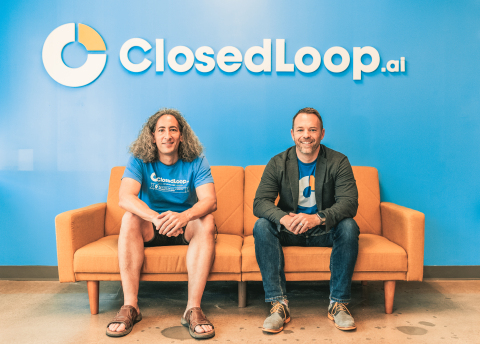
ClosedLoop.ai’s Co-Founders Dave DeCaprio and Andrew Eye
ClosedLoop.ai, a healthcare technology startup, recently raised $34 million in funding.
The Austin-based company plans to use
the funding to hire additional staff and to further develop its data science
platform for the healthcare industry.
Andrew Eye, ClosedLoop.ai’s CEO and Co-Founder,
recently sat down for an interview with the Ideas to Invoices podcast to talk
about his latest venture. Eye previously founded and sold two other technology
companies.
In 2012 Eye co-founded the mobile
software company Boxer, email management software. In 2015, VMWare acquired
Boxer.
Before Boxer, Eye co-founded the cyber
security firm Ciphent in 2007. Ciphent grew to nearly 100 employees with 1,000
customers by 2010 before being acquired by Accuvant (now Optiv).
Eye teamed up with Dave DeCaprio to found
CLosedloop.ai in 2017. Eye had previously worked with DeCaprio, who was working
on applying machine learning to the healthcare industry.
The venture became even more personal to
Eye following a healthcare challenge after his youngest daughter was diagnosed
with auto-immune hepatitis.
“The diagnostic odyssey we kind of went
on in that process made me really realize how little our health data as
patients is used in trying to figure out what’s wrong with us or what to do
about it,” Eye said.
In April, ClosedLoop.ai beat out more
than 300 participants including IBM, Mayo Clinic, Accenture, and Merck to win
the $1.6 CMS AI Health Outcomes Challenge.
“We thought this contest was tailored made for us from the beginning,” Eye said. “What they were asking the industry to build was AI that physicians trust. We had already been working on that for two years at the time. The contest ended up being a two-year-long contest because of COVID, it kind of stretched out.”
ClosedLoop.ai had been building software that could create
proprietary algorithms uniquely tailored to each clinic or hospital system to
identify at-risk patients and recommend the best course of treatment for each
person. The company had created the right product at the right time for the
challenge, Eye said.
“One of our favorite sayings is the
harder we work, the luckier we get,” Eye said.
The final submission for the contest was
due the week the massive snowstorm hit Texas last February. Eye had no power in
his house for six days. He drove his truck to the end of his road because he
couldn’t get out of his neighborhood. He parked in his car and used his cell
phone to tether to the Internet and he worked up to eight hours each day on the
project and then uploaded ClosedLoop.ai’s submission documents for the contest.
“We put every ounce of effort into
winning this because we think it’s really important in demonstrating what
artificial intelligence can do in healthcare,” Eye said.
“One of the things we like to say here
at ClosedLoop is we predict the future so you can change it,” Eye said. “You – being
a doctor, you – being a patient, you – being a nurse, you – being a care
manager. So, the idea is to leverage any linkable patient data that is
available to predict future health events.”
Usually, patient data is anchored in historic electronic medical records, admissions records for hospitals and clinics, and social determinants of health like whether you live in an area with good grocery stores, Eye said. ClosedLoop.ai takes all this linkable data and takes other features like prior diagnosis, current medications, and other variables and puts them into an algorithm and what comes out on the other side is predictive analysis, Eye said.
“There is no one master algorithm that is accurate for everyone,” Eye said.
Because the reasons people get admitted to a Medicare-focused practice in South Florida is different from the reasons people get admitted to a Medicaid-focused practice in the Bronx, Eye said.
“You’re going to have kids with asthma exacerbation
in the Bronx and you’re going to have retirees who are falling and breaking
hips in South Florida.”
Winning the CMS Challenge promoted
ClosedLoop.ai to raise its Series B round of funding about 18 months earlier
than it had planned, Eye said. It had the opportunity to get some really
strategic investors on board, so it raised the $34 million relatively quickly,
Eye said.
The Series B investment round was led by Telstra Ventures with participation from Breyer Capital, Greycroft Ventures, .406 Ventures, and Healthfirst. Notable angel investors Adam Boehler, former director of the Centers for Medicare and Medicaid Innovation and CEO of Landmark Health, and Sam Palmisano, former CEO of IBM, also participated in the round.
For more, listen to the entire podcast, pasted below, or wherever you get your podcasts – available on Google play store, Apple iTunes, Spotify, PlayerFM, Libsyn, and more.
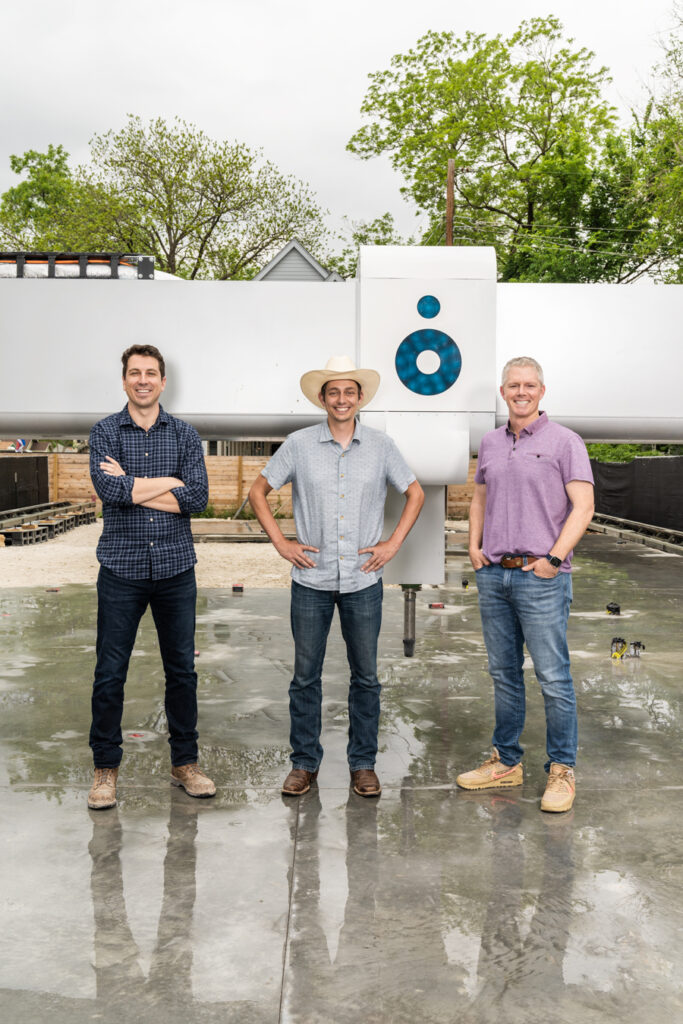
ICON CO-Founders Alex Le Roux, Jason Ballard and Evan Loomis, photo courtesy of ICON
ICON, the Austin-based startup that builds homes with its giant 3-D printers using concrete as substrate, has four large-scale 3-D home printers and it has tens of thousands of requests for homes.
“It’s sometimes heartbreaking but you have to decide what to say yes to and what to say no to,” said Jason Ballard, Co-Founder, and CEO of ICON.
That’s one of the reasons ICON sought more funding, Ballard said. The company announced Monday that it has completed a $207 million Series B round of financing led by Norwest Venture Partners. It’s one of the largest fundraising rounds for an Austin-based company in history.
Other investors
included 8VC, BIG-Bjarke Ingels Group, BOND, Citi, Crosstimbers, Ensemble Fifth
Wall, LEN Moderne Ventures and Oakhouse Partners.
To date, ICON has
raised $266 million since launching three years ago.
With the new funding,
ICON will be able to say yes to more projects and will be able to scale up its
manufacturing operations, Ballard said. It allows the company to scale up its
operations faster, he said. ICON’s
new Vulcan construction system can 3D print homes and structures up to 3,000
square feet.
“This is like the Apollo program for the future of the building industry,” Ballard said. ICON is trying to attract the most brilliant engineers, scientists, architects, operators, and leaders, he said.
“We are assembling the Avengers,” Ballard said.
ICON is focused on tackling one of humanity’s most profound problems which is homelessness, but it’s also focused on profound opportunities to build lunar space stations and Mars habitats, Ballard said.
ICON has built about two dozen homes all together in Texas and in Mexico, Ballard said. It teamed up with Mobile Loaves and Fishes, a nonprofit organization focused on helping Austin’s homeless, last year to build six 3-D printed homes for Community First! Village, a 51-acre master-planned development in Austin.
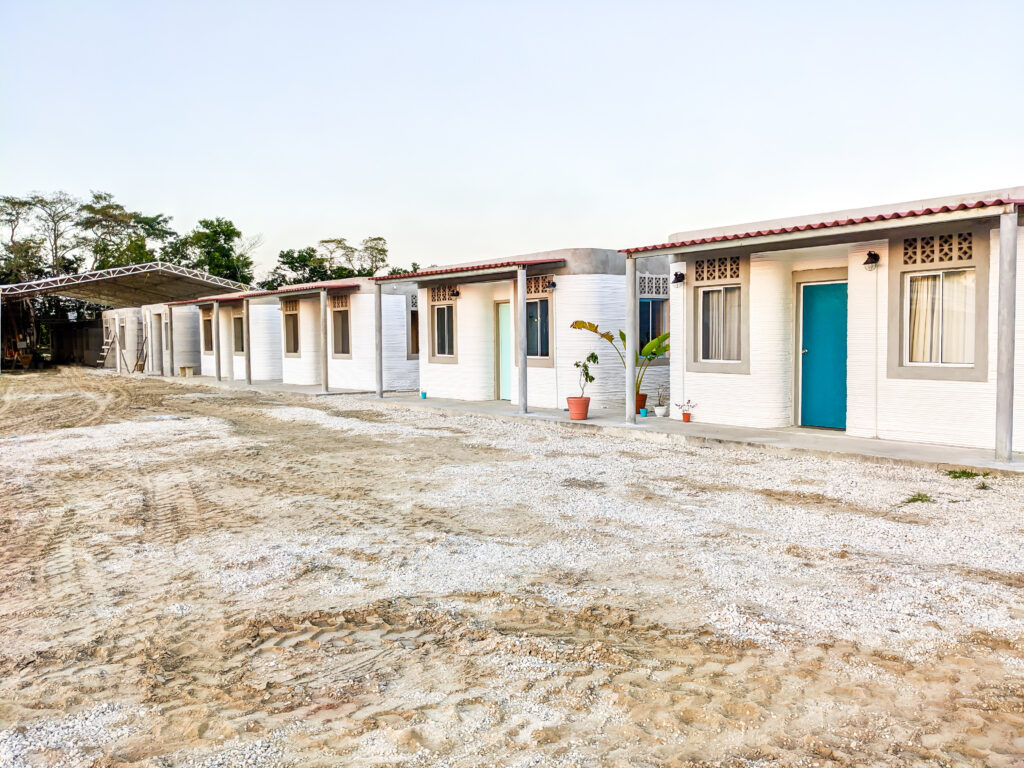
ICON 3-D printed homes in Tabasco, Mexico, photo courtesy of ICON
In addition to the Mobile Loaves & Fishes project, in 2020, ICON built 3D-printed homes in Mexico alongside nonprofit partner, New Story. ICON also partnered with the Defense Innovation Unit and the United States Marine Corps to train Marines to operate its technology and complete a field demonstration print at Camp Pendleton.
ICON plans to spend half of the money it has raised on scaling operations and the other half on innovation to make its printers even better, Ballard said.
“To make it faster, to make it cheaper, and to improve sustainability,” he said. It was only three years ago that ICON printed the first 3-D house in America, he said.
“And so, we’re still early days and
there’s a lot more research and development to be done as well,” Ballard said. “But
we didn’t want to wait until all of that was done before putting more houses on
the ground for folks because the needs are profound.”
ICON has already doubled its
workforce this year to more than 100 employees and plans to double its
workforce next year and again the year after that, Ballard said.
ICON has a manufacturing facility in
South Austin, and it has enough space to accommodate its growth for the next 18
months but it will most likely need to expand after that, Ballard said.
An ICON 3D-printed Martian analog habitat designed by BIG at NASA’s Johnson Space Center, photo courtesy of ICON
In addition to working to provide more
housing, ICON participated in a NASA 3-D habitat building challenge which led
to the company being awarded a contract to deliver a 3-D printed habitat, known
as Mars Dune Alpha at NASA’s Johnson Space Center. NASA will be using the 3-D
habitat for training and is already soliciting applications from people who
want to participate in the year-long Mars mission simulations.
ICON also received funding from NASA
for “Project Olympus” to create a space-based construction system to support
future explorations of the Moon. It’s at the Marshall Space Flight Center as
part of the Artemis program, Ballard said.
The space projects started out as a
small side project, but now they’ve become so big ICON is hiring entire teams
dedicated to work on each one, Ballard said.
“I have the most fantastic job,”
Ballard said. “Depending on the day, we’re trying to figure out how to house
homeless who are combating housing affordability and then the next day it’s
like moon bases.”
ICON is the only company in the
world where both of those kinds of efforts in underway in a very serious way,
Ballard said.
“Our work with NASA has helped us
mature the technology faster,” Ballard said. “The civilization that builds the moon
base is going to be the same civilization that finds a way to end homelessness.
These things go together, and they are not in competition at least not in our
context.”
In the next 90 days, ICON plans to make
a “pretty large” announcement for housing in the Austin area, Ballard said. He
can’t provide details yet, but soon, he said.
“ICON’s groundbreaking technology has created a new paradigm for homebuilding that fundamentally changes how housing is constructed,” Jeff Crowe, managing partner, Norwest Venture Partners, said in a news release. “The company is already building everything from single-family homes for the homeless all the way to structures for habitation on the moon and Mars. But we are particularly excited about the opportunity for ICON to collaborate with home builders and massively impact the housing shortage currently plaguing the U.S. We’re thrilled to add ICON to our portfolio of innovative prop-tech leaders and look forward to partnering with the team in the years ahead.”
In early 2021, ICON began building the first 3D-printed homes for sale in America for developer 3Strands. Most recently, ICON debuted its new Exploration Series featuring “House Zero,” which was designed for 3D printing and features an elevated architectural and energy-efficient design that highlights resiliency and sustainability.
It’s a difficult landscape for employers and employees to traverse right now in Austin and throughout Texas as COVID-19 and its delta variant spreads rapidly leading to a surge of infections.
The loss of life and increase in illnesses also have a profound effect on Texas’ economy. The Perryman Group, an economic research firm, issued a report citing a massive resistance among Texas policymakers to require “sensible and basic protective measures, such as appropriate masking requirements and measures to encourage higher vaccination rates” which is costing lives and money.
The Perryman Group estimates that “preventable decreases in output (gross state product) due to the inadequate reaction to COVID-19 total $13.4 billion on an annualized basis. Employment losses were found to reach almost 72,000 jobs.”
Texas Governor Greg Abbott, who recently tested positive for COVID-19, has not required a statewide mask mandate since March 2nd or provided incentives to increase vaccination rates. He also put an end to pandemic federal and state unemployment benefits at the end of June, two months before the rest of the nation. The move was to encourage people to go back to work. But during the last month, Texas has experienced a surge of infections not seen since the height of the pandemic.
To date, Texas has had 3.4 million cases of COVID-19 resulting in 54,863 deaths, according to data compiled by John Hopkins University. Almost 47 percent of the Texas population is vaccinated, which lags behind the rest of the country with an estimated 52 percent of the population fully vaccinated. And Texas is reporting more than 17,000 new COVID-19 cases every day, according to John Hopkins Data. The result has been an increase in hospitalizations and ICU beds at capacity in many metro areas including Austin.
Since
last March, a lot of Austin-based technology employers have adopted a hybrid
workplace model allowing employees to work from home or in the office.
Those employers, Dell, Google, Facebook, Apple, which all have large campuses in Austin, have extended the work from home arrangements for many workers. Google, which has a large campus in a downtown Austin skyscraper and another finishing up construction, is extending its global voluntary work from home policy through October 18th, according to a post by Sundar Pichai, CEO of Google and Alphabet. Google also requires anyone coming into work at one of its offices to be fully vaccinated.
“Sadly, due to the recent surge in the COVID-19 delta variant, several locations previously showing green on our COVID-19 Risk Reference are now red,” Clarke wrote. “We expect this trend to continue for the next several months.”
Apple is delaying plans to require employees to return to the office until January because of the recent rise in COVID-19 cases and the rapid spread of variant viruses, according to a Bloomberg News story, citing an Apple memo sent to employees this week.
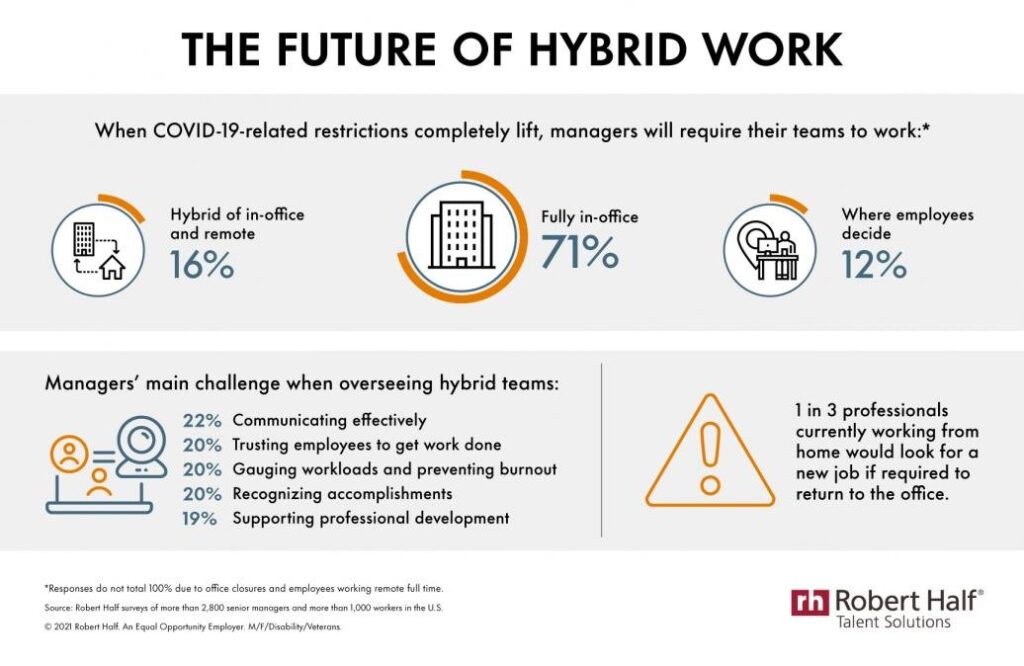
But a new study from Robert Half, a national employment agency, released this week, shows work from home arrangements could be short-term and end altogether when the pandemic ceases to be a threat.
In the survey, just 13 percent of Austin’s executives Robert Half surveyed, would allow employees to continue to work from home at the end of the pandemic. Austin ranked last on the list of 28 cities Robert Half surveyed.
Austin, Dallas, and Houston continue to be the most open cities with workers coming back into the office, according to Kastle Systems, a security company that gathers its data from badge swipes on the 2,600 buildings and 41,000 businesses it secures in 47 states.
In its weekly, Back to Work Barometer, Kastle Systems saw declines in office occupancy in nine of the ten cities on its list. And even Austin, Dallas, and Houston dropped below 50 percent occupancy over the past three weeks. The highly infectious delta variant of COVID-19 is to blame, according to Kastle Systems.
“Right now, everything is up in the air,” said Amber Gunst, CEO of the Austin Technology Council. “I know prior to the delta variant taking off many employers were planning a return to work, with flexible options for employees to work remotely when needed.”
“One of the key drivers for companies to bring employees back is the higher level of collaboration which so many tech companies rely upon for innovation,” she said. “Most are waiting to see how next few months turn out before making a final determination for 2022.”
Companies are also grappling with all kinds of issues surrounding the COVID-19 pandemic like whether to require employees to be vaccinated or to wear masks and to establish other safety protocols like hand sanitizing stations and plexiglass partitions in cubicle settings.
“We don’t mandate that employees have to be vaccinated, it’s a personal choice,” said Laura Woolford, Chief People Officer at AlertMedia.
The Austin-based startup provides emergency communication software, used by over 2,500 enterprise companies in 130 countries to keep employees safe from threats. So worker safety is its number priority, Woolford said.
AlertMedia allows its employees to work remotely. It does require vaccinations for employees who want to come into the office, Woolford said.
“We’ve seen the
benefits of people having that flexibility and being remote,” she said. “We’re
really enjoying this hybrid model.”
AlertMedia has more than 250 employees today and has doubled in size over the last year. Many of those new employees have been hired and brought on board to the company virtually through Zoom and Slack and other online platforms, Woolford said. She joined the company recently and didn’t meet anyone in person until she moved from Phoenix to Austin, she said.
As the pandemic has continued, AlertMedia has discussed which roles could be permanently remote, Woolford said.
“We recognize some
people are better at home,” she said.
The biggest
determinate of success for a remote workforce is trusting employees, Woolford
said.
“We
found people were working even harder from home,” she said. “You find more of
that than people slacking off.”
In fact, AlertMedia encourages employees to take time off and recharge, Woolford said.
Some startups like ICON and Eterneva have manufacturing operations that require employees to be on site.
ICON, which builds houses using giant 3-D printers, doesn’t mandate vaccines for its workers at its manufacturing plant in South Austin, but the company does require them to wear masks, said Jason Ballard, its CEO and Co-Founder.
“We’re watching the delta variant very closely,” he said.
Ballard caught a mild case of COVID-19 earlier, but he has recovered without any lingering effects. A few ICON employees have also contracted COVID-19 outside the workplace, he said. But the plant, which makes the 3-D printers, has contained each case and the virus did not spread, he said.
Eterneva, which grows diamonds from cremated ashes, operates a manufacturing facility in Austin. Its manufacturing employees needed to be in the office, but the company allowed its operations team to work remotely, said Adelle Archer, CEO and co-founder.
Eterneva, which has 27
employees, is expanding and Archer hired three of the company’s executives over
Zoom interviews. The first week of August, Eterneva held a company retreat and many
employees met each other for the first time in real life, she said.
“We likely will go to a hybrid model after the pandemic,” Archer said. “Our employees got a lot of benefit from the flexibility.”
In Austin, 109 companies made the Inc. 5000 2021 list of the fastest-growing private companies in the country.
Overall, the Austin companies on the list had a 183 percent median growth rate, $3.9 billion in total revenue, and added 8,312 jobs. The list includes 12 newly founded companies and 62 repeat honorees.
Empowering a Billion Women topped the list of Austin companies and ranked 28th overall. It also made the top ten list of fastest-growing female-run companies with Ingrid Vanderveldt as the founder and CEO.
Empowering a Billion Women, founded in 2013, pivoted last
year to launch a healthcare business to supply personal protective equipment
and other healthcare supplies to medical professionals and hospitals through an
international distribution network. As a result, the company grew more than 10,676
percent over three years.
OJO Labs, founded in 2015, claimed the second spot of fastest-growing Austin-based companies. It ranked 49th overall and reported a 6,767 percent growth rate over the past three years.
OJO Labs is a fast-growing real estate startup that uses
artificial intelligence to help people buy homes.
Literati, another female-founded startup, founded in 2017 by Jessica Ewing, claimed the 77th spot on the list with a 4,898 percent three-year growth rate. Literati runs a curated subscription book business for adults and children.
Sipsby ranked 79th on the Inc 5000 list and claimed the fourth spot for Austin-based companies. It is another startup, founded in 2016, run by a woman, Staci Brinkman. The company runs a subscription-based tea company with a 4,754 percent three-year growth rate.
AdOutreach ranked 87th overall and fifth in Austin with a 4,515 percent three-year growth rate. The advertising and marketing company, founded in 2016, helps businesses run YouTube ads to drive business and sales.
Others in the top 10 list of the Austin-based fastest-growing companies included Sedera, a healthcare startup, that grew 1,241 percent in three years ranking 389 on the Inc. 5000 and sixth on the Austin list. Lab Alley, ranked 396th, grew 1,216 percent, a business products and services company, ranked seventh in Austin followed by Restore Hyper Wellness + Cryotherapy, 426, a healthcare company with a 1,137 percent growth rate. Wursta, an IT management company, claimed the 440 spot with a 1,115 percent growth rate, ranked ninth in Austin. Pushnami, a software company, ranked 554 and claimed the 10th spot of Austin-based companies with an 869 percent growth rate.
As the grass grows, so does the lawn care
industry.
And this week, two lawn care startups combined
to create an even bigger company to tackle the problem of keeping lawns tidy.
Austin-based LawnStarter acquired San Diego-based Lawn Love. The financial terms of the cash and stock deal weren’t disclosed.
“The combination of LawnStarter and Lawn Love
will further propel growth of the on-demand economy for lawn care and other
outdoor services,” LawnStarter co-founder and CEO Steve Corcoran said in a news
release. “Joining forces enables LawnStarter and Lawn Love to be even more
disruptive together as we continue to revolutionize the outdoor services
industry.”
LawnStarter graduated from the Techstars Austin accelerator in 2014. Founded in 2013, LawnStarter has received over $27 million in funding. Investors include Lerer Hippeau, Edison Partners, Bull Creek Capital, Gary Vaynerchuk, Cotter Cunningham, Rony Kahan, and Varsha Rao.
Lawn Love, founded in 2014, graduated from the
Y-Combinator Accelerator, has raised$6.7 million in funding. Investors include Bullpen Capital, Y Combinator, Alexis Ohanian,
Joe Montana and Barbara Corcoran.
“This deal effectively teleports both Lawn Love and LawnStarter years into the future,” Lawn Love founder and CEO Jeremy Yamaguchi said in a statement. “It’s a dramatic acceleration toward our goal of empowering small business owners by providing the technology and tools to help them grow their businesses, compete with the big guys, and ultimately thrive.”
LawnStarter and Lawn Love will operate as
separate brands, led by Corcoran as CEO. LawnStarter’s headquarters will stay
in Austin. Yamaguchi is remaining with the combined company. LawnStarter has
329 employees and Lawn Love has 73 employees.
“All full-time Lawn Love employees are staying on board,” Ryan Farley, Co-Founder of LawnStarter wrote in an email response to questions. “As for future hires, we’re rapidly scaling our product and engineering teams. We have a leadership hire or two we’ll be announcing later this month.
The combined LawnStarter and Lawn Love company is in the top 120 metropolitan areas in the country, which covers roughly 67 percent of single-family homes in the U.S., Farley said. The company provides a marketplace where consumers can sign up for lawn service and a vetted list of lawn care companies provide the service. The company makes money by taking a percentage of each transaction.
“We’ll definitely keep
adding more markets as we get organic demand in those markets,” Farley said. “No
plans for international expansion yet.”
The overall lawn care market
in the U.S. is valued at $99 billion with roughly $44 billion of that being
residential. LawnStarter has a handful of property managers who manage several
homes, but 99 percent of its revenue comes from owners and renters, Farley
said.
“And that’s our plan,”
Farley said. “We want to be a household name that provides value to the end consumer.”
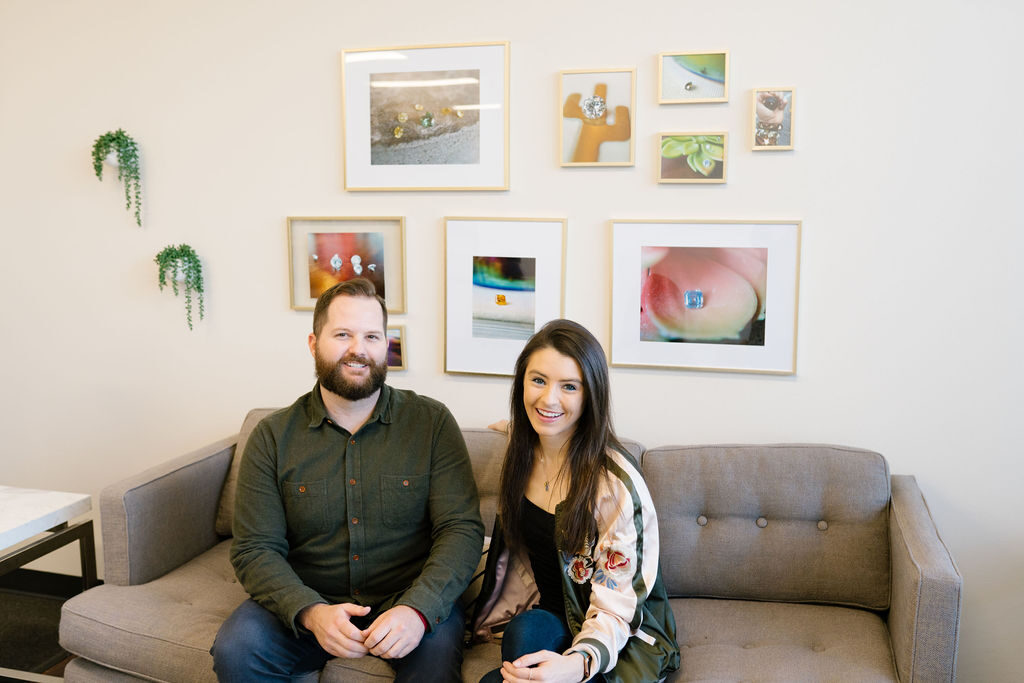
Adelle Archer and Garret Ozar, co-founders of Eterneva
The Covid-19 Pandemic has killed
more than 611,000 people in the United States including 53,000 in Texas.
In many cases, during the last year,
families were not able to gather for in-person funerals to celebrate the lives
of their deceased relatives because of lockdowns and restrictions around the
Pandemic.
Some of those families turned to Austin-based Eterneva, which grows diamonds from cremated ashes, as a way to deal with their grief and loss and celebrate the life of their loved ones.
This week Eterneva announced it has
closed on an oversubscribed $10 million Series A round led by Tiger Management
with co-investment from Goodwater Capital, Capstar Ventures, NextCoast
Ventures, and Billionaire Mark Cuban.
Founded in 2017, Eterneva has raised
$14.8 million to date. In 2019, Adelle Archer and Garret Ozar, co-founders of
Eterneva landed a $600,000 investment from Cuban on Shark Tank. The company has
grown dramatically since then.
Eterneva investors also include some top female
venture capitalists including notable angels like Lydia Jett (Partner at
Softbank) and Kara Nortman (Managing Partner at Upfront, founder of Angel
City), to Kathryn Cavanaugh, the managing director
of Capstar Ventures, who is joining Eterneva’s board.
“I am thrilled to support Eterneva’s next phase
of growth as they build a new category in deathcare that improves the lives of
consumers,” Cavanaugh said in a news release. “We are honored to back a
business that helps people to grieve better with products and services that
deeply resonate with today’s consumer.”
CEO Adelle Archer is one of a small group of female CEOs to raise a larger venture growth round. And Eterneva is the second end-of-life company ever to raise more than $10 million. Better Place Forests, based in San Francisco, is the other end-of-life company that has raised $52 million to date.
“We are a very fast-growing company,
we had been a very fast-growing company before the Pandemic and we continued to
grow quite a bit, triple digits, during the Pandemic,” Archer said.
The Pandemic had a big impact on
culture and opened people up to talk more about end-of-life discussions, Archer
said.
About sixty percent of all Americans had a connection with someone who died during the Pandemic, she said. So, people are a lot more open about discussing end-of-life issues and how they want to be remembered., she said.
“People were looking for really
special ways to honor their loved one,” she said “They also were not able to
have funerals last year which was really crazy. It drove a lot more research
online. I think what resonated with people a lot was this idea of something
that is personalized, meaningful and it’s really a celebration of life.”
An Eterneva Diamond
Eterneva helps grievers celebrate remarkable people and pets by making diamonds from ashes or hair, Archer said. Cremation rites are also projected to reach 78 percent by 2040, which is leading consumers to break with old funeral traditions, Archer said.
Eterneva partners with funeral homes and pet
aftercare providers across the United States to reach consumers seeking more
meaningful and personal memorial options at the point of decision.
The idea of personalization and a celebration of life and Eterneva’s diamond-making journey really resonated with young people, Archer said.
So Eterneva launched its TikTok video account
last year and 15 videos have received between 500,000 and 7 million organic
views since the beginning of the year, Archer said.
“It really shows how younger people are thinking
about this, and really embracing it and loving it,” Archer said.
The round will also go towards investing in
taking the Eterneva diamond journey experience to a new level and scaling its funeral
home and pet aftercare channel program nationwide, Archer said.
Eterneva has 27 employees today and plans to add another 15
people in the next 12 months. Eterneva has a diamond growing facility in Austin
and others in Switzerland and Germany. It plans to expand the Austin facility
with its latest funding round, Archer said. Eterneva’s diamonds
start at $3,000. The cost varies depending on the size, style, and color of the
diamond.
Eterneva also allows its customers to visit the diamond
growing facility to participate in the process. Some enjoy starting the diamond
growing machine or design a special setting for the diamond with a jeweler,
Archer said.
“It helps with a person’s grieving process,“ Archer said. “Even
when it’s done right, a funeral is only a day or a couple of days and grief we
know lasts years. American culture still has a lot of work to do in how we show
up for and support grievers. It can be a very isolating and lonely experience.”
“Being able to have something to shift your focus on and
have a community you can plug into that understands you is super powerful,”
Archer said.
In the wake of losing someone, there’s a time where people are forming meaning on what that loss meant, Archer said. People can share stories about that person’s life and keep them alive with us, she said.
“Why do we stop talking about people when they are gone? Why not keep talking about them and not make it weird,” Archer said.
In addition to honoring people, about 40 percent of Eterneva’s business is making diamonds from the ashes of pets.
The Texas and Panama story continues to evolve, said Juan B. Sosa,
U.S. president of the Panama Council.
“It’s a new era of trade, investment, and cooperation,” Sosa said during the Panama-Texas Business Summit on Monday at the Hotel Marriott Downtown. It’s one of the first in-person international summits to be held since the COVID-19 Pandemic. Some people wore masks. A slide flashed on the screen for places to get COVID tests. Some people shook hands but many people simply bowed.
More than 200 people gathered for the summit which brings together Panama and Texas government, business, and nonprofit organization officials. The two-day summit focused on specialty coffee, agriculture and food, banking and investments, tourism, trade, real estate, construction, technology, and clean energy.
U.S. diplomatic relations developed with Panama in 1903 after
its independence from Colombia and those relations further solidified with the opening
of the Panama Canal in 1914. The U.S. and Panama signed a treaty that gave control
of the Canal back to Panama in 1999.
Today, the U.S. and Panama work closely together to ensure
global trade and security in the region, Sosa said.
Texas exports $2 billion or 36 percent of the nearly $5.8
billion worth of U.S. merchandise exports to Panama in 2020, according to the
Texas Economic Development Council.
Texas’ seaports in Port Arthur, Beaumont, Brownsville, Corpus Christi, Freeport, and Houston, receive ships traveling through the Panama Canal.
Earlier this month, Panama President Laurentino Cortiz visited Austin, Houston, and Irving, Texas. His visit shows how important Texas is to Panama, Sosa said.
Panama also hosts the regional headquarters for more than 30 multi-national companies from the United States including seven from Texas, Sosa said. Texas companies with a big presence there include Dell Technologies with 3,000 employees, Halliburton, and Caterpillar.
The U.S. is the number one user of the canal, with 68 percent of transits heading to or from U.S. ports, according to the State Department. Imports from Panama include fish, seafood, gold, cane sugar, bananas, and pineapples. Panama is also recognized worldwide for its high-end coffee.
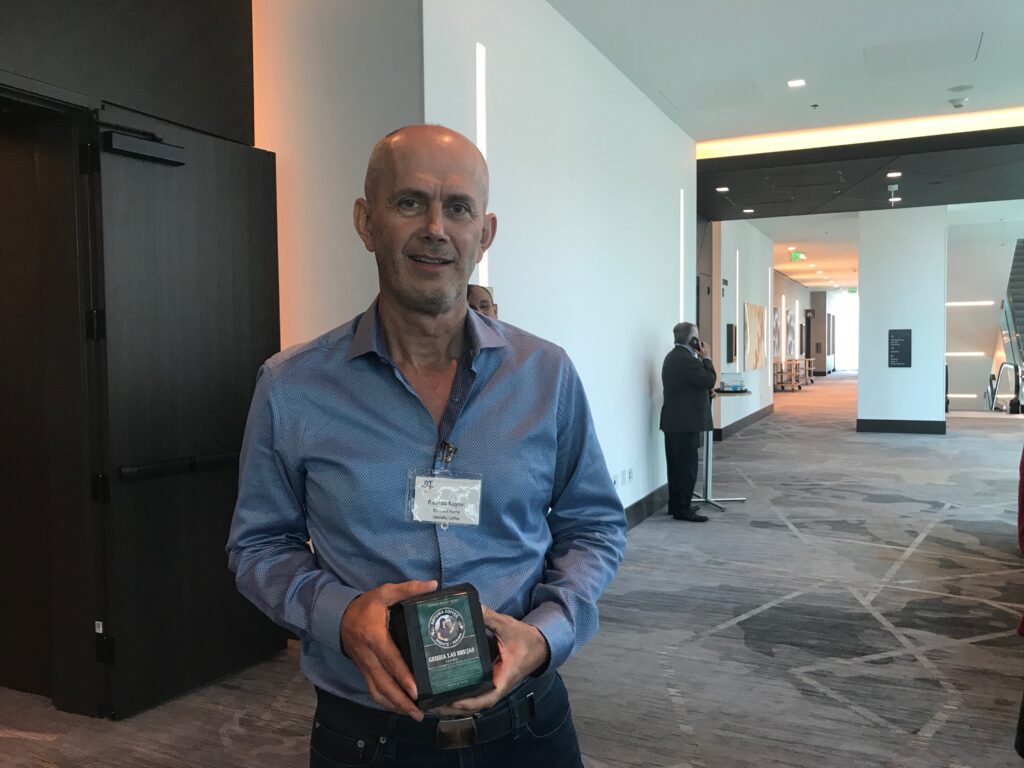
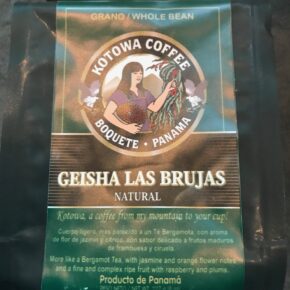
Ricardo Koyner, CEO Kotowa farms with a package of Geisha Coffee
Panama’s coffee industry is small, but it’s very specialized,
said Ricardo Koyner, CEO Kotowa farms.
“And it’s gone from conventional coffee to high-end coffee,”
Koyner said.
It’s kind of like the wine industry, he said.
Panama is cultivating a variety of coffee called Geisha, which
has been very popular with the Asian markets, he said. A pound of Geisha coffee
from Panama has fetched as much as $1,300 at auction, he said. Roasted it is
worth more than $3,000 a pound, he said.
Panama Geisha is rare, costs a lot to produce, and has great flavor, Koyner said. Panama’s soil, climate, geographic position all make it a favorable place to grow Geisha beans, he said.
The demand for the coffee is largely coming from Japan, Taiwan, China, and select markets in the U.S., he said.
“It’s definitely changing the industry,” Koyner said.
Geisha coffee is also being added to chocolate and liquor in Panama to make specialty products.
Overall, Panama’s economic growth rate is among the highest in the hemisphere. But it also faces challenges of inclusivity, more fiscal transparency, and enforcement of anti-money laundering legislation, according to the U.S. State Department.
Jonathan Diaz, business director of City of Knowledge Foundation in Panama, runs a technology park that was the former Clayton military base. It’s an innovation hub for technology, research, and science, and the United Nations has its regional hub there, he said. The park with 200 buildings sits across from the Panama Canal. It is home to a U.S. stem cell research lab among other ventures.
“We have a startup ecosystem that is very strong,” Diaz said.
The City of Knowledge recently signed an agreement with the
University of Texas at Austin to create a global innovation lab in Panama. The
hub is hoping to attract more companies from Texas and Austin to operate there.
Since the expansion of the Panama Canal in 2016, Texas has
become an even stronger trading partner.
The Port of Houston is one of the world’s largest exporters of oil
through the Panama Canal.
The partnership between Texas and Panama is strong, Sosa said.
Capstar Ventures L.P., an early-stage venture capital firm, announced last week that it has closed on its $41.3 million inaugural fund.
The
Austin-based VC firm founded by Kathryn Cavanaugh in 2019, invests nationwide in
innovative consumer companies.
Capstar
raised the fund from individuals, family offices, and institutions including
Capital Creek Partners, Tiger Partners L.P., and J.P. Morgan.
Capstar
Ventures is the first fund to close as part of J.P. Morgan Asset Management’s
Project Spark, focused on supporting emerging alternative fund managers,
including minority-led and women-led venture capital funds.
“Kathryn embodies the type of fund manager we set out to back through the launch of our Project Spark initiative and we are thrilled to partner with Capstar Ventures on its inaugural fund,” Jamie Kramer, Head of Alternative Solutions at J.P. Morgan Asset Management and Investment Committee Chair for Project Spark, said in a news release. “Kathryn brings a unique perspective, deep expertise and a differentiated vision for investing in the next generation of consumer companies, and we’re pleased to be participating in the fund.”
Capstar
Ventures invests in seed and Series A rounds for digitally native brands,
consumer goods and services, and technologies that power these startups. Its
focus is on Millennial and Gen Z consumer products and services and platforms.
“We seek
to invest in founders who are solving their own pain points and who directly
relate to and resemble their customers because we have seen how that authentic
connection translates into high growth companies,” Cavanaugh, Founder and
Managing Partner of Capstar Ventures, said in a news release. “And how
Millennial and Gen Z consumers resonate with that authenticity as they align
their purchasing power with their values.”
Cavanaugh
has been investing in and advising early-stage companies across consumer,
healthcare, and technology for the past 15 years. While working at Grace Beauty
Capital, Mainsail Partners, and De Novo Ventures, she deployed and actively
supported over $350 million of equity investments, including early-stage
disruptive consumer brands such as Rothy’s, Supergoop!,Parachute, Primary, and M.M.LaFleur.
In
2019, she moved to Austin to launch Capstar Ventures with anchor capital from
successful Texas entrepreneurs Steve Hicks, Kendra Scott, and Robert Gauntt.
“Steve,
Robert, and I are thrilled for the opportunity to partner with Kathryn to
launch Capstar Ventures because we share a commitment to supporting the innovation
and passion that entrepreneurs contribute to our world, and believe it is
critical to building a brighter future,” Scott, Founder of Kendra Scott LLC,
said in a news release. “We feel fortunate for the opportunity to support those
in the earlier stages of building their business and to work alongside
phenomenal partners to provide more diverse founders a seat at the table.”
Capstar
Ventures has invested in ten portfolio companies to date, including Culina, a leading
plant-based food company; Stylust, a commerce
technology platform; The Class, a health and
wellness platform; Sarah Flint, a women’s
luxury shoe brand; Packed Party, a celebration
lifestyle brand; St. Frank, a luxury home
décor brand; Museum of Ice Cream, an
experience-first development company; Bravo Sierra, the first
military-native wellness company; Eterneva, a grief
wellness company; and Intraloop, a community
insights technology platform.
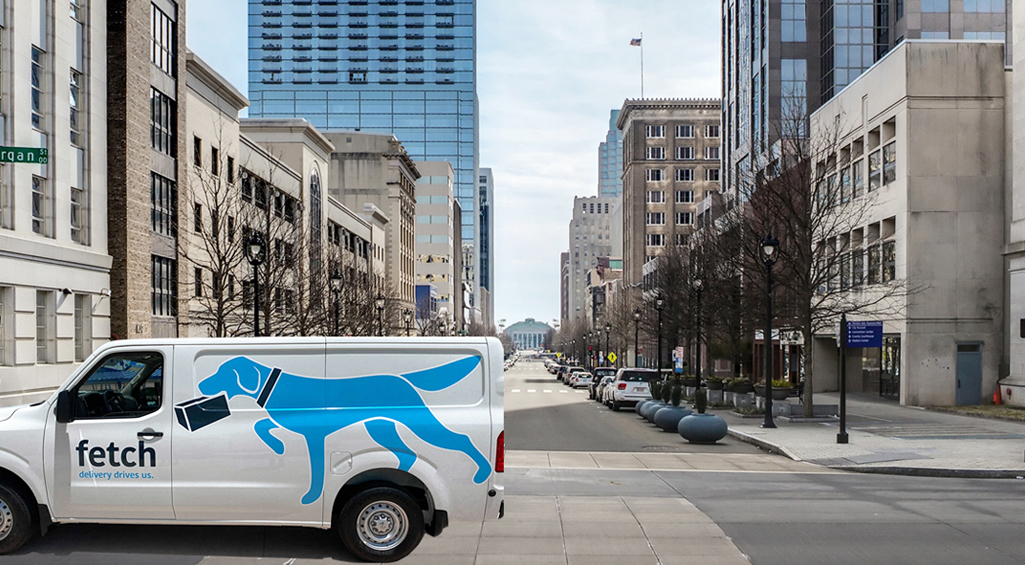
Fetch, a last-mile package delivery service aimed at apartment dwellers, announced last week it has closed on $50 million in funding.
Ocelot Capital led the Series C round of funding along with Greenpoint Partners, Alpaca VC, and Rose Park Advisors. Existing investors Iron Gate Capital, Signal Peak Ventures, Venn Ventures, Pando Ventures, and Seamless also participated.
In addition, Signature
Bank provided a $10 million venture debt facility.
To date, the company, founded in 2016 in Dallas, has raised $92 million, including an $18 million Series B round last year and a $10.5 million Series A round in 2019.
Fetch plans to use the
funding to open 24 new markets over the next two years and to expand within existing
markets.
“Fetch is the last-mile delivery solution that the apartment industry has always needed,” Andrew Townsend, Managing Member at Ocelot Capital, which also owns regional parcel carrier, Lone Star Overnight, said in a news release. “Based on our experience within parcel logistics and last-mile delivery, we view the Fetch model as the only sustainable option for multifamily and see it quickly becoming the gold standard for apartment operators. With the acceleration in e-commerce volumes, it is more apparent than ever that limited capacity parcel storage systems are no longer viable and Fetch is the only long-term parcel storage solution that meets the needs of both multifamily operators and residents.”
The
last-mile package delivery company currently operates in Dallas/Fort Worth,
Houston, Austin, San Antonio, Seattle, Denver, Atlanta, Orlando, Tampa,
Chicago, Phoenix, Charlotte, Raleigh/Durham, Washington, D.C., Jacksonville and
Portland, and will soon be expanding its footprint to Philadelphia, San
Francisco and Miami. Fetch accepts deliveries at local Fetch-operated
facilities and works directly with residents to schedule door-to-door delivery.
Delivering
roughly 3.5 million packages in 2020, Fetch has already hit the 2.5 million
mark for volume in June 2021 and they’re currently on track to deliver over 8
million packages by the end of the year.
“We’re excited about what this fundraise means for our company in terms of our ability to extend our package management solution to more cities, more apartment communities, and more renters across the country. We’ve proven our profitability in a number of markets and we’re aiming to triple our business in the next 18 months with that continued success and profitability top of mind,” said Fetch CEO Michael Patton. “The industry has recognized Fetch as the one package model capable of carrying multifamily into the future, and we’re honored that our investors feel the same.”