Starlink is developing a broadband Internet system enabled by
a constellation of low Earth orbit satellites providing service to those in
rural communities and places where existing services are too expensive or
unreliable, according to the company.
On February 15, SpaceX confirmed the deployment of 60 Starlink satellites.
Starlink has been testing its satellite Internet service with beta customers in the Texas Hill Country. It plans to roll out the service to more customers in mid-2021, according to a posting on Starlink’s website. It is taking orders on a first-come, first-served basis with deposits of $99 on the service. The hardware will cost $499, and the service will cost $99 a month
“To keep up with global demand, SpaceX is breaking ground on a new, state-of-the-art manufacturing facility in Austin, TX,” according to the job post. “Up to 25% travel to SpaceX Headquarters in Los Angeles, until Austin facility is fully established.”
SpaceX and Starlink could not be reached for comment.
In addition, Elon Musk, founder and CEO of SpaceX, posted a
tweet on Tuesday about creating the city of Starbase, Texas. He didn’t provide
any details. SpaceX is building rocket ships in Boca Chica, in the Southern
Texas county of Cameron.
Musk recently announced he had moved from California to
Texas as he has steadily increased the footprint of his companies in the state.
Musk’s other venture, Tesla, is building a Gigafactory on
the outskirts of Austin with plans to manufacture Cybertrucks.
And the Boring Company, which specializes in digging underground tunnels for highspeed commuter transportation, recently relocated its headquarters to Austin.
Bumble, the Austin-based dating and networking app, raised $2.2
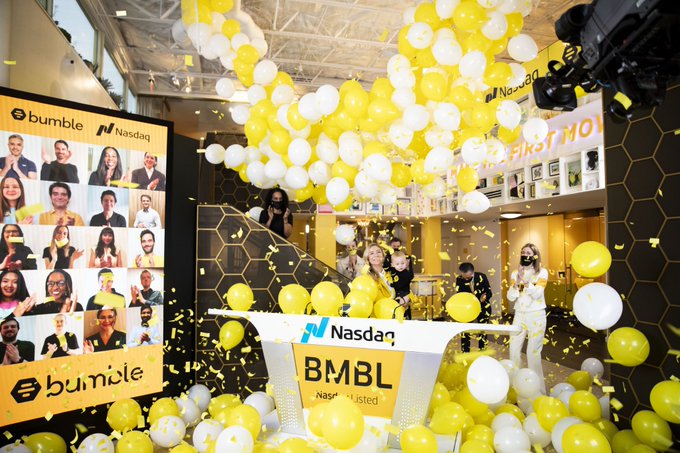
billion on Thursday when its stock debuted on the Nasdaq stock exchange at $43
a share.
The stock, traded under the symbol BMBL, soared nearly 64
percent on its first day of trading to close at $70.31.
Bumble’s Initial Public Offering also made its founder and CEO Whitney Wolfe Herd, 31, the youngest female self-made billionaire founder, according to Forbes.
“Today Bumble becomes a public company,” Wolfe herd wrote in a tweet on Twitter. “This is only possible thanks to more than 1.7 billion first moves made by brave women on our app – and the pioneering women who paved the way for us in the business world. To everyone who made today possible: Thank you.”
The Nasdaq stock market’s opening bell podium was decked out with yellow and white balloons and streamers to represent Bumble’s colors and to honor the company’s first day of trading.
Bumble, founded in 2014, operates two apps,
Bumble and Badoo, and reports more than 40 million users on a monthly basis.
Bumble plans to use the proceeds from the stock sale to repay part of a loan and for general corporate purposes and to pay the expenses of going public. It also plans up to 48.5 million shares of stock to purchase or redeem stock from certain entities affiliated with Blackstone, a New York-based private equity firm that owns a majority interest in Bumble.
Bumble currently employs over 600 people in offices in Austin,
Barcelona, London, and Moscow.
Techstars Austin has selected ten startups to participate in its 2021 accelerator program which kicked off this month.
The companies include BallBox, Enlightapp, Fêtefully, hampr,
Kousso, Livo, Mowies, Nutritional Freedom, SocialMama and Talk Howdy.
The program began on Jan. 11th and will end on
Demo Day scheduled for March 24th as a virtual event.
“As with most things in 2020, AsTechstars’ selection process
wasn’t exactly the same as in years past or as expected. That being said, the
virtual nature of, well everything, wasn’t new to us,” Amos Schwartzfarb,
Techstars Austin Managing Director said in a news release. “If there was any
exception to this year, it was the sheer quantity of applications we received
from very high-quality founders and businesses, which made it harder than
previous years to select our final 10. I am beyond thrilled with the 10
incoming companies we’ll be working with over the next three months and believe
this will be one of the strongest classes we’ve seen in Techstars Austin to
date.”
Techstars Austin also announced Caroline Tosbath as its new Program Manager. Previously, Tosbath worked at Capital Factory, an accelerator and co-working space focused on Texas startups.
“Working on the mentor program at Capital Factory taught me the importance of building meaningful relationships and the impact those relationships can have on founders’ lives and business,” Tosbath said in a news release. “I’m so excited to continue making meaningful connections for founders in my new role at Techstars, in addition to running the day to day of our program.”
The following startups are participating in the Techstars Austin 2021 program:
BallBox from Chicago – a network of kiosks enabling sport, tech, and leisure equipment rental at parks, beaches, hotels, and apartments.
Enlightapp from Fargo, ND – it helps teachers become experts on their students by allowing students to share their uniqueness through self-created student profiles.
Fêtefully from Dallas – a wedding and event planning platform that leverages personality algorithms and automated workflows to streamline the event planning process to make a luxury service accessible to an underserved market while also giving professional planners a way to earn money in their spare time.
hampr from Lafayette, LA – an on-demand, laundry service that will pick up your laundry and return it fresh and folded, right to your front door, within 24 hours.
Kousso from Charlotte, NC – a platform that delivers data-rich home profiles to simplify homeownership.
Livo from Coral Gables, FL – it works with residential rental property managers to enhance the “first-come-first-served” process by increasing flexibility for both the renter and property manager.
Mowies from Medellin, Colombia – a Content Market Network to create, share, sell.
Nutritional Freedom from Austin – a platform helping women to ditch diets and get healthy for good.
SocialMama from Houston – a network to connect women to the mom friends that they need, and experts they trust.
Talk Howdy from Austin – it is building communities through peer-led, small group virtual chats.
“We had one of the most competitive
applicant pools ever with brands from around the country, and these seven
companies and their founders really stood out,” SKU Managing Director Kirstin
Ross said in a news release. “It continues to amaze me the level of creativity
and commitment these founders have. They draw on their own personal experiences
to create products that bring something really new and special to the market.”
The latest accelerator program begins on Jan. 29th and runs through mid-May. The 12-week program includes a special curriculum with mentoring. SKU’s mentors include entrepreneurs from successful consumer-product companies including Deep Eddy Vodka, Amplify Snack Brands (Skinny Pop, Pirate’s Booty), and Vital Farms.
The accelerator culminates with a showcase
virtual pitch event which will take place on May 18th.
Vital
Farms founder and longtime SKU mentor Matt O’Hayer will give the keynote
address to kick off the latest program. He founded Vital Farms, an egg company,
in 2007, and built the company, along with his wife, Catherine, into the number
one pasture-raised egg and butter brand in the U.S. The company went public
last summer.
Lawyer Shari Wynne Ressler and serial entrepreneur Clayton Christopher, founder of Sweet Leaf Tea and Deep Eddy Vodka, founded SKU in 2012. Since then more 70 companies have completed the SKU program including Siete Foods, Seaweed Bath Co., Austin Eastciders, and EPIC Provisions.
Over the past year, SKU has expanded nationally with a partnership with BeyondBrands to launch New York-based BeyondSKU. In addition, SKU launched The ImpactSKU program for purpose-driven CPG startups in the Twin Cities, a partnership with FINNOVATION Lab. Last fall, SKU and DFW CPG joined forces to bring to launch SKU DFW in the Dallas-Fort Worth Metroplex. The six companies that participated in SKU DFW were All Y’alls Foods, Highwave, Meli’s Monster Cookies, mmmpanadas, Re:THINK Ice Cream, andSienna Sauce.
The
company filed its initial public offering documents with the Securities and
Exchange Commission on Friday. It did not provide details on the price of its stock,
which will be traded under the symbol BMBL on the Nasdaq stock market. In the
filing, the company reported it was seeking to raise $100 million.
New
York-based private equity firm Blackstone owns a majority interest in Bumble,
according to The Street.com.
“Throughout the journey of building Bumble, we were told that it was impossible to create a successful women-first brand and platform,” Wolfe Herd, Bumble’s founder, and CEO wrote in a letter included in the filing. “That women don’t, won’t, and shouldn’t speak first. That it would never work. Those objections have only fueled us. Six years and countless Bumble weddings, babies, friendships, business partnerships, and meaningful relationships later, we have a diverse and fast-growing community spread across six continents. We’ve celebrated 1.7 billion first moves made by women.”
The
stock filing provided some details on Bumble’s finances. The company reported
revenue of $416.6 million for 2020 through Sept. 30th and a net loss
of $116.7 million. That compares to $488.9 million in revenue for 2019 and net
earnings of $68.6 million and $360.1 million in revenue and a net loss of $23.6
million for 2018.
Bumble
operates two apps, Bumble and Badoo, and reports more than 40 million users on
a monthly basis.
Bumble
also plans to use the proceeds of the sale of its stock to pay down its debt,
according to the filing. The company entered into a loan in January of 2020 for
$625 million.
Bumble has more than 650 full-time employees with half working in engineering and product development. It leases approximately 10,000 square feet of space in Austin for its corporate headquarters. Bumble also has offices in London and Moscow and a data center in Prague.
Before founding Bumble in 2014, Wolfe Herd worked at Tinder, a competing dating app, where she served as vice president of marketing from May 2012 to April 2014. After leaving the company, Wolfe Herd filed a sexual harassment lawsuit against Tinder, which she later settled for more than $1 million, according to Forbes. In 2018, Match Group, which owns Tinder, filed a lawsuit against Bumble alleging patent and trademark infringement, as well as trade secret misappropriation. Bumble countersued. In June of 2020, Bumble reached an agreement with Match Group to settle the lawsuit.
The Financial Times also reported Wolfe
Herd received a $125 million payout following a reorganization of the company
and a $119 million loan, which she has since paid back.
The IPO filing also details Bumble’s employment contract with Wolfe Herd providing a base salary of $650,000 annually with a target bonus of $450,000. It also includes a leased vehicle, childcare services when Wolfe Herd travels with her children, and full-time security benefits at the office and when traveling.
It is the latest company to pull up stakes and move operations from California to Texas. Among them, Oracle announced last month that it plans to move its headquarters to Austin. And Hewlett Packard Enterprise announced plans to move its headquarters to Houston.
Digital
Realty, founded in 2002, has 1,550 employees and revenues of more than $3
billion in 2019. The company plans to
keep a “significant presence” in the San Francisco Bay Area.
Digital Realty already has operations in Texas, which date back to “2002 when its predecessor acquired 2323 Bryan Street, a major regional connectivity hub in downtown Dallas.”
Today, Digital Realty has more than 30 data centers in Texas, encompassing more than four million square feet and more than 100 megawatts of customer capacity. It also has nearly 20 percent of its North American workforce based in the state. It also has a data center in Austin.
Overall,
Digital Realty has more than 280 data center facilities in 49 metros across 24
countries on six continents.
“The central location, affordable cost of living, highly educated workforce and supportive business climate have helped make Texas an epicenter for business activity and technology growth,” Digital Realty Chief Executive Officer A. William Stein said in a news release. “As we continue to make strategic investments to best position Digital Realty for long-term growth, we are confident our expansion in Texas will help us meet the needs of our more than 4,000 global customers while continuing to deliver value for our stakeholders, employees, and the communities we serve around the world.”
Digital
Realty also plans to use wind energy and solar energy to power 70 percent of
its data center projects in Texas by mid-year.
“We
are excited that Digital Realty has chosen Texas as the new home for
their corporate headquarters, and I thank them for their expanded investment in
the Lone Star State,” Governor Greg Abbott said in a news release.
“Digital Realty joins other global technology leaders and more than
50 Fortune 500 companies now headquartered in Texas. We are seeing
increasing investments from innovative businesses thanks to our young, growing,
and educated workforce, and our pro-growth economic policies that help
job-creating businesses to thrive.”
DivInc, the nonprofit accelerator focused on fostering diverse startups, has announced the finalists for its third annual Champions of Change Awards.
The virtual event will take place online on March 4th.
DivInc’s 2021 event has a goal to raise $100,000 for its “2021
Social Justice Innovation Program which supports social justice innovators
addressing inequities and disparities caused by institutionalized bias and
racism.”
A committee selected this year’s nominees for the following categories: executive, diversity and inclusion, student, champion, investor, rising star, and nonprofit. There’s also a People’s Choice Award that is accepting nominations.
The event sponsors are Wild Basin Investments LLC, Vela Wood, Downtown Austin Alliance, Capital City Innovation, Baker Botts, RetailMeNot, Indeed, Cirrus Logic, Capital Factory, and Capital Metro. Its community partners include: Huston Tillotson University,BLNDED Media, Notley Ventures, and Narwhal Media Group
An experimental Beta City on the outskirts of Austin with transportation tunnels, autonomous vehicles, robots, flying drones, smart buildings, and all the latest technology applications.
That’s the vision of Joe Lonsdale, an entrepreneur, investor, and philanthropist, who recently moved 8VC, an investment firm, and The Cicero Institute, a public policy think tank, to Austin. He sees the region developing into an even bigger technology hub.
“It’s a big hub,” Lonsdale said. “I think there’s going to be a lot of really cool suburbs. One of my favorite ideas, which I don’t have time to do right now, but I’d love to work on, is to build a new city somewhere around here, nearby, in the next few years. Buy a bunch of land and dig tunnels connecting it to these places.”
There are all sorts of designs he
has sketched up with really cool ideas, Lonsdale said. He made the remarks on
the Ideas to Invoices podcast.
In the coming years, Central Texas is going to evolve into a major hub and it’s going to have a lot more people and a lot more companies in it, Lonsdale said. The challenge is to keep building, create transportation tunnels and make it easy for people to commute from less expensive areas into Austin, he said.
“It’s going to be a lot of fun,”
Lonsdale said.
The Beta City project would rival Neom, the revolutionary $500 billion new city that Saudi Arabian Crown Prince Mohammed bin Salman is building in the desert bordering the Red Sea. That project is slated to be complete by 2025 and will include drones, robots, artificial rain, holographic teachers, and more, according to plans obtained and reported on by the Wall Street Journal.
Lonsdale, the co-founder of Palantir, Addepar, OpenGov, Affinity, Esper, is also on the board of The Boring Company, founded by Elon Musk. The Boring Company recently bought a building in Pflugerville, according to the Austin American Statesman. Lonsdale plans to help solve Austin’s transportation problems using technology and tunnels built by The Boring Company.
‘We’re going to dig some tunnels and make sure we fix any kind
of traffic problems,” Lonsdale said.
“It’s one of these things that is great for economic inequality
as well,” Lonsdale said.
It raises equality and economic access for people if it’s done
right, he said. People can live in cheaper areas outside of the city’s core and
easily commute to their jobs, he said.
Lonsdale plans to do that project and the Beta City with a
little help from his friends, which include Musk, who recently moved to Texas. Musk
is staying at the home of one of Lonsdale’s friends. And Lonsdale recently
hosted a dinner with Musk and Michael Dell in which they talked about solving
big, tough engineering problems with technology.
This year Lonsdale moved his family to Austin and announced that
8VC would relocate its headquarters to Austin. He also wrote an Op-Ed in the
WSJ “California, Love It or Leave It” on bad policy decisions that have made
the state “unlivable.”
Restrictions on businesses during the COVID-19 Pandemic, in
particular, frustrated Lonsdale. His biotech ventures were not able to operate
and he wasn’t able to get through to city and state officials to get clearance.
Musk also publicly voiced frustrations with restrictions placed on Tesla
plants. Last summer, Musk announced he would be building the next Gigafactory to
make Tesla trucks in Austin.
Another big investment of Lonsdale’s is in Palantir, a software
company that provides intelligence insights to customers. It recently relocated
its headquarters out of the Bay area and to Denver, Colorado. Palantir has
advanced enterprise software that supports important workflows worldwide, and
half of its business is working for government agencies and the military.
The Bay area has become a lot more expensive to do business,
Lonsdale said. And it’s become very competitive for getting the best talent, he
said. The culture of the best engineers of the Bay area has become somewhat “poisonous,”
Lonsdale said. They are not loyal to their employer and some don’t want to work
on government and defense contracts, he said.
In the podcast, Lonsdale talks
about Wish, the e-commerce app, that just recently went public and that has
provided 8VC with its largest return to date – more than 500 times its
investment.
“Wish has been a very good
investment. There is a very strong team there. And they really proved what you
can do in mobile commerce,” Lonsdale said. “The best venture investments are proving
something newly possible in the world.”
Wish has become one of the top e-commerce companies in the world, Lonsdale said. The Wish app connects about 100 million consumers in the U.S. and Europe to about 600,000 merchants selling low-priced goods. There are about 100 million possible items you can buy, and they have really learned how to gamify mobile commerce, Lonsdale said.
“They are really good at guessing the items you want to buy,” Lonsdale said. The Wish app also partners with mom and pop businesses to send goods to their store and allowing people to pick them up there. That drives foot traffic to the mom-and-pop stores, Lonsdale said.
Austin could be the site of the next Wish or Palantir or big breakout technology startup, according to Lonsdale. Already, six of 8VC’s portfolio companies have relocated from Silicon Valley to Austin.
“Austin is seeing a lot of really
strong startups,” Lonsdale said.
Among them, Lonsdale’s younger brother,
Jon is a co-founder
of Austin-based Ender, a property management software startup founded in 2019,
which has raised $7 million in funding. Ender moved to Austin about a year ago.
Lonsdale expects the trend to continue. He knows many people who
have recently relocated from California to the Austin area, including his dad
who had lived in California for 40 years.
Lonsdale thinks Austin is a great place to raise his family. He and his wife, Tayler, have three young daughters. They like the Austin community and its schools and great quality of life. Lonsdale is also a huge patriot who believes in free speech and the right to bear arms. He likes Texas’ ethos of self-reliance and rugged individualism. He recently received his conceal carry permit. He hasn’t bought a ranch yet, but he did buy a cowboy hat and boots and has two forty-foot flagpoles in front of this house flying giant Texas and American flags – something he says his neighbors in California would have objected to. He’s bullish on Texas and Central Texas, in particular, attracting more technology talent, companies, and founders. And the key is to success is to address traffic, homelessness, inequality, and other issues right away with sound policy decisions to prevent problems that have plagued San Francisco in recent years, Lonsdale said.
For more, listen to the entire podcast, pasted below, or wherever you get your podcasts – available on Google play store, Apple iTunes, Spotify, PlayerFM, Libsyn, and more.
Hypergiant, based in Austin, has brought on board Abidali Neemuchwala, former Wipro CEO, to its executive advisory board.
The addition Neemuchwala, who oversaw $8 billion in revenue and 185,000 at Wipro, is a “vital step in growing Hypergiant into a $1 billion business, according to Ben Lamm, the company’s Co-Founder, and CEO.
“I’ve been so impressed by Abid’s leadership
capacity and ability to take a long-term view of the market,” Lamm said in a
news release. “He’s a proven, transformational leader who believes in the power
of technology to move a company forward and as such, is a core champion of the
Hypergiant business and execution model.”
Neemuchwala is also a board member of Virtusa, the Texas Economic Development Corporation, and the World Affairs Council of DFW.
In September, Hypergiant Industries hired a high-profile executive in the
software industry, Mohammed Farooq, as its new Chief Technology Officer and GM
Products.
“I really wanted Abid to join the company,” Farooq said in a news release. “He has
extensive experience in enterprise technology and in building platforms that
scale to mass adoption.”
Hypergiant plans to provide more information
about its AI Services Integration Platform – called Hyperdrive – later this
month. The platform will help enterprise companies to better manage the over
two hundred and fifty AI services companies and products currently in the
marketplace.
“I’m excited by Hypergiant, Ben Lamm and
Mohammed Farooq’s vision for a new enterprise AI future. The AI SaaS platform
that they are working on is unlike anything I have seen, and I’m thrilled at
the potential to help them bring it to market,” Neemuchwala said in a news
release. “I can easily see its massive market opportunity and potential for
growth.”
Neemuchwala joins leaders like Bill Nye, General Lance W. Lord, USAF (ret), John McKinley, and more who are currently advisors to the high growth startup.
Hypergiant serves clients in space, defense, and critical
infrastructure. It has recent partnerships with the United States Air Force and
Sumitomo in Japan. Founded in 2018, the company has 200 employees with offices
in Austin, Dallas, Houston, Seattle, and Washington, D.C.
Private equity firm HGGC, based in Palo Alto, led the investment.
Aceable, founded in 2012, as an online driver’s education site, has since it expanded its offering to provide other state-accredited courses on its digital learning platform. So far, Aceable has created online driver’s education and defensive driving courses, and real estate certification courses.
Aceable plans to use the funding to expand the online courses it
offers, according to a news release.
The company has seen an uptick in demand for online education courses as a result of the global pandemic as unemployed people seek to sharpen their skills or learn new ones.
“Changing or growing your career can create new opportunities to
reach your life goals. Our vision is to make it accessible to anyone to gain a
skill and a certification capable of setting you on the path of a well-paid
career that you love,” Blake Garrett, Founder and CEO of Aceable, said in a
news release. “We see HGGC as a strategic, long-term financial partner that
embraces and accelerates our vision to create unparalleled education
experiences that make it accessible for people to change their lives.”
“We
are big believers in Aceable’s mission and their long track record of success in
developing mobile-first education technology,” John Block, Partner at HGGC,
said in a news release. “Our investment reinforces our confidence in the team
and will allow Aceable to grow to the next level while helping people achieve
the life they want through continuing education.”
To date, Aceable has raised more than $100 million.