By Laura Kobylecky, Special Contributor to Silicon Hills News
This year, like many conferences, South by Southwest
transformed into an online experience and became SXSW Online 2021. As a result,
brands were unable to do their usual level of in-person experiential market
events. However, Wisconsin Cheese made an effort to bring some of their usual
SXSW energy.
At SXSW in 2019, Wisconsin Cheese created a particularly popular
marketing event. They had a room full of cheese at the Austin Convention Center.
Badge holders stood in a fairly long line to get into this event. Inside, there
was a giant cheeseboard that spanned the length of the room. The edges of the
room also had samples of cheese.
At times, a woman in a large dress with a wide skirt that held champagne flutes wandered through the room offering drinks. There were free samples of cheese to take home. There were also commemorative promotional items like postcards, buttons, and stickers. People stood around at small tables eating plates of cheese.
This year at SXSW, Wisconsin offered a virtual cheese experience. People were given the chance to RSVP to “Cheesin’ Around with Nick Offerman at #SXSWisconsin.” Some people were also sent samples of Wisconsin cheese. The Wisconsin Cheese Twitter account says that 2,021 customized boxes were sent out to people at “SXSWisconsin.”
I was sent one of the cheese boxes. It contained smoked Gouda, sharp cheddar, and a block of pungent blue cheese. There was also a Wisconsin Cheese lunchbox, a pint glass, some buttons, and a kazoo. This is the sort of thing you might normally expect from certain promotional marketing events at SXSW.
The event itself occurred over a Zoom call. There were several of these 30-minute sessions scattered throughout the day on Thursday, March 18th. There were a large number of people on my Zoom call. They all seemed cheerful and happy to be there. Some were eating the cheese they had been sent. People were encouraged to use their “Wisconsin Cheese” kazoos to hum a song.
Nick Offerman was summoned to the Zoom call. His overall demeanor was a bit similar to his
popular character on Parks and Rec, Ron Swanson. However, Nick seems a bit
friendlier than Ron. He really liked the bag of cheese curds he was sent and
claimed to have finished half already.
Later, a dairy farmer from Wisconsin joined the Zoom call
and he talked with Offerman about sustainable dairy practices. They discussed
the importance of sustainability in farming. Offerman seemed particularly
interested in the subject.
Later in the Zoom call, there were some celebrity cameos
that included Paul Lieberstein, widely known as “Toby.” The call was concluded with a brief cameo by American
smooth jazz saxophonist, Kenny G. Spirits were high throughout the zoom call. I
would have to say it was one of the most cheerful zoom calls that I’ve been on
recently. Despite the distance,
elaborate marketing stunts were alive and well at SXSW Online 2021.
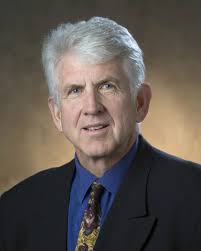
In the last decade, Metcalfe
has made it his mission to ignite the startup and technology community in
Austin and across Texas in what he often jokes are Austin’s suburbs of San
Antonio, Houston, and Dallas.
But just as the tech scene is red hot in Austin, it’s the end of
an era for Metcalfe.
At the end of the year, Metcalfe, inventor of Ethernet, founder of 3Com, plans to retire from his tenured and endowed professorship at the University of Texas at Austin. For 11 years, Metcalfe has served as Professor of Innovation in the Cockrell School of Engineering and Professor of Entrepreneurship in the McCombs School of Business, Murchison Fellow of Free Enterprise.
During Metcalfe’s
tenure, Austin has become one of the hottest tech hubs in the world. Google,
Facebook, and Apple have all expanded here. Oracle moved its headquarters to
Austin. So did Zoho. And last summer, Tesla picked Austin for its
$1.1 billion Gigafactory that will make Cybertrucks and other electric vehicles.
In addition to the big tech companies, dozens of startups have
spun out of the University of Texas at Austin and hundreds of others have made
Austin their headquarters. That trend accelerated last year during the Pandemic
as entrepreneurs, venture capitalists, and startups moved to Austin from
California and other cities.
Chief among them, Jim
Breyer, founder and CEO of Breyer Capital, moved to Austin and opened an office
here and has made several investments in startups. In addition, Joe Lonsdale an entrepreneur, investor, and philanthropist, moved 8VC, an investment firm,
and The Cicero Institute, a public policy
think tank, to Austin this summer. And Elon Musk also recently moved to Texas.
“People want to be in Austin because people want to be in
Austin,” Metcalfe said. “That leads to unusual behavior.”
It also has a network effect that tracks with Metcalfe’s Law, which states that the value of a network is proportional to the square of the number of connected users of the system. Austin becomes a better place for technology startups to take root and grow as the infrastructure for them expands as well as the talent pool.
“I think the one
negative is the damn city council,” Metcalfe said. “They want Austin to be
weird and that’s off-putting.”
Metcalfe has always
said he wants to make Austin wired, not weird.
For the past two years, Metcalfe has headed up an effort to
promote the use of geothermal energy.
“Geothermal is always listed as “other” as an energy source, but
it has the potential to take it all over,” he said.
In October, Metcalfe will finish up at TexasGeo.org, an organization he co-founded to promote geothermal startups, which was funded by a $1 million U.S. Department of Energy grant.
Metcalfe has also helped launch dozens of student-led startups as part of the Longhorn Startup program. He is teaching Startup Innovation this semester to 18 first-year students. His last class is on May 5th.
Metcalfe is also continuing to award innovation grants to
professors from a fund at the Texas Innovation Center, of which he is the
founding director.
After that, Metcalfe plans to start his 6th 10-year career, which is yet to be determined. Metcalfe’s careers, each roughly spans a decade, including his work at Xerox Palo Alto Research Park where he invented Ethernet on May 22, 1973.
His other careers include founding 3Com, working as a pundit and
publisher for InfoWorld, and serving as a venture capital partner with Polaris
Partners in Boston.
Metcalfe turns 75 on April 7th but “that’s not for me
any kind of triggering date.”
“By 12/21 I will have been at UT Austin for 11 years, which is
too long, time to move on,” Metcalfe said.
Whatever the opposite of Meta is, that’s the direction Metcalfe
plans to explore.
“The default is to stay here in boomtown,” he said. Metcalfe has
a house in West Lake Hills. But he also has a home in Maine, where he spends
his summers with his wife, Robyn. His grown children, Max and Julia, live in
California and have formed a startup, The Working Team.
Asked if he would consider becoming the Mayor of Beta City, the tech
town Lonsdale talked about creating in Texas with Elon Musk, Metcalfe said yes.
“Anything that Elon Musk is involved in, I want to be involved in,” Metcalfe said. “He’s my new hero these days. He’s replaced, Steve Jobs.”
At 2 p.m. on Tuesday, March 23rd, Metcalfe will be the featured speaker on Silicon Hills News’ Tech Talk club on Clubhouse. To hear more about this story, tune in!
The James Webb Space Telescope is the most powerful, complex, and expensive space telescope ever built.
The $8.8 billion telescope is at the center of the new documentary “The Hunt for Planet B” which had its world premiere at the South by Southwest Film Festival. The film follows a group of scientists, most of them female, on their quest to find another Earth among the stars.
And last Friday
night, the stars of the show participated in a panel discussion “Cosmic Breakthrough:
Women in the Hunt for Planet B” with the film’s director Nathaniel Kahn.
To kick off the discussion, Kahn asked Natalie Batalha, a professor of astrophysics at UC Santa Cruz who is featured in the movie, if the U.S. is on the verge of detecting life in the cosmos and how does the Webb telescope fit into that.
“Well to answer your first question, I think absolutely we’re on the verge of finding extant life, primarily by looking at extant planets,” said Batalha, who was a science lead on NASA’s Kepler mission, which revealed a staggering diversity of planets beyond the solar system. The James Webb Space Telescope will enable scientists to detect the chemical fingerprints of hundreds of planets, she said. And Trappist-1 is a red star that harbors seven planets, which could contain life, she said.
The whole community is waiting for the James Webb to launch, said Sara Seager, an astrophysicist and a professor of physics and planetary science at the Massachusetts Institute of Technology. She has spent her career searching for the first Earth-like exoplanets and signs of life on them.
“I feel
confident that there is life out there,” said Maggie Turnbull, an
astrobiologist with expertise in identifying planetary systems that may be
capable of supporting life. “It’s kind of incomprehensible to me that we would just
have only one planet of what we know are definitely billions of planets at
habitable temperatures throughout our one galaxy that could hold life.”
Turnbull
feels less confident in finding life sometime soon.
“We can
be on the verge of that for an indefinitely long time,” she said.
The James Webb Space Telescope is extremely powerful and will provide insights into the lifecycle of stars. Amy Lo, Deputy Director for Vehicle Engineering on the James Webb Space Telescope for Northrop Grumman in Redondo Beach, California, is featured in the movie and oversees the construction of the telescope, which is expected to launch into space in October.
“We’ve only looked for a blink of an eye in cosmic time scales,” said Jill Tarter, known for her work in the search for extraterrestrial intelligence (SETI). She is the Emeritus Chair for SETI Research at the SETI Institute. Tarter was portrayed by Jodie Foster in the 1997 movie “Contact.”
It’s really important to not just focus on the search for the next planet, but to clean up this planet, Tarter said.
“I
think that’s the first challenge,” she said. “Because if we can’t do that, we’re
just going to take our mistakes with us and do it somewhere else.”
The
search for life circles back to earth and helps us understand and sustain life
on earth, Batalha said.
“When
you go out and explore and you think about other worlds and spend all of this
time contemplating all of these other places, you can’t help at the end of the
day but realize how precious life is and to love this planet all the more,” Batalha said.
Everything is interconnected,
Turnbull said.
The ingredients for life are out there, Seager said.
“I think most of us think life is out there,” she said. “It’s just a matter of time.”
South by Southwest Saturday announced the winners of the 13th annual SXSW Pitch event.
It took place on March 17 and 18th as part of the SXSW Online digital experience. Judges chose 8 winners from each of the categories and a “Best In Show” winner, holoride, as well as awarding “Best Bootstrap” to Refiberd, “Best DEI” to Sisu Global Health, and “Best Alternate” to Colorcast.
The
category winners of the 2021 SXSW Pitch event in each category are:
Each of the winners received $1,000, two badges for next year’s SXSW conference, and exposure to investors and others.
“Now
in our 13th year of programming, Pitch continues to showcase the best
technology from around the world, proving our dedication to highlighting
today’s most forward-thinking movers and shakers,” SXSW Pitch event
Producer Chris
Valentine said in a news release. “Adapting to a digital
experience can come with unexpected challenges, but this year’s event was a big
success, and we’re thrilled to recognize each of the winners within this mature
class of startups.”
Among the strong trends showcased at this year’s event were accelerated innovation within the Health, Wearable & Wellbeing, and Future of Work categories, which can be attributed to the COVID-19 pandemic. Additionally, there was a significant focus on applied artificial intelligence.
When the pandemic hit Texas last year, Favor, H-E-B’s on-demand
delivery service, expanded into 75 new towns and cities in a week at the end of
March, said Jag Bath, the company’s CEO.
“Favor was very quickly able to expand into towns and cities
that had no on-demand delivery services,” Bath said
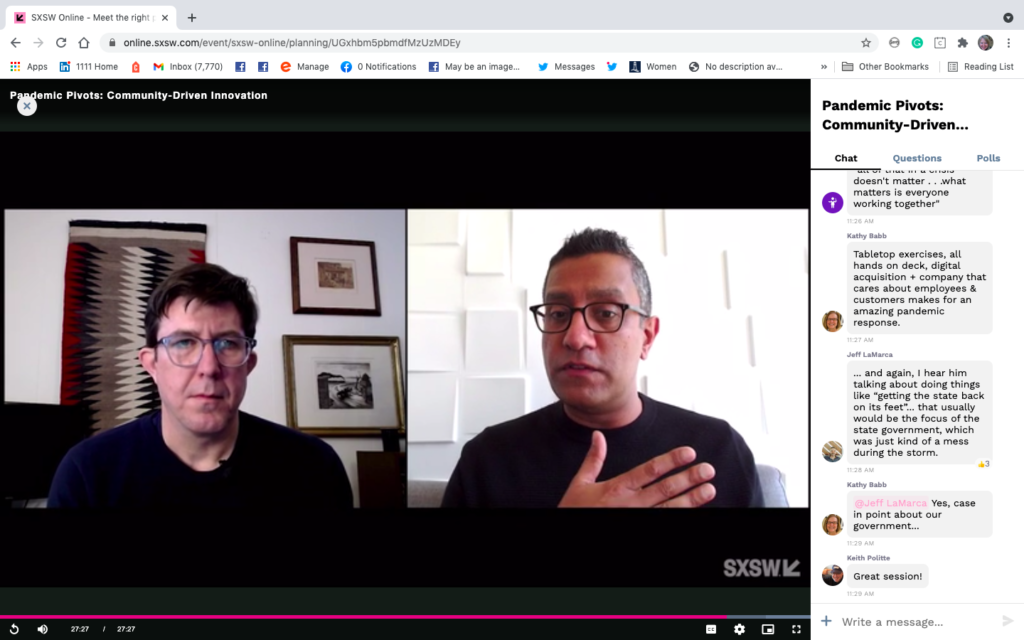
In comparison, in 2018, Favor expanded to 40 new cities in an entire year, Bath said. He spoke with Tom Foster, editor of Inc Magazine, on a South by Southwest interview titled “Pandemic Pivots: Community-Driven Innovation” which aired on Saturday morning.
The major focus of Favor’s big expansion was to get more service to seniors in Texas, Bath said. The senior support program was launched at the start of the pandemic, he said. The Centers for Disease Control reported that seniors were most at risk to contract Covid-19. H-E-B wanted to come up with a solution to get groceries and essentials to seniors at home, Bath said. H-E-B and Favor couldn’t rely on the latest technology and its app because many seniors didn’t have access to that technology. Instead, H-E-B and Favor had to build a system that seniors could easily use by phone, Bath said.
“You have to really think different,” Bath said. “Our norms when
it came to digital approaches had to be thrown out the window.”
H-E-B had to create a brand-new decentralized call center to allow staff members to take calls from seniors and allow runners to fill those orders and deliver them to their doorstep through contactless methods, Bath said. That system had to be built from scratch, he said.
“We became an essential business overnight at H-E-B and at Favor,” Bath said.
H-E-B’s experience at responding to hurricanes and other emergencies in Texas helped equip the company to prepare for the Pandemic. H-E-B and Favor early on began preparing for the pandemic. The toilet paper shortage took the company by surprise, Bath said. But the company was able to meet the needs of its communities in most other areas except for cleaning supplies, which were in short supply for a long time.
And when the Texas storm hit, H-E-B and Favor once again relied on its emergency preparedness, Bath said. Favor teamed up with restaurants and community partners in Austin, where it is headquartered, to provide almost 3,000 meals to people in need, he said. Food Banks also primarily depend on supermarkets to provide food, so H-E-B moved to give 23 truckloads of food and meals to Texas food banks as soon as it could get back on the roads and more than 20 trailers of water to people, Bath said. H-E-B donated $1 million to Feeding Texas and that is being distributed to 18 food banks across the state, he said.
“We have never seen an impact like this, which was statewide,”
Bath said.
H-E-B has been around for 115 years. Favor has only been around for seven years. Favor was H-E-B’s first acquisition in its history. But both companies focused on community, and that has led to their success, Bath said.
“It’s a people-first approach that has always been the heart of everything we do,” he said.
At its core, Favor is a local logistics company, Bath said. Logistics and operations are at the heart of H-E-B. Then you have this focus on community, and a people-first approach, he said. Combine those things together and you have something magical, he said.
Also, H-E-B and Favor are solely focused on the Texas market and that helps the companies better serve their communities.
“H-E-B is stitched into the fabric of Texas,” Bath said. H-E-B understands the communities it serves and is able to serve the needs of those communities better, he said.
The needs are different from city to city and rural town to
rural town, he said.
Katie Fang, Founder and CEO of SchooLinks, courtesy photo
SchooLinks, a college and career readiness platform, landed $8.3 million in funding last week.
LiveOak Venture Partners led the Series A round with participation from SJF Ventures and Juvo Ventures.
Katie Fang founded SchooLinks in 2014 in Los Angeles and moved the startup to Austin a year later. Forbes selected her as a Forbes 30 under 30 entrepreneur in 2018. Silicon Hills News did this story on the company in 2015.
SchooLinks plans to use the funding to hire more employees,
and on product development and building partnerships, according to a news
release.
SchooLinks works with school districts and guidance counselors to make sure that students choose the right education and career path. SchooLinks’ platform helps schools track various success metrics.
“Changing legislation at the state level and evolving market conditions are putting a spotlight on the school districts’ ability to set their students up for success in the job market regardless of whether they attended a 4-year college or not,” Fang, CEO and Founder said in a news release.
Since its founding, SchooLinks has helped many high school students with graduation plans, FAFSA completion, and post-secondary plans. The platform starts working with students, counselors, and families beginning in the 6th grade. The platform provides career assessments, college and career options, jobs and internship opportunities, financial literacy lessons, scholarship applications, and more.
SchooLink’s customers include the Dallas Independent School
District, Greenville County Schools, and San Antonio Independent School District.
The SchooLink’s platform handles back-office logistics for districts including
individual career and academic plans, course planning, CTE pathway, and more so that counselors can spend more
time with students.
As part of the funding round, LiveOak’s Mason Rathe will be
joining SchooLinks as vice president of finance and operations.
“It struck a chord, as a parent,” said Krishna Srinivasan, founding partner at LiveOak Venture Partners, who will take a board seat as part of the funding. He saw a big need for the services SchooLink offers.
Srinivasan and his wife have three children, two of them have
been admitted to college and another will go through the college application
process. He saw firsthand that students need more guidance associated with
which college program to select and what courses to take in middle school and
high school to prepare them to get into that program.
“Parents struggle with giving them guidance,” he said. A
better technology platform like SchooLinks can guide the students, he said.
“This is a really needed solution to help these kids on
their journeys from middle school through high school graduation,” he said.
School districts, counselors, administrators all agree this
is a great product and SchooLinks makes an administrator’s and a college guidance
counselor’s life easier.
“It is loved by students when they use it,” Srinivasan said.
SchooLinks has also had incredible growth in a short period
of time and is in dozens of school districts in dozens of states, he said.
“The metrics this company has associated with growth are
absolutely incredible,” he said.
And the main reason it is succeeding and accelerating its growth is that it has an exceptional founder in Katie Fang, Srinivasan said.
“The combination of those factors is kind of what drew us to
invest,” he said.
WeWork is one of the greatest Icarus stories of modern business history and it ties in everything from bubbles to capital to startup culture, according to Randall Lane, editor of Forbes.
“It’s got it all,” Lane said.
WeWork, a real estate company, skyrocketed to a $47 billion
valuation and then nosedived to near bankruptcy within a span of a few months.
Lane, who is also one of the narrators in the documentary,
spoke on a panel discussion at South By Southwest on Wednesday night after “WeWork: Or The Making and Breaking of a $47 Billion
Unicorn” debuted at the SXSW Film Festival.
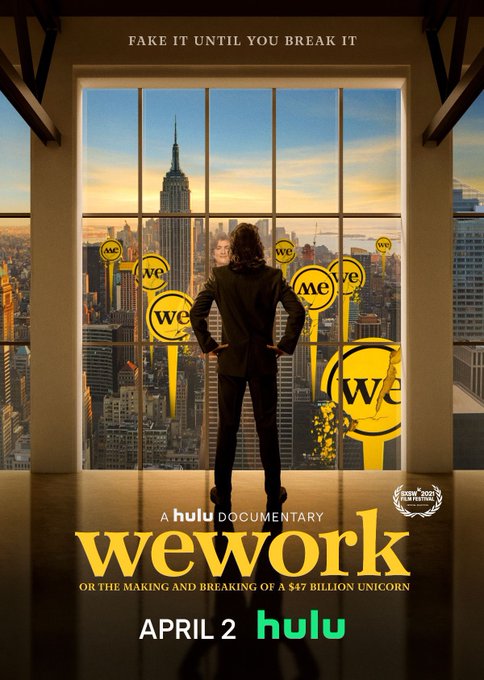
Forbes Entertainment partnered with Ross Dinerstein’s Campfire, and Olive Hills Media in making the feature-length documentary, which will begin airing on April 2nd on Hulu. Lane led an online discussion about the film with Dinerstein and the film’s director Jed Rothstein.
The movie starts out with Adam Neumann farting while
repeatedly trying to give an investor pitch about the company. That kind of
sets up the audience for the unconventional and weird tale about to unfold.
“The next revolution is going to be the We revolution,” said
Neumann, co-founder of WeWork, quoted early on in the movie. “And it will
restore in each one of us a sense of dignity and community without which
greatness cannot be achieved.”
The movie centers around Neumann, a tall gangly fellow who served as the hippie-messianic leader of the WeWork empire which consisted of brands WeWork, coworking, WeLive, co-living and Rise by We, a gym. Neumann, an immigrant from Israel, teamed up with Miguel McKelvey to co-found WeWork in New York in 2010. McKelvey is rarely mentioned in the film although he does appear on stage in some shots with Neumann. McKelvey oversaw the company’s culture and operations. He also spoke at SXSW 2018. Both men grew up in communes.
At its height, WeWork had more than 600,000 members
worldwide in 850 locations in 60 countries and 120 cities including Austin,
which has seven locations including its latest location, the SXSW Center.
Neumann did not grant the filmmakers an interview for the documentary. It relies heavily on footage shot of Neumann taken during the company’s heyday with Forbes and other journalists and at company events. The documentary makers do interview key employees, journalists, experts, and others to get insight into the WeWork culture, its community, and the business behind it all.
“The movie is very serious, but it is also super fun,” Lane
said.
WeWork also had a cult-like culture, said Dinerstein, who also was the executive producer of HBO’s docu-series Heaven’s Gate: The Cult of Cults.
“People want to be inspired. People want to be motivated.
They want to be a part of something bigger than the whole,” Dinerstein said. “A
lot of what Adam preached resonated with people. Heaven’s Gate is the same kind
of thing.”
But Neumann also made a lot of promises to employees that did not pan out. Most people agreed to salaries lower than what they could make somewhere else and they worked long hours because they were given stock options, said Don Lewis, a former attorney for WeWork, quoted in the movie. Those stock options have not panned out as the company withdrew its Initial Public Offering in September of 2019.
Neumann is such a great salesman, and he is really
charismatic, said Lane.
Neumann got carried away, said Rothstein, the film’s
director.
“He got out over his skis,” Rothstein said. “He drank too much of his own Kool-Aid and believed the hype and got greedy frankly.”
Neumann’s story is an immigrant story too, he said.
“Adam didn’t come here with a trust fund and a Harvard education,” he said.
There’s a very American component to this process of faking it till you make it, Rothstein said. There’s a fine line between aspirationally talking about things that don’t exist and making them happen and lying to people. If you cross that line, that’s when you get in trouble, he said.
“You saw that with Elizabeth Holmes,” Rothstein said.
The 2019 documentary “The Inventor: Out for Blood in Silicon Valley,” debuted at the SXSW Film Festival also. It tells the story of Holmes, an attractive and charismatic entrepreneur who faked test results and lied to commit fraud on a massive scale in promotion of her medical device company.
Once an entrepreneur crosses that line, it’s no longer
selling, it’s lying,” Rothstein said. “But
at least in his heart, Adam was trying to do something that was worthy of being
done. And I think it just spiraled.”
Dinerstein went into making the documentary thinking Neumann
was a white-collar criminal and he’s not, he said. At the end of the day, he
played by the rules, he said. He asked for money and people said yes, he said.
“He had the opportunity and he took it and that’s very much the American dream,” he said.
It was not fraud if he was playing within crazy rules, and
that speaks to a much bigger story, Lane said.
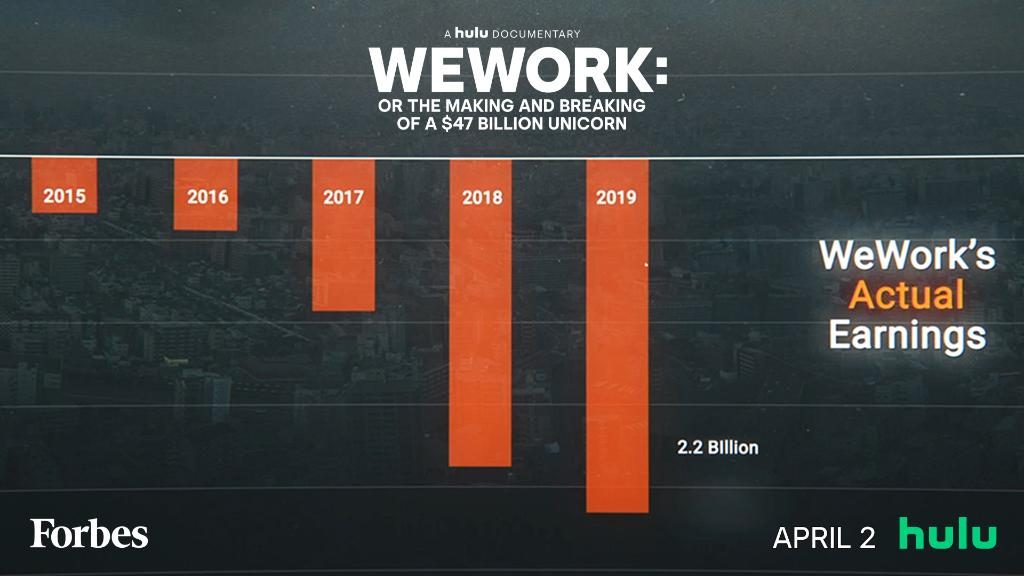
Speculative valuations encourage companies to hemorrhage money to grow, and that’s what Neumann was doing, Lane said. Neumann convinced SoftBank Founder and CEO Masayoshi Son to invest $9 billion into WeWork from his $100 Billion Vision Fund. And in the movie, Son reportedly told Neumann that he wasn’t being crazy enough and needed to think bigger with WeWork.
“You can’t achieve outsize gain with timid business
strategies,” Rothstein said. “You need to shoot for the stars. Obviously, it
spun out of control and it didn’t work out and it got extravagant and crazy in
ways that were unnecessary.”
The IPO revealed Neumann’s self-dealing acts like registering the trademark to the company and selling it back to the company and buying buildings and leasing them back to the company. Those things got a lot of attention from investors, Rothstein said.
The movie also underscores the idea of community and connection and how important it is especially highlighted by the Pandemic, Lane said.
“It became a really central question even from the first
interviews we did that we were hungry for being together,” Rothstein said. The
grand experiment of WeWork bringing everyone together became central to the
story as we talked to more and more people, Rothstein said.
In the end, even ex-employees of WeWork, quoted in the movie, said they missed the community and the idea of changing the world for the better.
How do you lose $47 billion in six weeks? Let us count the ways. See the #SXSW Official Selection, WeWork: or The Making and Breaking of a $47 Billion Unicorn, premiering April 2 on Hulu.
The amount of the investment was not disclosed. An article in Fortune estimated the investment by Austin-based Vista Equity Partners at $400 million.
AlertMedia, which has 200 employees, plans to use the infusion of capital to accelerate its long-term growth strategy, according to a spokeswoman. It also plans to continue to hire employees and to expand into new markets, according to a news release.
AlertMedia has raised $60 million since its founding in 2013, according to Fortune. And its major existing investors including JMI Equity, Next Coast Ventures, Silverton, and Brian Cruver, the founder and CEO will retain a significant ownership stake in the company. In addition, Cruver will remain as CEO and on the company’s board.
AlertMedia provides emergency communications software to more than 2,000 companies in more than 130 countries. Its customers include Walmart, JetBlue, Coca-Cola, Bottling, DHL, and Volvo. AlertMedia’s technology identifies risks to company locations or people and communicates that information instantly. The company says it minimizes response times during emergencies and other business-critical events.
“We help organizations
communicate more effectively during emergencies, which has never been more
relevant given the volume and severity of crises around the world,” Cruver said
in a news release. “Vista shares our belief that every business should ensure
its employees are safe, informed, and connected—and that emergency
communication software has the power to improve outcomes. We are thrilled to
have the experience of the Vista team on our side, providing guidance and
support as we continue to build AlertMedia into a best-in-class global
enterprise.”
The investment in
AlertMedia comes from Vista’s Foundation Fund, which invests in middle-market
enterprise software, data, and technology-enabled companies.
“For years,
organizations slowly increased focus on employee safety and emergency
preparedness. With the COVID-19 pandemic, protecting the health and safety of
employees while maintaining the ability to serve customers in a crisis has
become an organizational imperative and competitive advantage,” Ryan Atlas,
Managing Director at Vista Equity Partners said in a news release. “At Vista,
we invest in category-leading companies to help accelerate innovation and
maximize growth. We are excited to partner with Brian and the AlertMedia team
to help companies protect their people and maintain business continuity.”
The transaction is
expected to close in the second quarter of this year.
The financial terms of the acquisition were not disclosed. Turnkey, founded in 2012, had raised $120 million in venture capital. Vacasa has raised $639.5 million to date, including a $108 million Series D round last June, according to Reuters.
TurnKey
provides vacation rental management for approximately 6,000 premium homes in
more than 80 destinations nationwide.
Vacasa
plans to keep TurnKey’s Austin office and its employees, according to a news
release. Vacasa has more than 4,000 employees and offices in Portland and
Boise, Idaho
The
deal is expected to close in a month.
“This
is an incredibly exciting day as we plan to welcome TurnKey employees,
homeowners and guests into the Vacasa family upon closing of the transaction.
Our companies have a similar focus on delivering exceptional service to our
homeowners and guests, and we are excited to do that together at a key juncture
for the highly competitive vacation rental industry,” Vacasa CEO Matt Roberts said
in a news release. “The vacation rental sector continues to see
significant gains in market share for accommodations and, with our expert teams
and innovative technology, we’ll have the opportunity to lead the industry
forward.”
By
acquiring TurnKey, Vacasa expands its market reach to include Los Angeles and
Napa, California; Asheville, Black Mountain, and Holden Beach, North Carolina;
and Santa Fe, New Mexico.
“Innovation has been at the core of our business from the start. Our goal is to make vacation rental home ownership more efficient and more profitable for owners through the use of technology,” TurnKey CEO John Banczak said in a news release. “Moving forward together, we expect to deliver on our shared vision of developing innovative solutions to meet the evolving needs of our homeowners, and offer a consistent, reliable hospitality experience to our guests.”
Vacasa
and TurnKey offer full-service vacation rental management to homeowners by
providing customer support as well as cleaning and maintaining their
properties.
Dosh, founded in 2016, had raised $96 million in funding from investors including PayPal, Goodwater Capital, Next Coast Ventures, Chetrit Ventures, and Extol Capital.
Dosh created an app that allowed consumers to get cashback on all kinds of purchases from clothes to food to hotel rooms.
In the last year, Dosh struck up partnerships with financial institutions, neo-banks, and fintech companies like Venmo, Betterment, and Ellevest to offer its platform in their digital channels.
“Dosh’s technology is extremely complementary
to the long-term financial institution integrations and substantial scale we’ve
built over the past 13 years. With the addition of Dosh, Cardlytics will
accelerate its ongoing efforts to improve the advertising industry through our
brand-safe alternative, which provides superior returns based on actual purchases.
This creates real value for consumers, advertisers and our bank partners,” Lynne
Laube, CEO and co-founder of Cardlytics, said in a news release.
Dosh will join Cardlytics’ advertising
platform which has more than 163 million monthly active users.
“Combining
our technology with Cardlytics’ scale, we have an opportunity to drive
significant revenue for our advertisers while putting money back in the wallets
of consumers,” Ryan Wuerch, CEO and co-founder of Dos, said in a news release. “We
are excited to join the Cardlytics team and are looking forward to positively
impacting consumers and merchants.”
To date, Cardlytics has provided more than $500 million in cashback to consumers, while also driving positive, measurable results for its advertisers across a variety of industries including retail, restaurant, telecommunications, direct to consumer, grocery, and travel.