Author: LauraLorek@gmail.com (Page 19 of 354)

LauraLorek@gmail.com

Newchip Enters Into Bankruptcy Liquidation

By Laura Lorek, publisher and senior writer of Silicon Hills News

Newchip entered into bankruptcy liquidation last week.

The Austin-based company rebranded as Astralabs, doing business as Newchip and Newchip Accelerator, filed for Chapter 11 bankruptcy reorganization on March 17th, listing $1.7 million in total assets and $4.8 million in total liabilities, according to its filing. But last week, the bankruptcy judge forced the company into Chapter 7 liquidation, according to a letter posted by its co-founder and CEO, Andrew Ryan.

“I deeply regret to inform you that our company Newchip Accelerator after 6 + years of supporting startups globally, has faced a series of unfortunate events which have significantly impacted our operations,” said Ryan, formerly known as Ryan Rafols.

Among its top unsecured creditors, the company lists Apex Funding Source of Miami with a $536,000 claim, Clear Finance Technology Corp. of Ontario, Canada, with a $1.5 million claim, and Iruka Capital of New Jersey with a $594,000 claim. All of those were listed as “merchant cash advances,” alternative financing for small businesses where the borrower pays the interest upfront, and the lender takes a percentage of the company’s future revenue until it’s paid back.

In addition, Newchip received more than $776,000 in taxpayer funds under COVID-19 relief programs. It lists the U.S. Small Business Administration as a top 10 unsecured creditor with a claim of $500,000 for a COVID-19 Economic Injury Disaster Loan.

Newchip also received two Paycheck Protection Program loans for $141,289 in March of 2021 and $135,100 in April 2020, which were both forgiven.

Newchip raised $7.9 million in funding from accredited and nonaccredited investors, according to Crunchbase. However, the company has a history of losses. It filed documents with the SEC reporting a net loss of $197,884 for 2016 and a $748,999 loss in 2017. And in 2020 financial filings, it claimed $4.5 million in tax loss carryforwards.

In 2020, Newchip reported earning $2.6 million in revenue from selling its accelerator program to startups and $781,000 in 2019, according to its consolidated financial statements.

Silicon Hills News has been in contact with more than a dozen startups that claim the company took their money and didn’t deliver on the promises of the accelerator program. And one startup founder, Angela DiMarco, co-founder of Uniquely Phenom Collaborations in New York, said she paid $7,500 to go through Newchip’s accelerator and was pleased with the program.

“The education part of it was like getting an MBA, and where can you get an MBA for $7500, you know,” DiMarco said. “I went from not knowing what a KPI was to now being very comfortable that I can walk into a room full of investors and negotiate a term sheet.”

But DiMarco said she wouldn’t get that chance with Newchip to pitch to investors. She was supposed to do her three-minute elevator pitch to investors last week, which didn’t happen. She said she paid an additional fee for that opportunity and would try to get her money back.

In Vancouver, Washington, John Laine is not a happy customer.

In 2020, Laine gave a testimonial in favor of the company during the accelerator’s onboarding process. He hadn’t yet started the program, but when he did, he was hugely disappointed. Laine has asked the company numerous times to remove his name and testimonial from its marketing materials, but they have not.

At the time, Laine had a fintech startup and wanted to learn about crowdfunding. So he paid $3,800 of a $20,000 fee to participate in the accelerator.

“I did the program for less than a week and a half, and I realized I was duped,” he said. “It’s the crappiest version of online education you can produce.”

Laine contacted his credit card company and canceled the rest of the installments.

“Every business owner I’ve ever known is an optimist, and they prayed on that optimistic personality,” Laine said.

Newchip promised him that they would commit a minimum investment of $100,000 into his startup and that they did that for every startup that went through its program. But, unfortunately, he never got an investment.

Laine said they prayed on a particular avatar, a founder looking for a solution to bring their company forward.

Jari Kemppinen, the founder of Soulbotix, based in Australia, which builds custom ChatGPT-powered metahumans, joined the Newchip accelerator in February and paid $6,000 for the “courseware that gets you nowhere.”

“Seeking funding in Australia is a hopeless endeavor,” Kemppinen wrote in an email. However, he was attracted to Newchip because it was based in the US and offered remote learning and participation without relocating. He also liked the company’s promised connections and introductions to Newchip’s extensive VC investment portfolio. Unfortunately, once Kemppinen joined the program, he found little help from Newchip.

“I found that they lacked one-to-one communication, and I was left alone to navigate an enormous amount of content without any help,” Kemppinen said. “They just seemed to rely on founders looking after themselves.”

Kemppinen has yet to get any introductions to investors and would like a refund.

This experience disheartens him. “I am beginning to think the startup funding ecosystem is corrupt and not worth it,” he said. Too much work needs to go into creating so much documentation to gain some funding, he said. “Making solid partnerships, being honest, and working with your customers and partners is easier. That is what will make you money.”

A former Newchip employee said the company hired Garibay Ventures, based in Austin, to send spam emails to thousands of startup founders worldwide to recruit new startups for its paid program with the promise of investor introductions.

Ahmed Zobi, CEO and founder of Syntr Health Technologies, based in Irvine, Calif., received one of those emails from Anthony Garibay, CEO and Founder of Garibay Ventures, who claimed to be an investor.

Garibay Ventures said it recently partnered with Newchip’s accelerator to “get extra exposure to their investors (which I am a part of),” according to the email. The email included a link to the Newchip accelerator application.

In November 2020, Zobi paid $4000 to participate in the Newchip program. Newchip told him the actual cost of the program was $30,000, but they were granting him a scholarship for $26,000. But when he got the 12-page contract from Newchip, it included a clause that gave Newchip warrants or the right to buy a certain number of shares in the startup at a set price. Zobi showed it to his lawyer, who advised him not to sign. He didn’t. And Newchip never followed up to make sure the contract got signed. Zobi participated in the program but got little value out of it. His assigned mentor emailed him and said he was traveling to London. He ghosted him after that. The mentor never responded to follow-up emails or meeting requests, Zobi said.

“At the end of the day, I knew something was off because they never even asked for the contract back,” Zobi said.

“I think they just cared about getting as many startups signed up as possible,” Zobi said.

Other startups that paid to participate in Newchip’s global accelerator program are complaining on social media, primarily LinkedIn, that the company took their money and left them without resources. In addition, some former employees are alleging harassment in the Newchip workplace and a hostile work environment, according to a former employee.

Newchip started in 2016 as a marketplace aggregating the best deals from various equity-based crowdfunding platforms. It also was selected to participate in the Sputnik ATX accelerator program in Austin.

Newchip was not an equity crowdfunding platform itself. But it billed itself as the “kayak of funding,” Its website allowed nonaccredited investors to invest in deals for as little as $100 at a time.

The company said it made money from deal listing fees, investment commissions, exchange transaction fees, data analytics, and partners.

Travis Brodeen co-founded Newchip with Ryan Rafols, who has since changed his name to Andrew Ryan.

In 2018, Newchip raised $647,000 from more than 160 nonaccredited investors at a $15 million valuation on the equity crowdfunding platform Wefunder. Its goal was “to be the NASDAQ for the alternative investment market.”

But somewhere along the line, according to a former employee requesting anonymity, things went wrong.

The Newchip Accelerator has an F rating with the Better Business Bureau and two complaints from 2022 claiming the company lied to them. One complaint stated the startup paid $6,000 to participate in the program with a money-back guarantee that if they didn’t raise funds through Newchip, the accelerator would refund their money. However, the startup did not raise funds, and Newchip refused to repay its money.

Do You Need Venture Capital to Build a Business?

Michael Ramirez, the founder of SEO technology company Evisio.co

Special Contribution by Evisio

Every startup in the world has one thing in common: a dream. From humble beginnings in a basement or garage, entrepreneurs set out to build the next big thing. It’s a tale as old as time and has always been part of the American dream.

For most entrepreneurs, there’s inevitably one major obstacle blocking the path to making this a reality – funding. No matter how great the offering is, growing a business without money is hard. But how far are you willing to go to make it a reality?

One Austin man is betting the house on his success – literally. Michael Ramirez, the founder of SEO technology company Evisio.co, has decided to forgo the traditional route of seeking funding from venture capitalists. Instead, he has listed his home on the market to secure the cash he needs to scale his business.

Rather than sacrificing equity in the company he has painstakingly built from the ground up with outside investments, Ramirez decided to grow his startup via “bootstrapping” (i.e., pulling yourself up by your bootstraps).  

While venture capital, or VC, tends to get a lot of attention, largely thanks to the success of companies like DoorDash, Airbnb and Uber, many founders are unaware there are non-traditional ways to fund their startups.

Before we provide some alternative methods for VC funding, let’s take a closer look at the traditional role VC has played, the recent impact events have had on the field, and discuss other ways entrepreneurs like Ramirez are finding ways to finance their startups – without giving up a chunk of their business.  

What is Venture Capital?

Venture capital is a form of private financing in which an investor, investment bank, or other financial institution puts capital into a startup or small business in exchange for a piece of equity. This investment can come in many forms, including operational capital, technical expertise, or management experience.

In many cases, VC is used as a short-term investment, where investors provide cash for startups to grow and build infrastructure and then exit once the company has reached a position where it can be sold to a corporation or receive equity in institutional public-equity markets.

While shows like Shark Tank and movies like The Social Network have reaffirmed the romantic image of a group of unknown entrepreneurs taking their business from the basement to the peaks of Silicon Valley remains, in reality, less than 1% of startups receive outside investment capital.

What has led to this more cautious approach? And what does it mean for aspiring business magnates? Let’s find out.

The State of VC Investments in 2023

On Friday, March 10, 2023, one of the world’s most prominent VC institutions, Silicon Valley Bank, fell victim to panic, resulting in the third-biggest bank failure in United States history. It was a problem that caught many investors off guard – but it shouldn’t have.

Investopedia estimated 97% of the bank’s deposits were not federally insured, which was particularly problematic for the tech sector, which has been hard hit by the aggressive rise of interest rates in an attempt to offset inflation.

The total damage of the fallout remains to be seen. Still, the highly interconnected nature of VC could lead to far-reaching concerns for both investors and the companies they have invested in, including the risk of companies being unable to pay employees or investors being unable to secure funds.

As a result, it seems likely that VCs will become less risk-tolerant, which means startups will find it more challenging to secure funding as VC investors become more selective.

This is far from the only issue with using VC to fund business growth. The field is also a largely insular community. According to a study by Richard Kerby, more than 80% of U.S. venture capitalists are men, and 70% are white. The study also indicates that nearly half of all VC investors studied at either Harvard or Stanford.

This has had the unintended consequence of creating what is known as “pattern matching,” in which investors make decisions about future investments based on past experiences.

In other words, because VC has typically included a lack of diversity in race, gender, and alma mater, it has created a cycle where white men from top universities continue to dominate the field.

This landscape makes it challenging for founders to secure funding and successfully scale once it has been secured. That’s why some entrepreneurs are thinking outside the box when it comes to financing their businesses.

Why a Local Entrepreneur is Selling His Austin Home to Bootstrap His Startup

Many founders are looking for ways to avoid the VC model and instead are seeking ways to bootstrap their startups, which is considered one of the safest and healthiest ways to scale. The primary means of accomplishing this depends on either the business generating enough revenue to fuel its growth or the founders successfully securing another type of investment, either from their assets, via their friends and family, or finding another traditional source of capital like a bank.

But there’s the issue – most people don’t inherit a fortune from a distant uncle, win the lottery  or have some other source of behind-the-scenes funding. Solving this problem requires outside-the-box thinking to find nontraditional ways to secure financing – exactly what Evisio’s Michael Ramirez has done.

A self-described “serial entrepreneur,” Ramirez was not born into the lap of luxury. Growing up in inner-city San Antonio, he saw his share of financial and social struggles and made it his mission to change his family’s economic status.

“Despite our economic hardships, my parents taught me how to be resourceful, fight through tough times and see opportunities where others don’t,” he said. ”For example, when I was laid off from my first job out of college, I asked one of the company’s owners if he’d hire me as a contractor. Most people wouldn’t think to do that, let alone have the guts to ask.”

His hustle mindset led him to move to Austin, where he graduated from The University of Texas at Austin, started his marketing agency, became an SXSW speaker, and now bootstrapped his own marketing Saas company in Evisio.co.

“Starting with my SEO agency (which I still operate), I was constantly seeking ways to streamline the process of getting webpages to the top of Google rankings,” Ramirez said.”That’s when an idea struck me like a thunderbolt, and Evisio was born.”

A platform designed to streamline every aspect of search engine optimization and improve results, it’s suitable for every level of SEO expertise, from old pros to absolute novices. Ramirez was immediately confident this was a winning idea.

“But that brought me back to the funding problem,” he said. “I first wanted to prove the concept before taking on debt and giving away a lot of equity. But I didn’t have the cash to fund it myself, and unfortunately, my family is not independently wealthy. So, I had to get creative.”

This didn’t happen by chance, however. Ramirez worked multiple jobs to save money as he researched properties in Austin that would make a good investment. He then used his savings to build the first MVP (most viable product) and update the home. Once satisfied that he had improved the house’s value, he listed it on the market with the idea of using the proceeds to scale this venture.

“Is it risky? Sure. But if I’m not willing to go all in for this, why should I expect anyone else to?,” he said. “But by the way, if you know anyone looking for a beautiful 4-bedroom, 3-bath home in the heart of South Austin, send them my way,” he added with a smile.

Why Some Entrepreneurs Don’t Want VC

Despite making the headlines, most startups aren’t using venture capital. In some cases, this is because of shaky business models or over-saturated markets that make a business unappealing to investors. In others, it’s a conscious choice.

Some of the more common reasons why founders may choose not to seek VC include:

  • A loss of control – By surrendering equity to investors, founders can lose a portion of control over where their business is headed. Venture capitalists are not usually silent partners, which means they will have a share in how the business grows.
  • Forced timelines – Rapid scaling is not something every business is suited to, but the clock starts ticking when an entrepreneur accepts money from VC investors.
  • Unnecessary distractions – Securing VC funding takes a lot of time and energy. This can take you away from other equally important tasks during the crucial first two years of a business’ life. 
  • A poor fit – Things like geographical limitations, scalability issues, and the need for physical inventory can make VC a poor fit, particularly for companies not in the tech world. 

So, how do the 99% of startups that fall outside the realm of VC investors grow? By bootstrapping, of course.

Alternatives to Venture Capital

Entrepreneurs will go to extreme lengths to fund their dreams and retain company equity. But not everyone is a gambler. Some people are naturally more risk-averse. Luckily there are still lots of funding opportunities – without sacrificing control.

Here are some ideas for financing your business:

  • Selling assets – You don’t have to sell your house to fund your company as Ramirez did, but if you have other assets you don’t mind parting with, this is a route to consider. This could be anything from the mint condition Mickey Mantle rookie card your dad left you, your summer home, or your stock in Microsoft. Just remember you’re gambling on yourself here.
  • Government loans – While the U.S. Small Business Administration (SBA) only makes direct loans to help businesses recover from declared disasters, it does back loans designed to help small businesses get the needed funding.
  • Government grants – The SBA provides limited grants to small businesses and federal funding to states and eligible communities to promote entrepreneurship.
  • Programs for minorities – With a commitment to supporting the development of minority-owned businesses, the SBA has funding and resources earmarked for businesses owned and operated by African Americans, Asian Americans, Hasidic Jews, Hispanic Americans, Native Americans, and Pacific Islanders.
  • Incubators – Business incubators provide specialized programs to help new entrepreneurs learn and grow their businesses. These come in many forms, including academic institutions, nonprofits, and for-profit property development companies. These programs do not generally directly provide funding, but they can point you in the right direction.
  • Bank loans – Most banks offer small business loans and financing to provide startups with a cash infusion. However, many business owners have found approval challenging, as traditional banks are unwilling to issue high-risk loans.

VC is Not for Everyone

Venture capital funding can be a godsend for certain companies. Companies we know and love, like Facebook, Amazon, and Apple, were all backed by VC. But it’s not the right choice for every business. In his book Lost and Founder, author and entrepreneur Rand Fishkin provide honest advice about when a startup should consider taking VC money based on his experience building Moz.com.

With the constant threat of a recession looming, investors are taking a more careful approach to startups, which may lead to some businesses being left out in the cold.

Luckily, there are options. Work through yours and make a careful decision about your next steps. Ramirez does not doubt that selling my house will provide returns many times over. But if you’re not as bold as he is, there are still many sources of funding you can employ.

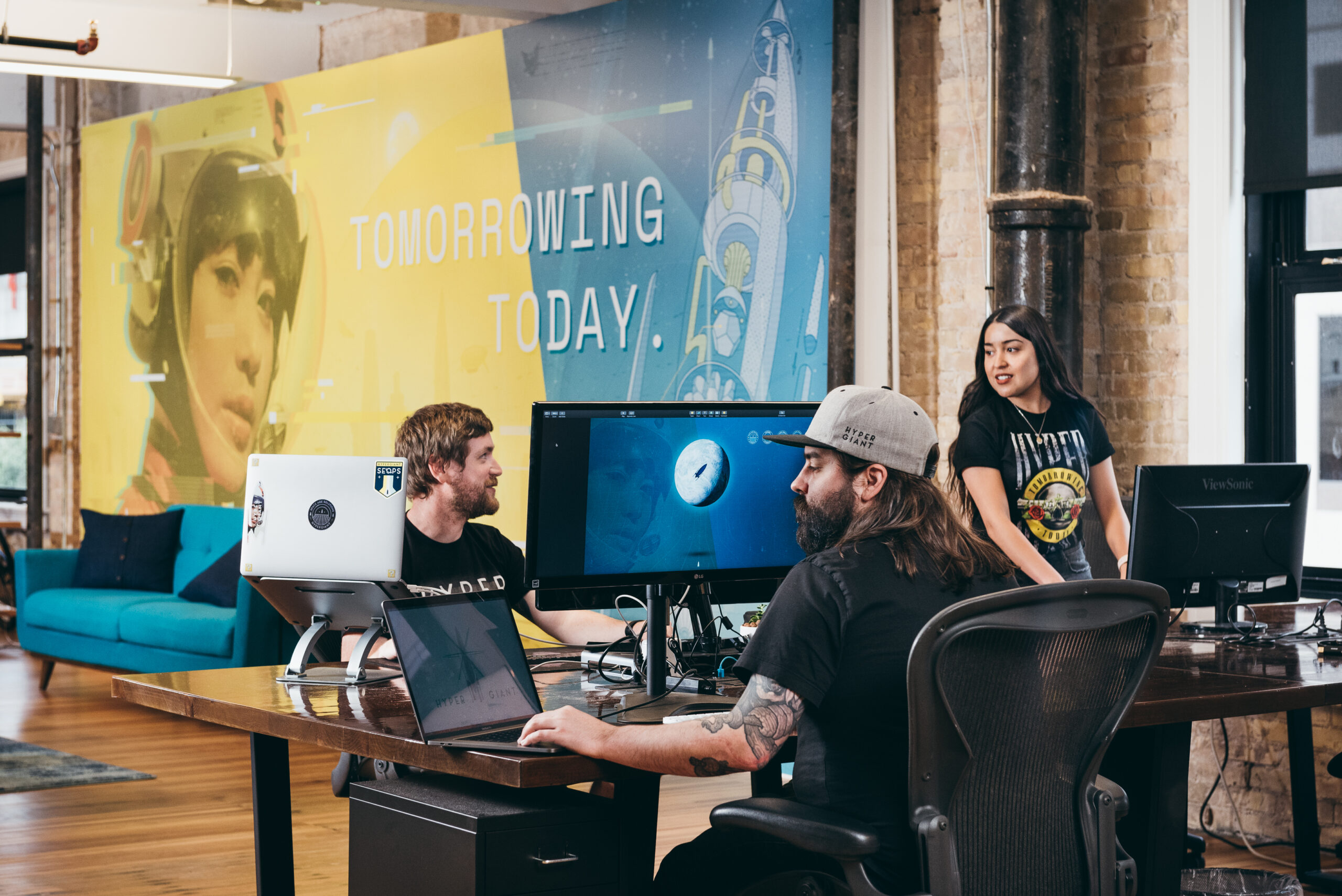
Hypergiant Galactic Systems Awarded $61.4 Million U.S. Air Force Contract

Hypergiant Galactic Systems has received a $61.4 million Small Business Innovation Research Phase III contract from the U.S. Air Force.

The company, based in Blanco, received the contract to provide user interface and user experience development services for cloud-based command and control.

Hypergiant will perform the work in Blanco by May 4th, 2026. Hypergiant Galactic Systems is a subsidiary of Hypergiant, based in Austin. Mike Betzer, Hypergiant’s president, and CEO, lives in Blanco, about 50 miles South and West of Austin, where Hypergiant Galactic Systems is based.

Air Force Life Cycle Management, Wright-Patterson Air Force Base, Ohio, is the contractor.

In 2021, the U.S. Air Force named Hypergiant Galactic Systems and 28 other companies as awardees on a potential $950 million contract. The contract is to build and operate systems across land, air, sea, space, electromagnetic spectrum, and cyber domains as part of the Joint All Domain Command Control program. In addition, the companies will compete to provide software and other solutions to the Department of Defense. The contract runs through May 2025.

Founded in 2019, Hypergiant’s customers include Sumitomo Corporation, Boeing, Schlumberger, Booz Allen Hamilton, and the United States Department of Defense. In addition, Hypergiant sells AI services, software, and solutions. The company has raised undisclosed venture funding from Sumitomo Corp. of America, Perot Jain, and other investors.

CharterUP Opens its Second Headquarters in Austin and Plans to Hire Over 100 Employees

As a kid, Armir Harris immigrated to the United States from Albania.

Harris learned the ins and outs of the transportation business at a young age from his uncle.

“I picked up the ground transportation business at the dinner table,” Harris said. “I had no plans on going into the transportation or bus industry at all, but shortly after college, my uncle got sick. He had a limousine and bus company, and I had to take over.”

At 23, Harris stepped in and then, in 2012, founded a company called Shofur, a charter bus service.

“As I started to scale Shofur, I realized that there were much bigger problems we weren’t solving in the industry,” Harris said.

Mom-and-pop operators with ten buses or less make up more than 80 percent of the nation’s bus companies, Harris said.

“There is very little transparency and very little to no accountability in the industry,” Harris said.

In 2018, Harris founded CharterUP, a real-time marketplace for charter buses with an Expedia-like model to provide customers with a better experience, Harris said. The company also sells its software to 600 bus operators on its platform.

This week, Atlanta-based CharterUp opened a second headquarters in Austin. It plans to hire more than 100 employees locally, Harris said. In addition, CharterUp announced it had hired Brian Showers as the company’s Chief Technology Officer, Nick Donelson as its vice president of product, and Evan Hopkins as vice president of supply.

Austin will serve as the company’s tech and product hub. However, the company’s sales, customer success, and finance operations will remain in Atlanta.

CharterUP’s customers include school athletics departments, government agencies, and corporations. The company takes a percentage of all transactions booked on its marketplace. It also licenses its software to bus companies to run and manage their fleets.

“We’ve been profitable almost every quarter since the inception through bootstrapping,” Harris said.

CharterUP’s reached $150 million run rate revenue in 2022 through bootstrapping, Harris said. In October, the company raised $60 million, in a Series A round from Tritium Partners, a private equity firm based in Austin.

In the past five years, CharterUP hired many technology and product employees who lived in Austin, and it made sense to make this its second headquarters, Harris said.

“Austin kind of grew organically, and as I got to spend more and more time in Austin, I realized that Austin was a thriving tech hub, and many companies were moving their headquarters to the Austin region as well,” Harris said. “So we recently decided to move our technology and products or technology headquarters to Austin, where I spend most of my time.”

CharterUP is also seeing increasing demand for its services in Texas, Harris said. CharterUP serves Dallas-Fort Worth, San Antonio, Austin, Houston, and El Paso and is expanding into McAllen, Brownsville, and throughout the Lower Rio Grande Valley.

The company has rolled out more than 160 buses in the Austin and San Antonio markets.

“You should be able to see them rolling around with the CharterUP logo on the buses,” Harris said.

Another thing driving demand is corporations moving people from outer suburbs to work in Austin and shuttles between San Antonio and Austin. Harris said the growth for corporate shuttles between Austin and San Antonio had grown over 280%.

CharterUP’s customers in Austin include H-E-B, the University of Texas at Austin, and Austin ISD. Harris said it recently signed a contract to provide Samsung with corporate shuttles. Tesla is also a customer, he said.

“One of the reasons why we also decided to move our technology headquarters to the area is we were confident that commerce and tech companies are still going to continue to move to the Austin market, and over time, Austin will grow as that will grow and will thrive as a tech hub,” Harris said.

SaaStock USA is Coming to Austin

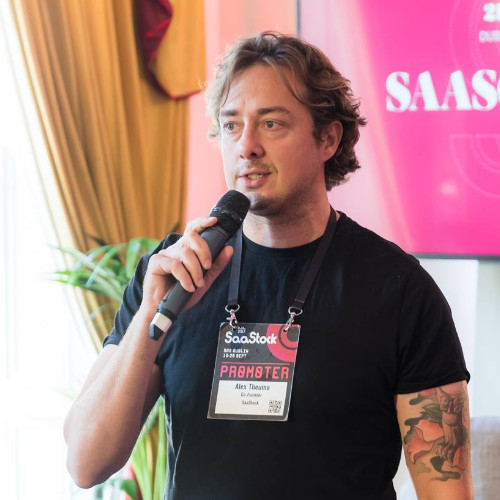
SaaStock is Europe’s largest conference focused on Software as a Service or SaaS.

It takes place in Dublin, Ireland.

But this year, SaaStock is launching its first Austin-based SaaS conference for a three-day event running May 31-June 2.

The conference, which is called SaaStock USA, features panel discussions and networking. It brings SaaS founders together with funders to help them access capital to scale rapidly.

SaaStock plans to make its SaaStock USA conference an annual event in Austin.

The conference first launched in Dublin in 2016, and its most recent event in 2022 saw over 5,000 attendees, many of whom were founders, executives, and investors focused on the SaaS startup industry.

SaaStock chose Austin because of its history as a startup hub and as a host to other technology conferences with a strong content, networking, and entertainment focus.

SaaStock expects over 800 attendees for its inaugural event and expects to provide Austin merchants a $1.2 million economic boost from spending on lodging, food, and entertainment over the three-day event. The event organizers expect to see that number exceed $10 million annually as plans to grow the event take root over the next five years.

“We’re excited to make Austin our home for future SaaStock USA conferences. We’ve long believed that Austin was the perfect city for the U.S. version of SaaStock. Austin is home to a healthy SaaS startup sector and the overall startup ecosystem is among the most active in the country. The city’s vibrant festival and music scene fits the experiential approach we take with our conferences, which places value on helping attendees create lasting connections through networking at entertainment-driven venues,” Alex Theuma, CEO and Founder of SaaStock said in a news release.

The SaaStock USA conference will feature over 50 speakers with proven experience as startup founders, executives, and trendsetters. Some of the notable speakers include Jason Cohen, Founder & Chief Innovation Officer of WP Engine; Mary D’Onofrio, a Partner at Bessemer Ventures; and Godard Abel, co-founder & CEO of G2.

Since its inception, SaaStock estimates that SaaStock Dublin has had a cumulative economic impact of over $500 million in the form of capital investment, M&A transactions, and new business deals over the past seven years.

“We have been attending SaaStock Dublin for 5+ years and have found it extremely productive. Nowhere can you meet so many SaaS startups in one spot in such a short period of time. While we’ve found several investment opportunities attending the events, we’ve also benefited from the networking opportunities and a chance to learn more about trends impacting the broader SaaS sector,” Kyle Poyar, Operating Partner, OpenView, said in a news statement. 

SaaStock USA will feature some of the following events and programs:

  • SaaS.City (May 31): a one-day accelerator for SaaS workshops led by SaaS experts addressing five critical startup functions, including CEO/Founder, Marketing, Sales, Operations Efficiency, and Fundraising/Investment; locations to be announced. 
  • Startup Program & Global Pitch Competition (May 31 – June 2): a launchpad for select SaaS startups to gain valuable feedback from SaaS investors and VCs.
  • NightStock (May 31 – June 2): evening networking and entertainment includes a Welcome Party, Rainer Street pub crawl, and Closing Party. 

For more information about SaaStock USA or to buy a ticket, visit the SaaStock USA website: https://www.saastock.com/saastock-usa/.

Discovering the Next Big Thing: 5 Highlights from SXSW 2023

By Laura Lorek, Publisher of Silicon Hills News

Last year, cryptocurrency, non-fungible tokens, blockchain technologies, and the metaverse dominated at South by Southwest.

This year, the buzz was all about conversational AI, particularly ChatGPT, which released GPT-4 during the conference. ChatGPT is a chatbot that uses conversational AI capable of understanding, processing, and responding to human language.

And one of its co-founders, OpenAI’s Co-Founder and President Greg Brockman, talked to Laurie Segall, founder of Dot Dot Dot Media, about the technology in a jam-packed keynote address.

  1. This is freakier than HAL in the 1968 film 2001: A Space Odyssey. (My alma mater – the University of Illinois, gave birth to the fictional HAL) Conversational AI is a sea-change technology that will shake up the economy as much as the introduction of the Internet did. Key takeaways from Brockman’s talk were that ChatGPT is a breakthrough technology, and Open AI, the company behind it, has made significant efforts to make it accessible and user-friendly. ChatGPT is an artificial intelligence chatbot launched in November of 2022. “ChatGPT reached its first 1 million user milestone in a week, surpassing Instagram to become the quickest application to do so,” according to a UBS report. “ChatGPT-3 uses a generative pre-trained transformer (GPT) to generate largely identical text to human conversation. GPT is part of the broader family of large language models, which are AI models that understand and can generate text.” On March 13th, OpenAi launched ChatGPT-4, which surpasses the previous version in its advanced reasoning capabilities. During his keynote, Brockman said, “this app really took off and people started using it, and we could see the gap between what people thought was possible and what actually had been possible for quite some time.” Brockman also expressed concerns about deploying the technology in a way that could be potentially harmful. He recalled a dinner meeting in 2015 attended by co-founders of OpenAI, including Elon Musk, to discuss the future of AI and whether they could positively impact the technology. They saw the potential for AGI, artificial general intelligence, and felt a sense of urgency to steer the technology in a positive direction. OpenAI started as a nonprofit research lab, hiring PhDs and open-sourcing code, but later realized they needed to scale and raise funds to make a more significant impact. The company aims to align its incentives with a good outcome for humanity and believes AI should be an endeavor of humankind, not just one company or individual. But even Brockman seemed a bit scared of the technology and the future. He’s not the only one concerned. On Wednesday, a group of technologists, including Elon Musk, penned a letter requesting a halt to all giant AI experiments.

OpenAI Co-founder Greg Brockman on ChatGPT, DALL·E and the Impact of Generative AI | SXSW 2023

The past year proved that AI is here to stay. We have seen AI disrupt every major industry, from search engines to art and music. The change will be felt in nearly every aspect of our daily lives.

2. We can unlock health insights and prevent disease from more knowledge about our genes. Personalized healthcare is based on patient genetics. I was surprised to hear Anne Wojcicki, Co-Founder and CEO of 23andMe, talk about the company’s healthcare focus. During the pandemic, 23andMe acquired Lemonade, which allows the company to provide medical expertise to customers and deliver care through a clinician group, physician consult, and pharmacy. Wojcicki noted that consumers often feel disempowered in healthcare, while physicians increasingly recognize the importance of genetics in patient care. She talked about the importance of pharmacogenomics, which can help match patients with the best medications based on their genetics. Wojcicki also noted that financial incentives could sometimes conflict with preventive care, underscoring the importance of consumers taking control of their healthcare. Along those lines, Wojcicki suggested patients should bring their 23andMe reports to their doctors to inform their care. Wojcicki also said conversational AI has the potential to predict and prevent health conditions. She discussed the possibility of risk prediction as a means of prevention. She said most of the AI currently used in healthcare is focused on disease optimization rather than prevention, but 23andMe is working on tests and research to predict behaviors that could help prevent disease.

CIA/NSA/National Geospatial-Intelligence Agency at the SXSW Creative Industries Expo

3. Welcome to the surveillance economy. For the first time (let me know if I’m wrong here, but I’ve never seen it before, and I’ve been going to SXSW for a couple of decades), the National Security Agency, Central Intelligence Agency, and the National Geospatial-Intelligence Agency all had booths along with the National Science Foundation in the corner of the Creative Industries Expo. Also, David Cohen, the deputy director of the CIA, and three other high-level members of the CIA participated in a panel discussion on “Spies Supercharged: Tech and the Future of the CIA.” “We recognize that technology is advancing very, very quickly, the pace of technological change is greater today than it’s ever been, and technology itself is a domain in which we need to compete with our adversaries,” Cohen said. “it’s not just that we need to use technology to do our business we need to understand how our adversaries are using new and disruptive technologies against us, how they are weaponizing technology.” The CIA was at SXSW to “find partners who want to work with us to find people who want to come and work for us,” Cohen said. The CIA focuses on wireless technology like 5G and 6G, quantum computing, artificial intelligence, biotechnology and bioengineering, financial technology, and advanced power like the next lithium-ion battery. I also learned that the CIA puts spy gear into mascara tubes, and now I’ll never look at my makeup the same way again. At the same conference, Chelsea Manning, a former intelligence analyst who leaked classified documents to WikiLeaks and went to prison for violating the espionage act, spoke on the need for more privacy and data protection. She said it’s not just governments monitoring communications; corporations increasingly use sophisticated surveillance and tracking technology to learn as much about their consumers as possible.

Cruise’s Origin AV

4. This is definitely not your father’s Buick or even my old Pontiac Firebird, for that matter. Autonomous vehicles are on the streets today, and more are set to come along with more electric vehicles. Cruise is an autonomous vehicle company of which General Motors owns 80 percent. Kyle Vogt, Cruise CEO, and Mary Barra, GM’s Chair and CEO, spoke with Emily Chang, a Bloomberg reporter, at SXSW in a featured session titled “Self-Driving Cars: From Science Fiction to Scale.” Vogt discussed how Cruise operates a “robotaxi” service in San Francisco and is scaling up its testing operations in Austin and Phoenix. The technology has moved from a science-fiction problem to an execution and scaling problem, Vogt said. Barra believes that AVs are the future of transportation and that they are an essential part of General Motors’ future. Vogt noted that AVs provide increased safety, mobility for those who cannot drive, and the potential for faster and more efficient movement of goods. There are distinct differences between self-driving and driverless cars, and confusion arises when companies market their products as self-driving when they are not fully autonomous, Vogt said. The goal is to have vehicles that work for the driver rather than the driver working for the car, Vogt said. Tesla’s marketing of its “full self-driving” feature confuses consumers, Vogt said. Vogt noted that Cruise had built its cars for dense urban areas, forcing them to solve problems such as construction zones, traffic light outages, and road blockages. He said the company had solved most of the technical and scientific risks. The need now is for robust infrastructure and software systems to operate large fleets of electric vehicles and balance supply and demand across the network, Vogt said. Cruise can expand into more towns and cities as more vehicles are manufactured, including the new “origin” vehicle. Vogt noted that its transformational design breaks away from the traditional car shape built around the driver. He also expressed concern about the U.S.’s approach to AV development and regulations compared to China, which is building infrastructure and incentivizing development. He suggests that the U.S. could be at risk of seeding leadership in AV automotive manufacturing. Overall, the automotive industry is transforming, with GM planning to have all of its light-duty vehicles electric by 2035, Barra said.

5. If the HAL and AI reference didn’t freak you out enough, then you need to know about brain implants. Brain-Computer Interfaces are being used with paralyzed patients today to restore some motor functions and regain independence. In a panel titled “Hello World: Brain-Computer Interfaces at Scale,” Tom Oxley, CEO of Synchron is focused on implantable BCI devices, which he called a neuro-prosthesis. Max Hodak, CEO of Science, who previously worked at Neuralink, also focuses on brain interface development and restoring vision. Synchron offers a different approach, which involves using technology that delivers electrode senses of stimulation into the brain using the blood vessels rather than requiring the removal of the skull to implant electrodes directly into the brain. Technological advancements that have made BCI possible include the miniaturization of electronics and wireless communications. But challenges still need to be addressed, such as ensuring lower power usage and immune barriers. The panelists also talked about the potential role of AI in BCI technology, with many current user interfaces being mediated by AI.  AI will likely play a role in the suite of tools enabling people to use BCI devices. In closing comments, Oxley with Synchron said he expects to have widespread commercial adoption of its BCI technology in the next three to five years. It is currently conducting clinical trials in the U.S. and enrolling patients.

GovExec and VMware Partner to Host In Focus: Public Sector Event in Austin on Importance of Secure Cloud Technology for Business Future

Sponsored Post:

GovExec, the market-leading sales and marketing intelligence company for government leaders and contractors, announced Friday their upcoming Austin event in partnership with VMware (NYSE: VMW), the leading multi-cloud services provider for all apps, enabling digital innovation with enterprise control.

As companies continue to scale, support a hybrid workforce, and need secure flexibility for their operations, cloud technologies become more central to the future of business. At In Focus: Public Sector attendees will hear from government and industry leaders who will explore their current conditions and the importance of secure cloud technology to serve their current and future needs.

EVENT DETAILS

What: VMware Explore In Focus: Public Sector

When: April 5, 2023, from 9 am – 1:30 pm CT

Where: The Bullock Museum, 1800 Congress Ave., Austin, TX 78701

Speakers include:

  • Amanda Blevins, Vice President and Chief Technology Officer for the Americas, VMware
  • Dr. Brian Gardner, Chief Information Security Officer, City of Dallas
  • Nassos Galiopoulos, Chief Technology Officer and Deputy Chief Information Officer, University of Texas at San Antonio
  • Mark Silis, Chief Technology Officer, Massachusetts Institute of Technology
  • Abdul Subhanis, Civilian Aide to the Secretary of the Army

“We’re really excited to bring together such a strong group of public sector IT leaders — especially in one of the top American tech hubs,” said George Jackson, Vice President of Events at GovExec. This event will be fun, informative, and fast-paced. It’s a must-attend for anyone interested in cloud systems.”

To learn more about or register for the event, please click here.

About GovExec:

GovExec’s data and insights set the standard for depth, accuracy, and impact for government leaders and contractors. GovExec provides data-driven strategic sales and marketing intelligence solutions that accelerate revenue growth to fuel market success. The platform is powered by the largest and most sophisticated database in the public sector, reaching over 3.3 million government influencers each month.

Ethernet Inventor Bob Metcalfe Named 2022 Recipient of ACM A.M. Turing Award

The Association of Computing Machinery (ACM) has awarded the 2022 ACM A.M. Turing Award to Bob Metcalfe, recognizing his contributions to Ethernet’s invention, standardization, and commercialization.

This award, often called the “Nobel Prize of Computing,” is named after Alan M. Turing, the British mathematician who laid the foundations of computing. It carries a $1 million prize with financial support from Google.

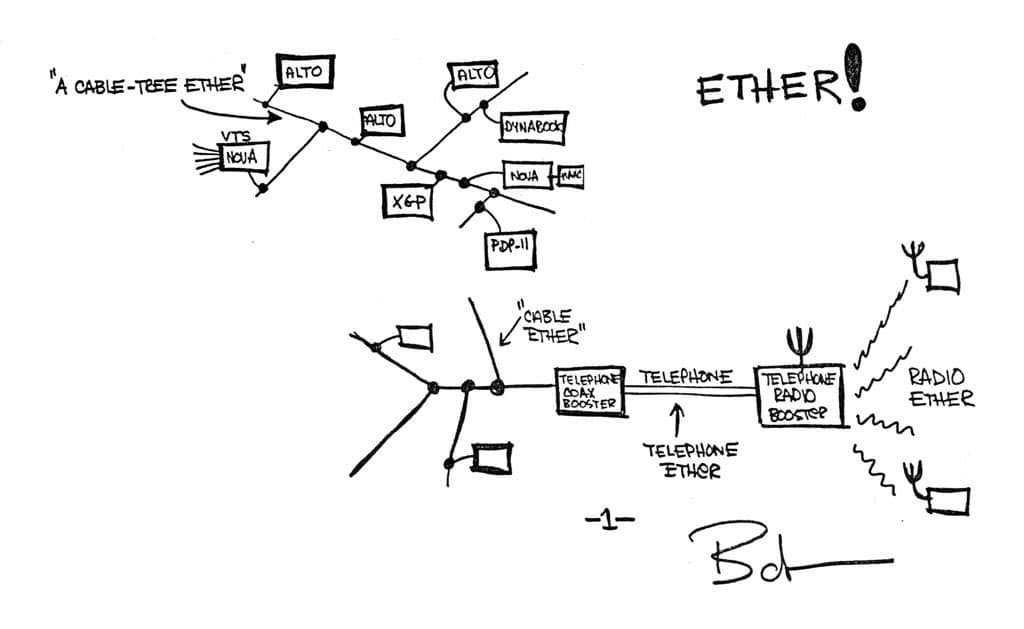
Metcalfe, an Emeritus Professor of Electrical and Computer Engineering at the University of Texas at Austin and a research affiliate in computational engineering at the Massachusetts Institute of Technology Computer Science & Artificial Intelligence Laboratory, invented Ethernet in 1973 while working as a computer scientist at the Palo Alto Research Center. He drew on ideas from ARPAnet, particularly packet switching, and an idea from the University of Hawaii: Aloha Network, a method for sharing a communication channel.

With the help of David Boggs, a co-inventor of Ethernet, Metcalfe built a 100-node PARC Ethernet, which was replicated within Xerox to create a corporate internet. Metcalfe left Xerox and founded 3Com in 1979, raising venture capital in 1981. The company shipped its first big product, Ethernet for the IBM personal computer, in 1982 and went public in 1984.

Today, Ethernet is the main conduit of wired network communications worldwide, with data rates ranging from 10 Mbps to 400 Gbps, and emerging technologies with 800 Gbps and 1.6 Tbps. Ethernet has become an enormous market, with revenue from Ethernet switches alone exceeding $30 billion in 2021, according to the International Data Corporation.

Metcalfe’s original design ideas have enabled the bandwidth of Ethernet to grow dramatically, making it possible for every computer to be networked. Ethernet remains the staple data communication mode, particularly when prioritizing security and reliability.

Bob Metcalfe’s 1973 sketch of his original “Ethernet” vision. Photo courtesy of Bob Metcalfe and the Palo Alto Research Center Inc., a Xerox Company. 

Metcalfe has received numerous honors for his work, including the National Medal of Technology, IEEE Medal of Honor, Marconi Prize, Japan Computer & Communications Prize, ACM Grace Murray Hopper Award, and IEEE Alexander Graham Bell Medal. He is also a Fellow of the US National Academy of Engineering, the American Academy of Arts and Sciences, and the National Inventors, Consumer Electronics, and Internet Hall of Fame.

The ACM President, Yannis Ioannidis, said, “Ethernet has been the dominant way of connecting computers to other devices, to each other, and to the Internet. It is rare to see a technology scale from its origins to today’s multigigabit-per-second capacity. Even with the advent of WiFi, Ethernet remains the staple mode of data communication, especially when security and reliability are prioritized. It is especially fitting to recognize such an impactful invention during its 50th anniversary year.”

Jeff Dean, Google Senior Fellow and SVP of Google Research and AI added, “Ethernet is the foundational technology of the Internet, which supports over 5 billion users and enables much of modern life. Today, with an estimated 7 billion ports around the globe, Ethernet is so ubiquitous that we take it for granted. It’s easy to forget that our interconnected world would not be the same without Bob Metcalfe’s invention and his enduring vision that every computer must be networked.”

Metcalfe will receive the ACM A.M. Turing Award at the annual ACM Awards Banquet, which will be held on June 10 at the Palace Hotel in San Francisco.

Manchester and Austin Forge Connections Through Music and Innovation at SXSW 2023

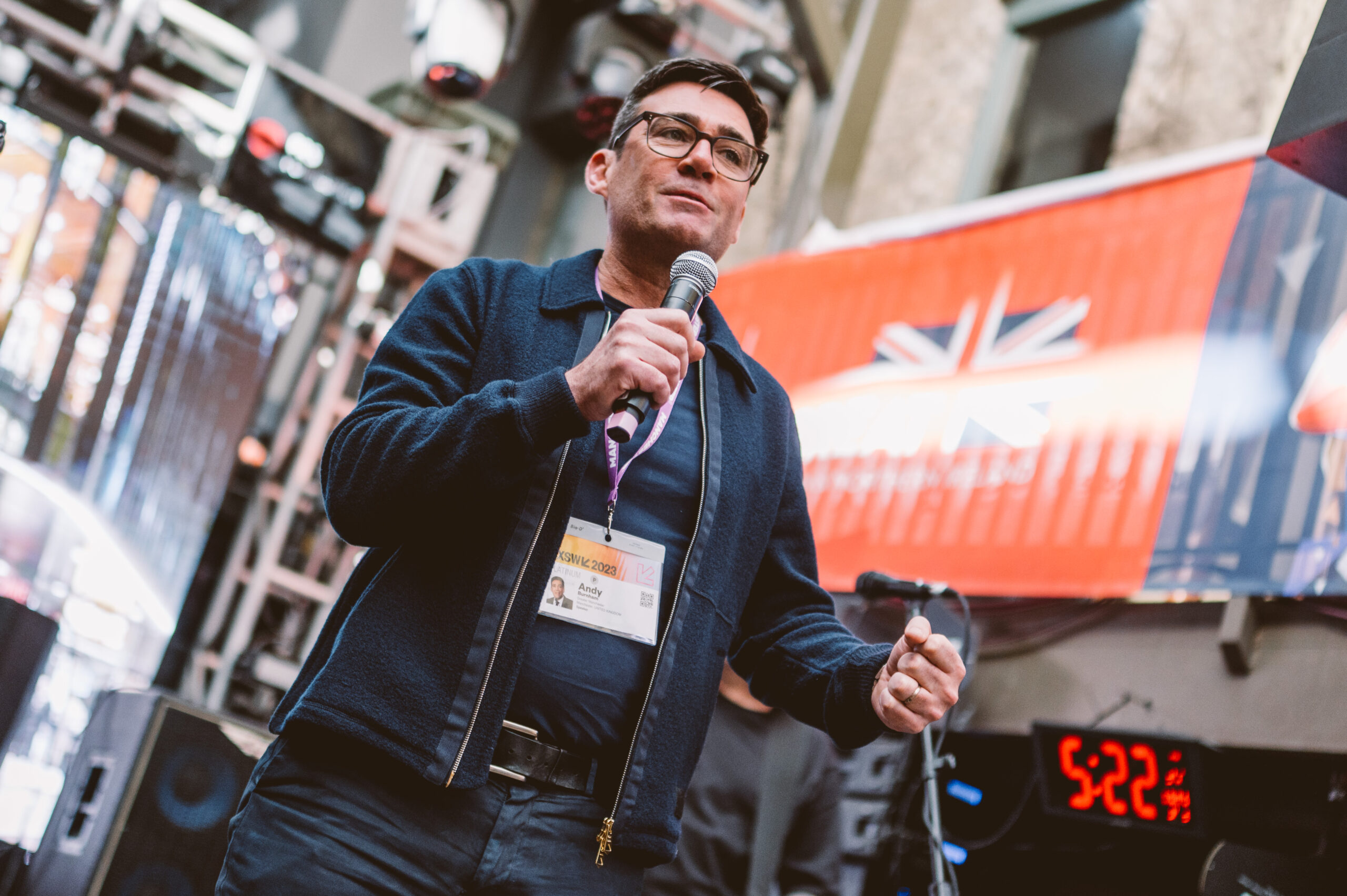
Photo by Thomas Jackson / TyneSight Photographic

By Laura Kobylecky, Special Contribution to Silicon Hills News

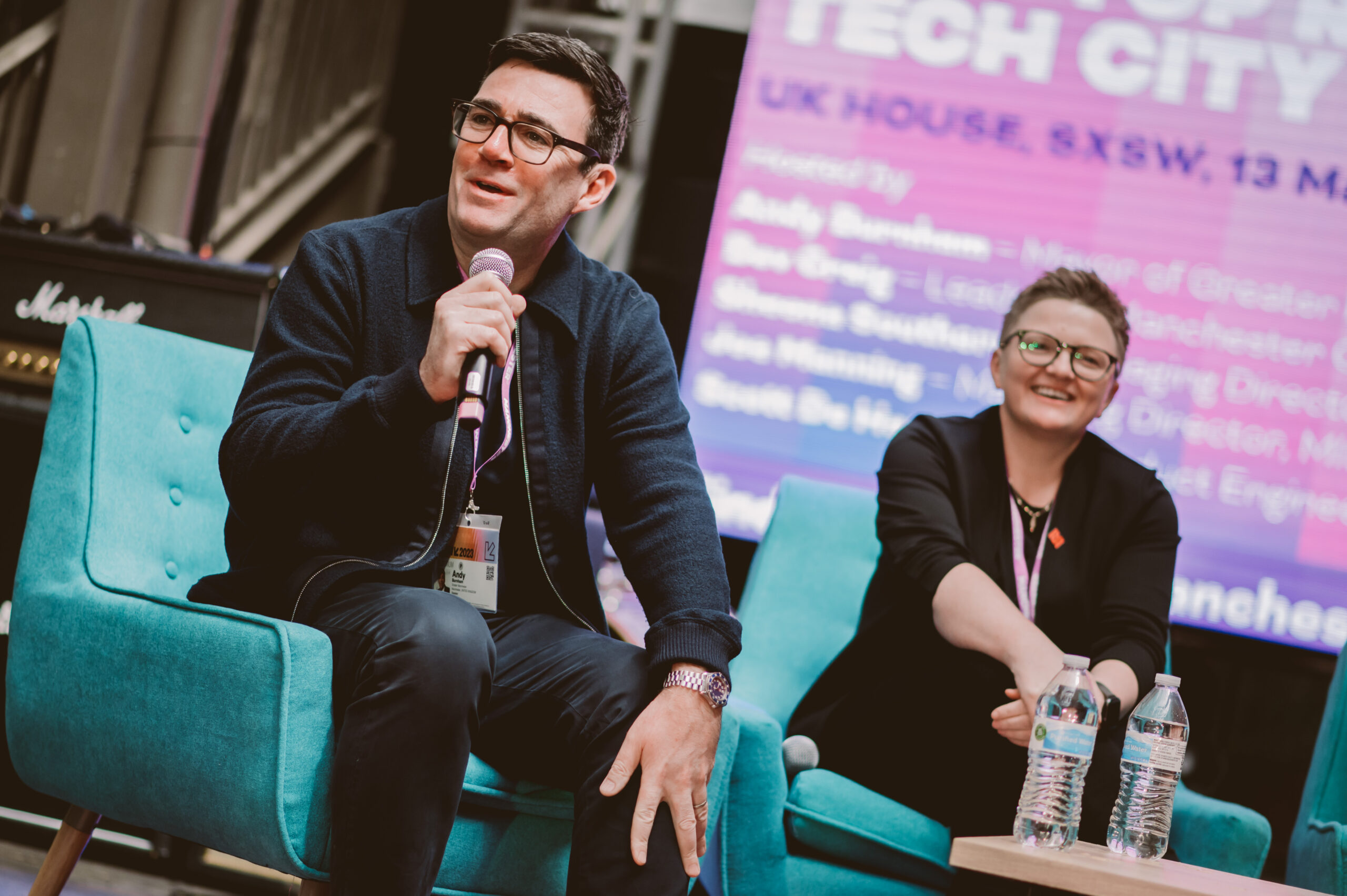
During SXSW 2023, The Courtyard on 4th Street was transformed into an official SXSW venue that hosted various events focusing on British innovation, culture, and music. One of these events brought Andy Burnham, Mayor of Greater Manchester, to the stage to talk about what’s happening in Manchester.

Burnham made connections between the growth and innovation patterns in Manchester and Austin.  I also spoke with a citizen of Manchester to get their perspective and watched a performance from a Manchester band at an SXSW show.

I sat down with Burnham, Mayor of Greater Manchester, to talk further about this connection.  Burnham explained, “The cities are so similar, to be honest.” After “coming to Austin for the first time in 2018 to go to South By,” he was “immediately struck by the similarities: a fast-growing city, a young city, a music city.”

He was also impressed by Austin FC, a football club that was founded in 2018, saying that “he loved it.” He described Manchester as “an old football city” and said, “There’s not much about English football that I don’t know.” This adds a particular layer of depth to his emphatic statement, ” They’ve built something new, something exciting… it’s got all the right kind of values built into it.” He believes that the “new fan culture” being built in Austin is something that “England will start to look to.”

He connects Manchester’s “passion” for football and live music culture with the culture of Manchester, stating that it’s “Something about the working class roots of Manchester. Working people have hard lives, and they needed something on the weekend.”

He explains, “Manchester is like Austin; we have an ecosystem of smaller venues.” Like Austin, these venues receive support from “lots of people who go and watch the new bands that are open-minded about music.” According to Burnham, “you go out any night of the week in Manchester, and you’ll find a few hundred people watching a new band.”

Burnham talks about the historical connections between Manchester, Austin, and SXSW. He said that “South By’s founders were regularly in Manchester in that period in the 90s and the early 2000s” and believes they were inspired by Manchester’s conference called “In the City,” which he describes as “similar” to SXSW.  Burnham describes this as something of a crossover and “not just by chance” but rather a sort of “cross-fertilization.”

Manchester is also concerned about some of the same issues as Austin. Affordability threatens the scene’s survival in both Austin and Manchester. Burnham believes that Manchester has “got a worry actually” because it remains “a working-class city,” but some of the working class may not be part of the music scene.

He states, “These days if you want to make it in the music industry, you’ve got to have money or be from a family that has money because it’s getting much harder to break through.” He thinks this is something that “should worry us all… because sometimes it’s those young people who come from those circumstances who become sort of the biggest personality, the character, and if that’s lost, then music is much the poorer for it.”

He also discusses “the risk” of Manchester perceiving “to trade on past glories: The Smiths, The Stone Roses, Happy Mondays, Oasis, New Order, Joy Division.” This can lead to situations where Burnham believes “we’ve kind of looked back too much, and we need to look forward more.”

Burnham’s more personal contribution to this is “a new initiative called Mayors Artist of the Month.” At “the last week of every month,” he has an open application, and from this, he chooses the “’ artist of the month,’ and they get airtime on the radio.” He says, “I promise you, I go out running, and then I listen to them all.”

Another similarity between Austin and Manchester is that Manchester will launch its own “new global music conference,” according to Burnham. He describes it as “not meant to be a rival to South By,” but he does draw comparisons between the two. This conference, he claims, “is about a forum for debate and for resolution of some of these issues in the industry.” He sees it as something that “counterbalances South by in many ways,” including the timing. Beyond the Music will take place in October.

On Saturday, March 18th, I returned to The Courtyard for the British Music Embassy. I spoke to Rob Brown, managing partner at a PR agency in Manchester’s MediaCityUK , to see how a non-government official feels about the Manchester/Austin connection. Brown has spent time in both Austin and Manchester and sees a kinship between the cities, saying that “they’re both boom cities.”

He explains, “you can see in the skyline of both cities they’ve changed immeasurably over the last ten years.” Brown says that skyscrapers may be typical in the US, “it’s quite unusual in the UK; it’s only really London and Manchester that have tall buildings.”

He also sees a cultural connection between the cities: “they’re both very vibrant music capitals.” Even though “Austin has more live venues than Manchester,” Brown still believes “you can see a great band every night of the week in Manchester.”

Brown is excited to be here at SXSW. He’s a passionate music fan, so enthusiastic that he’s already twice seen “The Golden Dregs,” a UK rock band.  This is his 10th SXSW, and he’s already planning to come back again next year.

On Friday, March 17th, I saw Ist Ist, a Manchester-based band, play at The Velveeta Room, an official SXSW venue. They played a show full of post-punk energy with tones that ranged from heavy rock to mellow emotionality. The lead singer, Adam Houghton, informed the audience that this band is from Manchester.

Manchester culture has made a connection with Austin at SXSW.

Photo by Thomas Jackson / TyneSight Photographic.

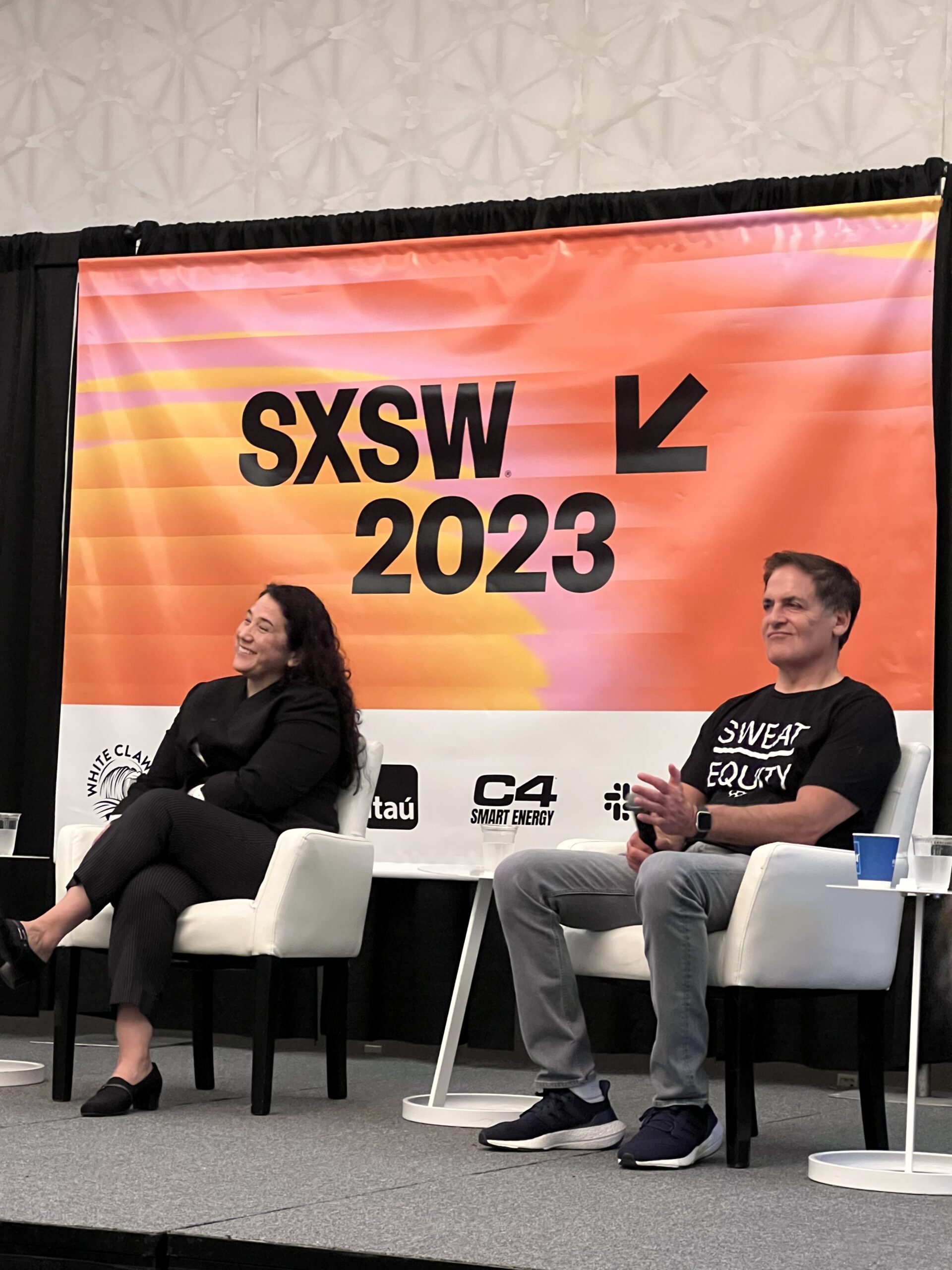
Billionaire Mark Cuban and SBA Administrator Isabella Casillas Guzman Speak on Entrepreneurship at SXSW Event Hosted by ZenBusiness

At South by Southwest, ZenBusiness hosted a talk on entrepreneurship with Billionaire Mark Cuban and U.S. Small Business Administrator Isabella Casillas Guzman, the highest-ranking Latina in a government office.

Austin-based ZenBusiness, a tech platform that makes it easy for anybody to start and run their own business, has helped form about 500,000 small businesses since its founding in 2015, said Michael Fanuele, ZenBusiness senior vice president, who moderated the discussion.

“Our purpose is unleashing the entrepreneur in everybody,” he said.

To start off, Fanuele asked SBA Administrator Guzman and Cuban about their first entrepreneurship experiences.

Guzman recounted how she grew up as the daughter of a small business owner.

“My dad bought his first veterinary hospital when I was one year old in East Los Angeles and grew it to chain of five veterinary hospitals,” Guzman said.

She spent time in his office and saw firsthand her dad’s passion for serving his customers.

“He worked harder than anybody I knew,” Guzman said.

Her dad also did community vaccination clinics and provided free services to his clients in need, Guzman said. Her dad ingrained in her “this grit and determination to really fulfill whatever it is that I was working on with such passion,” she said.

Guzman turned being seen as an underdog and being underestimated into an advantage. Her mother fought for her to be in gifted and talented programs at school. Her mother fought for her to have a seat at the table.

“It gave me a voice, confidence, and drive to feel that I can expect more,” Guzman said.

In middle school, Cuban was always the kid selling something. In college, he had side hustles, and after that, he joined Mellon Bank in Pittsburgh.

“I got in trouble because I saw an article in a magazine, and I clipped it and sent it to the CEO of the bank, and my boss and his boss and his boss did not like that, so you know, so I was the person that was always stepping out, so I knew at some point that I was going to have to work for myself it was just a question of when I would get there,” Cuban said.

Fanuele asked about the bar Cuban owned and ran at Indiana University.

Cuban ran parties at the Motley’s Pub, the hot bar on campus. When it got shut down, he bought it.

“We opened before I was even 21, but one day, they busted us too, and it was the best thing that ever happened to me because otherwise, I’d still be, not that there’s anything wrong, but I’d be running a bar in Bloomington, Indiana,” Cuban said.

After working at Mellon Bank, Cuban moved to Dallas and founded MicroSolutions, which he eventually sold to CompuServe for $6 million. He also co-founded AudioNet, an online streaming service, and sold it to Yahoo for $5.7 billion in stock. Cuban then bought the Dallas Mavericks National Basketball Association team. And since 2011, Cuban has been a “Shark” on ABC’s Shark Tank. And most recently, Cuban launched Cost Plus Drugs, an online pharmacy providing low-cost drugs.

Fanuele asked Cuban and Guzman to name some characteristics that define entrepreneurs.

“For so many entrepreneurs who are starting businesses today, it’s women and people of color. It’s this drive to try to achieve their version of an American dream of business ownership,” Guzman said. “That drive to create prosperity, to build wealth, to try to enter into spaces that they’ve not been able to before, I think that’s a unique thing about what the face of entrepreneurship looks like today.”

Other traits are grit, determination, flexibility, agility, ability to change, resilience, and vision, Guzman said.

Everyone can be an entrepreneur, Cuban said. “We’re all problem solvers.” The hard part is finding what you are innately good at, Cuban said.

 “Once you find something you could be good at, then it’s just a question of fear,” Cuban said.

Entrepreneurs have to cross that line and commit themselves to do it. But it takes a lot to act on it, Cuban said. Daymond John, CEO of FUBU and another Shark investor on Shark Tank, calls it the power of broke, Cuban said.

“One of the defining elements of an entrepreneur is you can’t be afraid to be broke because you will go broke at some point,” Cuban said.

Cuban recounted living with six guys in a 3-bedroom apartment and sleeping on the floor in his early days.

“You know it was nasty, I had my one towel I stole from motel 6,” Cuban said. “It was really disgusting, but it was the best thing ever because you know the power of broke; you got nothing to lose, and you go for it.”

And when your buddies are stepping over you to go to their job, and you’re starting this company, you realize that there’s only one direction to go, and that’s up, and that’s the power of being an entrepreneur, Cuban said.

“And we all have it, but taking that first step and finding the things we’re good at are the challenges,” Cuban said.

And the fear is warranted because half of all businesses fail in the first five years.

The SBA can provide tools and resources so that that fear can be reduced, Guzman said. She said that the SBA has more than 1,600 resource partners nationwide that focus on financial and capital readiness.

And beyond SBA loans, the federal government awards more than $4 billion yearly for research grants through SBIR.gov, Guzman said.

“Our growth model is to get you funded and also connect you to the largest buyer in the world, which is the federal marketplace,” Guzman said. It’s a $500 billion marketplace, and at least 1/4 of that is spent with small businesses and innovative startups, she said.  

The government grants are non-dilutive cash which means you don’t have to pay it back, Cuban said.

“When you’re starting a business, sweat equity is the best equity,” Cuban said.

« Older posts Newer posts »

© 2026 SiliconHills

Theme by Anders Noren — Up ↑