Author: LauraLorek@gmail.com (Page 20 of 354)

LauraLorek@gmail.com

Quantum Computing Startup Strangeworks Completes $24 Million Funding Round, Led by Hitachi Ventures and Backed by IBM and Raytheon Technologies

Quantum computing startup, Strangeworks has announced the completion of a $24 million round of funding.

The Austin-based company previously raised a $4 million seed stage round, bringing the total funds raised to $28 million.

Strangeworks, founded in 2018, reported Hitachi Ventures led the funding round with investment from IBM, and Raytheon Technologies. It also had follow-on investments from seed-stage investors Lightspeed Venture Partners, Great Point Ventures, and Ecliptic Capital.

Strangeworks, which has 21 employees, said in a news release that the investment allows Strangewowrks to offer a broader range of technologies beyond quantum computing, including quantum-inspired, high-performance computing, and artificial intelligence.

“Today’s announcement represents a significant milestone for Strangeworks,” Will Hurley, known as Whurley, the company’s founder and CEO, said in a news release. “Five years ago, I took the stage at SXSW for our first quantum computing keynote. Since that day, this team has stayed focused on our core mission, continuously beating industry expectations while utilizing only a fraction of the resources compared to the industry. Raising the Series A from these exceptional investors in this challenging economic climate sends a clear message to the market on where enterprise companies are placing their bets in a race to create quantum value.”

The funding comes after Whurley’s keynote speech at the 2023 SXSW conference using all AI-generated text and images.

Hitachi identified quantum computing as a critical technology to advance society and developed its own quantum technologies and quantum-inspired solutions, Norihiro Suzuki, Ph.D. and CTO of Hitachi, said in a news release.

“Quantum computing has the potential to help solve some of the world’s most pressing problems, from fighting climate change to curing fatal diseases that require far greater computational power than is currently available in classical computers,” Suzuki said. “The Strangeworks platform removes barriers to access quantum and quantum-inspired solutions creating customer value today.”

Raytheon’s investment in Strangeworks aligns with its customers’ interests, Dan Ateya, president and managing director at RTX Ventures, the corporate venture capital arm of Raytheon Technologies.

“We believe Strangeworks’ platform and their ability to make quantum and high-performance computing more accessible can support a wide range of applications in the aerospace, defense, and commercial sectors.”

‘Quantum computing is here, but exploiting its advantages requires rare know-how and lots of capital,”  Ray Lane, managing partner of GreatPoint Ventures, based in San Francisco, said in a statement. “Strangeworks democratizes quantum computing by opening proprietary platforms to consumption-based usage, and this is how large tech markets are unleashed.”

PentoPix Wins Best in Show and Entertainment Category at SXSW Pitch Awards 2023 for AI-assisted 3D Animation Platform

By Laura Kobylecky, Special Contribution to Silicon Hills News

PentoPix won the 2023 SXSW Pitch Awards in the “Entertainment, Media & Content” category. PentoPix also won the “Best In Show” award at this competition.  PentoPix uses AI-assisted technology to transform text into 3D animations.

SXSW Pitch showcased innovators and tech industry pioneers, from “indie tech companies to trailblazing startups” (1). The event featured 40 interactive tech companies in 8 different categories. The startups pitched in front of a panel of judges.  

I sat down with Volha Paulovich, Co-Founder & COO of PentoPix, to talk about her experience at the Pitch Awards. When asked for the shortest summary of her company, a demonstration of her freshly-honed pitching skills, she stated, “PentoPix is an AI-assisted platform that brings creativity and efficiency together by converting scripts into 3D animated videos for storyboarding and pre-production.”

She was very excited about winning the Best in Show Award at SXSW Pitch and said, “It’s surreal; I haven’t processed it. It’s the best outcome we could have expected. And in startups, you never expect the best outcome to happen.”

Paulovich found the SXSW Pitch awards to be a unique experience. She explained, “I pitch almost every day …I didn’t really think about it much, and then coaching started, and we shook things up completely, and it was great because it kind of never happens, and I’m really glad that we did.”

The process of SXSW Pitch involved some hands-on training. Paulovich described the process “Every startup gets a coach we get to meet a few times.” There are a required number of meetings “we have a minimum bar of, I think, two times, but you can do more… I did more, for sure…probably four. The experience also included a coach who “can guide you through the process of what it’s like on the day or how to structure your pitch better, leave comments about slides, how to prepare for Q & A.

Paulovich compared the experience to that of an athlete and spoke highly of her coach, referring to them as “absolutely amazing” and the overall experience as “something new and different.”

The SXSW Pitch experience was unique in the startup world, according to Paulovich “And it’s a level of support that you rarely get in startups, especially when it comes to the pitch.”  The pitch experience normally means pitching “to an audience of investors or potential users.” For these early-stage startups, “it’s kind of their job to find why your startup won’t work,” meaning that “you don’t really get to hear the honest feedback because everyone is so critical.” The SXSW experience means having a coach with “a completely fresh eye on you,” and Paulovich described this added value as “amazing.”

When asked more about what she learned from the SXSW Pitch experience, Paulovich described how she and her team “started tailoring things towards people we are meeting, and it just gave us this understanding.”  She reflected, “Always there are people who are not a match, and it’s okay. We are not a gold coin so everyone loves you.”

She emphasized the value of targeting a pitch, stating that “there are funds that invest in specific categories, everyone has investment criteria, and it’s okay when you don’t match. It’s not the end of the world; we’ve got to keep pushing, and that’s great to understand.” This wisdom came from “the exposure to so many different walks of life and so many different startups, to so many different investors.”

Winning this award had a meaningful effect on Paulovich and her company. She says, “Now, since we won, we think bigger, like, a much bigger scale.” The SXSW Pitch award is, according to Paulovich, “the top of the top.” This award inspired her team with a vision that “we are onto something, we are doing great things, not that I didn’t believe it before, but now we have this external validation.”

The external validation led to some more immediate changes. Paulovich explains, “to be honest, I was going to take a holiday after South By, and now, I don’t feel like doing that anymore.” The encouragement from this experience inspired the feeling that “It’s time to push and get out there and continue all the conversations we started, connect to all the people we met, and do more.”

The motivation here came from more than just winning the award. Paulovich found being in Austin for SXSW to be uplifting in many ways, saying that “in general, just being here in Austin, it gives that level of motivation and inspiration.” It makes people believe that “we can do it. We will achieve all these great things and milestones in the future,” and this “kind of fights all the mental health issues and all the negativity that may be involved in building a startup.”

The SXSW experience seems to have inspired Volha Paulovich, Co-Founder and COO of PentoPix and winner of the Best in Show Award at SXSW Pitch, and perhaps this inspiration will be shared by others.

Strangeworks CEO Whurley Wows the SXSW Audience with an AI-Generated Presentation on QuantumAI’s Potential to Shape the Future

Five years ago, Will Hurley launched his quantum computing company, Strangeworks, on the main stage at South by Southwest.

On Wednesday morning, he returned to SXSW to present the power of quantum computing and artificial intelligence to solve the world’s biggest problems and change how everyone works and lives.

“I think there’s a lot of dystopian fears out there; I think we should be talking about the utopian stuff,” Hurley, known as Whurley, said.

He spoke on “QuantumAI: Why your future depends on the convergence of Quantum Computing & Artificial Intelligence” to a packed ballroom of about 600 people. Other people were turned away at the door when the room filled to capacity.

During his presentation, Whurley spoke from a teleprompter with his speech on a handheld iPad.

He spoke on “how quantum computing and artificial intelligence are two of the most rapidly advancing, controversial, and debated fields in technology today.” Austin-based Strangeworks develops quantum computing software and has 21 employees. The company has raised $4 million in seed-stage funding.

“The convergence of these two technologies will play a significant role in shaping the future of our species and the world as we know it,” according to Whurley.

Throughout his presentation, he hinted that he was doing something different. And at the end, he revealed that everything he said was created with ChatGPT 4, the conversational artificial intelligent agent created by OpenAI. He said he came up with the idea when he submitted the teaser for the talk on the SXSW programming site. Then he used ChatGPT to come up with a presentation outline. And a day ago, he created the entire presentation with ChatGPT and AI-generated images. He re-did the presentation when the latest version of the software was introduced yesterday.

All of the images on the slides were created with AI. And a magazine, “Schrody Cat,” handed out to attendees, was created in 3 hours. “Everything written, seen or printed in this book has been co-created with AI,” according to a statement on the publication.

At the beginning of his presentation, he hinted that he was doing something different and encouraged the audience to take pictures because he would tell them about them at the end of the presentation.

He started by explaining quantum computing, a technology that uses quantum mechanics to solve problems too complex for classical computers.

Quantum computing massively speeds up computer power and can lead to improvements in drug discovery by a lot, Whurley said. He said it could also lead to more efficient batteries and fix environmental problems.

Quantum computing has many applications in cryptography, weather forecasting, and optimization of train schedules and supply chains.  

Quantum-AI technology can also have a profound social impact.

“We are building technologies that could get out of our control,” Whurley said.

The fear is of creating a machine like the T-1000, a shapeshifting android Terminator assassin featured in the movie “Terminator 2: Judgment Day.”

The fear is the robots will kill us or make people their pets, he said. The technology could also lead to income inequality and economic upheaval, Whurley said.

But it can also lead to social and economic progress, Whurley said. Monitoring banking systems in real time can lead to greater accountability in financial systems. It can also lead to improved technologies for sustainable energy. It can lead to higher productivity with autonomous robots and drones for agriculture and manufacturing, and as Whurley predicted, 100 percent unemployment by 2060.

At the end of his presentation, Whurley also said that he stopped blogging on March 13th, 2018, and that his website is now filled with hundreds of articles that were AI-generated while he was on stage.

At Whurley’s book signing following his presentation, Hugh Forrest, Co-president of SXSW and Chief of Programming, was nearby. When asked about what he thought of Whurley’s presentation done exclusively with AI-generated content and images, he said he didn’t see it. But he had heard it was a successful event. But he doesn’t think technology will replace human creativity anytime soon.

“I think Whurley’s middle name is interesting and eccentric, it’s part of his brand, and it has served him well,” Forrest said.

In 2030 when SXSW meets, everyone will understand better how to implement AI robots as virtual assistants, Forrest said.

So much of SXSW is built on creativity, human creativity, and imagination, that’s what makes SXSW, and that’s not going away, he said.

“We will have more assistance from more machines, more software, more hardware in the future,” Forrest said.

Colossal Aims to Revive Woolly Mammoths by 2028, Says CEO Ben Lamm at SXSW Conference

Colossal is on track to produce a woolly mammoth by 2028, said Ben Lamm, the company’s CEO, and Co-founder.

“I think we’re on the path for that,” Lamm said during a discussion on Colossal’s De-Extinction Mission at South by Southwest Tuesday afternoon. TechCrunch’s Managing Editor Darrell Etherington interviewed Lamm in Salon H of the Hilton Austin Downtown.

Colossal Co-Founder George Church is a Harvard geneticist who is spearheading the team of 40 scientists and researchers to bring the woolly mammoth back to life.

Lamm said the gestation period for a woolly mammoth is 22 months and can’t be sped up. The company is using Asian elephants to carry the baby mammoth to term. It also has built some artificial wombs to grow woolly mammoths in the lab. Some of the other projects Colossal’s working on, like the Tasmanian Tiger, or Thylacine, or the Dodo bird, might be brought to life sooner than the woolly mammoth because they have shorter gestation periods, Lamm said. Thylacine has a gestation period of less than a month.

Colossal, founded in September of 2021, is one of Texas’ unicorn companies and a moonshot company tackling big projects like bringing the woolly mammoth back from extinction along with the Tasmanian tiger and the Dodo, a bird species extinct since 1662. The synthetic biology company has raised $225 million and spun out Form Bio, a software platform, which raised a $30 million Series A round.

Colossal has 90 employees and 40 external collaborators and labs in Austin, Dallas, Boston, and Melbourne, Australia.

“Our goal is every animal we work on we want to reintroduce back into their natural habitat,” Lamm said.

Colossal has been working with Alaska natives and conservationists about introducing the woolly mammoth back to Alaska. It is also in talks with people in Canada, Lamm said.

There are 54 mammoth genomes, and Colossal is working with the University of Alaska to re-introduce Alaskan mammoths, Lamm said. Colossal has agreed to provide 200 mammoths, he said.

Ben Lamm, Colossal CEO and Co-Founder

“That re-wilding process has to be very thoughtfully done,” Lamm said. “We are looking for people to be collaborators in it.”

Colossal is being transparent and is focused on educating the public, which is essential when doing something this big, Lamm said.

Colossal’s goal is to bring keystone species back to the environment they were removed from, Lamm said.

Reintroducing the extinct species will benefit the whole ecosystem, Lamm said. He mentioned the successful reintroduction of Grey wolves into Yellowstone National Park. The wolves had been absent from the parkland for decades when the park brought them back in 1995. Lamm said it had been one of the most successful reintroductions of a species to an environment.

Linchpin for the ecosystem

Colossal focuses on linchpin species that are essential for the ecosystem, with the animals going mainly extinct because mankind has a history of murdering them, Lamm said.

Lamm said that Colossal has looked at other species, like the Steller sea cow, which has been extinct since 1768 and would benefit kelp forests by bringing it back. But there’s nothing “we can gestate it in,” he said.

“There are certain species we can’t go after,” he said.

Beth Shapiro, Ph.D., Colossal Scientific Advisory Board member, and lead paleogeneticist, is heading up the work on the de-extinction of the Dodo bird and has to create reference genomes. Lamm said it could cost between $6,000 to $25,000 to do bird genomes.

“Before we can do ancient DNA, we have to do DNA for existing species,” Lamm said.

Colossal isn’t trying to create clones. It is creating close proximities to extinct species, Lamm said.

Etherington asked Lamm if he could make a real Pokémon.

“We aren’t ever going to focus on Pokémon,” Lamm said.

Humanity faces more significant climate issues and problems to solve, he said.

“After we solve all the climate issues, we can start getting weird,” Lamm said.

Etherington asked Lamm about how Colossal makes money.

Lamm said he looks at de-extinction as a systems problem and runs Colossal like a software company.

“We look at monetizing all of the technologies that come from it,” Lamm said. He said that Form Bio was its first spin-out company, but it plans to do more.

Colossal has gotten negative feedback, and some people think what it’s trying to do is like Jurassic Park.  Lamm said thoughtful and informed people give Colossal feedback that is critical. He brings them onto the company’s advisory boards to improve their projects.

“I do not think Colossal is the solution to the biodiversity crisis,” Lamm said. “I think we’re bringing attention to the crises.”

Environmentalists and conservationists today are massively undercapitalized. Colossal doesn’t replace existing conservation efforts, Lamm said.  Lamm said that Colossal didn’t take money away from conservation efforts but brought new money into it.

“People still need to support these existing causes,” he said.

In the Q&A at SXSW, Lamm got asked several questions about what happens if things go wrong, and Colossal creates a nightmare situation and deviates from the original genome to create a Jurassic Park situation.

“We are trying to be very thoughtful of narrating it down versus engineering for fun,” Lamm said.

He said Colossal also faces regulatory oversight from the Environmental Protection Agency and others. He said it doesn’t plan to create mammoths for food or build battle mammoths.

SXSW 2023 Innovation Award Winners Announced

By Laura Kobylecky, Special Contribution to Silicon Hills News

South by Southwest announced the 2023 Innovation Award winners during an awards ceremony at the Austin Convention Center on Monday evening.

The winners are:

Immersive

Move.ai of London, an OS Application, uses AI, computer vision, and machine learning to capture high-fidelity motion without the traditional markers and suits. It helps enable motion capture with things like off-the-shelf cameras and mobile phones.

Media

For Tomorrow: an Innovation Ecosystem of Los Angeles helps connect insights, innovators, resources, and inspiration and encourages people with actionable on-the-ground solutions to reach out to them and join their network.  The company strives to “create what matters.”

Convergent Gaming

Time Investigators of Bourne End, U.K., is a mystery-solving game that uses augmented technology to further immerse players in the experience.

Audio

Nomono Sound Capsule of Trondheim, Norway, created a wireless, self-contained recording kit for easy recording in the field and on the go. The technology democratizes audio by enabling “anyone to capture good audio.” The award was significant to them as there were “40 people sitting in Norway waiting in the middle of the night with vodka” to find out the results of this competition.

Enterprise DEI Workplace

Sephora of San Francisco is a multinational retail brand with skincare, makeup, beauty, fragrance, and hair products.

Mid-Sized DEI Workplace Innovation

Bitwise Industries of Fresno, CA, uses apprenticeships to bridge the gap between working in the tech industry and learning. The company offers a living wage to apprentices working on real-world projects.

Rising DEI Workplace Innovation

Included.ai of Seattle uses DEI data science to build a people analytics platform.  Its process can help companies connect with talent from diverse pools.

Urban Infrastructure

Power From the People of Brooklyn, NY partners with property owners to help them secure permits and add public chargers to their properties.

Artificial Intelligence

Bird Buddy Smart Bird Feeder of Kalamazoo, MI, is an AI-powered bird that lets people know when a bird visits and takes pictures. The company’s mission is to reconnect people with nature; on average, users spend 10-11 minutes daily looking at birds.

Renewable Design

The Pollinator™ Kit for Renewable Design of Alameda, CA, makes a kit that lets creatives use renewable polyurethane to build and prototype.

Social Impact

The 35*2 Free Initiative of Towson, MD, creates programs that improve college-educated black women’s economic and financial mobility.  The company provides career coaching, financial guidance, and retroactive scholarships.

Sustainability

World’s Whitest Paint–Thinner Than Ever of Lafayette, IN, Purdue University researchers developed the paint that helps to “fight global warming by reducing the need for air conditioning.”

Health and Med Tech category

NeuraLight – Digitizing Neurology of Tel-Aviv, Israel, introduces “novel ways of diagnosing and monitoring” issues like Alzheimer’s.

Patient Safety Technology

Kalogon of Melbourne, Fl, makes a smart cushion. It is helping the world live an active seated life by improving posture, relieving pain, and increasing blood flow.

Best in Show

GAF Beats the Heat by Cooling Streets of Parsippany, NJ. is an initiative aimed at helping cities address urban heat at a community level by developing insights and assessing the effects of current cooling strategies.

From a pool of hundreds, over 50 finalists were considered for the 14 different categories.  The winners were announced in a ceremony hosted by Austin comedian Carlton Wilcoxson, who created enthusiasm throughout the night.

The Innovation Awards also included the induction of Dan Rather into the SXSW Hall of Fame.  He was greeted with a standing ovation. Rather said this award was significant to him because when he was young, he saw “the lights of Austin” as “a beacon of creativity and knowledge and infinite possibilities.” He lives in Austin and still believes in the strength of that beacon and told the audience, “keep dreaming, keep exploring, keep connecting.”

Before the presentation, energy was high in the line that curled around the corner of the ballroom. Various people speculated whether they would be granted access to the event or if capacity had been reached.

Michelle Vincent, who spoke at the SXSW session You Should Start Your Own Indie Agency attended. She was particularly excited about the Innovation awards, explaining that she was “running a company where we are trying to transform and innovate, so we’re really curious to see what SXSW is doing to set the standard.”  Her particular interests included the creative side of things, artificial intelligence, the metaverse, and film.

VC Jim Breyer Encourages Health Tech Innovation and Interdisciplinary Collaboration at SXSW Fireside Chat with UT President Jay Hartzell in Austin

As great as Austin’s trajectory has been, the best is yet to come.

That’s the gist of the conversation between Jay Hartzell, president of the University of Texas at Austin, and Jim Breyer, founder, and CEO of Breyer Capital. They participated in a fireside chat on “Building a Hub of Academic & Business Innovation at South By Southwest Saturday at Banger’s Sausage House and Beer Garden on Rainey Street.

Breyer called Hartzell one of “the great presidents of a university, if not the best president of a university in the United States.”

“I have never seen a leader doing so many tactical and strategic things for the university, the city of Autin, and the state of Texas,” Breyer said.

In the movie, The Graduate, the advice given to Dustin Hoffman’s character, Benjamin Braddock, is the future is plastics. Breyer referenced the movie when giving his advice.

“My advice to all of you….study linear algebra,” Breyer told the crowd. Linear algebra is the base of quantum technology, he said. Breyer is bullish on quantum but thinks the technology is still five to ten years away.

Breyer also encouraged interdisciplinary thinking between mathematicians, technologists, healthcare researchers, and more. Breyer said his mother, Eva, was a brilliant mathematician from Budapest, Hungary. His mother and father migrated to the United States, and his mother turned down a fellowship at Stanford to follow his father, who received a fellowship at Yale. Breyer was born in New Haven, Connecticut. He got his undergraduate degree from Stanford and his MBA from Harvard. As a venture capitalist, he was an early investor in Facebook, now known as Meta. He has also invested in Etsy, Spotify, and Grammarly.

About 15 years ago, Breyer began focusing on med-tech startups that use computational and artificial intelligence focused on medicine. He works with the best medical institutions to spin out startups. The first one Paige.Ai spun out of Memorial Sloan Kettering Cancer Center.  It uses artificial intelligence for cancer diagnosis and treatment. The next spinout was from the University of Texas MD Anderson Cancer Center. So far, Breyer Capital has made ten similar investments.

Breyer said a lot is happening with artificial intelligence and proprietary data at hospitals and universities. It starts with a great medical team and a license with the hospital or cancer center. Breyer said his job is to find the brilliant 30 to 40 men and women to form the startup. He said those employees are mid-career technologists who come from other technology companies like Apple, Alphabet, and Amazon.

“I’m always working on one or two of these,” Breyer said. “That’s what brings me here today.”

Breyer and his wife, Angela Chao, moved to Austin from California three and a half years ago. He had been on the board of Dell and spent years traveling to Austin. Michael and Susan Dell are dear friends, he said.  They encouraged them to move, and they finally did.

“We’re here forever,” Breyer said. “We love Austin, and we love the Hill Country.”

Since opening Breyer Capital’s Austin office, the firm has invested in many Austin-based startups, including OJO Labs, Sana Benefits, Homeward, DISCO, data.world, ZenBusiness, and ClosedLoop.ai.

Breyer said many universities are really siloed and don’t communicate well among the various departments.

“What Jay and the University of Texas are doing is breaking down many of those siloes,” Breyer said. “It takes leadership to break down those silos.”

Breyer pointed to the recent hiring of Dr. Claudia Lucchinetti as the next Dean of the Dell Medical School at UT Austin as a positive move to encourage more collaborations. Lucchinetti previously worked at Mayo Clinic in Rochester, Minnesota.

Not having a medical school for 100 years, Hartzell said UT doesn’t have to break down silos.

“They can build it in a way that is collaborative,” Hartzel said. “A lot of the university’s strengths are around robotics, AI, and technology. How do we get companies connected with us and find ways to work with us?

That means engaging with companies that want to hire students or that have a problem they want UT students and faculty to solve, Hartzell said.

“Universities don’t’ understand how daunting and complex it is for companies to build relationships,” Breyer said.

Breyer said he’s never seen it work with just a research person in charge of licensing technology.

“Innovation, entrepreneurship, the natural partnerships don’t happen,” Breyer said. “It comes down to the leadership, faculty, and post-docs. It’s happening here in Austin the way it doesn’t happen in other places.”

Hartzell asked Breyer what UT could do to support those collaborations.

Breyer said that UT Austin could continue attracting phenomenal talent, building affordable housing, and working hard to find intersection points. He said the idea is to get collisions between brilliant people to develop new ideas. Proximity and location are essential to make that happen, Breyer said. It’s important to have centers of excellence together.

“Not everyone needs to be around Austin, Texas downtown,” Breyer said.

Breyer suggested UT create a quantum-oriented center about 30 minutes from downtown, and he mentioned Stanford Research Parc in Palo Alto as a model. Breyer advised UT to own the land, and Hartzell agreed.

Another strength is Austin’s close proximity to San Antonio, Houston, and Dallas-Fort Worth, where phenomenal hospitals and educational institutions exist, Breyer said

MD Anderson sends data to our data scientists to build a model of a person to predict how the treatment is going to go, Breyer said.

“I truly believe in this area of AI and medicine,” Breyer said. “With the use of technology, we are making humans smarter.”

 One-third of prostate and breast cancer diagnoses are incorrect, Breyer said.

“With technology, I’ve seen the cycle move from 10 days to two days, and the accuracy is 95 percent,’ Breyer said.

U.S. Regulators Plan to Cover all Depositors at Silicon Valley Bank and Signature Bank and Investigate What Happened

Tech startups at South by Southwest could breathe a little easier on Monday after the Federal Deposit Insurance Corp. announced Sunday that it would cover Silicon Valley Bank’s depositors.

It also will cover depositors affected by the closure of Signature Bank. On Friday, regulators took over SVB, based in Santa Clara, Calif., with $210 billion in assets, making it the second-largest bank failure in history.  Federal regulators also took over New York-based Signature Bank with $118 billion in assets, the third largest banking failure in U.S. history.

The largest bank failure was in 2008 when Seattle-based Washington Mutual, with $308 billion in assets, collapsed.

“Over the weekend, and at my direction, the Treasury Security and my National Economic Council Director worked diligently with the banking regulators to address problems at Silicon Valley Bank and Signature Bank,” President Joe Biden said in a statement. “I am pleased that they reached a prompt solution that projects American workers and small businesses and keeps our financial system safe. The solution also ensures that taxpayer dollars are not put at risk.”

The Federal Deposit Insurance Corp. insures deposits up to $250,000 at banks. But many startups had millions in SVB and ran payroll, accounts payable and other expenses out of the bank. Covering the uninsured depositors at SVB and Signature Bank ensures that the companies can access those funds to run their businesses.

“These actions will reduce stress across the financial system, support financial stability and minimize any impact on businesses, households, taxpayers, and the broader economy,” according to a joint statement from the Federal Reserve, the FDIC, and the U.S. Treasury.

In addition, the Federal Reserve Board on Monday announced that Vice Chair for Supervision Michael S. Barr is leading a review of the supervision and regulation of Silicon Valley Bank in light of its failure. The review will be publicly released by May 1.

“The events surrounding Silicon Valley Bank demand a thorough, transparent, and swift review by the Federal Reserve,”  Chair Jerome H. Powell said in a statement.

“We need to have humility and conduct a careful and thorough review of how we supervised and regulated this firm and what we should learn from this experience,” Vice Chair Barr said in a statement.

ICON Plans to Unveil a 3D Printed Performance Center at SXSW

At SXSW 2023, ICON plans to unveil a 3D-printed performance center at the Long Center for the Performing Arts on Wednesday.

The event will begin with a discussion, “a Moonshot for Affordable Housing,” with ICON CEO Jason Ballard, Bjarke Ingels with BIG, Michaelle Addington with the University of Texas, and Sarah Satterlee with Mobile Loaves and Fishes, at 2:30 p.m. It will be followed by a reception and concert on the terrace with live music from Primo the Alien, The Bros Fresh, and Tameca Jones.

SunPower and Rewiring America’s Inflation Reduction Act (IRA) hosted a cocktail hour at ICON House Zero to showcase its technology on Saturday. The event featured a bluegrass band, an open bar, and tacos.

Austin-based ICON, a sponsor of SXSW, built the 2,000 square foot, three-bedroom 2.5 bath home featuring its 3D printed wall system, which replaces a building system. Its walls are made with the company’s proprietary cement-like material called “lavacrete.”

The house in East Austin was 3D printed by ICON’s next-gen Vulcan construction system and designed by Lake/Flato.

ICON has a history of doing big things at SXSW. In 2018, the company won the South by Southwest Accelerator pitch competition for its construction technology. ICON also generated a lot of buzz when it built a 3D printed home in East Austin in two days during SXSW using its 3D printer.

That first permitted 3D-printed house cost about $10,000 in materials. The 350-square-foot house was created as a proof-of-concept house in partnership with New Story.

The next year, ICON unveiled its “Vulcan II” 3D printer that can quickly print up to a 2,000-square-foot house at half the cost.

In 2021, ICON raised a $207 million Series B round of financing led by Norwest Venture Partners, one of the largest fundraising rounds for an Austin-based company in history.

And last year, ICON received a NASA contract worth $57.2 to develop construction technologies that could help build the moon’s habitats, landing pads, and roads. NASA is planning for long-term human exploration of the moon under Artemis.

SXSW Announces Winners of the 2023 Pitch Competition

By Laura Kobylecky, Special contribution to Silicon Hills News

The 2023 SXSW Pitch competition winners are Reality Defender, Climatiq, PentoPix, GPx, Reach Pathways, SXD Ai, Numbers Protocol, and Urban Machine.

The 15th annual SXSW Pitch competition, presented by ZenBusiness, occurred Saturday and Sunday at the Hilton Austin Downtown. It featured 40 tech companies from eight categories pitching in front of an audience of SXSW attendees, media, venture capital investors, and a panel of judges. The winners were announced Sunday night at an awards ceremony.

Reality Defender of New York, which created a deep fake platform, won the Artificial Intelligence, Voice, & Robotics Technologies category. Enterprises can use Reality Defender’s platform to flag fraudulent users and content. Their presenter says they are “the only one doing this right now” regarding their particular methods and how they detect deep fakes. 

Climatiq of Berlin, Germany, won the Enterprise & Smart Data Technologies. They use scientific data to “build climate intelligent solutions.”

PentoPix of London, United Kingdom, which uses AI-assisted technology to transform text into 3D animations, won the Entertainment, Media & Content Technologies category.

General Prognostics GPx of Boston, a company allowing physicians to remotely and non-invasively monitor blood biomarkers vital for managing chronic disease, won the “Food, Nutrition, & Health Technologies” category. The company’s process is similar to “continuous glucose monitoring,” minus the needles. The presenter emphasized that similarity and talked about how it could improve the quality of life for those individuals. 

Reach Pathways of Chicago won the Future of Work Technologies category. The company uses a “‘metaversity’ ecosystem” to connect talent and opportunities. It “rewards students for finding jobs and completing real-life and in-game tasks” and gamifies the recruitment system. 

SXD Ai of New York won the Innovative World Technologies category. It is a “tech-powered design platform” that is trying to make “creative visions into zero fabric waste clothing” that lower cost and carbon footprint without sacrificing beauty. Their presenter emphasized that, in the next few years, they would like to see one-third of the clothing “that we’re wearing right now” be zero waste. 

Numbers Protocol of Taipei, Taiwan, won the Metaverse & Web3 Technologies category. The company claims to be “building the most comprehensive solution to make digital media traceable and verifiable.” Its website describes the company as “a decentralized asset network for creating community, value, and trust in digital media.” It aims to make “digital media traceable and verifiable” to address issues like “misinformation, copyright, and royalty distribution.”

Urban Machine of Oakland, California, won the Smart Cities, Transportation & Sustainability Technologies. Category. The company is on a mission to build a sustainable future and plans to do this by “salvaging millions of tons of wood waste from construction and demolition.” They use “AI capable robots” to reclaim “old wood for reuse into locally sourced, premium lumber products.” 

Judges evaluated the companies on Creativity, Potential, Goodness, Functionality, and Team/People. The winner for each category received $4,000 and a trophy, two comped badges for the 2024 Interactive Festival, and a gift bag.

SXSW Pitch 2023 also honored its “Best In Show” winner, PentoPix.

Special awards were also presented to AMA — Environmental Agents for Best Bootstrap company. It creates “phygital” tools that integrate physical and digital elements to “improve people’s lives and their urban environments.” 

LeadrPro won the Best Speed Pitch award. The company directly connects sellers with software buyers. This category emphasized the unique skills and abilities it takes to funnel the whole mission and energy into a mere minute of time. 

The “Best in DEI” (Diversity, Equity, and Inclusion) award went to CreditRich, a company that “rounds up users’ spare change to pay their bills intelligently and optimize credit scores.” Their website explains that their “mission is to reduce poverty by giving people access to easy-to-understand financial education materials.” Their presenter told the audience that diversity is important to the startup scene, but currently, “less than 1% of funding goes to black founders.” They emphasized that we must “be the change that we all want to see.” 

Silicon Valley Bank’s Failure Could Ripple Through the Economy and Impact Austin Tech Startups

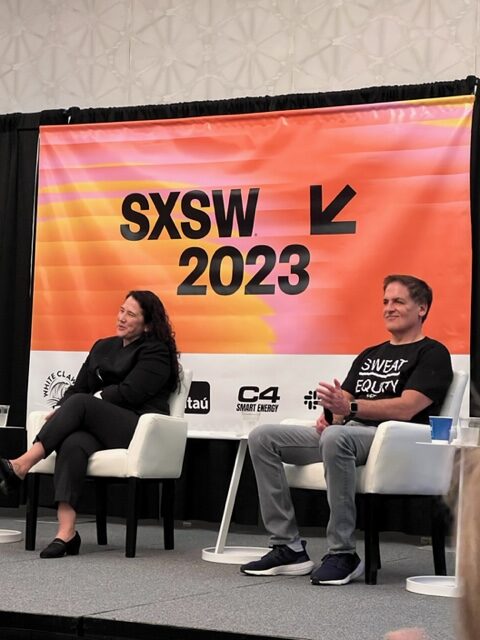
Isabella Casillas Guzman, the U.S. Small Business Administrator, and Mark Cuban, Billionaire Tech Entrepreneur at ZenBusiness SXSW panel Sunday morning

The Silicon Valley Bank failure can have downstream consequences depending on how the government responds to it, said Mark Cuban, billionaire tech entrepreneur.

“The rich people got wiped out already,” Cuban said at a South by Southwest panel discussion Sunday morning. “What’s at stake is the depositor. If they can’t get their money out come Monday, you ain’t getting paid. If you don’t get paid, others don’t get paid.”

SVB, which had $209 billion in total assets and $175.4 billion in total deposits at the end of 2022, failed on Friday. SVB is where a large share of VC firms and VC-backed startups all across the country held deposits, according to the National Venture Capital Association. It’s the second-largest bank failure in U.S. history behind Washington Mutual in 2008.

The investors of SVB are out of money, Cuban said. All those people who had deposits over the FDIC insured $250,000, that’s tens of thousands of companies that need access to their money for inventory, payroll, and accounts payable, Cuban said. If they don’t get access to their funds, it could have substantial ripple effects throughout the economy, he said.

“The Feds have to come in and say we’ve got you,” Cuban said. The bank got hit with a liquidity crunch, he said. “The federal government has to say all deposits will be made whole. I know that’s scary, but that’s the reality.”

Isabella Casillas Guzman, the U.S. Small Business Administrator, also participated in the SXSW panel discussion and said U.S. Secretary of the Treasury Janet Yellen was working closely with bank regulators on the collapse. She said that many of SVB’s depositors are small businesses and are critical to the U.S. economy.

“This weekend is critical,” Guzman said. Regulators are working to determine the right actions to ensure the U.S. economy remains strong.

On Sunday morning’s Face the Nation TV show, Secretary Yellen said SVB’s failure stemmed from a rise in interest rates. And that many of the depositors were small businesses and that the regulators were working on a solution for them, she said. But the Federal government didn’t plan to bail out the investors and owners of the bank.

“The problems of this bank, from reporting about its situation, suggest that because we’re in a higher interest rate environment, assets that it holds, many of which are Treasury assets, or mortgage-backed securities that are guaranteed by the government lose market value, and the problems of the tech sector aren’t at the heart of the problems of this bank,” Yellen said on Face the Nation, according to a show transcript.

SVB’s bank failure is the buzz around SXSW, the annual technology conference held in Austin every Spring.

 The bank backed a lot of startups locally, said Ross Buhrdorf, CEO of Austin-based ZenBusiness.

“We ran our business out of it,” Buhrdorf said. He spoke to Silicon Hills News Sunday morning after an SXSW panel his company moderated.

“We’re scrambling to figure out how to run day to day,” he said. “Like a bunch of us are.”

Buhrdorf, founding Chief Technology Officer of HomeAway, which sold to Expedia and is now known as VRBO, is also an active angel investor in Austin and has backed dozens of companies. All of them used SVB, he said.

ZenBusiness is one of Austin’s home-grown Unicorn companies. Founded in 2017, ZenBusiness runs an online platform to help small businesses incorporate and stay compliant with regulators. It raised a $200 million Series C round in late 2021, valuing the company at $1.7 billion.

ZenBusiness is not exposed financially, Buhrdorf said. He said it diversified its bank deposits in several banks before the bank failure. But ZenBusiness’ payroll is run out of there, he said.

“You don’t just change that and the next day go to another bank,” he said.

« Older posts Newer posts »

© 2026 SiliconHills

Theme by Anders Noren — Up ↑