
Are you a SAS startup or company? Then there’s a conference coming to Austin you may be interested in. And last night at Startup Grind San Antonio I announced that you can get a free ticket – but only for a handful of people so act quick. (Full disclosure the conference is an advertiser on Silicon Hills News)
Softletter’s SaaS and Cloud Applications University Returns to Austin, TX, May 13-15
As a special promo, we have provided San Antonio Startup community 10 comp tickets to attend SaaS University. These tickets are available on first come, first served basis. They allow you to enable SaaS and Cloud Apps University as full attendees and receive all conference takeaways.
To attend on a complimentary basis, please register here.
And use this coupon: STARTUPGRINDGUESTS
Missed your chance to attend for free? If you’re under $1 million in revenue, you can attend as a SaaS University and Cloud Apps scholar for $299 as a full attendee and receive all takeaways and attend all sessions with this coupon: SILICONHILLSSCHOLAR.
Questions? Please contact Rick Chapman at rickchapman@softletter.com or call directly at 860.388.7549.
Page 225 of 352
By LAURA LOREK
Founder of Silicon Hills News

Immigration laws haven’t kept pace with the digital economy, said Burnie Burns, founder of Austin-based Rooster Teeth.
Burns spoke on a panel of entrepreneurs promoting immigration reform Tuesday night at Techstars’ offices in downtown Austin. Erika Sumner, co-founder of Social Good TV, moderated the event.
The other panelists included Anurag Kumar, CEO of iTexico, a web and mobile app development company and Kristel Viidek and Marko Kruustuk, co-founders of Testlio, a mobile app testing service.
FWD.us and Partnership for a New American Economy are hosting events in nine cities in two weeks with the goal of accelerating immigration reform.
The Austin event attracted more than 50 people for a two-hour discussion featuring two panels.
The entrepreneurs took to the stage first. In 2004, Burns founded Rooster Teeth, which has the fourth most watched YouTube channel in the world with 5 billion views. He discussed his problems getting visas for immigrants to work for his company.
Burns ran into a lot of trouble when he tried to bring, Gavin Free, 18, from the United Kingdom to work for him.
Free is an expert on slow motion video and he’s a viral Internet hit, Burns said. Free created a video of him jumping on a six-foot water balloon in his backyard in slow motion, which has more than 50 million views on YouTube.
 But the U.S. government issues only 85,000 H-1B high-skilled worker visas each year. And the annual quota is met every year within the first week of April; five business days after the filing period opens.
“We had to go through all these processes to get him to qualify for a visa,” Burns said. Free’s age and educational level proved to be big barriers to overcome to qualify for a visa for workers of extraordinary ability, Burns said. He also had to have several letters written to immigration officials on his behalf.
In 2010, Rooster Teeth had to educate the U.S. Department of Labor about what YouTube was and why it was an important platform, Burns said. And then they had to prove why Free was an important extraordinary talent in this new industry. Rooster Teeth can employ contractors overseas in the U.K. and pay them to upload videos to from there, Burns said. But the U.S. doesn’t benefit from Rooster Teeth sending money to them aboard.
“My channel can be global but my company really can’t,” Burns said.
Immigration reform needs to address emerging technologies and ways to get talent to the U.S. to fuel those industries, Burns said.
In the Austin-Round Rock-San Marcos metro area, companies filed requests for 3,087 H-1B visas in 2010-2011, according to FWD.us. They paid a minimum of $1,575 for each H-1B application.
The founders of Testlio, Viidik and Kruustuk from Estonia might have to leave the country to grow their startup. The two launched their company in London and moved to Austin to participate in the Techstars program. They would like to stay here but they are having trouble getting visas. They may have to move their company back to London.
Another panelist, Kumar, founder of iTexico, immigrated to the United States at the age of 21 with no money, no family and no friends. Thanks to the immigration policy of the 1980s, he was able to get his green card and stay and start his first company when he was 25.
“I wonder what if the green card processing took six years, seven years or ten years like it does now where would I be right now? I probably would have had to do something else,” Kumar said.
Last week, the government of Mexico honored his company, iTexico, an Austin-based mobile and Web development company, with the 2014 National Entrepreneurship Award in the small business category.
“Talent is everything,” Kumar said.
And U.S. companies are in a global competition to attract the best talent to fuel growth in their businesses and the economy.
 Yet a mismatch between job openings in the Science, Technology, Engineering and Math fields and the current workforce in Austin exists, said Michelle Skelding, vice president of technology for the Austin Chamber of Commerce.
Skelding spoke on a second panel of experts which included John Holmes, vice president of legal at Freescale Semiconductor, Peter French, president of Café Commerce in San Antonio and Ramey Ko, attorney with Jung Ko PLLC.
Currently Austin has 8,000 job openings, as of March 2014, for computer science and math jobs, Skelding said. And there are 29,000 net job openings beyond that, she said. Austin has an unemployment rate of 4.5 percent right now. So there’s a gap in available talent and jobs.
Austin universities graduate 3,000 people in the STEM fields every year, so there’s a huge need and gap in the talent pool, Skelding said.
“We need to look internationally to fill those jobs and we’re not going to displace anyone in the process,” Skelding said.
For every H1-B visa filled there’s a positive correlation with job creation with 7.5 jobs created, Skelding said.
Freescale Semiconductor has 4,500 employees in Austin and hired 115 people in Austin last year.
“Eighty percent of the folks we are hiring require immigration assistance,” Holmes said.
Freescale currently has 250 employees on H1-B visas, he said.
“The wait for those folks, I think for us is four to eight years,” Holmes said.
The worst day for the UPS man in Austin isn’t Christmas but the H1-B visa deadline day, Holmes said. In the “bizarre lottery system” for H1-B Visas this year, Freescale got 60 H1-B Visas out of the 120 applications, he said.
“Freescale would like to see the H1-B visa cap raised dramatically or eliminated,” Holmes said.
Freescale also supports the right to work initiative which allows a graduate of an accredited U.S. university with a master’s degree or higher in a STEM field to automatically get a visa.
Small businesses and startups aren’t participating in the H1-B Visa process, said Peter French, president of Café Commerce in San Antonio. The process needs to be fixed, he said.
Some of the programs to obtain visas for immigrants are underutilized, French said. To find a solution, businesses need to think more creatively about how to keep immigrants in the U.S. working, French said. Research universities have an exemption, under the American Competitiveness Act for the 21st Century, for the H1-B cap, he said.
“We can do it with some of the tools we already have,” French said.
“We’re going to find a way,” he said. “The entrepreneurs are going to figure it out.”
Immigration reform legislation has been stalled in Congress, but the issue should be addressed again this fall, said Ko. The tech community from July to November should send letters, make calls and email Congress members in favor of immigration reform, he said.
The Partnership for a New American Economy is asking people to visit pnae.us/eletter to pledge support.

By LAURA LOREK
Founder of Silicon Hills News

Rohit Saxena and Eric Nordstrom with Sukhiware, biodegradable bowls and plates from leaves.
When he moved to the U.S., he couldn’t believe how many disposable paper and plastic dishes get tossed into the trash and landfills every day.
Saxena’s team at 3 Day Startup Green Tech in San Antonio last weekend, came up with a solution: Sukhiware, biodegradable plates and bowls made from a variety of leaves, like banana leaves.
Sukhiware and three other green tech startups pitched ideas Sunday night along with three nonprofit organizations to a panel of judges, investors and others at Geekdom at the Weston Centre. Sukhiware even created samples and brought them to show at their presentation. For market research, they met with local restaurateurs to find out if they would use the products. They came away with a pre-order for 50 bowls.
“The need is so obvious,” Saxena said. He showed a picture in his presentation of the streets of San Antonio littered with trash following the Fiesta Battle of the Flowers parade.
The first 3 Day Startup Green Tech began Friday night with individuals forming teams around ideas and the nonprofit organizations working on entrepreneurial projects. During the program, some of the teams brought sleeping bags and tents and camped out. It’s like an entrepreneurial bootcamp. They met, shared meals and snacks, pivoted, did market research, built prototypes and pitched their ventures all in one weekend.
“I’m surprised the green tech tribe is as big as it is,” said Lorenzo Gomez, executive director of the 80/20 Foundation, which funded the program and plans to finance a series of thematic 3 Day Startups targeted at particular industries. It did a 3DS on the performing arts industry in February and four of the six teams are still pursuing their ideas, Gomez said. The next 3 Day Startup is in May on Cyber security.
“You get super passionate people participating,” he said.
As a result, more targeted and better ideas come out of the industry-specific 3 Day Startups, he said. The goal is for these teams to take their ideas and run with them, Gomez said. The 80/20 Foundation plans to give scholarships to some teams to enter the CleanTech Open, a national accelerator that runs the world’s largest business competition for clean tech entrepreneurs.

Jeremiah Donohue, project manager for 3 Day Startup Green Tech
“This was the first time we brought nonprofits and individuals together,” Donohue said. “A lot of the nonprofits had a lot of experience. So there was this great collaboration and cross pollination going on.”
The nonprofit organizations want to find sustainable sources of new revenue for their organizations, Donohue said. The program helps them to think like entrepreneurs.

Lanny Sinkin, executive director of Solar San Antonio, presenting SolarBus SA
“This is a wonderful service for nonprofits,” Sinkin said. “It’s addressing a critical need.”
When Sinkin arrived at 3 Day Startup Green Tech on Friday, he attended a special session geared to nonprofit organizations. He came away with 17 ideas. He took those back to his staff and they ended up with 26 ideas. They eventually narrowed it down to one idea, the SolarBus SA, geared after the Geekbus, an educational bus focused on teaching Science, Technology, Engineering and Math applications to students.
The SolarBus SA is an education and marketing vehicle for Solar San Antonio. The bus will run on biodiesel or will be an electric bus that can hook into a solar charger, he said.
Solar San Antonio needs to raise $100,000 to make the project a reality.
And the opportunity for solar in San Antonio is enormous, he said.
Bexar County has 600,000 residential rooftops. Forty percent of those can install solar panels. At a cost of $10,000 per rooftop, that’s a $2.4 billion business, according to Sinkin.

Green Spaces Alliance pitching its cookbook and app tied to locally grown food
During its market research, Green Spaces Alliance found almost everyone they interviewed had some issue with getting fresh local produce to his or her plate.
“Some people love to garden but they don’t know how to cook,” said Nadia Gaona with Green Spaces Alliance. “Others love to eat, but they don’t know how to grow their own food or where to get fresh local produce from.’’
The Green Spaces Alliance cookbook would also include stories about local gardens and gardeners, Gaona said. The organization works with 38 community gardens and 200 gardeners in San Antonio. The book would also include seed paper inserts to pull out and allow people to plant in their own gardens. The app would include seasonal guides on what to plant and when.
The third nonprofit organization to present, San Antonio 2030 District, which launched in January, focuses on getting property owners to use its palette of services to reduce energy costs. It has 11 property owners signed up so far, said Pegy Brimhall.
Its goal is to launch the District Games, a program with gaming strategies and competition among property owners in the downtown areas, to reduce energy costs and improve efficiency. Right now, 1,100 property owners are in the district and the goal is to get them all signed up to participate in the District Games, Brimhall said.
“We want this to be scalable,” she said.
After successfully building the platform in one district, the goal is to roll out the program citywide, she said.

The team behind 2030 District
“I’m an entrepreneur,” she said. “I wanted to get the nonprofit to start thinking that way. Just because we’re a nonprofit doesn’t mean we can’t generate revenue for ourselves.”
One of the startups, Green Nexus pitched an online matchmaking service for green tech startups and investors.
“The number one problem that green tech startups have is finding funding,” said Kelley McGill with Green Nexus.
Existing sites such as AngelList don’t provide enough information to investors for them to assess the risk level of the startups, McGill said. More than 1,000 startups are currently listed as green tech startups on AngelList, she said.

The team behind Green Nexus
JSA Energy proposed a real time energy analytics dashboard to monitor buildings to save energy and money.

Shihlin Lu with JSA Energy with her team’s “Gold Red Bull Award” for Good Citizenship
Its energy dashboard and smart meters could help a commercial building owner save $1,700 a year in energy costs and cut carbon emissions by two-thirds, said Shihlin Lu, University of Texas at San Antonio junior studying environmental science.
It’s also applying for the CleanTech Open.
“This is the second 3 Day Startup I’ve participated in but I was really excited that it was focused on clean energy and sustainability,” she said. “I don’t think I would have accomplished this much if it wasn’t so focused.”
The team behind gaiah met at 3 Day Startup Green Tech and came up with an idea for a gamification app to reward consumers for buying green products and doing good deeds to benefit the environment. It makes money from direct ads to green consumers, product analytics and through the sponsorship of micro challenges to motivate people to do good things for the environment.
The gaiah team of Alex Maingot, Nic Jones, Michelle Kafir, Eduardo Bravo plans to apply for the CleanTech Open and to continue to pursue the idea.
The green products market is a $500 billion market, Maingot said. Today, 108 million Americans identify themselves as buying green products. The startup is looking for a $100,000 investment and a mentor to bring their app to the marketplace, Maingot said.
During the program, the gaiah team went to the Farmer’s Market to talk to people about their idea. And they talked with a chef who owns two restaurants and buys ingredients locally. They got a lot of positive feedback.

Alex Maingot pitching gaiah
The teams pitched some great ideas, she said.
“I love challenging the teams to think bigger and to not ignore their blind spots,” Burroughs said.
One of the issues a lot of nonprofits have is an aging supporter base so the more entrepreneurial they can become, the better able they are to be self-sustaining, she said. But some of the teams underestimate how much it’s going to cost to bring their ideas to market, she said.
“I’m always really fascinated by how inexpensive people think it is to develop big platform technologies. They are like oh yeah, it costs $10,000 or $50,000 and I’m like where are you shopping? There are always these gaps.”
BY LAURA LOREK
Founder of Silicon Hills News
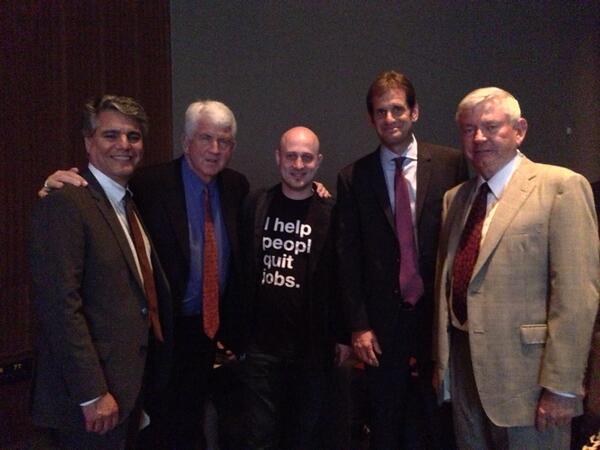
Greg Fenves, Provost of UT, Bob Metcalfe, professor of Innovation at UT, Joshua Baer, founder of Capital Factory and Longhorn Startup Labs instructor, Bobby Epstein, founder of COTA and Ben Dyer, EIR at UT and instructor at Longhorn Startup Lab.
“You might pivot a couple of times,” he said.
Epstein gave that advice at Longhorn Startup Lab’s Demo Day Thursday night to hundreds of people at the Lady Bird Johnson Auditorium. Bob Metcalfe, professor of innovation at UT, interviewed Epstein, who runs COTA, a Formula One racetrack and one of the largest startups in the Austin area. He quizzed Epstein about his entrepreneurial background and asked him what advice he would give to aspiring student entrepreneurs.
“The best advice you can give anyone as an entrepreneur is to be prepared to work 70 hours to 80 hours a week,” Epstein said.
It’s ok to risk everything, Epstein said. “But don’t risk more than that.”
Too many people start undercapitalized businesses.
“It’s great to be ambitious and start a business but don’t risk everything you have to start something that’s undercapitalized because that’s potentially a formula for failure,” Epstein said. “Don’t think that when you get to that next point the next dollar is going to be there. I think that’s really important before you spend it all.”
Epstein, a UT graduate, was born in New Jersey, but grew up in Dallas and spent time in Indianapolis. His father was an engineer, inventor, and entrepreneur and worked at Bell Labs.
He didn’t have a lemonade stand but he did host a carnival in his backyard. And he ran a DJ business in high school.
Epstein attended UT in 1983 and graduated with a degree in Liberal Arts. When Metcalfe asked him if he knew Michael Dell, who founded his company at UT in 1984, Epstein said no.
“He was a year ahead of you,” Metcalfe said.
“In many ways,” Epstein said.
Epstein didn’t start a company in college. But he did drop out of medical school. He ended up working on Wall Street on a bond-trading floor doing research. He created predictive and regression models on trading patterns.
“It was supposed to be a summer job,” Epstein said. He liked the job and he worked a lot of hours. He decided not to go to medical school and he continued working in the bond trading industry. He ended up working on mortgage derivatives and in 1992 he founded a broker dealer. He sold that business with 100 employees in 1995. He founded a new business, Prophet Capital Asset Management, and moved it to Austin in 1997 and has had 19 years of steady growth. His hedge funds manage more than $2 billion, according to a Forbes article.
“So this business was so successful that you were able to consider founding and financing COTA,” Metcalfe asked.
“Yes,” Epstein said.
“Can you tell us how that happened?” Metcalfe asked.
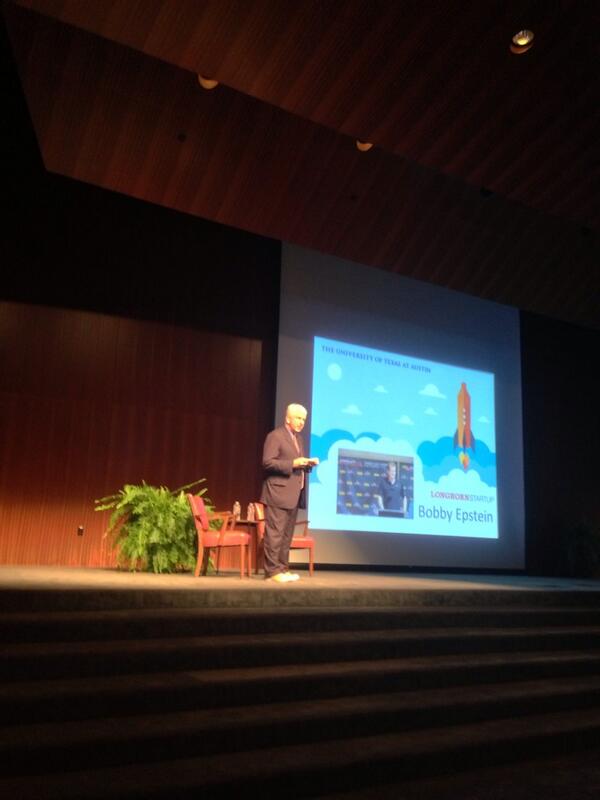 He met a guy who wanted to bring Formula One to Austin and Epstein thought that was a terrible idea. But he had a piece of property he bought in 2005 in Southeast Travis County that Epstein planned for houses. Instead, he pivoted. He turned what would have been a residential development into a racetrack. Today, that piece of property is about 20 percent of the land that COTA sits on. The 3.4 mile racetrack is on a 350 acre development. It also includes an amphitheater, which can accommodate up to 14,000 people.
The Circuit of the Americas got its primary funding from San Antonio Billionaire Billy Joe “Red” McCombs along with Epstein’s contributions. The state of Texas, through its Major Events Trust Fund, also pledged millions to the project.
Since COTA has been in business for a year and a half, it has had an economic impact of $1 billion, Epstein said. It has also raised the global profile of Austin, he said. And it has created lots of jobs, he said. COTA has 100 year-round employees and thousands that come in to work for events. The project costs $400 million in construction, the two Formula 1 races have generated $250 million to $300 million each in economic impact and the track has hosted more than 1.4 million people, Epstein said. And 250,000 have come in from outside Texas.
“A billion dollars in revenue in a year and half. Doesn’t that make you the biggest startup in Austin?” Metcalfe asked.
“It’s not all our revenue,” Epstein said. “That’s the only thing. We have two revenue streams. One revenue stream that goes to everyone else and one revenue stream that goes to COTA.”
“Let’s call it gross revenue,” Metcalfe said.
COTA does encourage people to come in from out of state and spend money, Epstein said.
“We get the people with the biggest pockets and have them come here and empty them out…if they have a great time they’ll come back,” Epstein said.
COTA isn’t yet profitable but it has helped the local economy tremendously, he said.
The racetrack is betting on other events such as the X-Games and concerts at its amphitheater, which will host a Jimmy Buffet concert next month, to push it into profitability.
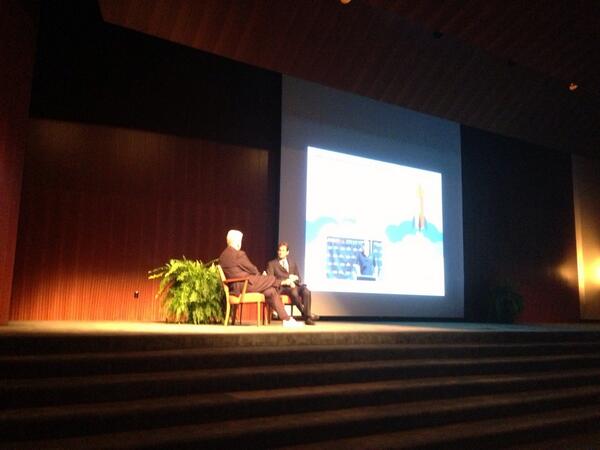 Metcalfe also asked Epstein about all the technology used in the cars and said that’s one more reason COTA is a high tech startup. The criteria for a fast car, according to a Ferrari car designer, are a fast engine, aerodynamic design and high-tech wheels, Metcalfe said. He didn’t mention the driver, he said. He asked if there would a driverless robotic car race or an electric car race.
Epstein said he didn’t think the drivers were expendable. They have tested driverless cars on the track though, he said. And they have raced electric and solar vehicles there also.
By LAURA LOREK
Founder of Silicon Hills News
 For six semesters, Longhorn Startup Lab has focused on turning undergraduates at the University of Texas at Austin into entrepreneurs.
Some of the students, with companies like Burpy, a grocery delivery service, Lynx Labs, a 3D modeling camera, MSpaces, Airbnb apartment rentals, and Clay.io, HTML 5 game developers platform, have gone on to raise money and develop their ideas into thriving startups.
Many companies like Zilker Motors, which wanted to create a car that travelled 100 miles on a gallon of gas, have failed.
But that doesn’t deter Bob Metcalfe, UT professor of Innovation, Ethernet inventor, 3Com founder, Joshua Baer, specialist of computer science and founder of Capital Factory, and Ben Dyer, UT Entrepreneur in Residence and founder of Peachtree Software. The three teach Longhorn Startup Lab which involves students creating companies and working with seasoned entrepreneurial mentors and listening to guest speakers like Bert Hurt, founder of Bazaarvoice and Michael Dell.
Some day, they expect one of those undergraduates will come up with the next big thing and go on to be as successful as Dell.
On Thursday at the Lady Bird Johnson auditorium at UT, 11 Longhorn Startup companies presented their startups, including six, which had participated in the class the previous semester. And one, ShorePower, a solar power solution for marinas, announced its dissolution because of a lack of interest from its target market.
Yet, a few companies have already gotten traction.
Micromulsion, which creates microgels for cell cultures in bioengineering research, announced it has received a seed stage investment from Mark Cuban, billionaire and keynote speaker at last semester’s Longhorn Startup Lab Demo Day.
Prepify, which provides free online training for students taking the SAT, won $20,000 as the national winner of the Walmart Net Impact “Better Living” social venture competition.
Waterford Media, a mobile role-playing game developer, has launched a Kickstarter campaign to raise $1,000 for its first game, The Runners.
Three startups targeted the hot wearables market including AirType, a virtual keyboard for tablets, Freeput, a headband device for the disabled that controls a computer’s mouse and keyboard by tracking eye movement, and Everywhere Energy, a shoe insert that harvests kinetic energy to power a cell phone.
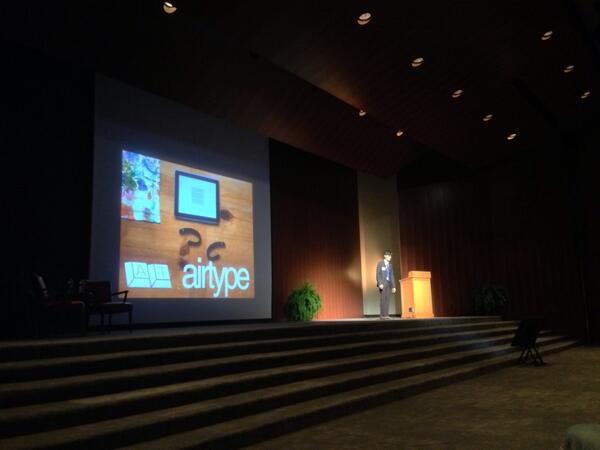 AirType’s wearable bracelets allow people to type on a tablet without a keyboard using its technology.
“AirType is not a toy,” said Sidhant Srikumar, a junior majoring in computer science at UT and the CEO of AirType. “It’s a keyboard. More importantly, it’s your keyboard.”
AirType, which is expected to cost $60, learns how a person types and writes. Srikumar said.
“Welcome to the future of computing on the go,” he said.
Everywhere Energy seeks to solve the problem of dead batteries for cell phones through an insole insert into any shoe tied to a battery packet that fixes to the side of the shoe. That battery packet, charged through kinetic energy from walking around, can be removed at the end of the day to charge a cell phone battery.
“But this is not a first world problem, this is a digital world problem,” said Darla Hollander, a senior in electrical engineering and CEO of Everywhere Energy. “For example, in Uganda, its projected in 2015, 70 percent of Ugandans will have cell phone subscriptions, yet only 9 percent of them will have access to electricity.”
They have to walk to charging stations and pay to charge their mobile phones every time, she said.
Everywhere Energy’s first project, Eversole, which harvests energy as people walk, is projected to retail for $80, she said.
Everywhere Energy expects to launch a Kickstarter project soon to finance its beta product.
“So the next time you look at your phone battery, think of Everywhere Energy and be your own battery,” Hollander said.
A year ago, Michael Baumgartner got run over by a sports utility vehicle and ended up in the hospital. The devices available to him in the hospital didn’t allow him to use his computer. His disability left him frustrated. That experience convinced him of the importance of the work Freeput is doing, he said.
“Wearable technology is changing the way people do things,” he said.
Freeput’s software records electrical activity recorded by certain body movements like eye movements and communicates those to the computer to manipulate a mouse. Freeput has already tested a prototype of its product.
“We’re confident we can have our device ready for market by 2015,” Baumgartner said.
“Freeput, it’s the mouse you control with your eyes,” he said.
The other companies presenting included Basedrive, a server-based storage system for law firms, UpNext, a mobile app that gauges wait times for restaurants, SocialToast, an app which integrates with Facebook to let college students find their friends at local bars and PineCone, a system to help companies onboard new employees.
Overall, entrepreneurial activity at UT has been on a rise for the past three years since Longhorn Startup Lab launched.
The next big company could come out of Longhorn Startup Labs, a dorm room, an incubator or the Longhorn Entrepreneurship Agency’s new headquarters. The agency started a year and a half ago and one of its big goals was to get a dedicated space on campus, said Grant Heimer, its outgoing director.
“We now have our own space,” Heimer said. It’s moving into an old apartment building behind the student services building. The 600 square foot space will be called UThinkTank and it will host LEA offices, meet-ups, co-working and events.
“It’s nothing fancy. But we think it’s perfect for students to pursue entrepreneurship,” he said.
By LAURA LOREK
Founder of Silicon Hills News

Photos by Laura Lorek
And it’s high tech.
Peer 1 now has one of the hippest tech sites in town.
The web hosting company recently moved into 25,000 square feet of space at Pearl, a 22-acre historic downtown development, dating to 1881, which once served as the bustling Pearl Brewery.
Now Pearl features shops, restaurants, bars, offices and apartments and Peer 1, a global web hosting company with more than 100 employees.
“We’ve created a live, work, play environment for employees,” said Robert Miggins, Peer 1’s senior vice president of business development.
That movement appeals, particularly, to younger workers who like to bike or walk to work and home and enjoy the coffee houses, bars and restaurants nearby.
Peer 1’s new workplace features an open workspace with twenty foot ceilings, chalk walls, whiteboards and an even a van that once served as a Pearl beer delivery vehicle that has been refurbished into a meeting room.
Peer 1 also installed a full kitchen so its employees can make breakfast tacos, lunch, dinner and other snacks. The former hair dying station for the former tenant, Aveda Institute, now serves as a bar. And Peer 1 installed a cantina lunch area decorated with Papel picado emblazoned with the Peer 1 logo hanging from the ceiling, booths, and colorful festive tables with red, green and silver metal chairs. The new headquarters also has a game room for employees to blow off steam playing Ping-Pong, foosball and Pac-Mac. Peer 1 also established a workout room with weight machines, treadmills, elliptical trainers and locker rooms with showers.
 The garage from the Pearl Brewery dates back to 1939. The building retains its historic features but it has been updated for a hip, young tech workforce.
The Peer 1 office has conference meeting rooms named after Texas brewed beers like Alamo, Santo, Lone Star and Pearl.
Pearl is at total capacity right now for office space, said Elizabeth Fauerso, its chief marketing officer.
In addition to Peer 1, San Antonio Area Foundation, Bank of San Antonio, CE Group and the KGBTexas have all set up shop there, she said.
“It’s a creative environment,” she said. “Peer 1 is the only explicitly tech company here.”
Peer 1’s knowledge-based workforce and clean technology industry and its focus on sustainability make it a good fit for Pearl, she said.
“We’re very excited to have Peer 1 here,” she said. “The technology industry is a fast growing industry in San Antonio.”
Peer 1 has been on the Northeast side of San Antonio for six years, Miggins said.
“We’ve gradually been growing our staff and building up our data center,” he said. “The data center is not quite full, but the office part of it – we were bursting at the seams. We began an office search in earnest a little over a year ago.”
Peer 1 narrowed its search down to three locations, none of which were at Pearl, Miggins said.
“They were one story buildings kind of in the middle of nowhere,” he said. “Nothing inspiring.”
Then Dax Moreno, director of North American sales, went to Peer 1 UK in South Hampton to visit its three-story bar and restaurant and reimagined it into a tech office.
“We got inspired to look for a more creative workspace,” Moreno said.
At that time, the Aveda Institute announced they were leaving Pearl. The space opened up and Peer 1 snatched it up. They worked with Texas Wilson to outfit the office in funky and functional Steelcase furniture. They even created a space which can be used for public meetings and conferences when a garage door is lowered to shut if off from the rest of the office.
“It just worked out really, really well,” Miggins said. “Several of our people have moved apartments and now walk to work.”
Peer 1 is also hiring developers, sales people, leadership, managers, supply chain, operations folks, Miggins said.
“We are hiring across the entire company,” he said.
The new location also raises the profile of Peer 1 in San Antonio. Many people know about Rackspace Hosting, a larger web hosting company here but they may not have heard of Peer 1.
Yet Peer 1 has its roots at Rackspace.
Richard Yoo, one of the founders of Rackspace, launched ServerBeach in 2002 in downtown San Antonio at what now serves at the CityNap building. They flew a pirate’s flag from the top of the building to signify its break from the main company. He grew the business within Rackspace and the company sold it in 2004 to Peer 1 for $7.5 million. Miggins stayed with Peer 1 and has been heading up its local operations ever since. Peer 1 competes with Rackspace for hosting customers, but it sees its competitive advantage as being a smaller organization.
“We’re smaller,” said Moreno. “We’re more nimble, more flexible.
Peer 1, based in Vancouver, Canada, provides web hosting at 19 data centers in four countries. It has more than $200 million in annual revenue and 500 employees worldwide.
“Our story is about offering customers lots of choice,’’ Miggins said. Its customers include WordPress.com, Virgin Gaming, Plenty of Fish, Softpedia and Wooz World.
Moreno also joined Peer 1 from Rackspace. He likes the size of the organization and it’s ability to react quickly to its customers and the marketplace.
“We don’t want to be the biggest, we want to be the best,’’ Moreno said.
 Peer 1 has struggled in the past with creating awareness about its business in San Antonio, Miggins said. But now the site at Pearl has already increased its visibility in the community and it’s attracting employees from outside the city too.
“This will increase the pace of new hires here,” Miggins said. “We can now attract people who are drawn by the lifestyle.”
San Antonio recently tied with New Orleans for the number one city gaining the most college graduates, according to a Forbes article. It reported San Antonio attracted 76,331 college graduates between 2007 and 2012 for a percentage gain of 20 percent.
By LESLIE ANNE JONES
Reporter with Silicon Hills News
 On a sunny Saturday, 12 children and young teens convened in MakerSquare’s classrooms for a little weekend coding. “What do we think these are?” teacher Drew Robinson asked a room full of kids seated before laptops. “Opening and closing HTML tags,” an elementary school boy speedily replied. Turns out, a kid’s ability to soak up languages extends to computer languages too.
The Saturday event was a free workshop and part of MakerSquare’s outreach effort for Hatch After School, a weekly web development and computational thinking program for K-12 students. The program costs $159 per month.
Barely a year old, MakerSquare started offering its web development boot camp last summer. Today, the school has two tracks for adults: A 10-week, part-time web development course that costs $3,380 and a 12-week full-time course that teaches the fundamentals of software engineering for $13,880. Demand is high, students come from all over the country and world. Co-founder Muhammad Meigooni says so far they’ve graduated 130 students, and they have a 96 percent job placement rate within three months of graduation. Now they also have youth program Hatch. The basics of that course are very similar to how adult students start to learn.
“They’re learning as quickly as adults,” Meigooni said of the first batch of Hatch students.
 Hatch After School is loosely designed in eight-week blocks, units can be shortened or lengthened based on the group of students. For the first eight weeks, students become familiar with HTML and CSS and the basics of computational thinking. In phase two, they’re introduced to Java and basic game design, and in the final phase they work on advanced web development or build an actual game using Java. The whole schedule might take six months to a year, and for advanced students who complete the phases and want to continue learning, MakerSquare will pair them with a mentor in the community who can continue to help.
Learning to code can be a daunting prospect, which is why MakerSquare’s program keeps it simple in the beginning. To start out, kids use “drag and drop” tools to place blocks of code to build web pages. From there they move on to pattern recognition and learning the vocabulary of which HTML tags do what, then after that they begin to write their own code.
Presently, most Hatch students are middle schoolers, but the program can accommodate students as young as second or third grade. The entry barrier is essentially typing ability: If kids don’t have solid typing skills, the level of frustration becomes too high.
Hatch After School isn’t all about screen time. Teachers Meigooni and Robinson like to break it up with real-life exercises too. One exercise they have kids do is divide up into pairs, one student is given a group of triangular and square-shaped puzzle pieces, and one student is given a diagram for how to arrange them (into the shape of a spaceship, for instance). The students sit back to back and the kid with the diagram has to instruct the other on how to put the pieces together without showing his partner the diagram. This lesson in computational thinking shows kids how very specific instructions have to be in order for a computer to produce a desired outcome.
Drew Robinson started out as a MakerSquare student in February. Previously, she was a high school teacher in Tulsa. Originally she taught history, but when the AP computer science teacher retired, she was tapped for the job due to her tech-savvy reputation and given just a summer to teach herself Java. Without formal training though, she couldn’t be as effective as she wanted in the classroom.
“If I kept going, I would’ve burned out,” she said.
 Robinson left her teaching job and picked MakerSquare to continue her coding education, partly because she was attracted to the school’s outreach programs. She immediately started volunteering with the school’s CoderGirls program for Girl Scouts of Central Texas. In the beginning of April, MakerSquare asked her to come on full-time with the Hatch program as director of k-12 curriculum.
The school is also working on putting together a space equipped with logic puzzles and iPads with games that will let kids work on critical thinking exercises while they wait to be picked up after their Hatch lessons end.
For kids and parents who want to check it out, there are free 90-minute workshops on some Saturdays. Check MakerSquare’s website or Facebook page for details on the next session.

Photo courtesy of AT&T
The company already delivers its 1 Gigabit per second broadband Internet network to Austin. It began to offer service there after Google announced plans for a 1 Gigabit network in Austin.
Google also announced earlier this year that San Antonio is on a short list of cities which may receive its Google fiber high speed network.
Why is this a big deal for Central Texas’ technology industry? Because Austin already has a Google Fiber network underway and AT&T is offering the service there. San Marcos-based Grande Communications has also announced plans for a 1 Gigabit network in Austin. And Time Warner announced plans to increase its speeds to 300 mbps up from 50 mbps in June.
Competition is good for the consumer. It means lower prices and better products.
But the benefit doesn’t stop there.
Startup companies and established companies with access to high-speed networks can dream up the innovative products that will drive our economy forward. They will be able to compete on a global scale with other countries that have much faster networks in place already.
In addition, the ability to get high speed Internet to all areas of the city benefits everyone because an educated population is a productive population.
“Similar to previously announced metro area selections in Austin and Dallas and advanced discussions in Raleigh-Durham and Winston-Salem, communities that have suitable network facilities, and show the strongest investment cases based on anticipated demand and the most receptive policies will influence these future selections and coverage maps within selected areas,” according to a news release.
In addition to San Antonio, the other metropolitan areas includes: Atlanta, Augusta, Charlotte, Chicago, Cleveland, Fort Worth, Fort Lauderdale, Greensboro, Houston, Jacksonville, Kansas City, Los Angeles, Miami, Nashville, Oakland, Orlando, San Diego, St. Louis, San Francisco, and San Jose.”
AT&T U-verse with GigaPower services are available in Austin and some surrounding communities, and are expected to roll out in parts of Dallas this summer. AT&T is also expanding its coverage in the Austin area.
By LAURA LOREK
Founder of Silicon Hills News
 The geeks might inherit the earth eventually, but for now, they’ve got their own building in downtown San Antonio.
On Monday, two Geekdom flags flew from the top of the historic Rand Building at 100 E. Houston St., signifying the move in of Geekdom members. It’s their new headquarters.
On the seventh floor, Lorenzo Gomez, director of Geekdom, thanked everyone involved in the yearlong renovation of the space and move to the new 12,400 square foot space. (Eventually Geekdom will takeover the entire building, but for now it’s occupying one floor) He thanked Geekdom Staffers Kara Gomez, Julie Campbell, Ryan Salts and Zac Harris as well as Nick Longo, co-founder of Geekdom, the place where startups are born. Geekdom tailored the space to meet the needs of its community members.
“Here we have more useable space for the community,” Longo said. “We doubled the size of the space for community members.”
 Geekdom members toasted with mimosas served in red solo cups and celebrated the new space with sweet rolls and macaroons from Bakery Lorraine.
A year ago, Graham Weston, chairman and CEO of Rackspace, through his Weston Urban LLC., bought the Rand Building from Frost Bank with plans to create a permanent home for Geekdom, a thriving community of technology workers in San Antonio. The space serves as the epicenter of the city’s technology community, Gomez said.
Alamo Architects‘ Irby Hightower and his team worked with Geekdom and its members to tailor a space specifically to their needs, Gomez said. It features a large community space for members with an open kitchen and bar stools nestled around a long table. The office is functional and looks cool with exposed pipes in the main room and a wooden ceiling by the kitchen, funky light fixtures, red and black carpeting to muffle the noise, murals, whiteboards and writeable walls. The signs to the conference rooms pay homage to video games of the past.
 The space also features bike racks and showers. And it has 23 offices and several conference rooms and a telephone room for private phone calls. It even has a mother’s lounge for new moms who need a private space for pumping breast milk.
 Geekdom’s community space also has multi-level workstations for people who like to stand while they work as well as desks for sitting.
The new Geekdom office also has lots of windows and offers spectacular views of downtown San Antonio.
Eventually, Geekdom will take over the entire Rand building. For now, it has moved into the seventh floor, but in a few months, the larger companies like TrueAbility, ParLevel Systems, Codeup, Pressable, Promoter.io, FlashScan3D and Sammis & Ochoa will move to the sixth floor.
“We have a Champagne problem,” Gomez said. “We have more demand then there is supply for. We have more startups that want space than we have space for. Next year this time, when the rest of Frost moves out it’s going to be a really big question we’ll have to figure out the answer for whether it’s more offices, more community space. We don’t know the answer yet.” It could be one big company with 100 employees moves in to an entire floor, he said.
 For the past two and a half years, Geekdom has been housed on the 11th and 10th floors of the Weston Centre, about a block away from the Rand. But the technology incubator and coworking space has grown dramatically with more than 750 members and needed a building of its own, Gomez said.
Later this summer, Geekdom will also open an events center on the first floor of the Rand Building. But for now, it’s hosting its events at the Weston Centre until the space can be finished out.
Geekdom’s new building is designed to launch, nurture and expand San Antonio’s technology industry through startups, Gomez said.
Laura Thompson, a public relations expert, joined Geekdom about a year ago. She plans to launch a startup called The African American Network, a broadcast company.
“I hope to be one of the companies that grows into a bigger space here,” she said.
The new space got rave reviews from Geekdom members.
“It’s cozy and warm,” said Jorge Amodio, a hardware developer and Geekdom member for more than a year.
The glass doors on the conference rooms are more inviting for collaborating and coworking, Amodio said. The natural light is also a bonus, he said. But the real draw is the people, he said.
“Geekdom is about being part of a smart, vibrant community,” Amodio said.
Geekdom is a sponsor of Silicon Hills News
 For the first time in its more than two year history, Geekdom will close its doors Friday at 2 p.m.
But don’t fret.
It’s only temporary.
Geekdom, the downtown technology incubator and co-working space in San Antonio, is moving to the historic Rand building, which dates back to 1913, this weekend. It will reopen on Monday in its new digs on the seventh floor with a celebratory brunch complete with mimosas and pastries from Bakery Lorraine.
Geekdom will occupy the sixth and seventh floors of the eight story Randy building and it’s also renovating a bi-level events space on the first floor. But until that space is complete, Geekdom will continue to hold its events on the 11th floor of the Weston Centre.
Its bigger companies like TrueAbility will move into the sixth floor of the Rand building later on this year.
And speaking of development in downtown San Antonio, Geekdom got a big shout out in this Wall Street Journal article.
“The building will eventually have a cafe, a rooftop bar, and other amenities “that the geeks want,” said Randy Smith. Mr. Smith is the president of Weston Urban, a real-estate development company founded in 2012 that aims to “create the ecosystem for tech entrepreneurialism” in San Antonio, Mr. Smith said,” according to the article.”Mr. Smith co-founded Weston Urban with Graham Weston, a native of San Antonio who is the chairman and chief executive of Rackspace, a cloud-computing company valued at $4.5 billion. Over the next five years, Weston Urban plans to develop a downtown district using four surface lots the group bought last year, along with three buildings it already owns, and by buying other properties. The plan includes 1,000 rental apartments plus restaurants, shops and other businesses designed to create a lively downtown.”
Geekdom is a sponsor of Silicon Hills News