Page 226 of 352

Microsoft Expands its Data Center Operations in San Antonio

microsoftIn 2008, Microsoft opened a $550 million, 470,000 square foot data center in the Westover Hills area of San Antonio.
At the time, a Microsoft executive said that was just the beginning of Microsoft’s investment in San Antonio.
She was right.
This week, Microsoft announced a $1 million donation to the University of Texas at San Antonio and its Texas Sustainable Energy Research Institute. The company is also entering into a three year partnership with UTSA focused on creating generators that consume less energy to power massive data centers.
“As Microsoft embraces a more thoughtful approach to powering the cloud, we’re looking at how we can reinvent the datacenter to be more efficient and use more sustainable energy sources,” Brian Janous, director of energy strategy at Microsoft, wrote in a blog post. “Very few cities have embraced the clean energy economy like San Antonio and its mayor, Julian Castro.”
Microsoft is also investing $250,000 to expand its existing data center in San Antonio by more than 250,000 square feet.
For more on the partnership, read UTSA’s post.

The video below, by UTSA, is from the event held at UTSA on Wednesday.

Rooster Teeth Rules the YouTube Roost

By LESLIE ANNE JONES
Reporter with Silicon Hills News

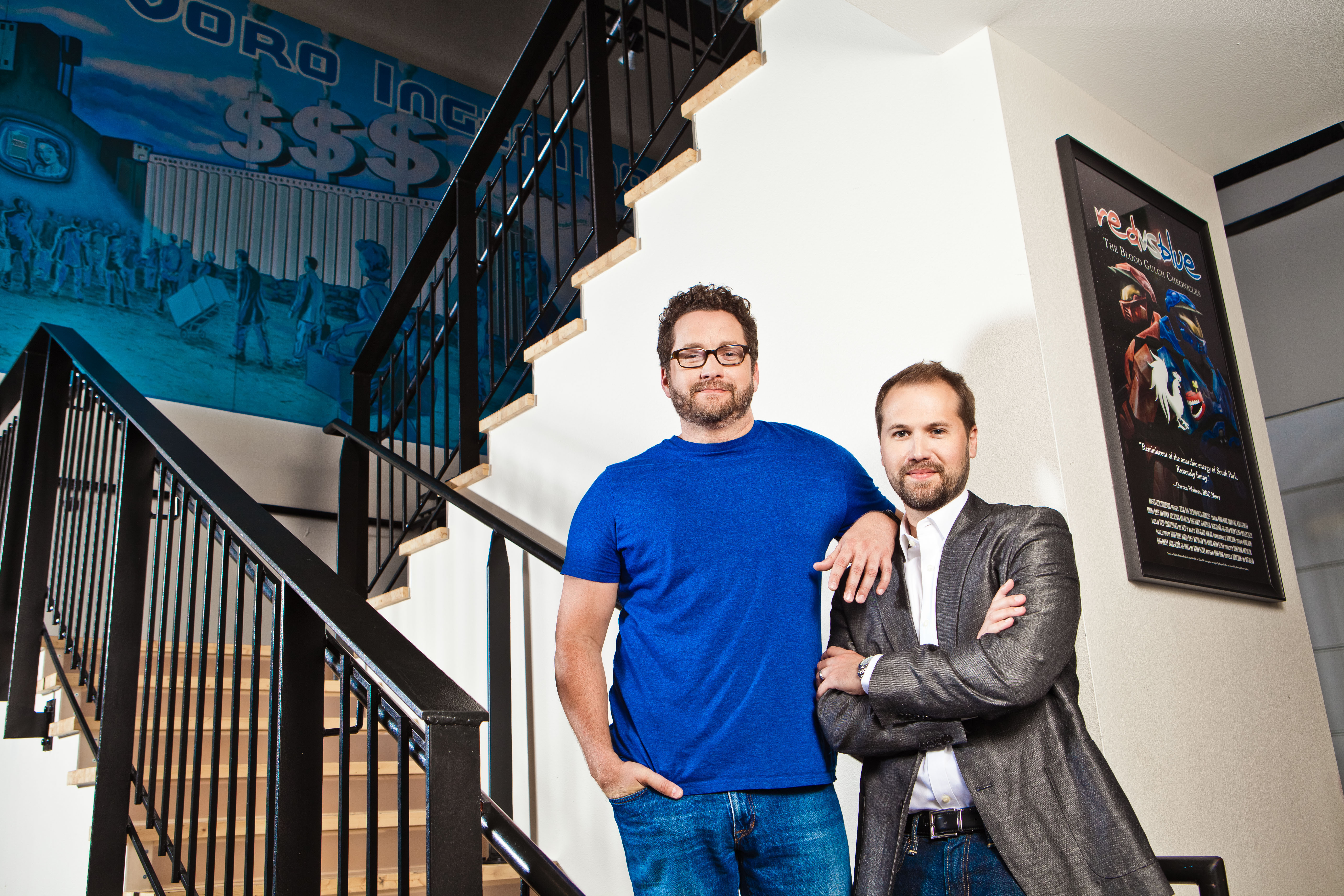
Burnie Burns and Matt Hullum, photo courtesy of Annie Ray

Burnie Burns and Matt Hullum, photo courtesy of Annie Ray

It might be the biggest online entertainment production house you’ve never heard of. Rooster Teeth celebrated its eleventh anniversary on April 1, and its much-loved series Red vs. Blue, which debuted in 2003, is now the longest-running American sci-fi show and has sold 1 million DVDs.

“Dr. Who [which is British] is still longer,” founder Matt Hullum concedes.

Today, Rooster Teeth has about 70 staff members for 30 ongoing web series, two podcasts, a merchandise store and a fan community with 1.7 million registered users. The company also runs the RTX gaming and internet conference, which is expected to bring 30,000 attendees to the Austin Convention Center in July.

Rooster Teeth’s audience is typically between ages 12-28, but viewership is getting older as the company ages. Historically, fans were 80 percent male but that’s also changing with the introduction of shows with female protagonists.

In a couple weeks, the company is leaving its south Austin building for a much bigger space at Austin Studios, and with the move comes plans for bigger productions including a live-action feature, though what form it will be released in is undetermined. It may come out, like Red vs. Blue, as a chaptered series, released in five-minute episodes.

“We’re not opposed to traditional media,” says Hullum. “We’re just not interested in using the Internet as a stepping stone to get there.”

Hullum met fellow founding partner Burnie Burns in college when they were both working at Texas Student Television. Hullum loved that there were hardly any gatekeepers at the station. The freedom of student TV was the first inkling of things to come.

Hullum went to Hollywood to work in film. Back in Texas, Burns sent Hullum the beginnings of Red vs. Blue. The project was “machinima.” It was created out of video game play with voiceover narration. The comedic series focuses on a civil war waged between two teams of soldiers (red and blue), and it uses footage from the first-person shooter Halo (since season 8, it also includes original animation). Today, it is one of the most prominent examples of machinima.

The show was an immediate Internet hit. Its creators didn’t have financial expectations for it until the second season premiered at the Lincoln Center in early 2004. Hullum said he figured just New Yorkers would show up, but fans from all over the world convened on the event.

Hullum moved back to Texas shortly after that. Initially, the operation was a handful of guys working out of a one-bedroom apartment in Buda, and it was just Red vs. Blue DVD sales and merchandise that made money, but soon requests for branded content started coming in from companies like videogame maker EA.

Today, the bulk of revenue stems from original content. Hullum says they try to make sure all products have at least two income streams and they don’t like to rely on unpredictable YouTube ad revenues. For example, the weekly Rooster Teeth podcast – where staff discuss movies, video games and upcoming projects – earns money through a premium subscription service for livestream access, integrated ads that air during the show, YouTube ads when the show becomes available there and merchandise. The podcast gets hundreds of thousands of YouTube views and a new episode of a Rooster Teeth show often sees 1 million or more.

To understand the fan loyalty that’s driven Rooster Teeth’s decade-long success, it’s helpful to talk to 25-year-old community manager Barbara Dunkelman. She began watching Red vs. Blue when she was 14, and from there Rooster Teeth became a major part of her social life. She’d go on the Rooster Teeth website before school, sometimes during school, and then at night often she’d stay online until three a.m interacting with other members, hosting chats, posting journals, commenting – about half the conversation was specifically about Rooster Teeth, she says, but the other half was just socializing.

“I was always kind of nerdy, interested in video games and that kind of culture,” she says. “And the Rooster Teeth community is extremely open and welcoming. Some of my best friends to this day are people I met on the website.”

Dunkelman was one of the most prominent community members, so when Rooster Teeth was looking for a community manager, they offered her the job and sponsored her work visa (she’s Canadian). In addition to marketing and social media, Dunkelman also plays the voice of Yang Xiao Long, one of the main characters on RWBY, the company’s Americanized anime, now one of its biggest shows. Soon, her character will have its own action figure. She’s gone from fan to having fans: She has 180,000 Twitter followers.

Rooster Teeth is fairly unique. Hullum says he knows or three- or four-man teams, but nothing that rivals the scale of Rooster Teeth for the kind of content it produces.

It helped that they were early movers. When the first Red vs. Blue episodes came out, YouTube didn’t exist. Much of their original website was devoted to explaining how to watch a video with a computer. If there’s a key to Rooster Teeth’s success – aside from creating entertainment that inspires fan devotion – it’s unwavering commitment to the online sphere. Hullum knew from experience how slow Hollywood works and how big studio money can dilute an original idea.

“We’ve seen so many groups all try to go for the movie or TV show, go the traditional route,” he says, “and in doing so abandon their original fan base, then when it doesn’t work out, it’s hard or impossible to rebuild.”

Dell Medical School Dean Expects Opportunities for Austin Tech Startups

By TIM GREEN
Reporter with Silicon Hills News

Photos courtesy of the University of Texas at Austin

Photos courtesy of the University of Texas at Austin

If the Dell Medical School were a startup, it would have cleared some important milestones.

It’s funded. Construction will soon start on its campus. And it’s got a leader in Dr. Clay Johnston.

Before being named dean of Dell Medical School, Johnston had been the associate vice president for research at the University of California-San Francisco, one of the country’s top ranked medical schools.

His roles at UCSF included developing programs to help get discoveries from research laboratories to the marketplace as director of the Clinical and Translational Science Institute.

He’s also been involved with a couple of startups. One has been backed by Rock Health, a digital health technology accelerator in San Francisco.

On the job since March 1, Johnston has started work on a range of priorities: hiring, developing curriculum, getting the school accredited and supervising construction. All of which must be done by the time the school welcomes its first class of 50 students in fall 2016.

Beyond those issues, Johnston told Silicon Hills News that he wants the school to play a role in the Central Texas economy.

Q. Silicon Hills News: You’re leading what could be the biggest startup in Austin.

A. Clay Johnston: It is definitely a startup, with the same sorts of issues and the same sorts of opportunities. The one nice thing is that it’s a startup that’s already through Series B funding in spite of just being a handful of employees right now. We’ll fix that pretty quickly.

Q. SHN: What’s your pitch for hiring to staff a brand new medical school?

A. CJ: It’s actually a pretty easy sales pitch. We’re really interested in people who see a better way forward, who see an opportunity to better provide health care, to provide better education in health care, to meet the innovation method of improving health more efficiently.

Those are people who often have been working hard to be creative or even transformative in their own institutions but are frustrated by the difficulty in making progress. So the opportunity in starting from the ground up is you really can have much more control.

And it’s more than just an opportunity. It’s almost a responsibility. Academic medicine is pretty stodgy, slow to change and is fully engaged in some of the dysfunction of the current health care delivery system. We have a responsibility to take advantage of our newness to test out different ways of doing things that could become models for the rest of the country.

That is an exciting startup to be a part of. It appears to be drawing the right type people, people who really want to make a difference.

Q. SHN: Have you had interactions with the tech community in San Francisco that helps getting the medical school started?

A. CJ: I’ve been involved with a couple of startups myself. One of which died before it was funded and one that’s still struggling; that came through Rock Health.

At UCSF, we set up systems to try to support people who had ideas for health products to get them to the startup stage. Sometimes to out-licensing stages and that included anything from biotech to technology devices, diagnostics, the whole range. I don’t have any personal stake in those but in creating the system to support them. This was a big part of my last job and I hope will be an important part of what the medical school does in Austin.

The system we created at UCSF ended up working quite well, creating a nice community that brought together a variety of folks from various industries that impact the startup world including entrepreneurs but others as well. And then brought them together with clinicians and also with laboratory-based scientists. And again it worked well.

Q. SHN: What is an area of opportunity in health and medicine?

A. CJ: For me a huge area of opportunity that no one has claimed yet is in digital health; in particular health technology companies from big data-type companies to personal sensor-type companies to clinician tools to assistants to clinicians and provision of care.

That has been a rapidly growing area for venture capital, but no place has really assumed dominance. The Bay Area is probably in the best position to do so because of the venture capital here but Austin could really take a leadership position in that space.

Q. SHN: What does a medical school bring to the mix that helps bring ideas from the lab to the marketplace?

OLYMPUS DIGITAL CAMERAA. CJ: There are a couple of ways that can happen. The ideas can come from the academic medical center and out into the community. That’s the traditional model for how this stuff happens. Basic science discovery that works its way out into a biotech company. That will definitely be an important role for the medical school over time, but it will be a while before we have even 100 faculty. And although we are clearly going to draw faculty that are more entrepreneurial and, I’m sure, more technology focus because that’s a major focus of the school. It will still be a while before their ideas they originate move out from the medical school.

What we would like to do is think about the Dell Medical School being a bridge to the community where an entrepreneur may have an idea about a new digital health application and then we can help assess whether that’s a viable idea in the current health care system and help modify it to increase the likelihood that it’s successful. And potentially create the environment in which to test it and demonstrate its value.

That’s similar to what we have done at UCSF and was really helpful. It’s more about creating these teams as opposed to creating the ideas. It’s assuring that you have the right expertise and laboratory in which to evaluate these interventions. That’s what we’re hoping to build at Dell Medical School.

Q. SHN: Have you been able to identify areas of research strength at UT Austin in places like the Department of Biomedical Engineering or College of Natural Sciences?

A. CJ: It’s too early to say specifically, but I’ll just say there is a tremendous amount of opportunity in the schools you just mentioned and in others.

In the computer science arena it’s just so ready to look for practical applications on the more clinical end of the spectrum. All the right tools are in place other than clinical informatics which needs to be developed at UT, but isn’t going to be a natural part of the medical school.

In Natural Sciences, too, and in many other areas in the university there have been through the years fabulous discoveries, fabulous scientists and they are clamoring for translational medicine that’s going to allow them to move their discoveries out to become health improvements. That’s been a major part of my job at UCSF and is easy for me to imagine how we can create those supporting systems for UT. So I think there’s huge opportunity there and we will definitely take that on.

Q. SHN: How was the process of commercializing research conducted at UCSF?

A. CJ: We created the UCSF Catalyst program. That program’s been going on for about three years. The return on investment in just research dollars alone gained from the program was on the order of tenfold so it’s been a highly successful program.

We encourage ideas. Now we do it for the community but first it was just for UCSF core health products. They could be drugs, diagnostics, devices or digital health, in any of those spaces. And then we have the ideas vetted by experts on those areas. Venture capitalists, biotech CEOs, digital health company CEOs, IP attorneys who form these of review panels for us. They would judge not the science, but how promising the discovery was and how promising the idea for a health product was. Then a subset of those received consultational awards, we called them. Basically we would form a team around the proposer to figure out how best to move it forward. That team would work the proposer to optimize the idea.

I can give you can example.

There was a guy working on a drug for Kaposi sarcoma and the drug also worked for other herpes viruses. It was just that he had started on Kaposi sarcoma and the group had him do some projects to demonstrate that it could work HSV-1 (herpes simplex virus-1) and that changed an idea that was probably going to go nowhere because it didn’t have an adequate market potential to one that has tremendous market potential.

He has gone on to get funding and move it forward. That was a simple but really important change that happened through the advice of that team.

It has worked really well and also worked to change the culture both on the academic side and the community side. There are now 120 consultants who volunteer as part of the program. They’re getting value because they can see cutting edge science coming from the university but also because they’re networking with each other. And that’s definitely valuable to them. So it’s been a big win-win program. You could imagine that would work well in Austin, particularly around the digital health area but also in other areas.

The University of Texas also published an interview with Johnston this week and did the video interview embedded below.

Bazaarvoice Buys Austin-based FeedMagnet

imgres-5Bazaarvoice announced Tuesday its acquisition of FeedMagnet, a social media curation company in Austin, for $9 million in cash.
The privately-held company, FeedMagnet, lets brands collect, curate and display consumer generated images, video and social content on their websites and other marketing properties.
With the acquisition of FeedMagnet, Bazaarvoice reported it wants to harness the growing trend of image sharing on social media sites for its clients.
“Capturing this user-generated content gives marketers the opportunity to help transform their websites into dynamic, customer-centric destinations, as well as repurpose images and posts with the highest engagement levels within the brand’s own social media, marketing, and advertising programs for even higher rates of awareness, engagement and loyalty,” according to Bazaarvoice.
“What Bazaarvoice does best is help companies establish more human relationships with their customers,” Gene Austin, CEO and president, Bazaarvoice, said in a news release. “With FeedMagnet, we can extend the deep level of insight provided in product ratings and reviews with highly engaging, emotive customer photos and social posts that depict how a product is used in real life and by real individuals. Brands incorporating these social expressions can build even better relationships with their consumers by delivering valuable contextual information in a more relational, enjoyable experience.”
Bazaarvoice will release more details about the acquisition at its Bazaarvoice Summit, scheduled for May 12-14 in Austin.

Agile Immersionists Meetup Offers “Hands-On” Experience at Geekdom

By ZACH REED
Reporter with Silicon Hills News

Agile8After work, Punit Sheth taught himself how to build mobile apps.

“It all started when I realized how much we rely on mobile applications; in almost any industry, you can see how mobile apps have helped streamline and optimize the processes they’ve been using for many years.”

He put his plans for dental school on hold, and invited others to join him in forming a startup team. He needed help.

Agile2That’s when he discovered the Agile Immersionists Meetup held at Geekdom, a collaborative coworking space and tech incubator in downtown San Antonio. AIM, as it’s called, welcomes techies from organizations of all sizes to work on projects collaboratively using its Agile methodology. It’s a clear give-get: visitors such as Sheth get a taste of Agile methods, while AIM members get practical, hands-on experience applying those methods to a variety of “real-world” scenarios.

Raje Kailasam, an Agile coach, is the group leader. Kailasam is scheduled to speak at the upcoming Scrum Gathering conference in New Orleans in May, and at Agile 2014 in Orlando in late July. She founded AIM to evangelize Agile methods, writing a curriculum meant to appeal to members who wanted both the Agile framework as well as immersion into its practical application. Agile’s “start small; iterate fast”
emphasis on producing a viable product in rapid “sprints” has led to a surge in popularity. By creating a continuous feedback loop between product and customer, Agile increases the likelihood that the offering will evolve in tune with marketplace changes.

Photos courtesy of Raje Kailasam

Photos courtesy of Raje

Typically, meetup attendees include a handful of developers, a technical writer, several veteran architects, a project manager just returned from an Agile role in the Netherlands, and two or three people with product marketing or “Big 5” consulting backgrounds. Each member has the opportunity to participate as a facilitator, a learner or a sponsor. Those with a strong technical foundation tend to be interested in understanding the Scrum-master, or process-owner, role. Others are drawn towards becoming a product owner who will define user scenarios. All of them see the meetup as having direct relevance to their day jobs. It’s an example of an organic, self-organizing outgrowth of the Geekdom tech community.

“It’s an example of an organic, self-organizing outgrowth of the Geekdom tech community. “If you’re doing cool things in technology, we’re your tribe. We want you to feel at home here,” said Lorenzo Gomez, Director at Geekdom. It’s doubtful that a program like Agile Immersionists would have existed prior to the incubator’s inception two years ago, because there was no galvanizing force behind San Antonio’s tech community. “If you’re an IT manager at Rackspace, USAA, or military research and operations, we want you to feel that you can send your people here” to experience the dynamism of the broader tech ecosystem. “It can all happen here.”

When Sheth joined the Agile Immersionists Meetup, he didn’t know what to expect. “All I knew was that I was meeting with a group of really passionate people who have a vision to utilize the Agile process on my idea…I definitely walked out with a gold mine of valuable knowledge. Raje and rest of the group did a wonderful job walking me all the way through” the Scrum process.

At the meeting, one member volunteered to be Scrum-master, the developers queried Sheth about his development tasks, and Kailasam periodically stepped in to ground everyone in the Agile framework. The group methodically defined scenarios and user stories, prioritized the product backlog of development tasks, and mapped out the first sprint cycle.

“The part where it all came together for me was when we developed the Scrum board at the end” said Sheth. “I could see all the moving parts finally fit in together and it opened up a whole new way I look at the development process now.” He went home and continued to map out his development planning calendar.

Kailasam said for many larger organizations, Agile is not just about learning a project management methodology, but embarking on cultural change. Agile requires active listening, information-sharing, and collaboration. A functioning, healthy team is prioritized over adherence to specific rules or processes.

Sheth agreed: “Whether you’re a start-up, established small business, or large corporation, I believe this process can help out anyone.”

Editor’s note: The author Zach Reed is a member of the Agile Immersionist group and has participated in their meetups. Also, Geekdom is a sponsor of Silicon Hills News

RideScout Expands to San Francisco

SFLaunchRideScout, an app that helps people find transportation, announced it is expanding to the San Francisco area.
The Austin-based company has also recently expanded its coverage to include “Sidecar, Silvercar, Muni, BART, Caltrain, Golden Gate Transit, AC Transit, Blue & Gold Fleet, Baylink Ferry and SamTrans — along with Flywheel, City CarShare, Bay Area Bike Share, and Scoot– as well as walking, driving, and even parking with Parking Panda,” according to its news release.
The free mobile app, available for both iOS and Android mobile systems, aggregates all ground transportation options for users.
“From day one, we have received requests for RideScout in San Francisco, as people have seen how easy and efficient it is to get around a city with our app,” Joseph Kopser, RideScout Co-Founder and CEO said in a news release. “The Bay Area has a wealth of ground transportation options, but the fastest or cheapest ride is not always clear. With RideScout, people can choose the best transportation option based on their needs right then and there, wherever they are, sorting by arrival time, cost or type of ride.”
RideScout is also available in Washington, D.C., where it launched in November of 2013 and Austin. It plans to add more partners in the Spring.

FreeFlow Research Works to Recruit More Tech Talent to the U.S.

By JONATHAN GUTIERREZ
Reporter with Silicon Hills News

Photo courtesy of FreeFlow Research

Photo courtesy of FreeFlow Research and Geekdom

A growing skills gap exists in the Science, Technology, Engineering and Mathematics fields for workers in the U.S.

One reason for this is because there is a lack of U.S. born students pursuing STEM degrees. Peter French believes something needs to be done to fill this gap.

French is the founder of a nonprofit organization called FreeFlow Research. FreeFlow is based at Geekdom in San Antonio, the largest co-working space in Texas. The purpose of FreeFlow is to build a strong network of researchers and entrepreneurs who are engaged in basic and/or applied scientific research in areas of cloud computing, software and technology development, mobile applications, clean energy technology, and other STEM-related industries.

FreeFlow, founded in October of 2012, last year merged with the Technology Connexus Association, which formally designated FreeFlow as a 501(c)(3) and exempted it from being federally taxed. That nonprofit designation helps FreeFlow pursue its mission to recruit top international talent to the U.S.

“The secret is out that having the smartest people, no matter where they’re from, is the way that your economy is going to move forward quickly and exponentially,” French said. “The U.S., from a policy standpoint, has just been slow in responding. My original vision in pursuit with FreeFlow is let’s find a tool that doesn’t require changes in the law that we can use right now to help retain smart talent.”

The name for FreeFlow Research clicked when French thought about how ideas, like email, can move freely across borders. Patents and intellectual property can be bought, sold, and moved around the world freely. Individuals who develop those ideas can not move from place to place so easily.

freeflow-square (1)One of the main goals FreeFlow has is to strengthen the relationship between San Antonio and Mexico at the tech sector level. The other goal is to reverse flow. FreeFlow wants to bring Mexican companies and investment into San Antonio to help make them stronger and more robust companies, but also wants to help U.S. companies who want to access the Mexican and Latin American market and get a better cultural understanding of what’s happening down there.

The idea with FreeFlow is to symbolize the freedom of movement of people, as well as ideas, French said.
“People should be able to live wherever they want,” he said. “If we want to have globally competitive companies, we should be able to have a global workforce. It should be an on-demand capability. (FreeFlow) wants to help facilitate that on-demand flow of people.”

In 2000, the U.S. congress passed the American Competitiveness in the Twenty-First Century Act. Before this passed, there was a sudden deficiency in talented researchers and Ph.D holders at U.S. universities and research organizations. Even federally funded programs like NASA and the Pentagon were lacking the talent they needed. The reason for this is because of the cap on H-1B visas that could be given to foreign individuals. Many of the qualified individuals who could fill positions at these places were foreign-born.

Congress thought they should make an exemption for certain organizations. That exemption is what enables FreeFlow to conduct research partnerships with for-profit entities or even other not-for-profit entities.
The Brooklyn Law School in New York has been a tremendous help and resource for FreeFlow, French said.

“They have people there that have a deep understanding of the legal issues both on the IRS side and on the immigration side, but have the willingness, desire, and drive to understand how to interpret all of these regulations to produce the outcome that we want. We’re continuing to look for people who share our vision and see the value in creating these talent communities.”

Jared Brenner, a second-year law student at Brooklyn Law and student clinician at the Brooklyn Law Incubator & Policy clinic, said French is what he would call a “social entrepreneur.”

“He’s somebody who’s sensitive to the public interest, but at the same time is not averse to helping companies large and small turn a profit,” Brenner said. “I think it’s becoming increasingly important to find ways for entities to do that to kind of bridge the gap between for-profit and non-profit ventures.”

Brenner said French is an open-minded individual and he’s willing to try new ways to get the tech talent the U.S. needs.

“FreeFlow is really all about protecting the information economy and fostering innovation by allowing companies to use new innovative ways to bring over highly-skilled workers that they need, and to keep students here to develop specialized projects,” Brenner said.

There are a lot of foreign entities out there such as European startups who would love to get an American foothold, but who struggle with visa questions, Brenner said.

“I really think we should be making it as easy as possible for these people to come over here and create,” he said. “I don’t see any reason why they should be stopped by an arbitrary cap on visas for highly-skilled workers. That’s what Peter and I agree on, and that’s why we work well together.”

Luis Martinez, Ph.D, is the director of the Center for Innovation and Entrepreneurship at Trinity University in San Antonio. He said there has always been the challenge with regards to international students in STEM, specifically at the graduate level and undergraduate level.

“They come to the United States, get trained in science, technology, or math and then are expected or required to give back,” Martinez said. “The challenge and the difficulty with that is we train these individuals up to be amazing scientists or fantastic engineers and then we ship them back home so they can become direct competitors to the industries we’re trying to grow here in the United States.”

For our country’s economic competitiveness, it’s important that we have a broad pool of talent to be able to further fuel that engine, Martinez said.

“One of the things that makes innovation and entrepreneurship in the United States really fantastic is that you have the opportunity for a diverse pool of talent, experience levels, and knowledge base,” he said. “It’s in that diversity that we will have strength when it comes to developing the next generation of trend-setting, world-changing companies and startups.”

Freeflow has launched an outreach campaign which targets international students enrolled in STEM programs at Texas universities. French and his team is designing a skills and needs assessment tool that will provide individuals with access to immigration and entrepreneurship resources, as well as offer them a chance to explore FreeFlow’s marketplace of opportunities for research projects, internships, apprenticeships and jobs.

FreeFlow has received a grant from the 80/20 Foundation. A big push for 2014 is to pursue other grants and private funding. FreeFlow also welcomes volunteers who want to help the organization. To share a personal immigration story, fill out a fellowship application, donate money, or volunteer visit FreeFlow’s website.

Geekdom is a sponsor of Silicon Hills News

Chinese Investors Eager to Come to Austin

By SUSAN LAHEY
Reporter with Silicon Hills News

Kean Wu, chairman of King Houes Network Technology, photo by Susan Lahey

Kean Wu, chairman of King Houes Network Technology, photo by Susan Lahey

A group of 30 investors from Shenzhen, China, heard pitches from tech companies Tuesday and Wednesday at the Omni Barton Creek Resort and Spa.

Members of the Boshang Group, which comprises about 6,000 businesses and is managed by the alumni association of Tsinghua University, spent several days in Austin looking for tech companies to invest in.
They called the event Invest Austin 1.0 and their U.S. partner, DB Business Group based in Ridgeland, Mississippi, hopes to bring diverse groups of investors to Austin quarterly to look at investment opportunities.

Among the area companies that pitched were Flow Concepts, Tap and Play Media, 9W Search, Upgrade USA, Suvola Corp., TechnoPhysics Solutions, Quarri Technologies and LifeAssist. Media were not allowed during the pitches. Tyler Barrett, COO for the DB Business Group, said the investors wanted to see a variety of companies from proof of concept stage to publicly traded. The investors, Barrett said, were familiar with Silicon Valley, but they had not previously focused on Austin.

This trip, said Jacob Milstead, business development manager for DB Business Group, investors were focused on tech companies from ideation to second stage financing. Other groups interested in real estate and other kinds of investments are waiting to come to subsequent events in Austin. Milstead said his company had held a similar business conference in China and had taken more than $200 million in offerings. “They did invest in a company and filled up the pipeline for them. These delegates want to grow a network, connect companies that need money with investors and bring in industry experts.”

If any of the Chinese companies does invest in an Austin company, DB will help manage the relationship which would likely include opening doors into the Chinese market for any of the companies that receive investment.

The World Post, a partnership of Huffington Post and Berggruen Institute on Governance ran an article April 3 on the rapid growth of Chinese investments in high tech companies, $6 billion so far in 2014, which exceeds the amount spent from 2009-2012. Daniel Rosen, co-founder of the Rhodium Group whose research the article reflected, said there was some concern about cyberterrorism with companies connected with the Chinese government. It also noted that the NSA had built “back doors” into the equipment of a huge Chinese telecom business, according to former NSA contractor Edward Snowden.

For the most part, group members said, Austin had welcomed them. They were upset about the last minute no-show by Chamber of Commerce president Mike Rollins who was supposed to speak to the group Tuesday morning. In response, Rollins said the group never confirmed the speaking engagement or gave him details where or when it would be.

Kean Wu, chairman of King Houes Network Technology, said through an interpreter that the group had found some businesses worth investing in and was looking forward to new partnerships and new relationships within the United States.

“The current globalization is occurring everywhere in the world and China and the U.S. are two big countries that influence each other.” While many investors are concerned about putting money in a company several states away, much less several time zones, Wu said “Countries such as the United States have a lot of integrity, businesses are protected by the legal system. We don’t feel like we have to worry.”

OP3Nvoice Chosen for BBC Worldwide Labs

2014-04-04 11.57.26-1OP3Nvoice, the London company that last year moved to Austin has become one of six startups accepted to participate in BBC Worldwide Labs, 2014. Ironically, the company met BBC executives at SXSW Interactive.

BBC Interactive provides acceleration for companies chosen for their natural alignment with BBC Worldwide’s existing business units and international brands. It integrates them into the BBC ecosystem. OP3Nvoice, whose platform makes audio searchable, maintains a team in London which has relocated to BBC headquarters for the duration of the program .

Said co-founder Richard Newton who is heading up the project in London, “We are investigating, with the BBC, how Op3nvoice’s search technology can be used in news gathering, video consumption, on the iPlayer (the UK version of Hulu), legal moderation of increasingly video based commenting activities, contextual advertising, efficient video production and editing.”

Silicon Hills News’ First Print Magazine

Thank you to all of our Kickstarter backers for making the first print edition of Silicon Hills News possible and to all of our advertisers a big thank you.

The magazine was a huge success at South by Southwest Interactive in March.

On April 18th, we’re hosting a celebration at Ino’z in downtown Wimberley. We’ll start at 4 p.m. and go until 7 p.m. We’ll have drinks and snacks and you can stay and enjoy a dinner by the Cypress Creek River if you would like or go check out The Leaning Pear or Kate’s Place – two great dining options in Wimberley.

At the party, I’ll have copies of the magazine and T-shirts.If you plan to join us, please get a ticket so we know how many people to expect.

Also, the magazine did so well, we’re planning to do another one on the biotechnology/medical industry in San Antonio and Austin. We plan to publish it in June. So if you want to advertise or support that venture, please email LauraLorek@gmail.com

« Older posts Newer posts »

© 2026 SiliconHills

Theme by Anders NorenUp ↑