Page 146 of 352

RetailMeNot Buys GiftCard Zen

retailRetailMeNot, a platform for deals and coupons, Thursday announced that it has acquired Phoenix-based GiftCard Zen, a secondary marketplace for gift cards.

The Austin-based company acquired GiftCard Zen for $22 million in cash and up to $11 million more if it meets specific targets and continues to employ a key employee after April 5th when the deal closed.

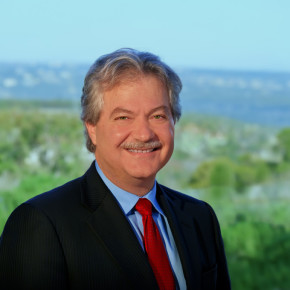
GiftCard Zen will continue to be based in Phoenix and its management team will report to Lou Agnese, senior vice president and general manager of RetailMeNot’s gift card business unit.

“RetailMeNot wants to be the one-stop shop for savings when a consumer shops at one of our thousands of retail partners or takes their family to a restaurant. GiftCard Zen is a great fit with RetailMeNot as its inventory of discounted gift card content will provide consumers another meaningful way for RetailMeNot to fulfill our mission to help people save money,” Cotter Cunningham, CEO and Founder of RetailMeNot said in a news release.

GiftCard Zen buys gift cards from consumers and businesses and sells them to consumers and businesses at a discount of face value. RetailMeNot estimates about $44 billion in unused gift cards exists in the U.S. and that’s just for cards issued between 2008 and 2014. Those cards could be sold on a secondary market like GiftCard Zen.

“GiftCard Zen shares the same mission with RetailMeNot, to help consumers save money when they shop at their favorite retailers, restaurants and brands,” Aaron Dragushan, founder, GiftCard Zen said in a news release.

In addition to the acquisition, RetailMeNot reported preliminary total net revenues for the first quarter to be at or above the high-end of guidance and in the range of $54 million to $54.5 million, versus guidance of $49 million to $54 million. And net income for the first quarter is expected to be between a net loss of $100,000 to a net income of $100,000.

RetailMeNot also reported preliminary total net revenues for 2015 are expected to be in the range of $228 million to $241 million, versus previous guidance of $225 million to $240 million.

Why Should Your Startup Get Funding in Austin?

By LAURA LOREK
Reporter with Silicon Hills News
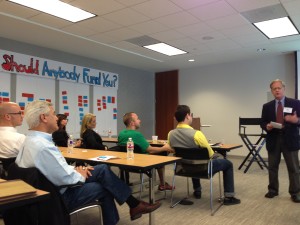
Mike Breck with the Texas State Small Business Development Center welcomes everyone to its Spectrum event on funding Austin startups.

Mike Breck with the Texas State Small Business Development Center welcomes everyone to its Spectrum event on funding Austin startups.

Startups and investors engage in a complicated dance in Austin’s funding ecosystem.

It is a topic which has generated a lot of discussion about whether enough investors and funds exist to finance entrepreneurs in Austin or whether the startups just aren’t good enough to land investment.

On Tuesday, about 70 people attended the Texas State Small Business Development Center’s Spectrum event at the Frost Bank Tower in downtown Austin for a panel discussion on “Why Startups Get Funded” moderated by Paul O’Brien, founder of Accelerate Texas.

IMG_7778The panel featured three entrepreneurs who landed investments on the TV show Shark Tank including Yuen Yung, now founder of Casoro Capital, a real estate investment firm and previously founder and CEO of How Do You Roll? a fast-casual sushi restaurant franchise. Christie Barany and Courtney Turich, co-founders of Monkey Mat, a portable playmate for kids, also participated. In addition, the panel featured an investor, Rick Timmins, chairman of the board of the Central Texas Angel Network.

IMG_7772To kick off the event, O’Brien asked the entrepreneurs to write on red and blue post-it notes on why investors should fund them and post them on a sheet under the amount of funding they are seeking from $100,000 on up. Many startups had revenue from grants, customers, government funding, contracts and more. Most were seeking under $1 million in funding.

O’Brien, who moved to Austin six years ago from Silicon Valley, said in California many entrepreneurs he meets start off with why they started their venture. In Texas, the entrepreneurs tend to talk about what they do. He said the most important message to convey to investors is why they should fund you.

“If you’re not capably communicating why you need investors and why they might want to work with you then they can’t help you,” he said.

O’Brien said customers and revenue aren’t always relevant.

“It comes down to why you’re doing what you’re doing,” he said.

In his presentation, O’Brien quoted from Businessman and Author Peter Drucker, saying the purpose of a startup is to create a new customer, not to find a customer.

“Because the purpose of business is to create a customer, the business enterprise has two and only two basic functions: marketing and innovation,” according to Drucker.

He also touched on the current controversy in Austin about whether the city has enough venture capital.

David Altounian, assistant professor of entrepreneurship at St. Edwards University, serial entrepreneur and a partner at Capital Factory, did a study on Austin’s venture capital investments last year. His conclusion is “Austin generates loads of seed money to fuel young businesses but lacks the Series A, Series B and late stage funding sources,” according to O’Brien’s presentation.

Then in February of this year, Richard Bagdonas, a serial entrepreneur in Austin, wrote a post “The Dark Ages of Austin Startup Capital” and published it on Medium and later republished on TechCrunch outlining a shortage of venture capital available for Austin entrepreneurs. That sparked a lively discussion among entrepreneurs and investors.

Indications are that venture capital investing is slowing down nationwide, O’Brien said. In his presentation, he quoted California Venture Capitalist Mark Suster saying “50 percent of the VCs tell Upfront Ventures that they will slow their pace.” And Mike Maples Jr., a partner in Floodgate, has reported that his firm will not invest in any more Austin based companies like Favor because of the Austin City Council’s recent regulations concerning ridesharing companies like Uber and Lyft and short term rentals that can be booked through sites like HomeAway.

After O’Brien outlined the difficulty in getting venture capital, he presented a slide with four questions entrepreneurs should answer on why they should get funded.

1. Why you? Why do you care?
2. Why will the market want it and why will it work?
3. Why do you need venture capital?
4. Why is this an opportunity for investors?

During the panel discussion, O’Brien asked the entrepreneurs why they got funding.

Barany, co-founder of Monkey Mat said investors on Shark Tank saw that they provided a simple solution to an everyday problem. They had only done $60,000 in sales, but they were building market traction, she said. In 2014 during Season 5 of Shark Tank, Lori Grenier and Mark Cuban invested $100,000 in the company for a 35 percent stake.

Yung secured the first $1 million investment on Shark Tank from Kevin O’Leary, known as Mr. Wonderful, during Season 4 in 2013. But the deal eventually fell through.

“When I look back at all the different things I’ve done they all got funded in different ways,” Yung said.

Yung said the key to his success was bringing people along on his entrepreneurial journey as if he were a travel agent. He painted a vision for investors and convinced them to come along on the journey, he said. For example, How Do You Roll wasn’t about sushi, it was about offering healthy food on the go, he said.

“Once they buy into that the money part becomes easier,” Yung said.

Those are all the different things that happen through the process to convince someone to write a check or wire the money, he said. They have to know what’s going on and they have to believe that you are going to do it, he said. And in the end, people only work with people they like, Yung said. You have to be someone an investor wants to work with, he said.

Timmins with CTAN said angel investors invest in people.

“You’ve heard that so many times it sounds sickening but it’s true,” Timmins said. “We will only invest in entrepreneurs we believe can do extraordinary things.”

The entrepreneurs tend to be younger than the investors and not have as much experience, or as much accumulated knowledge so they have to evaluate whether or not the entrepreneur can lead a group and motivate other people, he said.

“A simple quality that I look for all the time – can they listen, can they take direction, can they be mentored,” he said.

They also have to decide on some objective criteria like can the entrepreneurs meet a deadline and do something within budget.

Sixty percent of the criteria they put on a company, though, is about the individual, Timmins said.

That said, Timmins made a huge mistake in 2014. The largest investment CTAN made that year was in a bad entrepreneur and CEO.

“He turns out to be a cockroach,” Timmins said.
Paul OBrien with Accelerate Texas, moderated the discussion.

Paul OBrien with Accelerate Texas, moderated the discussion.

O’Brien thought that was funny because the term “cockroach” is now being used to label entrepreneurs who can survive the nuclear winter they are going to go through to find success.

Today, compared to eight or nine years ago it costs less to start a business but it is still not a trivial task, Timmins said.

He disagreed with O’Brien and thinks companies seeking investment should have a product or service completed and valuable customers.

“Go down the path of finding customers not just to help pay for the expenses you are going to occur but to validate your path,” Timmins said.

No matter what stage you are at you need cash, Yung said.

The bigger your network, the more likely it is you are going to find someone to finance you, Yung said.

Texas has 12 angel networks and there is an alliance of these networks that has been in place for four or five years to syndicate deals, Timmins said.

“In this community there are hundreds of super angels that invest in certain products, markets and industries,” Timmins said. “There is collectively a lot of money they use to invest. More important than the money, is the mentoring.”

In the end, most businesses fail even those that get investment.

“I got into the business knowing that most of these businesses are going to fail,” Timmins said. “Forty percent of every investment an angel will make will fail – and that’s knowing that I’m pretty good at selecting entrepreneurs. Thirty percent are going to return my capital in some form. Twenty percent are going to give me my capital back and some return. One is going to give me the return for all my investments I’ve ever made.”

“That doesn’t account for all the other businesses that didn’t get funding from me,” Timmins said. “This is a hard business. I have nothing but the utmost admiration for entrepreneurs knowing those odds.”

Next week, the Texas State Small Business Development Center will host Session Two: “Are You Targeting the RIGHT Source of Funding?” at the Frost Bank Tower on Wednesday.


Tarmac TX Accelerator to Launch in Austin

Photo courtesy of Tarmac TX

Photo courtesy of Tarmac TX

A new accelerator program, Tarmac TX, is launching in Austin. Esteban Fabiao, its director, answered a few questions via email about the nine month long program that offers coworking space, mentorship, events and workshops for seven startups. The program kicks off May 1st. The deadline to apply is Friday.

Q. SHN: What is Tarmac TX?

A. Tarmac TX is a 9-month 100% free accelerator program that has been set up by CALSO (a 501c3 nonprofit organization) in partnership with 3M. Its goal is to support startups developing tech-based solutions addressing social and environmental issues. It is part of a global network of 13 accelerators in 10 countries (San Francisco, Paris, Hong-Kong, Casablanca, Amsterdam, Brussels, Austin, Tunis, Luxembourg, Santiago, and Cape Town).

Q, SHN: Where are you based?

A. Tarmac TX is hosted at Tech Ranch, in North Central Austin.

Q. SHN: Who is heading up the accelerator?

A. The program has been designed by Nicolas Hazard, the President of CALSO. Locally, Tarmac TX is run by Esteban Fabiao. Esteban’s experiences as a consultant (A.T. Kearney) along with his project and team management skills are very valuable for the success of Tarmac TX. Having lived in Paris, Sao Paulo, and New Delhi, his international exposure is another asset for the selected teams to benefit from a different perspective.

Q. SHN: What do startups receive for participating?

A. Seven startups will be selected for the program. From May 2016 to January 2017, they will receive free co-working space at Tech Ranch, mentorship & one-to-one relationship with 3M’s engineers and employees, events and workshops, and networking opportunities (both locally and internationally).

Q. SHN: When are applications due?

A. The deadline to apply to Tarmac TX is April 8, 2016. Applications can be submitted on www.tarmactx.com.

Q. SHN: What kind of startups are you looking for to participate?

A. The program aims at supporting startups developing tech-based solutions addressing social and environmental issues. They can either be for profits or nonprofits, as long as the technology they are working on has a positive social or environmental impact. Ventures of any stage are eligible for Tarmac TX.

Q. SHN: Are there any funding opportunities for the startups?

A. CALSO, which is the nonprofit organization running Tarmac TX, is not seeking to make any investment itself. We want to help the startups which will be selected for the program with all the issues they are facing, including fundraising. We plan on connecting each startup with the right funders when they need to raise money.

Q. SHN: Why is this kind of accelerator needed in Austin?

A. Austin has an incredibly vibrant social impact ecosystem. The number of social enterprises created in Austin is growing. At the same time, the city has a high concentration of tech industries. Tarmac TX aims at bridging the gap between technology and social good. But social enterprises have a real need for business support services. They need help to structure their project and to be able to scale. Tarmac TX brings together experts from various backgrounds to guide those social entrepreneurs and help them take their project to the next level.

Q. SHN: How often do you plan to do the accelerator?

A. This is the first edition of Tarmac TX but we intend to have this program every year.

Q. SHN: Anything else you would like to add or make a point of?

A. The Selection Committee will be held at 3M Center on April 22, 2016. Ten to 12 startups will be pre-selected to pitch in front of a jury composed of experts in social entrepreneurship, as well as experts from the corporate sector, the local government, and the academic sphere. We are very excited with the great applications we are receiving! We are looking forward to helping these wonderful initiatives!

Q&A with CTAN: the Most Active Angel Group in the Country in 2015

Claire England, executive director of the Central Texas Angel Network.

Claire England, executive director of the Central Texas Angel Network.

The Central Texas Angel Network, known as CTAN, was the most active individual angel group in the country in 2015, according to the HALO Report recently released by the Angel Resource Institute and PitchBook.

Members of CTAN, a nonprofit organization of more than 150 accredited angel investors, invested more than $13.3 million into 43 startups last year. Of those, 20 were new investments and 23 were follow-on investments into existing portfolio companies. With these investment totals, the group increased its funding activity by 30 percent over 2014, though annual investment dollars dropped slightly from a high of $14.6 million in 2014. In addition, the CTAN portfolio achieved seven exits in 2015, almost doubling the group’s total exit activity since its founding in 2006.

Over the past 10 years, CTAN members have invested more than $68.4 million into 127 companies. Its top three investment industries are Information Technology and mobile software, life sciences, pharmaceutical and medical devices and consumer products, food and beverage. CTAN runs five funding cycles a year and the next deadline to apply is May 16th.

Rick Timmins, board chair of the Central Texas Angel Network.

Rick Timmins, board chair of the Central Texas Angel Network.

Claire England, CTAN executive director and Rick Timmins, board chair of CTAN, recently answered a few questions about the organization’s activity. The two jointly answered the questions by email.

Q. SHN: What were the top five investments for last year?

A. HUVRData, Ortho Kinematics, Phunware, Savara Pharmaceuticals, Xeris Pharmaceuticals. The last four listed were follow-on round investments for CTAN portfolio companies.

Q. SHN: CTAN had seven exits in 2015 – what companies had an exit?

A. Boxer, Deep Eddy Vodka, Fantasy Sales Team, Mahana, Mustang Valley Real Estate, Texture Media, Verb Products

Q. SHN: The investment dollars dropped in 2015, what does this indicate?

A. We can’t say for certain, but we do have a some thoughts on this… First, our single largest investment ever made in a company at one time was in 2014 ($3.1 million). This made 2014 a record year; yet, when we look back over the last five years, we show a significant upward investment dollar trajectory, and 2015 continues this trend.

Second, because our members invested in so many more companies than in previous years, it’s possible that affected the overall total investment dollars slightly. Essentially, our members spread their capital across a higher total number of startups in 2015, which we think is an even better outcome for our entrepreneur ecosystem.

To dive into the numbers further, the $13.3 million in 2015 still eclipsed the years prior to 2014 by a significant amount. For instance, the 2015 investment total represents a 37% increase over 2013. Simply put, the $14.6 million in 2014 was an outlier for CTAN with the largest-ever investment of $3.1 million into one company, while our overall investment growth remains very strong. Here’s the history from the past five years:

2015
$13.3M invested
43 companies
140 member investors

2014
$14.6M invested
33 companies
120 member investors

2013
$9.7M invested
32 companies
112 member investors

2012
$8.1M invested
28 companies
95 member investors

2011
$6M invested
22 companies
60 member investors

Q. SHN: What was the average investment size?

A. Our average investment size in 2015 was $363,000.

Q. SHN: What kind of startup is CTAN seeing as the most active?

A. We are seeing considerable variety in the type of startups in which members are investing. We have significant interest in both first-time CEOs and experienced CEOs; plus, diversity in seed-stage companies versus follow-on investment companies. Most of the companies are based in Central Texas, though we’re seeing increased deal flow from across Texas and even out-of-state.

Q. SHN: Is there any particular industry that is doing better than others?

A. We’re happy to say things look good across a variety of industries. We have an incredible diversity of experience in our membership base across multiple sectors, and it is reflected in the fact that in 2015, CTAN members invested in 12 different verticals.

Q. SHN: What would CTAN like to see from entrepreneurs in 2016?

A. Although funding is one of our principal activities, we also provide significant mentoring and advice to entrepreneurs pre-funding. We would like to see more entrepreneurs take advantage of this opportunity, especially by attending the Entrepreneurs Workshop that we provide to companies coming through each funding cycle. We strongly believe that mentoring and advising can improve outcomes, not only in terms of completing funding but also in long-term organizational success for startups.

Q. SHN: There’s been a lot of talk about a funding shortage in Austin for startups. What is CTAN’s opinion on this? Do your startups have trouble raising additional funds after the first stage from investors?

A. We have a policy to welcome back startups for further follow-on funding once they have received a seed investment from CTAN. These are our portfolio companies, which we seek to support in a number of ways, in addition to follow-on funding. Many of our portfolio founders take advantage of this funding opportunity. In fact, more than 50% of our funding in the last two years has been devoted to follow-on round investing for CTAN portfolio companies.

However, that said, there is still a shortage of capital in the Austin market as entrepreneurs attempt to raise funds beyond the early-stage rounds on which CTAN is focused. This has even been documented by a study released last year of funding in major metropolitan communities, including Austin.

Q. SHN: Anything else you would like to add or make a point of?

A. We think the best way to keep our momentum of increased investment activity going in 2016 is by growing our membership on an even more significant scale than in past years. We intend to do this by letting potential angel investors know about our strong deal flow, structured funding cycles, and first-class due diligence. We have an education program with topics and tools for investors of all experience levels; plus our member orientation and experienced mentors make it easier for those less experienced in angel investing to get started. The more individuals, couples, family offices, and investment groups that get involved in CTAN, the more capital we can deploy in seed-stage funding in our region.

Silicon Hills News to Launch the Innovative Coworking House of Innovation

SiliconHillsNewsLogoSilicon Hills News has covered the Central Texas technology scene for five years now and we have noticed a huge gaping gap in coverage.

The Austin and San Antonio region simply does not have a technology reality show that showcases all of the innovation gurgling up from the natural springs of this fertile cutting edge, paradigm shifting Internet Oasis.

So when we see a gap, we seek to fill it. And that’s exactly what we plan to do with our new Innovative Coworking House of Innovation. We’ve rented a big party house through HomeAway (just kidding) and we’re going to live in it. And we’re going to select a dozen startup entrepreneurs with game changing, big ideas, nothing little will be allowed, to move onto the lawn for six months. Each week a startup entrepreneur will be voted off the lawn and an old man (like 35 or even 40 years old) will come out of the house and yell at them to “Get Off My Lawn!” In the meantime, they will have to construct their own shelter with supplies they find in the wild, known as the cul de sac. We’re on the hunt for entrepreneurs looking to harvest water from meteorites or Mars or wherever the heck else we can steal water to supply the thirsty Texas cities sucking the aquifers dry. We’re also looking for someone to create that loopy thing to take us in a pod from Ray’s Drive Inn for puffy tacos in San Antonio to Round Rock Donuts in a few minutes without getting pod sick. Heck, we’ll even accept someone who can create a food pill that imitates tacos and donuts and a virtual reality headset of the venues so we never have to leave the house again. Other world changing ideas might include an invention that lets us read a book again or a Godzilla-like robotic monster that eats pollution and farts clean air.

All of the entrepreneurs accepted into the program will be put through a series of psychological tests which involve identifying a hiptser, hacker and hustler and also picking out satirical posts without consulting sites like Snopes. And all contestants will also be put through a physical obstacle course that involves throwing other contestants under a real bus, scaling a giant wall and pitching with a pitch fork. By the end of the first week, all contestants must have a minimal viable product and revenue of no less than $1 million or they will be disqualified.

The program also features weekly mentor sessions with Peter Thiel, Sheryl Sandberg, Oprah Winfrey, Mike Judge, Sandra Bullock, Matthew McConaughey, Willie Nelson and Robert Earl Keen. (If these actual people cannot be present because of a conflict in their work schedule, a suitable substitute mentor will be found through the Austin-based FindASubstituteMentorforaCelebrityYou’veBooked
WhoinNoWayPlanstoCometoYourEvent App.) More details will be posted soon.

U.S. Secretary of Defense Ash Carter Visits Austin and Talks Tech

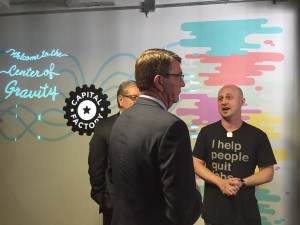
Defense Secretary Ash Carter talking with Capital Factory Founder Joshua Baer. Photo courtesy the Department of Defense.

Defense Secretary Ash Carter talking with Capital Factory Founder Joshua Baer. Photo courtesy the Department of Defense.

U.S. Secretary of Defense Ash Carter visited the University of Texas at Austin on Thursday followed by a trip to Capital Factory to talk tech with entrepreneurs.

During his visit to UT, Carter met with the Chancellor of the University of Texas System, Bill McRaven.

“At the University he met with the Institute on Domestic Violence and Sexual Assault, spoke to students and ROTC cadets on the Force of the Future, learned about the latest tech and innovation coming out of Texas Advanced Computing Center (TACC) and received up close demonstrations at ReNeu Robotics Lab,” according to the Department of Defense.

At Capital Factory, Carter hinted at opening a Department of Defense Innovation Office in Austin, according to those in attendance. (Silicon Hills News was not there. Maybe our security clearance isn’t high enough?)

At the event, Carter also announced registration is open for the Department of Defense’s Hack the Pentagon pilot program which encourages registered participants to find “bugs” or vulnerabilities in the government’s cyber security system.

It’s April and the Fools are Doing Their Thing

The Zebra, a car insurance comparison and aggregation startup, introduced its ICSPA or In-Car Selfie Prevention Alarm, a new vanity monitoring technology on Friday.

Aceable, the driver’s ed app, announced that Willow Smith, the 15-year-old daughter of actors Will Smith and Jada Pinkett Smith, contacted the Austin-based startup through her assistant because she’s interested in getting her driver’s license through Aceable’s California Drivers Ed.

At the University of Texas at Austin, President Gregory L. Fenves’ appointed a special task force on efficiency led by “lame duck Student Body President Xavier Rotnofsky and lamer duck Vice President Rohit Mandalapu.”

The Texas Comptroller issued a press release saying it plans to begin issuing #txcurrency with a $10 denomination featuring Willie Nelson.

And the Austin Chronicle is reporting that President Barack Obama just can’t get enough of the Austin tech and taco scene. The paper is reporting that the President plans to move here after his term is up.

Silicon Valley Pied Piper fans will love this one. At X, formerly Google[x], its mission is to invent and launch moonshot technologies that can make the world a radically better place — from self-driving cars, to internet-powered balloons, to energy kites, to self-flying delivery vehicles.

Today, it hired its first-ever Chief Compression Officer, Richard Hendricks, to lead the brand new Compression Team and make big ideas “smaller.”

A free hook up service at your local green grocery store? Yes, there’s an app for that. Austin-based Whole Foods announced this morning it is launching an in-store dating app called Main Squeeze.

From Space Salt to a Roomba that gives Zumba lessons, the Washington Post has compiled the most comprehensive list we’ve seen on brands making product and service announcement today.

How to Empower Women Entrepreneurs and Business Leaders

By LAURA LOREK
Reporter with Silicon Hills News

Screenshot (4)To get ahead, women must advocate for themselves, negotiate for equal pay, surround themselves with a supportive team and learn from mentors.
Those are a few of the tips gleaned from a panel of five executive women who have accomplished a great deal during their careers in corporate America during the Women Empowerment Through Entrepreneurship event Thursday night at the AT&T Executive Education and Conference Center.

Ingrid Vanderveldt, former Entrepreneur in Residence at Dell and now founder & CEO of EBW2020, moderated the panel. Preston James, an entrepreneur in residence with the Herb Kelleher Center for Entrepreneurship, Growth, and Renewal put on the event.

The glass ceiling still exists in the corporate world for women and even though they have cracked the surface, it has not yet been shattered, according to the panelists.

There’s a conference in New York called the Three Percent because just three percent of creative directors in advertising are women, said Leslie Wingo, president, and CEO of Sanders\Wingo, an advertising agency of 90 people. She said that has grown recently to 11 percent, but that’s still a fraction of where it needs to be, she said.

“That’s just cracking the surface,” Wingo said.

The glass ceiling is alive and well, said Christann M. Vasquez, president of Dell Seton Medical Center.

“I strongly believe we have a long way to go,” she said. “The demographics of the C-Suite clearly point that out.”

Women can shatter the glass ceiling by moving through their barriers and facing their fears, said Colette Burnette, president of Huston-Tillotson University. She moved from the corporate world into higher education and hit the glass ceiling when she didn’t have her doctorate. So at 55, she went back to school to get her Ph.D.

Women also must reach pay equality, said Wendy Smith, executive director of Seton Health Plan. There’s a 21 percent gap in female to male pay.

“That’s a huge focus for me,” Smith said. “That’s something that we have to have a voice on. It’s not acceptable that that gap exists.”

It’s difficult to find information on pay scales, Smith said.

“It’s hard to know even within your own corporation whether you are getting fair and equitable pay,” she said. But some online sites like Glassdoor can provide insight into industry salaries.

Don’t be shy and do your research about your salary, said Vasquez, president of Dell Seton Medical Center.

She learned a lot by reading Margaret Thatcher’s autobiography and Facebook Chief Operating Officer Sheryl Sandberg’s book, Lean-In. In that book, Sandberg illustrates how men are more aggressive in the workplace in negotiating what they want. Women need to do the same thing, Vasquez said.

And when it came time to negotiate her salary, Vasquez said she was “very clear about what I deserved to be paid and compensated unless they only wanted me to use 75 percent of my brain.”

“Don’t be shy, it holds us back and it doesn’t give us the right seat at the table,” she said.

The book Lean In empowered Burnette to not take the first offer when negotiating her salary with Huston-Tillotson, Burnette said.

“In the workplace, you have to be upfront and advocate for yourself,” Burnette said.

Don’t apologize for being a female, she said.

“I’m a black female. I like being a black female. I’m good at being a black female. So don’t apologize for that,” Burnette said.

Vanderveldt asked the panelists to talk about a moment of self-doubt in their careers and how they overcame it.

“I have self-doubt all of the time,” Wingo said. “You have two options when it comes to self-doubt. You can drink a lot of wine – which works momentarily.”

“The second option, sounds a little bit like Oprah, but it worked for me,” Wingo said.

First, acknowledge the self-doubt exists, then take note of when it happens and lastly write it down on a board. Then look at the list when you feel the self-doubt creeping in and it erases the self-doubt because they are just meaningless words, Wingo said.

“If someone told all the mean things to you that you tell yourself you would not be friends with that person,” she said. “So you need to tell yourself to shut up.”

Lynelle McKay, CEO of Girl Scouts of Central Texas, said she was filled with self-doubt as an engineer in the tech world. To overcome that, she created a network of people around her that could pump her back up again. A native of Hawaii, McKay ended up working in Phoenix, Arizona for Motorola in the 1980s. Her male coworkers told her the only reason she got her job was that she was a double minority. Having her kids and working full time grounded her and she realized she just had to do what was best for her family. She said she just had to focus on not letting other people bring her down.

“They are reacting to you because of the issues they have not because of you,” she said. “I realized I just needed to let it go.”

Burnette began her career as an engineer with a degree from Ohio State University. At her first job at a power plant, she was hazed. Her co-workers, older white men, asked if her engineering school was accredited and took out a book to look it up. On her first day, they put her in the basement of a coal-fired powered power plant.

“My first inclination was to quit,” Burnette said. But she persevered. She did tell her boss that if put her in the basement again she would tell her dad and then she would beat her boss up. After that, they gave her a different level of respect.

“I learned to have a sense of confidence in myself and not to be pushed around,” she said. “That was to discourage me. That’s what I call dream thieves and I wasn’t going to let anyone steal my dreams.”

eRelevance Corp. Raises $4.5 Million in Funding

Robert Fabbio, co-founder of eRelevance, photo by John Davidson

Robert Fabbio, co-founder of eRelevance, photo by John Davidson

eRelevance Corp., which makes a marketing platform for small to medium sized businesses to engage customers, on Thursday announced it has raised $4.5 million in its Series A round of funding.

The Austin-based startup, co-founded in 2013 by serial entrepreneur Bob Fabbio, has raised $8.6 million since launching. The company plans to use the money for sales and marketing and other resources to support its growth.

Rally Ventures, based in Silicon Valley, led the investment round. Other participants included Chicago Ventures, Miramar Venture Partners and Rothenberg Ventures along with an existing group of angel investors.

“eRelevance is addressing a real problem for the (small-medium business) market as the challenges of modern marketing are too difficult for SMBs to solve with software. SMBs require great customer service, great customer results, lots of internal domain expertise and continued innovation to deliver results over time,” Tom Peterson, venture partner, Rally Ventures, said in a news release. “eRelevance is solving this problem and we’re excited to be part of the company’s future.”

As part of the funding deal, Peterson is also joining eRelevance’s board of directors.

“Our technology enabled marketing automation service gives SMBs a new affordable choice in helping them grow their business. Because we’ve automated much of what is traditionally labor intensive work using marketing software tools we are able to deliver high quality work in a very responsive manner, at a price point that is difficult to compete with. And, unlike others, we quantify the value that we are delivering with nearly immediate return on investment,” Fabbio, co-founder and CEO of eRelevance Corporation. Fabbio has founded several companies in Austin including Tivoli and White Glove Health.

Silicon Hills News did this profile on eRelevance Corp. last summer.

Flavr Wins International Accelerator Pitch Competition at SXSW

Angelos Angelou, founded the International Accelerator in Austin.

Angelos Angelou, founded the International Accelerator in Austin.

South by Southwest Interactive not only showcases Austin’s technology scene to the world, but it has also become a global stage for international startups to showcase their products and services.

This year, International Accelerator, based in Austin, held its first FastPitch competition at SXSW at the Mexican American Cultural Center.

Flavr, a food tech app from Belgium, won the competition. The startup’s app connects food lovers with food makers in an on-demand marketplace. Flavr won a spot in the International Accelerator’s program and $50,000 in seed capital investment.

“We came to SXSW Interactive as part of Startup.be, a startup program for Belgian companies. We found out about FastPitch a week before so we only imagined this as a chance to gain some valuable experience pitching startup investors, not win it outright,” Alexander Van Lear, Flavr CEO, said in a news release. “”I honestly can’t believe our good fortune and am truly thankful to International Accelerator for the chance to compete.”

Coming in second place was Ergon Foods, a Greece-based startup which promotes Greek gastronomy through branded products and restaurants. Third place went to Ark Analytics, a Switzerland-based SaaS credit management solution that helps corporations, banks and insurers assess and manage risk inherent in complex transactions. Altogether, nine startups from nine different countries participated in the pitch competition.

“Being able to host a pitching event like FastPitch with startups traveling from nine countries during the world’s pre-eminent startup tech conference was a massive undertaking,” Phil Pompa, managing director of International Accelerator, said in a news release. “It’s a testament to the great network we have built over the past two years and the rich diversity of startup innovators eager to come participate in the American market through our accelerator program.”

The FastPitch gave startups a chance to pitch a panel of successful startup entrepreneurs and angel investors in hopes of gaining an invitation to join International Accelerator’s year-long program valued at over $300,000 in capital investments and in-kind contributions.

International Accelerator is focused solely on non-U.S. citizen founders. Angelos Angelou, founder of Angelou Economics and a long-time economic adviser to the tech industry in Austin, founded International Accelerator in 2013. With two selection rounds per year in June and November, International Accelerator runs a year-long program that provides access to seed funding, quality mentors and unique time-saving services needed to launch a startup in the United States.

« Older posts Newer posts »

© 2026 SiliconHills

Theme by Anders NorenUp ↑