Page 145 of 352

Austin VC Deals Increase but Dollars Drop in the First Quarter of 2016

iStock_000030057966Large copyThe good news is venture capital flowing into Texas topped $591.9 million in the first quarter of 2016, up nearly 40 percent from $423.5 million for the same quarter a year ago.

But venture capital flowing into Austin during the first quarter of 2016 dropped 49 percent to $141.3 million, compared to $277.8 million for the same quarter a year ago.

Those figures are from the latest MoneyTree Report from PricewaterhouseCoopers and the National Venture Capital Association, based on data provided by Thomson Reuters.

In Austin, venture capitalists invested in 25 deals during the first quarter, a 24 percent increase in deals compared to the first quarter of 2015, according to the MoneyTree Report. It’s also a 56 percent increase in deals and a 41 percent increase in terms of dollars compared to the fourth quarter of 2015.

The top deals in the first quarter included SilverCar which landed $27.9 million in venture capital, followed by Pivot3 with $19.1 million, InsuranceZebra with $17 million, Vast $14 million and Dispersol Technologies of Georgetown raised $12 million, according to the MoneyTree Report.

In Austin, the software industry attracted $57 million in eight deals making it the top investment sector, followed by media and entertainment with $32 million going into five deals and computers and peripherals attracting $19 million in one deal.

Five industries saw a decrease in investment dollars in Austin during the first quarter including healthcare services, industrial/energy, medical devices and equipment, semiconductors and biotechnology.

“In Q1 2016, all stages of development have experienced an increase in investment funding in terms of dollars compared to the prior quarter,” according to a news release. “The number of Seed, Early, and Later Stage deals increased, while the number of Expansion Stage deals decreased compared to the prior quarter.”

The rest of the state did well in attracting venture capital dollars in the first quarter with Dallas getting $104.1 million in 11 deals, Houston attracting a whooping $335.4 million in 11 deals and San Antonio bringing in $11 million in one deal.

Nationwide, venture capitalists invested $12.1 billion in 969 deals in the first quarter of 2016, with dollars and deals down 11 percent compared to the same quarter a year ago, according to the MoneyTree Report.

“Forecasting the year based on the first quarter is always difficult, but a few interesting trends stand out. While total venture investment activity didn’t jump out of the gate as quickly as last year, it was still a strong first quarter for venture activity compared to recent years,” Bobby Franklin, President and CEO of NVCA, said in a news release. “Of the decline that we did experience, most of that can be attributed to nontraditional investors scaling back their investment activity and refocusing on their core businesses. After a string of strong quarters for fundraising, venture investors will continue to be busy putting risk capital to work by finding and funding innovative ideas and growing them into the next generation of great American companies.”

“The first quarter appears to tell us that investors still have faith in the venture ecosystem,” Tom Ciccolella, US Venture Capital Market Leader at PwC, said in a news release. “However, the increase in expansion and later stage financing, combined with the drop in first-time financing, suggests a shift towards relatively mature startups.”

Houston-based Alert Logic Acquires Austin-based Click Security

ClickSecurityHouston-based Alert Logic announced it has acquired Austin-based Click Security.

The terms of the deal were not disclosed.

Alert Logic, security as a service solutions provider for the cloud, acquired Click Security to bolster its security analytics and threat detection solutions and to add to its security and engineering talent. The companies also provide complementary threat detection and incident analysis capabilities.

Marc Willebeek-LeMair and Brian Smith founded Click Security in 2011. They previously founded the network security firm TippingPoint Technologies Inc., which was acquired by 3Com Corp.

Click Security has raised $24.7 million including a Series B round in 2013 led by Lightspeed Venture Parnters, preceded by a Series A round led by Sequoia Capital in 2011. Other investors included Citi Ventures.

“Click Security has developed innovative approaches to detecting suspicious activity, correlating alerts, providing contextual intelligence and automating the analytical process to arm customers with deep security insight and continuous protection,” Gray Hall, CEO of Alert Logic, said in a news release. “We plan to quickly integrate the Click Security employees and technology into the Alert Logic Cloud Defender Security-as-a-Service platform to further protect our customers’ business critical IT infrastructures.”

Click Security provides firewalls, anti-virus software, intrusion prevention syhstems and real time security analytics that allow businesses to detect changes and identify an attack on its systems.

“Our founding vision at Click Security was to combine innovative security detection technology with advanced managed security solutions,” Willibeek-LeMair, chairman and founder of Click Security, said in a news release. “We are excited to be joining the industry leader in Security-as-a-Service solutions for the cloud, and to continue pursuing our original mission on a larger and faster-growing platform.”

WeWork Opens Second Location Near UT Austin’s North Campus

By HOJUN CHOI
Reporter with Silicon Hills News

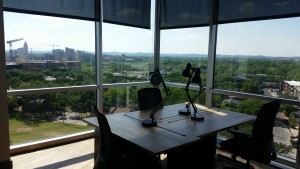
WeWork's new location near UT Austin's North Campus, photo by Hojun Choi.

WeWork’s new location near UT Austin’s North Campus, photo by Hojun Choi.

WeWork opened its second Austin location, “WeWork University Park” on Monday.

The new space is located on the 7th floor of the University Park business center at 3300 N. Interstate 35, near the University of Texas at Austin’s North Campus area. The building also houses one of Google’s Austin offices.

Emanuel Ibarra, program coordinator for the Herb Kelleher Center for Entrepreneurship at The University of Texas at Austin told Silicon Hills News that the university is looking to work more closely with the new WeWork location.

“Right now everything is preliminary and we really have not decided on or formalized anything,” Ibarra said. “For the most part, I think their community manager is trying to figure out if there is a better way to integrate the startup community at the university into what WeWork is doing.”

In addition to all the amenities offered at WeWork’s location on Congress Avenue, the space will also provide a fitness center for its members, along with free garage parking. The new 24,747 square foot coworking space will allow WeWork to accept about 470 more members in the Austin area.

The New York-based startup opened its first Austin location in February 2015, and hosted a launch party in March during which co-founder Adam Neumann spoke favorably of Austin’s startup scene, and talked about his inspiration for being an entrepreneur.

“It’s about being a global citizen for the world,” Neumann told Silicon Hill News during the 2015 launch party.

Earlier this year in March, the Wall Street Journal reported that the short-term lease co-working space, which was founded in 2010, had reached a valuation of $16 billion.

The newest WeWork location is one of several coworking spaces to open in the Austin area lately. TechSpace and Galvanize both opened downtown locations recently. They join other coworking spaces catering to entrepreneurs downtown like Capital Factory, fibercove, Vuka, Orange Coworking and Urban Co-Lab.

Correction: this article originally stated the square footage of the new space at 24,000, but the article has been updated with the exact figure which is 24,747 square feet.

Serial Entrepreneur Menell Joins Investor Relations Firm AngelSpan

By SUSAN LAHEY
Reporter with Silicon Hills News

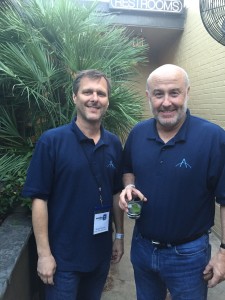
Bryan Menell and Joe Milam of AngelSpan

Bryan Menell and Joe Milam of AngelSpan, photos by Susan Lahey

Bryan Menell hosted his longstanding, monthly, Austin Tech Happy Hour Thursday at the Dogwood, except this time he was wearing an AngelSpan t-shirt. The serial entrepreneur sold his most recent company, Mahana, to Crunchtime in 2015 and has been looking for opportunities since. At the February Austin Tech Happy Hour, he asked friend Joe Milam, who runs investor relations firm AngelSpan, how things were going. One conversation led to the next and this week Menell announced he was joining AngelSpan.

AngelSpan helps startup entrepreneurs with their communication, accountability and relationships with their investors including monthly and quarterly updates and time-sensitive bulletins. Milam, who formerly worked from Silicon Valley’s famous money street–Sand Hill Road–founded Legacy Capital Management, which specialized in investments from family offices—family run investment vehicles. Milam explained his long game to Menell: “I want to increase the velocity of investing activity from what I call legacy angels into important and meaningful entrepreneurial opportunities…. There’s a gap in information, there’s a gap in knowledge, there’s a gap in the mechanism to do that efficiently, that’s what I want to solve….”

Bryan Menell and Joe Milam with AngelSpan

Bryan Menell and Joe Milam with AngelSpan

Austin is not a hotbed for family office investments because most of the money locally is new money, Milam said. But money from multi-generational wealth in cities all over the globe is available for investment in Austin startups, especially because money goes farther in Austin than many other cities.

“I’ve always known I needed someone with operating and execution experience to build out the vision.”

Menell is that someone.

Menell said he has always cared about helping entrepreneurs, which makes AngelSpan a fit. But he was also interested as someone who has had several investments.

“When you raise money from people, hopefully you get smart money from people who are connected, they have relationship, industry experience. But entrepreneurs take the money and then don’t communicate with them. I would write a check and then a year later get ‘Hey I need more money.’ And I’d be saying ‘I didn’t even know you were still in business. I haven’t heard anything from you, you haven’t leveraged my expertise, why would I invest again?”

Menell will serve as COO of the company.

New Funds Seek to Provide More Money for Austin Entrepreneurs

By LAURA LOREK
Reporter with Silicon Hills News

IMG_7786In Austin, entrepreneurs get funding from a wide variety of sources to launch or accelerate a new venture.

Those sources include friends, family, fools, banks, grants, incubators, angel investors, strategic partners, venture capital, private equity and other sources.

A panel of funding experts gathered Wednesday afternoon in an 11th floor conference room at the Frost Bank Tower to talk with entrepreneurs about where startups should seek funding for their ventures. The event, sponsored by Texas State Small Business Development Center, was the second part in a two-part discussion on funding startups. Last week, a different panel talked about why entrepreneurs should seek funding.

Paul O’Brien, founder of Accelerate Texas, moderated both of the discussions.

The latest panelists included Krishna Srinivasan, general partner, Live Oak Venture Partners, Sara T. Brand, founding partner, True Wealth Ventures, James Earl Brown II, founder, Arena Growth Partners and Orlando Castillo, senior lender, Able Lending.

LiveOak Venture Partners closed on its $100 million fund in 2014. Srinivasan and his two founding partners came from Austin Ventures. They saw an unmet need for seed stage and Series A funding for Texas-based entrepreneurs.

At True Wealth Ventures, Brand and her venture partner, Kerry Rupp, invest in women-led seed-stage startups in consumer health and sustainable products and technologies. They expect to have a $20 million fund. They plan to make 10 to 12 early seed stage investments ranging in size from $250,000 to $500,000, she said.

“Our thesis is a financial one that more gender diverse teams derive better financial performance based on a number of different studies,” Brand said. She also founded 512 Brewing Company with her husband, Kevin.

Arena Growth Partners is also raising a new fund. It is raising a $50 million fund focused on Information Technology and Information Technology enabled devices, Brown said. He has spent the last 20 plus years in the venture capital business with JP Morgan Capital, Polaris Partners and most recently he served as director of entrepreneurship at the University of Texas at Austin.

During his time in Austin, Brown has identified big gaps in the entrepreneurial ecosystem in funding and leadership talent. His firm is focused on encouraging people to think bigger and helping them get there, Brown said.

Able Lending focuses on debt financing, said Castillo. He joined the startup two years ago. It will do between 400 to 500 transactions this year, he said. The company is the lowest lender in the U.S. that is not a bank with an average rate of 10.7 percent on loans, he said.

O’Brien asked the panelists how they managed deal flow.

Able’s deal flow comes from outbound calls, banks, connections with the Small Business Development Center and a lot has come from word of mouth advertising, Castillo said.

True Wealth Venture gets deal flow from judging pitch competitions, mentors at Capital Factory, Brand said.

Of all the venture capital backed companies only three percent are women led, Brand said. It’s tough to find deals through traditional channels. So True Wealth Ventures is doing speaking engagements and social media outreach to find them, Brand said.

“One of the approaches Arena has taken is we’re trying to be helpful,” Brown said. The firm focuses on taking the servant leadership approach, he said.

LiveOak Venture Partners encourages entrepreneurs to submit business plans via email to plans@liveoakvp.com, Srinivasan said.

“Contrary to somewhat public perception, the partners at LiveOak, we are as eager to meet and interact with entrepreneurs locally as they are to meet and interact with us,” Srinivasan said.

Out of the 15 investments LiveOak has made, two of those investments came through email, Srinivasan said.

Entrepreneurs that submit an email plan also get a reply from one of the partners at LiveOak and if it’s within its investment focus in Texas, the entrepreneur is likely to get a meeting with one of the partners lasting from 30 minutes to an hour, Srinivasan said.

LiveOak meets with more than 300 companies a year, Srinivasan said.

Brown with Arena Growth Ventures, said he would challenge entrepreneurs to think about what they want to be when they grow up and how many nos are they willing to take and what are they willing to learn from them. And what do they want out of a partner.

“One of the challenges in Austin is there is not enough of us,” Brown said.

Austin got four to five new venture funds just because Austin Ventures went away, he said.

Entrepreneurs in Austin don’t get a chance to get enough nos, Brown said. They can meet with six venture firms here and then they’re done, he said. In Silicon Valley, they can meet with six venture firms in one day, six the next day and so on, he said.

“By the time you get to the 50th person who says yes, part of the reason is because your pitch looks fundamentally different than the first time you gave it and the tenth time you gave it and the 20th time you gave it,” Brown said. “So unfortunately you don’t get that opportunity here.”

There’s been a tremendous improvement in the market for early stage venture capital in Austin during the last few years, said Srinivasan. There’s about 20 early stage companies that received funding in the last three years, he said. That’s a huge improvement from the lack of early stage funding between 2009 to 2012, he said.

In Austin, angel investors are different than in Boston and the Valley, said Brown.

“In Austin, you have a lot of very smart people with disposable income that don’t know a whole lot about technology,” he said.

In the Valley or Boston, an angel investor is a two to three plus successful serial entrepreneur who has been there and done that in the space you are trying to start a company in and they get it, Brown said.

“You don’t have to evangelize in the space, they get it,” he said. They can introduce you to experienced employees and customers in your industry, he said.

“Here you don’t get that,” he said. “Here it can be a beauty contest. So what that means is that if you can convince them to invest in something that they don’t know but they are interested in you can get that capital.”

There’s a ton of capital in Austin where an entrepreneur can raise up to $1.5 million from people who don’t know a lot about the technology or industry and can’t help, he said.

The panelists also talked about syndicating deals. That’s one way to make the entire ecosystem thrive and grow through cooperation, collaboration and syndication, Srinivasan said.

One of the best things about Austin is it is a friendlier place – there’s this rare opportunity in Austin for more cross-functional innovation than there is in other cities, Brand said.

A key supply and demand imbalance exists in Austin today, Brown said. Entrepreneurship in Austin is at an all-time high, Brown said. At the same time, access to capital – institutional or otherwise is at an all-time low, he said. So there’s frustration in that tension and that’s understandable, he said. New funds are springing up to fill the gap but it’s taking time, he said. And entrepreneurs don’t have patience, he said.


RideScout and GlobeSherpa Rebrand as moovel

By HOJUN CHOI
Reporter with Silicon Hills News

mooveltransit's Austin office, formerly RideScout

moovel North America’s Austin office, formerly RideScout

Austin-based RideScout and Portland Ore.-based GlobeSherpa are merging under one brand: moovel North America.

Under the rebranding, Joseph Kopser, co-founder of RideScout, will be taking on the position of president of moovel Group GmbH, a subsidiary of German automobile titan Daimler AG – most famously known for their ownership and operation of Mercedez-Benz.

“In his new role as global president of moovel Group GmbH, Joseph is responsible for shaping and communicating the organization’s vision, mission and overall strategy on a global level,” company spokesperson Patti Kelly wrote in an email.

The announcement of the merger is the newest development in the business partnership involving the two startups and moovel Group GmbH, which acquired RideScout in September 2014.

RideScout uses a mobile app to better assist people searching for available transportation options.

RideScout announced in June 2015 that it had acquired GlobeSherpa, a company that provides a mobile platform for booking tickets for public transit.

One of the co-founders of the mobile ticket startup, Nat Parker, will now serve as the CEO of moovel North America, which will be headquartered in Portland.

“Transportation is no longer just a question of options, but of convenience and ease of use,” Parker said in the press release. “Our exceptional teams in Portland and Austin are in pursuit of the most seamless experience for both transportation providers and consumers to define the future of mobility.”

Large Logo-moovel_h_shiny_petrol_rgbKelly told Silicon Hills News that moovel, which also has offices in Austin, will continue to operate and that Kopser would continue being an active voice in the city’s startup ecosystem.

“Moovel is in pursuit of the best advancements that push the status quo with interoperable products built for transit agencies, app developers and end consumers,” Kopser wrote in an email. “At the end of the day, consumers not only want options, they want options that are efficient and easy to use – this is what we are striving to provide.”

Kopser and Parker announced the 2015 acquisition over a press conference live-streamed over YouTube, during which both co-founders expressed excitement over the chance to expand through the partnership- a sentiment Kelly said still holds true despite the new structure.

“We are happy to report both offices are growing and moovel North America will continue to hire in both locations,” Kelly wrote.

Kelly said that moovel is now looking to move forward with RideScout’s pilot project, “RideTap,” a software development kit that will allow other mobile services to easily integrate RideScout’s technology into their own platforms.

Though the application of “RideTap” has the potential to reach beyond just services that deal specifically with transportation, she said that it will help the newly formed entity, moovel, combine existing technologies of the two previously separate startups to best serve its customers.

“We are looking forward to launching the RideTap pilot in Portland later this Spring with TriMet, Lyft and Car2Go,” Kelly wrote. “Users of the TriMet Tickets app will be able to request a Lyft or reserve a Car2Go directly from the TriMet Tickets app, thanks to the RideTap software development kit.”

Correction: Due to an editing error, a previous version of this story referred to the merged company as mooveltransit. That is moovel’s ticketing platform. The name of the rebranded company is moovel North America.

HealthCare Texas 2016 to Take Place May 3rd and 4th in Austin

HealthcareTexaslogoWith the first Dell Medical School class kicking off in June with 50 students, the medical technology and biotechnology industry in Austin is set to boom.


Already, dozens of startups have launched in Austin and more are in the works.

So it’s the perfect time to gather for a conference to bring startups, investors and healthcare industry representatives together. And on May 3rd and 4th, the HealthCare Texas 2016 Conference will take place at Brazos Hall in downtown Austin. Dell Medical School, Texas Growth Capital Forum, the Austin Healthcare Council and the Moon Group at Merrill Lynch are sponsoring the event.

The conference will bring 300 innovators in healthcare information technology, digital health, life science and therapeutics together for two days. The event schedule includes three distinct program tracks. The first day will feature keynotes and innovation panels, and both days will have a program for venture capital matching.

The keynote speakers include Mark McClellan, former commissioner of the U.S. Food and Drug Administration and Christopher W. Kersey, chairman of Johns Hopkins International. In addition to the keynotes, the conference features 16 speakers and four forum panel discussions.

The conference also focuses on matching between startups and investors in the Series A and Series B stage. A select 20 companies with revenue of less than $3 million will receive invites to participate in private investor matched presentations and pitch open product presentations to all attendees during the startup expo event. Five finalists will be selected by a jury to present in a fast pitch form for a chance to win the Series A Venture Award.

The next day will focus on Series B financing. A select 35 Texas growth companies seeking late stage funding with revenue of $3 million or more will participate in private investor matched one-on-one sessions. Of that group, a jury will select the top five for a fast pitch competition for a chance to win the Series B Innovation Award.

“Our mission is to measurably increase venture capital and investor presence throughout the state,” Matt Black, director at the Texas Growth Capital Forum, said in a news release. “Startups founded in Texas need broader access to capital at every stage of growth to maximize any potential to achieve global scale. We’re focused on attracting diverse capital interests to Texas to build a last national network.”

For more information on the conference, visits the Texas Growth Capital Forum website and to register click here. Use the promo code #HCTX for a 20 percent discount.

Editor’s Note: Texas Growth Capital Forum is an advertiser with Silicon Hills News.

LiveOak Adds Venture Partner Focused on the Dallas Market

LVLiveOak Venture Partners announced Friday it has added Ram Velidi of Dallas as a new venture partner.

Velidi has had extensive experience as a venture investor over two fund cycles at Sevin Rosen Funds. He also has experience working with entrepreneurs as an executive with Net.Orange/NantHealth and Xybridge/ZHNE. Velidi will focus on investments in the Dallas Fort Worth Metropolitan area.

“Ram has a lot of experience in buildling a sustainable and growing organization, but his humble coaching style makes me as the entrepreneur open to his ideas,” Gagan Sharma, founder and CEO of Dallas-based BSI Financial Services, said in a news release.

“The founders of LiveOak have had tremendous success investing in Dallas based companies while at Austin Ventures,” Venu Shamapant, founder and general partner of LiveOak Venture Partners, said in a news release. “We look forward to repeating that success at LiveOak. Having Ram on the ground in the DFW Metroplex will be a great way to accomplish exactly that.”

LiveOak, a $109 million fund based in Austin, was founded by Ben Scott, Krishna Srinivasan and Venu Shamapant, all formerly of Austin Ventures.

Music Meets Video Launches in Austin

MMVMusic Meets Video, a new user generated content platform for emerging music artists, launched this week in Austin.

The startup has partnered with We Are the Hits, a leading music publisher, that allows it to host content from Universal Music, Sony/ATV, Warner/Chappelle and Kobalt Music Group’s song catalogs with more than six million hit songs.

Music Meets Video lets musicians cover songs by popular and emerging artists, then compete in head-to-head, fan-voted contests, with significant cash prizes. It’s kind of like American Idol on a small screen. The idea springs from singers and musicians posting videos to YouTube. Sometimes those videos end up generating a lot of buzz and a huge fan base that can springboard a career. Music Meets Video’s contests provide cash prizes and exposure for emerging artists as well as sponsorship opportunities for brands and record labels.

“Landing this partnership is a watershed moment for our company,” Alex Mitchell, co-founder and creator of Music Meets Video, said in a news release. “The volume of songs we have publishing rights to is astounding and we can use this large catalog to launch innovative contests that will be beneficial to our users and our contest sponsors. The most significant value of the partnership is the ease of mind we can pass on to our sponsors and users who are confused about what they can and cannot do with cover videos online. Any content on Music Meets Video has clearance from the top music publishers in the world.”

Since launching its beta of MMV in March 2015, it has already created 20 contests serving up 2.5 million votes, 5.5 million video views, and provided independent music artists with over $25,000 in cash prizes to fund and further their careers.

“We have found a way to successfully serve three very big markets,” Luis Berga, co-founder of Music Meets Video, said in a news release. “Our contests help the artists who make up 100 million cover videos currently up on YouTube have a platform to get exposure and be discovered. We also help record labels discover new talent, and offer the $65 billion digital marketing industry (per Statista) a new, unique and affordable way to reach target customers.”

Music Meet Video is based at Capital Factory in downtown Austin and is part of its accelerator program.

Screenshot (5)

Austin-based Aeglea BioTherapeutics Goes Public and Raises $50 Million

AegleaAeglea BioTherapeutics went public on the NASDAQ Stock Market Thursday at $10 a share with an Initial Public Offering bringing in $50 million.

Shares in the biotechnology company, which develops enzyme-based therapeutics in the field of amino acid metabolism to treat inborn errors of metabolism and cancer, closed down two percent at $9.77 a share.

Aeglea originally filed papers with the Securities Exchange Commission last June for an Initial Public Offering to raise $86.2 million.

The company plans to use the proceeds from the stock sale to fund the continuing development of its AEB1102 cancer fighting drug and to fund other drugs as well as for working capital, according to its registration statement filed with the SEC. The company recently began Phase One clinical trials of the AEB1102 drug in seven patients.

Aeglea licenses research from the University of Texas at Austin. It licenses the research work of UT Professor Dr. George Georgiou “on the engineering, optimization and initial animal validation of human enzymes to determine the systemic depletion of amino acids for cancer therapy and analyze enzyme replacement for the treatment of patients having inborn metabolic defects,” according to its registration statement.

« Older posts Newer posts »

© 2026 SiliconHills

Theme by Anders NorenUp ↑