Cruising around the Internet, it’s
difficult to know how much data is being gathered at the various websites a
person visits.
Of course, many have privacy polices
but many of those documents are so long that few ever plow through them.
And what’s being done with all that data? That’s an issue Osano plans to shed some light on.
Osana has built a platform for data privacy transparency. And it announced this week it has launched and raised $3 million in funding.
The Austin-based startup has created
Privacy Monitor, which is a free browser plugin and mobile app that helps
people manage their privacy when dealing with websites, software vendors and
other service provides.
Osano provides data analysis on the privacy policies of various websites through its Privacy Monitor app and browser plug-in. It allows users to determine how much data they want to share with websites and service providers.
“The average person doesn’t understand where their personal data goes in terms of how websites and service providers use and share it,” Arlo Gilbert, CEO and co-founder of Osano, said in a news release. “With data privacy at the constant forefront of tech industry and consumer conversations, greater transparency is desperately needed on the web to unlock the secrecy of convoluted privacy policies and give users control over their data again.”
LiveOak Ventures led the financing with participation from a
team of notable investors including Next Coast Ventures, Capital Factory,
Social Starts, Barracuda Networks and 345Partners Co-Founder Michael Perone,
data.world and Bazaarvoice Founder Brett Hurt, and Indeed Founder Rony Kahan.
Osano operates as B Corporation.
Gilbert is a serial entrepreneur who previously founded Meta
SaaS, which was acquired last year by Flexera. He also previously founded
iCall, a VoIP provider for iPhone which was acquired in 2012 and affiliate
marketing firm Click Feel Media.
QuotaPath, which makes a compensation management platform, announced this week it has raised $3.5 million.
The company, which is based in both Austin and Philadelphia, plans to use the funds to hire more employees and launch the QuotaPath platform to the public during the next three months. QuotaPath’s software allows anyone to track their sales commissions, bonuses, quota attainment, or paychecks.
ATX Seed Ventures, based in Austin, led the investment. To date, QuotaPath, founded in 2018, has raised $5 million. The company first launched its platform last September in a pilot program. And since then, it has seen interest in adopting it from startups and Fortune 500 companies, according to a news release.
A.J. Bruno, formerly CEO and Founder of Trendkite, is now Co-Founder
and CEO of QuotaPath.
“I’m incredibly proud of what we’ve done in such a short
time and this new investment is going to accelerate what we can do,” Bruno said
in a news release. “The next few months are going to be phenomenal.”
“The experienced team at QuotaPath has continued to
execute at a high velocity in an underserved space and we are thrilled to
continue the journey right along with them,” Chris Shonk, the Managing Director
of ATX Seed Ventures, said in a news release.
QuotaPath is a paid software that integrates with existing customer relationship management software, but it also has a free option, Cole Evetts, Co-Founder and COO of QuotaPath, said in a news release.
“We know how stressful it can be to ensure you’re being
paid properly and want to make it easier on everyone, regardless of your budget,”
Evetts said.
Austin is the new headquarters of Khoros, the combined company of Spredfast and Lithium.
Khoros announced the rebranding on Tuesday. The combined company
resulted from Lithium’s merger with Spredfast last year.
In September, when the two companies
announced their merger, they reported the headquarters would be in San
Francisco. Now, under the rebranding, the headquarters will be in Austin. But Khoros
will continue to maintain its San Francisco office and no employees will be affected,
according to a spokesman. Khoros has 431 employees in Austin.
Khoros has more than 2,000 customers including Pizza Hut,
Sprint, and HomeAway. It “manages more than 500 million consumer touch points
every day across social media, messaging, and owned channels,” according to a
news release.
“People crave connection,
and companies that create authentic connections with customers will thrive—but
it’s harder than ever,” Pete Hess, CEO of Khoros, said in a news statement.
“This challenge doesn’t just require new technology, but also a new way of
thinking. Since bringing together Spredfast and Lithium, we’ve been hard at
work to deliver on our promise to make truly comprehensive engagement possible.
We’re honored by the amazing reception we’ve had since the merger was
announced, adding more than 40 brand new customers in the last three months to
our incredible roster of leading brands.”
Khoros helps companies handle their social media accounts and
outreach online.
“This is very exciting
news for companies like ours that put our customers at the heart of our
business,” Unji Udeshi, Director of Global Customer Marketing at HomeAway, said
in a news release. “Lithium and Spredfast have been a part of our customer
engagement strategy for years as separate entities, helping us build customer
love and grow our business through our social media and owned channels. We’re
thrilled to see these two great platforms come together – it’s a real
game-changer for the industry.”
Khoros provides companies with one platform to manage all of
their social media accounts and provides a dashboard, data and analytics on how
social media posts are performing. It also uses artificial intelligence and
machine learning to provide customers with insights into their social media
accounts.
Ryan Merket, a
two-time founder, has also worked for Facebook, Reddit and Amazon.
And now he’s becoming a venture capitalist and joining Firebrand Ventures as a partner and opening its second office in Austin. Firebrand’s focus is investing in seed stage companies in Austin and the Midwest.
Firebrand, which was founded by John Fein in Kansas City, has strong ties to Austin. Its portfolio includes investments in five Austin-based startups from its first $17.7 million fund. Those companies include ScaleFactor, Threatcare, Candidly, PreFix and Skipper. Firebrand typically writes checks ranging in size from $250,000 to $500,000.
In total, Firebrand has invested in 20 companies from its first fund and it plans to announce its second, much larger, fund by the end of the year, Merket said. And 65 percent of its investments have a woman, person of color, or LBGBT founder, he said.
“We’re founder focused,” Merket said. “We have a
really great advisory team on Firebrand.”
Firebrand’s
advisers include David Cohen, Techstars’ CEO, Wendy Lea, former Cintrifuse CEO,
Brian McClendon, creator of Google Earth and Maps, and Tom Ball, co-founder of Next
Coast Ventures.
In addition to Firebrand,
Merket
is also incubating an idea with Techstars Studios on the side.
Merket, a self-taught programmer who grew up in New Braunfels, graduated from Oklahoma Wesleyan University with a communications degree. He taught himself how to code in 13 programming languages as a teenager. At college, the dean created a special self-directed program for him that allowed him to combine programming, design, and writing.
In 2008, Merket worked for a small design firm, PDG
Creative in Bartlesville, Oklahoma. At that job, he wrote a Facebook
application for TechCrunch that created a box that lived on people’s profiles
with TechCrunch headlines in it. The app was so popular, he got calls from the
New York Times, MSNBC and others to create an app for other media companies.
In 2009, Merket joined Facebook and worked on its Facebook
Connect team before leaving a year later to launch his own startup, MMTG Labs,
a white-label app store platform which launched on the TechCrunch DisruptNY stage
in 2010.
MMTG Labs raised $1.1 million from investors such as Sequoia Scout Fund, Alfred Lin, and 19 others. Two years later, InMobi acquired the company. For the next two years, Merket worked as director of product for InMobi and managed a team in San Francisco and Bangalore. He traveled 16 times back and forth to India.
Merket left InMobi in 2014 to join Reddit as one of
its first product developers. He worked there for a year before joining the Amazon
startup business development team where he has worked for the past three and a
half years. In addition, Merket has been an angel investor and has invested in 16
startups, five of which have been acquired.
Today, Merket, 37, lives in Austin with his wife,
Jenn, and their son, Charlie, 5, and daughter, Stella, 2. They moved to Austin
from the Bay Area two years ago to be closer to family.
Datical, which helps companies automate databases, Thursday announced it has received $10 million in funding.
River Cities Capital Funds led the Series C funding round with participation from existing investors S3 Ventures and Mercury Fund.
As part of the deal, Adam Midkiff, vice president at River Cities, has joined Datical’s board of directors.
Austin-based Datical, founded in 2013, plans to use the funds on research and development, customer service, and sales and marketing. To date, the company has raised $27 million. Datical was co-founded by Daniel Nelson, Robert Reeves, and Pete Pickerill — all founders of Phurnace Software, which was acquired by BMC Software in 2010.
“We are the market leader and have seen enormous growth in the last three years. This funding provides fuel for further innovation and expansion as Datical’s remarkable momentum has proven that modernizing the database release process is a necessary step in any digital transformation journey,” Derek Hutson, CEO of Datical, said in a news release. “We’re honored to have River Cities on board as we enter this next phase of growth and begin an exciting new chapter of transforming software development.”
Datical’s software lets companies update applications on their databases easily and efficiently.
“Datical is solving a critical, yet often overlooked problem facing development teams today,” Adam Midkiff, vice president of River Cities, said in a news release. “The company is uniquely positioned to change the way that organizations improve the customer experience through software, and we’re excited to work with such an innovative team on achieving this mission.”
Datical reported strong results for 2018, increasing its annual subscription revenue by 94 percent and increasing its customer base by 30 percent, according to a news release. Its customers include Freddie Mac, Anthem, Colonial Life and Zions Bancorporation.
Last year, Datical moved into new, larger 12,000 square foot headquarters at 9211 Waterford Centre Blvd, near the Domain. The company has less than 100 employees with plans to grow the team by 25 percent.
Hugh Forrest, Chief Porgramming Officer at SXSW, photo by John Davidson
By Laura Lorek, publisher of Silicon Hills News
Author and Journalist Malcolm Gladwell is the latest speaker to join the lineup at South by Southwest.
Gladwell is leading a documentary look at self-driving cars in the film “Autonomy,” which is set to debut at the SXSW Film Festival.
The film examines the world of automated vehicles and includes interviews with industry pioneers. It also examines how automated vehicles will affect society. Autonomous Vehicles could replace taxi, Uber and Lyft drivers, and truck drivers and be a huge disruptor in the transportation industry.
Hugh Forrest, Chief Programming Officer at SXSW, made the announcement about Gladwell joining the latest lineup of speakers during a Tech Talk breakfast meeting at the Austin Chamber of Commerce downtown Wednesday morning.
Artificial intelligence, which is the
technology that powers autonomous vehicles and robots, is one of the biggest
themes of SXSW Interactive this year, Forrest said. AI has been referred to as
the Fourth Industrial Revolution and it’s going to have far reaching impacts on
every sector of the worldwide economy.
Automation will lead to massive changes in the
workplace. And several speakers at SXSW including Ellen Shell, who wrote “The
Job: Work and its Future in a Time of Radical Change” and Kate Crawford,
co-founder and co-director of the AI Now Research Institute, will be talking
about the future of the workforce.
“A lot of the jobs we currently do are going to
be digitized,” Forrest said. “They are going to be outsourced.”
Robots cannot yet think as creatively as
humans, Forrest said.
In an age of increasing automation and machine
learning, creativity becomes an even more valued commodity, Forrest said.
“And that’s what South by Southwest is all
about,” he said.
During his talk, Forrest highlighted 30 speakers
who will have a huge impact this year. On the entrepreneurial side, they
include Adeo Ressi, serial entrepreneur and founder of Founder Institute and Kevin
Systrom, and Mike Krieger, co-founders of Instagram,
Another trend is actors and actress and athletes
increasingly turning to entrepreneurship, Forrest said. That can be seen with
speakers like Gwyneth Paltrow, founder of GOOP and Zoe Saldana, founder of her
own media company, BeSe.
Another highly anticipated speaker is Dr. James
Allison, who won the Nobel Prize in 2018 for his immunotherapy cancer
treatments. He is also the subject of a documentary film at SXSW called “Breakthrough.”
“It’s a lot about Austin the ‘60s and the “70s,”
Forrest said.
Allison went to the University of Texas at
Austin and was an aspiring country musician early on. The film is narrated by “Woody
Harrelson, and features music by Willie Nelson, Mickey Raphael, and a power
score by Mark Orton,” according to a news release. “Breakthrough tells Jim’s
story in a way that is inspiring, informative and highly entertaining.”
And the focus on medical technology and health
is a trend that SXSW continues to see with the opening of the Dell Medical
School at UT, Forrest said.
Another big theme at this year’s SXSW reflects
what’s going on in society with a growing digital distrust. Roger McNamee, a
Silicon Valley investor for 35 years and an early backer of Facebook and mentor
to Mark Zuckerberg, has written a just released book: “Zucked: Waking up to the
Facebook Catastrophe.” His talk should be thought provoking, Forrest said.
Other speakers Forrest highlighted include the husband and
wife couple, Author Neil Gaimen, and singer Amanda Palmer, Maria Shriver, who
will speak about Alzheimer’s disease and its effects particularly on women, Author
Brene Brown and on the music side, T. Bone Burnett, Wyclef Jean and David Byrne.
SXSW, which takes place March 8-17, has 25 tracks featuring panels, meetups, keynotes and more divided between Interactive, Film, Music, and Convergence. Forrest advises people it’s best to have a plan and not just show up and wing it to ensure people get the most of their experience.
Also, there’s a much larger presence of government speakers and politicians at SXSW this year. The talk by U.S. Rep. Alexandra Ocasio Cortez is also expected to generate a lot of excitement. In addition, SXSW just announced a two-day series of “Conversations About America’s Future” at SXSW in collaboration with the Texas Tribune. The speakers include Sen. Amy Klobuchar, former Gov. Bill Weld, Sen. Elizabeth Warren and former Governors Bill Weld, John Hickenlooper, John Kasich and former U.S. Secretary of Housing and Urban Development Julian Castro, House Minority Leader Kevin McCarthy and Mayor Pete Buttigieg.
Bigger than ever this year is the number of talks on the
legalization of marijuana and the burgeoning industry behind that movement.
Last year, SXSW had five panels on the topic. This year, SXSW has 60 panels on the
cannabis industry, Forrest said.
“SXSW is always about discovering the next big thing,”
Forrest said.
In 2014, Chris Shonk co-foundedATX Seed Ventures, an early-stage venture capital firm, based in Austin.
ATX Seed Ventures has three partners: Danielle Allen, Brad Bentz and Shonk.
Shonk said they saw the demise of Austin Ventures, the largest local venture capital firm which sunset that year, as an opportunity.
ATX Seed Ventures raised a $18 million fund in 2014, followed by a $32 million fund in 2016. Fund 2 is not fully committed, Shonk said.
“We still have capital to call and powder to invest,” he said.
ATX Seed Ventures plans to announce its third fund this year, Shonk said. It might announce something around South by Southwest, he said. Shonk spoke about the plans during a podcast interview with Ideas to Invoices.
ATX Seed Ventures has already had four exits of its portfolio companies including German car giant Daimler’s moovel brand acquisition of RideScout in 2014, FantasySalesTeam which sold to Microsoft in 2015 and Pledge Music’s acquisition of Set.fm in 2016, and Q2ebanking’s acquisition of Unbill in 2017.
“Millionaires were made,” Shonk said. And some of
those founders are now limited partners in ATX Seed Ventures’ fund, he said.
In its second fund, ATX Seed Ventures has invested in
12 companies and ten of them are founders that have previously run venture-backed
companies, Shonk said.
Some of ATX Seed Ventures other portfolio companies
include LIFT Aircraft, Slingshot Aerospace, SourceDay, RoverPass, GoCo, Olono,
Everfest and Alert Media. It makes investments of between $500,000 to $750,000
initially, but it will make whatever size it takes to lead, Shonk said.
There’s also a talent and experience spillover from startups
that exit in Austin, Shonk said. They bring a depth of executive and junior talent
to Austin that allows for the next generation of companies to go big, he said.
Seed stage deal funding in Austin has fallen for three
consecutive years, according to data from the PricewaterhouseCoopers MoneyTree
Report. But Shonk said that a lot of seed stage funding is now as large as
Series A funding used to be and that there is a focus on writing larger checks.
Seed stage is viewed as the Wild West, Shonk said. ATX
Seed Ventures is running a constructed fund, he said.
“It’s hard to do things small, at scale, that have
magnitude,” he said.
Most people have a shotgun approach to investing at
that stage, Shonk said.
But investing at that stage is really and art and a
science and that’s where ATX Seed Ventures’ expertise comes into play, Shonk
said.
“Seed and A are very fluid words, Shonk said. “The
seed rounds were leading now would have been A rounds back in the day.”
“But what we are seeing is tons of opportunities,”
Shonk said.
If something isn’t a fit for ATX Seed Ventures, he might send the deal to one of the accelerators in town or to angel investors, Shonk said.
For more on ATX Seed Ventures and Shonk’s views on Austin’s developing technology industry, listen to the entire podcast on Apple iTunes, Spotify or below.
Correction: This article has been updated to add all of the partners and to correct the date ATX Seed Ventures raised the second fund it was in 2016. Also, the second fund still has money to invest, Shonk said.
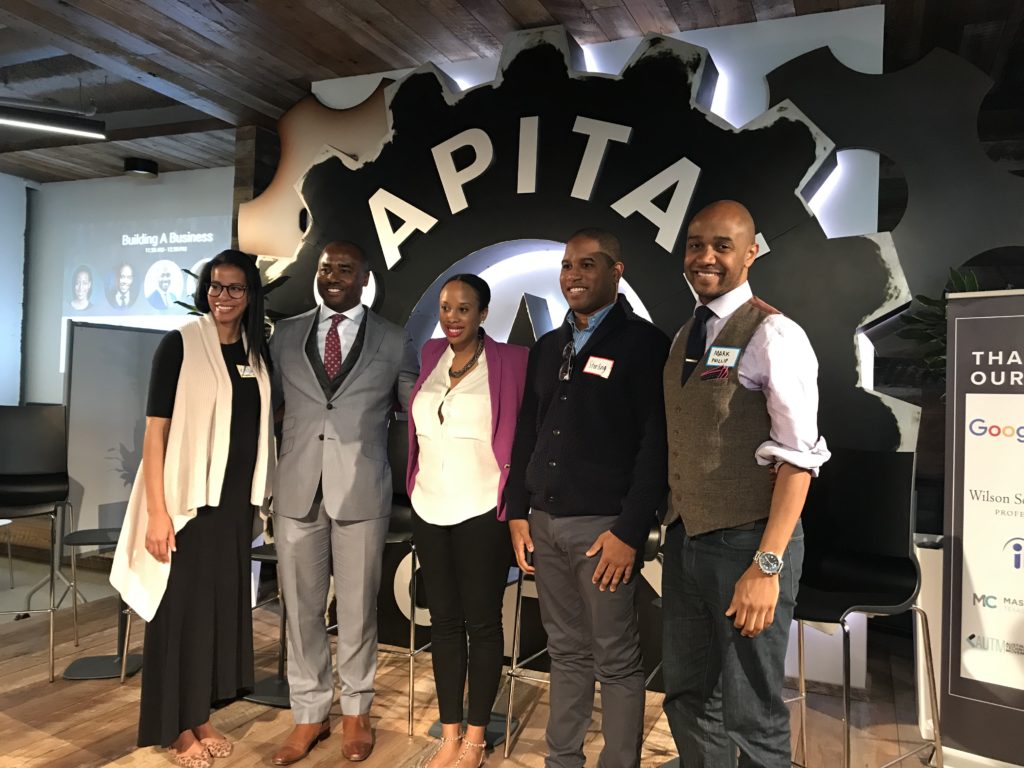
Panelists from Building A Business at the Black in Tech Summit at Capital Factory
By LAURA LOREK, Publisher of Silicon Hills News
The biggest problem Mark Phillip encountered in building a technology business in Austin was finding funding.
The founder and CEO of Are You Watching This, a sports data and analytics company, got told no by everyone, he said. Phillip spoke on the “Building a Business” panel at the Black in Tech Summit at Capital Factory last Thursday.
“I’m glad that
it happened now but I wasn’t happy about it then,” he said.
In the early days, Phillip spent $7,000 a month on data and ran his credit score down to zero because he financed his company with credit cards. But being able to get through that and get to profitability through bootstrapping was a huge accomplishment, Phillip said.
Phillip has a competitor in the Bay area that is
backed by venture capital. He said going toe to toe with the competitor, forced
him to build a company he could run by himself with better technology. Phillip
has a patent for excitement analytics that was awarded in 2016.
Today, Are You Watching This is profitable, Phillip
said. He runs the business out of his office at WeWork on Congress in downtown
Austin. Its customers include Bleacher Report, CBS Sports, Comcast, Golf Digest
and Sportradar.
But it hasn’t been easy to watch the changes in Austin
and the success of the tech community drive members of the black community
further out of town, he said. Phillip moved here from Baltimore 18 years ago for
a job with the intention of staying for a few years, but he never left.
Austin has undergone tremendous growth in the last two decades and because of its booming tech community, the city likes to look down its noses at the rest of Texas, Phillip said.
“We’re the cool kids, but we’re still the most socioeconomically
segregated city in the country,” Phillip said. “We still have one of the
smallest black populations in the state.”
Austin’s population is 7.6 percent black, according to
2018 stats from the U.S. Census Bureau. But gentrification and the growth of
the tech industry in East Austin continues to displace longtime residents. Many
of those residents have moved further north to Pflugerville.
It’s sad to see Facebook groups where everyone new
ends up in Pflugerville because that’s where they have to be, he said.
“We fix it here, we fix it with connections,” Phillip
said.
Allies and stakeholders in Austin, who are not black, who are focused on diversity are helping said Sterling Smith, founder of Launch Partner and Sandbox Commerce.
For example, Stephen Straus in Austin created the Startup Diversity and Inclusion Pledge in 2017 to help women and people of color get access to jobs, venture funding and opportunities in the technology industry, Smith said.
A.J. Bingham, who founded The Bingham Group, a law firm specializing in lobbying two years ago, grew up in Austin and graduated from the Liberal Arts and Science Academy, a magnet school at LBJ High School. He said he’s used to the lack of diversity in places like the Texas State Capitol, but he doesn’t let it deter him from going after what he wants.
Bingham became the first president of color of the Young Men’s Business League of Austin, one of the oldest social service organizations in Austin, founded in 1913. He’s also the only black person on the Long Center board of trustees. He said once a black person gets on a board, they can provide access for others to communities they might not have access to otherwise.
Panelists also talked about other challenges they have
encountered building businesses.
Resiliency is necessary because being an entrepreneur is a roller coaster ride, said Lauren Washington, co-founder Black Women Talk Tech and Fundr.
Surround yourself with others who are going through
the entrepreneurial journey, Washington said.
It’s important to be around people who understand what
you’re going through, she said.
Also, hiring is a critical at the early stage and every hire must be someone who believes in the mission and is willing to contribute whatever it takes to make it succeed, Washington said.
“It’s a really tough thing to find in a person,”
Washington said.
It’s also important to fire fast, she said.
For entrepreneurs just getting started, Phillip
advises them to create a monthly newsletter to share with supporters. It
provides accountability and can keep an entrepreneur on track, he said.
“When you are first getting started it’s a critical
thing to do,” he said.
Husband and Wife Co-Founders Javier Marriott and Ruth Stedman with their pup, Lola, are the founders of Groccery Pup, a healthy and fresh dog food brand
By LAURA LOREK, publisher of Silicon Hills News
Austin is known as a high-tech hub of innovative startups.
But
it’s also the birthplace of many consumer-packaged goods like Siete Family
Foods, a Mexican-American food brand, that just landed $90 million in funding.
It makes grain free chips, grain free tortillas, hot sauces, cashew queso and
more.
Siete
graduated from the Austin-based SKU Accelerator, which is a 12-week program with
a stipend focused on helping consumer products-based startups expand.
Other
products to launch out of SKU include Shade Tree Lemonade, Austin Eastciders, Seaweed
Bath Co. and Sway Water to name a few.
This week, SKU officially launched its seventh accelerator cohort with seven startups at a meet and greet party Tuesday night at Meet at Relay in Springdale General on Austin’s eastside. SKU selected Bhoomi Cane Water, Grocery Pup, Lamik Beauty, Pure Active CBD, Stackables, White’s Pickle Salsa and YVY.
Lamik Beauty is
a vegan, non-toxic cosmetic line for women of color. The SKU accelerator will
help Lamik expand, said Kim Roxie, its founder. She’s from Houston and used to
run a retail cosmetics store, but she shut it down to make her own cosmetics
line. Lamik has participated in DivInc and the SputnikATX accelerator programs.
SKU
picked Lamik and the other six companies from more than 400 applications for
its latest cohort.
Ruth Stedman and her husband Javier Marriott are also in the program with their startup, Grocery Pup. They created a healthy line of dog food made with human grade ingredients in a USDA human food facility in Round Rock. They didn’t like the highly processed dog food with bad ingredients that they found in most grocery stores. So, they created their own for their pup, Lola, a three-year-old Pomeranian Husky.
“We wanted her to eat fresh foods like us,” Stedman said.
Grocery
Pup is going to be sold at Whole Foods in Austin starting next week and is
currently available online. It comes in frozen one-pound pouches, which sell
for $8.95 or a bigger three-pound bags with three pouches with real beef,
turkey and pork flavors for $29.99. The food is cooked sous-vide style to
ensure maximum freshness.
“SKU has a lot of experience scaling brands,” Stedman said. The goal is for Grocery Pup to go nationwide via retail stores, she said.
Stackables is a portable and modular gas grill for tailgating or camping, said Megan Grigsby, marketing director. One-unit costs $399, and the company is currently taking pre-orders, she said.
“It’s
a heavy-duty grill that has a large cooking area and is going to last you a
long time,” Grigsby said.
What
Stackables hopes to get out of SKU is to really narrow down its target market,
Grigsby said. And establish a scalable go to market strategy, she said.
Third
generation farmer, Jon Kelley, decided to diversify his crop last year from
soybeans and wheat to industrial hemp at his family farm in Bartlesville,
Oklahoma. His company is Pure Active CBD.
The Hemp Farming Act in the 2018 Farm Bill removed hemp, defined as cannabis with a low concentration of THC, from Schedule 1 controlled substances and made it a regular agricultural commodity. It became legal last December.
Hemp
has a lot of uses, Kelley said. He’s extracting CBD oil from the plant and
putting into CBD-infused carbonated watermelon and citrus flavored waters.
His water, KAVVA, is in development right now and he plans to have it available for a pilot run in the can by March 5th, Kelley said. It will be available for retail sale in Austin and that’s why he’s in SKU to help him roll it out through distributors and stores, he said.
His
product, KAVVA, is going all the way from seed on his farm to shelf in the
stores, Kelley said.
The other SKU companies are:
Bhoomi
Cane Water which is made from cold-pressed fresh sugar cane from local farmers.
White’s
Pickle Salsa, a women-owned business based in Waco, Texas that provides a unique
alternative to traditional tomato-based salsa.
YVY,
a subscription-based, home cleaning product that uses an organic formula that
does not harm people, kids or pets.
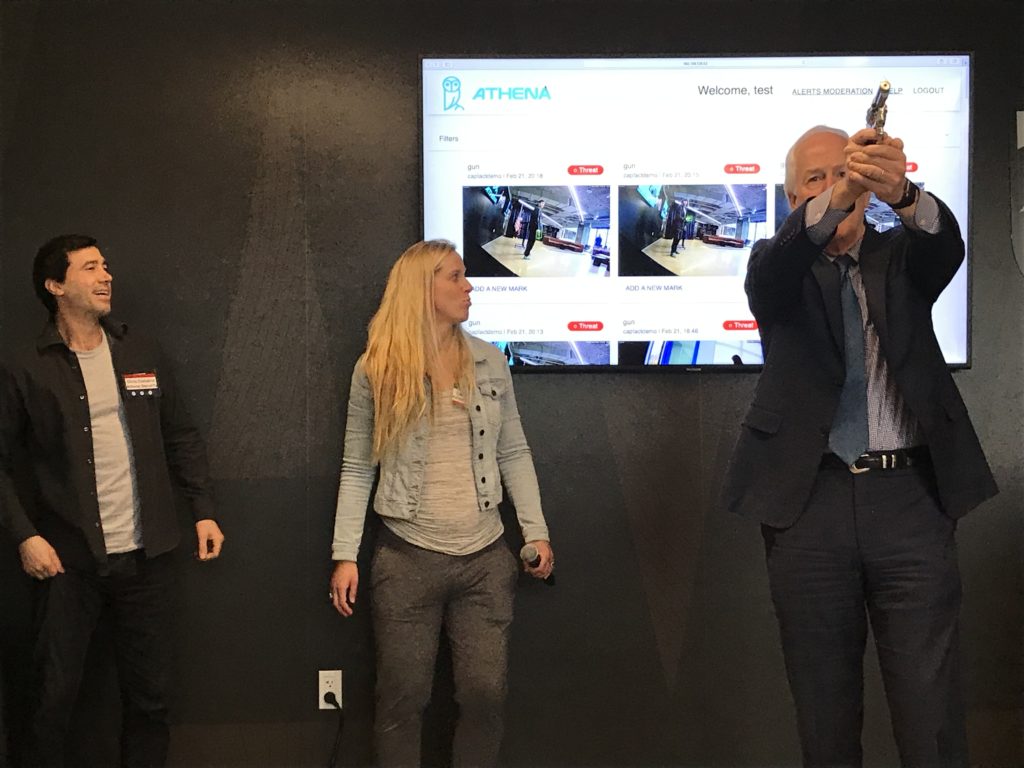
The founders of Athena Security demonstrating its gun detection technology with Sen. John Cornyn at the official opening of the Defense Innovation Center at Capital Factory
By LAURA LOREK Publisher of Silicon Hills News
Athena Security showed off its gun detection system at the official opening of the Defense Innovation Center Thursday at Capital Factory.
The startup uses existing security cameras coupled
with its specialized software that relies on machine learning and artificial
intelligence to identify guns in a public setting.
For example, if a person pulled out a pistol or an
automatic rifle at a school or church, the system would immediately send an alert
to law enforcement officials.
Sen. John Cornyn tested the system by pointing a
handgun, which Athena supplied, toward the ceiling during a live demonstration
of the technology Thursday afternoon.
Cameras captured the moment and flagged the handgun
with a green square on a picture that flashed on a big screen immediately.
Athena Security, which moved to Austin recently, is
run by Lisa Falzone, CEO and Chris Ciabarra, Chief Technology Officer. Their
goal is to prevent a crime from occurring by identifying a shooter early on
through their sophisticated artificial intelligence platform.
Athena is one of the startups that could potentially work
with the military at its new Center for Defense Innovation at Capital Factory,
on the eighth floor of the Omni Building in downtown Austin. The center had its
official grand opening on Thursday afternoon with hundreds of people in
attendance including dignitaries from local, state and federal government. They
included Sen. Cornyn, Texas Speaker of the House Dennis Bonnen and Gen. John M.
Murray, head of the U.S. Army Futures Command Center, based in Austin.
The Center for Defense Innovation has space for Army Futures Command, AFWERX, Defense Innovation Unit, the National Geospatial-Intelligence Agency and a team from Booz Allen Hamilton, a military contractor. Capital Factory is a co-working and technology accelerator in downtown Austin that is home to hundreds of startups and entrepreneurs. It also has a branch in Dallas and puts on programs geared to entrepreneurs.
Joshua Baer, CEO and Founder of Capital Factory, welcoming everyone to the official opending of the Defense Innovatin Center
“Capital Factory is the center of gravity for
entrepreneurs working in Texas,” said Joshua Baer, its founder and CEO. “This
is the place where entrepreneurs and innovators of all kinds come together to
collaborate and build a better future using technology.”
Now with this new floor, Capital Factory is a new
center of gravity of defense innovation, Baer said.
“This was not our idea,” Baer said. “We didn’t ask
DIU, the Air Force or the Army to come here. They came to us.”
The entire Texas ecosystem, including San Antonio,
came together to welcome the Army Futures Command to Austin, Baer said. Austin
competed with more than 140 cities for the command which is based at UT and
employs 500 U.S. Army personnel and civilians.
Another thing that makes the Center for Defense
Innovation at Capital Factory unique is that it isn’t in a secure facility,
Baer said.
“This is a place for collaboration, not for secrets,”
he said. “Serendipity is an essential ingredient for innovation and it’s hard
to have serendipity behind barb wire. And that’s why they came here.”
Sen. Cornyn said people don’t really think of the
federal government and innovation together. In fact, the federal government is
often thought of as antithetical to innovation, he said.
“So, I’m really excited to see the cross-cutting collaboration
taking place here,” Cornyn said. “And I think it will help us be stronger, be better
and be better stewards of the taxpayer dollar.”
The Center for Innovation tears down silos and forges
a path into the future for military readiness, he said.
The Army Futures Command chose to come to Austin
because it’s the best petri dish of innovation in Texas, Cornyn said. It is already
home to hundreds of technology startups and the University of Texas which has
one of the top ranked engineering schools in the nation, he said. UT also
specializes in robotics, artificial intelligence, machine learning, augmented and
virtual reality and other technologies the military needs, he said.
“When it comes to equipping our military with the best
resources and technology possible, we have to think outside the box and that’s
what the Army Futures Command is all about,” Cornyn said. “And I can’t think of
better place for that ingenuity than Austin, Texas.”
The military and Texas have a 150-year history and
strong bonds, said Texas House Speaker Bonnen. Texas provides the military with
more than 174,000 members, more than any other state after California. The
state is also home to 15 active military installations with a $100 billion
economic impact, Bonnen said.
Austin is home to 6,500 tech companies, 36 incubators
and tens of thousands of students and veterans, Bonnen said.
Gen. John M. Murray, head of the U.S. Army Futures Command Center, based in Austin.
The Army Futures Command is the largest reorganization
of the Army since 1973, said Gen. Murray. The first part of a problem is
addressing that there is a problem, and the Army has failed at modernizing its
forces for the past 30 years, Gen. Murray said.
No one in uniform wants to fight another war, Gen.
Murray said. They want to deter war and the way to do that is through strong
defense and innovation, he said.
The center has great potential in allowing the U.S.
Army to accomplish its mission to make sure soldiers have the tools they need, Gen.
Murray said.
Wall mural at the new Defense Innovation Center
In a press conference, Gen. Murray said he knows there
is interest from other companies in the defense industry to establish some
presence inside Capital Factory. He doesn’t know how many companies will move
here. That wasn’t the intention of the Army Future Command, he said. It wanted
to be close to where innovation was happening and to work with existing
startups to help it solve problems, he said.
In addition to Athena Technologies, Senseye also gave
a demonstration of its lie detector technology at the event. Senseye, a four-year-old
tech startup which moved from Los Angeles to Austin, has already worked with
the U.S. Air Force to help train fighter pilots.
Aside from all the startup activity, defense
contractors show up at Capital Factory daily since the Army Futures Command picked
Austin, Baer said.
To get an idea of what might happen in Austin, look at
Crystal City in the Washington, D.C. area, which has the nation’s largest concentration
of military contractors because of the Pentagon, Sen. Cornyn said.
Already, Booz Allen Hamilton, a military contractor, plans
to double its presence at Capital Factory. It currently has 35 employees and
plans to have 70 within a year, said Karen Dahut, executive vice president at
Booz Allen Hamilton, who leads its global defense business.
Booz Allen has been at Capital Factory for more than
four years. It has worked with “creative director Mike Wikan and his Austin-based
team to create Tabletop Commander, a virtual tabletop that uses immersive
technology and artificial intelligence powered natural language processing to
help the Air Force run virtual reality exercises,” according to news release.
Other products include Project Jellyfish, CodeLift and DataLift, to help the federal government collaborate more effectively with commercial clients, Dahut said.
The lockers at Capital Factory look a bit different since the military moved in