Siemens Healthineers, Prism Ventures, Genesis Merchant Capital, and Lago Consulting Group led the Series A funding.
In addition to the funding news, Babson has also appointed David Stein, Ph.D., former head of global strategy and innovation at Siemens Healthineers to CEO. Eric Olson, Babson’s founder, and former CEO will assume the roles of chairman of the board and chief operating officer.
Babson Diagnostics, incubated at Siemens Healthineers, has created technology that analyzes blood samples using a small sample from a finger prick.
“With our strategic partnerships, clinical studies, and research and development programs in place with key retail partners, this financing moves our company into a crucial commercialization phase,” Olson, Babson’s founder, said in a news release. “Together with our growing team and a strong network of strategic partners, we will realize our mission to improve our customers’ health by making diagnostic blood testing more convenient, accessible, and human.”
The company plans to roll out its
technology at retail locations throughout the country.
Babson’s first-generation SARS-CoV-2
IgG antibody test received FDA emergency use authorization in June. The
company’s antibody test is offered free of charge to essential front-line
pharmacy and grocery workforces and is currently in use in clinical studies
with leading research centers such as Dell Medical School at The University of
Texas at Austin.
Austin Startup, SigmaSense just closed on $22 million in funding to make touch screen devices perform better.
The company, founded in 2015, received the Series A funding led by Foxconn Technology Group, which is the world’s largest contract manufacturer of electronics with customers like Apple, Dell, and Sony.
Other investors
participating included Corning, E Ink, GIS, and
MRI and former Dell CFO Tom Meredith also participated in the round.
SigmaSense recently opened its new headquarters
in north Austin and has a strong development team in Boise, Idaho. The company
also maintains a customer and engineering support operation in Taiwan and is an
active member of the Silicon Catalyst network.
SigmaSense plans to use
the funds raised to make its touch solutions the stand in the $4.7 billion
interactive display market, which spans from mobile phones and laptops to large
interactive digital signage and whiteboards. SigmaSense will spend the funds
developing its semiconductor and software solutions.
It plans to put its technology in in-person touchless order kiosks for the hospitality industry and home entertainment applications.
The COVID-19 pandemic
has created a strong demand for “touchless” technology and that’s what
SigmaSense is going to focus on. It sees opportunities in automobiles, consumer
devices, medical products and industrial applications.
“This financing and powerful syndicate provide a
strong endorsement of SigmaSense’s technology breakthrough and the impact
across market opportunities,” Rick Seger, SigmaSense’s CEO, said in a news
release. “Our team has spent years developing new touch experiences that
outpace the market and will shift expectations across multiple
multi-billion-dollar markets. From foldable phones to large-screen game tables,
this new technology provides far better experiences.”
SigmaSense’s technology also reduces costs while boosting performance, according to the company.
“SigmaSense is
delivering an exciting new sensing technology and we look forward to bringing
some of their amazing touch capabilities to our interactive ePaper displays,” Johnson
Lee, CEO at E Ink Holdings said in a news release. “E Ink is devoted to
strengthening its ePaper ecosystem. With the collaboration with SigmaSense, E
Ink will be able to offer new technology to our customers to enhance their
products.”
SigmaSense’s reduced voltage and noise immunity
properties create better large screen touch technology, according to MRI, which
has an outdoor sign subsidiary.
“We’ve been the leader in building ruggedized
outdoor displays for years, but with the shift to interactive digital signage,
all new opportunities are emerging,” said Bill Dunn, CEO of MRI. “SigmaSense
performs reliably in rain, heat or cold, which is an extreme engineering
challenge. Simply put, they have nailed it, by providing reliable sensing
through thick, vandal-proof glass while wearing gloves.”
To spur innovations in geographic exploration for oil, Shell has launched a new innovation studio in Austin.
It’s called Studio X and it launched this month with three initial products focused on the future of exploration and discovery. This is Shell’s first innovation studio in the United States. The company, founded in 1907 as Royal Dutch Shell, is better known as just Shell. It is a global energy company with more than 80,000 employees and 2019 revenues of more than $344 billion.
In 2016, Shell made Fast Company’s most innovative companies list for its use of big data, and analytics. Shell used fiber optic cables to collect readings from oil well sites then crunched that data and analyzed it to determine lifetime productivity. That technology helped the oil giant to more effectively invest in productive oil sites.
Studio X is a place for entrepreneurs, data scientists, geoscientists, software engineers to crowdsource ideas to solve major challenges in energy exploration, according to a news release.
For example, Xeek, offers challenges for innovators to solve. Many of them come with a cash prize. One of the challenges that is launching soon is called “The Rock, the Strike, and the Dip.” “To figure out how the Earth has changed through time geologists collect “strikes and dips” (orientation and angle) from rock outcrops.” The challenge asks someone to come up with a solution to take the measurements using satellite images and radar digital elevation models. The challenge which launches soon has a $10,000 prize.
Studio X also is launching XCover, which is a global talent network for virtual exploration projects. It matches geoscientists to exploration projects. And its incubator, SixLab, provides exploration entrepreneurs with mentors, resources, and facilities.
“Studio X brings tech
advances at a challenging time for exploration and the global economy,” Mauhan
Zonoozy, Acting GM of Studio X, said in a news release. “The technology
within will lead to better ways of working in the exploration field —
increasing collaboration and ultimately improving outcomes. Studio X will fuel
big ideas, connect a network of global talent with remote work opportunities,
empower and guide entrepreneurs and startups, and crowdsource bold solutions to
make the ideas of today into the industry-leading tools of tomorrow.”
Studio X is focused on
collaboration and breaking down industry silos.
“Studio X was
developed by Shell to reimagine the future of work in exploration,”
said Marc Gerrits, Shell’s Executive Vice President of Global Exploration.
“To meet increasing global energy demand, oil and gas will remain an
element of the energy mix for decades to come. By harnessing efficiencies,
embracing new technologies, and deploying digital capabilities, Studio X will
be at the forefront as the exploration profession evolves.”
Austin-based Hypergiant Industries, which is focused on creating new products using artificial intelligence for businesses, has hired a heavy-hitter in the software industry, Mohammed Farooq, as its new Chief Technology Officer and GM Products.
Farooq also joining Hypergiant Industries’ board of directors. He previously worked as general manager with IBM Global Technology Services where he helped to build IBM’s hybrid and multi-cloud managed services business into a $35 billion business.
He joined IBM upon IBM’s acquisition of Farooq’s cloud software company, Gravitant, a pioneer in the hybrid multi-cloud market space. Before that, Farooq worked as Chief Technology Officer for the State of Texas for six years.
“Mohammed is a leader with decades of experience in the software industry particularly focused on scaling large software businesses. He helped transform IBM’s clients to digital and AI enterprises driven by hybrid and multi-cloud architectures that Mohammed developed,” Ben Lamm, CEO of Hypergiant Industries, said in a news release. “It has been a pleasure working with Mohammed on Hypergiant’s core offerings, Go To Market strategies and technology portfolio, and now officially bringing him on full time to the company.”
At Hypergiant
Industries, Farooq will have a technical and operations role in developing Hypergiant’s
core AI platform and distributed cloud services.
“I’m excited to further lead the development of the core distributed AI technology platform and SaaS applications portfolio for Hypergiant,” Farooq said in a statement. “Hypergiant is successfully enabling AI solutions with clients in the Space, Defense, and Industry Supply Chain verticals. It’s exciting to work with these client use cases to deliver the next generation distributed cloud and AI offerings spanning clouds, edge, IoT, and 5G technologies. Hypergiant hits the market at the perfect time and has the right talent, culture, and leadership to accelerate that timing. I’m thrilled to be taking on a leadership role in guiding the organization forward.”
Hypergiant serves
clients in space, defense, and critical infrastructure. It has recent
partnerships with the United States Air Force and Sumitomo in Japan.
Hypergiant has been making several key new hires in the last year bringing on Mark Arnold, as its vice president of corporate development, Mark Katz as Deputy General Counsel, and Will Griffin as its vice president of ethics and diversity.
Hypergiant Industries, founded in 2018, has 200 employees with offices in Austin, Dallas, Houston, Seattle, and Washington, D.C.
Kendra Scott, CEO, and lead designer of Kendra Scott, LLC, courtesy photo
Austin Jewelry Mogul Kendra Scott has joined the cast of Shark Tank as a guest shark.
The 12th season of the Emmy-award winning entrepreneurial pitch show kicks off Friday, Oct. 16th at 7 p.m. central time on ABC News. The show features scrappy entrepreneurs looking for funding for their bright ideas.
Scott is an accomplished entrepreneur who founded her own jewelry business 19-years-ago in a spare bedroom of her house with just $500. At the time, she also had a three-month-old son. She overcame so many obstacles while building her namesake jewelry company into the global powerhouse brand it is today.
Today, Kendra Scott has over more than 2,000 employees, 100 standalone stores across the US and is sold in premiere retailers including Neiman Marcus, Nordstrom, Bloomingdale’s, and 600 specialty boutiques worldwide and boasts a thriving web business. It has also expanded into fine jewelry, home décor, and beauty products.
In a promo for the show, Scott tells a person pitching the
sharks “I’m one of only 20 women who have built a billion-dollar brand and I
can help you become a unicorn too.”
In 2019, Scott made Forbes’ list of America’s Richest Self-Made Women with an estimated net worth of $550 million, according to Forbes.
Last year, Scott launched the Kendra Scott Women’s Entrepreneurial Leadership Institute, known as the WEL Institute, at the University of Texas at Austin. And this year, she joined the faculty at the university to co-teach Women in Entrepreneurship. Scott is a professor of practice in the College of Fine Arts. She teaches the class along with Jan Ryan, professor of practice and executive director of the Center for Creative Entrepreneurship. The course is being taught online.
The other guest sharks to join for Season 12 of Shark Tank include Daniel Lubetzky, founder and executive chairman of Kind Snacks, Blake Mycoskie, founder of TOMS, and Alex Rodriguez, three-time MVP and 14-time All-Star, World Series Champ baseball shortstop and third baseman and CEO of ARodCorp. The guests join the regular cast of Mark Cuban, Barbara Corcoran, Robert Herjavec, Daymond James, Kevin O’Leary, and Lori Greiner.
Several Austin-based startups have appeared on Shark Tank throughout the years including Eterneva, a diamond memorial company, EverlyWell, an at-home testing company, PopUp Play, an app for customized playhouses, Chi’Lantro BBQ, Mexican-Korean BBQ chain, and BeatBox Beverage, the seller of wine-based punch in a box.
Photo of Recourse production, courtesy of UT Austin
The
old saying is out of hardship and adversity comes innovation.
Just take a look at the University of Texas’ McCombs School of Business and its use of a hologram application called Recourse to beam a professor into the classroom during the Coronavirus pandemic.
The application is the brainchild of Contextual Content Group, a new startup headed up by serial entrepreneur Jim Spencer. He sold his last venture, Newsy, an early mobile and streaming video online news service, for $35 million to E.W. Scripps Company in 2013. Before that, Spencer served as vice president at Ask Jeeves, general manager of news and information programming at AOL, and executive director of strategic partnerships at NBC.
Jim Spencer, courtesy photo
Spencer
moved to Austin a few years ago and he has been teaching a class on business journalism
at UT and working on his next startup.
“COVID
greatly accelerated remote working and distance learning and it pushed
everything forward,” Spencer said.
Earlier
this year, Spencer formed Contextual Content Group, which now has four
employees. Its first project is Recourse, the holographic educational
application. They pivoted the company and got the project up and running in 90
days, Spencer said. The 3-D immersive video combines in-person and online
teaching.
“Probably
the most rewarding thing about this is that it is an inspiration to be solving
a real problem with a real customer,” Spencer said.
UT
McCombs School of Business hired Contextual Content Group to make its
classrooms safe for both professors and students during the COVID-19 pandemic. UT
wanted to go beyond video and bring something really engaging and innovative to
students, Spencer said.
At the end of August, UT kicked off the fall semester with fewer students on campus because of the ongoing COVID-19 pandemic More than 75 percent of the seats in classes are offered online with only five percent offered fully in person, according to UT. The rest of the classes are offered through hybrid courses that mix online and in-person elements.
The
benefits of using Recourse in the classroom are that it keeps the professor
safe in an enhanced teaching setting, according to UT. It also greatly enhances
the student learning experience.
“We knew we could make the digital experience better,” Joe Stephens, senior assistant dean, and director of working professional and executive MBA programs said in a news release.
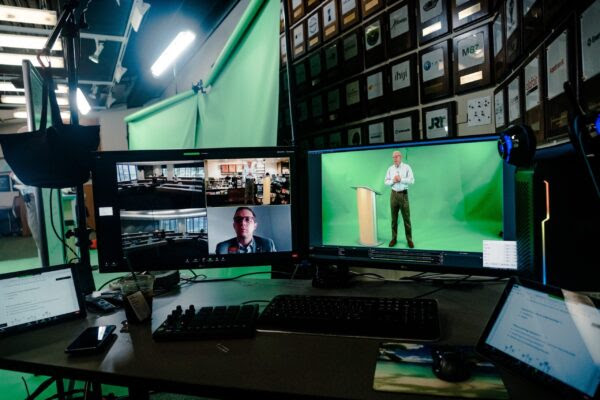
Recourse is being produced at IC2 Institute at UT. The professor is in a studio with a green screen and his full-body image is captured by multiple cameras. Then the 3-D holographic image is beamed into a UT classroom for socially distanced students to watch in person and to students off-campus via Zoom.
A producer is in the studio to handle all aspects of the broadcast, Spencer said. The professor doesn’t have to learn anything about technology. He needs to only focus on his lessons and the students, Spencer said.
“What
you want the professors to focus on their passion and what they’re paid to do
is to teach,” Spencer said. “It’s what
they love to do and want they want to do.”
The professor also has three 65-inch high-resolution monitors facing him projecting images of the students in the classroom and at home. He can interact with them in real-time and answer questions live – just like a classroom.
Recourse is currently being used in accounting professor Steve Limberg’s Executive MBA class.
“This is an authentic
experience because I can see all the gestures and the nuances that students are
expressing, whether it be raising a hand or nodding, and as a result, it really
is very much like being right here in the classroom,” Limberg said in a news
statement.
Recourse delivers high-bandwidth video with high-quality audio with little or no latency in the experience, Spencer said. It really enables the students to engage with the professor as if they were present in the same classroom, he said.
UT’s McCombs School of Business
is using the technology to teach a fall 2020 executive MBA accounting class but
plans to roll it out to other classrooms in the future. The response from
students has been positive, according to UT.
In addition to Recourse, Contextual Content Group plans to roll out other applications, Spencer said. Its next step will be to build its next product using natural language processing and artificial intelligence to create an on-demand immersive video experience, Spencer said.
The McCombs School of Business at The University of Texas at Austin has contracted with Austin-based Contextual Content Group to create a new 3D immersive video solution known as Recourse that combines in-person, hybrid and online teaching to deliver an engaging and interactive distanced learning experience.
While working on a startup in the San Francisco Bay area,
Nick Soman realized he was paying more for health insurance every month than rent.
And in the Bay area rents are sky-high.
“I remember thinking that was brutal,” Soman said.
That experience eventually led him to found Decent, which offers affordable health insurance options for 1099 contractors, entrepreneurs, and freelancers. Soman is a serial entrepreneur. He sold his first company, Reveal to Napster, and he has worked to build the Kindle at Amazon and the growth team at Gusto, a payroll and benefits startup.
Decent moved to Austin about a year ago to partner with the Texas Freelance Association. And this month, Decent announced it has closed on a $10 million round of funding. The funding will allow the company to expand statewide in Texas and offer plans for individuals as well as small businesses, Soman said. To date, Decent, founded in 2018, has raised $18 million.
Decent offers health plans that are 30 percent cheaper by working with independent direct primary care doctors and its partners include AXA, HCA Healthcare, Medlion, Hint, and Costco Health Solutions, Soman said.
And it might seem like a tough time to run a healthcare insurance startup during a pandemic. The coronavirus pandemic has affected Decent’s business, but instead of claims rising, it has seen them drop as people put off elective procedures, Soman said. Decent does cover COVID-19 testing and it has seen an uptick in expenses related to that, he said.
Overall, the pandemic has been really humanizing, Soman said. Decent’s staff of 30 are all working from home and meet up online in Zoom calls, he said. Before the pandemic struck, Decent worked out of The Riveter, a coworking space in downtown Austin. It closed its offices permanently in late May. Next year, Decent will look for new offices when it’s safe to return to the workplace, Soman said.
For now, Decent is focused on solving a big problem that affects millions: providing affordable healthcare coverage, Soman said. Decent is in business as much for the impact it can have for people as it is in building a big business, he said.
And that stems from his experience in the healthcare industry. He is the only one in his family who is not a doctor. He grew up hearing from his parents, who are family practice doctors, about the importance of focusing on patient care. They would complain about how their counterparts on the insurance side didn’t value their patients as they did, Soman said. He created Decent to put people first.
About 90 percent of companies with 1,000 or more employees
have embraced this thing called self-funding health insurance, Soman said. Those
companies bear risk themselves, he said. They also buy something called
re-insurance in case a bunch of people get sick, he said. But because they are
big organizations, they are able to save 30 percent on health insurance, he
said.
Soman recognized that self-employed people didn’t get those advantages.
And that is a huge problem, he said. Decent works to bring the self-funded model
for healthcare insurance downstream to individuals and small business, he said.
“It’s difficult to do what we’re doing because we are
working with the small businesses and the independents that are sort of getting
the short end of the stick,” Soman said.
There have been people who have tried to serve the market by
cutting corners, Soman said. But Decent
doesn’t do that, he said. And Decent doesn’t ask about a person’s healthcare
background, he said.
Soman wants healthcare to work for everyone regardless of
past problems. He knows how important healthcare can be when a person needs it.
During his second year in business school, Soman spent four months in intensive
care and another six in rehab after he got Guillain-Barre Syndrome, which
paralyzed his nervous system. He recovered, but that experience gave him great
empathy for individuals with existing conditions.
“Forgoing health insurance is like sitting atop of a ticking
financial time bomb,” Soman said in a news statement. “Affordable,
comprehensive health insurance helps to safeguard the future for small
businesses and their employees. Decent is
working to make sure that all businesses can afford to do that.”
data.world conference meeting, photo courtesy of data.world
During the COVID-19 pandemic,
a lot of companies are taking stock of the data they have on hand and sorting
it out to their economic advantage.
It’s kind of like how
homeowners are doing renovation projects and people are cleaning out closets
and organizing their stuff.
So too are companies.
And that, in part, has spurred increased demand for Austin-based data.world’s software. The company, a Certified B-Corp, provides enterprise data cataloging and data mining tools.
“People are trying to
navigate through the most trying time they’ve had since the great depression,” said
Brett Hurt, the company’s CEO and Co-founder. The ability to access data
quickly for insights and decision making can lead to a competitive advantage,
he said.
“We turn our customers
into data heroes,” Hurt said. data.world can transform a company into a data-driven
culture by providing it a catalog of its data assets kind of like a library
card catalog system.
data.world on Tuesday announced
it has closed a $26 million round of financing led by the Tech Pioneers Fund. That
brings data.world’s funding to date to $71.3 million since its launch in 2016.
data.world initially sought to raise $10 million, but its round was 260 percent oversubscribed, Hurt said. And three of its investors are customers of data.world including the Associated Press, Prologis, and Workday. Hurt raised 70 percent of the funding from his house on online conference calls during the pandemic lockdown.
One of Austin’s newest
VC firms, Breyer Capital, led by Jim Breyer, a prominent Silicon Valley
investor, wrote one of the last checks into the round, Hurt said. Prologis Ventures
also participated along with Alumni Ventures Group. Existing investors Shasta
Ventures, OurCrowd, and Workday Ventures also participated along with angel
investors Arthur Patterson, Lincoln Brown, and Cotter Cunningham.
With the funds raised, data.world plans to invest in product development and hire additional employees for sales, marketing, customer service, and engineering roles, Hurt said. The company has 75 employees currently with 10 open positions right now, he said. It has added several employees since the COVID-19 pandemic began that Hurt has only met virtually.
data.world has built a collaborative data
resource that is used by researchers, journalists, universities, companies, and
others. In addition, data.world sells a cloud-native enterprise data
catalog that allows companies to more effectively harness their data as a
competitive advantage, Hurt said. Its customers include
the Associated Press, Prologis, WPP, and Wunderman Thompson Data.
“We rely on data.world
to help our analysts and business leaders make data-driven decisions about real
estate investments and global supply chain opportunities,” Luke Slotwinski,
vice president of data and analytics at Prologis said in a news release. “data.world’s
intuitive interface and powerful technology, including their knowledge graph,
makes data discovery and exploration more accessible and immediately actionable
to our business. Having deployed data.world’s solution, we have seen firsthand
its impact as a data multiplier and are pleased to invest in its latest funding
round via Prologis Ventures. We are thrilled to be a data.world customer and
business partner.”
Data.world also has several strategic partnerships and product integrations with AWS, Snowflake, Semantic Web Company, MANTA, and others. It has more than 60 integrations, Hurt said. data.world’s knowledge graph software now has 16 patents and the company continues to improve its software as a service product with more than 1,000 new releases in the last year.
Also, data.world
launched the Coronavirus Data Resource Hub, a free and open data catalog for
COVID-19 research.
By CHAD SWIATECKI, Freelance Contributor to Silicon Hills News
It makes sense that the Austin financial technology startup Episode Six would make the Asian Pacific region a high priority as the company sought to pick up customers for its software platform that lets financial institutions build custom payment and other solutions.
After all, while New York and London are still two of the world’s top financial powerhouses, there’s no denying how quickly centers such as Hong Kong, Singapore, and Tokyo have emerged over the past two decades to make up a thriving region that is another center to help money move around the globe.
John Mitchell, Episode Six’s Co-Founder and CEO, photo courtesy of Episode Six
John Mitchell, the company’s Co-Founder, and CEO said Episode Six’s pursuit of Tier 1 and Tier 2 banks makes it important to play in all of the world’s financial hubs. A recent move into Copenhagen earlier this summer as a tech provider for the fintech startup ARYZE lays the groundwork for the announcement of a New York-based customer expected to come later this month.
The most significant recent news for Episode Six was the closing of a $7 million Series A funding round that included HSBC,Mastercard, and SBI Investment Co., Ltd. among the participating investors. That round closed in July and will give the company the capital it needs to expand its sales, support, and engineering teams to prepare for a planned growth phase that Mitchell said will prove the scalability of the company’s tech. It expects to have 45 employees by the end of the year with more hiring planned for 2021, although Mitchell said the uncertainties caused by the Covid-19 pandemic have kept company executives from stating a target headcount.
Founded in July of 2015, Episode Six develops software for financial services firms, e-commerce companies, and other companies that issue payment products. Customers can license Episode Six’s software to create new digital products.
“We witnessed a lot of change, from the consumer demand standpoint to what companies were putting out to digitization,” Mitchell said by phone recently. “We realized that one of the biggest constraints to being able to innovate was the technology around payments had become unimaginative, particularly around payments. Everything was old, dated, inflexible, hard to work with, and because of that, creating new programs, products, and methods of transferring value was quite difficult.
“We came together to solve those issues and created Episode Six based on that idea, and we created a technology and software platform that enables businesses that have some sort of payment initiatives, ranging from financial institutions to big tech to fintech, to be able to take our software, integrate it into their payments ecosystem and then, through hundreds of APIs, build out programs that they need to meet the needs of their customers.”
The new business with ARYZE will use Episode Six technology to help the Danish company create its Digital Cash product that is intended to be a replacement for existing currencies that will be easier and cheaper to move for payment processing. ARYZE, which is also raising $15 million to fund the launch, sees a $2 trillion market for improving digital payments.
Mitchell said Episode Six’s software platform is needed by large banks and other institutions that are hampered by moldering technologies that often don’t work together elegantly, creating inefficiencies and making it difficult to improve their processes. He said the disruptions caused by the pandemic have created more demand for flexible and innovative payment technology as consumers and businesses move away from physical currency.
“Financial institutions are sitting on multiple systems and layers of legacy systems that are tied together to work and that their book of business relies on, and to untangle that, add to it or change it is a big initiative that takes resources and time,” he said. “There has to be a catalyst and push to get people to move to where they need to go.”
Episode Six Chief Financial Officer and Co-Founder Chermaine Hu, photo courtesy of Episode Six
The company doesn’t disclose its revenue or profitability information. Chief Financial Officer and Co-Founder Chermaine Hu said she expects it will triple its current revenue in the next 12 to 24 months.
Anticipating that the company will prove the scalability of its platform with its new hires, Mitchell said Episode Six executives will work on a Series B funding round early next year.
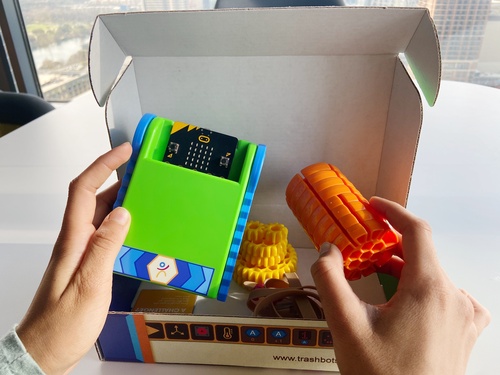
Trashbots’ robotics kit, photo courtesy of Trashbots
The pandemic has spurred demand for Trashbots, which makes a hands-on robotics platform aimed at the K-12 market.
“The K-12 market, as a whole, is more important now than ever,”
said Rohit Srinivasan, Co-Founder of Trashbots. “Especially as schools are trying
to figure out how they are going to teach in a post COVID world.”
Trashbots provides a really unique way for schools to do hands-on
STEM and robotics education from the safety of a student’s own home, he said.
“That is what makes us more relevant now than ever,” he said. “Schools
are buying our product and shipping it to their students’ home and conducting
robotics classes over Zoom.”
And it’s not just schools, Rohit said. Parents are also buying Trashbot’s
products, he said.
The Austin-based startup recently completed the Sputnik accelerator, which provided its initial investment round of $100,000. Trashbots is working to complete its $500,000 seed-stage round and has signed on Trinidadian DJ and entrepreneur Christopher Leacock, also known as Jillionaire, founder of Silicon Labs, Nav Sooch; Austin Ventures founder, Joe Aragona; and founder of Yodle and OJO Labs, John Berkowitz.
Trashbots plans to use the funding to expand its supply chains and
inventory and on marketing and hiring two or three additional employees. The company has four employees right now and
has several contract employees as well.
Trashbots is also able to run a really lean company and tap into talent pools at the university level by providing students with hands-on experience working on a robotics startup, Rohit Srinivasan said.
In Austin, Rohit Srinivasan and his brother
Sidharth Srinivasan founded Trashbots in the spring of 2016 along with Paul
Austin, a former NI executive. The Srinivasan brothers were still in high
school at the time. Today, Rohit is a junior studying engineering at the
University of Texas at Austin and Sidharth has graduated from Westlake High
School and deferred his acceptance to Stanford for a year to work on Trashbots
full time.
The Sputnik Accelerator program allowed Trashbots to kick the business
in high gear and scale the business, Rohit Srinivasan said. It also introduced
them to their current COO Chris Strzok, who lives in Wisconsin and has a
background in STEM education.
Trashbots sells its products nationally to schools and to
individuals through its website. It’s seen a huge uptick in demand since the
pandemic, Sidharth Srinivasan said. And right now, schools are seeking products
that provide an alternative to screen time for students, he said.
“They need other ways to keep their students engaged that is not
staring at a screen,” Sidharth Srinivasan said.
Trashbots has been a good solution to that, he said.
“We’re poised to see a lot of growth over the next year or
so,” Rohit Srinivasan said.
Trashbots sells a Trashbots Kit for $100 or a 10 pack for
$1,000. It also provides courses for free on its website to program the robot.
Students have made fishing rods, ball kickers, construction machines, and even a robot that makes music with the kits, Rohit Srinivasan said.
“The possibilities of what you can do with this one kit is
limitless,” he said.