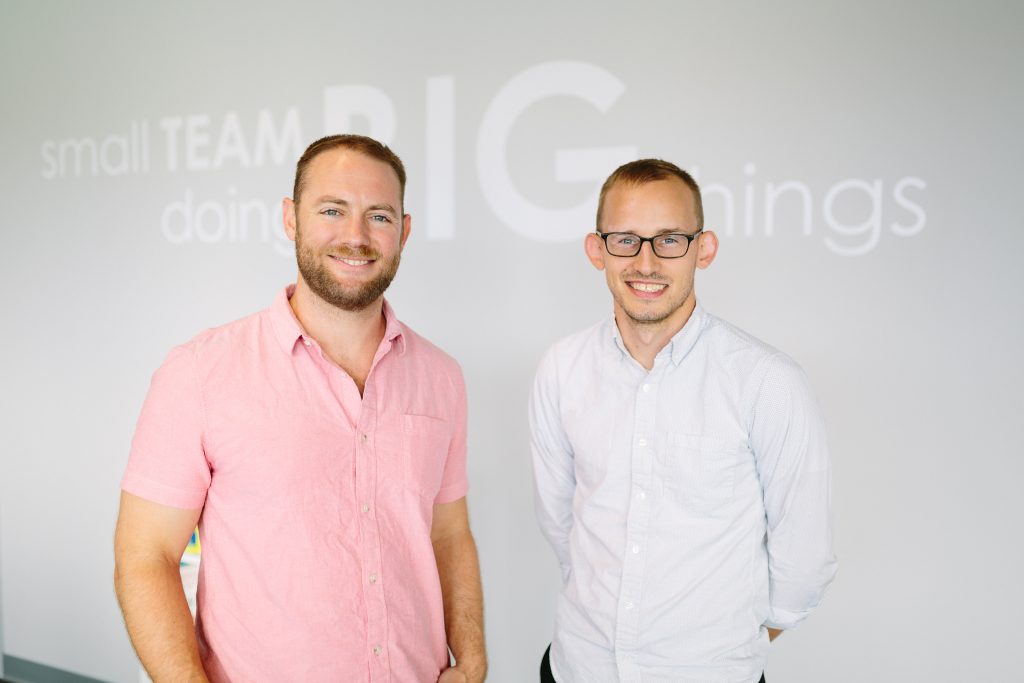
Will Young and Nathan Hackley, Co-Founders of Sana Benefits, photo courtesy of Sana
Sana Benefits, the startup disrupting the healthcare insurance industry by providing coverage for small businesses at a discount, announced Wednesday that it has closed on $20.8 million in funding.
To date, Sana, founded in 2017 by Will Young and Nathan Hackley,
has raised $27.1 million.
The latest round of funding came from existing investors, said Young,
Co-Founder and CEO of Sana Benefits. Talks about raising the Series A round started
late last year, he said. Gigafund led the round with participation from Trust
Ventures and mark vc.
“I think what’s really exciting about raising the money is, for
one, it’s a validation that we are actually making progress against our mission
to make quality healthcare more accessible, understandable and affordable,”
Young said. “We are able to raise money because we delivered results against
that.”
Sana has also expanded its sales outside of Texas and is now
available in the state of Kentucky and plans to launch in Illinois in the
fourth quarter of this year, Young said.
The pandemic has not slowed its business, Young said. The demand
for affordable healthcare plans for businesses continues, he said. Sana
Benefits’ membership has grown 10X in the past year.
Sana Benefits provides an alternative to big insurance providers
like Aetna, Anthem Blue Cross Blue Shield, United Healthcare, Cigna and Humana.
It competes with them by providing insurance that is, on average, 30 percent
cheaper, Young said. Sana’s platform covers health, vision, dental, telemedicine and
maternity, in addition to benefits like ClassPass.
Sana moved to Austin from San Francisco in 2018 and has expanded
dramatically. At the start of the year, Sana had 37 employees, and today it has
80, Young said. And the healthcare insurance technology startup continues to
hire in the areas of sales, marketing, operations and engineering, he said. It
might double again in size by next year, he said.
“As we scale, we have to grow the team,” Young said.
Sana’s headquarters at Manchaca and Slaughter Lane in South
Austin are vacant right now. The company’s workers are all performing their
jobs remotely. And Young said he doesn’t know when they will return to the
office.
“We won’t require people to go back to the office for a long
time,” he said.
In a lot of ways, Sana was better prepared than most startups to
have its employees work virtually, Young said. Hackley, Sana’s co-founder, has
been working remotely from Ohio since the company started. And Sana has grown,
in part, by tapping into talent pools outside of top-tier cities, Young said.
And Young and his wife recently had their first child.
Working remotely with a baby has given him a lot of empathy for parents juggling
work and home responsibilities during a pandemic, he said.
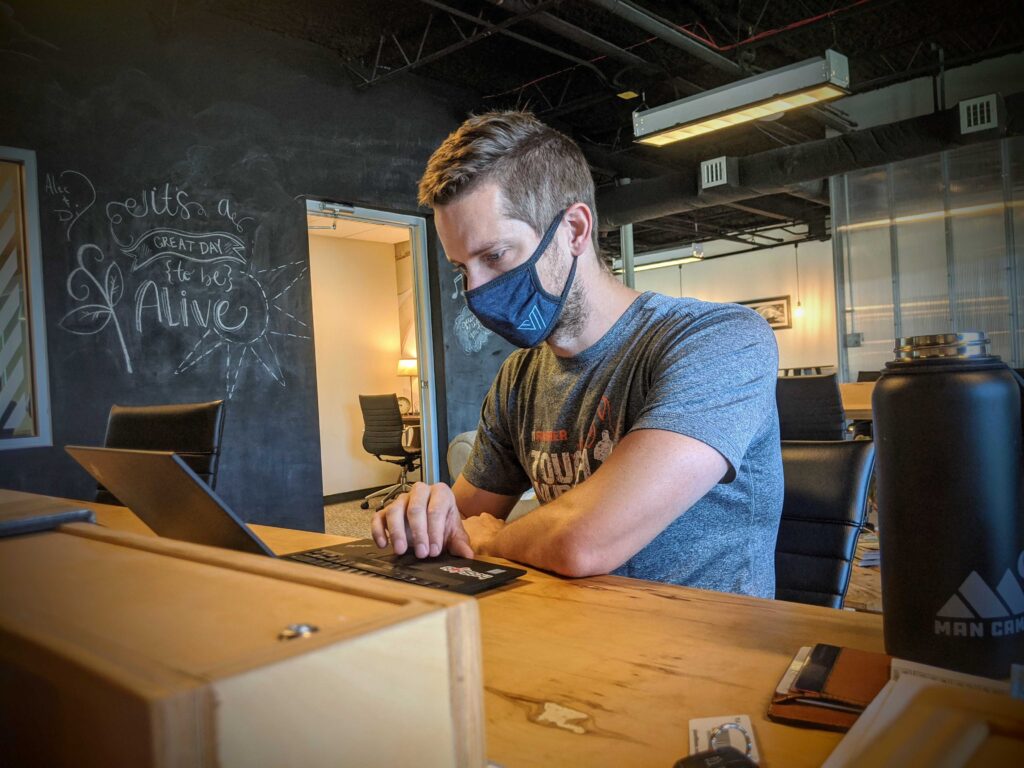
Young people working in co-working creative space wearing surgical mask protection for preventing coronavirus spread, photo by Alessandro Biascioli
By OMAR L. GALLAGA, Freelance Contributor to Silicon Hills News
A few weeks ago, Michelle McKown celebrated her return to a workspace at Central Austin’s Vessel Coworking with a cheerful Instagram story post. “Back at @Vesselcoworking and it feels so good!” she posted, “Don’t @ me! It’s lunchtime & I can’t eat through a mask!”
McKown, like perhaps thousands of others in Austin who were regulars at more than 60 coworking spaces before the COVID-19 pandemic, vacated the premises in March. She’d been a loyal customer since last August, using the space to study and write papers as a returning student studying to be a therapist.
Returning after five months without ever having canceled her membership, McKown says she decided to come back because she felt Vessel’s owners were approaching the issue of customer safety thoughtfully, and because she sorely missed the social interaction. She also needed separation between her home and work life.
“School started back up and I’m going insane at home,” McKown said over a video call from her tabletop at Vessel. “I can’t work at home. Some people thrive doing it, but I can’t.”
So she returned, joining about 10 others who are spaced apart physically and temporally at the coworking space throughout the week. “They made changes to the A/C system to make it safer. They have sanitizers all over the building,” McKown said. The business also had facemasks printed with the Vessel Coworking logo on them. “They made me feel like, OK, this is being done well and I feel safe coming back to this.”
Closings
Six months into the pandemic, some Austin coworking spaces
are finding that freelancers and entrepreneurs as well as large businesses with
nomad employees are slowly dipping their toes back into coworking. A comeback
of sorts for coworking may be on the horizon, despite ongoing COVID-19
infections in Texas.
In the case of Orange, which had initially planned to return after a temporary shutdown, the economics of the situation turned the closing permanent. Founder Dean Siracusa said longtime members canceled memberships and some members were forced to work from home by companies who had been paying some or all of their Orange membership fees.
A Hail Mary Facebook and LinkedIn ad campaign to attract new members in May was unsuccessful. “We stopped the campaign when it both, 1, was not working and, 2, was attracting some backlash from the general public about safety,” Siracusa said in an email. An attempt to negotiate a reduced-rent lease with building owner H-E-B also didn’t work out, he said. “We liquidated all of the supplies and furniture and closed up. And that’s basically the whole thing.”
One of Austin’s most high-profile coworking spaces and
startup incubators, Capital Factory, has all but given up on the idea of a
shared collaborative space for entrepreneurs, at least in-person ones, for the
foreseeable future.
“Coworking is dead until COVID passes,” Capital Factory founder and CEO Joshua Baer declared in an August 16 blog post at Austin Startups. The founder says Capital Factory is pushing virtual-first events and meetings, particularly for anything involving larger groups. Not everyone will adapt to working from home, or being away from a home office, he said in the post, but added, “I believe that a double-digit percentage of people will never go back to working in the office.”
Signs of life
One person working on an afternoon in August at Galvanize, a coworking space in downtown Austin. Galvanize has instituted social distancing practices, sanitation stations
Some people never left and, surprisingly, some Austin
coworking spaces never actually shut down amid the pandemic.
David Perez, the founder and president of Lumen Insurance Technologies, is one of the die-hard coworking devotees who continued to work outside the home even in March and April.
He works out of Galvanize in downtown Austin and goes there every day, 9 to 5, for three really great reasons. They are ages six, three, and 18 months.
“It’s bad,” Perez jokes, “it’s really hard to get anything
done in the house.” The Galvanize space is attractive as a place to work
“because of the stillness and the quiet amid the chaos from home and kids being
there. Now, I had a place I could go and actually work in peace and quiet.”
It’s been even quieter since March, “A ghost town,” Perez
says, but he’s continued to get work done at Galvanize, checking his mail and
engaging in some socially distanced networking and conversation when others are
in the space. “Sometimes it’s just friends, sometimes it’s potential business
or investment opportunities,” he said.
Perez is the kind of customer that has kept some coworking
businesses going, along with small-business loans and the generosity of
businesses and membership holders who’ve kept paying fees even when they aren’t
using a space.
Gerald Zingraf, a member at Vessel Coworking in Austin, photo courtesy of Steven Knapp
That’s been the case at Vessel, where owners Steven and Beth Knapp have been taken aback by the support they’ve received through the pandemic to keep the doors open at the business, which opened in 2015.
“I can’t describe the generosity we felt from that,” Beth
Knapp said. “We weren’t holding anyone to a contract or any membership
commitment over their head. If someone said, ‘I need out,’ we let them out.”
A small handful of regulars continued to work out of Vessel in the spring and Steven continued to go to the space every day, scaling down big breakfasts to a few Nervous Charlie’s bagels. They continued in their role of dinner party or backyard barbecue hosts making the space comfortable and friendly for their clients and helping them make connections with others.
The numbers of those using Vessel have slowly crept up; Beth and Steven say their clients have been respectful of spacing, wear masks in common areas and throughout the For the City center where Vessel is housed, and that there’ve been no incidents of COVID infections among those who patronize Vessel.
“Nothing has changed other than that I just think overall
everyone’s awareness of how they should be as a community,” Steven Knapp said.
That doesn’t mean the couple hasn’t agonized over how best
to protect their customers and to make a safe space for working. They’ve tried
to make thoughtful decisions and to solicit feedback from customers as the
pandemic’s parameters have continued to change, Beth Knapp said. “I feel like
definitely people would judge us and have something to say on how we’ve handled
this along the way. We haven’t been sure how to navigate it.”
A future coworking boom
One thing that businesspeople like Joshua Baer, coworking
owners like the Knapps and coworking experts agree on is that post-COVID,
whatever work looks like, it will be boom times for coworking spaces providing
safe, productive places to work.
Already Vessel is seeing an uptick in requests for accommodations
for small teams and for usage of a second off-site space they own that’s set up
for all-day conferences. Coworking spaces with private offices and plenty of
room to spread out will be in high demand as working from home becomes
unsustainable long-term and businesses hedge on bringing workers back to home
offices, says one long-time coworking entrepreneur.
Liz Elam, the former owner of Austin’s Link Coworking and creator of the Global Coworking Unconference Conference (GCUC), says COVID-19 is weeding out businesses that were already in danger before the pandemic and paving the way for a big step forward in the industry.
“Those that do survive have a fantastic opportunity on the other side of COVID,” Elam said. Working from home, she says, sounds great at first, but is a haven for distractions, can exacerbate depression among singles and is typically not subsidized by businesses.
“If you are taking space in somebody’s private home, you should have to pay for their internet. You should give them an ergonomic desk. You should give them a chair and you should pay them for a portion of your house that they’re utilizing,” Elam said.
Short of that, she said, businesses will likely ask
employees to utilize a mix of work-from-home and safe coworking spaces,
especially ones that cut down on commuting distances. “It’s really good for
suburban and rural coworking,” she said. “So like Cedar Park, Pflugerville,
Georgetown, San Marcos are great places to have coworking spaces right now
because that’s where people live.”
Elam says that these businesses have a mission to put people
at ease about their safety concerns if they want to stay in business. That
could mean upgrading air systems, changing floor plans and adding private
offices, investing in lots of wipes and hand sanitizer, and most importantly, making
sure their marketing is up to date.
“They need to put it on their website, they need to make it
front and center,” she said, “they need to change their photos to show social
distancing.”
The Knapps say they are optimistic that Vessel Coworking,
which they took over three years ago, will thrive in the new normal. They think
coworking spaces still fit a huge need in Austin.
“People still want to be part of the community,” Steven
Knapp said, “they still want to work amongst people.
“Certainly I think people are just tired of being at home,” he said.
Correction: This article has been updated to correct Michelle McKown’s name.
She’s also a lawyer who previously served as executive director of the
Entrepreneurs Foundation of Central Texas and served as director of Lemonade
Day Austin, which is geared to getting youth involved in
entrepreneurship.
The Chamber is looking for nominations from individuals and companies who create or develop innovative technologies, platforms, or business models that are changemakers.
The A-List event is normally held at Austin City Limits’ Moody Theater downtown,
but this year’s event will take place virtually on October 7-8th. It’s
called A-List: Up Close & Personal and its hosted by the Austin Chamber and
SXSW. The event will feature a three-part series of virtual award announcements
and speakers.
In the podcast, Christie also discusses how the Pandemic has affected
entrepreneurship in Austin and how businesses are coping with the dramatic
changes. Atlassian, which occupies a downtown office tower, told its 5,000
workers that they can work from home permanently. And Google, which also
occupies a downtown office tower and is building another new high-rise, has
told its workers they can work from home until the summer of 2021. Facebook,
which also last year moved into its new skyscraper in downtown Austin, has also
told its employees they can work from home until the summer of 2021. And
Austin-based Indeed which has more than 2,000 employees in Austin, has told its
employees to work from home as well.
All of the Greater Austin Chamber of Commerce’s 41 employees began working
from home in mid-March and they don’t plan to return to the office until
December at the earliest, Christie said.
In her role, Christie spent a lot of time traveling the globe representing Austin in Singapore, Hong Kong, Dubai, Israel, the United Kingdom, Egypt, and other countries, but all that came to a halt once the Covid-19 Pandemic struck. Still, Christie has managed to reach out to contacts globally and work together virtually. She has worked with entrepreneurs in Israel and Mexico virtually to help make connections in Austin. And because people aren’t commuting as much, some people have more time to spend on a Zoom or phone call than in the past, she said.
For more, listen to the entire podcast, pasted below, or wherever you get your podcasts – available on Google play store, Apple iTunes, Spotify, PlayerFM, Libsyn, and more.
Notley Venture, a social impact investment firm
based in Austin, has pledged $250,000 to kick off the network, which will begin
accepting applications on Sept. 1st.
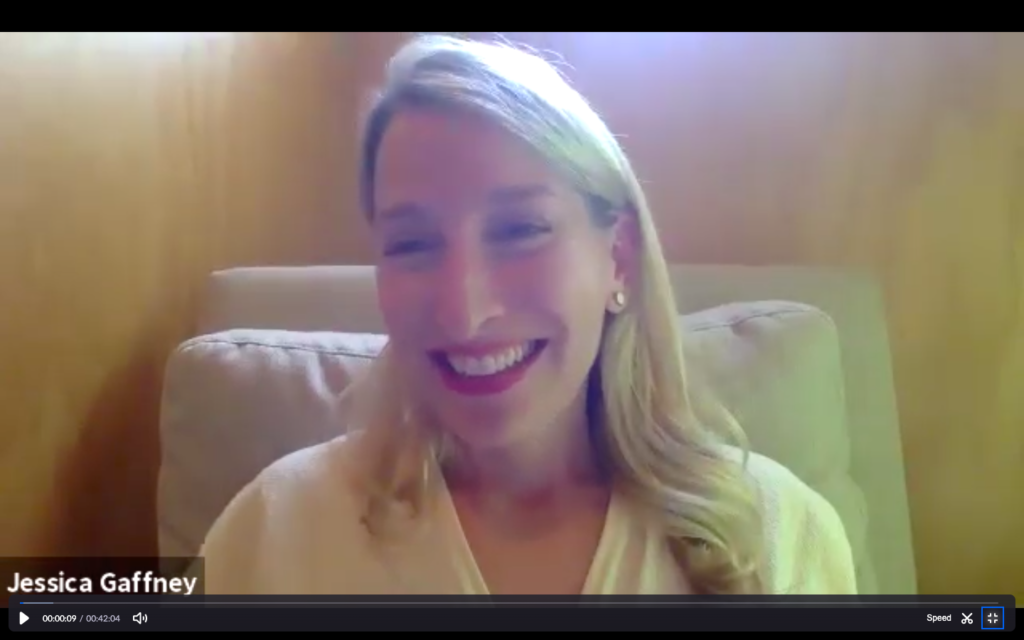
Jess Gaffney, CEO and Executive Director of
Women@Austin, discussed Women@Austin’s new program, the Beam Angel Network on
the Ideas to Invoices podcast.
Women@Austin has been around for about six years now. Jan Ryan, serial entrepreneur, started Women@Austin, which kicked off on Valentine’s Day in February of 2014. It began with a steering committee of 16 women with the goal of tripling the number of women-funded companies and providing more mentorship and increasing the visibility of female entrepreneurs in the community.
A few years ago, Ryan became executive director of entrepreneurship and innovation at UT’s College of Fine Arts. That’s when Women@Austin became part of Notley Ventures. In 2019, Women@Austin hired Gaffney as its CEO and Executive Director.
“We have four focus areas: knowledge, connections, capital, and a growth mindset,” Gaffney said.
In focus groups with more than 60 female founders, Women@Austin learned that lack of access to capital was the biggest barrier female founders faced when trying to scale their ventures, Gaffney said. And the national research bears that out as well, she said. Only about 2.2 percent of VC dollars and 21 percent of angel dollars go to women-founded companies, Gaffney said.
“It’s not equitable,” Gaffney said. “There’s
also a very clear opportunity for investors because when women are given a
chance they perform. And not only do they perform, they outperform men.”
Women founders perform 63 percent better and
exit at least one year quicker than investments with all-men founding teams,
according to Women@Austin research.
Beam is aimed at angel investing because women need capital at the earliest stages, Gaffney said. It is looking for fund startups with at least one woman in the founding team. The startups must also be based in Texas. The amount of the investment will vary from $100,000 to $300,000, Gaffney said. It is industry agnostic, she said. It looks at the team, market competition, product, and business model in evaluating the startups it will invest in, Gaffney said.
Beam offers different membership levels to angel investors. Its founding committee and the first group of investors and advisors include Anna Robinson, Ceresa; Cat Dizon, Active Capital, Dan Graham, Notley, Ethan Monreal-Jackson, Notley, Caroline Fabacher, Springdale Ventures, Jane Ko, Taste of Koko, Jennifer Cobb Moynihan, Elevate Communication, Mellie Price, SoftMatch, UT and Capital Factory, Rachel Sanchez-Madhur, One Drop, Sandeep Madhur, Snapdocs, Tina Dai, Silverton Partners, Saurabh Khetrapal, Fair Trade Safaris & Kazana Ventures.
Beam
also plans to pair applicants with mentors to help everyone prepare pitch decks
and video presentations to pitch to investors. It’s to create an equitable
application process to ensure that all women founders and their startups get
equal consideration, Gaffney said.
Community Partners include Alliance of Texas
Angel Network, Austin Chamber of Commerce, Black Women Talk Tech, BossBabesATX,
Capital Factory, Culturati, DivInc, Entrepreneurs Foundation, Greater Austin
Black Chamber of Commerce, Hello Alice, In Bold Company, Newchip, SKU, Sputnik
ATX, and Kendra Scott Women’s Entrepreneurial Leadership Institute (WEL
Institute) at The University of Texas.
“We are proud to support the launch of Women@Austin’s Beam Angel Network. Today, there are more women turning to entrepreneurship than ever before, and 21% of Austin businesses are woman-owned” Leigh Christie, SVP, Global Technology & Innovation, Austin Chamber, said in a news release. “Beam has the opportunity to provide the needed connections and opportunities for these entrepreneurs and our investors.”
For more, listen to the entire podcast, pasted below, or wherever you get your podcasts – available on Google play store, Apple iTunes, Spotify, PlayerFM, Libsyn, and more.
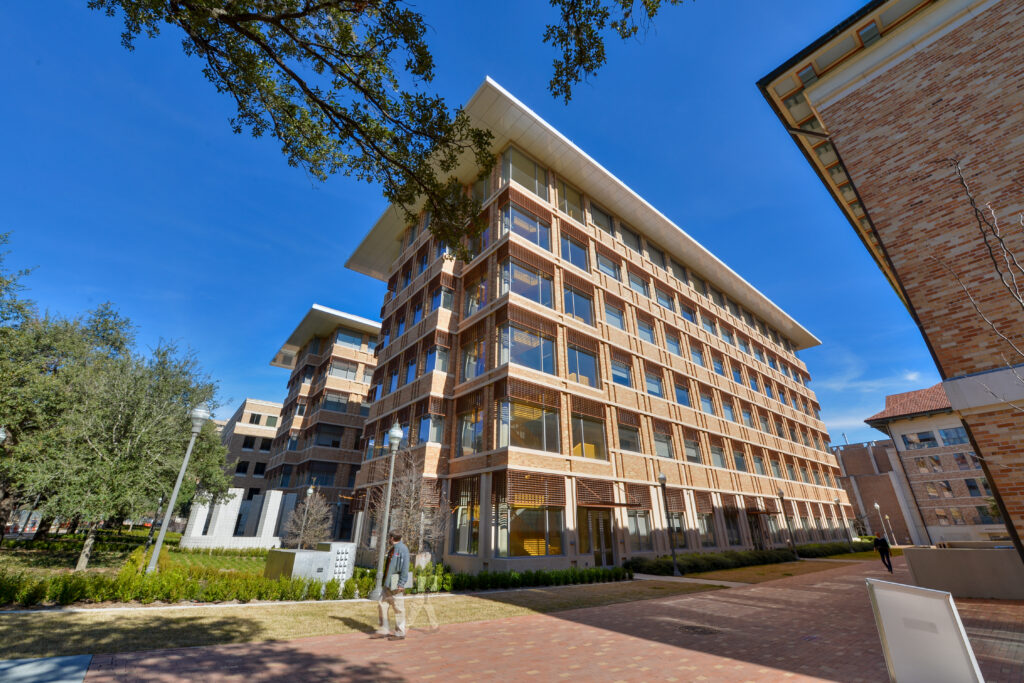
The NSF AI Institute for Foundations of Machine Learning and the Machine Learning Laboratory will be administratively housed in the Gates-Dell Complex at The University of Texas at Austin. Photo credit: Vivian Abagiu/University of Texas at Austin.
The National Science Foundation on Wednesday announced
the selection of the University of Texas at Austin to lead the NSF AI Institute
for Foundations of Machine Learning.
UT is spearheading one of five NSF AI Institutes
nationwide and each one will receive $20 million in funding.
The UT NSF AI Institute for Foundations and Machine Learning will focus on major theoretical challenges in artificial intelligence including creating new algorithms, neural networks, and robotics.
“Many of the world’s greatest problems and challenges can be solved with the assistance of artificial intelligence, and it’s only fitting, given UT’s history of accomplishment in this area along with the booming tech sector in Austin, that this new NSF Institute be housed right here on the Forty Acres,” UT Austin interim President Jay Hartzell said in a news release.
Partners for the UT institute include the City of Austin, Facebook, Netflix, YouTube, and Dell Technologies. And UT will collaborate with researchers at the University of Washington, Wichita State University, and Microsoft Research.
Overall, the AI industry is booming with more than $191 billion in revenue by 2024, growing at a rate of 37 percent annually, according to Market Research Engine. Austin has a strong foothold in the industry with companies like SparkCognition, CognitiveScale Hypergiant Industries, Cerebri AI, OJO Labs, REX, and others.
UT Austin has also created the new Machine Learning Laboratory, which will house the AI Institute and serve as a place for data scientists, mathematicians, roboticists, engineers, and ethicists to collaborate. Tech entrepreneurs and UT Alumni Zaib and Amir Husain donated to the Machine Learning Lab.
The UT NSF AI Institute will be led by Adam Klivans, a
UT computer science professor. He will also direct the Machine Learning
Laboratory along with Alex Dimakis, associate professor of electrical
engineering and computer engineering.
Adam Klivans is a professor of computer science at The University of Texas at Austin and director of the NSF AI Institute for Foundations of Machine Learning and of the Machine Learning Laboratory. Credit: University of Texas at Austin.
“Machine learning can be used to predict which of thousands of recently
formulated drugs might be most effective as a COVID-19 therapeutic, bypassing
exhaustive laboratory trial and error,”
Klivans said in a news release. “Modern datasets, however, are often diffuse or noisy and tend to confound current
techniques. Our AI institute will dig deep into the foundations of machine
learning so that new AI systems will be robust to these challenges.”
UT
is also creating a new Masters Degree program in AI and plans to create
additional AI programming geared to high school students and working
professionals.
A new method for object detection, called ExtremeNet, performs on-par with state-of-the-art region-based detection methods. Credit: Philipp Krähenbühl/University of Texas at Austin. Read more: http://www.philkr.net/media/zhou2019bottom.pdf
In
addition to UT, the NSF’s other AI Institutes include:
NSF AI Institute for Research on Trustworthy AI
in Weather, Climate, and Coastal Oceanography, led by a team at the
University of Oklahoma, Norman
NSF
AI Institute for Student-AI Teaming, led by a team at the
University of Colorado, Boulder
NSF
AI Institute for Molecular Discovery, Synthetic Strategy, and Manufacturing (or
the NSF Molecule Maker Lab), led by a team at the University of Illinois
at Urbana-Champaign
NSF
AI Institute for Artificial Intelligence and Fundamental Interactions, led
by a team at the Massachusetts Institute of Technology.
The United States
Department of Agriculture also announced two AI-focused institutes that will
receive $40 million in funding over the next five years. They are the USDA-NIFA AI Institute for Next Generation Food
Systems, led by a team at the University of California, Davis, and
the USDA-NIFA AI Institute for Future Agricultural Resilience, Management, and
Sustainability, led by a team at the University of Illinois at
Urbana-Champaign.
After running out of salsa, Brian White decided to mash up
his own version using pickles as the main ingredient.
He added jalapenos, pickles, onions, and spices and came up with what is now known as PickleSmash, which is a salsa made without tomatoes.
“I like experimenting with mashups of different foods,” White said.
White learned how to can pickle salsa and then he started bringing it to doctor’s offices, and law offices where he was doing technology jobs and “everyone loved it,” he said.
In 2018, he went to New York City to attend the summer fancy
food show and he got connected to some partners who he still works with today.
Last year, PickleSmash, a bootstrapped consumer packaged goods startup, joined the SKU accelerator in Austin and that had a huge impact on its brand and growth, White said. It started out as White’s Pickle Salsa, but in the SKU program, White met creative director Liz Berry who helped rebranded the company to PickleSmash. She helped the company with packaging, logo, and other brand elements.
Through SKU, White also learned how to pitch investors and raise capital. The company has raised $350,000 in seed-stage funding so far from 15 angel investors, White said.
To raise brand awareness, last November PickleSmash did a Kickstarter
campaign and raised more than $11,000 of a $10,000 goal.
“Kickstarter is a really unique platform,” White said. It provided great exposure to influential consumers and raised brand awareness, he said.
It’s tough running a small business during normal times, but it’s extra tough during pandemic times. The pandemic has been a roller coaster ride for PickleSmash, White said. He discusses the challenges PickleSmash has faced during a Zoom audio interview for Silicon Hills News’ Ideas to Invoices podcast.
“I think everyone is dealing with unique sets of challenges,”
he said.
PickleSmash was at the beginning of its events season in mid-March
and all of that got shut down, White said. And it was supposed to launch in
retail grocery in mid-April and that got shut down, he said.
“So we really had to pivot,” he said.
PickleSmash went to a direct to consumer selling strategy through
online sales with a lot of marketing, White said.
During the business lockdowns, PickleSmash was deemed an essential business so it never shut down operations, White said.
Logistics and supply chain continues to be a problem, White said.
Now, PickleSmash is dealing with a unique supply chain
problem, he said. There is a glass jar shortage, he said. For the next two to
four months, everyone is kind of struggling and vying for those limited
resources until the manufacturing plants can catch up, he said.
Meanwhile, White is preparing to roll out PickleSmash into Central Market stores throughout Texas on Sept. 1st. It’s also talking with Spec’s about stocking PickleSmash, he said. And it’s hoping to get into H-E-B as soon as it reopens its new products pipeline again, he said. PickleSmash has found a lot of success selling its salsa at Ace Hardware stores.
For more, listen to the entire podcast, pasted below, or wherever you get your podcasts – available on Google play store, Apple iTunes, Spotify, PlayerFM, Libsyn, and more.
At a Youth Peace Summit held at the John Knox Ranch in Wimberley, Ryan Jordan saw how young men and women from 20 countries bonded.
One of the ways was through dance.
Even though the teenagers spoke different languages and came from a variety of cultures and backgrounds, they all liked music and dance, said Jordan, who served as executive director of the Austin-based Amala Foundation, which hosted the summit.
That summit is where the idea for DanceFight, a mobile dance competition platform, began. To bring the project to life, Jordan teamed up with Rich Sloan to co-found Virtual Arts, maker of the DanceFight app. Jordan and Sloan have experience in consumer mobile apps and music-tech ventures.
Last week, Virtual Arts closed on $2 million in seed-stage
funding to further develop the app, which is available for Apple devices right
now. With the funding, Jordan plans to create an Android app for the Google
Play Store that will be available in October. The startup also plans to expand
internationally later this year. Investors include Quake Capital Partners, Sound
Media Ventures, VSCO’s CEO and Co-Founder Joel Flory, and Thunderstruck Dance
Competitions.
Also, Virtual Arts plans to expand and re-brand the app beyond dance competitions to include singing, comedy, rap, cheerleading, basketball trick shots, skateboarding, and other action sports, Jordan said.
“Any way kids want to compete,” he said.
The skills-based platform
is aimed at Generation Z, primarily 13 to 24-year-old youths who grew up with
mobile devices, he said.
Other apps like TikTok and Instagram’s new “Reels” let
people watch dance videos. But DanceFight is different because it encourages interactivity
and pairs up dancers in side by side competitions and lets viewers decide the
winner. The dance moves are whatever the dancer decides. They are only limited
by their imagination and creativity.
“In the app, people are dancing in many different ways from
break dancing to hip hop,” Jordan said.
Work on the app started a year and a half ago, Jordan said.
It was released in the Apple App Store about eight weeks ago and it received
the designation in the as “Apps We Love.” DanceFight is free to use. Virtual
Arts makes money from in-app purchases and through ads and sponsorships, Jordan
said.
DanceFight is also working with major record labels including Sony Music Entertainment, Warner Music Group, and Universal Music Group for dance challenges. It gives dancers access to millions of songs to create or join a challenge. DanceFight is also working with musicians like Pitbull to use the app to introduce new music and dance challenges, Jordan said.
DanceFight has also partnered
with artificial intelligence company Hive AI to block any inappropriate content,
Jordan said. And the app excludes commenting and direct messaging to prevent
bullying and harassment, he said.
“We created a safe space for kids to express themselves fully,”
Jordan said.
DanceFight also never shows vote totals, just a winner, Jordan
said. DanceFight has leaderboards and players earn points for participating in dance
competitions as well as for winning them, he said. The focus is on inclusivity
and creating an environment where everyone feels welcome, he said.
“Competition is a way to have fun,” Jordan said.
DanceFight also plans to create an equity pool for participants and to reward them for contributing to the platform, Jordan said.
Virtual Arts has 11 full-time employees and six part-time employees. It recently hired Blake Gardner, former Perk Chief Technology Officer, Ben Rose, former head of growth for Pandora, and Norma Ventura, a former Creative Strategist at Khoros. In the next year, DanceFight plans to add 20 more employees. Right now everyone is working virtually during the pandemic, but eventually, they plan to rent office space at Vuka in Austin, Jordan said.
Since the COVID-10 pandemic, Austin-based Fetch has seen a 59 percent increase in volume for its package delivery service to apartments.
As e-commerce explodes
in popularity, apartment complexes have turned to Fetch to handle the crush of
package deliveries.
The company has almost
doubled the number of communities they serve this year with more than 120,000
apartment homes under contract.
And this week, Fetch,
a last-mile package delivery service aimed at apartment dwellers, announced it
has closed on $18 million in funding.
Iron
Gate Capital and Pando Ventures led the round and were joined by existing
investors Signal Peak Ventures, Silverton Partners, Seamless, and Venn
Ventures. Fetch plans to use the funding to enter new markets, and in sales and
marketing and to invest in its warehouse strategy and delivery technology.
Previously,
Fetch raised
$10.5 million in Series A funding last year. To date, the company, founded
in 2016, has raised more than $32 million.
According
to Scott Carman, Managing Partner of Pando Ventures, package volume will continue
to remain high as ecommerce shopping becomes more commonplace.
“The
increased number of deliveries that apartment communities have been forced to
deal with in recent months is something that is here to stay,” Carman said in a
news release. “The Fetch model takes that burden off the shoulders of on-site
teams, which is why we’re seeing so many property management companies make the
switch. Moving forward, Fetch’s expansion is crucial to the multifamily
industry’s collective effort to provide prompt, reliable, and customized
package delivery for renters. That’s why we’re proud to be part of their Series
B funding effort, and their push to serve new markets and new clients.”
“This
fundraise and our fast growth in the middle of a pandemic is a testament to our
team’s dedication and hard work,” Fetch Founder and CEO Michael Patton said in
a news release.
ICON’s 3-D Printed Welcome Center at Mobile Loaves & Fishes’ CommunityFirst! Village in Austin, photo courtesy of ICON
ICON, the Austin-based startup that builds homes with its giant 3-D printer using concrete as substrate, on Wednesday announced it has closed on $35 million in funding.
Previously,
the company raised $9 million in seed-stage funding.
ICON is arguably one of Austin’s most innovative startups tackling big problems like building homes for the city’s homeless population. It teamed up with Mobile Loaves and Fishes last year to build six 3-D printed homes for Community First! Village, a 51-acre master-planned development in Austin.
The company has received other accolades landing on the Austin Chamber of Commerce’s A-List of hottest startups last year. Time Magazine also named the company one of the best inventions of 2018. Popular Science named ICON one of the best 100 Greatest Innovations of 2018.
Moderne Ventures led the Series A round of investment. Other investors include international architecture firm BIG-Bjarke Ingels Group, CAZ Investments, Citi, Crosstimbers Ventures, Ironspring Ventures, Next Coast Ventures, Oakhouse Partners, Trust Ventures, Vulcan Capital, and Wavemaker Partners.
“Traditional building and construction techniques have not improved since B.C., they have only become more expensive,” Constance Freedman, the Founder, and Managing Partner at Moderne Ventures said in a news statement. “The results are vast deltas in affordability, limitations on design, and both time and efficiency challenges. I believe we will see an evolution of the entire home-buying value chain, especially when integrated with other technologies like digital transactions and augmented reality. Consumers will be able to order, build, design, and purchase a brand-new home in a matter of days–something that’s truly innovative and truly disruptive. We are excited to support ICON as it continues to change the world.”
“In early 2018, there were no 3D-printed homes in North America, and today, there are almost twenty and we’re gearing up for hundreds more,” Jason Ballard, Co-Founder and CEO of ICON, said in a news release. “We anticipate more high-velocity progress in the years ahead to help bring housing and construction into the modern world and in-line with humanity’s highest hopes. The present challenges the world is facing due to new coronavirus have only emphasized the tremendous gap between the housing that we have and the housing that we need. We are grateful to those who have believed in our mission from the beginning and are excited to have a larger team of global investors joining us in our belief that the housing of our future must be different than the housing we have known.”
ICON’s new round of funding will accelerate the development of its printers, create a variety of home types and designs, and enhance its core technology.
ICON unveiled its first 3D printer and successfully secured a building permit and printed a home in Austin in March 2018. And a year later at SXSW, ICON unveiled its next-generation Vulcan 3-D printer and announced strategic projects in the U.S. and Mexico.
In addition to the Mobile Loaves & Fishes project, in 2020, ICON built 3D-printed homes in Mexico alongside nonprofit partner, New Story. ICON also partnered with the Defense Innovation Unit and the United States Marine Corps to train Marines to operate its technology and complete a field demonstration print at Camp Pendleton.
ICON
is also hiring with “numerous roles across robotics, off-planet construction,
materials science, software engineering, architecture, building science and
operations.”
Despite the novel coronavirus
pandemic, deals are still getting done in Austin’s startup community.
Austin-based SpyCloud announced on Tuesday that it has closed on $30 million in additional venture capital funding.
To date, the cybersecurity
company, founded in 2016, has raised $58.5 million, according to Crunchbase.
SpyCloud plans to use the funds raised to expand its product and
engineering teams and build new ways to detect and prevent fraud.
The company has created an anti-fraud platform that specializes
in preventing account takeover by criminals. SpyCloud’s software can find
vulnerabilities in a company’s computer system before cybercriminals can
strike. SpyCloud’s software flags employees and customer accounts that have
security issues early on. And the company checks to make sure the accounts have
not been exposed and passwords are secure.
Centana Growth
Partners led SpyCloud’s Series C investment, with participation from all
existing investors: M12 (Microsoft’s venture fund), Altos Ventures, Silverton
Partners, and March Capital Partners.
“Criminals work together to steal information and find creative ways to monetize it. As a result, even the most careful and sophisticated organizations are vulnerable,” Ted Ross, SpyCloud CEO and co-founder said in a news release. “SpyCloud will continue to pursue new and innovative ways to stay ahead of criminals and provide solutions that make the internet a safer place for individuals and businesses.”
The pandemic has
affected SpyCloud’s business. Its services are in big demand because scams have
proliferated online since the lockdowns began in March. SpyCloud researchers
found 139,000 new web domains related to the virus with multiple scams designed
to steal people’s personal information.
“SpyCloud’s approach to fraud prevention is helping businesses
protect themselves and their customers at a time when threats are more
pervasive than we’ve ever seen. We heard from major financial institutions and
a wide range of enterprises that SpyCloud’s solutions are critically important
to their anti-fraud efforts,” Eric Byunn, partner at Centana Growth Partners
who joins SpyCloud’s board., said in a news release. “We’re proud to help them
continue the fight and discover new ways to protect both companies and
consumers from these evolving threats.”
“With so many people
now working from home and multiple family members sharing devices with a mix of
personal and professional applications, attack surfaces have increased
significantly. Criminals are certainly taking full advantage of these new
opportunities to exploit your employees and their family members,” Ross said.
Cybercriminals are
able to break into a company’s computer system using stolen credentials. They can
then steal financial information or intellectual property and damage a company’s
reputation. SpyCloud’s system is designed to catch them before they breach the
system.