Category: Austin (Page 192 of 318)

Good Technology Buys Austin-based Macheen

imgres-1Good Technology, based in Sunnyvale, Calif., bought Austin-based Macheen, a mobile cloud applications service provider.

Terms of the deal were not disclosed.

Macheen, founded in 2010, has raised $34.4 million in five rounds of investment, according to its Crunchbase profile. The company provides broadband connectivity to mobile devices. The company provides a software as a service platform that brings mobile broadband and connected services to all devices.

As Bring Your Own Device deployments continue to become mainstream, Good Technology’s “customers want to alleviate the risk and cost associated with rapidly increasing mobile regulations, tax liabilities and complexities around mobile reimbursement and corporate stipend programs, while at the same time carriers are looking to better serve their enterprise customers,” Christy Wyatt, chairman and chief executive officer, Good Technology, said in a statement. “By acquiring Macheen and its cloud-based offering, and coupling that with expanded carrier relationships, we will be securely and cost-effectively taking more friction out of deploying secure mobile apps and workflows – further positioning Good ahead of the industry in the race to democratize mobility.”

Gartner predicts devices connected to the Internet, excluding PCs, tablets and smart phones, will grow to 26 billion units in 2020.

“To this point, BYOD programs were generally defined by configuration, policy control and device management for smart phones and tablets,” Richard Schwartz, president and chief executive officer, Macheen said in a news statement. “Together, our joint technology will offer controlled corporate usage of a broader set of enterprise devices and beyond as the era of Internet of Things (IoT) becomes a reality.”

Understanding the 600+ Sessions for the 2015 SXSW Interactive Festival

BY HUGH FORREST
Director of the SXSW Interactive Festival

imgresGeek Christmas has arrived! On October 20, the SXSW Interactive Festival unwrapped more than 600 accepted sessions for next March in Austin. This is the biggest announcement for the upcoming season, as these 600 sessions represent the bulk of daytime programming for the 2015 event.

Content covered in the October 20 announcement ranges from design to branding, from coding to MedTech, from entrepreneurism to next-generation journalism. Speakers include a handful of big names (people like Steve Case, Josh Clark, Kristina Halvorson, Tara Hunt, Ben Huh, Matt Mullenweg, Clara Shih, Kara Swisher, Stephen Wolfram and Amy Webb), plus hundreds of names of up-and-coming innovators who you probably haven’t heard of yet. Indeed, SXSW specializes in previewing people and ideas that you may not know about now, but will be big in the future.

Five tips for a better understanding of this huge programming announcement are as follows:

1. How sessions are selected. Most of the 600+ sessions came from the SXSW PanelPicker, a unique approach that allows anyone in the community to enter a speaking idea and likewise allows anyone in the community to vote / comment on all the received ideas. The PanelPicker has become very popular over the last few years. This year’s interface received more than 3000 total entries from across the US and around the world. 2015 was also a record year in terms of total number of votes cast. But public voting accounts for only 30% of the decision-making process on any given proposal. The other 70% of the decision-making process for each proposal comes via analysis from the SXSW Advisory Board (40%) and the SXSW staff (30%). Three different inputs helps prevent people with large social media followings from unfairly influencing the PanelPicker system.

2. The PanelPicker is great. Leveraging the intelligence of the community has helped SXSW Interactive content continue to improve and improve. The PanelPicker interface helps us keep in touch with the newest and most relevant digital industry trends. Likewise, this interface empowers experts to organize sessions on topics that fit their expertise. In many ways, the PanelPicker embodies the bottom-up ethos that structures so much of what we love about online culture.

3. The PanelPicker has plenty of flaws. But pretending that the PanelPicker system of selecting content is perfect would be completely silly. Because so many proposals are entered via this interface, lots of amazing speaking ideas often fall through the cracks. If you entered a speaking idea in the 2015 PanelPicker and your idea wasn’t part of the October 20 announcement, then its entirely likely that the PanelPicker system failed again. The system isn’t flawless — sometimes the content that rises to the top is incredible and sometimes it isn’t. Apologies for any judging mistakes and oversights that we made this year.

4. Sessions are the heart and soul of SXSW. Attending SXSW Interactive programming provides an unparalleled opportunity to hear some of the world’s foremost experts preview tomorrow’s top trends. With so many different areas of focus, the event is your one-stop-shop to gain valuable insights on a variety of verticals. Or take part in our workshops to enjoy extended, in-depth learning that will help you master the given topic at hand. For 2015, these workshops move to the new JW Marriott in the heart of downtown Austin.

5. Sessions are just the tip of iceberg. While daytime programming is hugely important, superior networking drives so much of the popularity of SXSW. Being in Austin in March allows you to makes dozens of career-enhancing connections over the course of a few days that would otherwise take months to achieve. These connections are often made before, during and after sessions. Meet Ups that are scheduled throughout the five-day event offer another fantastic forum to make new acquaintances with people inside (or outside) your current area of focus. Connections are also facilitate via the dozens and dozens of social events that occur during SXSW.

Visit the SXSW Interactive website to learn more about the 2015 event, which runs March 13–17. Or, if you have three minutes to spare, take a peak at the sizzle reel for next spring. Save $300 on the walkup fees by purchasing your badge by the end of the day on Friday, October 24.

Editor’s note: This post originally appeared on Medium and is reprinted here with permission from Hugh Forrest.

Is Austin’s Healthcare System Ready for a Revolution?

By LAURA LOREK
Founder of Silicon Hills News
IMG_4151Technology has dramatically changed the way people live their lives from transacting business to communications.

But what happened to all the innovations in healthcare that allowed technology to be embraced, Dr. S. Claiborne “Clay” Johnston, Dean of the Dell Medical School, asked during a keynote lunch address at InnoTech Austin.

“Healthcare is really Moore’s Law in reverse,” Johnston said.

Moore’s Law states computer processing power doubles nearly every two years. That makes innovations easier and cheaper and leads to dramatic advances in computing.

But that hasn’t happened in the healthcare industry, Johnston said.

“Healthcare, it’s really a broken system,” he said. “It’s really a broken innovation system.”

Johnston presented a list of ten reasons why the healthcare system is broken including the costs of care are out of control, no one pays for prevention and it’s tough to find a doctor.

When Johnston moved to Austin it took him several months to find a good pediatrician.

IMG_4123“If I wanted to find a great Italian restaurant that has a table for four tonight and I can see reviews and they make a great tiramisu, right now I can make that appointment,” Johnston said. “I can’t find any information about a doctor who is taking new patients. Are they any good? Do people like them? Which is more important? “

The system is also broken because no one reminds patients to take their medicine, office visits are shorter and shorter and flu management requires a doctor’s visit even though the doctor can’t prescribe any antibiotics to make the patient better, Johnston said. It would be much easier to diagnose the patient through email or through a phone call, he said.

“We force this really, really inefficient process on everyone that no one benefits from,” Johnston said.

The system is broken because vending machines have all kinds of bad junk food and sugary drinks, Johnston said. People can’t find apples in vending machines, he said.

Doctors are spending more time documenting patients than spending time with them, Johnston said. All of those documents don’t benefit the patient or the doctor, he said. And patients can’t email their doctors, he said. Instead, the system forces an office visit on patients, he said.

Also, Johnston mentioned those pesky hospital gowns that expose a patient’s rear end to everyone as the number one reason the healthcare system is broken.

“This is in jest, but it’s actually real,” Johnston said.

Doctors and nurses don’t have to access a patient from behind, but from the front, he said. Where they came from, no one knows, he said.

One of the big divides in healthcare right now is the difference between what is research and what is care, Johnston said.

The goal is to create a better ecosystem for healthcare and increase value for society with better health outcomes for less money, Johnston said. The system must encourage innovation, he said.

At his former job at the University of California at San Francisco, Johnston created an online platform to crowdsource suggestions on how to improve the healthcare system in the hospital. They got 144 ideas. They narrowed it down to 20 proposals. Then they created teams to implement three selected proposals on switching drugs from intravenous to oral administration, from expensive respiratory treatments to inhalers and to prevent the overuse of blood products. They spent $35,000 gathering data on blood transfusions and analyzing it. They were able to use the data to educate the physicians and others in the department on over use of blood products. Overall, they spent $220,000 on three projects and got a return of $11 million in savings in two years, Johnston said.

“That’s a pretty good return on some projects,” he said. “And the program continues and grows….the system has worked so successfully it has been implemented in other places in San Francisco.”

IMG_4161Johnston plans to launch the same program with the Seton Hospital System in Austin.

“The key with it, it created a way to get a funding stream to start to do the right thing within this broken ecosystem,” Johnston said.

The bigger priority is to look at the city’s health and improve the community overall, Johnston said.

Very few cities have taken a snapshot of the health of its citizens, Johnston said. San Francisco analyzed the data. And it provides a framework for prevention and intervention, he said. Johnston hopes to do the same thing in Austin to provide a snapshot of the health of its citizens.

To change the system, value has to be embraced by the medical institutions, doctors and patients. Doctors shouldn’t given unnecessary tests and MRIs.

IMG_4163And participants in the system need to be able to be innovators, Johnston said.

Austin needs better data, Johnston said. And all of the stakeholders need to be brought together to work on improving the system, he said. And doctors need better training, he said.

The ultimate goal is to push Austin as a model of a healthy city, he said.

HackTX to Take Place at the University of Texas at Austin on Saturday

images-1Do you feel like hacking for 24 hours?

Then, if you’re a student 18 years or older in high school or an undergraduate or graduate student in college, you can participate in the third annual HackTX hackathon kicking off Saturday, Oct. 18 and running into Sunday.

The event will take place in the student activity center at the University of Texas at Austin. You must register to participate.

Dell and Major League Hacking support the event which will allow students to show off their coding, design and other skills.

“Hundreds of students will be teaming up with their fellow Longhorns and peers from colleges and institutions throughout the southwest and as far as Mexico to create websites, applications and hardware projects,” according to a news release. “Over the course of 24 hours with very little sleep, these teams will take their ideas from a harebrained concept to an actual working project that can be in an expo on Sunday.”

Other sponsors for the event include Microsoft, Trip Advisor and DIRECTV. Event organizers are expecting more than 600 students in the region to participate, in its largest HackTX to date.

Six Startups Demo Their Ventures at InnoTech Austin

By LAURA LOREK
Founder of Silicon Hills News

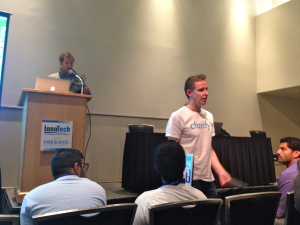
Paul Murphy, CEO of Clarify.io, answering a question from the audience at the InnoTech Austin Beta Summit

Paul Murphy, CEO of Clarify.io, answering a question from the audience at the InnoTech Austin Beta Summit

Six startups showed off their ventures during six-minute presentations at the InnoTech Austin Beta Summit Wednesday morning at the Austin Convention Center.

The demos provided the companies an opportunity to show, not tell, the audience what their companies did, said Bryan Menell, managing editor of AustinStartup.com and the panel’s moderator.

First up, Burpy, an online grocery delivery service available in Austin, San Antonio and Houston, showed how easily customers could place orders and have them delivered to their doorsteps. Burpy charges $6.99 for orders under $50.

“Burpy is your shoppelganger, we’re you inside the store,” said Sharez Prasla, Burpy cofounder.

Burpy spun out of Longhorn Startup, a semester long class geared at nurturing undergraduate entrepreneurs at the University of Texas at Austin. The founders also recently completed the Techstars Austin program.

Next up, Paul Murphy, CEO of Clarify.io, formerly known as Op3nVoice, an application that makes audio and video files searchable. Murphy showed off Clarify’s self-service API that allows developers to make apps to search audio and video files easily using keyword and topics.

It’s perfect for searching all kinds of media files, Murphy said. For example, CallTrunk, a service that allows people to record and archive phone calls, uses the technology to allow its customers to search past calls by keywords. Mobento, a site that aggregates educational videos online, uses the Clarify technology to search its videos for exact keywords and then it marks where in the video those words appear.

Right now, Clarify’s technology only works with the English language, but it’s expanding into other languages, Murphy said.

The third startup, PatientIO, a product of Filament Labs, provides a patient delivery care platform. The platform allows healthcare providers to deliver treatment information and reminders to patients.

“We provide a real time window into what’s going on outside of the clinic,” said Jason Bornhorst, its cofounder and CEO.

Filament Labs graduated from the Techstars Austin program in 2013. The company, which has five employees, has raised $1.2 million in seed stage funding. The company’s app is available on the iOS and Android platform and via the Web. It also has plans for SMS delivery in the future.

Bill Boebel showed off Pingboard, an online office management tool. Boebel, managing director of Capital Factory, previously co-founded Webmail.us and later sold the company to Rackspace Hosting.

Pingboard, founded in 2013, officially launched its beta test this summer. The company has raised $1.25 million in seed stage funding. What Pingboard seeks to do is replace paper management tools in the office by providing an office directory, vacation calendar and employee database. The service lets employees set status alerts when they are out of the office or on a business trip or home sick. It also lets them schedule vacation and makes that information available to others in the office.
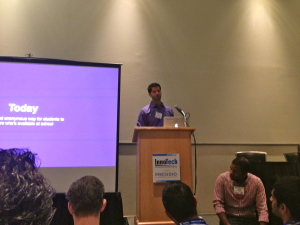
Lander Coronado-Garcia, CEO of Thread, a dating site for UT students.

Lander Coronado-Garcia, CEO of Thread, a dating site for UT students.

Lander Coronado-Garcia, CEO of Thread, a new dating app only available to University of Texas at Austin students, showed how it works.

“Our mission is to make connecting around campus, fun and safe and especially classy,” he said.

The app also has a method to report on people who are acting improperly on the site, he said.

Thread, which launched at UT this month, already has 1,000 users, Coronado-Garcia said. The app asks students to rate their favorite restaurants, activities, classes and other interests and then offers up 25 matches with photos and profile information per day to each user. Only confirmed students, who’s identities are verified through their UT email addresses, can connect with each other.

“Once a connection is made, chatting with someone is really simple,” Coronado-Garcia said.

Thread, founded by Zachary Dell, son of Michael Dell, is starting off at UT and plans to rollout to other colleges once it reaches critical mass at UT. Thread also plans to integrate geo-location features in the future too, Coronado-Garcia said. So that someone who goes home for the holidays can find other students to date in his or her hometown.

Lastly, Kevin Warden of Wingup.com demonstrated his mobile app that allows people to network with others in cities they visit.

“This is going to help you essentially take a break from that solo trip,” Warden said.

The app integrates with Trip.it, a trip itinerary organizer, and enhances business trips by providing information on how to connect with other Wingup travellers visiting a city.

The app isn’t live yet. Warden plans to launch Android and iOS apps soon.

Overcoming Barriers to Get More Women in Tech

By LAURA LOREK
Founder of Silicon Hills News

IMG_4101 2It’s no secret women in technology jobs are underrepresented.

Women hold more than half of all professional jobs in the U.S., but make up less than 24 percent of all computer-related jobs, “representing a huge pool of untapped talent,” according to a study by the Clayman Institute for Gender Research at Stanford.

“The numbers are not moving in favor of increasing women’s participating in technology; in 2008 women earned only 18 percent of all computer science degrees. Back in 1985, women earned 37 percent of CS degrees,” the Clayman Institute reports.

The 2014 Women in Tech Summit at InnoTech Austin on Wednesday featured straight talk about the challenges women in technology face and ways they come overcome barriers and excel.

During the opening keynote address, Angela Yochem, chief information officer of BDP International, talked about being ignored in meetings at a previous job. She would offer her ideas and her colleagues would politely listen and move on. So she teamed up with a male coworker. She offered up an idea. He copied down exactly what she said. He waited about five minutes and then offered up the same idea.

“All of a sudden he was the most brilliant guy in the company. He was on fire,” Yochem said.

The group embraced his idea. They did this for three month and it always worked the same. They ignored her but they embraced the exact same ideas when it came from him. One night over drinks, they told the group of what they had been doing. The group laughed uncomfortably but they were horrified, Yochem said. They had been tuning her out.

“They said they didn’t realize they were doing this,” Yochem said. One guy floated the notion that maybe they were tuning her out like they tune their wives out at home, she said.

This happens to women in conference rooms all over the U.S., said Janelle Monney, founder and managing partner of The Monney Group.

In fact, National Public Radio just did a story on how women’s voices are not perceived as authoritative in the workforce. It reported on studies showing that feminine voices are perceived as less trustworthy, less competent and insecure.

Yochem and Monney also discussed work and life balance. They both agreed working made their children more independent and self-reliant, which are the traits they need to succeed in life.

Women also need to focus on what makes them happy, Yochem said.

“Ever single one of us needs to take time for ourselves,” Yochem said.

A member of the audience asked about policies companies should have in place to attract and retain female workers. Yochem said the company has to have a culture of flexibility and good managers with bosses that have the employees’ backs and makes sure their voices get heard.

South and Southeast Austin to Get Google 1 Gigabit Internet in December

By LAURA LOREK
Founder of Silicon Hills News

David Anthony, technical program manager, Mark Strama, city manager and Parisa Fatehi-Weeks, community impact manager with Google.

David Anthony, technical program manager, Mark Strama, city manager and Parisa Fatehi-Weeks, community impact manager with Google.

Google plans to launch its 1 Gigabit Fiber Internet service in South and Southeast Austin in December.

“I want to emphasis off the top, that is where we will start,” said Mark Strama, city manager for Google Fiber. “This is not where we will finish. We will be rolling this network out in segments throughout the entire city. But we have to start somewhere.”

“Because we are building it from the ground up we can’t deploy the whole city at once,” Strama said.

In April of 2013, Google announced Austin as the latest location for its Google Fiber. It planned to launch the service in mid-2014, but the project has taken longer than originally expected because of weather delays and other issues.

Since Google announced its plans, AT&T and Grande Communications have also begun to roll out their own 1 Gigabit Internet service in Austin.
In August, AT&T launched its 1 Gigabit per second Internet service to tens of thousands of its customers in Austin.

Google welcomes the competition, Strama said. Google wants everyone to have access to the fastest Internet possible, he said.

Fiber TruckHigh speed broadband Internet has a transformative effect on society, Strama said. Business models like Youtube and Netflix weren’t possible in a dial-up Internet world. But Google, by making the Internet 100 times faster, will create all kinds of new businesses and applications that entrepreneurs and inventors will dream up, he said.

Video conferencing applications will be some of the first real applications of Gigabit data, Strama said.

Installing Google fiber is a massive construction project, said David Anthony, technical program manager. The project involves planning, permitting and deploying fiber optic cable, he said.

Google is installing 20 Fiber huts, 1,000 telecommunications cabinets and 3,000 miles of fiber optic cable, Anthony said.

GoogleFiber_Austin_mapAustin is the third city to get Google’s 1 Gigabit network. In 2012, Google deployed a 1 Gigabit network in Kansas City, Kansas and Kansas City, Missouri. Google also provides a 1 Gigabit network in Provo, Utah.

In February, Google invited 34 cities nationwide including San Antonio to explore what it would take to bring Google Fiber to their city. Strama said he didn’t have any updates on San Antonio yet, but he expected to announce something soon.

The U.S. lags the rest of the world when it comes to providing high speed Internet. The U.S., which ranks 14th in the world in Internet speed, has average connection speed of 11.4 Mpbs. Only 13 percent of those connections are fiber, compared to 86 percent in Japan.

Google is providing free Gigabit Internet access to 100 nonprofit organizations in the city.

Cratejoy Raises $4 Million and Plans to Hire Engineers

Alex Morse and Amir Elaguizy, co-founders of Cratejoy in Austin, courtesy photo

Alex Morse and Amir Elaguizy, co-founders of Cratejoy in Austin, courtesy photo

Cratejoy, which provides one-stop service to begin a box subscription, just landed $4 million in Series A funding from Charles River Ventures.

The one-year-old Austin startup also launched the public beta of its service. It provides web hosting, page templates with mobile integration, subscription billing management systems and business analytics to e-commerce companies selling to customers via box subscriptions. Its customers, in a private beta test included A Little Bundle, curated monthly bundles for expecting mothers; Austin BatBox, all things about Austin; Root Bizzle, a tie of the month club and The Fox Society, custom-planned dates for Austin couples.

The latest round of funding brings Cratejoy’s total funding to date to $6.2 million. The company raised $2.2 million in seed funding from SV ANgel, Y Combinator, Capital Factory, Andreessen Horowitz, Maverick Capital, Start Fund and ACE Venture Fund.

Cratejoy plans to use the funds to hire engineers and to continue to build out its platform.

“We’re also honored to announce Devdutt Yellurkar of CRV will join our board. Devdutt has pioneered CRV’s investments in next-generation commerce and SaaS companies, and we love what he has to say about us,” Amir Elaguizy, co-founder of Cratejoy wrote in a blog post announcing the funding.

“Everything points to subscription being the future of commerce and consumption, bringing exceptional goods and services to consumers before they even know they need them,” Devdutt Yellurkar, general partner at CRV, said in a statement. “Amir and Alex are going to make that future possible with Cratejoy. They’re founders with a very real, fantastic vision and a true passion for subscription commerce.”

This profile of Cratejoy appears in Silicon Hills News’ latest print magazine.

Q&A with Mike Martinez, candidate for Mayor of Austin

Courtesy photo

Courtesy photo

This weekend, the Austin Technology Council featured a guest post from Austin Mayoral Candidate Mike Martinez in its meet the candidates for Mayor series. Silicon Hills News is asking each of the candidates a series of follow up questions. Their responses will all be posted here following their guest blog posts with ATC. First up, is a Q&A with Mayoral Candidate Mike Martinez.

WORKFORCE DEVELOPMENT

Q. Technology in Austin, as in all major hubs of innovation in the country, has a pipeline problem when it comes to filling jobs. There are more jobs in the Science, Technology Engineering and Math fields open than there are qualified applicants. What steps can you take, as Mayor, to ensure that the Austin workforce can meet the needs of the growing technology industry?

A. We need to ensure the specific needs of tech and life sciences job creators, educators, and workers are aligned. The recently announced Austin Tech Partnership between the City and the Austin Tech Council will benchmark efforts to better understand and support our unique talent landscape.

Those benchmarks will help us establish priorities in the near term like supporting industry outreach and recruiting, in the mid-term including education workforce training programs with ACC and alternative providers like Maker Square, and long term including increased industry participation in the many regional STEM programs and efforts to prepare all Austinites to participate in the digital economy.

We have recently added to the city’s economic development policy that require companies moving to Austin to integrate STEM programs within their companies and partner with our local schools. This along with the above mentioned suggestion could drastically improve our pipeline of workforce members and I am committed to doing all I can as Mayor to foster even stronger goals and initiatives.

DIVERSITY AND INCLUSION

Q. Studies have shown that diversity is a key to success in the technology industry and business in general. How, as Mayor, would you specifically work to nurture diversity in the tech sector to ensure more opportunities for minorities and women?

A. This has been and will remain a priority. As Mayor, I’ll continue existing City Digital Inclusion efforts to ensure all members of the Austin community can access and participate in the digital economy. In addition, Austin tech needs digital creatives to fill the 9000 tech jobs we see coming by 2017. Integration of the tech community into City efforts and the programs offered by longtime regional stakeholders like Skillpoint Alliance and Girlstart are key to ensuring all Austinites have the opportunity to participate in a 21st Century economy.

Entrepreneur support groups like Women@Austin and the mentor structures leveraged by local startup incubators and accelerators are becoming real forces in our community. I’d like to see those models expanded to raise awareness of the entrepreneurial potential of all Austinites. We must also engage further with our local minority chambers such as the Greater Austin Hispanic Chamber, Austin Black Chamber and others to build stronger partnerships and foster further opportunities.

LIFE SCIENCES

Q. Austin is getting the Dell Medical School, which will act as a catalyst in helping to develop the area’s life sciences industry. What do you think the City of Austin needs to do to support and nurture this emerging industry?

A. There’s no doubt that the Dell Medical School is going to impact our life sciences sector along with the rest of our community. UT, the State, the City, and the tech industry must work together to ensure that we’re able to compete with efforts in Houston, San Antonio, and Dallas to sustain healthy life sciences ecosystems.

The medical school is a unique opportunity to integrate tech and the larger community and I look forward to being an integral part of this amazing transformation within our community. As Mayor, I will ensure that our city is intimately involved and all stakeholders have ample opportunity to participate and help us develop best practices and sustainable policies.

INCENTIVES

Q. What is your view on providing incentives to tech companies to locate or expand in Austin?

A. Incentives are important to growing Austin’s business climate. In the past, we’ve seen incentives provided to bring in large brands from out of state. I think this is a great idea but it has to be balanced with the impact of those arrivals on regional talent, housing, and traffic infrastructures.

I have proposed a reemphasis on incentivizing local mid-size and small businesses to ensure all Austin entrepreneurs are able to add critical support to – and participate in the success of – Austin’s tech economy. We have the talent, entrepreneurship, education and vision right here in our own community to take Austin to the highest level possible in creating good paying, long term, sustainable jobs.

InnoTech Austin Kicks Off Wednesday

Austin14_275x175 (2)InnoTech Austin kicks Off Wednesday morning with a keynote speech on fostering entrepreneurship, technology and innovation.

The talk features Bob Metcalfe, Professor of Innovation at UT Austin, Laura Bosworth, CEO and Co-Founder of TeVideo BioDevices and Michele Skelding, senior vice president Global Technology and Innovation at the Austin Chamber of Commerce.

A Women in Tech Summit begins at 9:10 a.m. and features a full day of sessions and talks from powerful women in technology throughout Austin discussing everything from overcoming barriers to innovation to effective communications strategies.

In addition, the Beta Summit returns to InnoTech at 11 a.m. and features a handful of promising young startups. Bryan Menell of AustinStartup.com will moderate that event.

InnoTech Austin, sponsored by Presidio, is the longest running standalone technology conference in Austin. The 11th annual event includes full day data and analytics track, full day security track. It also features sessions on IT Leadership & Strategy, Healthcare IT, Cloud technologies and mobility, CIO Gala luncheon and the Austin Digital Marketing Summit.

Tickets are still available. And make sure to pick up a copy of Silicon Hills News’ latest print magazine at the conference, which will be held at the Austin Convention Center.

« Older posts Newer posts »

© 2026 SiliconHills

Theme by Anders NorenUp ↑