Category: Austin (Page 146 of 318)

Austin-based Vast Lands $14 Million in Venture Capital

VastVast, a data platform to sell cars and houses, announced Monday it has received $14 million from Capital One Growth Ventures.

The Austin-based company, founded in 2005 in Silicon Valley, had not raised any money previously. It has created two main brands: CarStory for automotive and HomeStory for real estate. The company plans to use the money to expand its CarStory product and also to further develop its products for the real estate market, according to a news release. CarStory helps consumers discover and decide what car is right for them with artificial intelligence, data and analytics. The vehicle discovery platform now curates more than 3.5 million vehicles.

As part of the investment, Jaidev Shergill, managing partner of Capital One Growth Ventures, will join the Vast board of directors.

“What Vast is delivering to consumers with its CarStory product is very intriguing to us at Capital One,” Shergill said in a news release. “Consumers expect more information at their fingertips and for that data to be personalized and customized. Big data technologies enable this and Vast delivers it.”

“Big data for life’s biggest purchases, that’s what Vast is all about,” Vast CEO John Price said in a news release. “Our patented approach delivers critical discovery information, predicts alternatives and analyzes the local market to guide the purchase decision in service of the buyer.”

Silicon Hills News did this story on Vast last March.

True Made Foods Wins the Food+City Challenge Prize for 2016

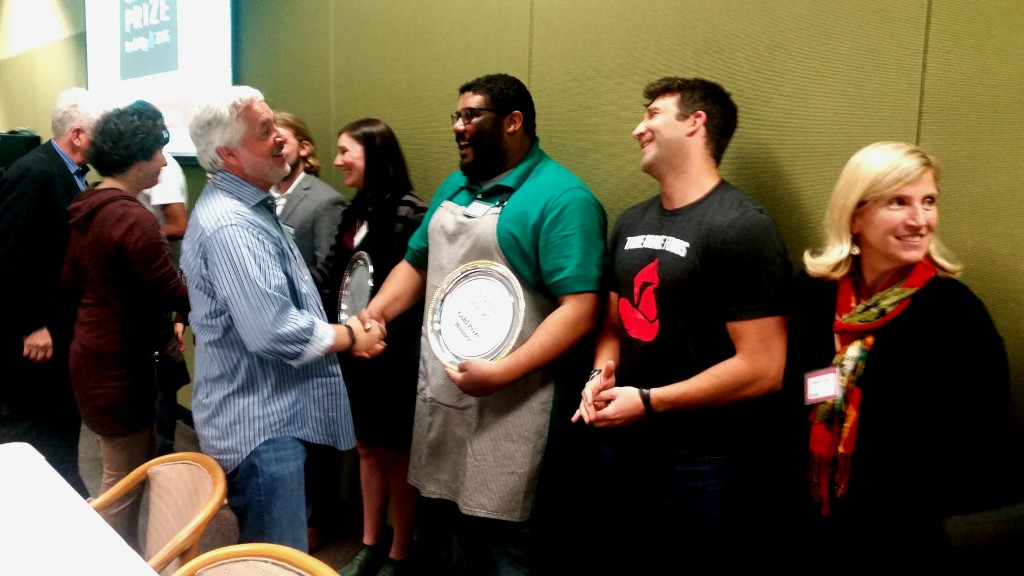
True Made Foods co-founders Kevin Powell and Abraham Kamarck , photos by Hojun Choi

True Made Foods co-founders Kevin Powell and Abraham Kamarck , photos by Hojun Choi


By HOJUN CHOI
Reporter with Silicon Hills News

True Made Foods took first place in the second annual Food+City Challenge Prize competition held at the University of Texas at Austin campus on Saturday.

The New York-based startup won the $30,000 grand prize and beat 19 other startups from all over the world. In addition to the grand prize, four runner-up companies received $5,000 in prize money each for their ventures. They included: Agruppa, Garbage to Garden, The Food Corridor and Anchor Nutrition.

“This is really important for us because it brings us validity; it shows that we have a good pro​​duct and something to show for it,” True Made Foods co-founder Abraham Kamarck said.

True Made Foods makes ketchup, barbeque sauce and hot sauce from fresh vegetables, with less sugar than traditional sauces. Kamarck, a former helicopter pilot for the U.S. Navy, said that he and co-founder Kevin Powell are seeking to make certain foods more nutritious by using vegetables to sweeten their products. Powell, who also served in the U.S. armed forces before pursuing more entrepreneurial endeavors, said that the startup industry can help veterans transition back to civilian life.

“Some veterans come back with a feeling of being socially disconnected from civilian life, but when you’re in a startup it forces you to get out there and meet people, investors and mentors,” Powell said.

True Made Foods will use the prize money, according to Kamarck, for the company’s branding and marketing efforts. The company is currently looking to raise $750,000 by the end of the year, he said.

“We’re still at the seed stage, and we’re less than a year old so every penny goes towards getting our product out there on shelves and creating awareness,” Kamarck said.

Food+City, a nonprofit organization that seeks to educate and inspire action around global food systems, organized the day-long event held at the McCombs School of Business.

Robyn Metcalfe, director of Food+City, said the organization’s board of advisors first had the difficult task of narrowing down a list of more than 170 startups that applied to compete in the event. Then Food+City invited 20 companies to compete in Saturday’s event, and designated mentors helped them polish their pitches and business plans.

Each competing team set up a booth at the McCombs School of Business’ Atrium room, where they had a chance to mingle with the attendees and promote their companies. A panel of judges chose ten startups to compete in the pitch competition, during which contestants gave three-minute pitches on their business plans.

“We really try to look at the whole food system,” Metcalfe said. “So we wanted judges that were from all different parts of the food system.”

The criteria the judges followed was based on Get Backed, a book that offers guidance to business owners on how to raise money for their ideas. The author of the book, Evan Baehr, co-founder of Austin-based Able, an online lending platform for small businesses, attended the event for a special book signing.

Baehr said the hardest part of entrepreneurship is the execution of the idea. And though many business owners have great ideas, Baehr said they often do not have the networks and mentorship to lead them towards effectively raising funds and traction for their idea.

“People often have big ideas, but they don’t know investors personally and they probably don’t know founders that have raised capital before who can teach them how to build their pitch decks and how to ask for money,” Baehr said.

About 700 people attended the event. Metcalfe said in future years, Food+City may change the scope and focus of the competition.

“Next year, we’ll certainly do some things differently because we want to be just as innovative as anybody else; we have to walk our talk,” Metcalfe said. “Our major interest right now is looking at food distribution, and whether it’s time for us to focus a competition like this specifically in that area.”

Click here to check out the full list of 2016 Food Challenge Prize finalists.

The crowd at the Food+City Challenge Prize 2016 event

The crowd at the Food+City Challenge Prize 2016 event

Bazaarvoice Gets New Headquarters

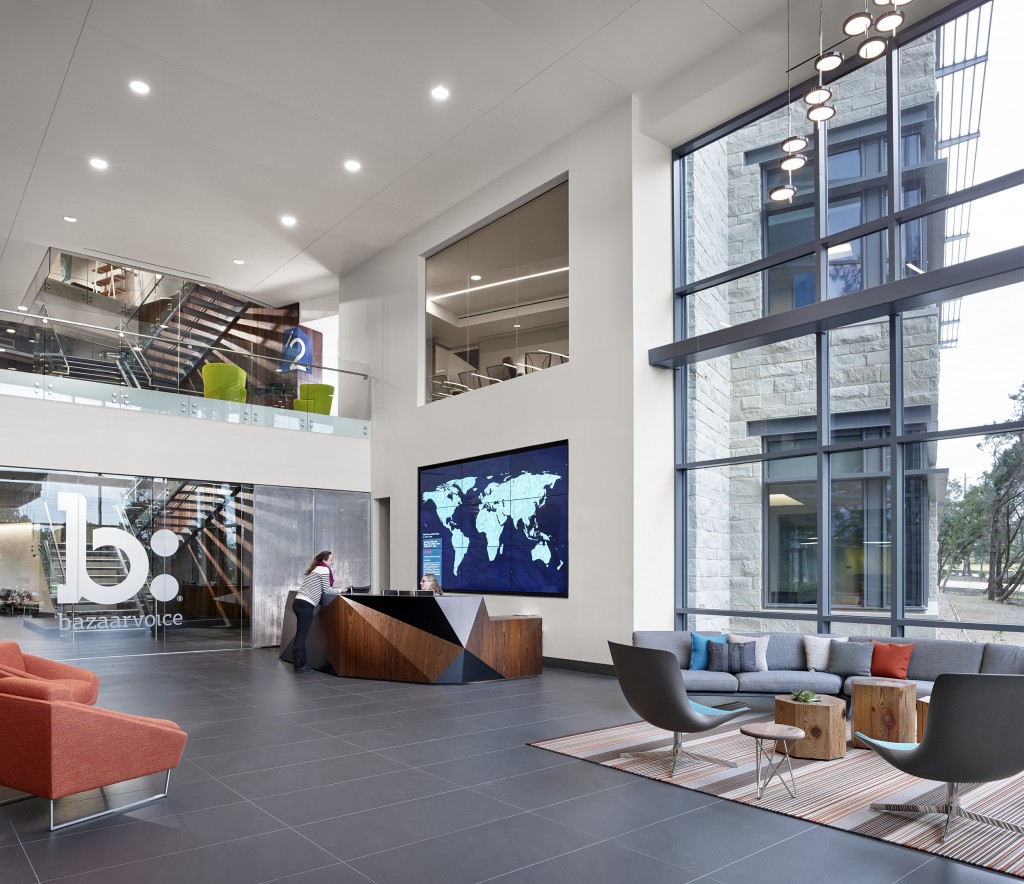
Bazaarvoice_NewHQ_Main-Lobby
Bazaarvoice, the world’s largest network of active shoppers, this week unveiled its new company headquarters in the Quarry Oaks business park in North Austin.

Its new 137,615 square foot building houses Bazaarvoice’s 600 employees. And it includes a Whole Good Market Café for company employees.

“As Bazaarvoice moves into its 11th year as a company, it is important that we have a headquarters that not only reflects the company’s storied past and our bright future, but also incorporates the local community we have been tied to for the last decade. This building hits the mark on all accounts,” Gene Austin, CEO of Bazaarvoice, said in a news release. “We had fantastic support with making decisions that impacted the design of the building from our external partners – all of whom are local companies renowned in their particular area – as well as from our Bazaarvoice employees. The result is an impressive headquarters building that our employees can feel proud to work in every day.”

Bazaarvoice_NewHQ_Kitchenette

Bazaarvoice’s building features a glass-lined central staircase contributes to the company’s culture of openness and collaboration. Austin-based Riverside Resources developed the new headquarters which features outdoor decks, four-side cut lueder limestone, curtainwall glass, accented steel beams and exposed interior concrete.

In addition to working with Riverside Resources, CBRE’s Workplace Strategy team partnered with Bazaarvoice to create a space that redefines how the company works. The result is a variety of work settings, including both collaborative and private spaces with huddle rooms, sit/stand desks and offices, and focus rooms.

Bazaarvoice_NewHQ_Fitness-Center

Austin-based Clarify.io Selected to Participate in Microsoft’s Machine Learning Accelerator

clarify-negative-squareAustin-based Clarify.io, which allows developers to search and understand audio and video using a simple API, was selected to participate in Microsoft Ventures’ Machine Learning Accelerator in Seattle.

And Paul Murphy, the company’s founder and CEO, reported in a blog post that the company is not relocating to Seattle.

“We are thrilled to work with some of the people defining this industry,” Murphy wrote in a blog post. “The combination of our approaches and Microsoft’s fundamental research will let us meet our clients’ needs and accomplish things for them that weren’t previously possible.”

Microsoft travelled to 12 cities in the U.S. and Canada and reviewed hundreds of business applications from 50 countries before selecting 10 companies to participate in its machine learning accelerator. The rest of the companies are listed in a Microsoft blog post.

Murphy also reported the company would be renting a houseboat, because it was cheaper than an apartment.

“And yes, the houseboat comes with 4 kayaks, 2 stand up paddleboards, and 2 bikes, so we’ll be getting in shape while the machines figure out what they should be doing,” Murphy wrote.

Pitch with Purpose Encourages Female Founders to Apply

CircularPitch with Purpose is encouraging women entrepreneurs leading high-growth, scalable businesses that support the resolution of the world’s most pressing problems to apply for its pitch competition.

Circular Board, based in Houston, announced the competition Thursday in partnership with the United Nations Foundation, Dell and Guggenheim Partners.

Companies with at least one female founder are encouraged to submit an application online and three finalists will be selected to present in front of judges, investors and media at Circular Summit, scheduled for April 14-15th in Houston. The deadline to apply is March 18th.

The winner of the competition will receive $10,000 from Guggenheim Partners. They will also receive Dell technology suite, admission to the Circular Board accelerator for women entrepreneurs, mentorship from Susan McPherson, founder and CEO of McPherson Strategies, Elizabeth Gore, Dell entrepreneur in residence and emeritus chair of the United Nations Foundation’s Global Entrepreneurs Council and Zaw Thet, managing partner of Signia Venture Partners. The winner will also receive a feature on MORE Magazine’s digital platform.

Five semi-finalists will also win entry into Circular Summit.

“Texas claims the worst record of supporting women seeking venture capital. Last year, 42 Texas startups got Series A rounds. Zero of them had female founders, and it’s not for a lack of women in business. In fact, several Texas cities, like San Antonio and Houston, are considered the fastest growing for female founder–driven economic clout,” Carolyn Rodz, CEO and founder of Circular Board and co-chair of Circular Summit, said in a news statement. “The goal of Circular Summit and Pitch with Purpose is to initiate action around the data surrounding the global impact of women-owned businesses, and we’re doing it in Texas because this is an area where the gender gap is widest.”

The number of women-led businesses in the United States increased by 74 percent between 2007 and 2015, a rate 1.5 times the national increase of other businesses, according to the OPEN State of Women-Owned Businesses Report.

“When you consider that women reinvest 90% of their income back into their communities, children and health, you begin to see that if these entrepreneurs succeed, they will help solve the world’s problems,” Gore, co-chair of Circular Summit, said in a news statement. “48 percent of female founders cite a lack of available mentors or advisers as a barrier to growth, which is why we’ve incorporated top-tier mentor support and introductions into highly localized networks into Pitch with Purpose.”

Greenbelt Greens Launches in Austin

Greenbelt GreensThe salad days are here to stay in Austin.

And thanks to a new Austin-based subscription service, Greenbelt Greens, people can get chef-designed salads and grain bowls sent straight to their doorstep. The startup just launched its service this week.

Customers can personalize their deliveries when they set up their Greenbelt Greens profile. They’ll be asked about dietary restrictions and nutritional goals. Greenbelt Greens will then suggest a list of possible meal ingredients, which customers can tweak to their taste.

“Prior to your weekly delivery, you’ll be provided with your upcoming menu. You can review and request to remove any ingredients or swap out for your weekly ‘back-up’ meal,” according to the company.

Greenbelt Greens 2
Greenbelt Greens uses fresh, seasonal ingredients and produces their salads locally. It never provides frozen ingredients. It also puts the full nutritional content on every meal.

The service cost $10 per meal, delivered. Salads and bowls come packaged in reusable mason jars (we’ll pick the empty jars up from you when dropping off your next order), and are ready to eat with the twist of a lid.

(Full disclosure: Greenbelt Greens is a sponsor of Silicon Hills News and this is a sponsored post)

Techstars Announces its 2016 Austin Cohort

techstarslogoFor the first time half of the Techstars Austin cohort hails from Austin.

This is the fourth class for the popular Techstar accelerator in Austin and the first one led by its new managing director, Amos Schwartzfarb.

“It was not intentional,” Schwartzfarb said. “We were very location agnostic. It wasn’t a field in the spreadsheets we have….I do think it’s a testament to how the community is really evolving and growing in Austin.”

The theme is as much as possible no theme, Schwartzfarb said.

“We were really looking for things that were interesting that were pushing limits – innovative in some way in the space they were already playing in,” he said.

The program begins Feb. 15th and runs through May with Demo Day scheduled for May 19th.

“During SXSW Techstars will have a presence here and our teams are highly encouraged to go get out of the office and take advantage of all the people coming to town,” Schwartzfarb said. “They’re encouraged to go out and meet potential customers and meet potential investors.”

“I think this is a really phenomenal class I can’t wait to get started and get under the hood with everyone and see what kind of fantastic things come out the other side.”

The local startups include Authors.me, a platform to connect authors with publishers led by Monica Landers, David O’Brien and Henrik Kjallbrin and CarServ, a platform that transforms communication and workflow in the auto repair industry led by Marshall Mundy. The others are Kandid.ly, photography services led by Sam Ulu and Maria Walley, PenPal Schools, a global education platform led by Joe Troyen and Miguel Vazquez and Popup Play, founded by Bryan Thomas and Amelia Cosgrove.

Another close-by startup is The Helper Bees, a service that connects seniors with local helpers, based in Georgetown, founded by Char Hu, Danny Lynch and Eric Corum.

And Remidi, the maker of a wearable musical instrument, is listed as being based in Turin, Italy and Austin with founders Andrea Baldereschi, Andrea Bulgarelli, Marco Casolati, Mark DeMay and Alberto Forneris.

Bamba Group, a web-based data collection tool, hails from both Toronto, Canada and Nairobi, Kenya. Its founders include Al Ismaili, Faiz Hirani and Shez Tejani.

Casabots of San Jose, Calif., a general purpose commercial cooking robot, is founded by Deepak Sekar.

FieldVine, a task management construction tool based in Myrtle Beach, South Carolina, is founded by Ray Antonino, Rebecca Antonino and Adam Michel.

Google and HUD to Bring High Speed 1 Gigabit Internet to Public Housing Developments

A West Bluff resident and her son will receive the Google high speed fiber network to their home at no cost. Photo courtesy of Google.

A West Bluff resident and her son will receive the Google high speed fiber network to their home at no cost. Photo courtesy of Google.

Google and the U.S. Department of Housing and Urban Development announced Wednesday plans to bring high speed Gigabit Fiber Internet to housing developments nationwide.

The goal is to improve access to the Internet for the nation’s poorest residents and to help children get access to materials online to improve their education and help boost their performance at school.

U.S. HUD Secretary Julian Castro and Google Fiber Vice President Dennis Kish announced that the West Bluff Townhomes in Kensas City, Missouri is the first public housing development to be connected to Google Fiber’s ultra-high speed gigabit Internet free of cost through the ConnectHome Initiative. And during the next several months, gigabit service will be available to another 1,300 public housing units in the Kansas City metro area.

Additionally, Google Fiber will be bringing those high speeds to HUD assisted and affordable housing in all fiber cities, including the ConnectHome fiber cities of Atlanta, GA, Durham, NC, San Antonio, TX and Nashville, TN. No time table was given for the rollout of the service.

ConnectHome is a public-private collaboration to narrow the digital divide for families with school-age children who live in HUD-assisted housing. Through ConnectHome, Internet service providers, non-profits and the private sector will offer broadband access, technical training, digital literacy programs, and devices for residents in assisted housing units in 28 communities across the nation.

“For far too many low-income families, and especially their children, connecting to the Web remains a distant dream,” Castro said. “Knowledge and education are the currency of this 21stCentury economy, and Google Fiber is helping ensure that all children, no matter where they live, have access to the tools they need to be competitive in their schoolwork and close the digital divide.”

“At Google Fiber, we believe that superfast speeds and access to home broadband can move entire communities forward. That’s why we’ve partnered with ConnectHome to bring some of the fastest Internet speeds to those who need it most. Families in these properties will be able to access gigabit Internet service, at no cost to the housing authority or to residents,” Kish said.

Inspired by its early success of the work with the Housing Authority for the City of Austin, Google Fiber is complementing its free gigabit Internet service by working with local partners to make new investments in computer labs and digital literacy classes so residents learn the skills they need to get online.

20 Finalists Compete Saturday in the Food+City Challenge

FoodcityTwenty finalists from all over the world will be in Austin on Saturday to compete in the 2016 Food+City Challenge Prize Showcase Day.

A panel of 17 judges will evaluate the finalists and select the winners of $50,000 in prize money and perks from Food+City partners. The showcase day runs from 10 a.m. to 4:00 p.m. on Saturday and is free to attend and open to the public. RSVP through Eventbrite. The event will be held at the McCombs School of Business on the University of Texas at Austin campus.

The panel of judges include Bob Metcalfe, professor of engineering, innovation and entrepreneurship at the Cockrell School of Engineering at the University of Texas at Austin, Martin Berson, founder of Snap Kitchen, Edwin Marty, food policy manager for the Office of Sustainability of the City of Austin, Claire England, executive director of Central Texas Angel Network, Randy Evans, HEB Director and Executive Chef for Restaurants and 12 other experts in the fields of food, nutrition and innovation.

OJO Labs Lands $5.8 Million in Venture Capital

By LAURA LOREK
Reporter with Silicon Hills News

BerkowitzA new startup, OJO Labs just closed on $5.8 million in Series A funding from local investors.

Austin-based LiveOak Venture Partners and Silverton Partners led the financing.

John Berkowitz, co-founder of Yodle and David Rubin, founder and former CEO of ProfitFuel founded OJO Labs in February of 2015. Yodle, which merged with ProfitFuel, is the fifth largest tech employer in Austin and provides an online marketing platform for 50,000 small to medium sized businesses.

“We love Austin,” said Berkowitz.

Berkowitz raised $50 million from investors on both coasts for Yodle and OJO Labs could have gone outside of Austin to raise its money. But Berkowitz said Austin now has the ability to fund its own. And LiveOak Venture Partners and Silverton Partners provide a “refreshing take on V.C. funding,” he said.

“We wanted to make this a cool Austin story,” Berkowitz said.

Instead of getting venture capital from a big name in Silicon Valley, in the end it’s a people story, Berkowitz said.

“Krishna and Kip are a great team,” he said.

“We look at hundreds of companies each year and are excited to work with OJO because it combines a best-in-class team with a massive vision,” Kip McClanahan, General Partner at Silverton, said in a news release.

“We are very excited to provide our resources and experience to help accelerate the OJO vision,” Krishna Srinivasan, General Partner at LiveOak said in a news release. “We are confident that with the combination of John and Dave’s entrepreneurial experience and leadership, the differentiated technical approach and the magnitude of this opportunity, this will be a huge success story.”

OJO Labs, with 11 employees, is based at WeWork on Congress in downtown Austin. The startup is building a technology that uses machine learning, neural networks and proprietary conversation models.

OJO Labs is attacking a big problem at the right time with the best team, said Berkowitz.

“We’ve assembled the best possible technical team,” Berkowitz said. “We can compete with all the teams in New York and in the Valley. The team we have now is an incredible group of rock stars.”

They are building a text-based customer service agent using artificial intelligence. The company is in private beta with a select group of businesses and consumers right now. It is working on perfecting the product, Berkowitz said.

This is not a new vision, Berkowitz said. People have been talking about creating intelligent conservation-based agents since the 1980s, but now the time is right, Berkowitz said.

“It used to be a dream,” Berkowitz said.

In the past, the technology wasn’t up to par yet. But now it is and people are comfortable talking to a machine, he said. OJO Labs technology focuses on text-based conversations.

A huge segment of the population doesn’t mind if it’s a machine or a human as long as it is smart and provides great customer service, Berkowitz said.

Over the past year, the market has gained significant momentum and companies of all sizes are investing heavily in AI and messaging-based interfaces. “We are building technology that will power conversations between humans and machines in ways that have never been done before,” said Josh Levy, PhD who is Chief Data Scientist at the company.

The startup plans to use the money to pay its development team while it perfects its product.

“This gives us a long runway to take our time to create something really great,” Berkowitz said. “Once we have a great product and market fit we will release it into the market. We’re going to take our time and do it right.”


« Older posts Newer posts »

© 2026 SiliconHills

Theme by Anders NorenUp ↑