Category: Austin (Page 210 of 318)

Startups Gangnam Style

By SUSAN LAHEY
Reporter with Silicon Hills News
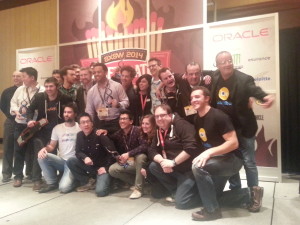
20140310_190555Korea brought its first group of startups to SXSW in 2014, the Geeks from Gangnam, sponsored by the Banks Foundation for Young Entrepreneurs and the Korea Creative Content Agency.

Offering products as creative as a Korean travel news app and an origami app called “Let’s Fold,” that lets people do origami virtually and competitively, the group is part of an entrepreneurial training program called D.Camp, a startup community ecosystem that helps incubate entrepreneurial companies.

Seokwon Yang, senior manager of business operations for D.Camp , photo by Susan Lahey

Seokwon Yang, senior manager of business operations for D.Camp , photo by Susan Lahey

Seokwon Yang, senior manager of business operations for D.Camp said SXSW has offered a fantastic opportunity for Korean entrepreneurs to make connections with potential customers, get a glimpse of how other parts of the world handle entrepreneurship and get a chance to demo their products.

Five thirty team, photo by Susan Lahey

Five thirty team, photo by Susan Lahey

Some parts of the startup culture are challenging for Koreans, he said. “Fail forward is not part of Korean culture,” he said. “If you fail in Korea, you feel like a loser. There is shame. You don’t want your friends and family to know. We need to learn ‘fail forward.’”

Tech Ranch sponsored a Geeks from Gangnam party with K-Pop bands from Korea and some of the Austin startup community leaders Monday night at Brass House.

So How Did YOU Get Picked for Accelerator?

By SUSAN LAHEY
Reporter with Silicon Hills News

images-2So how out of 500 applicants for Accelerator, does Chris Valentine of SXSW choose the 48 companies (and their alternates) who will have the chance to pitch?

This year, for example, contestants came from Ireland and Slovenia, Denmark, Finland, the Netherlands, London, Tel Aviv and all over the United States.

“I spend a lot of time every day looking for interesting companies from around the world,” Valentine explains.

If he finds a cool technology, he passes the link onto an intern to check it out further. If some city, like Berlin, starts churning out cool startups, he might offer someone recommended to him in the scene a badge in return for scouting the area for cool startups. He also has the help of a qualifying committee including Ben Dyer, Tony Averbeck, Bart Bohn, Carla Cook, Kyle Cox, Michael Crider, Dean Cruse, Ken Demarest, Laura Kilcrease, Collin Osborn and Chris Treadaway.

“We all know about what’s happening in Chile, Brazil, all these countries. But what gets me really excited is that a lot of these companies are taking technologies that we may be developing here and developing them for their cultures. It’s like, you may be Uber for India. Facebook is trying to take Russia and they can’t because Russia has their own social site like Facebook that makes sense for that culture.”

Valentine says he knows a lot of the companies won’t be commercial successes in this iteration. One company, for example, makes designer gowns with solar panels on them for phone charging. Considering the small market for designer gowns, much less those with solar panels, the judges believed the application might have been more practical on outdoor gear….or even a tent.

“I hadn’t heard of anyone putting a solar panel on clothes,” Valentine said. “And here I am,” he indicated his smart phone connected into a nearby power strip. “I’m always looking for a place to charge my phone.” The company, Pauline Van Dongen, from the Netherlands may have to pivot. But then, Valentine said, This company may or may not be successful. The judges will say ‘I love this idea but what about this change.’ Maybe she’s so far in she can’t pivot. Maybe she’ll have to fail.”

Other Austin companies that made the cut included Op3nvoice, Plum (formerly Ube), EvoSure, Shelfbucks and sonarDesign.
Last year, Valentine said, he had five contestants from outside the U.S. This year he had 15 and he expects that to grow.

Winners of the 2014 SXSW Accelerator Competition

By SUSAN LAHEY
Reporter with Silicon Hills News

Winner of the SXSW Accelerator programs, photo by Susan Lahey

Winner of the SXSW Accelerator programs, photo by Susan Lahey

The huge ballroom that hosted the SXSW Accelerator Awards Sunday night was packed and the mood was warm and festive as emcee Francisco Dao, founder of 50 Kings suggested a giant selfie, Oscars-style, and winner Barak Hachamov of Israel took a video of the group clapping for his award to send back to his family.
Hundreds attended the awards ceremony which seems to swell every year.
This year’s winner in the Entertainment and Content Technologies category was Waygo of Providence, Rhode Island. This app that lets people scan Chinese with their smartphone cameras to instantly translate it into English, without using a data connection. Another company, Word Lens, does the same thing, but only for Western text. Founder Ryan Rogowski said “It has been great to be here at South By, talking to other startups and being honest about how we’re all failing, even if we’re succeeding.”
ThriveOn, a San Francisco company that offers a mental health assessment and suggestions online, won in the Health Technologies category.
Synbiota of Montreal, won in Innovative World Technologies. Synbiota is a collaborative, open web platform that allows people to create materials, food, medicines and fuel using DNA as building blocks.
Samba.me of Tel Aviv, Israel, won in the Social Technologies category. Samba.me replaces “LOL” with actual reaction shots of people as they see what you’ve shared socially.
Skully Helmets won in the wearable technologies category. The motorcycle helmet is currently a “rear view mirror on steroids” that lets riders see what’s going on behind them without taking their eyes from the road ahead. But the company intends to increase its functionality to make it, “Google Glass that can save your life” according to founder Marcus Weller.
Trustev of Cork City, Ireland, won in the Enterprise and Big Data Technologies category. This company provides real time, online identity verification to eliminate fraud and increase revenues for retailers.

Avegant winner, photo by Susan Lahey

Avegant winner, photo by Susan Lahey

Winners each received a check for $4,000. There was also a one-minute fast-pitch competition for some of the entrants who didn’t make it into accelerator. Avegant is a multi-media device that offers virtual retina display, essentially using the back of the eyeball as a screen. That company won $1,000.
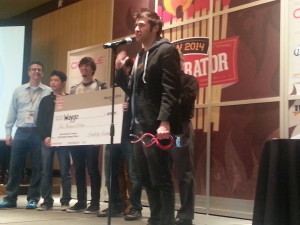
Waygo, photo by Susan Lahey

Waygo, photo by Susan Lahey

Some of the world’s coolest technologies were presented over Saturday and Sunday at SXSW Accelerator competition. Dresses with solar panels built in for charging your smart phone; software that lets you scan your house with a smart phone and create a virtual environment to try out paint colors, furniture and more; an artificially intelligent emotional recognition software that lets webcams read people’s micro expressions as they watch videos; technology in consumer products that monitors nutrition and onset of chronic conditions before symptoms occur….
Some of the sessions garnered so much interest the line snaked outside the door. Innovative World Technologies—a broad category for disparate kinds of products and services and wearable tech were two examples. As one judge put it wearable tech companies are “competing for the real estate of the body.”
All Accelerator competitors have the benefit of coaches who help them prepare their pitches. Judges included tech heavy hitters such as Pike Powers, Erick Schonfeld of DEMO, Garry Tan of Y Combinator, though at the ceremony when recognition of judges was called, only Ben Dyer, Entrepreneur-in-Residence at the Cockrell School of Engineering at UT was present. He later joked that he should get more credit for having judged all those companies by himself.
Emcees included Bob Metcalfe, professor of innovation at the University of Texas at Austin and founder of Ethernet and 3Com, Laurie Segall—technology correspondent for CNN Money—and John Sculley, formerly of Pepsi and Apple.

Mahana Won the Austin Fast Pitch Competition at SXSW

By LAURA LOREK
Founder of Silicon Hills News

IMG_2917At the Austin Chamber Office Sunday morning, a standing room only crowd turned out at 9:30 a.m. to hear the ten finalists of the Austin Fast Pitch competition at South by Southwest Interactive.
That’s pretty amazing considering the parties at SXSW stretched into the wee hours of Sunday morning and daylight savings time change meant that everyone lost an hour of time as the clocks sprung forward.
The room at the Austin Chamber, which holds about 100 people, heated up quick with the two-minute pitches from Austin-based tech startups.
The Austin Technology Incubator, Central Texas Angel Network and Silicon Hills News hosted the panel.
Online, more than 40 companies competed for the ten semifinalist spots, said Kyle Cox, director with the ATI.
The five finalists were in retail and medical applications.
“Austin is becoming a hub for online commerce,” Cox said.
And with the new University of Texas Dell Medical School, the city is becoming a hotbed of activity for the healthcare industry, he said.
The finalists included Embrace, authentic customer relationship management, eyeQ, reinventing the in-store shopping experience, Mahana, iBeacons for customer relationship management at restaurants, Pristine, Google Glass for medical applications and Spot On Sciences, a convenient diagnostic blood test called HemaSpot.
Mahana won the Austin Fast Pitch competition, Spot on Sciences took second place and Pristine was third.
The winner will receive a series of stories about them in Silicon Hills News detailing “the entrepreneurial journey.” The winner also gets a chance to pitch the Central Texas Angels Network and a spot in the Austin Technology Incubator.
Venu Shamapant, general partner with LiveOak Venture Partners, John Stockton, venture advisor with Mayfield Fund and Tom Cheredar with Venturebeat served as the finalist judges. The runners up also get to choose from a selection of prizes.

UT Longhorn Pitch Showcase Winner Puts Power in Your Shoe

By SUSAN LAHEY
Reporter with Silicon Hills News

CEO Darla Hollander of Everywhere Energy

CEO Darla Hollander of Everywhere Energy

Everywhere Energy won the UT Longhorn pitch competition Saturday morning at SXSW.

The company uses “a commercially available material” to collect kinetic energy through a shoe insert that can later be used to charge a cell phone.

CEO Darla Hollander said the technology was originally devised by Stanford Research Institute and used by the Defense Research Projects Agency. It was determined that it could not generate enough energy to make it worthwhile for DARPA to pursue, but with the small amount of power needed to charge today’s cell phones, it is worthwhile for consumers. The company hopes to build something discreet that can be used by people wearing various footwear options, including people in third world countries where sandals are the norm.

“The only thing keeping people tethered to their desks,” said COO Melinda Haghighatian, is the need for power. The company’s tagline is “Be Your Own Battery” @everywherenergy.

The UT Longhorn Startup Showcase featured some of the top startup ideas coming out of the University of Texas. The winner won a trophy and membership in ATI’s Development portfolio.

20140308_102938-1Other companies that competed include Prepify, which offers free, online, gamified SAT prep to students. The company cited research that students who do SAT prep fare significantly better than students who don’t, but only students from families with the financial resources tend to take SAT prep. Meanwhile colleges and universities are all looking for top students in lower socioeconomic brackets. Prepify will sell leads on these students for $500 each, which is less than a fourth what colleges and universities typically pay for marketing per student.

This week the College Board announced that it would change the SAT’s, removing the essay requirement, simplifying the language and dropping the scoring from the 2,400 point back to 1600, as well as offering free prep. Prepify co-founder Joseph Bartolotta said the company would have to pivot some in response to the announcement but he expects the College Board to be slow to implement its test prep and that the prep will not be available outside the U.S. So Prepify might target foreign students.

Retell is a mobile app that lets consumers give feedback to retail establishments via mobile devices. While some companies, like Whole Foods, already have in-store solutions to let consumers give feedback but they have to go to a kiosk, rather than using their own devices when and where they want.

Recommenu is an app that allows customers to pull up menus from restaurants nearby to decide where to eat or what to eat once they arrive. Necto Net Contact Management integrates technology with business contact management. QR codes and software for business people with multiple business identities who wear numerous hats.

Judges for the event included Bob Metcalfe, Kyle Cox, Michael Cider, Ben Dyer, Ken Demarest and Rob Warren. Rudy Garza emceed. Christina White of NAE Grand Challenges Scholars Program hosted.

Where Can I Get That Awesome SXSW Silicon Hills News Print Magazine?

IMG_2861Every night, you can find copies of the first print edition of Silicon Hills News at Fogo de Chao starting at 5 p.m. for Entrepreneur’s Lounge. This is an invitation-only party so if you’re not on the list, you might want to check one of the other spots.

This afternoon, I’m dropping some more copies by Capital Factory, the SXSW Interactive hotspot, coworking space and tech incubator and accelerator, nestled on the top floor of the Omni Hotel building downtown and at the Austin Chamber of Commerce offices.

In San Antonio, the magazine is available at Geekdom, the coworking and technology accelerator and incubator, based at the Weston Centre downtown.

Silicon Hills News copies are also available scattered throughout the Austin Convention Center and I’m (Laura Lorek) carrying around copies with me and dropping them at panels and parties that I attend. So if you see me, ask me for a copy.

On Sunday, copies will be available at the Silicon Hills News, Austin Technology Incubator and Central Texas Angel Network panel at the Austin chamber offices starting at 9:30 a.m. and running until noon.
After SXSW, the magazine will be available in PDF format at our website.

Hire, Fire or Skip? Find out With Austin-based ROIKOI

ROIKOI_Logo - CopyROIKOI is a new hiring application recently launched in Beta and the company is making a big splash at South by Southwest Interactive.

Austin-based ROIKOI is the signature sponsor of Entrepreneurs Lounge, an invitation-only party aimed at entrepreneurs, investors and insiders, held on the rooftop of Fogo de Chao every night through Tuesday. ROIKOI’s giant banner hangs from the rooftop.

Andy Wolfe, founder of ROIKOI

Andy Wolfe, founder of ROIKOI

The company, founded by Andy Wolfe, an ex-BazaarVoice employee, is backed by a number of successfull local entrepreneurs including Brett Hurt, founder of BazaarVoice and Andrew Busey, serial entrepreneur and mentor. The startup has raised $1 million to date.

ROIKOI is built around a fairly simple question – of everyone you’ve ever worked with, who would you hire and who would you not? The app is designed like a “game” that allows users to anonymously vote whether they would hire, fire or skip people they have worked with. The app features the top people leaderboards organized by company, geography and industry.

“Only great scores and great people show up. Negative scores and individual votes remain private. Apps like Secret and Whisper have shown that anonymity is key to authenticity, but ROIKOI is able to focus on the positive and use its data for good.”

ROIKOI seeks to solve the problem of finding top talent for companies from those who know them best. It seeks to provide better feedback than LinkedIn’s endorsements or Klout’s system.

Chat it Up at SXSW with Austin-based Banter

Banter_PlayStore_StreamAustin-based Banter just launched at South by Southwest Interactive.

Yes, some people say not to launch at SXSW because the signal to noise ratio is just too high. So much stuff going on SXSW that a new company might just lost in the shuffle.

But Banter’s app seeks to solve that problem.

Banter is the “first anonymous social network,” which connects people to topics and converstaions that they might be interested in. Users can reveal as much or as little about themselves as they choose on Banter and they can chat about whatever they want. It has created apps for the Android and iOs mobile phones, available for free download at Banter.

Andrew Busey

Andrew Busey

Andrew Busey, inventor of iChat, the first Web-based chat platform created Banter along with Tony Chen, ex-Zynga head of product.

Banter works by allowing people to make public or private chat rooms varying in size from a couple of people to large groups. The chat rooms can also be location-specific around a venue, conference or party. Public chat messages only last for 24 hours and private messages can last for six months.

The app is great for live events when people want to talk about the Oscars, Super Bowl, news events or when people go to a bar or an event together like SXSW.

“If you’re looking for a room that doesn’t exist Banter will let you create it or join the closest room in the same context,” according to its news release.

Tony Chen

Tony Chen

“Banter allows users to finally expand beyond friends and family to include new people that share views and interests,” according to its news release. “Chat was so popular during the early days of the Web because of how invigorating this experience of connecting with new people can be — especially new people that share your passions. But somewhere along the way, chat died and was replaced by social networking. Now, just as you might text your friend while waiting for the bus, you can chat with someone in South Africa about the 2014 World Cup. That’s the power of Banter.”

The 10 Best Startups in Austin?

By SUSAN LAHEY
Reporter with Silicon Hills News

With more than 500 people in attendance there was a line out the door for Capital Factory’s event: The 10 Best Startups in Austin. Several of the companies were high-tech takes on low tech problems. For example, Weeva was created when founder Kim Gorsuch thought her father was going to die.
“We realized we would lose more than him, whe would lose his memories and his stories and that was a big part of our personal history.” Weeva lets many people in a family or friend group—anyone invited—share stories around a person or experience. Anyone invited into a private group can log onto Weeva and tell his or her part or version of a story. Weeva can even collect the stories and bind them into a book.
Local Plant Source helps professional farms that grow landscaping plants who usually have to bulldoze $6 billion worth of plants every year because landscape designers have no demand for them and they have no mechanism for selling the plants directly to consumers. Founder Andy Fletcher said Local Plant source lets buyers find and purchase plants, streamlines delivery services and allows farms to sell, rather than destroy extra plants.
Loop & Tie has transformed corporate gift giving. The company targets huge gifting organizations which might include property managers, who give large quantities of gifts, many of which are commoditized and not all directed to a recipient’s taste. With Loop & Tie, the company can send a gift and the recipient can either receive the gift or choose from other selections in the same price range (without ever knowing how much the giver paid).
NuHabitat gives home buyers something they’ve wanted for decades: access to the Multiple Listing Service. Founder Jeff Burke said that on other home listing sites it takes a week or more to update listings, by which time the home could have sold—in a hot market like Austin. So many of the homes listed are no longer for sale. Plus, there’s inside information that previously only agents had access to. With NuHabitat, agents can pay $50 a month and offer the full MLS to customers with only their information, rather than information from several different agents. And it’s updated every 10 minutes.
Rail Yard helps connect businesses with the best telecom services for their businesses. It is used by commercial real estate companies to provide added value in finding the right business space.
Other companies included Aceable, which offers mobile driver’s ed courses that cost a fraction of what traditional driver’s ed courses cost. Founder Blake Garret said the company has designed the platform flexibly to move into other verticals as well as moving into the global education market. Cratejoy which provides solutions for subscription e-commerce companies—think Dollar Shave Club—such as customer rebilling that ‘s flexible and subscriber address verification. Famigo provides a safe place for kids to play on smart phones and tablets without seeing inappropriate materials or wandering into e-commerce sites or a parent’s social media. Mahana, provides a comprehensive solution for restaurants and customers including tracking customer preferences and alerting customers to wait times at various restaurants. And Spokefly, the Airbnb of bicycle rental.

Startups from Around the World at SXSW

By SUSAN LAHEY
Reporter with Silicon Hills News

20140307_124220There were startups from Guatemala and Germany, Malaga, Spain, France, Australia, Russia, Denmark, Sweden and more at the invitation-only SXSW Global Startup Forum at City Hall. In addition to local dignitaries like Austin Mayor Lee Leffingwell and SXSW Interactive Director Hugh Forrest, was a panel of venture capitalists moderated by Laura Kilcrease of Triton Ventures and including David Teten of ffVenture Capital, Pablo Salazar of Naranya Ventures, Rogelio de los Santos of Alta Ventures and Sandeep Kumar of Tech Ranch.
Teten, whose company is based in New York, said he had recently done a study and one of the interesting data points was that VCs get better returns when they invest outside of the hotspots of New York, Boston and Silicon Valley.
“Intellect is equally distributed. Great ideas are equally distributed. Capital,” he said, “is not.”
To find the great ideas outside their geographic area, the VCs said, they go to a lot of conferences, host their own events and talk to a lot of people. De los Santos said a warm lead is always better than a cold introduction but he won’t turn someone away if they contact him on Twitter, email or any other mode of communication. Teten said his company was working to attract good companies by providing strong support and mentorship for the companies they already fund.
Kilcrease asked Kumar what best practices entrepreneurs can use to encourage investment.
“The first thing is to get a customer,” Kilcrease said. “ One of the challenges entrepreneurs have is they think they can only get a customer after they get a product. That’s actually not true.” All they need is people who say they would pay for the product.
When asked by a member of the audience how many rejections constitute an actual rejection, the VCs said “One.” If something in the company changes, the market changes, the numbers change or the track record of the startup changes you might come back in a year. Otherwise no means no. However, startups should expect to get hundreds of rejections before they get a check.
“I’ve had several incidents where I’ve said to an entrepreneur ‘No, I’m sorry, I don’t think it’s a good time to meet with you and they acted insulted.” Teten said. “We do make mistakes all the time (not investing in good companies) but it’s not possible to do the job and meet with everyone. You have to have a high filter.”
There’s also a matter of fit, the VCs said. “It’s harder to get out of a marriage with an investor than to get out of a marriage,” Teten said, “so you’d better make sure you’re comfortable with the VC. That they’re someone you want to have around the table.”
In the tech world, Salazar said, there’s “A lot of arrogance on both sides…everybody believes they’re going to be the next Twitter. So it’s hard to find the right fit between two arrogant parties.”
When asked about the playing field for exits, Salazar said that the more mature U.S. market has many companies that “are born with the exit in mind. Other countries don’t have that hunger. That makes a lot of difference on how not only how the company is designed but also executed. That only exists in the U.S., England and maybe Germany. In other countries, entrepreneurs have to change their mindset and focus on the exit from day one.”
Conversely, Teten said, his company doesn’t focus on exits at all. “Once you have a real business there’s always some way to exit,” he said. “The exit is totally unpredictable from the seed stage and we usually have a small stake in the company at exit anyway. Why worry about something we have no control over and can’t predict?”
The event was part of a new push by SXSW to incorporate startups from all over the world.

« Older posts Newer posts »

© 2026 SiliconHills

Theme by Anders NorenUp ↑