Category: Austin (Page 157 of 318)

Dell and Microsoft Team Up to Offer Hybrid Cloud Solutions

By LAURA LOREK
Reporter with Silicon Hills News
IMG_6745Microsoft and Dell have been partners every step of the way since Dell’s founding, said Michael Dell.

And Wednesday, the two companies announced another partnership.

At DellWorld 2015, Dell and Microsoft announced new hybrid cloud solutions. It’s a Microsoft Azure-based hybrid cloud called the Cloud Platform System Standard, the newest addition to the Microsoft’s Cloud platform. It’s built on Dell’s hardware and runs Microsoft’s software.

Satya Nadella, CEO of Microsoft, joined Dell on stage at the Austin Convention Center for the announcement.

They’ve been working on this for a few years, Dell said.

Customers want cost savings and agility and that’s why many of them turn to a hybrid cloud environment, Dell said. A hybrid cloud is the combination of a private cloud environment with a public one.

The goal is to make the cloud more accessible to organizations of all sizes, Nadella said.

“Dell shares a vision with Microsoft that open architectures and simplified cloud management will benefit customers of all sizes, freeing them to focus on their businesses and not their technology,” Dell said in a statement.

Bloomberg TV Business and Technology Anchor Emily Chang joined Dell and Nadella on stage to quiz the business leaders about their collaboration.

Dell is buying EMC and Microsoft is making PCs, Chang said. She asked Dell and Nadella if they are friends or frenemies.

“We’re absolutely friends,” Dell said. Customers don’t just want one thing, he said. Dell has worked for years with Microsoft on Microsoft Windows. Microsoft is pushing Windows 10 into new space with its surface touch technology, Dell said. Microsoft’s prices on its computers are pretty high, and that is where Dell can meet its customers need at a lower price, Dell said.

“At the core we are friends,” Nadella said. “Our friendship is about serving our customers.”

That’s what guides us, he said.

Both companies are stimulating demand for PCs, Nadella said.

Editor’s note: Dell has been a sponsor of Silicon Hills News

Dell is the Master of its Own Destiny

By LAURA LOREK
Reporter with Silicon Hills News

IMG_6737The merger of Dell and EMC is good for everyone, said Michael Dell, during his keynote address at DellWorld 2015.

The $67 billion merger would create one of the world’s largest IT companies under a private company structure.

“Investing for the long term – no 90 day shot clock,” Dell said.

“Complete alignment from our customer focused innovation and investments in R&D to our leadership and our ownership 100 percent focused on you,” Dell told his customers attending the fifth annual conference held at the Austin Convention Center.

Most CEOs say it’s easier to manage a private company, Dell said. The price tag to merge with EMC is $67 billion, Dell said.

“The master of your own destiny? Priceless,” Dell said.

In 2013, Dell took the company he founded 32 years ago in a dorm room at the University of Texas, private in a deal valued at $25 billion.

“When we took Dell private two years ago we called it the world’s largest startup,” Dell said. “When we take EMC private, wow, who had any idea how big a startup could be?”

IMG_6739

“The last two years have been fantastic for me,” Dell said. “We’ve been able to do so much that makes me so proud like accelerating innovation.”

Last year, Dell increased the number of patents it has filed up 27 percent from the previous year. That brings the total number of patents filed for Dell to 8,000, he said.

“This is the result of focused investments in R&D, innovation and acquisitions totaling some $18 billion over the last eight years,” Dell said. “Our position in the market has never been stronger or more differentiated.”

Dell is no longer just a PC company. It is an end-to-end solutions provider with hardware, software, security services, cloud computing and more, Dell said. It has gained market share across its four business sectors, its financially strong and hiring thousands of salespeople around the world, Dell said. And it’s Net Promoter Score, which is how customers rate Dell, has never been higher, he said.

“I’m even more convinced that going private was the right decision for you and our company,” Dell said. “There are more opportunities ahead of us than I have ever seen.”

Startups like Uber and AirBnB are disrupting traditional industries, Dell said. Companies in all industries need to prepare for that digital reinvention and transformation, Dell said.

“Each day technology is driven deeper and further into our lives,” Dell said. “Technology doesn’t support the business model, it is the business model.”

Product companies are being digitally transformed. The car industry is going through a digital revolution with smart cars. Dell said his Tesla got a software upgrade over the weekend and now it can drive itself. He said he’s looking forward to trying that out.

The Internet of Things is also bringing an explosion of devices, applications, sensors and data, Dell said. That’s resulting in 44 Zettabytes of information in total by 2020, a Zettabyte is a one with 21 zeros after it, Dell said.

The next big innovations will come from machine to machine communications, artificial intelligence, machine learning, robotics, drones, enormous numbers of sensors and data analysis.

“It’s a digital universe and it’s the next trillion dollar opportunity for growth and productivity,” Dell said.

The key to realizing this opportunity is to process and analyze all of the new data being generated, Dell said.

Dell on Tuesday launched the new Dell Edge Gateway 5000 series, a purpose built Internet of Things gateway to manage data being generated from Internet of Things applications for companies. It can connect any sensor, any device to any other endpoint and to the Internet, Dell said.

Dell continues to innovate in its server business and data center business and it has a great storage business, Dell said. And the EMC acquisition gives it the industry’s biggest and best and most innovative storage business, he said.

Dell is also focused on the cloud and cloud services as one of its fastest growing businesses, in particular the hybrid cloud, which is a combination of public and private cloud environments, Dell said.

And it’s still committed to its PC business, Dell said. It’s working with Microsoft on the integration of Windows 10 into its machines. A few weeks ago, Dell was in New York City for the launch of its XPS line of computers.

“Our new machines are beautiful, they are sleek, powerful, fast, big beautiful displays with the smallest form factor in the market,’ Dell said. “Our XPS 15 with Windows 10 may be the best PC ever made.”

And Dell was the fastest growing major PC vendor last year, he said. Dell has had 11 consecutive quarters of PC growth, he said.

Throughout the keynote presentation, Dell also presented various customers and showed how they partnered with Dell to solve challenges in their businesses. Customers included DocuSign, Coca-Cola, New Belgium Brewing Company, InMobi in India and Microsoft.

Editor’s note: Dell has provided sponsorship of Silicon Hills News

Artists and John Mayer Entertain the Crowd at DellWorld 2015

DellWorld 2015 kickoff party

DellWorld 2015 kickoff party

Bathed in a blue hue of light, DellWorld 2015 officially kicked off Tuesday night with a big party in the Austin Convention Center.

At the event, Dell brought in a variety of artists to entertain the crowd including a sketch artist. She drew people’s portraits on a tablet computer and then printed them out.

Another artist cut silhouettes out of black paper and then mounted them on a white background for guests.

A woman gets her picture taken in front of a beer can creation at DellWorld

A woman gets her picture taken in front of a beer can creation at DellWorld

Dell also brought in “The Bumbys,” performance artists who provide “a fair and honest appraisal of a person’s appearance” using nothing but their typewriter and their wit. They had one of the longest lines.

And throughout the cavernous convention center hall, Dell had various Austin-only food trucks supplying pizza, burgers, tacos, grilled cheese, Amy’s ice cream and Hey Cupcakes and plenty of beer and wine.

But the main attraction was Grammy Award Winning Singer, Songwriter and Guitarist John Mayer, who started performing at 8 p.m. Mayer did an acoustic solo performance with his various guitars and a harmonica. Yet he rocked the house playing many of his well-known songs such as Daughters, My Stupid Mouth, Your Body is a Wonderland, Neon and Waiting on the World to Change as well bantering with the audience throughout his set.

In 2000, Mayer said he was playing at Stubbs at South by Southwest when he got approached by a record label that wanted to sign him. The talent agent said he wanted to sign “the blind guy,” according to Mayer. He’s made a point of looking up at the audience since then. But he still likes to play with his eyes closed.

When Mayer played “Your Body is a Wonderland” he said he’s matured quite a bit from the 21-year-old boy living in a dorm room. He loved the song at 21, hated it at 31 and now he’s comfortable with it again at 38, Mayer said.

At the end of the song, Mayer said it went pretty well. It was a song sung by a guy with lower back pain, a 401 K and shin splints.

But Mayer, who wore blue jeans and a white t-shirt and olive colored jacket and an elegant watch, didn’t look like a middle-aged rocker with ailments. As one of the most talented guitar players alive today, he played with passion and experience.

His last song, “Waiting on the World to Change” is the one he has received the most flack from people on, he said. Perhaps, it’s because it’s upbeat, he said. A lot of people have told him that he shouldn’t wait for the world to change; he should go out and change it. And with his music, he has.

Texas Emerging Technology Fund Still Benefiting Life Sciences Startups

By EVA RUTH MORAVEC
Special Contributor to Silicon Hills News

Photo licensed from iStockphoto

Photo licensed from iStockphoto

Former Gov. Rick Perry’s pet project, the Texas Emerging Technology Fund, isn’t dead, it’s just been relocated.

Now under the management of the Texas Treasury Safekeeping Trust Company, there are about 100 active companies still in the fund, 60 percent of which focus on life sciences, said portfolio manager Jyoti Gupta at an Austin Technology Council seminar Wednesday.

This year, the Texas Legislature appropriated $12 million to help manage the fund, but also voted to abolish it and transfer it out of the governor’s office. Gupta said the fund was moved to her department Sept. 1 and added that the $12 million will be used to “add into the investments that we have made into these companies, as we see appropriate, as it makes sense for us.”

And, if any of the investments – in total, $400 million in Texas tax dollars were granted to companies and universities by the Texas Emerging Technology Fund – see profits, those dollars will also be “recycled back into the fund,” Gupta said. She estimates the remaining investments are worth about $145 million, but her office is currently undertaking a thorough inventory of the investments that will likely take months.
Starting in 2005, Perry began to offer grants for start up companies seeking seed stage money.

Last year, 19 Central Texas companies received $111.17 million in ETF funding, according to a report provided to the legislature, and promised to produce more than 15,000 new jobs.

In total, the fund has given 145 companies a financial boost, particularly important during the economic downturn, but faced criticism for its lack of transparency and investments in high-risk companies. Several grant recipients went bankrupt, and not all kept their promises to create jobs for Texans.

But there were also numerous success stories, which didn’t go unnoticed by Perry, who touted job creation and the “Texas Miracle” in failed presidential campaigns in 2012 and this year.

The turmoil was put to rest early this year, when Republican Gov. Greg Abbott abolished the fund – meaning it’s no longer accepting investment applications – less than two weeks after taking office. Since there were already companies in the fund, though, it had to be managed, and was reassigned to the Texas Treasury Safekeeping Trust Company, which manages state assets.

Meanwhile, Abbott also established the Governor’s University Research Initiative with $40 million and a mission to attract Nobel laureates and other major researchers to Texas universities.

“It is unfortunate that money doesn’t really exist anymore in its original form,” said Yash Sabharwal, COO of Xeris Pharmaceuticals Inc., which received $1.9 million in ETF money in 2012. “Those funds did have an impact.”

Xeris, which makes injectable treatments for diabetes, received ETF cash after promising to bring 12 jobs to the area. Sabharwal said the company now employs 13 Austinites and two people out of town. In January, Xeris announced it completed a $17.9 million capital raise to advance its diabetes treatment products.

“The money did help us bridge the gap,” during the economic downturn, Sabharwal said. But these days, the Central Texas life sciences tech market is hot. While it’s still “challenging to get money,” Sabharwal said, there are more options.

According to the council, the 206 life sciences companies in the greater Austin area comprise about 6,000 jobs and more than $1 billion in economic value. Austin’s life sciences community has grown organically, said Julie Huls, president and CEO of the Austin Technology Council, adding that the sector leans more towards technology because of Austin’s established tech ecosystem.

“Life science is the future of Central Texas technology,” Huls said to about 125 people at the opening of the council’s seminar.

Now, the council is pushing for more targeted growth in concert with other major Austin tech moves, including the future Dell Medical Center at The University of Texas at Austin and new wet labs at Austin Community Colleges. Sabharwal hopes the area will also soon attract major pharmaceutical companies to complete the life science tech supply chain.

Ottobock’s Regional President and CFO Andreas Schultz said his nearly-100-year-old prosthetics company, now worth more than $1 billion, relocated from Minnesota to Austin last year.

“We wanted to marry the tech that we bring from the medical device industry to the tech that exists in Austin,” Schultz said.

Ottobock was founded to meet the needs of veterans injured in World War I.

“We help people reclaim their lives after an incident, after an amputation, after coming back from wars, especially in the U.S., and we really help people regain their mobility,” he said.

Schultz joked that the one thing officials could do to help his business succeed was to have a direct flight from Austin to Frankfurt.

“We are working on a flight to Germany that should start in 2016,” said Charisse Bodisch, senior vice president of economic development for the Austin Chamber of Commerce.

Dell is Going Big but It’s Still Committed to its PC Business

By LAURA LOREK
Reporter with Silicon Hills News

Michael Dell at the Dell World press conference

Michael Dell at the Dell World press conference

At the Dell World press conference on Tuesday, the music gave a clue to what’s on Michael Dell’s mind these days.

American Authors’ song “Go Big or Go Home” blared over the speakers as a few hundred people waited for Dell to take the stage.

One of the lines is “I’m thinking life’s too short, it’s passing by, so if I’m going to go at all: Go Big or Go Home.”

Dell’s Go Big or Go Home deal is of course its proposed $67 billion merger with Boston-based EMC, the largest tech merger in history, which the company announced last week.

“I’m tremendously excited about this combination,” Dell said.

“It gives us a world leading company in the four significant areas of IT today: in servers, storage, virtualization and PCs” Dell said. “And it gives us an incredible position in the IT of tomorrow: digital transformation, converged infrastructure, the software defined data center, hybrid cloud, security and mobile.”

The combination company also give Dell “an incredibly strong go to market engine with access to the world’s largest companies as well as an incredible reach into small and medium businesses and emerging markets around the world,” Dell said.

The combined company would have more than $80 billion in revenue and be a leader in several IT industries.

In his Dell World keynote on Wednesday morning, Dell said he would spell out the company’s strategy and announce a number of new solutions. He said he was glad they announced the EMC deal last week.

Dell World is the sixth annual conference in which the company meets with several thousand customers, analysts, press and others in downtown Austin at the Austin Convention Center for a few days. It features an Expo with products and services from Dell and its customers as well as meetings and keynote talks.

“This week I get to explain what I call version 1.0 of the unifying theory of the universe,” Dell said.

Michael Dell and his senior management on stage at the Dell World press conference.

Michael Dell and his senior management on stage at the Dell World press conference.

During the question and answer session with reporters, his senior managers joined Dell on stage.

One reporter asked how Dell could digest such a big company like EMC when one of its competitors HP is dividing itself in two.

“We’ve got a different viewpoint as to how our company should evolve than HP does,” Dell said. “First off all, we think that scale is important. I think that when you look at this industry companies that have succeeded in the volume data center space have been attached to large PC businesses, client businesses and the volumes really matter.”

At this very moment, there’s an explosion in devices, not just PCs and smartphones but all the devices connected to the Internet of Things, Dell said.

“We also find that customers actually don’t want more suppliers; they want fewer suppliers,” Dell said.

One of the resounding things Dell said he has heard in the executive summit during the last few days at Dell World is Chief Information Officers at companies are telling Dell the merger makes their job a lot easier.

There’s been a lot of speculation, but Dell is fully committed to the hardware space, said Jeff Clarke, Dell’s vice president of operations and president of client solutions.

“We are absolutely committed to the PC space. It’s a scale business and we will participate in every piece of that,” Clarke said.

Phones haven’t replaced PCs, Clarke said. People still depend on PCs to do their jobs, he said.

“The world of a display, a keyboard and a microprocessor to do work is here, it isn’t going to go anywhere, and we’re committed to it,” Clarke said.

One reporter asked about the lack of innovation and creativity in the PC industry today.

Clarke said he didn’t think that was true. There’s been a tremendous amount of innovation in the PC space and it will only continue, he said. The industry has 1.8 billion installed base with 600 million PCs that are five years or older with a desire to upgrade, he said. Dell has the world’s smallest 13 inch and 15 inch notebooks with the highest definition zero infinity display and 18 hours of battery life, Clarke said.

Michael Dell also said China is the company’s second largest market behind North America. Dell has opened 12,000 company-owned stores throughout China, he said. Sales of PCs in China grew 10 percent last quarter, compared to a year ago, he said.

Private Equity Firms to Acquire Solar Winds for $4.5 Billion

images-1SolarWinds announced Wednesday that it has entered into an agreement to be acquired by Silver Lake Partners and Thoma Bravo, private equity firms.

Under the terms of the deal, SolarWinds stockholders will receive $60.10 per share, worth a total buyout of about $4.5 billion in cash. That price is about 43.5 percent higher than the closing price of SolarWinds’ stock on Oct. 8, the day before it announced it was exploring strategic alternatives.

SolarWinds’ board of directors approved the agreement following a “comprehensive review of strategic alternatives,” according to a news release.

“This transaction recognizes the strength of our unique business model and provides our shareholders with immediate and substantial cash value at a compelling premium,” Kevin B. Thompson, President and Chief Executive Officer of SolarWinds, said in a news release.

Becoming a private company will provide SolarWinds flexibility to executive on its long term plans, Thompson said.

The deal is expected to close in the first quarter of next year pending stockholder and regulatory approval.

Skills Fund Raises $11.5 Million in Seed Capital

imagesSkills Fund announced Wednesday it has raised $11.5 million in seed capital to issue loans to students in coding programing bootcamps.

The Austin-based startup partners with Dev Bootcamp, Metis, Galvanize, Hackbright Academy, CodeU and Sabio. Skill Fund’s goal is to train students to fill millions of high-paying, unfilled tech jobs in the U.S.

“The only way to guarantee successful student outcomes is for all stakeholders – lenders, accelerated learning programs, and quality assurance entities – to share in the risk when students invest their time and money in education,” Rick O’Donnell, founder and CEO of Skills Fund, said in a news release. “By only partnering with bootcamps on whom we’ve performed due diligence on their quality and outcomes, providing students full transparency in annual percentage rate of their loan before applying, and tying all stakeholder’s financial success to that of students, Skills Fund is supporting a revolution of higher education quality and student loans.”

O’Donnell previously served as chief of consumer protection agencies in Colorado and as its former secretary of higher education. He currently serves on the federal advisory committee overseeing college accreditation agencies.

Iowa Student Loan provided the funding.

“We’re excited for the opportunities this alliance with Skills Fund will create for software engineers,” Steve McCullough, Iowa Student Loan president and CEO said in a news statement. “By ensuring access to funding for accelerated learning programs we’re helping boost their earnings potential and fill high-need jobs, benefitting economic growth.”

Partner accelerated learning programs are located throughout the United States, and are focused on promoting access for a diversity of students.

Unbound Commerce Acquires Apptive

Chris Belew, co-founder and Chief Executive Officer of Apptive, courtesy photo.

Chris Belew, co-founder and Chief Executive Officer of Apptive, courtesy photo.

Unbound Commerce, based in Boston, announced its acquisition Monday of Austin-based Apptive.

Apptive has created a software platform that allows online merchants to create and manage native mobile apps easily.

The financial terms of the deal were not disclosed.

Unbound Commerce works with more than 600 merchants, including major brands such as Finish Line, Sears and Rockport. Apptive’s mobile platform complements its mobile platform. Together, the companies will “provide out-of-the-box integrations for leading eCommerce enablers including Bigcommerce, Shopify, Demandware, Magento, Yahoo, and Volusion,” according to a news release.

“Through our new app-build capabilities, more merchants can take advantage of delivering deeper mobile commerce engagement,” Srinivasarao Nandiwada, co-founder and CEO of Unbound Commerce, said in a news release. “Mobile sites are great for expanding reach and acquiring new customers. Mobile apps, by contrast, deliver richer, more satisfying interactions to the retailer’s best customers.”

Mobile apps are growing in popularity with both merchants and customers.

“This is one of those situations where the combined company is greater than the sum of its parts. The Apptive and Unbound platforms together will create a powerful and unique solution in the eCommerce industry,” said Chris Belew, CEO of Apptive. “The combination will enable us to build on our market leadership and to enable even more brands and retailers to succeed in the age of smartphones and tablets.”

Belew and Jason Jaynes founded Apptive in 2011. They raised funds from Central Texas Angel Network and Barshop Ventures. The company has raised $1.3 million since its inception, according to its CrunchBase profile.

Helping to Commercialize UT’s Big Ideas at The stARTup Studio

By LAURA LOREK
Reporter with Silicon Hills News

The October meeting of The stARTup Studio led by Bob Metcalfe, professor of innovation at UT.

The October meeting of The stARTup Studio led by Bob Metcalfe, professor of innovation at UT.

The University of Texas at Austin is like a Thomas Edison lab of invention with its professors cooking up the next great ideas.

The 3-D printing industry started at UT with Carl Deckard, a graduate student in mechanical engineering and Professor Joseph Beaman. Also, Professor John Goodenough created the lithium-ion rechargeable battery.

During the last decade, UT’s Office of Technology Commercialization has helped license technology to start 64 companies, including 48 in Texas, according to its latest report.

To nurture big ideas, Bob Metcalfe, Ethernet inventor and UT professor of innovation, heads up a monthly gathering, called The stARTup Studio, along with Ben Dyer and Louise Epstein, who run the Innovation Center at UT with Metcalfe.

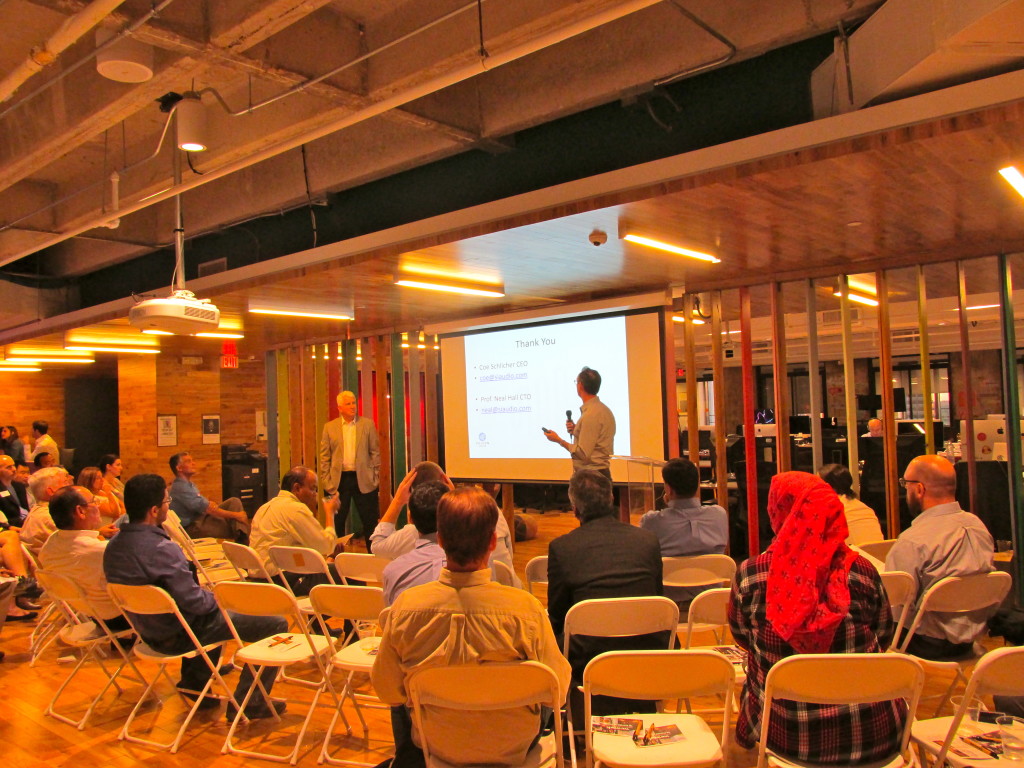
At the event last week, three professors presented their companies, Nova Minds, Heliotrope and Silicon Audio to a small group of industry experts, entrepreneurs, investors and other invited guests at WeWork on Congress. The UT Austin Office of Technology Commercialization, the Austin Chamber of Commerce and WeWork Austin sponsor the events.

“We’re not trying to get them to exchange their lab coat for a brief case,” said Epstein, managing director of the UT Innovation Center. “But we want to help propel their inventions to impact the world…Our job is to help them get to the next level.”

NOVA MINDS
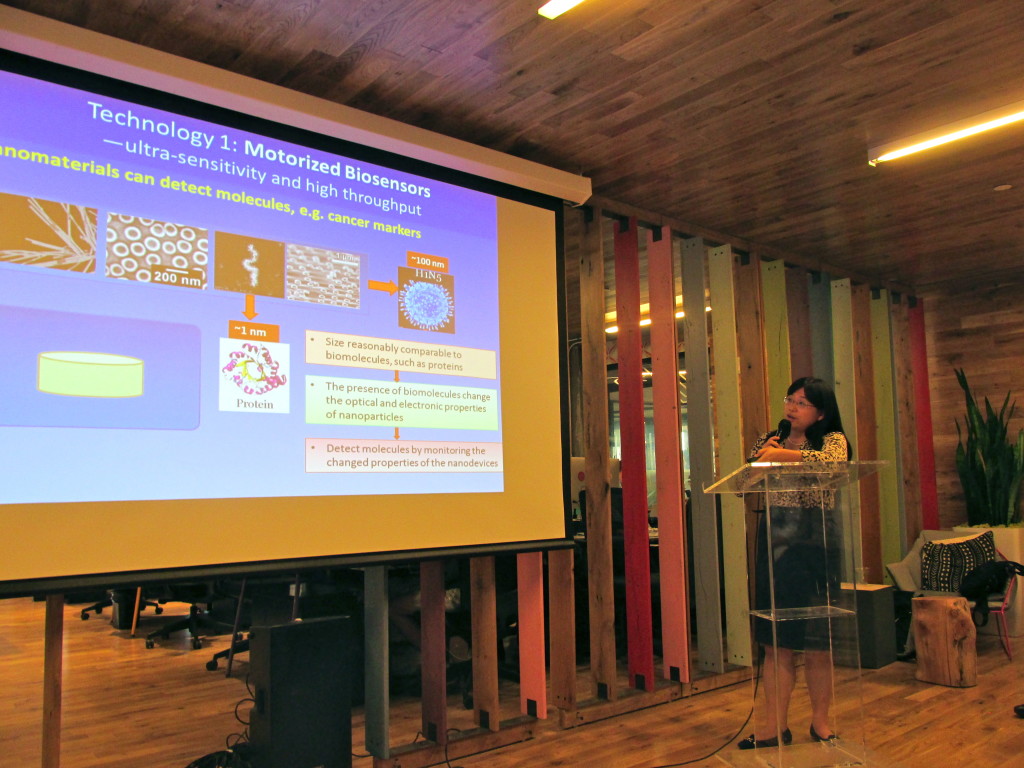
Donglei “Emma” Fan, an assistant professor in the department of mechanical engineering at UT, presenting Nova Minds.

Donglei “Emma” Fan, an assistant professor in the department of mechanical engineering at UT, presenting Nova Minds.


At the event, Donglei “Emma” Fan, an assistant professor in the department of mechanical engineering at UT, presented Nova Minds, an early-stage startup focused on innovative technologies for biomedical research sensing and drug delivery. Frank Zhu is the Chief Executive Officer and Fan is the Chief Technology Officer. Fan “is the inventor of “Electric Tweezers” that can precisely manipulate nanoscale materials in aqueous suspension by combined AC and DC electric fields,” according to her online profile.

Her company is developing high-speed motorized bio-nanosensors. When the materials are reduced through nanotechnology to the tiny size of a fraction of the width of a strand of hair, the sensors can be used for early stage detection of cancer.

Nova Minds is also developing technology for 3-D porous thin films. They could be used for wearable bandages to monitor vital signs or to monitor athletic performance.

In one example, Fan showed a slide with a picture of a young girl playing a violin and said the bandage could be attached to her arm to detect correct posture. Or it could be used to train golfers, she said.

For the next step, Fan plans to apply for National Science Foundation Small Business Innovation Research, known as SBIR, grants.

Heliotrope Technologies

Delia Milliron, co-founder of Heliotrope Technologies and associate professor of chemistry at UT.

Delia Milliron, co-founder of Heliotrope Technologies and associate professor of chemistry at UT. Photo courtesy of UT.

The next presenter, Delia Milliron, co-founder of Heliotrope Technologies, is the Chief Scientific Officer at the early-stage startup that is developing new materials and manufacturing processes for electrochromic devices focused on creating energy-saving smart windows.

“It’s a company,” Milliron said. “It’s not about research. Our goal is to make money and to build a highly profitable company producing smart glass.”

The company, founded in 2013 and based in Berkeley, Calif., created a dynamic window coating of nanocrystals to control light and heat transmission. The windows with the coating can switch between three states: transparent, heat blocking and heat and light blocking. The window can be powered for a year with a couple of double A batteries, Milliron said.

Heliotrope is developing its products for the residential and commercial glass market, with a market size of $16 billion worldwide for smart glass, growing at 5 percent annually. It is also looking into the automobile market.

“It’s a good time for this market play,” Milliron said.

Buildings consume 40 percent of all the energy in the U.S. in lighting control and for air conditioning and heat, Milliron said. The smart windows have the potential to greatly reduce energy costs and to save money and reduce the impact on the environment.

The company received a $3 million grant from the Department of Energy, $1 million National Science Foundation SBIR grant and it has received private seed stage funding. Milliron moved to Austin a year ago and is an associate professor in chemical engineering at UT.

“We see that this is the future for smart glass that this is going to become the standard,” Milliron said.

The biggest hurdle for widespread adoption right now is cost, Milliron said. Today, it costs $50 per square foot for Heliotrope’s smart window technology, they are working to get the cost down to $25 a square foot, she said.
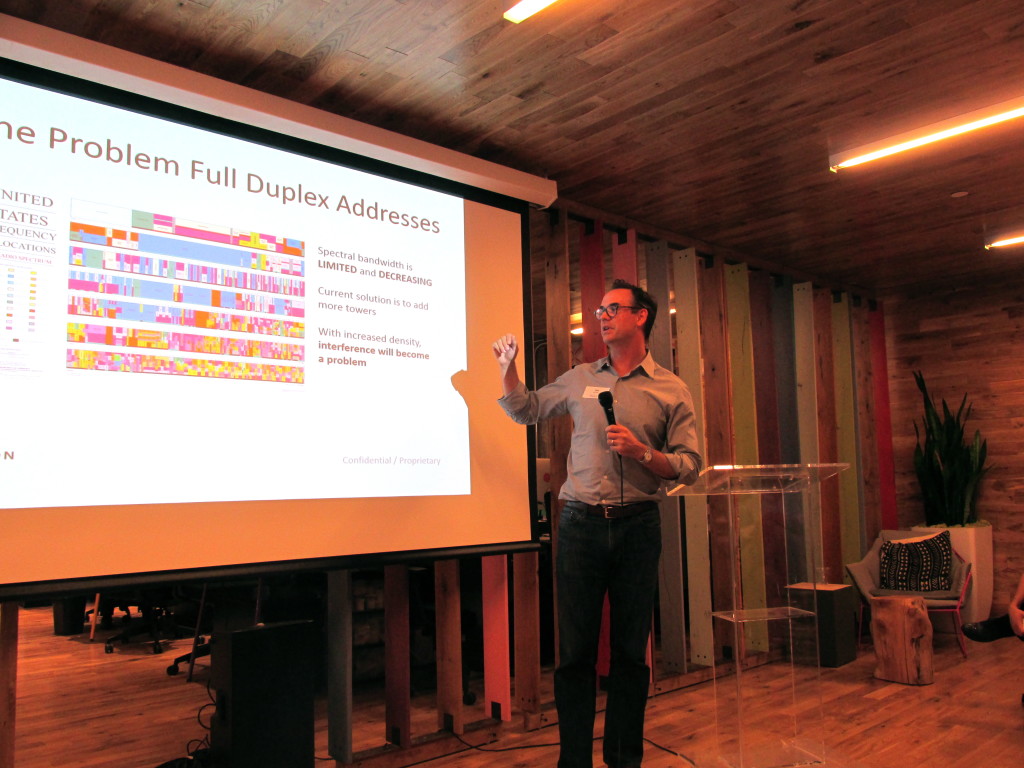
Coe Schlicher, CEO of Silicon Audio, presenting at The stARTup Studio.

Coe Schlicher, CEO of Silicon Audio, presenting at The stARTup Studio.

Silicon Audio

The final presenter, Silicon Audio, has been around the longest and already has a few products on the market. Neal Hall, an assistant professor in electrical and computer engineering at UT, founded the company in 2007.

Silicon Audio created an optical seismometer that records at much lower frequencies. It began creating the device in 2008 and in 2012 showed a prototype to a company in the oil and gas industry, Hall said. The company funded the development and now the product is commercially available, he said.

In 2007, Silicon Audio created a very sensitive, high fidelity microphone for smartphones. The company found a partner for that technology, Hall said.

With capital from two successful projects, Silicon Audio is now developing a magnet-free small-scale radio wave circulator to be placed on a microchip in a cell phone, Hall said. The device has the potential to revolutionize radar and wireless applications, by allowing a cell phone to send and receive data twice as fast on the same channel simultaneously.

“It’s the future of 5G communications,” Hall said. Right now, the communications standard is 4G, but 5G communications is expected by 2020.

Coe Schlicher, CEO of Silicon Audio, said the company looks for a unique technology that is at the inventor level and then works to create a marketable product. Next, they usually apply for a government research grant to develop the product. They generally skip pitching to a venture capitalist and instead go directly to a customer, Schlicher said. That customer invests $2 million to $6 million to bring the product to market, he said.

But with the circulator, Silicon Audio is looking at getting outside funding, Schlicher said. Andrea Alu is an associate professor of electrical and computer engineering at UT and his group members, invented the circulator technology. UT licensed it exclusively to Silicon Audio. Alu is the Chief Technology Officer of Silicon Audio RF Circulator, an affiliated company created in 2014 to bring his technology to market.

The circulator solves a real and growing problem, Schlicher said. Today, radio frequency bandwidth is limited and its availability is decreasing. Up until now, the only solution is to build more cell towers, Schlicher said. But Silicon Audio solves that problem and allows people to send and receive information simultaneously resulting in fewer dropped calls and jammed Wi-Fi signals, he said.

Silicon Audio’s RF Circulator costs ten times less, it’s 100 times smaller and 100 times lighter, Schlicher said.

London Company Wins Pitching Contest at Oslo Innovation Week 2015

By SUSAN LAHEY
Reporter with Silicon Hills News

Oslo, 13.10.2015. Neil Daly from Skin Analytics wins pitching contest at Oslo Innovation Week 2015. Photo: Gorm K. Gaare COPYRIGHT:© GORM K GAARE

Oslo, 13.10.2015. Neil Daly from Skin Analytics wins pitching contest at Oslo Innovation Week 2015. Photo: Gorm K. Gaare
COPYRIGHT:© GORM K GAARE


OSLO, NORWAY: Despite a remarkable collection of Nordic startups, the surprising winner of the 100 Pitches competition at Oslo Innovation Week, which included two outliers from London and Austin, was the London company: Skin Analytics. The device attaches to a smart phone and when people upload photos of moles that concern them, uses the same criteria physicians would use to analyze the moles for possible melanoma without having to go to the doctor. Founder Neil Daly is from Australia, the country that has the highest risk of melanoma, followed closely by Norway. When caught early, the chances of recovery are high, but caught later, it is often fatal.

Skin Analytics won the prize of 300,000 Norwegian Kroners—about $37,000—and help to launch the company globally. Pitches were held in Austin, London, and all over the Nordics, with semi-finals in Oslo and the final competition at Startup Lab at the Oslo Science Park. Fred Schmidt, Capital Factory’s international director, was master of ceremonies for the finale which drew about 200 people.

Earlier Thursday, Daniel Senyard, COO of the Austin company TripChamp had pitched. TripChamp uses a proprietary “normalizer” to access and identify travel deals from myriad sources, from discounts generally only offered to group travel outfitters to rates offered by specialist travel agencies to public rates. It can often get big discounts for its business customers. As winner of the Austin pitch competition, he was flown to Oslo—all expenses paid—to participate in the semi-finals.

Unlike pitches in the U.S. which are often high pressure and not particularly friendly, pitches at the Startup Lab in Oslo were downright warm and fuzzy. The moderator coached the audience to be supportive during the pitches because entrepreneurs were likely nervous. And when the time was up, the audience was cued by a sign to applaud, thereby both silencing and encouraging the pitching entrepreneur.

Companies pitching included everything from Vio, which unbundles magazine articles and lets consumers read content from dozens of publications according to their interests—like Spotify or Netflix—to Poop Time, a very early stage wearable company that puts a reusable sensor in a baby’s diaper to alert the parent about number one or two or whether the child is dehydrated or has a fever.

RSM Imagineering had built a fracking pump that it hopes will go 1,000 hours without servicing unlike current pumps which last about six. There was a company with a silicone spray that’s harder than others, for industrial uses and a company called FilmGrail that would aggregate all sources of television shows and movies into another Spotify-type streaming service that allows people to “follow” others for recommendations and social interaction. There was also a parking app that would let private individuals rent driveways for parking and help drivers find parking places, either private or public.

“Even though it was disappointing not to have made it to the finals,” Senyard said, “getting to the semi-finals of an international pitch contest is a great result and experience for TripChamp. “Culturally it’s been really amazing. I’ve never been to this part of the world…the startup scene seems to be very willing to introduce you the right people. I did find it very interesting…the companies that made it through to the finals were much earlier stage. It’s a younger startup scene.”

In the edtech world, he said, he saw several companies that had traction in several countries and tens of thousands of users. But the companies that competed in the finals largely didn’t.

Senyard also pointed out some of the differences between Norwegian and U.S. competitions of this type. Catered meals were provided for all participants, free. “People weren’t jumping in to capitalize on the situation and make money.” Also, after the pitches in the U.S., investors and startups either lunge for or away from one another. At Oslo Innovation Week, once the pitches were done, they were done. There were no hasty meetings to get a piece of the action. One of the five of them actually had a product released. If you’ve got a young scene makes sense.

Judges for the pitch competition included Bård Stranheim (Innovasjon Norge), Sean Percival (500 startups), Tellef Thorleifsson (Northzone), Ekaterina Gianelli (Inventure), Kristin Riise (DNB) and Jeanne Sullivan (Sullivan Adventures, StarVest.

Schmidt launched the program with a clip from Norwegian television where he had been targeted by a comedian who hid inside a building, quickly threw on a costume like passers-by and then followed the stranger until they noticed. He happened to have a skullcap, goatee and leather jacket to pull off a full-on Fred Schmidt.

Oslo, 13.10.2015. Neil Daly from Skin Analytics wins pitching contest at Oslo Innovation Week 2015. Here with the head of the jury, Jeanne Sullivan and master of ceremonies Fred Schmidt on the left. Photo: Gorm K. Gaare COPYRIGHT:© GORM K GAARE

Oslo, 13.10.2015. Neil Daly from Skin Analytics wins pitching contest at Oslo Innovation Week 2015. Here with the head of the jury, Jeanne Sullivan and master of ceremonies Fred Schmidt on the left. Photo: Gorm K. Gaare
COPYRIGHT:© GORM K GAARE

Editor’s note: Lahey’s trip was sponsored by Oslo Business Region, which puts on Oslo Innovation Week and the Norwegian Consulate in Houston.

« Older posts Newer posts »

© 2026 SiliconHills

Theme by Anders NorenUp ↑