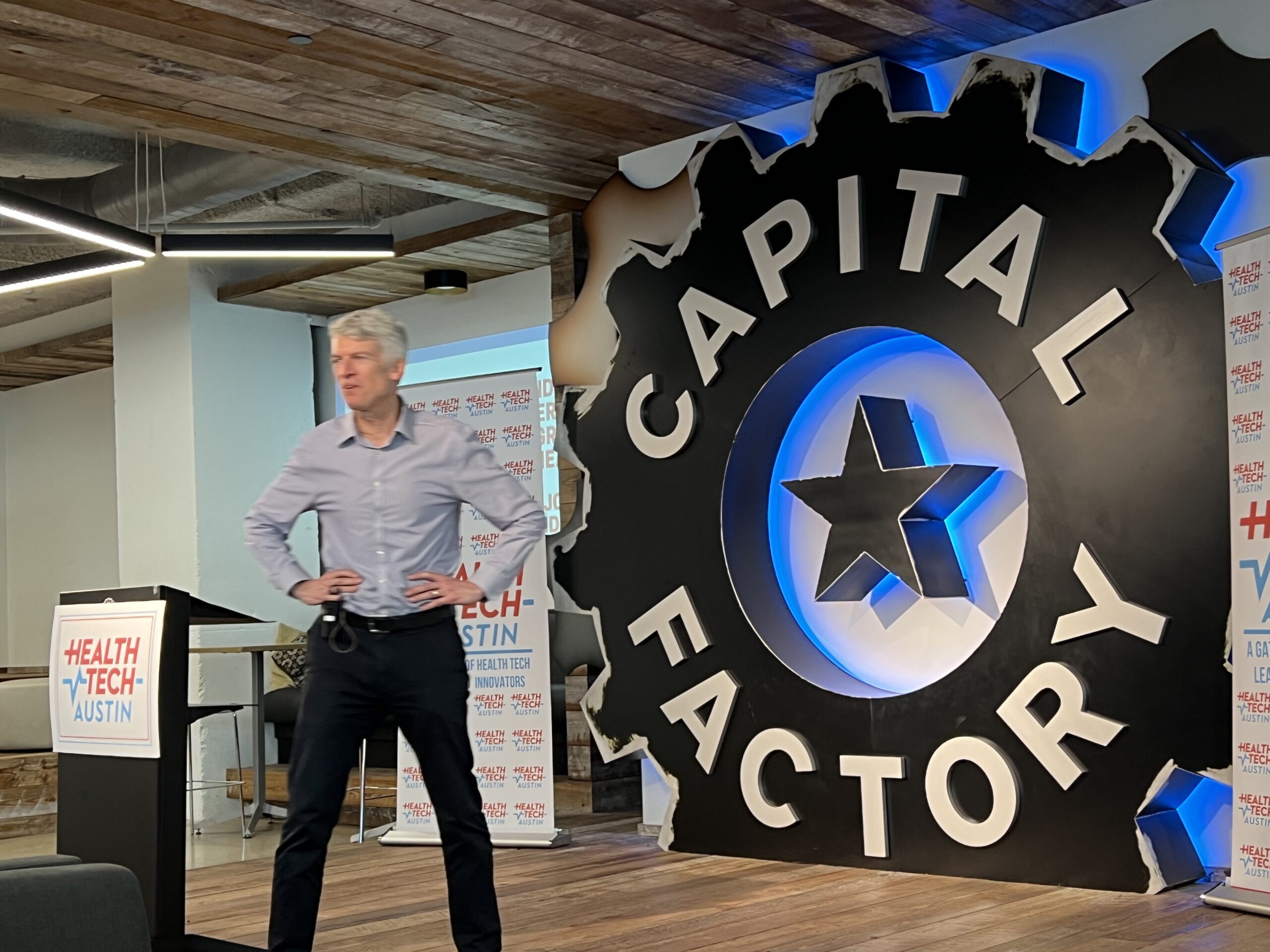
Hugh Forrest, C0-President and Chief Programming Officer at SXSW speaking at the Heath Tech Austin Summit
This year’s South by Southwest is going to be bigger than 2022, but not yet back to the pre-pandemic level, according to Hugh Forrest, Co-president and Chief Programming Officer at SXSW.
More than 51,000 people are expected to attend SXSW 2023, which runs from March 10th to March 19th.
There’s going to be a big increase in international attendance this year, Forrest said.
The SXSW conference features panels, sessions, meet-ups, workshops, networking, and more. It includes Interactive, Film, and Music segments and features 25 tracks of programming.
About a decade ago, SXSW added the Health & MedTech programming track, which runs from March 10th through March 13th, Forrest said.
SXSW added the track because SXSW is largely a reflection of what’s happening in Austin, Forrest said. And the Dell Medical School was opening, which spurred development and innovation locally in biotechnology, medical technology, and healthcare.
Forrest spoke Thursday morning at the Heath Tech Austin Future of Care Delivery Summit at Capital Factory. He said the event provided a preview of the kinds of programming that will be showcased at SXSW.
Among the sessions, there will be a discussion on how doctors are using TikTok now to reach younger audiences, Forrest said. Nick Jonas, singer, and songwriter, will be in a featured session titled “Crushing: The Burden of Diabetes on Patients” at 10 a.m. on March 13th.
Forrest also highlighted a documentary, “No Ordinary Campaign,” which will screen on March 12th at the Alamo Theater on Lamar. The film focuses on Brian Wallach, a former Obama White House staffer, who was diagnosed with ALS “on the same day he and his wife Sandra brought their second daughter home from the hospital.” The documentary focuses on Wallach’s fight against ALS and his fight for drug approval and research funding. Journalist Katie Couric is one of the film’s executive producers.
The Health & MedTech tracks have grown to be incredibly popular with SXSW attendees, according to SXSW. This year, the content includes everything from aging, data, and FemTech to organ transplants and virtual care. It also includes a new area of focus on brain-computer interfaces, featured in the sessions titled “Hello World: Brain-Computer Interfaces at Scale” as well as in “Superhuman: Meet The World’s First BCI Pioneers.”
The intent of the healthcare system isn’t aligned with improving things, said Dr. S. Claiborne “Clay” Johnston.
“It’s not about making healthcare better,” said Johnston, the inaugural deal of the Dell Medical School, who left that job in 2021 after seven years and co-founded Harbor Health in 2022.
Austin-based Harbor Health is disrupting the way patients receive healthcare.
The first time he talked about his new venture in public was Thursday morning at the Health Tech Austin’s Future of Care Delivery Summit at Capital Factory.
Tony Miller, the other co-founder of Harbor Health, is a serial healthcare founder. He formerly founded Bind Benefits in 2016 which offered on-demand healthcare and sold to United Healthcare. Before that, Miller founded Definitely Health which sold to United Healthcare for $300 million in 2004, according to the Wall Street Journal.
Harbor Health is working with employers and Medicare to redesign benefits and care to reduce costs and improve care.
“We’re wasting a ton of money,” Johnston said.
For example, only 25 percent of people with high blood pressure are being treated for it, Johnston said. If that rose to 100 percent, then 60 percent of heart attacks and strokes could be prevented, he said.
Harbor Health is a fee-based system that focuses on preventative care and providing access to doctors through telemedicine and even text-based exchanges, Johnston said. It’s also focused on finding the best specialists for the patients, he said.
Harbor Health is redesigning the care system around things that matter, Johnston said.
The new healthcare provider has three clinics in Austin, Round Rock and Kyle. The clinics provide primary care, chronic disease management, behavioral health, health and wellness services, and Medicare wellness exams. The multi-specialty clinic groups treat infants, children, adolescents, and adults.
Harbor Health has raised a $9.5 million Series A round of funding from two investors, according to Pitchbook. The company has 100 employees, Johnston said.
Curative started in 2020 as a company focused on improving outcomes for sepsis patients.
But then the Pandemic struck.
It quickly pivoted to become one of the nation’s largest testing centers for COVID-19 with 19,000 locations. Its test sites completed 36 million tests and 2.5 million vaccinations, said Fred Turner, the company’s CEO, and co-founder.
Now Curative’s headquarters are based in Austin with 400 employees and it’s pivoting again.
At the Health Tech Austin Future of Care Delivery Summit at Capital Factory Thursday morning, Turner shared more about the company’s new mission as a healthcare insurance provider. It’s creating a Netflix model for next-generation healthcare.
The startup has created a new employer-based health plan that offers $0 copays, $0 deductibles for in-network services, and preferred prescription drugs as long as the member completes a baseline visit to their primary care physician without 120 days of plan activation. If they don’t, then the member defaults to a plan with a high deductible plan.
At the baseline visit, the member is given a preventative health assessment, but they are also taught how to navigate the system, Turner said. Each member is assigned a “health navigator” who helps them understand their goals and needs and navigate the complex healthcare system.
After Curative’s COVID-19 testing business, Turner said he wanted to focus on something that would move the needle on how healthcare was delivered and make it better for everyone.
Fifty percent of the people in the U.S. get their insurance from large-group employer health plans. Curative is available to companies with more than 50 employees in Austin. It plans to move into the San Antonio market next within a few months, then Dallas and Houston later this year, Turner said.
High deductible health plans don’t work, Turner said. Those plans usually discourage people from getting preventative care like mammograms and colonoscopies or early detection of diabetes and heart disease, he said.
“By not investing in primary care and preventative care that comes back to bite you,” Turner said.
Curative’s plans offer zero cost in network and that builds trust with members, Turner said. Curative wanted to design a plan so that the member always knows what it will cost to receive care, he said.
Two percent of a healthcare plan’s members are generating 50 percent of the costs, Turner said. A dollar spent on primary care is worth way more than a dollar spent to treat a major health problem that if detected early could have been prevented, Turner said. In the long run, the plan ends up saving a lot of money and people are healthier, he said.
Curative already has 10,000 providers in the Austin area, Turner said. Its network includes major providers such as the Austin Regional Clinic, Austin Diagnostic Clinic, and all of St. David’s facilities, among others as well as 24-hour access to a local physician via telemedicine.
“We want you to go get care,” he said. “We want you to get the right care.”
Curative picked Austin for its headquarters at 900 Congress because the Curative brand is already well-known here, Turner said. In addition, Curative has a lab in Pflugerville. It also chose Texas because of its regulatory environment for new healthcare companies, he said. And Austin has a number of headquarters for large companies, he said.
To date, Curative has raised $8 million in venture funding, according to Crunchbase.
The event takes place from 8:30 a.m. until noon. The event features opening remarks from Dr. Desmar Walkes, a public health expert, family physician, and medical director for the City of Austin, and Hugh Forrest, co-president and chief programming officer for South by Southwest.
The event also features four “TED-like talks” from the following speakers: Fred Turner, chief executive officer and co-founder of Curative, Mike Geeslin, president and CEO of Central Health, the Travis County Health District, Kacie Kelly, chief innovation officer at the Meadows Institute and Dr. S. Claiborne “Clay” Johnston, co-founder and chief medical officer of Harbor Health, a vertically integrated health delivery system that launched last year in Austin.
“I thought that maybe by starting a new academic medical center we could change the health system. I was wrong,” Johnston says in a news release. “We need to design an entirely new system.”
Kelly agrees and says, “Solving the mental health crisis requires a complete paradigm shift. At the Meadows Institute, we are working with health systems, school systems, and justice systems to design and implement data-driven solutions that are available today to correct the trajectory of mental health care.”
The summit opens with breakfast at the Capital Factory, first floor of the Omni Austin Hotel Downtown, 700 San Jacinto.
Madhu Basu, the founder of Unnanu, wants to scale his startup to a billion-dollar contextual search company in the next ten years in Austin.
Already, he’s been issued a U.S. patent on selecting media using weighted keywords and he has another patent pending. He’s focused initially on applying the technology to match job seekers with jobs through Unnanu Hire.
But he sees widespread applications of the technology across all industries.
In this episode of the Ideas to Invoices podcast, Basu discusses his company’s plans for 2023 which include raising more than $3 million in seed-stage funding and hiring more than a dozen employees.
Previously, Basu founded and served as CEO of PMCS Services, which provided IT consulting, staffing, and solution services for more than 16 years. He also co-founded IntegrateUS, Prachas Technologies, and The Fresh Vegetable Package company.
“Unnanu is my fifth company,” Basu said. “I always found businesses to solve other businesses’ problems.”
Basu founded Unnanu because he saw a need to map job candidates to job descriptions contextually. He couldn’t find a way to do that. So, he built a solution and created better contextual search technology.
“It’s actually a search problem,” Basu said.
He named the company Unnanu, which means hello in his native Indian language.
“Why? Because our search is so intricate part of what we do, it’s kind of like saying hello I need this,” Basu said.
Search technology has to be refined, Basu said.
“I think we have a chance to get better at that,” he said.
Open.AI with its ChatGPT technology is exploring artificial intelligence and machine learning to provide better answers to search questions, Basu said. He mentions a recent video from Greylock’s Intelligent Future Summit featuring a discussion between Open.AI CEO Sam Altman and Reid Hoffman, a serial entrepreneur and general partner at venture capital firm Greylock Partners on the future of AI. In the talk, Altman says with the new conversational AI models, there will be a serious challenge to Google’s existing search business. It’s a massive trend and very large businesses will be built around conversational AI, Altman said.
Unnanu is targeted at becoming one of those, Basu said. A fundamental problem with AI is it is missing contextual analysis, Basu said. His pending patent is focused on contextual analysis and weighted keywords, he said.
Right now, Unnanu is bootstrapped. The company recently participated in the Founder’s Institute program in Austin. And it has since gone on to participate in Founder’s Lab, Basu said. It’s in the process now of raising funding, he said.
Unnanu used to be based at Galvanize, which abruptly shut down operations in Austin last year. The company is now located at WeWork on Congress downtown.
For more listen to the entire podcast below or wherever you get your podcasts.
Madhu Basu is the founder of Unnanu, a tech startup from Austin that helps businesses by using a patented contextual weighted keyword search. The company currently provides a simple solution for businesses to have resumes mapped to jobs contextually.
Sana, a healthcare insurance company, Tuesday announced it has laid off 19 percent of its staff.
Will Young, Sana CEO and Co-Founder, announced the layoffs in a LinkedIn Post late Tuesday afternoon. He also posted a statement on the company’s blog. He said the layoffs were painful but necessary to keep the company operating successfully in today’s environment.
Laid-off Sana employees began posting “open to work” status on LinkedIn Tuesday. Sana had around 210 employees. A source reported 40 employees were let go this week.
Sana is providing its laid off employees severance pay equal to three months of their base salary, paid medical, dental and vision insurance coverage through May 31st, the ability to keep their laptops, removal of the one year cliff for equity and three months of career services through RiseSmart, a job placement services firm.
For the past few years, Sana has focused on “accelerating growth and product development came at the cost of higher risk tolerance and greater expenses,” according to Young’s blog post. He wrote that the company is “fundamentally well-positioned to weather downturns.
“However, we need our investments to reflect the realities of the current macroeconomic environment and funding climate,” Young wrote. “This means re-orienting our company for leaner times today so we can continue delivering on our mission decades from now.”
To date, Sana, founded in 2017 by Young and Nathan Hackley, has raised $107 million. In June of 2022, Sana closed on a $60 million in Series B funding.
Sana provides health care options for small businesses. The company reports that Sana’s customers often save up to 20 percent compared to legacy insurers. It also provides telehealth care and low co-pays. Itoperates in eight states.
In January of 2022, the company opened Sana MD in Austin. It is Sana’s first primary care health center for members. In addition to in-person office visits, Sana gives employees access to virtual care with providers specializing in primary care, pediatrics, maternity and mental health.
The news of Sana’s layoffs come a week after Decent, another healthcare startup based in Austin, announced plans to wind down operations to a core team and layoff most of its 40 employees.
Nationwide, tech companies have been trimming staff. Zoom announced on Tuesday it was cutting 1,300 employees, according to the New York Times. Other tech companies in Austin laying off employees include Dell, which announced this week plans to cut 6,500 employees worldwide, according to the Times. Microsoft, Alphabet, Salesforce, Meta, Amazon and PayPal have all announced layoffs recently, the New York Times reported.
Beth Shapiro, Ph.D., and lead paleogeneticist working to bring the dodo bird back from extinction with Ben Lamm, Co-Founder and CEO of Colossal Biosciences
By Laura Lorek, Publisher of Silicon Hills News
First, Colossal Biosciences announced in September of 2021 plans to bring the woolly mammoth back from extinction.
The next year, the synthetic biology company announced plans to bring the Tasmanian tiger, also known as the thylacine, back to life.
Now Colossal is announcing the launch of its avian genomics group, which will bring back the Dodo, a bird species extinct since 1662. Colossal is using breakthrough gene-editing technologies to recreate the woolly mammoth, Tasmanian tiger, and dodo.
Colossal Biosciences also announced on Tuesday that it raised $150 million in Series B financing. To date, the company has raised $225 million since launching in September of 2021. The funding makes Colossal a Unicorn company, meaning its valuation is more than $1 billion.
“It’s exciting being a Unicorn, but I don’t think it’s more exciting than bringing back the woolly mammoth,” said Ben Lamm, co-founder, and CEO of Colossal.
In addition, Colossal spun out, Form Bio, a software platform last September, which raised a $30 million Series A round. Colossal, which has 80 employees and 40 external collaborators, has labs in Austin, Dallas, Boston, and Melbourne, Australia. Colossal expects to add additional employees as the various projects progress, Lamm said.
“The projects we are working on, we are seeing early success in the de-extinction efforts, and technology development,” Lamm said.
Colossal’s latest round is led by the United States Innovative Technology Fund, known as USIT, a private equity fund founded by U.S. Billionaire Thomas Tull, a technology investor. Other investors included Breyer Capital, Bob Nelsen, Animal Capital, Victor Vescovo, In-Q-Tel, Animoca Brands, Peak 6, BOLD Capital, and Jazz Ventures, among others.
“This support by Thomas Tull and the others ensures that we will get further faster,” Lamm said.
There is a hunger for this kind of moonshot type initiative that can move the needle forward for all of humanity, Lamm said.
“The World Wildlife Fund found that in the last 50 years, Earth’s wildlife populations have plunged by an average of 69% at the hands of mankind,” Lamm said. Colossal Biosciences has put together teams of some of the smartest people on the planet to tackle that problem, he said.
“By gathering the smartest minds across investing, genomics, conservation and synthetic biology, we have the opportunity to reverse human-inflicted biodiversity loss while developing technologies for both conservation and human healthcare,” Lamm said.
The launch of Colossal’s new avian genomics group will help to address the decline in the world’s bird population, which has lost more than 3 billion birds in the last 50 years, a stat from the Cornell Lab of Ornithology.
“The IUCN Red List also now categorizes more than 400 bird species as either extinct, extinct in the wild or critically endangered,” according to Colossal. “Colossal is on a mission to reverse these staggering statistics through genetic rescue techniques and its de-extinction toolkit.”
The work to bring the Dodo back to life is being spearheaded by Beth Shapiro, Ph.D., Colossal Scientific Advisory Board member, and lead paleogeneticist.
“The Dodo is a prime example of a species that became extinct because we – people – made it impossible for them to survive in their native habitat,” Shapiro said in a statement. “Having focused on genetic advancements in ancient DNA for my entire career and as the first to fully sequence the Dodo’s genome, I am thrilled to collaborate with Colossal and the people of Mauritius on the de-extinction and eventual re-wilding of the Dodo. I particularly look forward to furthering genetic rescue tools focused on birds and avian conservation.”
The dodo is iconic, and Shapiro has been working on it for more than a decade at the University of California at Santa Cruz, Lamm said.
“It is the symbol of manmade extinction,” Lamm said.
Most of the work on dodos will be done in Texas and the first dodo brought back to life will be a Texas dodo, Lamm said.
Lamm sees other applications for Colossal’s gene editing technologies in agriculture with new biofuels and preserving biodiversity, as well as in healthcare with gene therapies and vaccine development. Some of the technologies Colossal is developing will also have government applications, Lamm said.
“Dr. George Church and Colossal’s deep work in genomics is creating some of the most cutting-edge advancements in biotech,” according to Tull, USIT Chairman. “Their innovative technology has important applications for scientific discoveries, including biomedicine, and we look forward to supporting this crucial work.”
Colossal’s woolly mammoth de-extinction team, which is headed up by Church, now has more than 40 scientists and three laboratories. They are working with Asian and African elephants to implant an embryo to bring back the woolly mammoth. The team also launched a children’s education and research project with the University of Alaska Fairbanks on woolly mammoths in Alaska.
The Colossal thylacine team with 30 scientists in the U.S. and Australia has done a lot of work with stem cells in the lab and they have prototyped an artificial ex-utero development for early-stage marsupial gestation.
“The work is massively accelerated and currently ahead of our internal schedules,” Andrew Pask, Ph.D., Colossal Scientific Advisory Board member, and thylacine lead, said in a news statement.
In addition, Colossal recently launched its Conservation Advisory Board adding Forrest Galante, Virginia Riddle Pearson, Iain Douglas-Hamilton Ph.D., Former Lt. Governor of Alaska Mead Treadwell, permafrost research Jim Coates, Alaska’s Head of Fish and Wildlife Commissioner Doug Vincent-Lang, and Former Director of U.S. Fish and Wildlife Aurelia Skipwith, J.D.
Colossal has also established partnerships with WildArk, Aussie Ark, Save the Elephants, Elephant Havens, the International Elephant Foundation, Re:Wild, and the AZA’s SAFE.
Colossal also added new members to its Scientific Advisory Board including world-leading scientist Christopher E. Mason, Ph.D., Doris A. Taylor, Ph.D., Rachel J. O’Neil, Ph.D., Austin Gallagher, Ph.D., Tom Gilbert, Ph.D., Mike McGrew, Ph.D., Matthew Wooller, Ph.D., and Duane Froese Ph.D.
Colossal Biosciences has 80 employees and Austin-based Form Bio has 45 employees. Colossal may spin out new companies in its not-too-distant future, Lamm said.
“I’m excited about Texas and what we are developing here,” Lamm said
Decent, the Austin-based health insurance provider is “shutting down all of its operations to just a core team,” according to a blog post published Friday afternoon by Nick Soman, the company’s founder, and CEO.
“Decent’s mission since Richard Luck and I founded the company five years ago has been to deliver affordable health insurance for all. Starting in Texas in 2018, we launched health plans for 35% less than market rates with a Net Promoter Score of 79 vs. the industry average of 14. In 2021 we launched a professional employer organization to help small businesses band together to get even lower rates, and saw 100% renewal among eligible small businesses. I’m proud of what we’ve built, and prouder of the team that has built it.”
“Unfortunately, we just hit a massive and unexpected setback. It’s not impossible to move forward, but we will need time to figure out how,” Soman wrote. “For that reason, we are winding down all of our operations to just a core team.”
The company had 60 employees, according to an interview with Soman last November. The current number of employees is 40, according to a spokeswoman.
Decent, founded in 2018, has raised $43 million to date including a series that closed in December of 2021, according to a spokeswoman. Last fall, the company launched a massive ad campaign in Austin promoting its services on billboards around town.
In his post, Soman reports that Decent had been working with a major partner to prepare for nationwide expansion this quarter. It wound down its product in anticipation of the partner’s new and improved one, according to Soman.
“We were all systems go as of last Wednesday,” Soman wrote. “Then late last week, our major partner pulled out without warning, citing unspecified concerns from their executive team and leaving us with no near-term path to market. We explored every possible avenue to salvage the partnership, but to no avail.”
That left Decent without a health insurance product, and as a result, it has to stop serving customers, according to Soman.
Decent will let its team go in the coming months with notice and severance, according to Soman.
Correction: Title corrected and updated to reflect Decent winding down operations to a core team, but not shutting down completely. Also, the article was updated with the current employee count and funding amount of $43 million.
After moving to Austin recently, SciPlay’s CEO Josh Wilson has plans to expand operations and move into new areas including building SciPlay’s own gaming platform.
In this episode of Ideas to Invoices, Wilson talks about how the COVID-19 pandemic affected the mobile gaming company’s operations. It led to a boom a business as people looked online for ways to entertain themselves while stuck at home. He also talks about the company’s current outlook and plans for the future.
In 1998, Aaron Schurman founded Phantom EFX in Cedar Falls, Iowa. It was acquired by Scientific Games and now it is a stand-alone company called SciPlay, which is traded on the Nasdaq stock exchange under the symbol SCPL.
In 2019, Wilson became CEO, and his vision is to make SciPlay the best entertainment company for consumers.
SciPlay currently offers social casino games like Jackpot Party Casino, Gold Fish Casino, casual games like Bingo Showdown and Solitaire Pets Adventure, and hyper-casual games such as Rob Master 3D and Deep Clean. It does not have any plans for the Metaverse right now, but the company plans to build out its own gaming platform to connect directly with its customers.
SciPlay also recently contracted with America’s Got Talent Judge Sofia Vergara for an ad campaign. In the TV commercial, Vergara plays SciPlay’s Jackpot Party Casino game. The campaign was highly successful, Wilson said.
SciPlay has more than 500 employees worldwide including more than 150 in its Austin office, which was established in 2016.
For more, listen to the entire podcast posted below or wherever you get your podcasts.
Josh Wilson is SciPlay’s Chief Executive Officer. The company makes social casino games like Jackpot Party Casino and Goldfish Casino and others. Wilson recently moved to Austin where SciPlay has a large office. In this episode, he talks about the company’s current outlook and plans for the future.
The Austin area saw a huge slowdown in venture capital invested in the fourth quarter with $775 million flowing into 78 deals, according to PitchBook-National Venture Capital Association Venture Monitor data.
That is down 50 percent in dollars invested from the fourth quarter of 2021 which recorded $1.5 billion in 122 deals, according to the Pitchbook report. It is also a 36 percent decline in the number of deals being done.
“After years of frenzied investments and soaring company valuations, venture capital investment levels are readjusting as businesses assess the current economic landscape,” according to the report.
Despite the fourth quarter slowdown, overall, for 2022, the Austin area still had a phenomenal year with $4.9 billion of venture capital invested in 416 companies.
That’s on par with stats from 2021 when Austin had a record-breaking year with $4.9 billion in venture capital investments. And it’s actually an increase in deal flow by nearly 7 percent from 387 companies in 2021.
Overall, companies in Texas raised $1.6 billion in venture capital in the fourth quarter of 2022, in 180 deals. That is down nearly 56 percent from $3.6 billion in the fourth quarter of 2021. And down nearly 34 percent in deal flow from 271 deals in the fourth quarter of 2021.
For all of 2021, Texas companies raised $9.5 billion, down nearly 20 percent from $11.9 billion raised in 2021. Deal flow also dropped 16 percent in 2022 to 840 companies funded, down from 1,004 in 2021.
In Austin, the biggest deals in the fourth quarter went to Jasper, a content generation platform, that received $141 million in venture funding. The Series A round made Jasper Austin’s latest Unicorn company valued at more than $1.5 billion. Jasper is one of the startups developing conversational AI and image generation AI similar to Open.AI’s ChatGPT. Its investors include Insight Partners, Coatue, Bessemer Venture Partners, IVP, Foundation Capital, Founders Circle Capital, HubSpot Ventures and more.
The second largest deal went to Infinitum, based in Round Rock, which is developing motors and generators powered by its patented technology. It raised $110 million in a Series D round. Its funding came from Riverstone Holdings Latin America, Alliance Resource Partners, Caterpillar Venture Capital and Cottonwood Technology Fund.
And rounding out the top three deals is Dabbsson, which has created a clean energy backup generator for homes. It landed $75 million.
Top 10 Venture Capital Deals in Austin in 2002 Q4
Jasper, an AI content generation platform, $141 million
Infinitum, develops motors and generators, $110 million
Dabbsson, alternative clean energy equipment maker, $75 million
Setpoint, real estate fintech and software platform, $43 million
SubjectWell, clinical trial, and patient matchmaker platform, $35 million
Way, a software platform for curating experiences for hospital brands, $20 million
Flueid, a software platform to automate title and escrow closing practices, $20 million
Maergo, shipping and logistics platform for retailers, $20 million
Keystone Bank, banking services, $18 million
Beatbox Beverages, ready-to-drink alcoholic punch, $16 million