Category: Austin (Page 54 of 318)

SKU Welcomes 7 new Startups into SKU Track 8

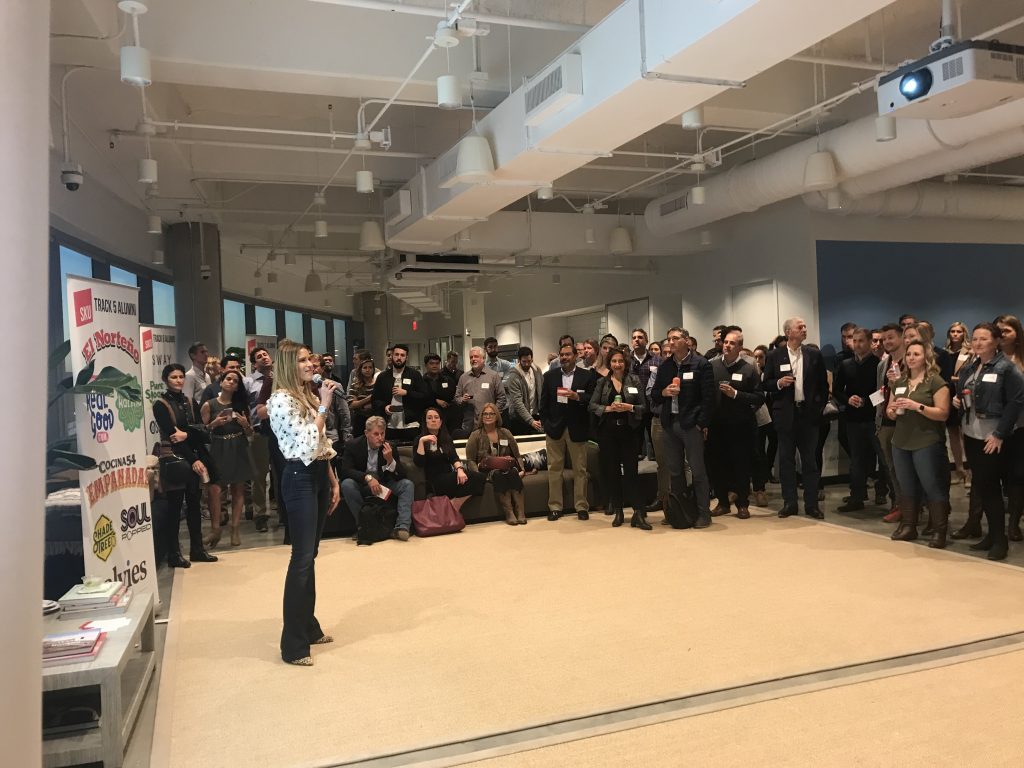
Kirstin Ross, managing director of SKU at the SKU 8 Launch Party

By LAURA LOREK, Publisher of Silicon Hills News

SKU, a consumer-packaged goods accelerator, on Tuesday officially kicked off its SKU 8 cohort.

The seven companies accepted into the 14-week program are Aura Bora, Blenders & Bowls, Cheddies, Esker, Ladybird Provisions, Mushroom Revival, and Paleo Powder Seasonings.

More than 150 people attended the SKU launch party held at WeWork SXSW Center at 1400 Lavaca Street Tuesday evening. WeWork has established its WeWork Food Labs at the center in partnership with SKU.

“We continue to grow up and expand out the Austin network,” Kirstin Ross, managing director of SKU said during a presentation at the event.

SKU, founded in 2011, has made great strides in expanding out of the Texas market with the completion of its Beyond SKU program last year in New York, which ran from September through Demo Day on Dec. 3rd.

This year, SKU plans to expand even further with the launch of SKU Impact, an accelerator program partnered with Finnovation, an impact accelerator, based in Minneapolis, Minnesota.

In Austin, SKU has a track record of success with 44 companies going through its seven accelerator programs. And 84 percent of those companies are still in business, Ross said. Its alumni include Siete Family Foods, Austin Eastciders and EPIC Bar.

Part of SKU’s secret sauce to success is its network of trusted mentors, Ross said. SKU’s mentors include Clayton Christopher, founder of Sweet Leaf Tea and Deep Eddy Vodka, Doreen Lorenzo, former president of Frog Design and Quirky and Mike Dodd, general partner at Silverton Partners.

Erin Thompson and Kara Jordan, founders of Blenders & Bowls

Among the latest startups for SKU 8 is an Austin favorite, Blenders & Bowls, which specializes in natural fruit smoothies and organic bowls of acai topped with hemp granola, fresh fruit, and local honey.

In 2011, Erin Thompson and Kara Jordan moved from Hawaii to Austin and launched Blenders & Bowls from a food truck. They opened their first brick and mortar location in 2012 and now they have five locations throughout Austin. With the acceptance into the SKU accelerator, they plan to launch a consumer-packaged version into grocery stores soon.

“Over the last few years people have always asked us how do I make these at home,” Thompson said. “So, we’ve always had this idea of packaging them and being able to sell them in the stores. This year, everything kind of happened. It was like a serendipitous moment….Now we’re full steam ahead and packaging our blends so people can make bowls at home.”

Blenders & Bowls plans to launch in grocery stores this year, Thompson said. It first plans to sell the blends from its retail locations, she said.

Paleo Powder Seasonings, based in Giddings, founded 2013, offers grain-free seasonings and seasoned coating mixes also known as breadless-breading, said Dustin Gersch, founder and owner.

“I grew up in a small Texas town, ate a lot of food, played football in high school and college,” Gersch said.

After college and no longer playing football, Gersch entered the workforce and weighing 315 pounds wasn’t healthy, he said.

In 2010, he started doing CrossFit and he began following a Paleo diet. He went from 315 pounds down to 258 pounds.

His CrossFit coach told him to beware of the ingredients in spices. Gersch cooked a lot and many of the convenience seasonings had gluten, sugar or MSG ingredients. That’s when he made his first seasoning recipe. During the next three years, he met people who suffered from auto-immune diseases and that’s why he developed a season that had no inflammatory spices – Paleo Powder AIP – autoimmune protocol.

Paleo Powder’s all-purpose seasonings are in 2,800 stores nationally including H-E-B, Walmart, Whole Foods, Sprouts, Wegmans and Albertsons and more.

“We want you to add flavor to the food you are eating and help you stick to your program,” Gersch said.

He applied to SKU to have access to experts in the Consumer-Packaged Goods industry to help him strengthen his knowledge and help shape the company’s direction moving forward, Gersch said.

Shannon Davenport, founder of Esker Beauty

Esker Beauty, a line of skincare products, relocated from Los Angeles to Austin.  Shannon Davenport founded the company in 2018 after spending more than a decade in the research industry focused on beauty, design, art and consumer trends in New York and Los Angeles. She saw a real need for plant-based skincare products and decided to launch Esker to meet that need. Esker products are available at Nordstrom, Anthropologie, Goop and online and they have been featured in Vogue and Self Magazines.

Davenport launched the business and gave birth to her daughter around the same time. Austin is her husband, Greg Foley’s hometown, they located here last year to be closer to family.

In the SKU accelerator, Davenport is looking forward to learning from mentors who have scaled their brands, raised money, and have a lot of expertise in the CPG industry, she said.

Mushroom Revival, based in South Deerfield, Massachusetts, is in the process of relocating to Austin for the SKU program. Alex Dorr, its owner, and founder couldn’t be at the launch party, but his mom, Marjorie Dorr, who lives in Austin and is on the company’s board, represented Mushroom Revival at the event.

“Mushrooms are just now being explored and seen for all of its benefits for increased energy, better night sleep, clear mind as well as clearer skin, “ Dorr said.

The company was born out of finding a better cure for Lyme disease. Her son got the disease and struggled with achy joints, depression and other symptoms. He didn’t like all the high doses of antibiotics he was prescribed. The only medicine that alleviated his symptoms was mushroom medicine, Dorr said.

“It was mushrooms that got him out of bed and revived his health,” she said. He then went on to study mushrooms and all its beneficial properties and that led him to create Mushroom Revival, she said. Mushrooms are also good for the planet and can be used to clean up toxic waste, she said.

“The Fungi kingdom is really just blossoming here in the U.S.,” she said.

Another Central Texas startup, Cheddies, which creates a high protein, all-natural cheese chip, is from San Antonio. Brothers Francisco and Tomas Pergola founded the company in 2016 to create healthier chips for snacking. Cheddies is now available at H-E-B, Amazon and more than 150 convenience stores.

Auro Bora sparkling water on display at SKU 8 Kickoff Party

Other Startups in SKU Track 8 include Aura Bora, based in San Francisco, which creates sparkling water from herbal extracts with ingredients like lemongrass, peppermint, lavender, cactus and basil, and Ladybird Provisions, based in Austin, which makes pre-made butter coffee bombs like Pure Focus that contain organic coconut oil and grass-fed butter and promises to promote healthy brain function and stimulate the metabolism.

Ideas to Invoices Top 10 Podcasts for 2019

Silicon Hills News’ podcast Ideas to Invoices entered into its third season in 2019. And here are the Top 10 podcasts for this year, according to our stats on Libsyn, a podcast hosting platform.

Thank you to all our listeners and subscribers. For all of the Ideas to Invoices podcast please visit Ideas to Invoices on iTunes and you can support Silicon Hills News by and the Ideas to Invoices podcast by becoming a patron on our Patreon site.

  1. Techstars Austin’s Amos Schwartzfarb Talks Sales Strategy and More on the Ideas to Invoices Podcast
  2. Chris Shonk: ATX Seed Ventures Plans to Raise its Third Venture Fund
  3. Carey Smith Launches Unorthodox Ventures in Austin to Invest in Startups with Great Products
  4. Internet Pioneer Bob Metcalfe Celebrates Ethernet’s 46th Anniversary
  5. Barry Mione: SaveDay Seeks to Democratize Access to 401K Retirement Plans
  6. Founder Institute’s Adeo Ressi Thinks Startups Succeed When Entrepreneurs Find Their Purpose
  7. ALTR’s CEO Dave Sikora Says Data is as Valuable as Money and ALTR Uses Blockchain Tech to Secure Data
  8. Joyce Durst: Growth Acceleration Partners Says Diversity and Inclusion is Key to its Success as a Custom Software Developer
  9. Sridhar Vembu: Zoho’s CEO Discusses its Unique Culture and Plans for its Austin Campus on the Ideas to Invoices Podcast
  10. Austin Technology Council’s Amber Gunst is Focused on Growing and Scaling Austin Software Companies

Silicon Hills News’ Top 10 Stories of 2019

OJO Labs Founders John Berkowitz and David Rubin at OJO Labs’ Headquarters, photo by Errich Petersen

Silicon Hills News had a great year in 2019 with hundreds of thousands of visitors to our website and social media feeds, several thousand downloads of our Ideas to Invoices podcastand more than 1,000 people attending our annual events and monthly lunch and learn gatherings.

And 2020 promises to be even brighter.

We’ll be kicking off the New Year with our annual calendar party, this year it’s being held at The Riveter in downtown Austin on Jan. 23rd.

But before we move onto 2020, let’s look back at 2019 and see what stories our readers thought deserved the most attention. This ranking of the top 10 includes one story from late in 2018 on Sana Benefits, a healthcare company that moved from San Francisco to Austin that year and continued to rank in the top 10 for 2019.

Also, our most-viewed story is our roundup of the hottest startups to watch in 2019. We will be releasing our list of hottest startups to watch for 2020 on New Year’s Day. So, make sure to come back and check it out because your startup might even be on the list.

1. 25 Hot Austin Startups to Watch in 2019

2. Spredfast and Lithium Rebrand to Khoros and Select Austin for its New Headquarters

3.  H-E-B to Build a New Tech Center in San Antonio and Hire 500 Employees

4.  ICON Unveils a New Large Scale 3D Printer to Build Affordable Homes

5.  Paradromics Moved from Silicon Valley to Austin and is Creating a Brain Modem

6.  OJO Labs Acquires Austin-based RealSavvy

7.  Zoho Plans to Go Big in Austin but Also Wants to Keep Things Weird

8.  Health Insurance Startup Sana Benefits Moves Headquarters to Austin

9.  Austin’s Spiceworks is Bought by Ziff Davis

10.    OJO Labs Raises an Additional $45 Million in Venture Capital


Verb Raises $6.4 Million to Bring Leadership Training to the Masses

Suzi Sosa, Co-founder and CEO of Verb, courtesy photo

Verb, an Austin-based startup focused on teaching leadership skills, announced recently that it has raised $6.4 million in seed-stage funding.

The funding came from angel investors including Brett Hurt, Nav Sooch, Andy Roddick, Leon Chen, and Barshop Ventures.

Verb plans to use the money for sales and marketing as well as the development of its business to business software as a service platform offering leadership development training.

 Leadership development is not just for senior executives, said Verb co-founder and CEO Suzi Sosa.

“We find there is a universal pain point around that first layer of managers – first-time managers,” Sosa said. “These leadership skills have never been taught before and there is a humongous market for managers directly above them or directly below them.”

 Verb’s platform is focused on training employees on soft skills by using a blended learning model.

 “Verb provided us with the opportunity to offer leadership development as a benefit to our team members,” Whole Foods Market CEO John Mackey said in a news statement.

With the latest investment, Verb also plans to do key product enhancements, including personalized learning, expanding the content library, and a new mobile app.

Sosa co-founded Verb in 2013 along with Tom Meredith. The startup spun out of the University of Texas at Austin where Sosa led the social entrepreneurship program from 2010 to 2013. In 2015, the company announced it had raised $2.3 million in seed-stage funding. At that time, Verb focused on connecting large corporations and foundations to thousands of social entrepreneurs worldwide through competitions and its platforms.

In 2017, Verb pivoted to focus on providing leadership training to companies through a subscription-based business model, Sosa said.

Its customers are mid-market companies and large enterprises looking for a turnkey leadership development solution that they can use with their entire employee base, Sosa said. Whole Foods is one of its customers, she said.

“There wasn’t an affordable and high-quality scalable solution for leadership training for all employees,” Sosa said.

Verb makes its own content spearheaded by Jessica Agneessens, Verb’s senior vice president of learning strategy, Sosa said. Previously, Agneessens spent 20 years at Whole Foods where she led an internal leadership academy and created a modern model of leadership development, Sosa said.

That training includes basics for managers like giving and receiving feedback and setting goals and working in teams, but also contemporary skills like having a growth mindset and self-awareness, Sosa said.

“The way that adults learn best is through interactive learning,” Sosa said.

Verb’s leadership lessons are comprised of 15-minute activities that layer onto each other, Sosa said. In a typical activity, a person might watch a short video clip and then they are required to write or create something in the platform to put it into practice, she said. Verb also has team-based learning modules that link everyone together in a group on Verb’s platform. And Verb gives companies the tools to run workshops and training exercises at their own companies, Sosa said.

“Our platform is intended to be highly interactive and experiential,” Sosa said.

Verb is trying to impact skillsets and mindsets with training on how to have a difficult conversation, how to set goals, how to prioritize time, Sosa said. It is also focused on the growth mindset, being aware of your unconscious biases and even confidence – developing confidence as a leader, she said.

Since a lot of the training on leadership is expensive, it has been reserved for the elites in companies, Sosa said. Minorities are often not there, she said. So, the platform is an affordable and scalable way companies can deliver this to everyone with a focus on diversity and inclusion, she said.

“Cultivating leadership more democratically across an organization,” Sosa said.

“We hope this will help companies identify leadership talent that may be more diverse,” she said. “It gives them visibility they didn’t have before.”

Verb’s platform varies in cost depending on the size of the company, the range is from $120 to $500 a year per employee, Sosa said.

In the first quarter next year, Verb plans to launch a new mobile app.

Verb has 30 employees and plans to move its headquarters to Owen’s Garage in East Austin early next year, Sosa said.  

Personal transformation and leadership development are something companies are looking for, Sosa said.

“We need people who are confident purpose-driven leaders,” she said.

WeWork and Sku Team Up to Launch WeWork Food Labs in Austin

WeWork SXSW Center, courtesy photo

Austin has become a hotbed of activity for consumer-packaged goods companies.

And Sku Accelerator, founded in 2011, has been a major catalyst for helping brands do well.

And now SKU is teaming up with another well-known name in Austin – WeWork, which has seven locations throughout Austin. The newest site is WeWork at the SXSW Center at 1400 Lavaca Street. WeWork SXSW Center has more than 65,000 square feet across three floors. It features large floor to ceiling windows and an expansion rooftop terrace with a view of the State Capitol.

And on Tuesday, WeWork announced it was establishing WeWork Food Labs, the company’s first incubator focused on food startups. It’s the first Food Labs space in Texas and the third nationwide behind San Francisco and New York, according to a news release.

The WeWork space includes a merchandising area and pantry, as well as commons areas for events.

WeWork is partnering with Sku to provide mentorship to members as well as host events for those in the food entrepreneurship and innovation space.

Sku is about to launch its eighth accelerator class in January. Its alumni companies include Grocery Pup, Shade Tree Lemonade, Siete Foods, Austin Eastciders, and Epic Performance Bars.

“We believe innovation in the CPG industry can be accelerated when we work together with others,” Kirstin Ross, managing director of Sku, said in a news statement. “With much of the food and CPG industry working in tandem, we are excited to be partnering with WeWork Food Labs, to give startups and legacy food brands the space, resources and expertise needed to continue innovating within the food industry.” 

Adam Yee, a serial entrepreneur who most recently built The Better Meat Co., which provides plant-based proteins for food service providers and meat processors, is heading up the WeWork Food Labs in Austin as its manager. Yee’s previous company recently partnered with Perdue.

“We’re very excited to be entering the center of the Austin food scene and see incredibly creative and disruptive solutions born out of our latest WeWork Food Labs location,” Yee, manager of WeWork Food Labs Austin, said in a news statement. “We hope that by providing the space, programming, mentorship and network that food startups in Austin need, we will continue to help drive innovation in the food industry and power a more sustainable future in food.”

WeWork Food Labs is also home to a number of food startups including OHi Superfood Bar, a company creating plant-based, refrigerated bars, and Naturally Austin, a community for the natural product industry in Central Texas.


Sense Corp. Moves Headquarters to Austin From St. Louis

Austin downtown skyline view and view down Congress Avenue with the Texas State Capitol building in view.

A consulting company focused on data and artificial intelligence, Sense Corp., is moving its corporate headquarters from St. Louis to Austin.

The company, founded in 1996, already had an office in Austin. It also has operations in Dallas, Houston, Columbus, and Minneapolis.

“While a large portion of our business has always come from Texas, we are excited to strengthen our presence in Austin,” Keat Wilkins, Sense Corp CEO, said in a news release. “Moving home to Austin and relocating the headquarters brings us back to our roots.”

Sense plans to create 200 new jobs and invest more than $80 million in Texas during the next five years, according to a news release.

 “I am proud to welcome the new Sense Corp headquarters to the Lone Star State, and I am grateful for the hundreds of new jobs they will create in the city of Austin,” Governor Greg Abbott said in a news release. “Texas is a national leader in economic growth and job creation thanks to investments from companies like Sense Corp, and we look forward to this continued partnership. Working together, we will keep Texas the number one state for innovation, economic opportunity, and prosperity.”

“This move highlights our focus on digital transformation within the commercial and government sectors,” Jimmy Schatte, Senior Vice President of Public Sector at Sense Corp., said in a news release. “We’ll be better positioned to serve our agency customers here in Texas and nationwide.”

Sense’s Austin office focuses on commercial, public sector, technology, and marketing divisions. The Sense Corp headquarters is located at 2500 Bee Cave Rd. Building 3, Suite 100.

“We’ve experienced a 125 percent increase in headcount within the Austin office in the last two years,” Wilkins said. “Given this explosive growth, we wanted the new headquarters to improve innovation, collaboration and cost-competitiveness, while providing an exceptional state-of-the-art work environment for our employees.”

Sense Corp plans to continue to have a strong presence in St. Louis, supporting administration, finance, training, and IT functions.

Sana Benefits is Disrupting the Healthcare Insurance Industry in Texas

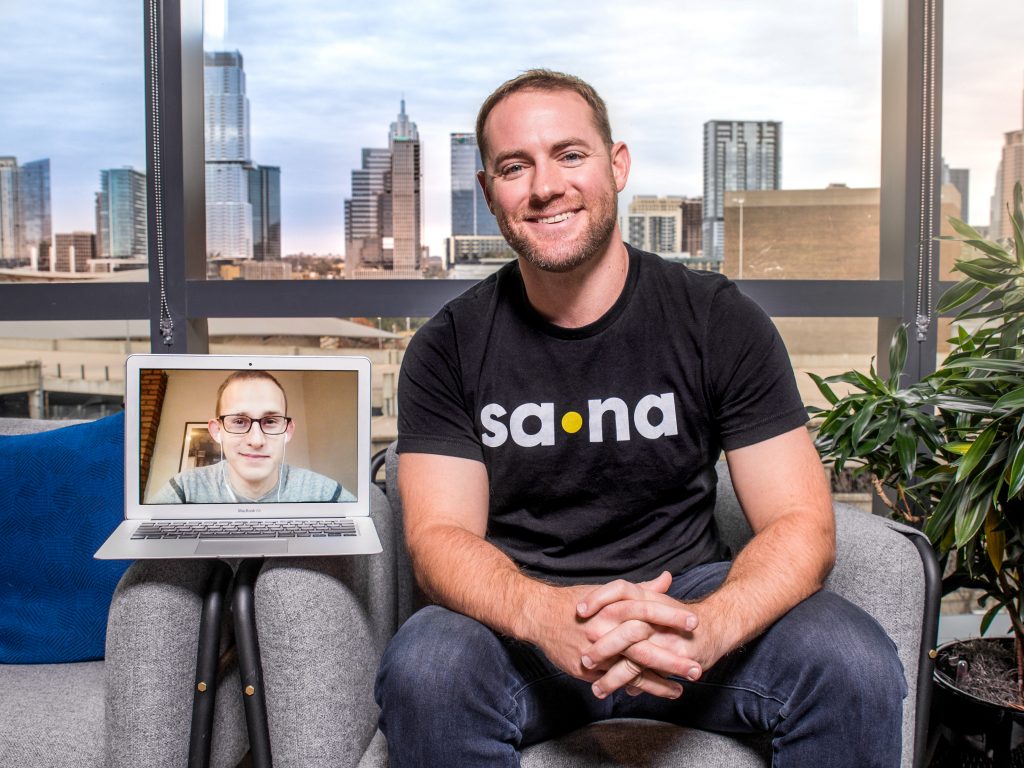
Nathan Hackley (computer) and Will Young, co-founders of Sana Benefits, photo by Errich Petersen

Sana Benefits moved to Austin a year ago from the San Francisco Bay area with a focus on disrupting the insurance industry and providing healthcare coverage for small to medium-sized businesses.

 “We had this idea for how to fix small business health insurance and the barriers to starting it California were really high,”  said Will Young is the Co-Founder and CEO of Austin-based SANA Benefits, a healthcare insurance technology startup.

“But when you looked at which states were most inviting of innovation in insurance, Texas is number one on the list,” Young said. “The regulators here are really excited to welcome new models and new forms of competition.”

“Once we spent some time in Austin, we fell in love, so it was an easy decision,” Young said.

Austin is much more livable than San Francisco these days, he said. Young talks about the challenges the healthcare industry faces and how Sana is working to provide more affordable care to small to medium-sized businesses during this episode of the Ideas to Invoices podcast.

Young founded the company with Nathan Hackley in 2017. The two formerly worked together at Justworks, a benefit and payroll company in New York.

Since moving to Austin, SANA Benefits has grown dramatically from less than 10 employees to almost 40. The company also recently closed on $ 3.6 million in seed-stage venture funding. And it moved from a small office at WeWork Barton Springs into much larger headquarters at Manchaca and Slaughter Lane in South Austin. It used the Austin-based startup, Swivel, to find the real estate space to accommodate its growth, Young said.

Sana Benefits is providing an alternative to other big insurance providers like Aetna, Blue Cross, United Health and others. It competes with them by providing insurance that is, on average, 30 percent cheaper, Young said.

“In terms of the value we deliver to people, we save them a lot of money,” Young said. “We also just think about how to serve our members differently. We treat them like human beings. We answer the phone when they call. And if they want to see a doctor that is out of the network. We go and get their doctor into the network. We are running this health plan the way we would want it to be run where it is oriented around serving the needs of members.”

Sana targets companies that have between five and 500 employees that offer health insurance to its employees, Young said. It gets the word out about its product through podcasts, digital ads, billboards, events and by calling small and medium-sized companies, he said.

The healthcare industry needs disruption, Young said. The U.S. is last among the world’s developed nations in providing healthcare to its citizens and it used to be number one. The U.S. has an immense bureaucratic and complex healthcare industry that charges people different rates for service depending on who is paying, Young said.

The cost of care has climbed massively in the last decade, Young said. Companies are raising deductibles for employees to make the plans more affordable, he said. They are shifting the risk to the members, he said.

Meanwhile, the patient providers are losing the human touch, Young said. And hospitals are increasingly suing patients to collect on huge bills.

Sana can’t fix everything but it’s working with its customers to navigate the bureaucratic system and provide the best care for its members, Young said.

For more on SANA and Young’s entrepreneurial experience, listen to the entire podcast. Also, please rate and review our Ideas to Invoices podcast on iTunes and support Silicon Hills News by becoming a patron on our Patreon site.

Internet Pioneer Bob Metcalfe Says the Internet’s 50th Birthday is Just the Start of Disruptions and Innovations Tied to Massive Connectivity

Connectivity is not new, said Bob Metcalfe, inventor of Ethernet and professor of innovation at the University of Texas at Austin.

It harkens back to rivers and roads. The Chinese expression is “If you want to get rich, first build a road,” he said.

His ancestor, Blind Jack Metcalf, built the first 180 miles of road out of Yorkshire, England, at the start of the Industrial Revolution.

Metcalfe, born in 1946, said he was lucky to be born at that time because so many inventions were happening including the wireless TV. But chief among them, in 1947, Bell Labs invented the transistor and that began the movement of connectivity from atoms to bits, he said.

“The roads to the Internet,” he said.

Metcalfe gave a talk Thursday afternoon reflecting on the 50th anniversary of the Internet in the Mulva Auditorium in the Engineering and Education Research Center at UT Austin.

The official birth date of the Internet is Oct. 29th, 1969, when a UCLA student, Charley Kline, sent the first online message to the Stanford Research Institute over a link on the ARPANET, the predecessor to the Internet. The routing computer for ARPANET was made by BBN, based in Cambridge, Massachusetts, and was created by a team headed up Frank Heart.

When Kline tried to send the message “Login” the system crashed after he typed Lo – so the first message was Lo. It was later spun into “Lo and behold the Internet.”

In 1969, Metcalfe was working on a four-person team on a senior project at the Massachusetts Institute of Technology to build a computer. He got the job of building the computer’s memory. When it came time to present the project, the other three students had dropped out of the class and Metcalfe had memory but no computer. He did get an A in the class. Most importantly, that project taught him how to send bits down a very long wire one at a time, he said.

At that time, the ARPANET had four connections or “nodes” which included UCLA, Stanford Research Institute, U.C. Santa Barbara, and the University of Utah.

Around that time, Metcalfe got a job at MIT to connect four of the university’s computers to the ARPANET. He created the “PDP-10 IMP Interface, MIT Project MAC, 1970” that ran for 13 years, he said.

During his presentation, Metcalfe showed a chart with all the early connections made to ARPANET. The first country, outside the United States, to connect was Norway.

Metcalfe joined the Xerox Palo Alto Research Center, known as Xerox PARC, in 1972.

The reason Ethernet got developed was Xerox PARC was building what arguably was to become the first personal computer, Metcalfe said. They needed someone to build a network to tie them all together, he said.

Metcalfe invented Ethernet with Dave Boggs, an electrical engineer, and researcher at PARC. The first Ethernet board in 1973 ran at 2.94 megabits per second, Metcalfe said.

“The speed of this network was determined by the space on this board,” he said.

Metcalfe showed a slide of his 1973 sketch of his original “Ethernet” vision.

Ethernet had to wait 25 years for Wireless Internet (WiFi)  A lot of yellow (the official color of Ethernet) wires got strung in the meantime, Metcalfe said.

But the invention of Ethernet did not mean it automatically became a standard in the computing industry.

General Motors and IBM also approached the Institute of Electrical and Electronics Engineers with competing standards. The IEEE made all three standards: Ethernet was 802.3, General Motors’ Token Bus was 802.4 and 802.5 was IBM Token Ring.  They battled it out in the marketplace and eventually Ethernet won as the standard, Metcalfe said.

In 1979, Metcalfe left Xerox PARC and founded 3Com. And in 1982, as a sales tool, he coined a phrase that has come to be known as Metcalfe’s Law that “the value of a telecommunications network is proportional to the square of the number of connected users of the system.” George Gilder in Forbes Magazine in 1995 and in his book “Telecosm” named it Metcalfe’s Law.

This year, as the Internet turns 50 years old, and the World Wide Web turns 30 years, already 4.49 billion people are connected online, up nine percent from 2018, Metcalfe said. That is already 57 percent of the 7.7 billion people on the planet, he said.

“This rush of connectivity is highly correlated with accelerating freedom and prosperity,” Metcalfe said.

It’s also led to web publishing and innovations in search with Google in 1998 and e-commerce with Amazon in 1994, followed by the rise of social networks with Facebook in 2004 and Twitter in 2006.

There has been a convergence of voice, video, data industries that led to giant industry disruptions, Metcalfe said. The next big disruptions will also be very big, and they will be in education, energy and health, he said.

The Internet has also created a lot of what Metcalfe calls “pathologies of sudden connectivity” that has led to the proliferation of online porn, spam, polarization, radicalization, addiction, erosion of privacy, breaches of security, hate speech, and the spread of fake news.

Metcalfe quit posting to Twitter when his Apple watch told him he was spending 3.5 hours a day on Twitter. He went cold turkey in January of this year and hasn’t tweeted since then he said.

And the pace of change is only accelerating. The first 50 years of the Internet is only just the beginning, Metcalfe said. More and greater disruptions are on the horizon.

The “augmented video mobile gigabit Internet of Things” is here and it is leading to even more connectivity, Metcalfe said. There are already eight billion things connected to the Internet, outnumbering the number of people on this planet.

“Connectivity is a new frontier,” Metcalfe said. “It’s open. It’s not closed.”

Infinitum Electric Closes on $12.5 Million in Additional Funding


Ben Schuler, Infinitum Electric Founder & CEO

Infinitum Electric, an electric motor maker, announced Thursday that is has raised $12.5 million in funding.

The Austin-based startup, founded in 2016, closed the Series B round of funding led by Cottonwood Technology Fund with participation from Chevron Technology Ventures and AJAX Strategies and other investors.

The latest funding follows a $1.8 million Series A round of funding the company closed in January. To date, Infinitum Electric has raised $15.2 million.

The company plans to use the funds to hire new employees and open its global headquarters and manufacturing facility in Austin.

Infinitum Electric has six patents on its electric motor technology and another 15 patents pending. The company’s motor technology is focused on the HVAC, oil and gas and aerospace industries.

“Since participating in the Series A round in December, we’ve seen Infinitum advance tremendously. They’ve added key leaders to the team, signed multiple customer contracts and are prepared to ramp their own manufacturing facility,” Dave Blivin, managing director, CTF said in a news release. “We’re proud to have led the Series B round, and we’re excited to see Infinitum attract the support of leading investors who will further enhance their success in the growing electric motor industry — one that is ripe for the type of disruptive innovation Infinitum provides.” 

“Our patented motor technology will completely transform the electric motor market, a market that has changed very little since inception more than 100 years ago,” Ben Schuler, CEO, Infinitum Electric, said in a news release. “With this latest round of funding, we’re well-positioned to replace traditional HVAC motors with our breakthrough motor technology, resulting in a smaller, smarter and more efficient offering for thousands of HVAC end users.”

Infinitum’s electric motors are efficient, customizable, and cost 25 percent less and weigh 60 percent less than other motors. Infinitum’s motors also have Internet connectivity.  

Austin-based Cerebri AI Raises $7 Million

Cerebri AI, which uses artificial intelligence and machine learning to improve customer relations for companies, announced Wednesday that it has raised $7 million in venture capital funding.

The Austin-based startup raised the funds from new investor Arcris Capital Partners and existing investors.

Cerebri AI has raised $16.4 million to date.

The company, founded in 2016, develops and sells CVX, a platform for customer service.

 “CVX is a break-through product for banking, insurance, telecom and other large-scale enterprises, and is especially suited for the Asian market,” Afzal M. Tarar, Chairman and Managing Partner of Arcis Capital Partners, said in a news release.

“We are encouraged by the support of our new and existing investors in bringing our revolutionary CVX platform to market,” Jean Belanger, Co-founder & CEO of Cerebri AI, said in a news release.

“We are incredibly pleased to welcome Arcis Capital Partners to the Cerebri AI team,” Arun Prakash, CFO of Cerebri AI, said in a news release. “Arcis has extensive experience in financing software companies like Cerebri AI, and in helping bring complex solutions such as CVX v2 to market.”

Silicon Hills News named Cerebri AI as one of its top 25 Startups to Watch in 2019.

Cerebri AI, an artificial intelligence solutions company, is first tackling the automotive and financial services industries with machine learning and artificial intelligence technology to mine customer data for actionable insights.

The Artificial Intelligence Market is expected to exceed more than $191 billion by 2024, growing at a rate of 37 percent annually, according to Market Research Engine.

« Older posts Newer posts »

© 2026 SiliconHills

Theme by Anders NorenUp ↑