

Category: Austin (Page 53 of 318)

Austin is Becoming a Real Estate Technology Hub

The Future of Real Estate Summit took place at the Hotel Van Zandt last Wednesday in the Rainey Street District.

The 4-Star boutique hotel, which opened in 2015, is a symbol of the transformation that has taken place in downtown Austin in the last decade. The neighborhood once filled with single-family homes is now an entertainment district with bars and restaurants and several high-rise hotels and condominium projects under construction or just completed.

Across the street from the 16-story Hotel Van Zandt, the Quincy, a 30-story tall mixed-use office building is being constructed on what used to be a gravel parking lot.

Nate Baker, CEO and Founder of Qualia Labs

“Austin is on fire right now, it’s unbelievable,” said Nate Baker, CEO, and Founder of Qualia Labs, a real estate technology company that streamlines the homebuying process. Qualia hosted the real estate summit that brought together some of Austin’s hottest real estate technology companies along with real estate professionals.

Qualia is part of that growing real estate tech hub in Austin. It opened an office here three years ago with sales and customer success as its major focus, Baker said. Today, Qualia has 170 people in Austin, more than its San Francisco headquarters, and they are in a variety of roles including product development, he said.

While Qualia is considering relocating its headquarters to Austin, San Francisco still has more engineers than Austin, Baker said.

“I think that will change at some point,” he said.

Austin is an easy sell to employees, Baker said. They enjoy the quality of life here and the cost of living is affordable, especially compared to San Francisco, he said.

Austin is also ripe for innovation in the real estate market with a handful of real estate tech companies here addressing problems in the industry, Baker said. Among them, OJO Labs, Opcity, which was acquired by Realtor.com in 2018, and Homeward, which allows consumers to make all-cash offers to secure their next home before selling their existing home. 

Everyone is working to make it easier to buy or sell a house, Baker said.

“It’s really a hard process today,” Baker said. “You would think that it would be better.”

Buying and then selling the same house costs 10 percent to 15 percent of the home’s value and involves a lot of work for the homebuyer, homeowner and real estate industry professionals, Baker said.

Qualia created software focused on the backend of the transactions.

“It’s kind of solving the guts of the paperwork and escrow and the really complicated stuff behind the scenes,” Baker said. “What it does is it makes it really easy for the consumer to do a transaction.”

Qualia’s primary customer is the title agent, but more than 600,000 real estate agents and lending officers also use Qualia to manage their transactions, Baker said.

“Our focus is to help the way things are get better rather than try to get rid of anybody,” Baker said. “That never works. You must build for how it is and make it better.”

Ben Rubenstein, Opcity CEO, and Co-Founder

Opcity Co-Founder and CEO Ben Rubenstein spoke at the summit about the future of real estate agents.

“They are still going to be a really critical part of the transaction but won’t necessarily do the same jobs that they do today,” Rubenstein said.

A lot of the search and discovery process is going to go away, he said. And a lot of the taking people around to their homes is going to go away, he said.

“Certainly, the negotiation process is going to remain,” he said. “There will be fewer agents in the long run, but they will be doing many more transactions.”

Another big piece he talked about is how title organizations can be closer to the transaction.

“Today, most of the title marketing is going directly to agents and finding ways for agents to refer them business,” Rubenstein said. “I think in the future, title and lending will partner with portals like Realtor.com to have a seamless experience.”

“Consumers want to be responded to much faster,” he said. “And they also want a one-stop end to end solution. Realtor.com is the concierge on the entire journey.”

Realtor.com bought Opcity in 2018 for $210 million. Since then, Opcity is slowly transitioning its brand to Realtor.com, Rubenstein said.

The company is also growing dramatically in Austin. It recently opened a 30,000 square foot tech hub on the East Side, and it has maxed out space at its 50,000 square-foot headquarters at the Austin Bergstrom Tech Center on the Southeast Side, he said. They are on the hunt for larger headquarters and they plan to hire 500 new employees this year, he said. Already, Opcity has 660 employees.

Austin has become a hotbed for the real estate tech industry, Rubenstein said. There is a lot of money pouring into this space, he said.
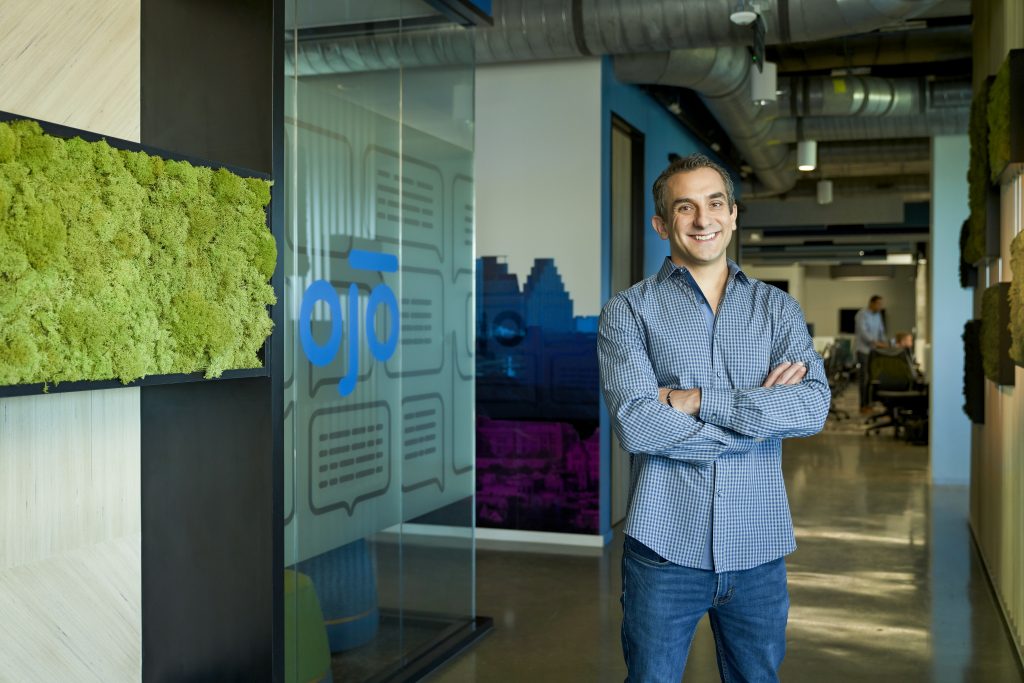
John Berkowitz, CEO, and CoFounder of OJO Labs

OJO Labs has seen that evolution underway in Austin also, said John Berkowitz, its CEO, and Co-Founder. He spoke at the summit about artificial intelligence and its impact on the real estate industry.

“We’re applying AI and machine learning to a lot of parts of the real estate journey,” he said.

AI is going to reduce menial tasks and help people make better decisions through big data, he said.

“The big headline coming out of it is this is going to make specific groups of real estate agents very effective and be able to handle more transactions,” he said. “It’s going to extend the country’s best agents to more consumers. Remove the things agents don’t like to do and increase the things they do like doing.”

Real estate agents don’t want to respond to a niche message about a home at 3 a.m., real estate agents do want to sell homes, he said.

OJO has created a virtual assistant that helps homebuyers and sellers. Its agent uses natural conversations conducted via text messages to help a person find a house.

Last year, OJO moved its headquarters to the top floor of a newly completed four-story building at 1007 South Congress Ave. Construction is still underway in the area as developers complete another office building, hotel and more. It’s part of the commercial real estate boom underway in Austin.

And Berkowitz thinks this is just the beginning of Austin’s evolution as a tech center. And with Keller Williams, The Guild, Homeward and other innovators in the real estate industry based here, Austin is becoming known for its real estate technology, Berkowitz said.

“We just have that momentum,” he said. “It’s just going to keep going.”

There are some serious investors and entrepreneurs moving to Austin from the West Coast contributing to the city’s growth, he said.

“I don’t think people realize this is literally day one,” Berkowitz said.  “Whatever we have seen in the last decades, it’s nothing compared to what is coming. You are going to see this become ground zero for a lot of innovation and a lot of change.”

Austin-based Wikibuy is Booming Since its Acquisition by Capital One


Adam Gauvin, Wikibuy’s Co-CEO and vice president of product at Capital One and
Walt Roloson, Co-CEO and vice president of business at Capital One

Austin has become an eCommerce hub.

And that’s thanks, in part, to homegrown startups like Wikibuy, which was acquired by Capital One for an undisclosed sum in November of 2018.

Other major Austin players in the eCommerce industry include RetailMeNot, Bazaarvoice, BigCommerce, Dosh, Convey, H-E-B Digital, Black Locus/Home Depot, and Favor.

And Austin is also home to Walmart’s Digital Innovation Center downtown and Amazon’s major hub in the Domain.

Austin’s technology industry is attracting major retail players and nurturing home-grown startups.

“Becoming part of Capital One was beyond our dreams,” said Adam Gauvin, Wikibuy’s Co-CEO and vice president of product at Capital One.

“We had a lot of interest from a lot of players,” he said. “Capital One was someone we knew, and they were like-minded.”

Capital One Financial Corp., based in McLean, Virginia, is one of the nation’s top 10 largest banks. It’s known for its Capital One credit card with the slogan “what’s in your wallet?” and famous spokespersons like Taylor Swift and Jennifer Garner. Capital One also operates two Capital One Cafes in Austin which allow people to grab a coffee and work remotely.

Since its acquisition, Capital One has provided investment and allowed the company the freedom to explore new areas, Gauvin said. And Wikibuy has grown dramatically, he said. Wikibuy has gone from 19 employees to 30 employees in Austin and 75 employees nationally, he said. The site has grown from one million users to three million users, he said.  And Wikibuy is serving more than 30,000 e-commerce sites and it’s growing, he said.

And both Gauvin and Walt Roloson, Co-CEO and vice president of business at Capital One, are still running the company from Austin. They met with media at the Hotel Van Zandt for a briefing on their business Wednesday morning.

Wikibuy started out as a comparison-shopping engine. A shopper would search for a product and Wikibuy would offer up the best price. It still does that, but it also has a browser attachment now that can automatically apply coupons to purchases and offer cash-back rebates to shoppers.

Wikibuy competes with sites like Austin-based RetailMeNot, Austin-based Dosh and Rakuten, formerly eBates, with its North American headquarters based in San Mateo, Calif.

E-Commerce overall is booming as more consumers turn to the Internet to make purchases.

Holiday retail sales hit $730.2 billion in 2019, up 4.1 percent, compared to the same time a year earlier, according to the National Retail Federation. Online and other non-stores sales made up $167.8 billion of that amount, up nearly 15 percent from a year earlier.

Another trend is mobile shopping is growing 20 percent to 30 percent a year, Gauvin said.

Wikibuy plans to grow steadily from Austin as online shopping becomes an even bigger part of the overall retail industry, Gauvin said.

“We’ve had pretty steady success,” he said. “Our hope is we continue to make a bigger dent in the marketplace.”

Austin-based FlashParking Receives $60 Million in Funding

Finding a parking space in downtown Austin is an increasingly difficult task that FlashParking seeks to solve.

And the Austin-based company landed $60 million in strategic investment from the Growth Fund of L Catterton, a private equity firm.

FlashParking plans to use the funds to scale its parking solution into connected mobility hubs.

Founded in 2011, FlashParking previously raised $4.3 million.

FlashParking provides parking lot owners with real-time data so they can raise or lower parking prices depending on demand.

 “FlashParking is a best-in-class parking solutions provider with proven technology and an industry-first cloud-based software solution,” Michael Farello, Managing Partner, L Catterton Growth Fund, said in a news release. “We are pleased to partner with the FlashParking leadership team to accelerate the Company’s growth and facilitate the delivery of mobility services to consumers and businesses.”

In the coming months, FlashParking plans to announce new partnerships with transportation, logistics, and mobility companies that are leveraging its platform.

“Over the last nine years, we have built the FlashParking platform with quality and adaptability in mind by making it cloud-based, mobile-first, and future-ready. This unique platform has allowed us to configure an operating system that’s not only the best solution for parking infrastructure today but also a model that’s ready for tomorrow,” Juan Rodriguez, co-founder of FlashParking, said in a news release. “With this funding from L Catterton, we’ll be able to quickly scale our mobility hub operating system and become the only company that can turn customers’ parking assets into facilities that enable every facet of mobility, including mobile-enabled parking and valet, staging for TNCs, charging for electric vehicles, cleaning and servicing, drone launching and landing, and points for delivering.”

FlashParking already has a partnership with Texas Medical Center (TMC), the world’s largest medical city. Its mobility platform controls 30,000 parking spaces via 230 lanes across 34 facilities while simplifying parking, reducing congestion, improving traffic flow, and enhancing the experience for the more than 10 million patients, visitors, staff, and students who visit TMC annually.

In addition to TMC, FlashParking serves more than 6 million parkers per month and processes $1 billion in transactions at more than 1,300 locations worldwide.

Catterton current and past investments include ClassPass, Artsy, Vroom, Get Your Guide, and Enjoy.

Austin Tech and Startup Events to Attend in January

Happy New Year!

A little late to post the January events this year. But that’s because of the 2020 Austin Silicon Hills News Austin Calendar. It’s made it back from the printers and it’s being prepared for its debut at the sixth annual SHN Calendar Party. This year, the party is being held at The Riveter from 6 p.m. to 9 p.m. on Thursday, Jan. 23rd. Please join us to meet the 12 startup founders and advocates featured in the 2020 calendar. If you don’t have tickets yet, get your tickets soon because we will sell out.

Thank you to our sponsors for the calendar and event including The Riveter, (our venue host) the Austin Chamber of Commerce, BuildGroupInnoTech AustinKronologicSana BenefitsEgan-Nelson Law FirmSilicon Hills LawyerKronologic.ai and Active Capital. And In-Kind Sponsors: MassChallenge Texas. We still have room for a few more sponsors to make the event spectacular. Please sign up on Eventbrite.

See you there!

Jan. 15th

Leadership Team: Executing a High-Performance Decentralized Team Strategy

When: 5 p.m. to 8 p.m.

Where: Max’s Wine Dive, 207 San Jacinto Blvd., #200, Austin, TX

What: Engineering scarcity, strong competition, migration policies among other factors are affecting current talent and product strategies even in the fastest-growing organizations. We will encourage a dialogue to discuss the execution and dynamics of decentralized teams, using talent from all over the world, while maintaining their culture and service on top. For more info.

Jan. 16th

The Agents of Change for DEI

When: 10 a.m. to 12 p.m.

Where: The Riveter, 1145 W. 5th Street, Austin, TX 78703

What: A new year brings change and action. If you’re a head of DEI, HR professional, recruiter, or hiring manager, we invite you to join our interactive DEI event featuring an all-star lineup of panelists. For more info.

Jan. 16th

TeXchange Austin

When: 11:30 a.m. to 1 p.m.

Where: Capital Factory, 701 Brazos St. Austin, TX

What: Fireside Chat with Chris Palmisano, COO of Rocket Dollar, With the rise in demand for startup capital, there have been “new” mechanisms for fundraising that have evolved to meet the ever-growing needs of the community. For more info.

Jan. 16th

Insure Tech ATX

When: 7 p.m. to 9 p.m.

Where: NFP, 1250 S. Capital of Texas Highway, No. 600, Austin, TX

What: Topic: Creating B2B Relationships in InsurTech, FinTech, and Beyond. Speakers: Mark O’Leary & Rachelle Oribio. For more info.

Jan. 21st

Austin Music Tech Meetup  

When: 7 p.m. to 8 p.m.

Where: Capital Factory, 701 Brazos St., 16th Floor

What: Jason Fox, Founder and CEO of music app Earbuds, will be recounting his founder story of his journey from the NFL to startups as well as the experience of going through the Techstars Program in Austin. For more info.

Jan. 22nd

Winter Job Fair at Capital Factory  

When: 7 p.m. to 8 p.m.

Where: Capital Factory, 1st Floor, 701 Brazos St, Austin, TX 78701

What: Join us for 2-hours of networking focused on connecting Capital Factory companies to individuals seeking employment within the Austin tech and startup community! Come meet our budding startups, learn about available opportunities and drop off a resume. This event is FREE and OPEN TO THE PUBLIC. For more info.

Jan. 23rd

Austin Technology Council: Roundtable Breakfast

When: 7:30 a.m. to 9 a.m.

Where: Newmark Knight Frank 2530 Walsh Tarlton Lane, Suite 200, Austin, TX

What: Sales leadership: the impact of client harassment on your team. Monthly breakfasts targeted to specific groups within the Austin technology community to come together in a small group of 25-40. These events include a featured speaker who kicks off open discussion amongst attendees. For more info.

Jan. 23rd

Silicon Hills News 2020 Austin Tech Calendar Party

When: 6 p.m. to 8 p.m.

Where: The Riveter, 1145 W. 5th Street, Austin, TX 78703

What: Join us for Silicon Hills News’ 6th annual Austin calendar party. We’ll have drinks, light bites, entertainment by The Specials, specialty coffee drinks by Cactus Cafe Coffee and lots of fun and networking with the best and brightest in the Austin technology community. And we’ll introduce the startups and startup advocates and leaders featured in the Silicon Hills News 2020 desktop calendar.  For more info.

Jan. 25th

Data Day Texas

When: Saturday 8 a.m. to 8 p.m.

Where: AT&T Executive Education & Conference Center – 1900 University Avenue – Austin, TX 78705

What: Originally launched in January 2011 as one of the first NoSQL / Big Data conferences, Data Day Texas each year highlights the latest tools, techniques, and projects in the data space, bringing speakers and attendees from around the world to enjoy the hospitality that is uniquely Austin. Since its inception, Data Day Texas has continually been the largest independent data-centric event held within 1000 miles of Texas. Our most recent editions have drawn over 1000 attendees. For more info.

Jan. 29th

Big Ass Social Happy Hour

When: 6 p.m. to 8 p.m.

Where: Hanger Lounge, Fourth & Colorado

What: BASHH is Austin’s relaxed mixer filled with professionals of all backgrounds that feel awkward knowing each other online but not offline. The ties come off a 6:00 pm, and there are no speakers or panels, no lame pitches, no egos; all are welcomed to relax and have happy hours! For more info.

Austin’s 2019 VC Investment Hits $1.7 Billion, up Nearly 28 Percent from 2018

In 2019, Austin-based private companies raised $1.7 billion, up almost 28 percent from 2018, another record year, according to the latest MoneyTree Report from PwC and CB Insights.

The report found investors did 151 deals in 2019, up almost 22 percent from 2018.

And in the fourth quarter of 2019, Austin-based startups raised $295 million, up 34 percent from the same quarter a year ago in 37 deals, up 37 percent, according to the report.

RigUp landed on the MoneyTree report for the top ten investment deals of 2019 twice. It earned the top spot with its $300 million Series D investment announcement in the third quarter and claimed the ninth spot with its Series C investment round of $60 million in the first quarter.

Other Austin companies on the top 10 investment list in Texas last year included SparkCognition with $100 million raised in the fourth quarter and Siete Family Foods with $90 million raised in the first quarter. Austin-based ScaleFactor also made the list with $60 million raised in the third quarter.

Overall, Texas’ venture capital investment in 2019 hit $3 billion, up 30 percent from 2018, according to the MoneyTree report.

The report found investors made 267 deals in 2019, down slightly from 275 deals a year earlier.

In the fourth quarter, venture capital investment was $499 million, up almost 4 percent from the same quarter in 2018.

The top five deals in the fourth quarter included a $100 million venture capital investment into Spark Cognition of Austin. And The Zebra reported receiving a $39 million Series C round of funding to claim the second-largest deal of the quarter. Shipwell of Austin with a $35 million round came in third. And Houston-based Expedi landed $25 million to claim fourth place followed by San Antonio-based Airstrip Technologies with $21 million.

Overall, Texas ranked fourth nationally for deal activity behind California, New York and Massachusetts. Those three states rake in 77 percent of all the venture capital in the United States, according to the MoneyTree Report. Texas ranked ninth for overall investment dollars.

Nationally, U.S. VC funding fell in 2019 nine percent to $108 billion, still the third biggest year ever. And in the fourth quarter, U.S VC-backed companies raised $23 billion, down 16 percent compared to the third quarter.

Other significant trends include a drop in the number of $100 million-plus rounds, which fell to 38 companies in the fourth quarter, compared to 58 in the third quarter and 67 in the second quarter, according to the MoneyTree report. Still, 2019 saw the most $100 million-plus rounds ever with 213, raising $47 billion in 2019, the second-biggest year of mega-round funding.

U.S. technology initial public offerings fell for the second straight quarter, though year over year exits remain higher. In the fourth quarter, 20 U.S. VC backed companies had an IPO exit, compared to 22 in the third quarter. Overall, 90 technologies had IPO exits in 2019, compared to 86 in 2018.

And at the end of 2019, the U.S. has a record number of unicorn companies with 199 VC backed private companies valued at $1 billion or more, up from 149 at the end of 2018.

The Top 10 Venture-Backed Deals in Austin in 2019

Year Qtr Company Name Round Amount ($M)
2019 3 RigUp Series D 300
2019 4 SparkCognition Series C 100
2019 1 Siete Family Foods Growth Equity 90
2019 3 ScaleFactor Series C 60
2019 1 RigUp Series C 60
2019 1 Outdoorsy Series C 50
2019 2 EverlyWell Series A 50
2019 1 DISCO Series E+ 50
2019 3 TurnKey Vacation Rentals Series E+ 48
2019 2 FloSports Series C 47

Source: MoneyTree Report from PwC and CB Insights.

Austin’s Carl Deckard, one of the Pioneers of the 3D Printing Industry, has Died

Carl Deckard

Carl Deckard, 58, one of the pioneers of 3D printing died in Austin over the holidays.

Deckard died on Dec. 23, according to his obit.

Deckard was one of the inventors of “Selective Laser Sintering,” the technology at the forefront of 3D printing.

Deckard developed the technology at the University of Texas at Austin while he was working on his undergraduate degree and later his master’s and Ph.D. degrees in the UT Mechanical Engineering Department.

Deckard eventually spun out a company, DTM, to commercialize the technology.

For years, Deckard’s patents “were some of the highest revenue-generating intellectual property out of UT Austin,” according to the university.

And Deckard’s innovation helped give birth to a new industry, the 3D printing industry, which is worth nearly $16 billion last year and is projected to reach nearly $24 billion by 2022, according to The Wohlers Report.

Today, 3D printing is used for all kinds of applications including making dental crowns, hip replacement joints, printing pizza, chocolate sculptures and other food, toys, jewelry, and even for printing human tissue and recreating human organs.

Deckard was one of Austin’s innovators who made a huge contribution to the technology industry locally and globally.


The Pioneers of 3D Printing: Terry Wohlers, industry expert, Chuck Hull, co-founder of 3D Systems, Carl Deckard, inventor of laser sintering, Lisa Crump, co-founder of Stratasys and Dave Bourell, professor of mechanical engineering at UT, photo by Laura Lorek

Silicon Hills News was lucky enough to interview him at a  25th annual International Solid Freeform Fabrication Symposium, the world’s leading research-focused summit on 3D manufacturing, held at UT Austin in August of 2014. Here’s the full story from that event.

Deckard also co-founded another company in 2012, Structured Polymers, which created a proprietary scalable process for commercializing high-performance polymer powders for 3D-printing. Evonik, a German company acquired Austin-based Structured Polymers in January of 2019 for an undisclosed amount.

“Carl held 27 patents and was profiled by Fortune magazine as one of five modern technology pioneers, inducted into the Manufacturing Hall of Fame by Industry Week, and named a Master of Manufacturing by the Society of Manufacturing Engineers,” according to his Obit.

“He is survived by his sons, Thomas; Michael and wife Chelsea; sister, Lucy; and ex-wives Sally and Kimberly. A celebration of his life will be held in January. In lieu of flowers, please send donations to Austin Pets Alive at austinpetsalive.org/donate,” according to his Obit.

Austin’s Televet Lands $2 Million in Funding

Telemedicine has come to the pet market.

Austin-based Televet, an online platform that connects veterinary clinics to existing clients, announced that is has raised $2 million in seed-stage funding.

Dundee Venture Capital and Mercury Fund, co-led, the round with participation from GAN Ventures. Founded in 2015, TeleVet has raised $2.3M to date.

The company plans to use the money to hire key employees and on product development to meet the demand for its telemedicine platform and apps.

TeleVet is focused on connecting the nearly 33,000 veterinary clinics and more than 160 million pet owners in the United States. It has created a communications platform that allows veterinarians to interact with their customers through texts, emails and video calls.

Televet is designed to give veterinarians more flexibility in their daily schedule by responding to clients online. The service also provides greater access to clients living in rural areas with limited veterinarian clinics.

“Over the past four years, we’ve become extremely close to our customers and the industry,” TeleVet Co-Founder and CEO Steven Carter said in a news release. “Running a veterinary practice can be stressful. You’re expected to be constantly available and always have the answers. We want to show veterinarians that we don’t just care about your practice, we care about you.”

Veterinarians can integrate TeleVet into their existing office workflow, instantly receiving and scheduling virtual consultations, online appointment scheduling, digital prescriptions and more. It also has partnerships with Embrace pet insurance, Vetsource for home prescription delivery and Covetrus’ practice management software.

“We’re bullish on the pet technology space, particularly solutions like TeleVet that serve both sides of the market. Pet owners have spent roughly $18 billion annually on veterinary care in the last two years, making veterinary care the fastest-growing category in Pet Tech,” Allie Esch at Dundee Venture Capital said in a news release. “TeleVet will power the next generation of veterinarians who are quick to adopt digital technology, recognizing that revenue, retention rates and care can improve through tech adoption.”

“TeleVet provides a modern, mobile experience for veterinarians and practice owners,” Blair Garrou, Managing Director at Mercury Fund, said in a news release. “Now pet owners can communicate with their vet as easily as they do with any other service provider. With more than 30,000 veterinary practices in the U.S., there’s a huge opportunity ahead for TeleVet.”

Austin’s ePayPolicy Receives a Significant Investment from Serent Capital

ePayPolicy, a digital payment processor for the insurance industry, announced last week that it has received a significant investment from Serent Capital, a private equity firm with offices in Austin and San Francisco.

Austin-based ePayPolicy, founded in 2014, did not disclose the amount of the investment. The company plans to use the investment to accelerate its growth, according to a news release.

ePayPolicy provides an easy-to-use, end-to-end solution with integrations into the most widely used agency management systems

ePayPolicy allows agencies and others in the insurance industry to implement electronic payments in days, dramatically reducing the number of paper checks they process while also simplifying their accounting reconciliation with automated data entry.

 ePayPolicy has more than 2,300 customers and it processes more than $2 billion in payments annually

“This investment from Serent is a game-changer in our ability to take our product to the next level in user experience, product offerings, and service enhancements. We’re already the preferred electronic payments solution for 27 state associations and are excited to now bring our product to the rest of the country,” Todd Sorrel, Co-Founder of ePayPolicy, said in a news release.

“ePayPolicy’s customer references and satisfaction scores are some of the best we’ve ever seen. We knew immediately this was a team that knew how to create outstanding products,” Kevin Frick, Partner at Serent Capital, said in a news release. “We’re incredibly excited to partner with Todd and Milan to expand ePayPolicy’s market reach and continue to drive exceptional value for their customers.”

ePayPolicy is Serent Capital’s 9th payments investment and 10th investment in the insurance market. Serent previously invested in Diamond Mind, Real Green Systems, KEV Group, and Payliance. Serent has also been active in the insurance market with investments in Intygral, Next Gear Solutions, Senior Dental Care, and Aftermath.

Austin’s argodesign Expands Again With a New York Studio

Photo courtesy of argodesign

argodesign is expanding again.

This time the Austin-based design firm is opening a studio in New York. Mehera O’Brien will run the studio as head of creative.

argodesign launched its European studio in Amsterdam last March.

“Our New York studio centers around cross-pollinating technology with the traditional approach of user-centered design,” O’Brien said in a news release. “argo looks at invention in a slightly different way, employing technology as a transformative medium for designing products humans want and need to use. We’re excited to extend this to the New York market and beyond.”

The New York design team has previously worked at the top design firms of frog, Dalberg, Gensler, and Method. Their focus is on global health, community impact, and enterprise product design.

“The last 18 months have been an incredible time of growth for argo, expanding into Europe and doubling the size of the company in less than a year,” argo Co-founder and Chief Creative Officer Mark Rolston said in a news release. “It’s the culmination of our first five years focusing on strong creative culture and doing great work. Our vision is to build something bigger than any one of us. New York is one more step in building that legacy.”

Argodesign, founded in 2014, sold in 2018 to $22 billion IT company, DXC Technology, for an undisclosed sum. Since then, the company has been expanding into new markets. Its clients include CognitiveScale, Magic Leap, United Rentals, and Sam’s Club.

P&G Buys Billie, a Women’s Shaving Products Startup

Billie, a startup that makes shaving products for women, just got acquired by P&G.

The companies did not disclose the financial details of the deal.

Billie, founded in 2017 in New York, is a portfolio company of Austin-based Silverton Partners. That same year, Silverton Partners led a $6 million seed-stage investment for the company with participation from returning investors including Female Founders Fund and Lakehouse Ventures. To date, Billie had raised $35 million, according to Crunchbase.

Georgina Gooley and Jason Brayman founded the company that focused on female body care. It offers a subscription-based, direct to consumer brand that sells 5-blade razors, shaving cream, body wash, body lotion, and other goods. Gooley and Brayman will continue to run the company which caters to Millennial and GenZ consumers.

P&G said the deal complements its existing portfolio of products focused on women including its Venus, Braun, and Joy brands.

“We’re thrilled by the prospect of joining P&G to bring high-quality products at affordable prices to women around the world,”  Gooley, co-founder of Billie said in a news release “Their ability to create global household brands that have stood the test of time is a testament to their brand-building expertise; together, we’ll be able to create an even stronger brand for womankind.”

 “The impact and consumer connection Georgina and Jason have been able to make with Billie in a short period of time has been remarkable,”  Gary Coombe, CEO of P&G Global Grooming said in a news release. “The combination of Billie’s high-quality, naturals-focused razors and body care products, and P&G’s highly-skilled and experienced people, resources, technical capabilities and go-to-market expertise will allow us to further reach Millennial and GenZ women through a fresh, bold attitude.”

“The combination of brands, talent and expertise will strengthen P&G’s Grooming business and accelerate growth for Billie, as well as fuel the development of additional products designed for the specific needs of women,” according to a news release.

Billie donates 1 percent of its revenue to women’s causes including Every Mother Counts, which focuses on making pregnancy and childbirth safe for women.

« Older posts Newer posts »

© 2026 SiliconHills

Theme by Anders NorenUp ↑