Austin-based UpEquity, a tech-enabled mortgage company, announced it has closed on $50 million in funding.
S3 Ventures led the Series B funding which included $20 million in
equity and $30 million in debt.
Other investors included Next Coast Ventures, BP Capital
Management, Alumni Ventures, Gaingels, Launchpad Capital and Early Light Ventures.
To date, UpEquity has raised $77 million.
UpEquity reported it has seen year over year revenue growth of 500 percent and it anticipates originating more than $1 billion in mortgages over the next 12 months.
UpEquity, founded in March of 2019, moved to Austin from Boston. The company has 90 employees. Its headquarters is at 3501 S. Congress Ave.
“Institutional investors have deployed a stunning $77 billion in a period of six months into single-family homes as an asset
class with no signs of slowing down,” Charlie Plauche, partner with S3 Ventures,
said in a news statement. “Your average homebuyer is now regularly competing against
massive companies that can offer very attractive terms to sellers such as
all-cash offers and fast close times. UpEquity’s technology is leveling the
playing field for everyone by enabling average homebuyers to also make all-cash
offers with market-leading close times.”
“At the end of the day, our vision is to create equal access to
the American dream through frictionless, on-demand homebuying, and it starts
with bringing technology into the underwriting process,” UpEquity Co-Founder
and CEO Tim Herman said in a news statement. “By removing cost and
inefficiencies from the mortgage process, our customers can make all-cash
offers at zero cost to them and still get access to competitive interest rates.
They get the best of both worlds.”
UpEquity allows homebuyers to make all-cash offers, which can make
the difference between getting a house under contract quickly in a highly competitive
real estate market.
“We’re giving our customers more choices than the legacy mortgage
industry. We’re able to do so without sacrificing essentials like competitive
mortgage rates and while providing an exceptional customer experience,” Herman
said. “This gives the average American a more fair chance of winning the home
they want.”
UpEquity says it is able to close a mortgage in an average of 18
days, a much shorter and more efficient process, according to the company.
“We are impressed with the company’s vision to enable all
Americans to win their dream home, even when faced with stiff competition from
institutional investors,” Plauche said. “In short, UpEquity allows the average
homebuyer to have a shot at competing with the large real estate investment
firms of the world in the homebuying process. We are
Harvey
Najim left a career at IBM to found Sirius Computer Solutions in 1980,
originally named Star Data Systems. In 2011, Najim stepped down from Sirius and
Joe Mertens, a longtime executive, became Chief Executive Officer.
“Today is an exciting day for Sirius,” Mertens said in a news release. “We have long admired CDW and welcome the opportunity to bring our complementary services and solutions capabilities to serve a broader market of customers as a combined company. Sirius and CDW share common values and a performance-driven, customer-focused culture. We look forward to the opportunity to combine Sirius’ considerable talents with CDW’s, and to being part of a larger, stronger organization that will be even better positioned for growth in the evolving IT services and solutions landscape.”
In
2020, Sirius, one of the largest IT solutions integrators in the United States,
had net sales of $2.04 billion. The company has 3,900 large and mid-sized
customers.
CDW,
based in Chicago, is buying the company from an affiliate of Clayton, Dubilier
& Rice. Sirius has 2,600 employees.
“As
customers require increasingly complex and critical digital transformation
initiatives, Sirius’ broad portfolio of world-class technology-based solutions
and services-led approach will immediately add to our capabilities to meet this
demand,” Christine A. Leahy, president and chief executive officer of CDW, said
in a news release. “Combining our businesses will accelerate progress on our
three-part growth strategy by augmenting our portfolio and enhancing our
ability to deliver customer-centric outcomes across the full technology
solutions stack and lifecycle. We look forward to welcoming the talented Sirius
team and leveraging our common values and collective unparalleled expertise to
deliver the best customer experience and create value for CDW shareholders.”
“Sirius
is a strong business with a talented team that offers compelling technology
solutions to their clients,” CD&R Partner Stephen Shapiro said in a news
release. “We are proud to have supported the company’s growth, and we wish them
continued success in the future.”
For the first three quarters, the report’s data shows companies
have attracted $238.7 billion across 12,837 deals and breaking the previous
record set in 2020 of $155.4 billion.
And on a statewide basis, Texas
attracted $1.8 billion of venture capital in 174 deals in the third quarter. Overall,
for the first three quarters, Texas has attracted $6.7 billion worth of
investment in 541 deals.
Austin
saw $981.4 million invested in 76 deals in the third quarter. For the year, Austin companies have attracted
a record $3.8 billion in venture capital in 265 deals.
Texas
had $3.15 billion in 22 exits in the third quarter. Overall, for the first
three quarters, Texas has had $10 billion worth of exits in 55 deals.
Austin
had the bulk of the state’s exit activity with $2.97 billion worth of exits in
the third quarter. And year to date, $5.7 billion in exits.
“Eighteen months into the COVID-19 pandemic, the VC industry has
continued to prove its resiliency while also directly supporting the country’s
economic recovery and strengthening public markets,” according to the report.
“The growing participation of
well-resourced nontraditional investors such as mutual funds, PE, hedge funds,
and crossover investors in the venture space has contributed to the rise in
deal size and valuations, reshaping the industry landscape in the process.”
In the third quarter, the U.S. saw a
record $187.2 billion in exit value, and a total of $582.5 billion year to
date, 101.6 percent higher than 2020’s record of $289 billion, according to the
report.
Many of those companies are heading
to the public markets to exit. Initial Public Offerings are having a
blockbuster year with 221 occurring so far nationwide.
Austin’s biggest IPOs of 2021 include Bumble in a traditional IPO and E2Open in February through a special purpose acquisition company, or SPAC, FTC Solar in April, and DISCO in July, both traditional IPOs.
“If there are any clouds on the
horizon for the industry, they may come in the form of the evolving pandemic,
as well as economic and policy uncertainty,” according to the report.
Top
10 Deals for the Third Quarter of 2021 in Austin
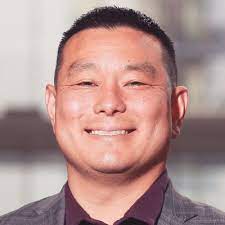
Henry Yoshida, CEO and Co-Founder of Rocket Dollar
After
selling Honest Dollar, the company he co-founded, to Goldman Sachs, Henry
Yoshida recognized another super trend.
He
had spent his career in the financial services industry with a particular focus
on retirement accounts. Before Honest Dollar, Yoshida, a certified financial
planner, had also founded MY Group LLC, a $2.6 billion assets under management
retirement plan advisory firm and he had spent 10 years with Merrill Lynch.
Yoshida,
a graduate of the University of Texas at Austin who also has an MBA from Cornell
University, saw a super trend emerging in people wanting to invest in
alternative assets as part of their retirement planning.
So, in 2018, Yoshida co-founded Rocket Dollar, an Austin-based fintech startup that provides self-directed retirement accounts that let people invest in cryptocurrency, real estate, and other investments. His oldest daughter helped name the company, Yoshida said.
“Our
company lets people go to different places they previously couldn’t go before
just like a rocket can take you further than a plane, a plane can take you
further than a car, and a car can take you further than a bike and so forth,”
Yoshida said.
Yoshida
recently sat down with Silicon Hills News’ Ideas to Invoices podcast to talk
about the growth of Rocket Dollar.
Rocket
Dollar has customers who are investing in NFTs, non-fungible tokens, which is a
derivative of the cryptocurrency space, Yoshida said.
“It’s
a little bit, to be fair, of a gray area right now,” he said. “Cause
technically, you are not allowed to invest IRA dollars into collectibles.”
A
physical collectible could be a painting, a baseball card but now there are
many platforms that are taking these formally collectible investments and
putting them on a platform and chopping them up into pieces of stock, Yoshida
said. NFTs are a digital securitized version of art, which makes it eligible to
be invested in, he said.
“Very
little but we do some of that right now,” Yoshida said.
Some
NFTs are selling for millions of dollars. Yoshida is friends with an
entrepreneur in Austin who owns several of the Bored Ape NFTs, which have
become hot commodities.
“Yuga
Labs, the company behind the now-famous Bored Ape Yacht Club line of NFTs, sold
its collection of 107 Bore Ape NFTs at an online auction with Sotheby’s for
$24.4 million,” according to Blockonomi, a cryptocurrency media site.
Rocket
Dollar also recently announced it has closed on a $8 million Series A round of
funding and it plans to spend the funds to dramatically scale its company,
Yoshida said.
“This
new capital is going to allow us to basically make the platform better and get
ready to grow by 10 times, by 50 times, and by 100 times in terms of the number
of customers, and the assets we have on the platform and so forth,” Yoshida
said. “For us, it’s a great time in our business. We have great new institutional
investors.”
Previously, Rocket Dollar raised money from a lot of individuals and local angel investment, but its last round was made up of coastal institutional investors, Yoshida said. That money will allow Rocket Dollars to take its assets under management from $400 million to $1 billion to $5 billion and beyond, Yoshida said.
The
COVID-19 pandemic also changed the way Rocket Dollar operates. Its downtown office
lease came up for renewal in May of 2020 and the company decided to let its
employees work virtually from home, Yoshida said. All 20 of its employees are
in Austin except for one so the team gets together for meetings and social functions,
he said.
“I think that next year, and as we continue to grow, we’re going to continue to be a remote work company but instead of coming in when you want to the office we maintain, it will be a come in when we have reasons to get together for team meetings, spring planning and so forth.”
For more on Rocket Dollar and Yoshida’s entrepreneurial journey, listen to the rest of the podcast below or on Apple, Google, or wherever you get podcast.
Texas has 267 companies on the Russell 3000 Index and only 23 percent of them have women on their boards of directors, according to the 50/50 Women on Boards Gender Diversity Index.
And
only 13 of them are gender balance where they have 50 percent women and 50
percent men on their boards.
Those figures for 2021 are a 2.9 percent improvement over 2020 when Texas had 254 companies and 20.1 percent of them had women on their boards and none of them had gender balance, according to the Gender Diversity Index.
But still, there is a whole lot of room for improvement.
And that’s the mission of 50/50 Women on Boards, a national nonprofit organization aimed at driving the movement toward gender balance and diversity on corporate boards.
“The
sustained increase and progress for women is positive, but there is work to be
done to achieve gender balance and diversity on corporate boards,” Stephanie
Sonnabend, CO-Founder and Chair of 50/50 Women on Boards, said in a news
release. “After
more than a decade of collaborating with corporations and action groups
committed to advancing women to corporate boards, we know that what gets
measured gets done. Thereby, we are furthering our commitment to diversity. In
addition to women holding 50% of all corporate board seats, we call for women
of color to hold at least 20% of ALL the corporate board seats.”
And
the movement has come to Austin. The 50/50 Women on Boards organization just
launched a
chapter in the Austin area. The three board chairs of the Austin chapter are
Laura Webb, Wendy Howell, and Michele Skelding.
The Austin chapter is hosting its first event on Nov. 12 at 11 a.m. The two-hour event includes a VIP panel session followed by a one-hour strategic networking session with a director coach.
Lorenzo Gomez, Chairman of Geekdom, David Mongeau, Founding Director of the UTSA School of Data Science and Entrepreneur Graham Weston at San Antonio Startup Week
By LAURA LOREK, Publisher of Silicon Hills News
Like the California gold miners of yesteryear, San Antonio leaders are betting big on a new type of mining to bring the city good fortunes.
It’s data mining.
The world is awash in big data and businesses, government, and the military all want to hire data scientists to make sense of it all, so they can make better decisions.
It’s also a highly lucrative field. The average data scientist’s salary is $100,560, according to the U.S. Bureau of Labor Statistics. And top data scientists with advanced degrees can fetch as much as $350,000 to $450,000, said David Mongeau, founding director of the UTSA School of Data Science.
The demand for data
scientists is much greater than the supply, Mongeau said.
UTSA’s School of Data Science is one of three data science schools in the country with the others at the University of Virginia and the University of North Carolina. The University of California at Berkeley also has the Berkeley Institute for Data Science. That’s where Mongeau previously worked as executive director until last July.
“What attracted me here was the sheer ambition and demography of this city, and the people in this city, and the aspiration and ideas of how data science can contribute so much socially and economically to people who represent the future of America,” Mongeau said.
Mongeau spoke Monday afternoon on a panel titled “Data Doesn’t’ Lie: The Future of Downtown SA” with Entrepreneur Graham Weston and Lorenzo Gomez, chairman of Geekdom at the Dry Goods Building at 107 N. Flores. The discussion was part of the sixth annual San Antonio Startup Week.
UTSA’s School of Data Science is the first stage of UTSA’s development of its downtown campus. The 167,150 square foot building at 506 E. Dolorosa is a $90 million project that is slated for completion next year. UTSA also plans to expand its business school downtown. Eventually, plans call for as many as 10,000 students downtown.
“I think that we can build the largest school
of data science in the country,” said Weston, who donated $15 million to UTSA
for the project.
San Antonio will see large numbers of kids going from being the first generation in their families to go to college to then go on to being high earners in the technology industry, Weston said.
“We can produce 500 graduates a year out of
the school of data science that will create some of the best jobs,” he said. “But
it will also create a pipeline of talent to bring great opportunities and jobs
to San Antonio.”
There is an undersupply of people in the fields of data science, machine learning, artificial intelligence, Weston said.
“The world will be reshaped by the world of
big data and the world of data scientists,” Weston said.
UTSA, with 40,000 students, has grown
dramatically in the past few decades. UTSA’s commitment to downtown is going to
be the biggest thing that ever happened to the city, Weston said.
“If we produce thousands of these jobs,
companies will be locating here to access our pipeline of talent,” Weston said.
The idea is to bring more opportunities to San Antonio’s under-served populations, Mongeau said. He is hiring a staff member to do K-12 school outreach in San Antonio. It is critical for students to have strong math skills at the K-12 level, otherwise, it is hard to get into data science at the college level, he said.
“Math is the showstopper for many students in
data science,” Mongeau said.
Right now, every graduate of UTSA’s data science program has been hired immediately upon graduation, Weston said.
“90 percent of the recent graduates have moved away,” Weston said. To build a great city, we need them to stay.”
Part of the UTSA School of Data Science’s mission is to cultivate entrepreneurs, Mongeau said. To foster that, UTSA is hosting the first Tim and Melissa Draper Data Science Business Plan Competition in the spring, he said.
In addition, the UTSA School of Data Science
will collaborate with Geekdom to have Geekdom members at the school and some
people from the school in Geekdom offices, Mongeau said.
“San Antonio has so much more potential for
startups and entrepreneurship than we have tapped into so far,” Weston said.
One of the key things to grow San Antonio’s economy is to create companies here to create the jobs of tomorrow, Weston said.
“We hope to recruit some companies but
ultimately we have to create our own,” he said.
There are ideas that will come out of the
school of data science that will create a whole new dimension of opportunities
in the startup community, Weston said.
“This is one of those areas that I think is an
easy sell,” he said. “If someone has the aptitude to be in this field there is
no question it is going to be a good field for years to come.”
It’s a straight shot to a great, exciting
future, Weston said.
UTSA is like Carnegie Mellon University in Pittsburgh in the 1980s, Mongeau said. Carnegie Mellon was a regional university with aspirations of being a nationally recognized one, he said. It achieved that with the support of the local government, business leaders, and academic leaders, Mongeau said. He went to undergraduate at Carnegie Mellon in the 1980s and saw the transformation firsthand. UTSA’s School of Data Science also has the support of the city, business, and academic leaders, he said.
“I think we now have universities that allow
us to dream bigger,” Weston said. “I think that our biggest obstacle is
thinking too small…Let’s not settle. Let’s commit to having this city be one of
the best in science and technology and great jobs.”
San Antonio Startup
Week features presentations, panels, workshops, and pitch competitions, happy
hours and networking events. The events are free and open to the public, but
registration is required, and limited tickets are available for select events.
Monday’s highlight featured a talk in the afternoon between Entrepreneur Graham Weston and David Mongeau, the founding director of the UTSA”s Data Science School, moderated by Lorenzo Gomez, chairman of Geekdom.
Austin-based Sana
Benefits sponsored the happy hour at the Dry Goods Building at 107 N. Flores.
Tuesday’s event kicks off with a discussion on “Breaking into Tech & Sports as a Young Asian American Woman,” followed by “Investing in Diverse Founders.” The afternoon includes a startup spotlight on Jobward, a discussion on “What Ted Lasso Can Teach You About Leadership,” “How Your Team Can Help You Sustain a Competitive Advantage” and “Converting Likes to Dollars: Building a Sales Playbook for Your Startup.”
The day concludes with a Philanthropic Pitch Competition at the Tobin Center for the Performing Arts. Tickets to that event are $35.
On Wednesday, San
Antonio Startup Week features another full day of programming including “The
Future is Female – SA Women in Robotics.” The day concludes with a partner
event: “Red Bull Basement: Pitch Camp” at Espuela’s The Bar at the Bridge.
On Thursday, TechBloc is hosting the TechFuel
pitch competition at the Tobin Center. The sold-out event features a pitch
competition for $100,000 in prizes. Five startup finalists will via the prizes
which include a $50,000 grand prize winner and $20,000 to the runner up. The
remaining $30,000 will be awarded to the audience’s favorite. After the
competition, Alamo Angels will host a free party featuring additional prizes
from Capital Factory and the San Antonio Chamber of Commerce.
Friday features a panel discussion on “Transfer
– A Multi-Generational Panel on the Impact of a Lasting Legacy.”
San Antonio Startup Week continues the following week with the Louis H. Stumberg Venture Competition at Trinity University on Tuesday and the BEAM San Antonio October Event on Wednesday.
Olea Edge Analytics, a water monitoring system for utilities, announced it has closed on $35 million in funding.
Insight
Partners, a private equity and venture capital firm based in New York, led the
Series C funding round.
Austin-based
Olea plans to use the funds to further develop its artificial intelligence and
edge computing-based solutions to help utilities manage water. It also plans to
use the funds to hire more employees in all areas.
To date,
the company has raised $50.6 million.
Olea has created a water monitoring system that allows utilities find trouble spots in municipal water systems. The company helps them save money and conserve water by using its platform that uses a combination of hardware and software to detect leaks and other problems in real-time.
“Cities
and water utilities are facing tremendous challenges from all sides: financial,
operational, hiring and more,” Olea Edge Analytics CEO Dave Mackie said in a
news release. “This investment aligns perfectly with our objectives to scale
the company, drive innovation in the water industry and help cities and
utilities operate more efficiently.”
“Olea
Edge Analytics brings incredibly impressive AI and machine learning to an
industry that is hungry for innovation,” Nicole Shimer, Vice President at
Insight Partners said in a news release. “Customers in the water market can see
almost immediate returns on their investment with this technology. We’re
excited to partner with Olea on their mission of bringing clean, safe and
affordable drinking water to all with their one-of-a-kind technology.”
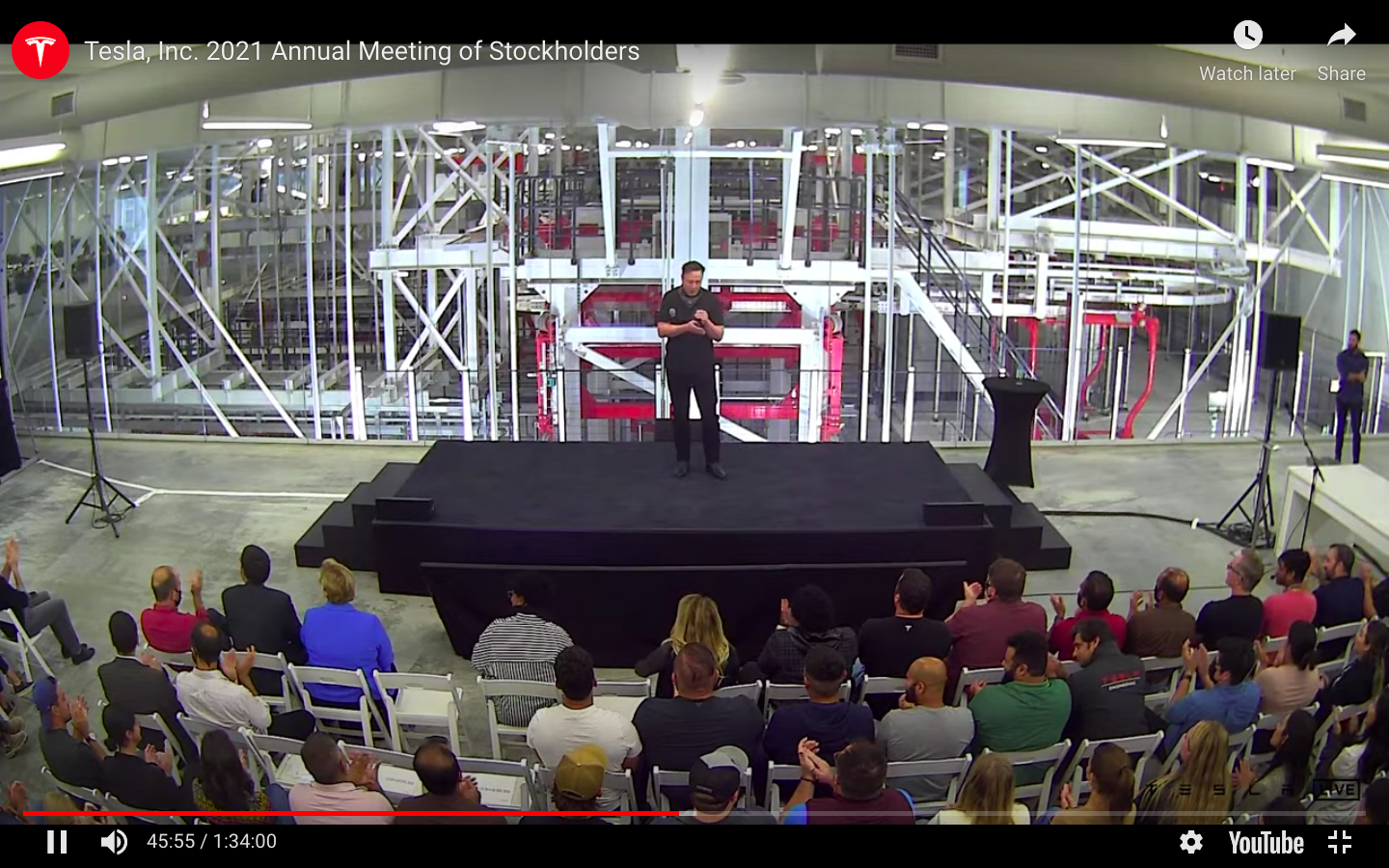
Elon Musk, CEO and Founder of Tesla at the company’s annual shareholder meeting held at the Austin Giga Texas factory Thursday afternoon
Tesla is moving its headquarters from Palo Alto to Austin.
Elon Musk, Tesla Founder and CEO, made the announcement at Tesla’s 2021 shareholders meeting, which was held in Austin at Tesla Gigafactory under construction in eastern Travis County and broadcast on YouTube. In July of 2020, Musk announced plans for its $1.1 billion Giga factory that will make Cybertrucks, Semi, Model 3, and Model Y electric vehicles. The plant is located on 2,100 acres at SH 130 and Harold Green Road.
“Just to be clear, though, we will continue to expand our activities in California,” Musk said. “This is not a matter of Tesla leaving California. Our intention is to increase output for Fremont and Giga Nevada by 50 percent.”
The site in California is packed and it’s landlocked and it’s tough for employees to afford houses in California, Musk said.
“There is a limit to how big you can scale in the Bay Area,” he said.
Austin has attracted other large corporate headquarters from California including Oracle and Zoho Corp. And HP recently announced plans to relocate its headquarters to Houston.
The Texas Giga factory has a lot of room for expansion. It is located five minutes from the airport and 15 minutes from downtown, Musk said. Tesla intends to scale the Texas plant even more than its California operations, he said. The plant will make the Cyber Truck and an All-Terrain Vehicle as well, he said.
“We’re going to create an ecological paradise right here on
the Colorado River,” he said. “It’s going to be great.”
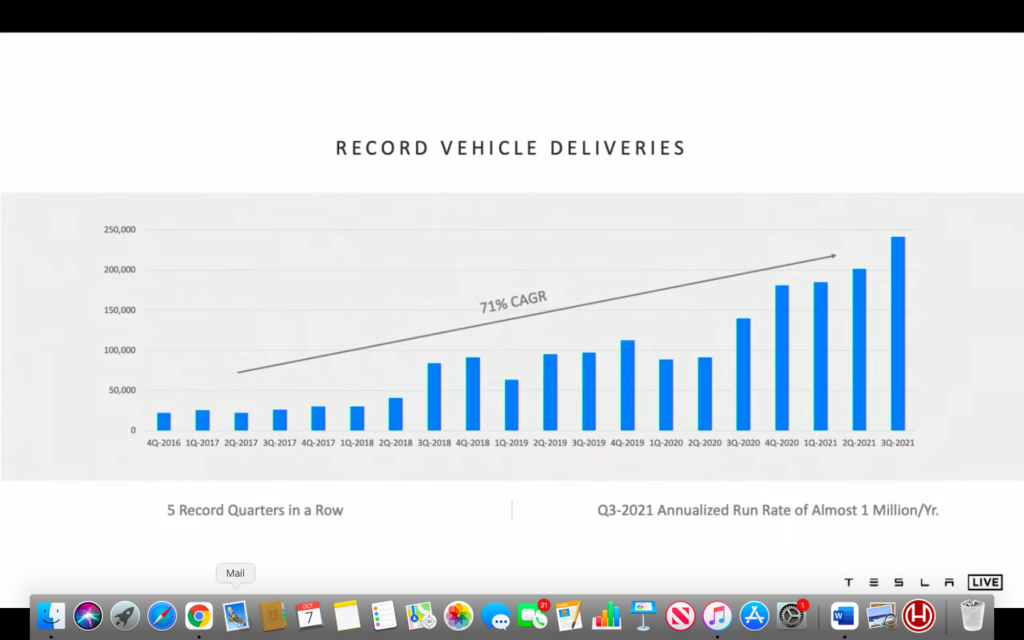
In the 12 months that ended in September, Tesla has delivered 800,000 vehicles to customers, started new production lines in Shanghai, constructed two new Giga factories on two continents including the one in Austin, said Robyn M. Denholm, chair of the Tesla board. Tesla makes the Model S, Model X, Model 3, Model Y, and Roadster.
And during the last 12 months, Tesla has helped shift the
public’s perception of electric vehicles, Denholm said.
“By 2030, Tesla is aiming to sell 20 million electric vehicles per year and deploy 1500 gigawatt-hours of energy storage per year,” Denholm said. “Our mission is clear the automotive sector and the energy sector have to become fully electric.”
Tesla has been hampered by supply chain woes like many
manufacturing companies. That means it hasn’t been able to bring new products
online, Musk said. Cyber truck production should begin next year, Musk said.
And supply shortages should be fixed by 2023, he said.
Production will start in Giga Texas this year, but it will not reach high volume production until next year, Musk said. Tesla’s long-term competitive advantage will be its manufacturing operations, he said.
Over time, all manufacturers will make electric vehicles and eventually will make autonomous vehicles, Musk said.
Tesla is open to licensing its autonomous vehicle technology
to other manufacturers because it will make roads safer and save lives, Musk
said.
“Our goal really is to make the cars as affordable as
possible,” Musk said.
Problems with the supply chain shortages of parts and chip shortages have led to price increases recently, he said. But eventually, the prices will come down, he said.
“We are going to need a lot of batteries,” Musk said. Telsa
is telling suppliers as many as they can make, Tesla will take, he said.
Solar and wind-generated electricity and battery storage are key to a sustainable future, Musk said.
Musk said he was in Austin during the blizzard that hit last
February. He was staying at a friend’s house with no electricity, no heating,
no power, no Internet He said he couldn’t even get to a food store. It went on
for several days, he said.
If he had the Tesla Solar + Powerwall, he would have had
lights and electricity and if he had Starlink Internet, he would have had
Internet too, Musk said.
“If doomsday comes, it could be helpful,” he said.
Tesla has a number of projects in Texas with the energy grid system, including a 100-megawatt energy storage facility in Angleton, Texas, about 40 miles south of Houston in Brazoria County. Tesla is working with the Electric Reliability Council of Texas, ERCOT, on other major installations as well, he said. Tesla’s battery technology can regulate energy usage efficiently and store a supply for times of peak demand, he said.
“If there had been Tesla megapacks here during the blizzard, the power would not have gone out,” Musk said.
In addition to energy and the Giga Texas plant, Tesla is launching discount car insurance in Texas next week, Musk said. Telsa currently offers car insurance in California since 2019. It is only available to Tesla owners. Musk said Tesla plans to enter other markets and roll out nationwide next year, but that it’s a cumbersome process getting regulatory approval state by state.
Musk moved to Texas last December after selling his houses in California. His other company, SpaceX, has a rocket factory and launch facility called Starbase near Boca Chica, in South Texas. SpaceX also has a Rocket Development and Test Facility in McGregor, West of Waco. SpaceX recently announced plans to build a $150 million rocket plant at the site, according to the Waco Tribune.
Another Musk venture, The Boring Company, also moved to Austin. The Boring Company is reportedly in talks with the cities of Austin and San Antonio to build a tunnel between the two cities – a stretch that spans about 75 miles and would create an even bigger tech region, according to a report in Auto Week.
In addition to Musk, Billionaire Joe Lonsdale, who is friends with Musk and worked with him at PayPal, moved 8VC to Austin last year and has big plans for developing the central Texas region. And Billionaire Jim Breyer, founder and CEO of Breyer Capital, also moved here and he has invested in dozens of Austin-based ventures.
FemTech, which includes everything from menstrual products
to telehealth services, is an industry that growing rapidly globally.
Austin Startup Week hosted a panel discussion Wednesday with innovators from across the country to talk about telehealth services and the FemTech industry.
Women’s telehealth is bridging the gaps of access, said
Shawna Butler, a registered nurse, who introduced the panel.
“There is a growing
awareness of health disparities and of health inequities across all of our
health indicators but especially when we start looking at women’s health and
women’s healthcare,” she said.
The panel discussion included Dr. Brittany Barreto, host of FemTech Focused podcast, who served as moderator. The panelists included Sigi Marmorstein, CEO and Founder of BabyLiveAdvice, telehealth consulting services in Los Angeles, Kiki Freedman, Co-founder and CEO of Los Angeles-based Hey Jane, a virtual clinic that offers access to abortion pills and care, and Dr. Fahimeh Sasan, Kindbody’s founding physician and an obstetrician-gynecologist in New York.
The FemTech market is estimated to be valued at $1.2 trillion globally by 2027, according to FemTech Landscape research report, spearheaded by Barreto. And as of July 2021, the report found 657 active women’s health companies globally. And about 20 new companies are added every month. And 80 percent of them are led by women.
And while FemTech deals are getting money, they are not
getting enough, according to the data. In the first quarter of 2021, 22 deals
in the FemTech category attracted $418 million in investment, but that
represents only 3 percent of total digital health funding during the same
period, according to S&P.
The Austin Startup Week panel also discussed Texas’ new law, SB 8, that bans abortions at six weeks with few exceptions. The law also includes rewards for people who turn in women who break the law.
A group of Austin-based startup tech leaders have spoken out against the law while big tech companies have remained silent, according to a Bloomberg news article recently. And a movement, Don’t Ban Equality, details the damage the law is doing in attracting and retaining female talent to Texas as well as its overall economic impact.
“Existing restrictions to abortion care as of 2020 in Texas already cost the state over $14 billion annually in economic losses,” according to Don’t Ban Equality. “Even before SB 8, a new report by Oxfam America ranked Texas as the 48th best state for working women in 2021, making it the fourth-worst in the country.”
Texas is among the states that were already considered to be hostile toward abortion rights, according to the Guttmacher Institute. It reports that in 2021, 90 abortion restrictions have been enacted this year.
But while that is going on, Hey Jane, an online telehealth startup aimed at providing abortion pills and care to women, raised $2.2 million in August. Hey Jane, which launched this year, operates in California, New York and Washington.
Telehealth abortion access was not legal in Texas before SB 8, Freedman said. Regulation needs to change in Texas to make access available, she said.
Kindbody, fertility and family planning clinics with 12 locations nationwide, which does in-person and virtual care, recently raised $62 million in Series C funding, bringing its total capital raised to $122 million.
The market for fertility and family planning services is underserved because the costs have been so high, said Sasan. A lot of obstetrics care can be done through consultations online, Sasan said.
“We really marry virtual and in-person treatments,” she
said.
Telehealth is where it is at right now, said Marmorstein,
CEO and Founder of BabyLiveAdvice.
Most people have cell phones, and the cost of data has gone down dramatically, making online care more accessible to more people, Marmorstein said.
In 2009, it cost $15 to $16 for a telehealth appointment and
now it’s just cents, she said.
“That allows us to do more for less money,” she said.
The COVID-19 pandemic also led to the adoption of telehealth care services among pregnant women and doctors, even more, she said. That is greatly needed, because women often get information from unreliable sources like Facebook, Google, and chat rooms with other women, she said. Telehealth allows them to get better information from doctors, she said.
Telehealth access to abortion became a mainstream option during
the COVID-19 pandemic, Freedman with Hey Jane said.
The pandemic unlocked more data on the safety and treatment
of telehealth services like abortion treatment, she said. That added to the
growing pile of evidence that telemedicine abortion is safe and effective, she said.
That data is going to lead to regulatory changes, she said.
The pandemic also highlighted the need for more telehealth services to new moms. There’s a lot of care given to women before they give birth, but very few visits following the birth, Sasan said. The six weeks after giving birth has a lot of risks for women resulting from seizures, bleeding, and postpartum depression, she said. Telehealth gives the doctor access to the patient after birth more often and from their home and that can prevent some major health problems, Sasan said.
In addition, telehealth can address mental health issues for women even better than in-person care and has been going on even longer than medical health, said Marmorstein, with BabyLiveAdvice.
Online postpartum support groups have grown from 40 a month to more than 300 a month and they are all full, Marmorstein said. And it’s not just for women, many men also participate, she said.
Telehealth also evens the playing field to give women access
to healthcare, Freedman said.
With telehealth abortion access through Hey Jane, women no longer have to drive hundreds of
miles to get an abortion, she said. Through telemedicine, Hey Jane can give 24-hour support and
women can reach out at any hour for help, she said.
There are states with only one maternity ward serving millions of moms creating maternity desserts, said Marmorstein. Because of COVID, the U.S. lost 33,000 OB GYNs who left the field, she said. And the situation is getting even worse, she said. Telemedicine can fills some of those needs, she said.