Category: Austin (Page 262 of 318)

TrueAbility, a SXSW Accelerator Finalist, Launches the Linux Challenge at SXSW

imgres-13TrueAbility, a company that tests the technical abilities of job candidates through hands-on online testing, is a finalist in the innovative web category for the fifth annual SXSW Accelerator competition taking place next week in Austin.
The San Antonio-based startup, which is part of the 2013 TechStars Cloud program, beat out more than 500 companies to secure one of the finalist spots in the SXSW accelerator.
TrueAbility will pitch first on Monday at 5 p.m. in Startup Village on the fourth floor of the Austin Hilton and if it makes it to the finals the company will present again on Tuesday.
In addition to the SXSW accelerator, TrueAbility is also running a contest at SXSW for Linux IT professionals, named Linux Showdown. The Texas-themed event takes place both online and at SXSW from March 8th to 15th.
“The Linux Showdown is an opportunity for contestants to demonstrate their Linux skills and compete for numerous geek themed prizes as well as coveted leader board positions,” according to a news release. “In order to bring SXSW to Linux IT professionals who can’t make it to Austin, Linux pros from anywhere in the world are eligible to participate and can compete online against challengers at SXSW.”
At SXSW, TrueAbility will be set up at March 9 through 11th at the Dirty Dog Bar, 505 E. 6th, Austin, TX (just two blocks from SXSW Startup Village and the Austin Convention Center).The finals, by invitation only, will be held online on March 14.

Disclosure: TrueAbility is an advertiser of Silicon Hills News

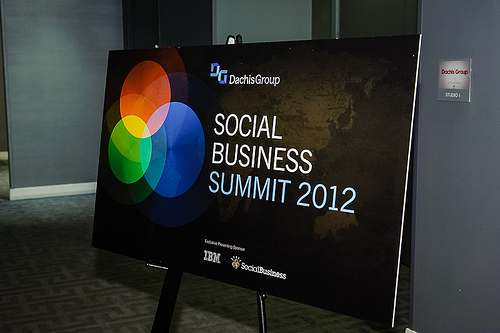
Harnessing the Power of Social Media at the Social Business Summit in Austin

BY SUSAN LAHEY
Reporter with Silicon Hills News
Photo courtesy of the Dachis Group.

Photo courtesy of the Dachis Group.

When the lights went out at the Super Bowl, Oreo scored a social media touchdown by Tweeting out: “You can even dunk in the dark.”
It was spoken of at the 2013 Social Business Summit the way “Think Different” and “Just Do It” were spoken of in advertising circles. It was a stroke of brilliance, a visit from the social media muse. It generated the kind of attention every business wants from its social media but no one knows how to create. The Oreo Tweet, however, came in second after the Old Spice social media campaign which garnered more than 40 million views. In that campaign, the Old Spice Guy made 186 video responses to fans and blasted them out over social media channels.
The campaign doubled sales of the body wash, bringing it to number one. And nearly every speaker at the day-long Social Business Summit referenced it….with slides.
Photos courtesy of Dachis Group.[/caption]These are the social media Camelot stories that drew 200 people to the W Hotel Thursday. The Dachis Group of Austin put on the summit. Later this year, they’ll hold Social Business Summits in Shanghai, Mumbai, London, Sao Paulo, Tokyo and New York.
At the Austin event, the question before speakers was how one takes a constantly changing medium with more than 400 outlets, each having millions of disparate constituents, and weaves that into an ongoing business plan. They used the term “Perfect Storm” a lot.

Photo courtesy of the Dachis Group

Photo courtesy of the Dachis Group

Many speakers focused on the numbers–how much social media could increase sales and customer satisfaction; how wide is the window to jump in on a trending story; the precise equation for the half-life of a social media buzz. But it was the second-to-last speaker who addressed the manic and often ill-advised effort to constantly be in customers’ faces with social media, having no clear objective in mind.
Olivier Blanchard, author of Social Media R.O.I. asked the poignant question—and made the audience repeat it with him twice—“What the fuck are we doing?”
The reason to have a social media campaign, he said, the reason to track customer behavior and engage customers in conversation, is to become a better company.
“We should be focusing on building better products, creating better customer experiences, eliminating hurdles and pain points for customers, converting our audience to customers, driving loyalty,” he said. Social media should be part of sales and PR, community involvement and business intelligence. And a huge part of customer service. Better to have a team dedicated to responding to negative Tweets about the company in real time than to have a call center, he said.
Blanchard was only one of several speakers to insist that social media could no longer be the baby of the marketing department but had to be integrated throughout the organization. Employees must get involved with the company’s social media presence—a suggestion that unfortunately brought up several unanswered and tricky legal questions regarding employee policies and freedom of speech.
Blanchard and others also suggested that any company serious about social media needs a mission control center where staffers are watching Twitter for mentions of the company, engaging in conversations in real time over every social media channel they’re involved with, and watching news for relevant topics to comment on to connect with constituents.
All of this needs to be incorporated into a content process with a content strategy and a staff to write copy, edit it and post it, according to Michael Brito of Edelman Digital. Companies need to become media businesses, which means they need quality content, based on stories of customers and vendors, trends and news, and–only marginally–marketing information. Companies need an institutional process for generating and distributing that content.
Timing of social media was discussed at length. Dr. Scott Henderson, Principal Data Scientist of Gnip, said that for certain purposes, such as product development and brand management, engagement should go deep and be on a slower clock than, say responding to a trending event. Public relations and supply chain issues should be responded to quickly and concisely. Customer service should include deep engagement but should happen almost instantly. The window for responding to a trending story was often only a few hours.
Brian Solis, Principal of Altimeter Group, said studies show that responding to customers in five minutes rather than 24 hours results in seven times more sales. Customers, he said, don’t want to surf websites on their phones. They want “snackable” information in real time, such as reviews.
The real advantage social media has over static content such as websites, he said, is the opportunity to respond in the moment a customer is having an experience, resulting in shared experiences. Shared experiences are the future of branding because they are the only way to be flexible to the changing nature of humans, what he called the “human algorithm.”
John Hagel, Co-Chairman of Deloitte LLP Center for the Edge spoke of quite a different kind of human algorithm. His group is charged for looking beyond what companies are doing now to technologies and practices they might adopt in the future. Many of those technologies track human behavior and performance. One study, for example, looked at performance behaviors of people playing World of Warcraft and tracking their own weaknesses and opportunities for improved performance. Similar techniques, he said, might be employed in the workplace.
Another tracking study involved an app being piloted in San Francisco that tracks a user’s behavior over time and identifies patterns. From that pattern, it can identify a tribe of people with similar patterns. Once a tribe is identified, the app can recommend restaurants or other businesses frequented by members of the tribe.
“Ultimately it can become a trusted advisor,” Hagel said.
One of the metrics the Center for the Edge studied through concentrated data collection was the optimal performance one could achieve in a team related to the team dynamics. There was a delicate balance, he said, citing two different studies, between a team being so interconnected that it wasn’t outward reaching enough to perform well and a team being sufficiently connected that they shared personal as well as professional parts of their lives. In that balance, he said, was tacit company knowledge exchanged.
New technologies, Hagel said “are creating mounting performance pressure on all of us. This isn’t just a cyclical problem and there will not be a downturn in a few years. The pressure has been mounting for decades and there’s absolutely no sign of it leveling off. Performance matters and you have to be able to tie it back to metrics—financial metrics, operating metrics, front line metrics.”
While Hagel’s presentation seemed to reduce human behavior to a stream of data, the speaker who followed him, Zappos founder and CEO Tony Hsieh had an almost diametrically opposed perspective on human interaction. In fact, it was pointed out that he never spoke once about social media or in his entire presentation.
“Social media is a bad word for us,” he confessed. (Though the Zappos Facebook site has 476,000 users.)
Hsieh explained that he was happy to sell his first company, LinkExchange, to Microsoft, partly because the culture was so unhappy. After he and co-founders had hired all their friends, they had no means by which to choose good employees outside their social circles.
When he founded Zappos, the company’s culture was paramount. Since the company has moved outside Las Vegas, Nevada, many of the company’s employees live in the same apartment complex and socialize regularly. They are reinvigorating a little-known, community-oriented part of downtown Las Vegas (read, no gambling or glitz). And Hsieh has purchased the former Las Vegas city hall to get all employees under one roof. He thinks now in terms not of density but of “collisionable hours” or hours of the day during which time people have to run into one another in the walkable community he’s trying to establish for Zappos.
When asked what he thought about Yahoo’s Marissa Mayer insisting on employees all occupying a space and whether that was a good idea, Hsieh said it depended on whether they all liked each other. Building a culture where people like each other is key to the whole Zappos concept.
If there was one takeaway from the conference as a whole it would have to be that, while data tracking and engagement building are a function of a social media strategy, what differentiates a business with a social media strategy versus a social media business is having a business whose goals are aligned with the customers, partners and associates they’re engaging with.
For most businesses, that remains the elusive Holy Grail.


CareerMob Wins StartupBus 2013 Finals at Rackspace

CareerMob team pitches to judges at StartupBus 2013 Finals.

Five person CareerMob team pitches to judges at StartupBus 2013 Finals.

The first team to pitch at the finals of StartupBus 2013, CareerMob ended up winning the competition.
The five-person team from New York and Washington won on its pitch for a site to help returning veterans find jobs by hooking them up with mentors in a variety of career fields.
“This team has been amazing,” said Tatiana Bakaera, one of the team leaders.
The members of CareerMob were all strangers. They met on the bus 72 hours ago and formed a company, built a website and put together presentation and marketing materials on the road.
“We’ve been going 72 hours on the bus without any stops except for sleep,” said U.S. Air Force 1st Lt. Josh Siefried. “The most important thing our site does is it connects you with a mentor.’’
Already, dozens of people have signed up to volunteer as mentors to help veterans transitioning away from military service and into civilian jobs, Siefried said.
The six judges for the StartupBus Finals competition at Rackspace.

The six judges for the StartupBus Finals competition at Rackspace.

CareerMob fills a real need and solves a problem in the marketplace, said Robert Scoble, one of the event’s six judges. He announced the winners of the event at Rackspace’s headquarters in San Antonio.
All six buses arrived at Rackspace on Wednesday and pitched to a panel of judges that night. Those judges narrowed the finalists down to seven teams. Those teams included CareerMob, Grassroots.io, Ghostpost.io, Cloudspotting, USupply.me, Exversion and Nextchaptr.
Overall, six buses set out on March 3rd with 152 people to form dozens of companies. One of the buses travelled from Mexico City, Mexico. The buses departed Rackspace Thursday afternoon for Austin where they will pitch at the All Stars Finals Friday night at Rackspace’s Open Cloud Experience at Champion’s Bar.
The judges named Nextchaptr, a crowdsource book publishing site, as runner up. The five-member team came from Chicago, Columbus and Cleveland and rode on the Midwestern StartupBus.
“The Kickstarter model for books makes a lot of sense to me,” Scoble said.
The experience was a great one, said Zack Price with Nextchaptr.
“It’s fun to test an idea and bounce it off brilliant people who are like minded entrepreneurs,” Price said.
The team plans to continue to develop the company, said Greg Sostario with Nextchaptr.
“We have people interested in it,” he said “This meets a need in the marketplace.”
Another team pitching at StartupBus to judges at Rackspace.

Another team pitching at StartupBus to judges at Rackspace.

This year, StartupBus scaled back the event, said Elias Bizannes, StartupBus founder. Last year, StartupBus had the largest event in its history with more than 300 people participating. This year, they chose to scale back.
“We wanted to create a quality experience,” Bizannes said.
Despite the premise of creating a company in three days, StartupBus really isn’t focused on creating startups, Bizannes said.
IMG_0348“It connect you to people,” he said “Those connections create life changing experiences.”
While some of the teams choose to go on and pursue their ideas, others move on to new ventures.
This year, StartupBus had an Alumni bus with people who had participated in the process before, Bizannes said. Two of those teams, Yank, a personal guardian app, and RepCheck are going on to compete in the Startup Bus All Star Finals tomorrow night. Two more teams that get the most online traction will also go on to compete in the finals. Altogether six StartupBus teams will vie for the All Star Final title Friday night.
“The entire experience is trying to teach people to adapt,” said Mike Caprio, a community leader for StartupBus from New York.
“The goal of StartupBus is not to create companies,” he said. “It’s to empower people to change the world and disrupt the status quo.”

Seven Teams Compete to Become the Startupbus 2013 Winner at Rackspace

BExUBk8CYAEK1uf-1After 72 hours on the open road, six StartupBuses and 152 people landed at Rackspace in San Antonio for the final pitch competition on Thursday.
Seven teams made the finals held at Rackspace’s headquarters. They included CareerMob, Grassroots.io, Ghostpost.io, Cloudspotting, USupply.me, Exversion and Nextchaptr. The Startupbus All Star Finals will be held at Rackspace’s headquarters at SXSW at the Champion’s Bar on Friday in Austin. That competition will consist of two teams from the Alumni bus, two selected by an online audience and the two finalists selected by Rackspace’s judges.
Also, this year, Startupbus sponsored an “Alumni Bus” of people who had already gone through the experience. Those teams also gave two minute pitches on Thursday. Yank and RepCheck won the two spots to compete in the All Stars Finals.
One of the teams going on to Austin, BriefSkate from Tampa, not only created a company but actually had a prototype of their skateboard built and shipped overnight.
“Everything has been on the fly,” said Darin Lewis, one of the three founders of BriefSkate. “It’s just unique.’’
Alexei Novitsky had a patent for a skateboard that could act as a briefcase or backpack. The skateboard allows people to store a phone, notebook, computer and more.
“I originally created it because I didn’t like having a backpack,” Novitsky said.
On the bus, he pitched a bunch of ideas including one for a zero gravity chamber. Then he met up with Lewis and Spencer Muratides and they learned of his skateboard patent. So they decided to create BriefSkate. They had a 3-D plastic prototype manufactured in Colorado and sent to Rackspace’s headquarters. They had an actual skateboard model built in Tampa and sent to them too.
The team even got on Tony Hawk’s radio show and did an interview with him while travelling on the bus.
In the end, they have a website, youtube video and prototype product to pitch at the All Stars Startup Bus Finals in Austin on Friday.

Apparently There’s This Conference Happening in Austin?? Adventures in Austin, Part 1.0.0

BY IAN PANCHEVRE
Silicon Hills News Reporter

Screen Shot 2013-03-06 at 9.56.17 AMIt’s okay if you haven’t heard the rumors yet.
Supposedly – and this has been verified by a number of sources who are generally in the know – gossip has been stirring about the sudden appearance of various technology professionals and enthusiasts in Austin this weekend. Apparently, a bunch of people randomly decided to travel from distant lands and descend upon Texas’ capitol.
I’ve been told there’s some sort of conference going on. I think it’s called South by Southwest. But I’m not sure. I’ve only heard people say “South by.” And every time I’ve read about the get-together, it’s referred to as “SXSW.”
At any rate, I was told there would be plenty of free food and drinks of the alcoholic persuasion. That was all I needed to hear to plan on going. But when I learned that a Badge for the Interactive Festival cost $1,150, I suddenly had second thoughts.
Fortunately, I learned about a program called Interact, which is a “community of the brightest young entrepreneurs in the startup scene.” Interact was founded by Maran Nelson, a senior at the University of Texas. Their premier event, Interact ATX, has partnered with high-profile sponsors to generously provide discounted badges to 100 young entrepreneurs, as well as exclusive events for the 2013 Interact class.
Somehow, I managed to trick the good people of Interact into thinking I was bright, young and an entrepreneur.
The truth is, I’m 23 which feels surprisingly old. Sure, I was fortunate to attend an Ivy League school, but my two-year stint in New Haven was enough to teach me that “bright” is very much a subjective term. As for being an entrepreneur? I’ve worked on a few projects, past and present, the pinnacle of which was a social, customer-loyalty app called Qliq. But everyone knows that you’re not a real entrepreneur until your company IPOs or sells for 10+ figures. So I’ve still got some work to do until I can plan my sabbatical on the French Riviera.
But enough about me. Let’s talk about South by Southwest, erm, SXSW.
Needless to say, I’m excited for what’s to come. So excited that a declarative sentence, written in all caps and followed by a dozen exclamation points would underrate my excitement.

    I’M SO EXCITED THAT I DON’T EVEN KNOW WHAT I’M DOING!!!!!!!!!!!!

No, seriously. What am I doing these next few days?
IA_CMYK_noiconAs a SXSW novice I don’t really know how to navigate the festival. Fortunately, Interact ATX has put a few events on the calendar for me. But I can’t help but notice that hours of my days are open, unstructured, free.
For the past few days, almost by the hour, I’ve been learning – through email, twitter, blogs, Facebook, and carrier pigeons – of some new, super awesome, can’t miss, absolutely-must-attend meet up, crawl, hackathon, pool party, rooftop party, nightclub party, and lounge party.
And then there’s the serious stuff. The keynotes, the presentations, the workshops.
Fortunately, there are lots of resources for keeping tabs on SXSW.
Twitter aficionados might find it useful to follow a few accounts, which have been carefully curated by The Horn: @ChronSXSW, @AusChronMusic, @sxswparty, @360sxsw, @SPINsxsw, @googlesxsw, @Media_TheHorn, @rsvpforyourlife, @SXSWbaby, @SXSWPartyList, @sxswist and @Do512.
If you’re a traditionalist, the official SXSW website is a good place to start. Take note that if you have a badge to any of the three festivals – Music, Film, and Interactive – you’ll also have access to the Comedy events. Hello Sarah Silverman!
For the more professionally minded among us, the Greater Austin Chamber of Commerce has kindly provided a master schedule of events that it is supporting.
And if you want to get ahead of the curve by downloading as many SXSW apps as possible, before the festival (yes, even among early adopters, there are early adopters). Well, this would be the place to start.
I have to admit – it’s already feeling like sensory overload and I haven’t even finished my laundry yet.
And then there’s Silicon Hills News. Susan Lahey, Andrew Moore, and of course, Laura Lorek, will all be present to share their experiences with the world wide web.
As for me? SHN has been fantastically supportive about letting me explore my journalistic whims. So for the next few days, I’ll be writing a series of sorts. This is part 1.0.0 of Adventures in Austin. In future pieces, I’ll explore the economic impact of SXSW, deep-dive into Interact ATX, and comment on the technologies that are making the most noise.
But right now, I need to move some clothes out of the dryer and into a small suitcase. I-35 is calling my name. Time to get going.

Facekey and Cloud Options Highlighted at San Antonio New Tech

BY ANDREW MOORE
Silicon Hills News Reporter

imgres-12It’s the first week of March — and that means the latest meeting of SA New Tech! Want your company to have biometric face and fingerprint scanners just like in spy movies? FaceKey can do just that. Plus, Cloud Options shows how cloud computing space can be sold in a futures market like any other commodity.

Cloud Options (aka Strategic Blue)
photo-3Cloud Options is a cloud brokering company founded by CEO James Mitchell Ph.D. It is also one of the 12 startups currently going through the TechStars Cloud program at Geekdom.
The company serves as a middleman between big cloud computing companies, like Rackspace Hosting, and clients that need more flexible, or cheaper, cloud options that the big companies can’t provide.
“Wouldn’t it be great if you could get reliable costs for your particular project that starts on a particular date and runs for a particular duration,” says Mitchell. “And wouldn’t it be great if you didn’t have to prepay for that.”
When dealing with a major cloud computing provider such as Rackspace Hosting or Amazon, customers have to commit to long term services. A business that only needs four months of cloud hosting, or only two months but at a very high volume, is forced to pay for more time than they need. Furthermore, that business is forced to use a credit card – a required part of signing up for the services.
Cloud Options allows users to “book” shorter or more irregular stays on big cloud company services at a lower price than those companies offer. The companies get a simple invoice from Cloud Options instead of having to use a credit card for payment. Invoices are sent out at the end of each month of scheduled cloud usage, and the months don’t even have to be back-to-back. Using Cloud Options, a business could book two months in the summer and one month in the fall if they wanted to.
Cloud Options pulls this off by first buying a year of cloud computing space from a major company at a substantially discounted price – which the company agrees to because it provides income security and grants them access to more customers using their services.
“Cloud providers love Cloud Options because we are a valuable service for customers who are frustrated by limited billing choice,” says Mitchell.
Cloud Options then sells parts of that space to cloud users at a somewhat lesser discount – which grants Cloud Options a profit. By paying Cloud Options, users not only get a small discount but can now book cloud computing space on a much more flexible schedule. If a user overstays their contract with Cloud Options, they can continue to use cloud services but will now have to pay the provider directly at full price.
Cloud Options offers additional advantages as well. Cloud Options has already paid for its cloud computing space in advance, which means it can offer a user certainty that the discounted price offered will not fluctuate in the future. The company can even accommodate users in other countries that wish to pay in non-U.S. currency.
Cloud Options was funded by Morgan Stanley for 14 months before the bank had to break connection because of regulations. T-Systems Managing Director Sam Kingston is currently an investor in the company and will eventually be the Chief Operating Officer.

FaceKey
Photo 1-2FaceKey was founded by Yevgeny B. Levitov Ph.D. – a former soviet scientist who immigrated to the U.S. in 1991. The company has been working on biometric recognition solutions for ten years and has created a small face and fingerprint recognition device similar to what is seen in movies. In fact, FaceKey’s technology was in the film “Man on a Ledge”. It is also utilized at Geekdom of San Antonio. FaceKey matches a user’s face to two different images – one in regular light and one in infrared light. This allows the device to see its user in a wide range of lighting conditions.
Levitov claims there are many advantages to using a biometric system for building access instead of just cards.
“This card can be used by me or by you – by anybody else,” said Levitov.
Levitov says cards can be exchanged, broken, or lost just like any “key” device. Cards also carry an additional cost because one must be given to every employee.
photo-2There are more interesting security risks as well. Levitov showed the audience a small handheld device which he bought from China for $19.99. The device looked like a gadget from a Jason Bourn film.
“This is card duplicator. It is very smart device. It can duplicate your card even if it is in your pocket,” said Levitov. “The problem is that this device copies the information on the card even with (an) encryption. That’s why there is no security.”
Levitov says the technology is especially useful in emergency situations.
“If you have for example some disaster in the building like fire, it’s very difficult to find out what has happened and who has not survived – who is missing. Our system can – in real time – help you to find who is missing.”
Other examples of where biometrics can be helpful include the practice of “buddy punching” — A situation where a friend will punch their buddy’s time card after work so he can leave early. A biometric device would prevent this from occurring.
FaceKey can install a fingerprint system for $1,000 or a fingerprint and face recognition system, similar to the one at Geekdom, for $2,500. While this price is much higher than the core components of card systems, which are around $300, Levitov says that card systems require a complicated and expensive network of wiring between card reading panels which is hidden in a card system’s price. FaceKey, he says, can be integrated with a building’s existing computer network which results in a much cheaper installation cost verses a card reader. The device can even function if its network goes down, utilizing a built in database of biometric data.
FaceKey is currently talking to several companies working for the Department of Homeland Security to see if its technology can be utilized in that area.

HandShakez Gets $3.6 Million in Venture Capital

imgres-11Handshakez announced Wednesday that it has closed $3.6 million in venture capital financing.
Austin Ventures led the Series A round along with with First Round Capital, FLOODGATE, CrunchFund, Valhalla Partners and Thinktiv.
The Austin-based startup is “led by Jason Wesbecher, previously VP of Strategic Accounts at Jive Software; Scott Brittain, previously VP Engineering at Solarwinds; and Michael Osborne, previously Chief Revenue Officer at Bazaarvoice,” according to a news release
Handshakez has 50 customers on its customer relationship collaboration and analytics platform.
“The act of shaking hands is as old as commerce itself — and signals engagement, trust and balance between two people,” Handshakez co-founder and CEO Jason Wesbecher said in a news release. “This engagement has been under enormous strain in the last two decades by CRM technologies that have not kept up with the needs of the modern customer. The term CRM itself is wildly out of touch: customers don’t want to be managed, they want to be engaged. Handshakez is solving this today by humanizing and simplifying front end processes to put the customer at the center of the relationship.”
“There is a tremendous opportunity to take customer relationships out of email and bring new levels of collaboration to an age old sales process,” Thomas Ball, General Partner at Austin Ventures, said in a news release. “Successful enterprise companies like Jive and Yammer have proven that engagement, not record keeping, is the future. Handshakez has what it takes to build an industry-leading company in this space: seasoned leadership, an insider’s understanding of the market, and the vision to re-shape front-end enterprise applications around the customer.”

Taskbox Raises $600,000 in Seed Stage Funding

logo_fullcolorRight before South by Southwest kicks off, Taskbox is making a lot of news.
The Austin-based startup Taskbox, which makes a popular iPhone app to manage an email inbox, announced it has raised $600,000 in seed stage funding from angel investors with the Central Texas Angel Network.
The company also released the 2.0 version of its social task management app for email. The app turns email into prioritized tasks.
Silicon Hills News did this spotlight on the company last October when it had a campaign going on Kickstarter to raise $30,000. That campaign was not successful.
“Taskbox is transforming the process of reading, prioritizing and following up on emails and action items,” Andrew Eye, CEO of Taskbox, said in a news release. “Taskbox isn’t only for casual use. Our customers have been asking us for features that would allow them to organize both their personal and professional lives in one tool.”
“With Taskbox, users can experience the best aspects of task management without ever leaving their inboxes,” Rick Timmins of the Central Texas Angel Network said in a news release. “Taskbox is not only making it faster to manage email workflows, but its bringing transparency and accountability back to the email process. People can finally close the loop on every outstanding message. If that isn’t providing value in today’s world, I don’t know what is.”
Taskbox also made GigaOm’s list of the 10 startups to visit with at SXSW Interactive 2013. And Taskbox is one of 12 finalists chose to pitch at the Hatch startup competition on Sunday.

Austin-based Bloomfire Raises an Additional $8 Million in Financing

imgres-10Bloomfire announced today that it has raised another $8 million in financing from founding investors at Austin Ventures and Redpoint Ventures.
The Austin-based company comes as the company’s has landed 200 paying customers and 65,000 users.
To date, Bloomfire has raised $18 million. The company plans to use the money for engineering, sales and marketing.
Founded in 2010, Bloomfire bills itself as a software company that has created a “knowledge sharing platform.” Today, it also announced improvements to its flagship product to connect its customers to multimedia content, real time Q&A and social networks.
“The way people discover, consume and share information has fundamentally shifted, as mobile and social platforms continue to reshape how we communicate and interact across every aspect of our lives, especially in the workplace,” Chris Pacitti, General Partner at Austin Ventures, said in a news release. “By unifying the information silos created by mobile, social and cloud technologies, Bloomfire is poised to make a huge impact on how enterprise workforces collaborate. We look forward to continuing to support them in that mission.”
“Bloomfire has taken a leadership position in addressing the critical unsolved problem of capturing and sharing valuable informal knowledge and delivering it exactly where and when it is needed,” Jeff Brody, Partner at Redpoint Ventures said in a news release. “Craig Malloy and his veteran team of entrepreneurs have worked together for years in previous businesses that Redpoint and I have funded. They have made impressive progress in Bloomfire’s first full year of operation and made our investment decision very easy.”

Geekdom Launches GeekdomX, a Global Coworking Affiliate

GeekdomBEmmKB7CMAAKLD2, the collaborative coworking site in downtown San Antonio, has launched GeekdomX, a new affiliate in which it will seek partners globally to open similar coworking sites.
Geekdom, which launched a little over a year ago, has 600 members. Its first GeekdomX location will open in San Francisco this summer.
Nick Longo and Graham Weston, cofounders of Geekdom, have plans to expand the concept nationally and internationally through select partnerships. Already six cities and one country have expressed interest in establishing a GeekdomX.
“We’re looking for people with tech cred,” Longo said. “This isn’t about collecting royalties. It isn’t a franchise. This is not about world domination. This is about finding the right people in their community to build a tech city.”
Today, Geekdom unveiled the program along with a new Website. Longo, director of Geekdom, is also speaking on alternative financing for coworking spaces this afternoon at the Global Coworking Unconference Conference. Geekdom is a sponsor of the event and has a booth at the Austin Music Hall, where the two-day conference is taking place, to provide information on its new program.
Screen Shot 2013-03-05 at 11.35.21 AM

Geekdom is a sponsor of Silicon Hills News and SHN is a media sponsor of the Global Coworking Unconference Conference

« Older posts Newer posts »

© 2026 SiliconHills

Theme by Anders NorenUp ↑