
 RideScout won first place in the Austin Technology Council’s Startup Showdown at the 2013 CEO Summit last week.
RideScout is an app that lets people see all the options available to them to get a ride. It launched during South by Southwest and had more than 300 users sign up for the service, said Joseph Kopser, RideScout CEO.
Austin-based RideScout’s app aggregates and ranks the best options for getting a ride including public buses, transit, subway, taxis, limos, shuttles, pedicabs, Car2go and peer to peer ride sharing. It’s only available for Apple iPhones right now, but an Android version is expected later this year.
RideScout beat out Nibl It, a micropayment system for publishers, Lodestone Social, social media rewards systems for sports teams, Ideal Asset, an asset marketplace, and ReQwip, a marketplace for buying and selling triathlon equipment, to take the top prize, a year membership in the Austin Technology Council.
Last year’s winner, Toopher reported that winning the Startup Showdown helped its business expand.
Category: Austin (Page 253 of 318)
 I moved to San Antonio in 1989 from Beaumont, Texas.
In San Antonio, I covered the nascent high technology industry including a pioneering, but now defunct company called Datapoint and about a half dozen spin off companies formed by former Datapoint executives.
Back then, Michael Dell was still building his PC company, founded in 1984 in Austin. It had gone public in 1988 when the personal computing industry was still in its infancy and was poised to take off.
The Semiconductor Manufacturing technology consortium, known as SEMATECH, set up operations in Austin in 1988. It focused on solving problems for the semiconductor manufacturing industry.
Central Texas, known primarily for microchip and PC manufacturing, was just a blip on the radar of the high-tech industry. In fact, people jokingly referred to the area as Silicon Hills, a reference to the region’s attempts to emulate the highly-successful Silicon Valley.
And even back then, people in both cities talked about the need to collaborate and work together to build Central Texas into a regional technology powerhouse. Members of the Greater Austin-San Antonio Corridor Council, founded in 1984, met regularly to address issues facing the region. I distinctly remember a big push to get a high-speed rail established between the two cities. But the newly founded Southwest Airlines largely quashed that movement because the airline saw the railroad as a threat to its business.
Today, Austin is booming with all kinds of technology startup companies and incubators and accelerators like Capital Factory, Tech Ranch and DreamIt Ventures. Dell is now a giant company. National Instruments is another home-grown tech powerhouse. And Visa, Apple, General Motors, Union Pacific and others have all set up innovation centers in Austin and announced major expansions.
Just down Interstate 35 about 75 miles to the South, San Antonio is also booming. It has a thriving biotechnology and cyber security industry. It also has Rackspace, a web hosting company with more than 4,500 employees and $1 billion in annual revenue and Geekdom, a collaborative coworking space downtown that incubates high tech startup companies.
So this region is booming. And Austin and San Antonio are not just competing with Silicon Valley, Boston, Denver, Boulder, Chicago, New York, Los Angeles and other technology centers nationwide. This region is in a globally competitive race with countries like Taiwan, Singapore, China, Japan and India for talent and resources to create the next technology innovations.
Technology is the engine that drives our economy.
So shouldn’t we all be working together to find out how best to compete in a global marketplace?
Let’s talk about it.
On Monday at Capital Factory, a RISE Panel, hosted by Roberto Rondero de Mosier will take place from 10:00 a.m. until 11:30 a.m. to discuss the Austin/San Antonio Connection.
Here’s the description: “During the next 20 years, the Austin-San Antonio corridor will rival the current Dallas-Fort Worth Metroplex. Come speak to folks in both investor/entrepreneur communities who are on the edge of exciting new developments that will make this THE metroplex of innovation over the next generation. Questions: What is the funding landscape in Austin v. San Antonio? What programs are in place to promote mindshare between the two cities? Is there a city that is right for my entrepreneurial venture? What unique entrepreneur talent is coming out of San Antonio that Austin financiers may not know about yet? Featuring: Jason Seats, Managing Director of TechStars Cloud; Steven Quintanilla, Founder of Kirpeep; Laura Lorek, Silicon Hills News; Another TBA.”
Sign up now, and we’ll see you on Monday at Capital Factory.
 With the explosive growth in Austin’s high tech industry, can companies find enough tech talent locally?
That’s a big issue technology executives in central Texas are grappling with right now, said Susanne Bowen, CEO of PeopleAdmin and chair of the Austin Technology Council’s Community Foundation.
She moderated a panel of experts on the subject of “Disruptive Talent Development: Global War for Skills” at the Austin Technology Council’s CEO Summit last week at the Austin City Limit’s Moody Theater.
Austin is expected to create 10,000 new high tech jobs by 2017 and 2,400 of those openings are for software developers, according to an ATC survey. Yet the local education pipeline will fill only about 23 percent of those positions, Bowen said.
That means the technology skill pipeline in the science technology engineering and math, known as STEM, fields are critical to fuel growth, she said.
“We’re a net importer of technical talent and we have been for more than 20 years,” Bowen said. “So the future is plain for Austin’s tech workforce. Our demand has and will continue to outstrip the supply.’
The technology skills shortage isn’t going to be solved by poaching employees from other local companies, Bowen said. And companies cannot continue to rely strictly on recruiting and importing that talent from other areas.
“Those are not sustainable, nor cost effective solutions to the challenge,” Bowen said. “So we need to grow our own talent here in central Texas.’’
And the best way to do that is to launch an assertive and aggressive campaign to engage educators, parents and students about the opportunities in STEM fields, Bowen said.
A huge shortage of engineers exists in Austin and nationwide, said Michael Raiford, vice president of manufacturing at Samsung Austin.
“If we don’t keep the labor force here that’s educated in high tech then we won’t be able to attract businesses,” he said.
He grew up in Austin and became an engineer. He wants his kids and other children to have those same choices and job opportunities in Austin.
As a CEO of a tech company, the biggest challenge Gene Austin faced was he couldn’t find people fast enough to fuel the company’s growth, he said. Austin, president of Bazaarvoice, got involved in the Greater Austin Chamber of Commerce’s education taskforce to help find solutions.
“We really have a challenge,” he said. “We really have an opportunity at the same time.”
Daniel Planko, partner University Ventures, says one solution is to build specialized engineering institutions.
“This is a national problem,” he said “This is a global problem. “
The skills gap begins in grade school, said Austin.
The focus of the education system has been on how many kids can graduate high school, he said. It has not been on college preparedness, he said.
Kids start dropping out of math in fifth and sixth grade, said Raiford. They need to stay in math and science to become an engineer in college, he said.
“Out of the people who enter college to be an engineer less than half make it,” he said. “We really have a weed out culture instead of a weed in culture.”
One solution to get kids more engaged at an early age is to have engaging teachers teaching math and science, according to the panelists. They said that can be accomplished by paying teachers based on performance.
Kids have to be engaged in fifth grade, said Planko. If they aren’t taking advanced math in junior high, it’s going to be really hard to catch up in high school and college.
Another way to spark kid’s interest in STEM fields is to have businesses involved in the schools.
Samsung Austin has a program “The Day in the Life of an Engineer” and gets requests from schools from all over, Raiford said.
“We’ve got to get more involvement in the schools and more exposure to kids to engineering at an early age,” he said.
Samsung also sends a lot of engineers, especially female engineers, to the schools for career days to talk to the kids about engineering.
“It’s an investment in our future to get all kids interested in STEM,” Raiford said.
 RISE Week 2013 kicks off on Monday!
Are you ready for a week of fantastic sessions covering everything from how to juggle entrepreneurship and having a family to crowdfunding or finding angel or venture capital investment for your startup?
This year marks the seventh year for RISE, which stands for Relationship and Information Series for Entrepreneurs. And the nonprofit organization that puts on the conference makes sure that it is free for everyone to attend. Volunteers, who are experts in their fields, offer more than 280 sessions Monday through Friday on a wide range of topics aimed at entrepreneurs in all kinds of industries. Of course, Silicon Hills News will focus on the technology sessions at Capital Factory and Tech Ranch, among other locations. We’re particularly excited about Tuesday’s Lunch and Learn Session on Angel and VC Funding.
The RISE Opening Keynote and Reception on Monday evening features The Royitos “Don’t do Mild” Award presented by Roy Spence, founder of GSD&M and Royito’s Hot Sauce. Also, Ingrid Vanderveldt at Dell will host a conversation with Melinda Emerson & Gene Marks, nationally recognized business leaders and columnists followed by a keynote address by Gary Keller, founder of Keller William Realty.
This year, RISE is putting on a series of “Super Panels,” featuring top entrepreneurs on topics from crowdfunding to women’s entrepreneurship.
The Super Panels Include:
- Monday: Entrepreneur Super Panel
- Tuesday: RISE Lunch & Learn: Angel & VC Funding
- Wednesday: Women’s Entrepreneur Super Panel
- Thursday: SocialGood (B Corp) Super Panel
- Friday: Crowdfunding Super Panel
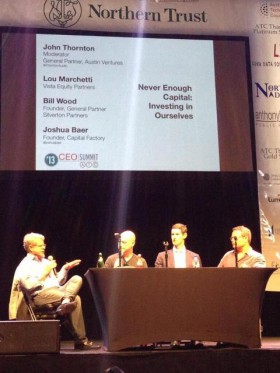
Photo of the funding panel courtesy of Austin Technology Council.
Some say that good companies don’t have trouble raising money. But others disagree.
On Wednesday, a panel of VCs and Angel investors talked about the money available for deals locally at the Austin Technology Council’s CEO Summit.
John Thornton, managing partner with Austin Ventures, moderated the panel.
Capital Factory has provided seed stage funding for 15 companies during the last four years, said Joshua Baer, its co-founder.
Some startups can get profitable on $50,000, Baer said. And crowdfunding on sites like Kickstarter is making funds available to companies that might have gotten turned down by angels or venture capitalists, Baer said. He knows of founders who couldn’t get money locally and then raised a $1 million on Kickstarter.
Capital Factory focuses on companies that can get profitable on less than $1 million in startup funds. It also focuses on Software as a Service firms that serve the business to business market, Baer said.
Bill Wood, general partner with Silverton Partners, focuses on funding Austin-based companies.
Because it’s easy to startup a company and doesn’t take a lot of money, Silverton Partners sees more startups forming, Wood said. The teams are made up of founders who are dramatically younger. The majority of its founding teams are in their 20s, Wood said.
The good thing about young founders is that they don’t know what’s not possible, Wood said. They have drive, ambition and a willingness to sacrifice, he said.
Vista Equity Partners moved to Austin 18 months ago. It is exclusively focused on software, said Martin Taylor, principal with Vista.
“We think of ourselves as a software holding firm,” Taylor said. Vista has two investment funds. It has a $3.5 billion fund for investments in companies with greater than $150 million in revenue and a smaller $400 million fund for investments in companies with more than $15 million in revenue.
 Austin’s technology industry contributes $21 billion annually to the city’s economy.
The city has 3,787 technology companies which employ 105,667 or 9 percent of the local workforce.
Brian Kelsey, an economic development consultant and lecturer at The University of Texas at Austin, prepared this information for the Austin Technology Council’s CEO Summit on Wednesday.
He delivered the presentation to CEOs and high level executives from local technology companies attending the CEO Summit on Wednesday at the ACL Live’s Moody Theater.
 To kick off a nationwide initiative focused on creating middle-class jobs and spurring the technology industry, President Barack Obama is in Austin today.
First off, he visited students at Manor New Tech High School, an innovative six year old school focused on science, technology, engineering and math.
“So this is the first stop that I’m making on a tour of the Austin area today,” President Obama said. “And I chose Austin partly because I just love Austin but also because there are some terrific things going on in this area, in communities like Manor. And there are terrific things going on in communities all across the country that are good models for all of America to follow.”
Manor New Tech High School is doing things differently than other high schools and it’s working, President Obama said. The majority of students don’t come from wealthy backgrounds, he said. Yet their test scores are high and the majority of the students go on to college.
“Our economy can’t succeed unless our young people have the skills they need to succeed,” President Obama said. “Every day, this school is proving that every child has the ability to learn the real world skills they need to succeed in college and beyond.”
In Austin, people are working together because they understand that when they work together everyone succeeds, President Obama said. Austin has created 85,000 new jobs in the last three years.
Apple and Visa are getting ready to open new offices and General Motors is hiring for its new innovation center, President Obama said. The tech sector makes up one quarter of new jobs in the city, he said.
“And all of this has helped to make Austin one of the fastest-growing cities in America,” Obama said.
People in Austin are doing something right and the rest of the country can learn from them, he said. His entire speech is available on the WhiteHouse.gov website.
After his visit to the school, President Obama had lunch at Stubb’s BBQ downtown and then travelled to Capital Factory, a startup incubator, to meet with entrepreneurs.
“We’re looking forward to showcasing Austin as an innovative model for the rest of the country.” #ObamaAustin baer.ly/16iud2l
— Joshua Baer (@joshuabaer) May 9, 2013
Later, the President toured Applied Materials, a semiconductor manufacturer. Austin’s Mayor Lee Leffingwell attended the event as well as San Antonio’s Mayor Julian Castro.
President Obama also launched a competition to establish the first of three manufacturing innovation institutes. He is seeking to set up 15 manufacturing innovation institutions across the country and is currently seeking $1 billion investment from Congress to establish them.
“No job in America should go unfilled just because a person doesn’t have the right skills,” President Obama said.
During his talk at Applied Materials, the President recounted his trip to Capital Factory, where startups take off, President Obama said.
“And everywhere you turn, somebody has got a new idea,” he said. “They’re all thinking big. They’re taking risks. It’s exciting.”

President Obama at Capital Factory with Joshua Baer and Stacy Zoern – Official White House Photo by Pete Souza
“And one of the things we’re doing to fuel more inventiveness like this, to fuel more private sector innovation and discovery, is to make the vast amounts of America’s data open and easy to access for the first time in history,” President Obama said. “So talented entrepreneurs are doing some pretty amazing things with data that’s already being collected by government.”
As an example, President Obama mentioned StormPulse, which uses government data to predict weather patterns.
And on Thursday, President Obama announced that the government is making even more data available and making it easier for people to find and use.
“And that’s going to help launch more startups,” President Obama said. “It’s going to help launch more businesses. Some of them undoubtedly will be using this data powered by chips that essentially started right here at Applied Materials.”
To read President Obama’s full remarks at Applied Materials, please visit the Whitehouse.gov website.
BY SUSAN LAHEY
Reporter with Silicon Hills News

Rudy Garza, founder and managing general partner of G-5 talks with the entrepreneurs at IBM Global Entrepreneur Mentor Day, photo by Tarzan Sharif
Beyonic founder Luke Kyohere, from Uganda, said 20 percent of the $150 billion paid out in cash in developing nations is lost for various reasons, including having to pay armed guards to transport it. In the countries where Beyonic works and hopes to expand, people lack smart phones and debit cards and though mobile payment systems exist, they are fragmented. So Beyonic created a cloud-based, Software as a Service, known as SaaS, platform to connect with those mobile payment systems, meaning $30 billion in funds now reaching their intended beneficiaries. Currently the company has signed on with the three largest networks in Uganda and Kenya which, Kyohere said, gives the company 75 percent of the market.
Kyohere, who has started three companies and sold one, said Beyonic was looking for $80,000 for platform development, $220,000 for marketing and sales and $200,000 for integration. The company hopes to move into the $70 billion microfinance market, and the $320 billion public and government sector. “We want to be the Twilio for payments,” Kyohere said.
The IBM Global Entrepreneur Mentor Days program admits companies under five years old whose business models fit the theme IBM Smarter Planet. Companies interested in applying must use data capture or integration, integrate data laterally across and end-to-end process, system, organization, industry of value chain and must “yield new insights that drive actions, improving the outcome.” Those outcomes must change the end-user experience or ecosystem with intelligence that’s “real-time, forward-looking, or predictive.”
Participants must become members of the IBM Global Entrepreneur program and receive mentoring from area experts like Mitch Jacobson, who is Co-director and lead adviser to ATI Clean Energy companies, Sancia Matthyssen, business partner transformation leader in IBM’s Business Partner organization and Jerry Sullivan, retired general partner from Adams Capital Management.
Three other finalists competed Wednesday afternoon.
Kin Valley is a closed social network that allows parents to control access to their children, which still allows children to participate. The business started with the idea of connecting families in a protected space but has been adopted by large organizations whose constituents are children, such as the Girl Scouts of America in Houston, Puerto Rico Health and Human Services Department, Navajo Nation Department of Education and Childstart. Kin Valley exceeds federal standards for online child protection. Parents get to choose the level of interaction between their kids and all other participants on an individual basis. Founder Jim Donnelly has had five successful startups and exits.
Picture it Settled is what founder Don Philbin calls “Moneyball” for legal negotiations. Since the majority of cases are settled out of court, Philbin said, negotiations can take a long time, involving anywhere from two moves to 50. Philbin, himself a lawyer, said Picture it Settled uses a model of 13,000 cases involving hundreds of thousands of moves to create a predictive model of what the actual settlement number will be, helping attorneys figure out where to begin negotiations with a visual model of where each of the parties might begin and what the actual number will likely be.
There’s still maneuvering to be done, Philbin said. “The right number at the wrong time is still the wrong number.” But with the software, attorneys can start closer to the mark than they otherwise might have and settle negotiations more quickly.
“People are irrational during lawsuits,” Philbin said, “but they are predictably irrational.”
Philbin’s target market includes corporate counsel, trade associations, people responsible for strategic partnerships.
The fourth finalist was Toopher, an app for IOS and Android that tackles the $114 billion annual problem of ID theft and hacking. Toopher authenticates your password at ATMs, your own computer and other places where you use security, without your phone ever leaving your pocket. With Toopher, just having the password isn’t enough, your phone’s location awareness system has to verify that it’s you. The app even logs users out when they walk away or locks down accounts when someone else has tried to activate them.
There were two keynote speeches at the event as well. Jeff Eisen, IBM Chief Architect for Watson Core Technology spoke about the development of Watson, an artificial intelligence that can break down human language looking for answers. The technology made a debut on the game show Jeopardy in 2011. Currently the IBM team is moving Watson into the medical services field where misdiagnosis and diagnoses that are not evidence based is a critical problem.
Watson can read and understand the lexicon of hundreds of medical journals and articles. So, with a cancer patient for example, Eisen said, a doctor can enter a patient’s medical reports and Watson can recommend additional tests. With the input of the test results, Watson can prescribe various courses of treatment based on copious amounts of data.
IBM also hopes to move Watson into the financial services realm.
Rudy Garza, Austin angel investor and founder of G-51, gave the final keynote speaking on mentorship, calling LinkedIn “the coolest thing ever” for building mentoring networks.
It is difficult, Garza acknowledged, to approach someone for whom you have respect and ask him or her a question that may sound stupid, only because you’re new in the arena and that person is a veteran. But it’s crucial to overcome that anxiety because the newer you are, the more you need to develop mentorship relationships that you can call on when it’s crunch time.
“You can’t wait until you’re at the launch point, with money in the bank,” Garza said. “Once you put the money in the bank it’s like running through a tunnel with a train behind you. You know, or should know exactly how long company will operate before run out of money. You can’t stop and say ‘Oh wait, I need to go hire someone. I don’t know anyone to hire as VP of sales.” If you have a mentor team, however, you can tap those people for ideas about who to hire fast. They’ll often even help you select someone.
 BY LAURA LOREK
Founder of Silicon Hills News
Mike Maples Jr. wants Austin entrepreneurs to create a “Thunder Lizard,” a $100 billion company within 10 years.
He explained that the idea for Thunder Lizards comes from Godzilla, the fictional giant lizard hatched from radioactive atomic eggs in Japan, that stomped on entire cities, spit fire, destroyed things and was a force to be reckoned with by everyone who encountered him. Godzilla, the Thunder Lizard with an attitude, created chaos and destruction.
“A great startup aspires to be a Thunder Lizard and there’s no plan B,” Maples said.
That’s the kind of company that Austin needs, Maples told a crowd of about 150 people gathered for the Austin Technology Council’s 2013 CEO Summit at the ACL Live’s Moody Theater on Wednesday.
Maples, formerly co-founder of Motive in Austin, now runs Floodgate, a venture capital firm in Silicon Valley.
“The tech industry is an industry of exceptionalism and that a very small number of companies truly matter,” Maples said.
In the beginning of his talk, Maples referred to Brett Hurt’s Lucky7.io blog in which Hurt lays out the different stages of companies. Austin has stage one companies in the consulting and services industry like Perficient and stage two companies that have products like Bazaarvoice, HomeAway and Solarwinds. And stage three companies that are sustainable franchise companies like Dell and Whole Foods.
But Maples sees there is an even longer view of the “long game,” and those are the multi-billion dollar world changing enterprises.
Then Maples launched into a fascinating discussion of “exponential entrepreneurship,” which he links to Albert Einstein and his non-linear way of thinking.
In the tech industry when it comes to exponential entrepreneurship, two basic laws exist, Maples said.

Screenshots from the films Godzilla, The Return of Godzilla and Godzilla 2000, photo from Wikipedia
“The power of Moore’s Law is more powerful than any incumbent,” Maples said.
“Moore’s law guarantees that the tech industry is not an industry of bubbles. The technology industry is always going to have a magical supply of startups to challenge the incumbents.”
It is our asymmetric weapon of the startup, Maples said. The PC supplanted the mainframe, and then the networked server disrupted the PC industry, followed by the Internet and social networking.
Maples also said that he believed the social networking wave in the computer industry was over and it was time to get on with the next wave of innovations.
The second law Maples explained is the Power Law, which states that the biggest outcome is bigger than all of the other outcomes combined and the next biggest outcome is bigger than all of the cumulative next set of outcomes combined.
In the next year, angels will fund 10,000 to 20,000 companies and 50 to 100 of them will not suck and will provide an exit greater than $50 million, Maples said. About 10, plus or minus five, will be special, Maples said. He defines special as getting to $100 million in profitable revenue within five years of Series A funding.
“In a typical year, the most valuable company is worth more than the other 9,999 companies combined,” Maples said. “That’s pretty interesting. That’s pretty counter-intuitive.”
Maples hopes that Twitter, one of his early investments, will have the most valuable crown some year.
So what does the Power Law mean?
“Being awesome is about being number one and no plan B,” Maples said. “Being number two is dramatically worse than being number one and being number three almost doesn’t matter, particularly in a given market segment. But high tech is a winner take all business.”
Among Maples’ angel investments, Twitter is by far, worth more than all his other angel investments combined. Twitter is worth more than 200 times his original investment, Maples said.
Dropbox is worth more, right now, than all of the other YCombinator funded companies combined, Maples said.
“The Power Law is an important law to respect,” he said. “It animates exceptionalism just as much as Moore’s Law.”
Going long involves embracing these laws as weapons of advancement and entrepreneurship, Maples said.
“I basically believe high tech entrepreneurship is about using the asymmetric power of Moore’s Law to create one of the ten best companies of the year,” Maples said.
So to create a breakthrough company, entrepreneurs need to use nonlinear reasoning. And that’s hard because people are hardwired for linear thinking. Maples used Einstein’s exponential reasoning and nonlinear thinking as examples of creating breakthrough ideas. He had counterintuitive and abstract ideas.
Today, too many entrepreneurs reason by analogy when they come up with their startup idea, Maples said. They copy what others do but with a slight variation, he said. That will not give you a breakthrough idea, he said.
“When people say I’m the this of that I almost always say no,” Maples said.
Also, the Lean Startup methodology to figure out a startup idea will not lead to the breakthrough idea, Maples said.
He challenged entrepreneurs to employ first principle reasoning and to come up with a valuable company that nobody is building.
To quote from Jonathan Livingston Seagull, a book Maples read when he was ten and still considers one of the most meaningful books on entrepreneurship, Maples displayed a slide that stated, “The limits that we experience in this world are usually not created by the world they are created in our own minds.”
“Break the chains of your thought and you break the chains of everything,” he said.
Tech entrepreneurs today have an imagination problem, he said.
“The thing that I’ve learned from these entrepreneurs is the really great ones are the ones that refuse to see the limits that other people see,” he said.
BY LAURA LOREK
Founder of Silicon Hills News
No one disputes that Austin has become a major technology hub.
But some say that Austin tech entrepreneurs don’t think big enough when it comes to launching startups.
“Too many Austin companies are lifestyle companies not betting on world domination like Silicon Valley,” said Bob Metcalfe, professor of innovation at the University of Texas at Austin. Austin tech entrepreneurs need to focus on innovation and changing the world at scale, Metcalfe said. That’s what he did when he co-founded 3Com in 1979. They wanted to connect the world and that resulted in new jobs, but it wasn’t the focus, Metcalfe said.
“Our goal was innovation at scale,” he said.
Metcalfe was one of three experts on a panel titled “The Long Game: Building Tech Successes” at the Austin Technology Council’s CEO Summit Wednesday morning at ACL Live at the Moody Theater in downtown Austin. Mark McClain, CEO of SailPoint Technologies, moderated the panel.
Instead of building really big companies, some worry that Austin entrepreneurs sell their ventures too soon.
The hardest decision for the VC and the founder is when is the right time to take an offer, said Brett Hurt, vice chair, founder of Bazaarvoice and now venture partner at Austin Ventures.
John Arrow, CEO and Founder of Mutual Mobile, said there is certainly the possibility in Austin that companies are selling too soon. Last year, Mutual Mobile turned down an buyout offer for $50 million. “It’s something we very seriously looked at,” Arrow said. But the company’s ideology focused on making the world a better place through mobile technology, Arrow said. But if there was another zero behind the offer and it was $500 million that might trump their ideology, he said.
The way to solve the systemic issue resulting in a lack of innovative tech startups in Austin is to get more companies starting up in Austin, Arrow said.
“People are starting up companies in the Valley like people in Austin are starting up bands,” Arrow said.
He recommended starting a tech entrepreneur class in high school to get kids interested at an early age.
Mutual Mobile is four years old and has 350 employees. The founders just launched its stock option plan and the question they got asked the most from its employees was when is the Initial Public Offering, Arrow said. They needed to educate the employees on other ways to redeem the stock options other than an IPO like through free cash flow and share buyback, Arrow said.
Silicon Valley has the gold rush and swing for the fences mentality and Austin needs to adapt more of that attitude, said Hurt.
“I think the biggest thing missing in Austin is know-how,” said Hurt. He details his thoughts in a post “The State of Tech Entrepreneurship in Austin” on his Lucky.io blog.
He recounted how Sergey Brin and Larry Page tried to sell the source code for Google to Excite for $1 million but they got turned down. So they went on to create a world changing company. Hurt said Austin entrepreneurs have the potential to create the next world changing company.
“Let’s think bigger and not become the India to Silicon Valley,” Hurt said.
Austin needs to change the world through innovation, he said.
“Austin has a huge opportunity here,” he said.
Companies should not focus on IPOs as the ultimate accomplishment, Metcalfe said.
The IPO is just a relatively minor financial event in a company’s lifecycle and it’s not the end game, Metcalfe said. After 3Com went public, Metcalfe said he was still there.
“You’ve got a company to run right after the IPO,” Metcalfe said.
It wasn’t an exit. It wasn’t game over. He still had a company to run.
“I see a lot of product pitches, a lot of them, and too many of them have a slide about the exit,” Metcalfe said. “Someone is teaching our entrepreneurs to put an exit slide in their six minute pitches and it breaks my heart. Cause the company doesn’t even exist yet and they’re already talking about exiting. What’s the entrance?”
Another entrepreneur had a slide about the company’s philanthropic endeavors, and Metcalfe told him to focus on making money first before worrying about how to give it away.
Austin also needs to have more tolerance for failures, said Hurt. In Silicon Valley, they churn out failure after failure, he said. That’s why it turns out so many successes, he said. They continue to experiment.
Austin now has several incubators with Capital Factory, Incubation Station, DreamIt Ventures and Tech Ranch, Hurt said.
“Most people in incubators will never make money,” Hurt said. “Most experiments will fail.”
But it only takes a few to succeed to create a culture of innovation, he said.
One of the biggest things happening in Austin is the Dell Medical School at the University of Texas at Austin. The school will not only have doctors and biologists but engineers and entrepreneurs all over it, Metcalfe said.
Biotechnology, nanotechnology and 3-D printing offer all kinds of possibilities for entrepreneurs to develop startups, said Hurt.
Hurt also recommended the book Abundance, by Peter Diamandis and Steven Kotler, to encourage entrepreneurs to think about big ideas.
Diamandis has started a company, Planetary Resources, to mine asteroids, Metcalfe said. That’s a big idea, he said. At the University of Texas at Austin, undergraduate students suffer from ideas that are too small, Metcalfe said.
That’s true of a lot of entrepreneurs in Austin, Hurt said.
“They are thinking too small,” Hurt said. “They are thinking of an exit strategy too early.”
Austin has plenty of money, Metcalfe said. Venture capitalists know how to fly to Austin too, he said.
“We need to focus on having better companies,” he said.