Category: Austin (Page 252 of 318)

Sign Up for AngelHack in Austin

https_proxyDamon Clinkscales, organizer of Founder Dating in Austin, is organizing AngelHack in Austin, which takes place on June 1st at Mass Relevance’s headquarters at eighth and Brazos.
Clinkscales provided the post below and even included a discount to the event for Silicon Hills News reader. So don’t wait, act now.

Ready to take your big idea to the next level?

Then join AngelHack in Austin on June 1st for their global hackathon competition, where you can win $100,000’s in prizes, seed capital, acceptance in a Silicon Valley accelerator, and trips out to Silicon Valley where you’ll pitch your startup to reps from Google Ventures, Andreessen Horowitz, and the largest investors around.

Come alone or bring a friend. There’ll be hundreds of other developers and designers there for you to work with. Full details about the event are here and there’s even a discount for Silicon Hills News readers. For more information about AngelHack visit its website.

Startup Advice from Serial Entrepreneurs in Austin

By LAURA LOREK
Founder Silicon Hills News
BKKg61ZCAAAkRCVStartup founders can learn a lot from entrepreneurs who have been there and done that.
And on Monday, three serial entrepreneurs in Austin shared some of the challenges they faced in building their companies and some tips on how others can succeed.
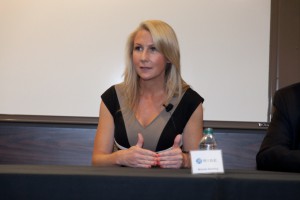
Sam Decker, co-founder of Mass Relevance, Carl Shepherd, co-founder of HomeAway and Susan Strausberg, co-founder of 9WSearch participated in a RISE lunch and learn entrepreneurship super panel moderated by Ellie Brett, founder of Media Bombshell. About 120 people attended the event held at Mass Relevance’s downtown headquarters and sponsored by Turnstone.
Decker’s entrepreneurial roots go back to fourth grade when he ran a go-kart repair business and that got him into fixing engines.
He started working for Apple out of college. Then he ran three failed startups in the Bay area before Dell called.
“Even at Dell I always sought out the entrepreneurial jobs,” Decker said.
BKNAHbXCcAAg6ckHe worked at turning Dell.com into a big business. But after seven years, he wanted to launch a startup again.
Decker left to work at Bazaarvoice, founded in 2005. After five years, Bazaarvoice had $50 million in revenue and 500 people.
“Any time you are making that move to the next journey you are stepping off a cliff,” Decker said.
He left Bazaarvoice to co-found Mass Relevance, a social media company focused on handling Twitter campaigns for TV, sports and media companies.
Today, Mass Relevance has 85 people and does half its work for brands and half for media and sports teams.
Strausberg grew up in an entrepreneurial family.
“One needed to be in control of one’s own life,” she said.
Over time, she became obsessed with computers. She worked in publishing and film. She founded a publishing company and co-produced BKNAUiBCEAAbSdr“It Came from Hollywood,” a Paramount Pictures film.
She earned the title of “Dot Com Diva” for launching EDGAR Online, a financial data company, in 1995 with her husband Marc Strausberg. They left the company in 2007 to pursue other interests. They moved to Austin a few years ago to launch 9W Search Inc., an advanced financial search engine aimed at mobile users.
Shepherd, co-founder of HomeAway, was not a born entrepreneur.
“I did not come to be an entrepreneur overnight,” he said. “I was a late bloomer.”
At first he worked as a consultant for what is now Accenture and he also worked for magazine publishers.
He cut his entrepreneurial teeth at Hoover’s Online, where he worked as chief operating officer. Hoover’s Online was an information research business and was one of the first successful subscription based companies on the Web. He took the company public in 1999 and stayed on for a few years and then he joined Austin Ventures. That’s where he met Brian Sharples. They had coffee at Starbucks, the one that’s across the street from what’s now HomeAway’s headquarters. At that Starbucks, they started brainstorming ideas for businesses. They came up with one for selling information on outsourcing. But they both settled on addressing the pain in the vacation rental market. They both had families who liked to stay in rental homes instead of hotels when they travelled.
“Renting a vacation home really sucked,” he said.
They set about to fix that problem and came up with HomeAway as a solution.
Today, HomeAway has 1,300 employees on six continents including 600 employees in Austin, Shepherd said.
Next, Brett with Media Bombshell asked the entrepreneurs a series of questions including what was their biggest surprise about being an entrepreneur.
“The biggest surprise is that really great ideas and wonderful people and the best possible teams fail,” said Shepherd.
“So few people understand and embrace innovation,” said Strausberg.
“The highs are higher and the lows are lower,” said Decker. “Every rejection is like a rejection. And every win is like we’re going to be huge.”
But over time, the volatility starts to shrink, Decker said.
The next question Brett asked was what was the toughest challenge the entrepreneurs faced and how did they get through it.
Strausberg said in 2003 Market Watch wanted to buy EDGAR Online but that fell through. They had to pivot the business and find another way to exit the business, she said.
At Hoover’s Online, Shepherd bought a company called Power Rise in August of 2001 and after September of 2001 they had to completely revamp the business and eventually close down Power Rise. They had to pivot Hoover’s Online to go back to a subscription model.
Coming up with a company name is one of the biggest challenges a startup faces, Decker said.
One of the big challenges Mass Relevance faced when it launched was securing an official partnership with Twitter, Decker said. He personally negotiated the rights to use Twitter’s data, which was a critical aspect of their platform.
The panel also discussed how they handled risk. Decker said a good entrepreneur does his best or her best to mitigate risk.
And Shepherd said he has gotten more tolerant of risk during the past five to seven years.
“I feel like I’ve been far more in control as an entrepreneur than I was as an employee,” he said. “And I’m far more aggressive today than I was five or six years ago.”
The panel also gave advice to entrepreneurs.
Don’t lie to the IRS, said Shepherd. He has a 28-year-old son who is running a startup in the Bay Area and that’s the advice he gave him.
“Surround yourself with people and advisors who know what they’re doing,” he said.
“I would say first of all, think twice, then think three times,” Strausberg said. Thoroughly investigate the market, the competition and the validity of the idea, she said. And make sure you’re ready to cope emotionally with the risk and uncertainty of running a startup, she said.
“Think bigger,” said Decker. Whatever you’re thinking about add a zero to it, he said.
“Push yourself,” he said.

How Startups Can Build an Effective Advisory Board

By SUSAN LAHEY
Reporter with Silicon Hills News

Brandon Knicely, managing director of Portico International, photo by Susan Lahey

Brandon Knicely, managing director of Portico International, photo by Tricia Merce

Brandon Knicely, managing director of Portico International and founder of Austin Innovation Partners, has started mid-cap companies and small companies, invested in developing nations and worked for non-profits in New York City. He’s served on advisory boards from New York to Silicon Valley and he’s almost never seen one that was really done right.
The boards had too narrow a focus, frequently just trying to “buy” customers, for example. Or everyone on the board came from the same industry. Often they failed to bring in a facilitator from the outside who could speak plainly and tell the bigwig board members to wait their turns. Knicely gave a RISE session Monday noon at Tech Ranch on how to build an advisory board.
An advisory board, Knicely said, can help a business see the unseen…find out what it does not know. As a venture capitalist, he said, experience taught him to judge in three minutes whether a business was going to make it or not. That’s the kind of knowledge it helps to have on an advisory board. A well placed board member can give you insight to your competition, bring funds your way and help you analyze your market position in addition to bringing your company to the attention of other influential people.
“The number one weakness of startups, the missing link in the chain, is how do we understand the needs of the market and how do we value comparatively those needs?” he said. An advisory board can help with that.
Photo by Susan Lahey

Photo by Tricia Merce

Startups, he said, begin with mentors in the ideation stages and move to advisory boards. By the time they contract someone to be on an advisory board, they have to have their act together, know what they want from the advisor and respect the advisor’s time. He knows people who have effectively used LinkedIn to find advisors who could help with the early stages of the business. But they have to focus on what that advisor’s passion is and make connections based on that. That kind of relationship and mutual interest is going to produce the best board.
Startups should choose advisors with the same care professional teams use to choose their players.
“I love Austin,” Knicely said. “I’ll be buried here…but a lot of startups treat building their business like a pick-up football game. ‘Hey, man, you’re available.”
Not that all advisory members have to be high-performance athletes. Having too many personalities in the room can make it difficult to build consensus and move forward. An advisory board also needs some “quiet doers.”
They shouldn’t be from the same industry. Knicely showed a picture of an apple, loosely pieced together from slices of four different kinds of apples. From a design standpoint it looked cool, but when he asked the audience to evaluate it as a product, they pointed out that some customers might not like the disparate flavors, it might not last very long since sliced apples have a short shelf life, it might be difficult to package and ship—considerations that might have fallen through the cracks in a room full of designers.
He had several other considerations:

  • The relationship should be between the CEO and the advisory board, but communications about meetings etc. should be outsourced. It’s too time consuming. “When you’re starting a business, you don’t even have time to talk to your wife,” Knicely quipped.
  • Meetings should be regular and facilitated by someone from the outside who has the professionalism and emotional maturity to handle conflict deftly but who doesn’t have to worry about offending anyone. He remembered an incident with one board member jabbing a pen into the $300 Egyptian cotton shirt—and the arm– of another. Somebody needs to be there to handle that.
  • Meetings shouldn’t try to cover everything. The CEO has to set priorities and the agenda and outcomes must be clear.
  • Meetings should include fun. With huge corporations, board meetings involve retreats to resorts or at least golf. In Austin, a startup on a budget can find plenty of fun for its advisory board members after the meeting.
  • Startups should require no more than an hour a month—or a 3-hour quarterly board meeting—from advisors. It’s crucial to know, upfront, what kind of time and help the advisor is willing and able to offer and respect that boundary.
  • Advisory board members should be rewarded. Contracts customarily run for two years with a three-month “cliff” meaning no board member receives equity until after three months of solid performance. After that three months, he has generally seen half of a percent to one percent equity per board member.

To get really good advisors, Knicely said, the most important thing is relationship and treating advisors with respect.
“People will ask ‘How did you get this guy on your advisory board?’” Knicely said. “But it’s all about how you treat people.”

Austin Ranks Seventh in Top Cities for Female Entrepreneurs

More and more women are starting up companies.
Intuit, which sells QuickBooks accounting and financial software, ranks the best cities for female entrepreneurs and found that San Francisco ranks first, followed by Seattle and Washington, D.C.
Austin ranks seventh and Houston earns an honorable mention. San Antonio is not on the list.
For more on female entrepreneurs, check out Intuit’s graphic below.

The Top Cities for Female Entrepreneurs [INFOGRAPHIC]
via: The Top Cities for Female Entrepreneurs [INFOGRAPHIC]

RideScout Wins ATC’s Startup Showdown

BJx4XYaCMAECxLsRideScout won first place in the Austin Technology Council’s Startup Showdown at the 2013 CEO Summit last week.
RideScout is an app that lets people see all the options available to them to get a ride. It launched during South by Southwest and had more than 300 users sign up for the service, said Joseph Kopser, RideScout CEO.
Austin-based RideScout’s app aggregates and ranks the best options for getting a ride including public buses, transit, subway, taxis, limos, shuttles, pedicabs, Car2go and peer to peer ride sharing. It’s only available for Apple iPhones right now, but an Android version is expected later this year.
RideScout beat out Nibl It, a micropayment system for publishers, Lodestone Social, social media rewards systems for sports teams, Ideal Asset, an asset marketplace, and ReQwip, a marketplace for buying and selling triathlon equipment, to take the top prize, a year membership in the Austin Technology Council.
Last year’s winner, Toopher reported that winning the Startup Showdown helped its business expand.

Learn More About the Austin-San Antonio Connection at RISE

austin_sanantonioI moved to San Antonio in 1989 from Beaumont, Texas.
In San Antonio, I covered the nascent high technology industry including a pioneering, but now defunct company called Datapoint and about a half dozen spin off companies formed by former Datapoint executives.
Back then, Michael Dell was still building his PC company, founded in 1984 in Austin. It had gone public in 1988 when the personal computing industry was still in its infancy and was poised to take off.
The Semiconductor Manufacturing technology consortium, known as SEMATECH, set up operations in Austin in 1988. It focused on solving problems for the semiconductor manufacturing industry.
Central Texas, known primarily for microchip and PC manufacturing, was just a blip on the radar of the high-tech industry. In fact, people jokingly referred to the area as Silicon Hills, a reference to the region’s attempts to emulate the highly-successful Silicon Valley.
And even back then, people in both cities talked about the need to collaborate and work together to build Central Texas into a regional technology powerhouse. Members of the Greater Austin-San Antonio Corridor Council, founded in 1984, met regularly to address issues facing the region. I distinctly remember a big push to get a high-speed rail established between the two cities. But the newly founded Southwest Airlines largely quashed that movement because the airline saw the railroad as a threat to its business.
Today, Austin is booming with all kinds of technology startup companies and incubators and accelerators like Capital Factory, Tech Ranch and DreamIt Ventures. Dell is now a giant company. National Instruments is another home-grown tech powerhouse. And Visa, Apple, General Motors, Union Pacific and others have all set up innovation centers in Austin and announced major expansions.
Just down Interstate 35 about 75 miles to the South, San Antonio is also booming. It has a thriving biotechnology and cyber security industry. It also has Rackspace, a web hosting company with more than 4,500 employees and $1 billion in annual revenue and Geekdom, a collaborative coworking space downtown that incubates high tech startup companies.
So this region is booming. And Austin and San Antonio are not just competing with Silicon Valley, Boston, Denver, Boulder, Chicago, New York, Los Angeles and other technology centers nationwide. This region is in a globally competitive race with countries like Taiwan, Singapore, China, Japan and India for talent and resources to create the next technology innovations.
Technology is the engine that drives our economy.
So shouldn’t we all be working together to find out how best to compete in a global marketplace?
Let’s talk about it.
On Monday at Capital Factory, a RISE Panel, hosted by Roberto Rondero de Mosier will take place from 10:00 a.m. until 11:30 a.m. to discuss the Austin/San Antonio Connection.
Here’s the description: “During the next 20 years, the Austin-San Antonio corridor will rival the current Dallas-Fort Worth Metroplex. Come speak to folks in both investor/entrepreneur communities who are on the edge of exciting new developments that will make this THE metroplex of innovation over the next generation. Questions: What is the funding landscape in Austin v. San Antonio? What programs are in place to promote mindshare between the two cities? Is there a city that is right for my entrepreneurial venture? What unique entrepreneur talent is coming out of San Antonio that Austin financiers may not know about yet? Featuring: Jason Seats, Managing Director of TechStars Cloud; Steven Quintanilla, Founder of Kirpeep; Laura Lorek, Silicon Hills News; Another TBA.”
Sign up now, and we’ll see you on Monday at Capital Factory.

Austin’s Battling a Global War for Tech Talent

GettyImages_153030424With the explosive growth in Austin’s high tech industry, can companies find enough tech talent locally?
That’s a big issue technology executives in central Texas are grappling with right now, said Susanne Bowen, CEO of PeopleAdmin and chair of the Austin Technology Council’s Community Foundation.
She moderated a panel of experts on the subject of “Disruptive Talent Development: Global War for Skills” at the Austin Technology Council’s CEO Summit last week at the Austin City Limit’s Moody Theater.
Austin is expected to create 10,000 new high tech jobs by 2017 and 2,400 of those openings are for software developers, according to an ATC survey. Yet the local education pipeline will fill only about 23 percent of those positions, Bowen said.
That means the technology skill pipeline in the science technology engineering and math, known as STEM, fields are critical to fuel growth, she said.
“We’re a net importer of technical talent and we have been for more than 20 years,” Bowen said. “So the future is plain for Austin’s tech workforce. Our demand has and will continue to outstrip the supply.’
The technology skills shortage isn’t going to be solved by poaching employees from other local companies, Bowen said. And companies cannot continue to rely strictly on recruiting and importing that talent from other areas.
“Those are not sustainable, nor cost effective solutions to the challenge,” Bowen said. “So we need to grow our own talent here in central Texas.’’
And the best way to do that is to launch an assertive and aggressive campaign to engage educators, parents and students about the opportunities in STEM fields, Bowen said.
A huge shortage of engineers exists in Austin and nationwide, said Michael Raiford, vice president of manufacturing at Samsung Austin.
“If we don’t keep the labor force here that’s educated in high tech then we won’t be able to attract businesses,” he said.
He grew up in Austin and became an engineer. He wants his kids and other children to have those same choices and job opportunities in Austin.
As a CEO of a tech company, the biggest challenge Gene Austin faced was he couldn’t find people fast enough to fuel the company’s growth, he said. Austin, president of Bazaarvoice, got involved in the Greater Austin Chamber of Commerce’s education taskforce to help find solutions.
“We really have a challenge,” he said. “We really have an opportunity at the same time.”
Daniel Planko, partner University Ventures, says one solution is to build specialized engineering institutions.
“This is a national problem,” he said “This is a global problem. “
The skills gap begins in grade school, said Austin.
The focus of the education system has been on how many kids can graduate high school, he said. It has not been on college preparedness, he said.
Kids start dropping out of math in fifth and sixth grade, said Raiford. They need to stay in math and science to become an engineer in college, he said.
“Out of the people who enter college to be an engineer less than half make it,” he said. “We really have a weed out culture instead of a weed in culture.”
One solution to get kids more engaged at an early age is to have engaging teachers teaching math and science, according to the panelists. They said that can be accomplished by paying teachers based on performance.
Kids have to be engaged in fifth grade, said Planko. If they aren’t taking advanced math in junior high, it’s going to be really hard to catch up in high school and college.
Another way to spark kid’s interest in STEM fields is to have businesses involved in the schools.
Samsung Austin has a program “The Day in the Life of an Engineer” and gets requests from schools from all over, Raiford said.
“We’ve got to get more involvement in the schools and more exposure to kids to engineering at an early age,” he said.
Samsung also sends a lot of engineers, especially female engineers, to the schools for career days to talk to the kids about engineering.
“It’s an investment in our future to get all kids interested in STEM,” Raiford said.

RISE Week Kicks Off on Monday

images-5RISE Week 2013 kicks off on Monday!
Are you ready for a week of fantastic sessions covering everything from how to juggle entrepreneurship and having a family to crowdfunding or finding angel or venture capital investment for your startup?
This year marks the seventh year for RISE, which stands for Relationship and Information Series for Entrepreneurs. And the nonprofit organization that puts on the conference makes sure that it is free for everyone to attend. Volunteers, who are experts in their fields, offer more than 280 sessions Monday through Friday on a wide range of topics aimed at entrepreneurs in all kinds of industries. Of course, Silicon Hills News will focus on the technology sessions at Capital Factory and Tech Ranch, among other locations. We’re particularly excited about Tuesday’s Lunch and Learn Session on Angel and VC Funding.
The RISE Opening Keynote and Reception on Monday evening features The Royitos “Don’t do Mild” Award presented by Roy Spence, founder of GSD&M and Royito’s Hot Sauce. Also, Ingrid Vanderveldt at Dell will host a conversation with Melinda Emerson & Gene Marks, nationally recognized business leaders and columnists followed by a keynote address by Gary Keller, founder of Keller William Realty.
This year, RISE is putting on a series of “Super Panels,” featuring top entrepreneurs on topics from crowdfunding to women’s entrepreneurship.

The Super Panels Include:

Finding Funding for Tech Startups in Austin

Photo of the funding panel courtesy of Austin Technology Council.

Photo of the funding panel courtesy of Austin Technology Council.

A familiar compliant in Austin from tech startup entrepreneurs is that there’s never enough money to fund their ideas.
Some say that good companies don’t have trouble raising money. But others disagree.
On Wednesday, a panel of VCs and Angel investors talked about the money available for deals locally at the Austin Technology Council’s CEO Summit.
John Thornton, managing partner with Austin Ventures, moderated the panel.
Capital Factory has provided seed stage funding for 15 companies during the last four years, said Joshua Baer, its co-founder.
Some startups can get profitable on $50,000, Baer said. And crowdfunding on sites like Kickstarter is making funds available to companies that might have gotten turned down by angels or venture capitalists, Baer said. He knows of founders who couldn’t get money locally and then raised a $1 million on Kickstarter.
Capital Factory focuses on companies that can get profitable on less than $1 million in startup funds. It also focuses on Software as a Service firms that serve the business to business market, Baer said.
Bill Wood, general partner with Silverton Partners, focuses on funding Austin-based companies.
Because it’s easy to startup a company and doesn’t take a lot of money, Silverton Partners sees more startups forming, Wood said. The teams are made up of founders who are dramatically younger. The majority of its founding teams are in their 20s, Wood said.
The good thing about young founders is that they don’t know what’s not possible, Wood said. They have drive, ambition and a willingness to sacrifice, he said.
Vista Equity Partners moved to Austin 18 months ago. It is exclusively focused on software, said Martin Taylor, principal with Vista.
“We think of ourselves as a software holding firm,” Taylor said. Vista has two investment funds. It has a $3.5 billion fund for investments in companies with greater than $150 million in revenue and a smaller $400 million fund for investments in companies with more than $15 million in revenue.

The Economic Impact of Austin’s Technology Industry

images-5Austin’s technology industry contributes $21 billion annually to the city’s economy.
The city has 3,787 technology companies which employ 105,667 or 9 percent of the local workforce.
Brian Kelsey, an economic development consultant and lecturer at The University of Texas at Austin, prepared this information for the Austin Technology Council’s CEO Summit on Wednesday.
He delivered the presentation to CEOs and high level executives from local technology companies attending the CEO Summit on Wednesday at the ACL Live’s Moody Theater.

« Older posts Newer posts »

© 2026 SiliconHills

Theme by Anders NorenUp ↑