Female founders have traditionally had a much tougher time raising capital than their male counterparts.
And while there have been a lot of pitch competitions, media articles, and focus on the problem, startups led by women still receive a tiny fraction of the overall V.C. dollars invested every year. In fact, last year, startups led by a sole female founder received 2.3 percent of total capital invested in U.S. venture-backed startups in 2021, according to Pitchbook. And only 14.8 percent went to companies co-founded by women.
But things are starting to look up for female-founded companies in Austin.
“The Southwest, led by Austin, Dallas-Fort Worth, and Phoenix, has seen explosive growth in capital raised by female-founded startups in recent years,” according to PitchBook data.
“Austin, the Texas state capital, has seen female-founded startups raise more than $2.8 billion since the start of 2020, a 161% increase from its 2008 to 2019 total,” according to PitchBook.
Here are 15 venture-backed female-founded startups in the Austin area to watch.
Founder: Co-FoundersDr. Andrea Thomaz and Dr. Vivian Chu
What it does: Diligent Robotics is developing a suite of artificial intelligence that enables robots to collaborate with and adapt to humans in everyday environments.
President Joe Biden declared the Pandemic is officially over in an interview on 60 minutes Sunday and Silicon Hills News agrees.
That means Silicon Hills News is hosting in-person events again.
Welcome back! Before the pandemic, Silicon Hills News hosted monthly lunch and learns at Galvanize, special events like ContentATX, Space ATX, BlogItSA, and our annual calendar party.
Now Silicon Hills News is hosting a monthly series of fireside chats called BigIdeasATX. The first one took place at Strangeworks on August 25th and featured Will Hurley, founder, and CEO of Strangeworks, and Katie Lewis, founder, and CEO of DMass. They talked about quantum computing, artificial intelligence, and other technology trends in Austin. The event was possible thanks to our sponsors: Solwey, which can create custom-tailored e-commerce systems, innovative social networks, event management systems, fintech applications, CRMs, and more. And Perkins Coie Law Firm, which is ranked by Fortune as one of the 100 best companies to work for. The firm is known for its entrepreneurialism, innovation, diversity and inclusion, and collegiality.
The next BigIdeasATX2 will be held at OJO Labs on Sept. 29th from 5:30 p.m. to 7:30 p.m. The event features John Berkowitz, serial entrepreneur, co-founder and CEO of OJO Labs, and Beth White, Founder and CEO of MeBeBot. Sponsors for the event include Solwey, Decent, and Unnanu. There are still a handful of tickets left to attend the event and one sponsorship slot available.
In October, Silicon Hills News will host two events. The first, BigIdeasATX3 will feature Shubhi Rao, founder, and CEO of Uplevyl, and Riana Lynn, founder, and CEO of Journey Foods. It will be a highly curated group of women in tech, CEOs, funders, founders, and C-Level executives. The event will take place on Oct. 26th.
In addition, BigIdeasATX4 will take place on Oct. 28th and will feature some more entrepreneurs from our 2022 Tech Calendar. Details to be published soon.
Stay tuned in by subscribing to our newsletter. Silicon Hills News will be announcing more events soon.
Electric bikes, buses, trucks, trains, cars, drones, electric charging stations, smart cities, and a focus on sustainability and lessening the environmental impact of transportation.
All of those topics and more will be explored at the second annual Move America conference, which is coming back to Austin at the Palmer Events Center on Sept. 27 and 28th. Tickets cost $995, and free tickets are available to those who work in the government sector.
The event features almost 400 speakers including opening keynote speakers: Linda Zhang, Chief Engineer, F-150, Ford Motor Company, and Teague Egan, Founder and Chief Executive Officer of EnergyX,
To kick off the event, a panel of speakers will talk about accelerating mobility startups from O to 100 including Tobias Lescht, director of EV Infrastructure and Energy, Revel, Sahil Segal, portfolio engagement director, Frontier Fund, Toyota Ventures, and Alex Mitchell, senior vice president, market transformation, LACI.
Also, on day one in the morning, another keynote is Scaling with speed: lessons in accelerated e-mobility deployments featuring Jeff Nieman, senior vice president, operations initiatives with Hertz, and Vic Shao, Chief Executive Officer of bp pulse fleet.
A highlight in the afternoon is a talk by Alex Rodrigues, Chief Executive Officer of Embark Truck. He is speaking on Making Trucking More Efficient with Self-Driving Technology at 2:05. In February, Silicon Hills News did a video interview with Rodrigues for Move America. We talked about the company’s autonomous truck technology which is being used to move goods from Houston to San Antonio. For more on the interview, watch the video.
Uploaded by MOVE: Mobility Re-Imagined on 2022-02-21.
On day two, Karl Popham, manager of electric vehicles and emerging technologies, Austin Energy, kicks off the day with the opening keynote, followed Kent Helfrich, chief technology officer, VP Global R&D, General Motors, talking about investing in next-generation batteries that will lower EV costs.
Day two also features Austin Mayor Steve Adler talking about the advances and challenges in designing smart cities.
And at 11:30 a.m., Matt Chasen, Chief Executive Officer and Founder of Austin-based LIFT Aircraft, and Martin Salinas, Chief Operating Officer of AFWERX, will talk about the development of dual-use aerial mobility vehicles.
On Sept. 28th at 12:30 p.m. in the Energy and Charging Theater, Silicon Hills News is moderating a panel on “How data and AI are changing the mobility landscape.” The panel features Tim Haille, executive director of the Contra Costa Transportation Authority, Daniel Spahr, COO of Stream Analyze, and Helena Kazi, Founder, and CEO of Giganomics.
Silicon Hills News has a limited number of tickets available here. Once those are full, Silicon Hills News readers can get 50 percent off a ticket using the code SPKREF50.
Michael Ramirez is the founder and CEO of Austin-based evisio, a search engine optimization software company.
Evisio helps agencies, marketers, SEO consultants, and businesses of all sizes improve organic search results, no matter their level of SEO knowledge. It takes the guesswork out of SEO by giving users strategic insights and actionable tasks that can be assigned to team members right inside of evisio.
By bringing all parts of the SEO process together in one powerful platform, evisio makes SEO simple and easy.
Ramirez is originally from San Antonio. He is Mexican American with deep roots in Texas and grew up on San Antonio’s West Side and graduated from Lanier High School. He studied at the University of Texas at San Antonio for two years before transferring to and graduating from The University of Texas at Austin.
“So that’s what brought me out here 16 years ago,” Ramirez said.
While attending UT Austin, he studied advertising and specialized in digital media.
“That’s when I first heard about SEO – back in 2007-2008,” Ramirez said.
In the summer of 2008, Ramirez landed his first internship at a digital marketing company in Georgetown, TX as an SEO specialist. As an intern, he remembers working on reciprocal link-building campaigns and a lot of other tactical SEO work. However, he never lost sight of the bigger opportunities Google was creating in this rapidly growing field.
“I really was inspired by and loved the idea of this new, massive channel – Google – and that it was the entryway to the Internet,” Ramirez said. “That was the place you had to be to be found and get traffic.”
“I was so in awe of the creative process and the art and science around the field,” Ramirez said.
After completing his summer internship, Ramirez worked full-time for the agency in Georgetown for three years. However, in 2012 the company fell on hard times and announced it would be laying off employees, Michael being one of them, before closing its doors a few months later.
Before severing ties completely, Michael took a chance and negotiated with one of the partners to contract him to fulfill the remaining SEO contracts. And it worked. Michael took on the remaining contracts and launched his SEO agency, SearchRPM.
While running his agency, Michael quickly realized the challenges of selling, managing, and executing SEO services. Prospective clients didn’t trust SEO companies due to the lack of transparency in the services being provided, managing a team of technical and creative contractors was difficult, tactical solutions would remain untouched inside multiple project management systems, Google Docs and Sheets for months, and this made it extremely difficult for the agency to scale.
That experience led to the product birth of evisio in 2017, an SEO management platform. Michael’s vision was to bring SEO together in one place. Evisio gives agencies and consultants a central hub for automated auditing, analyzing, organizing, and executing tasks to increase efficiency and accountability. It’s a software-as-a-service business model with monthly subscriptions starting at $79 for a basic plan up to $499 for a custom plan.
Evisio is in a hot market. The global market for SEO agency services market is expected to grow from $42 billion in 2021 to $51.2 billion this year at a compound annual growth rate of 22 percent, according to a report on ResearchAndMarkets.com. The market is expected to reach $109 billion in 2026 with a compound annual growth rate of almost 21 percent.
Not to mention the pandemic led to an increase in business from everyone going online, Ramirez said.
Evisio is a bootstrapped venture that launched to the public five months ago and is actively seeking new customers. Michael is focused on investing in technology and building the best product for his customers.
“The goal is to make it one of the most competitive SEO tools in the industry,” Ramirez said.
For more information, listen to the Ideas to Invoices podcast with Michael Ramirez below. Or visit evisio.co or contact them at hello@evisio.co
Michael Ramirez is the Founder and CEO of Austin-based evisio, which focuses on search engine optimization. Evisio helps agencies, marketers, SEO consultants, and businesses of all sizes get results, no matter your level of SEO knowledge.
Austin had a record-breaking year with startup activity overall on the rise.
In 2021, companies in the Austin-Round Rock metropolitan area raised $4.9 billion in venture capital in 387 deals, more than double the $2.3 billion raised in 2020, according to Pitchbook-National Venture Capital Association Venture Monitor data.
A few trends Silicon Hills News has detected in Austin in recent years include a rise in real estate tech companies, a cluster of insure tech companies, new space startups, and more female-founded startups and BIPOC-founded startups. And the trend of companies relocating to Austin from other cities continues.
The city is also a hotbed of activity in consumer packaged goods, medical technolgy, fintech, artificial intelligence, robotics, machine learning, blockchain and big data.
What it does: Beth White, founder, and CEO of MeBeBot, created a virtual assistant powered by artificial intelligence that can answer frequently asked questions for companies.
Why it’s hot: MeBeBot has amazing customers: Epicor, e2open, Ziff Davis (includes Spiceworks, RetailMeNot, IGN, etc.), HireVue, Abrigo, CrowdStreet, Terminal, Massage Envy, Toyota Insurance Management Solutions, Care.com, and IGT. Over 22,000 global employees are paid users and adoption has accelerated as more companies have gone to remote or hybrid offices.
Funding: The company has raised $2.5 million in seed stage funding.
What it does: Riana Lynn co-founded Journey Foods in 2018. Journey Foods has created a machine learning-powered software platform for food companies. Its enterprise technology improves product monitoring and development for CPG companies, ingredient suppliers, and manufacturers.
Why it’s hot: The supply chain management market was valued at $18,699.45 million in 2020 and is projected to reach $52,632.37 million by 2030, registering a CAGR of 10.7%, according to Allied Market Research.
What it does: ConverseNow’s voice AI technology has reshaped the future of restaurants; whereby virtual assistants automate the order-taking process so overburdened staff can turn their attention to fulfillment and in-person service.
Why it’s hot: The company has customers in 40 states and more than 1,200 restaurants. It works with brands such as Domino’s Pizza, Fazoli’s, and Blake’s Lotaburger. Its recent funding allows it to meet explosive demand by deploying in new locations at scale.
What it does: Uplevyl launched in November of 2021 to provide an app and digital platform to help women elevate their professional, personal and financial lives and advance a sustainable ecosystem of self-directed growth and accountability.
Why it’s hot: Shubhi Bhonsle-Rao, Uplevyl’s founder and CEO, is a former senior executive with Alphabet, Tesco, PricewaterhouseCoopers, and Ford Motor Company, among others. She also sits on the board of directors of Open Lending, Center for Global Development, and International Center for Research on Women and is an honorary advisory council member of the Federal Reserve San Francisco. On Silicon Hills News’ Ideas to Invoices podcast, Rao said she wanted to build a digital product for women that used technology and data for good.
What it does: Will Hurley, David Cardona, and Justin Youens founded Strangeworks to humanize quantum computing and make it accessible to everyone. By guiding companies through the confusion of quantum computing, Strangeworks helps accelerate the integration of this new technology in corporations, universities, and enterprises.
Why it’s hot: Quantum Computing is the next big thing. “In 2021 alone, announced investments in quantum-computing start-ups have surpassed $1.7 billion, more than double the amount raised in 2020. We expect private funding to continue increasing significantly as quantum-computing commercialization gains traction,” according to McKinsey & Company research firm.
What it does: dMASS is a social impact startup using A.I. to help companies accelerate innovation and unlock growth by saving material, energy, and water throughout manufacturing and supply chain operations. dMASS’s A.I. was built in partnership with a Fortune 100 Life Sciences company, and the platform connects the dots between global innovation patterns and trends, and unexpected opportunities.
Why it’s hot: Sustainability and supply chain management are the focus of most companies today. “Supply chains have always been critical but often operated behind the scenes. The COVID-19 pandemic and ensuing disruption changed that, revealing the importance of supply chains to a much wider audience,” according to PwC. “The pandemic also accelerated the need to update and upgrade supply chains in an increasingly digital world.”
What it does: Literati is a modern book distributor and curator focused on matching every child with the right book.
Why it’s hot: The U.S. book market was $36.7 billion in 2021 and it is projected to continue to grow at a 2.2 percent compounded annual growth rate through 2030. The online book market is growing even faster and consumers are looking for curated sources to find new books as the brick-and-mortar stores continue to consolidate.
What it does: Loop Insurance uses AI technology, big data, and telematics to create more fairly priced insurance products.
Why it’s hot: “According to a December 2021 LexisNexis Risk Solutions survey of U.S. consumers, 71% are interested in the of use telematics-enabled usage-based insurance (UBI) for purposes of discounts. However, consumer adoption remains much lower, presenting a significant opportunity for both consumers and insurers.”
What it does: Founded in September of 2020, Cart.com makes eCommerce software and provides services to scale businesses online
Why it’s hot: The eCommerce software and platform market had a market value of US$ 3.81 billion in 2022, and is expected to grow at a CAGR of 12.5% from 2022 to 2032, reaching a value of US$ 12.37 billion, according to Fact.MR
What it does: Eterneva celebrates remarkable people and pets by turning their ashes into diamonds.
Why it’s hot: Cremation rites are also projected to reach 78 percent by 2040, which is leading consumers to break with old funeral traditions, according to Adelle Archer, Eterneva Co-Founder and CEO.
What it does: Eventus is a leading global provider of multi-asset class trade surveillance and market risk solutions.
Why it’s hot: The Global Trade Surveillance Systems Market size is expected to reach $5. 6 billion by 2028, rising at a market growth of 18. 9% CAGR during the forecast period, according to ReportLinker.
What it does: The Guild is a hospitality company that offers full-building management and turns upscale apartments into tech-enabled hotel suites.
Why it’s hot: The travel and tourism market is projected to reach $175.4 billion in 2022. Revenue is expected to grow at nearly 5 percent per year through 2026 and reach $211.1 billion by 2026, according to Statista market research firm. The market’s largest segment is hotels with a projected market value of $99.69 billion in 2022.
What it does: Autonomous Linen Management Platform for Hoteliers that Reduces Expenses and Operating Costs by up to 40%
Why it’s hot: Laundris was awarded a patent on the technology behind its commercial laundry system. “The market size, measured by revenue, of the Industrial Laundry & Linen Supply industry is $17.2 billion in 2022,” according to IBISworld. The market is expected to increase by 8.4% in 2022.
What it does: ICON is a construction technology company that uses 3D robotics, software, and advanced materials to build houses and other structures.
Why it’s hot: There’s a nationwide housing shortage and ICON has a solution. It has teamed up with Lennar, one of the nation’s leading homebuilders, to build the largest community of 3D-printed houses to date using ICON’s robotics, software, and advanced materials. The 100-home community broke ground this year and is being codesigned by architecture firm, BIG-Bjarke Ingels Group.
What it does: Diligent Robotics is developing a suite of artificial intelligence that enables robots to collaborate with and adapt to humans in everyday environments.
Why it’s hot: The Industrial Robotics Market was worth around $41.7 billion in 2021 and is estimated to grow to about $81.4 billion by 2028, with a compound annual growth rate of approximately 11.8 percent over the forecast period, according to Zion Market Research.
What it does: CesiumAstro builds high-throughput, plug-and-play active phased array communication payloads for airborne and in-orbit platforms. Cesium’s full-stack, multi-mission hardware and software products enable a range of commercial and defense objectives.
Why it’s hot: The space industry is booming.Citi expects the space industry to reach $1 trillion in annual revenue by 2040, with launch costs dropping 95% to unlock more services from orbit,” according to CNBC.
What it does: Homeward enables homebuyers to make all-cash offers and buy a new home before they sell their old one.
Why it’s hot: U.S. housing gained a record $6.9 trillion in 2021, nearly doubling what was previously the largest annual gain of $3.7 trillion in 2005. The full U.S. housing stock is now worth $43.4 trillion, according to a Zillow report. And even though it has cooled recently as interest rates have risen, it is still expected to continue to grow at a record pace, according to Zillow.
What it does: OJO has created a free assistant that handles queries from homebuyers.
Why it’s hot: The housing market nationwide has been white hot for the past few years and only recently began to slow down a bit with interest rates rising. OJO Labs ranked 365 on the 2022 Inc 5000 list of fastest growing companies with a 1,650 percent growth rate.
What it does: SparkCognition is an AI technology startup operating machine learning software to analyze increasingly complex data stores.
Why it’s hot: The global artificial intelligence market was valued at nearly $59.7 billion in 2021 and is estimated to expand at a compound annual growth rate of 39.4 percent to reach $422.37 billion by 2028, according to the Zion Market Research firm.
What it does: Self Financial is a fintech startup that helps customers build credit and save money. It provides tools necessary for building on-time payment history and responsible use of credit, in collaboration with issuing banks services for those who are new to credit or who might not have access to traditional financial products.
Why it’s hot: The market size stood at $112.5 Billion in the year 2021. The Global Fintech Market size is expected to reach $332.5 Billion by the year 2028 and is expected to grow to exhibit a Compound Annual Growth Rate of 19.8% during the forecast period, according to Vantage Market Research Firm.
What it does: data.world makes it easy for everyone—not just the “data people”—to get clear, accurate, fast answers to any business question. Our cloud-native data catalog maps your siloed, distributed data to familiar and consistent business concepts, creating a unified body of knowledge anyone can find, understand, and use.
Why it’s hot: The global big data analytics market size was valued at $240.56 billion in 2021. The market is projected to grow from $271.83 billion in 2022 to $655.53 billion by 2029, exhibiting a compound annual growth rate of 13.4% during the forecast period, according to Fortune Business Insights.
What it does: Aceable is an online education startup that offers state-approved driver’s education and real estate courses.
Why it’s hot: The global e-learning market was worth $215 billion in 2021. It is estimated to reach an expected value of $645 billion by 2030 at a compound annual growth rate of 13% during the forecast period (2022–2030), according to Straits Research.
What it does: Zenbusiness offers business products and services that help business owners start, run, and grow a business.
Why it’s hot: People launching new businesses in the U.S. have reached all-time highs in the past couple of years. The U.S. Census Bureau reported that 5.4 million new business applications were filed in 2021, surpassing the record set in 2020 of 4.4 million, according to NPR.
In Austin, 97 companies made the Inc 5000 2022 list of the fastest-growing private companies in the country.
Overall, the Austin companies on the list had a 244 percent median growth rate, $5.3 billion in total revenue, and added 16,792 jobs. The list includes 28 newly founded companies and 69 repeat honorees.
AdOutreach, which helps companies with video marketing, topped the Austin list of fastest growing companies with a 6,052 percent growth rate in the last year. It ranked 60 overall on the Inc. 5000 list.
Webforce, an eCommerce and CRM company, claimed the second spot for Austin with a 6,009 percent growth rate. It ranked 62 overall on the Inc. 5000 list.
Homestead Brands, a firm that acquires, invests in, and scales e-commerce furniture brands, took third place with a 3,839 percent growth rate. It ranked 117 on the Inc. 5000 list.
Digital Thrive, a marketing firm, took fourth place on the Austin top ten list of fastest growing companies with a 3,056 percent growth rate. It ranked 168 on the Inc. 5000 list.
The rest of the top ten included Everly Health with 2,643 percent growth rate and 201 overall, Element 26 with 1,948 percent growth rate and 285 overall, Boostlingo with 1,820 percent growth rate and 312 overall, Cover Desk at 1,800 percent growth rate and 317 overall, Canopy Management with 1,758 percent growth rate and 325 overall, and OJO Labs with 1,650 percent growth rate and 355 overall.
Galvanize Austin sent an email to its members on August 17th to inform them it is closing its coworking operations on August 31st.
“I’m reaching out to inform you that Galvanize has made an immensely tough decision to sunset our coworking operations in Austin,” Lindsey Rohde, senior director of campus operations, wrote in an email to Galvanize members.
“This means our doors will be closing on Wednesday, August 31, 2022,” according to Rhode. “Galvanize is proud to continue serving students through our remote online Galvanize and Hack Reactor programs.”
“We fully acknowledge the sudden nature of this news; with that, we ask that you show our staff kindness through this transition,” she said.
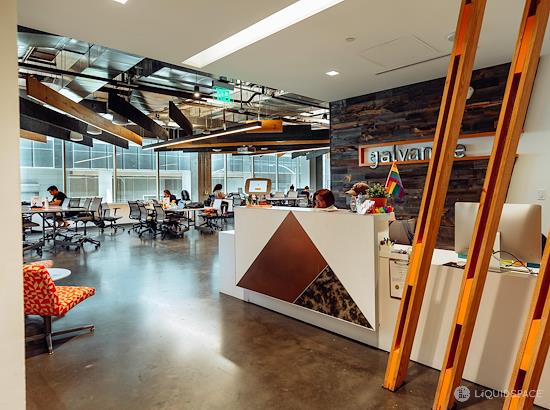
Galvanize opened its Austin campus in the Northshore building at Second and Nueces It occupies three floors and has been home to dozens of companies. It offered coworking for $275 a month for open seating and $475 for a reserved desk and private suites for $650 a month. It offered members conference rooms, weekly mentors and workshops, free coffee, and snacks. It also rented offices to entire companies. In fact, Michael Lam and Ben Rubenstein started Opcity at Galvanize and later moved to larger headquarters and sold the company to Realtor.com.
Some of the companies currently based at Galvanize include Silicon Hills News, Kronologic, Lumen Insurance Technologies, Axiacore, and Steve Ward Media.
Galvanize, founded in 2012, has also been home to Hack Reactor programs and its instructors have taught students how to become coders and data scientists. In 2018, Galvanize bought San Francisco-based Hack Reactor, making it one of the largest coding programs in the country.
In January 2020, K12, a publicly traded learning company based in Herndon, Va., bought Denver-based Galvanize for $165 million in cash. At that time, Galvanize had eight campuses nationwide including Austin, Boulder, Denver, New York, Phoenix, San Francisco, and Seattle.
Galvanize is also shutting down its Seattle location at the end of the month, according to a story in Geekwire.
The team bringing the thylacine back to life: Ben Lamm, Co-Founder and CEO of Colossal Biosciences, Andrew Pask Ph.D., the leading marsupial evolutionary biologist, and the world’s foremost Tasmanian tiger expert and world-renowned geneticist and serial biotech entrepreneur George Church, Ph.D., and Co-Founder of Colossal
Colossal Biosciences announced Tuesday that it has started the de-extinction process of the thylacine, a beloved Australian marsupial, also known as the Tasmanian tiger.
The company first announced plans to bring the woolly mammoth back to life last September. It is using breakthrough gene-editing technologies to recreate the woolly mammoth and thylacine.
The thylacine is a slim, striped keystone species that was native to Australia, including Tasmania and New Guinea, and went extinct in 1936.
“Colossal is committed to the de-extinction of keystone species that their return will result in a positive impact on the ecosystem they once thrived in as well as developing key technologies that can also be used for species preservation,” said Ben Lamm, Co-founder, and CEO of Colossal. “Of all the species proposed for de-extinction, the thylacine has arguably one of the most compelling cases. The thylacine was eradicated as a result of direct human influence less than 100 years ago, rather than through natural processes such as those that led to the extinction of the dinosaurs.”
“The thylacine was completely unique among living marsupials,” Lamm said. “Not only did it have its iconic wolf-like appearance, but it was also our only marsupial apex predator. Apex predators form extremely important parts of the food chain and are often responsible for stabilizing ecosystems. The habitat in Tasmania has remained relatively unchanged, providing the perfect environment to re-introduce the thylacine and enabling it to reoccupy its niche.”
By bringing back the thylacine, Colossal hopes it will help restore Australia and Tasmania’s ecosystem to its natural state before the marsupial went extinct as the result of a combination of human poaching and the introduction of non-native predators.
To date, Colossal has raised $75 million in funding. It has more than 70 employees with offices in Dallas, Austin, and Boston and it is hiring for numerous positions, Lamm said.
Colossal’s Austin team is focused on computational biology and developing proprietary software to make it easier for comparative analysis of genomes for de-extinction leveraging AI and machine learning, he said.
Colossal’s woolly mammoth restoration team now has over 35 dedicated scientists spanning various functional areas including cell engineering, stem cell biology, embryology, computational biology, and genome engineering as well as three laboratories focused on the mission for mammoth de-extinction. Colossal is assembling an expert thylacine team and is near completion of its new dedicated thylacine laboratory.
For the project, Colossal has partnered with the University of Melbourne and its Thylacine Integrated Genetic Restoration Research Lab, headed up by Andrew Pask Ph.D., the leading marsupial evolutionary biologist, and the world’s foremost Tasmanian tiger expert.
“This is a landmark moment for marsupial research and we’re proud to team up with Colossal to make this dream a reality,” Pask said in a news release. “The technology and key learnings from this project will also influence the next generation of marsupial conservation efforts.”
The rewilding of species to their original habitats has been shown to effectively restore and revitalize damaged ecosystems with examples such as the reintroduction of wolves to Yellowstone, and the Tasmanian Devil to Australia..
In addition to leading conservation partners, Colossal has attracted many like-minded impact investors, including nature gaming group Untamed Planet and local Australian non-profit WildArk, as well as Chris, Luke, and Liam Hemsworth.
“Our family remains dedicated to supporting conservationist efforts around the world and protecting Australia’s biodiversity is a high priority. The Tassie Tiger’s extinction had a devastating effect on our ecosystem and we are thrilled to support the revolutionary conservation efforts that are being made by Dr. Pask and the entire Colossal team,” Chris Hemsworth said in a statement.
Chris and his family have been major Australian conservation supporters over the years and worked with Wildark to help return the Tasmanian devil back to the mainland while creating a healthy population without the facial-tumor disease, Lamm said.
“I got connected to Chris and Luke when we were raising our Series A and decided to invest in the company,” Lamm said. “They were incredibly passionate about not just the return of the thylacine but how the technologies Colossal is developing can be used to help with marsupial conservation and gestation. We could not be more excited for their support and involvement.”
Colossal has set a timeline of five to six years to bring the woolly mammoth back from extinction, Lamm said. It has not publicly announced a timeline for the thylacine yet, he said.
“I will say though that marsupials have quite a shorter gestation period of weeks in the womb versus 22 months with elephants,” Lamm said. “Based on the numerous high quality samples preserved and the shorter gestation, the Tasmanian tiger has a potential to be one of the first animals to be returned from extinction.”
The process is very similar to the process the teams are leveraging for the de-extinction of the wooly mammoth, Lamm said.
First samples of the extinct species must be collected, which Dr. Pask has collected over the last decade, he said. Next, the sequencing of those samples and assembly of the thylacine genome must be completed and then compared to genomes of its closest living relatives – in this case, the dunnart as well as other dasyurids, Lamm said.
The Colossal team of computational biologists then uses software to determine the right genes that need to be edited in the dunnart that will result in the phenotypes of the thylacine, he said.
“Our genetics teams then leverage CRISPR and other gene editing tools to make the edits and leverage cloning technologies to transfer the edited nucleus to an egg in order to create an embryo that can either be grown in a surrogate or an artificial womb,” Lamm said. “On the thylacine project, we are in the final analysis phase and will begin genetic engineering soon. Some edits have already started to take place and are being tested for efficacy.”
Right now, Colossal has dedicated teams on mammoth and thylacine.
“As we get further in our journey, we will evaluate other species that the world and nature could benefit from their return,” Lamm said.
Axiacore Founder and CEO Camilo Nova, (left) Steve Ward, Chief Business Development Officer (right), and Antonio Piazza, project coordinator
At 23 years old, Camilo Nova started Axiacore, a software development firm in the South American country of Colombia.
But Nova taught himself to program in python at the early age of 14. He was lucky to have Internet access and a computer in a country where those resources were not readily available, he said.
“I grew up in the right neighborhood, in the right place,” Nova said.
He went on to study engineering and spent time at Stanford University in Palo Alto, California. He also worked in San Francisco, New York, Chicago, and Miami.
Through his travels, Nova realized that most small to medium-sized businesses do not have access to software development firms. That’s why he created Axiacore, founded in 2007. The company’s Austin office is based at Galvanize in the Second Street District downtown.
“Most companies fail because they are trying to put on someone else’s shoes,” Nova said. Axiacore is able to create custom-built technology solutions for small to medium-sized businesses, he said. So, businesses can get a custom-made pair of shoes, he said.
Most companies think that they can buy some software online or sign up for a subscription software service and they have solved all their technology needs, Nova said. But the one-size-fits-all solutions often don’t work, he said.
Axiacore consults, designs, and engineers digital products that solve a specific problem, Nova said. The firm even works with nonprofit organizations like the Saint Louise House, founded in Austin 21 years ago to help moms and children experiencing homelessness.
Axiacore created custom forms and online software in Spanish and English for Saint Louise House that allows staff to communicate in Spanish with its clients, said Robin Kamperman, director of operations at Saint Louise House.
“It gives our residents the ability to communicate easier,” Kamperman said.
Saint Louis House operates two apartment buildings and residents need to request maintenance for issues ranging from plumbing or clogged garbage disposal, she said. The online forms give them that ability, she said.
“The biggest asset to the software is its simplicity,” Kamperman said. “It is easy to use.”
Axiacore was able to design and build the software that helps Saint Louise give better service to the people they serve, Nova said.
“If you take the time and effort to understand the business you can build something just for them,” he said.
Companies that can’t afford to invest in technology have a much lower rate of growth, Nova said. The same is true of countries, he said. Colombia is known for its agricultural exports of bananas and coffee, sugarcane and cotton, Nova said. But it’s difficult to be competitive with just food exports, he said. That’s why he is focused on tapping Colombia’s knowledge workers to create software projects for companies, he said.
“Companies get better if they embrace diversity – not racial diversity but diversity in thinking,” Nova said.
Axiacore is a remote-first company with two employees in Austin and 30 more in Colombia, Mexico, Argentina, Peru, Honduras, and Costa Rica.
“Pretty much we are able to hire people from everywhere,” Nova said.
Steve Ward, an entrepreneur who runs two businesses in Austin including SailATX, a sailboat charter company, hired Axiacore to help with his businesses. Then he joined the staff as a chief business development officer.
“Axiacore has incredible depth and knowledge of software development,” Ward said.
“The biggest value I think I’ve gotten from Axiacore is really peace of mind. Sort of trust of who I’m working with.”
Axiacore also gets tangible benefits for its clients like saving time, improving efficiency, and making them more effective.
“It’s hard to put a dollar figure on that,” Ward said.
The Austin Chamber of Commerce in partnership with South by Southwest honored its A-List Award winners last Wednesday night at a ceremony at the Long Center for the Performing Arts.
It’s the 11th annual awards ceremony that shines a spotlight on homegrown startups. This year was the first time the chamber recognized local investors.
The winners were recognized in six categories.
In the bootstrapped category KungFu.ai, an artificial intelligence consulting firm won.
In the angel and seed stage category Afia, a consumer-packaged goods company that makes Mediterranean foods like three cheese falafel balls in grocery stores, won.
In the early-stage category FloorFound, which handles shipping logistics for retailers on large items that customers return, won.
In the later-stage category: AffiniPay, a payment processing business that serves legal, accounting, architectural, engineering and construction firms, won.