Category: Austin (Page 149 of 318)

Phunware Raises $19.3 Million of $49.9 Million VC Offering

imgres-5Phunware, a mobile marketing platform for brands, Monday filed papers with the Securities and Exchange Commission to raise up to $49.9 million.

The Austin-based company, founded in 2009, has previously raised $47.7 million in five rounds of funding, according to its Angellist profile.

In June of 2014, Phunware raised $30.7 million in Series E funding. Its previous investors include Fraser McCombs Ventures, Maxima Ventures, Wild Basin Investment, the Central Texas Angel Network, Cisco and WWE.

Alan Knitowski, Chairman, CEO and Co-Founder of Phunware, recently tweeted several jobs Phunware is looking to fill including director of platform engineering, account executives in software and sales for media and entertainment and healthcare and a manager for software development.

In UT Austin Class, Students Earn Credit Hours by Building Startups

By GRAHAM DICKIE
Special contribution to Silicon Hills News
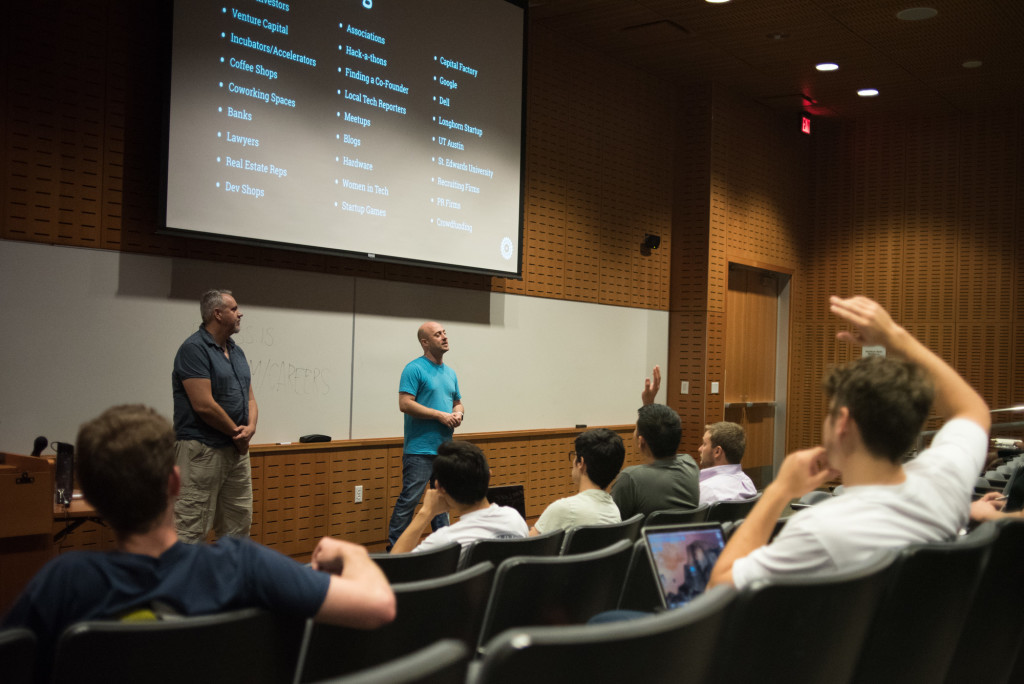
Damon Clinkscales and Joshua Baer teaching Longhorn Startup seminar at the University of Texas at Austin.  Photo by Graham Dickie.

Damon Clinkscales and Joshua Baer teaching Longhorn Startup seminar at the University of Texas at Austin. Photo by Graham Dickie.

The world of tech innovation may be colored by mythological dropout figures — Steve Jobs, Mark Zuckerberg, Bill Gates, Austin’s Michael Dell — but at the University of Texas, a course called Longhorn Startup is showing how students can stay in college and still pursue the next Facebook.

Or, to use some ideas from last semester’s group of enrollees, Longhorn Startup is showing how they can start the “Uber for dry cleaning,” the “Netflix and AirBnB for cosplay,” or a powdered drink company while studying for an engineering midterm happening right down the hallway.

Now in its fifth year at UT, the course teaches students through a mixture of talks from community figureheads, Ask Me Anything sessions (lingo borrowed from the website Reddit), and mentor programs. In the fall it functions as a once a week, seminar-style class, and in the spring it becomes a full, one-on-one lab experience about furthering a specific business venture.

In a typical session, Longhorn Startup could include a visit from Bob Metcalfe, the inventor of Ethernet, free pizza sponsored by a business like HomeAway, discussion on how to sell a company, and 30 minutes set aside for open pitches to like-minded peers, most of whom have serious entrepreneurial ambitions. It’s a place for ideas and people to meet.

“It always helps when you’re in a class with people who are similar to you,” said Nelson Tao, who started the so-called “Uber for dry cleaning” with classmate Ryan Norton. “Students are all out there, but it’s just random, different mentalities. It’s very helpful when everyone’s all clustered together.”

On a recent Thursday, inside the gleaming Bill and Melinda Gates Computer Science Complex on the east side of campus, the course’s main instructor, Josh Baer, is giving a history lesson. Baer is a looming figure in the Austin startup scene: In addition to his work with Longhorn Startup, he is the founder of Capital Factory, the downtown crossroads for tech life here that President Obama once visited.

He starts by showing a Youtube video involving jelly beans that draws an analogy about why one should take advantage of every day and do something special. He then begins a discussion about the many people who followed that advice in Austin, giving a primer on the startup scene here back to its origins in the early 1980s.

Baer goes on to note the big Austin success stories of the last few years (HomeAway, RetailMeNot, BazaarVoice) and lists current office spaces available for entrepreneurs, Capital Factory among them.

The class closes with a Q&A session alongside fellow startup guru Damon Clinkscales. The students quickly begin asking: “What’s the importance of a convertible investment?” “Is it appropriate to pass out fliers for our business at another startup’s party?” “How do I stop people from stealing my intellectual property?”

“I wouldn’t say they all have ideas,” Longhorn Startup teaching assistant Sanchana Vasikaran said. “But I think every single student has the same drive and motivation and desire to have a startup or are interested in the startup community.”

Lessons for the class have also touched on somewhat arcane concepts like accelerated financing, how to find a co-founder, and, in the case of student Abel Hernandez, the importance of fashion choices. (Remember the controversy around Zuckerberg’s hoodie during his initial public offering presentations?)

“Always dress nice,” Hernandez says. “Don’t ever show up with a pair of shorts and a T-shirt, raggedy hair and some piercings. Don’t go like that. As much as we’re trying to change the idea that it’s okay, to investors you seem like, ‘You shouldn’t do anything with him.’”

But despite all this information and the large amount of resources available to the class, the startup community on campus is “a little underground,” said Margaret Efthim of Longhorn Entrepreneurship Agency, another organization for student entrepreneurs.

According to Efthim, though, that community is growing every year, and Longhorn Startup serves a big portion of it.

Vasikaran added that the enthusiasm is there — it just comes to down to publicizing what’s being offered.

“If more students were aware of the resources that programs like Longhorn Startup program and Longhorn Entrepreneurship Agency are able to provide, I feel like more students would be involved in this community and more startups would probably be formed at UT,” Vasikaran said.

The serious work for Longhorn Startup, and the students who are still interested in the “underground community,” will start in the spring semester. A handful of nascent companies from the fall seminar advance, and the students behind them will receive credit hours and ample personal time with Baer and community mentors to flesh out their ideas.

Tao, who is behind the dry cleaning app, is already building his case.

“Today we had order number 13,” Tao said. “And order 13 is pretty neat because it was a repeat customer.”

On its website, Longhorn Startup has an extensive list of past companies that have crystallized with help from the class. Cerebri, a creation from this last spring, is focusing on rebuilding how call centers function and recently won $100,000 through a competition. Many others from the first few semesters still maintain social media pages and websites, and the class’s yearly demo day dependably generates local press coverage.

So even though the attendance is still relatively small, Longhorn Startup appears to have struck a chord with more than a few students and the larger Austin tech ecosystem. Dell, the computing magnate who famously found success after a premature exit from UT, has even come to speak to the class.

“You don’t have to drop out of college [to build a successful startup],” Efthim said. “Being at UT gives you some huge advantages.”

Editor’s note: Graham Dickie is a student at the University of Texas at Austin. He wrote this story for Professor Rosental Alves’ Entrepreneurial Journalism class. It is reprinted here with permission.

Oracle Plans Massive New Austin Campus

searchOracle Tuesday announced plans to build a 560,000-square-foot campus and parking development on 27 acres on the waterfront of Austin’s Lady Bird Lake.

In addition, Oracle is buying an adjacent 295-unit apartment building for employees to live and “to support a work-life balance.” The campus located in the Lakeshore Development area will be focused on Oracle’s cloud expansion.

Oracle also announced plans to expand its local workforce by 50 percent during the next few years. The company declined to disclose how many employees it currently has in Austin. The Austin Chamber of Commerce reports Oracle has between 1,000 and 2,000 employees in Austin. The new jobs will be in Oracle Direct, its cloud sales organization. The company plans to hire a lot of recent university graduates and technical people early in their career.

“There are several reasons we picked Austin. It has a very vibrant technology community,” said Scott Armour, senior vice president of Oracle Direct. “It provides us the ability to acquire and retain the talent we need. I also think if you look at Austin it’s very well placed with universities in the area.”

The campus combined with company owned housing is a unique setting for Oracle, which is based in Redwood City, Calif. It will be designed with a special focus on the needs of millennials, Armour said.

Oracle, founded in 1977, has 130,000 employees worldwide. The company operates ten facilities in Texas and has a data center in Austin. Oracle has 400,000 customers across 145 countries. For fiscal 2015, Oracle reported total revenue of $38.2 billion and net income of $9.9 billion. Oracle sells software, Cloud computing infrastructure, hardware and services.

Last week, Oracle announced its acquisition of StackEngine, a year old Austin-based startup focused on cloud computing. All of the employees of StackEngine will join Oracle, the company announced. The financial terms of the deal were not disclosed.

“What Oracle is doing in Austin reinforces what I’m talking about when I say that great cities do big things, especially in the technology sector,” Austin Mayor Steve Adler said in a news release. “With this significant investment, Oracle demonstrates that it believes in Austin and its future, and it’s serious about creating fantastic job opportunities in our community. I look forward to working with major employers like Oracle to tackle our biggest challenges, including Mobility and Affordability.”

“We’re positioning the State of Texas to become a home for innovation and technology,” Texas Governor Greg Abbott said in a news release. “Thanks to our skilled workforce, combined with our low-tax and low-regulation environment, one of the largest tech companies in the world has chosen to expand in Austin. As Governor, I will continue to pursue policies that invite the expansion and relocation of tech companies to Texas.”

Julie Huls to Resign as President of the Austin Technology Council

Julie Huls, photo courtesy of the Austin Technology Council.

Julie Huls, photo courtesy of the Austin Technology Council.

Julie Huls, the president of the Austin Technology Council, confirmed she is leaving the nonprofit organization in the first quarter of next year.

“I’m super proud of what we have built together,” Huls said. “I’m totally confident the organization will continue to expand, support and strengthen Austin’s technology industry.”

Huls has led the Austin Technology Council for the past six years. During that time, the organization has expanded its membership and grown its revenues and assets. And it recently moved into new headquarters at 301 Congress.

Huls doesn’t have any plans to announce for her next move. She plans to stay in Austin. The organization wanted to wait to announce the leadership change until they found a new president, but word leaked out early. ATC has organized a search committee to find a new president and it may hire an outside search firm, Huls said.

“Now is a great time for a new leader,” Huls said. “The fundamental pillars are in place.”

Huls compared the experience of running the ATC for the past six years similar to the demands of running a startup.

The ATC, founded in 1992 as the Austin Software Council, operates as an independent nonprofit 501-C6 organization. It also runs the ATC Foundation, a separate 501-C3 organization.

The ATC reported revenues of $584,774 for fiscal year 2013, compared to revenues of $319,235 in 2012, according to its latest 990-tax report filing. The organization also had net assets of $102,266 in 2013, compared to $46,331 a year earlier.

A year ago, ATC formed the Austin Technology Partnership with the City of Austin. It has an annual budget of $775,000 with the city contributing $294,500 and the rest of the money coming from the private sector.

ATC has three full time employees and four interns from the MBA program at St. Edward’s University. Austin’s tech industry has an annual regional economic impact of $21.5 billion and supports 26 percent of the area’s jobs.

The ATC has 280 companies as members representing 1,600 executives and more than 60,000 employees in the Austin area.

Oracle Acquires Austin-based StackEngine

pbuw8i0trst6atnkxbieOracle announced last Friday that it has acquired StackEngine, a year old Austin-based startup focused on cloud computing.

All of the employees of StackEngine will join Oracle, the company announced. The financial terms of the deal were not disclosed.

Last October, StackEngine, a platform for Docker apps, announced it had raised $1 million in seed funding from Silverton Partners and LiveOak Venture Partners. In June of this year, the company raised $3.5 million in a Series A round.

Bob Quillin, Eric Anderson and Robert Gordon, formerly of CopperEgg, Hyper9 and VMware, founded the company.

StackEngine’s sale to Oracle is the first exit for LiveOak Venture Partners, a $109 million venture capital firm based in Austin.

“This is a great outcome for the team, the investors and the Austin technology community at large,” Krishna Srinivasan, co-founding general partner at LiveOak Venture Partners and previously a board member at StackEngine, said in a news release. “StackEngine perfectly fits the mold of us being the first institutional investors behind visionary entrepreneurs who disrupt the status quo with exciting technologies here in Texas. We look forward to many more exciting outcomes from the 13 companies in our portfolio and future investments.”

A Faster Internet Accelerates Disruption of the Status Quo

imgres-3By BOB METCALFE
Reprinted with permission

Ahoy!

What is today’s single most impactful driver of human progress?

Connectivity AKA Networking AKA The Internet.

The Internet is spreading rapidly, already reaching half the human race since turn-on in 1969. And with the Internet’s spread come freedom and prosperity. Democracy and Free Enterprise.

The Internet’s speed is increasing — we are now building out the Gigabit Internet. Not so long ago we carried ASCII on the Kilobit Internet, starting in the 1970s. Then Powerpoint. Then voice. Now video on the Megabit Internet, since the 1990s. Soon the Gigabit Internet and what? augmented and virtual reality…

The Internet’s mobility is increasing as smart mobile phones proliferate. A big next step will be the Internet of Things (IoT) — we’re just now finding out some of the earlier “things” to be networked — phones, thermostats, watches, cars, robots…

And we continued being surprised by the new innovations that are enabled by this new connectivity, delivering on network effects. We are befuddled by the Unicorns, all enabled by the Internet and the power of its connectivity.

Industry after industry is being disrupted, for the good, as each has its uber moment. We were surprised by the Internet’s disruptions of computing, memos, mail, telephone, television, journalism, advertising, books, music…

Next up, way bigger industries: energy, education, healthcare…

The status quo is big and mean — am looking at you, FCC — but it’s quickly overwhelmed by network effects.

Connectivity. Networking. The Internet.

Merry Christmas! and Happy New Year!

Bob Metcalfe is professor of innovation at the Cockrell School of Engineering at the University of Texas at Austin, visiting innovation fellow at MIT, Ethernet co-inventor, 3Com founder and partner emeritus at Polaris Partners. This post was reprinted with permission. It first appeared on Facebook.

Bob Metcalfe

Diversity Fund Helps Women, Gay and Minority Businesses Get Funded

Charlie Jackson, founder of the Diversity Fund in Austin. Courtesy photo.

Charlie Jackson, founder of Diversity Fund in Austin. Courtesy photo.

Diversity Fund recently launched in Austin and aims to help startups and ongoing businesses raise capital through equity-based crowdfunding.

In particular, Diversity Fund, founded by Charlie Jackson, aims to help women, LGBT and minority-led businesses get financing directly from investors through debt or equity funding up to $1 million a year for any Texas business.

The portal also helps investors find deals to put their money into. Jackson recently answered some questions about the business and why it’s needed in Austin and Texas.

Q. What is the Diversity Fund?

690964-62d44b32fb6926aedd4c72690c1e51dd-medium_jpgA. Diversity Fund is an online finance portal, operating under the new securities crowdfunding rules, that allows business to sell equity to or borrow money directly from investors. (We are currently operating under the Texas State Securities Board equity crowdfunding rules.)

Q. How does the Diversity Fund portal work?

A. Businesses decide how much money they need to raise, sign up, select whether they want to offer Rewards, Lending, Equity or any combination and launch their deal. When their “deal” goes live, investors are then able to finance these businesses directly from the business (securities rules require that deals be available for a minimum of 21 days for investors to view, ask questions, and perform their own due diligence) and invest in local businesses right in their own city. Under these new rules, ANY Texan can now be an investor regardless of income (previously only “accredited” investors had access to such deals).

Q. Why did you decide to create it?

A. Businesses always have a challenge raising capital unless they already have assets or have been in business more than two years. We wanted to provide them a faster and easier way to get financing using the crowdfunding model while at the same time provide investors a way to participate directly in business finance.

Q. Who is your customer?

A. We specifically focus on women, LGBT, and minority-led businesses. Although these make up the majority of all small businesses, they traditionally have had a harder time achieving funding.

Q. What sets you apart from your competition?

A. We offer a simplified way for businesses to raise capital and for investors to directly participate in the funding of Texas businesses.

Q. Are you bootstrapped? Do you have VC funds or Angel investment?

A. Bootstrapped so far. No outside financing to date.

Q. Why is this fund needed in Austin?

A. Austin has lots of entrepreneurs and a great support system for hi-tech startups, but has lacked in good financing for other types of business.

Q. What is your biggest accomplishment so far?

A. We’ve already gone live with three businesses and have many more seeking us out to participate in the portal.

Q. What is your biggest mistake?

A. Like many startups, it has taken us a bit longer to launch than we originally planned.

Q. How do you get the word out about Diversity Fund?

A. We market through a variety of channels, particularly by focusing or organizations (online and offline) that support entrepreneurs in our target market.

Q. How many employees do you have?

A. We have a team of six.

Q. Where are you located in Austin?

A. We don’t yet have offices, but plan to locate downtown.

Q. What Austin resources have you drawn on to help launch Diversity Fund?

A. Network of friends and contacts (I’ve worked on hi-tech startups in Austin for the past 20 years).

Q. What else would you like to mention?

A. Although we’re relatively new, we are excited about this business model, already expanding throughout Texas and look forward to a national launch in 2016.

Everfest Indexes Festivals and Captures Memory Rich Experiences

By GRAHAM DICKIE
Special contributor to Silicon Hills News

Inside the offices of Everfest in Austin, photo by Graham Dickie.

Inside the offices of Everfest in Austin, photo by Graham Dickie.

Right up the hill from the pandemonium of this month’s Trail of Lights and inside a former accounting firm is the office of Everfest, a tiny Austin startup working on the fringes of the same festival industry but forging a worldwide path.

On a recent Monday it is a low-key scene there. Two coders are slouched over in the backroom working on a beta version of the company’s app, a box fan hazardously tied to the ceiling acts as air conditioning, and founder Paul Cross is sitting down to wax philosophically about Everfest’s mission.

Cross dubs Everfest, which is vying to build the definitive digital ecosystem for all kinds of real-world festivals, “a giant positive memory dispenser.” He talks about a time he hiked to a remote Scottish beach that doubled as his “aha! moment” for the startup. And, sounding like a Burning Man attendee on the comedown, he balls his hands up to mimic the shape of a brain, “this ball of gray matter,” to discuss societal shifts he has been researching that have created the conditions for Everfest to succeed.

A veteran of entrepreneurialism, Cross has the eccentric, self-mythologizing startup spiel down to a tee.

He explains that, as he deciphered it when Everfest was in utero, young people today care about the value of experience more than the value of commodities. He says they want to be memory-rich, not cash-rich, a shift that likely has contributed to today’s booming festival culture. (Almost one-tenth of the US population attended a music festival in 2014, according to Billboard.)

The abundance of festivals, Cross continues, presented a couple of untouched areas for Everfest to capitalize on: festival enthusiasts had no comprehensive authority to look to online, and many festivals couldn’t provide their own digital frameworks.

Established in late 2014 by Cross and his friends Brad Dixon and Jay Manickam, Everfest wants to be that authority. The company now has a staff of “10-ish,” employee Adam Greenspan said. It has positions devoted to festival outreach and coding, but it is at a pre-funding stage where titles are not important and office doors can be torn off the hinges to be used as beer pong tables. (There is also a sign near the front door laying out formal beer pong rules.)

Everfest employees Amir Mozafari (left) and Adam Greenspan, photo by Graham Dickie

Everfest employees Amir Mozafari (left) and Adam Greenspan at the Pecan Street Festival in Austin, photo by Graham Dickie

As a service, Everfest is straight-forward. It consists of two major parts – a website and an app. Together they are supposed to encompass the before, after, and during of a festival visit.

The website is like an index, serving up the essentials of individual events: their line-ups, when and where they are happening, links to social media pages, and other relevant information. The app resembles large festivals’ current offerings. Its purpose is to give users what they need to know – like where the bathrooms are – and then to get “the hell out of the way” Greenspan said. Because of Facebook integration, you can find your friends and stage a meet-up point with a built-in map interface.

Everfest is not limited to music festivals like Austin City Limits. On its website it lists 11 additional categories, ranging from “Faith” to “Historical.” In a section labeled “Unique,” you can find gatherings like the Texan Onion Fest or the Pushkar Camel Fair in India (it lasts for more than two weeks in late November). The company estimates its database encompasses around 8,000 events, and what is unique is how it has consolidated them all under one roof.

Cross hopes people will eventually use the service to inform, index and record their experiences at all these types of festivals, sharing and adding to Everfest’s catalogue in the process – turning it into a kind of rich, personal wiki for large events.

The concerns right now for the company are building up the website; strengthening the mobile app, which is available on iPhone and Android and should enter beta soon (“I wish they would give us some credit for just building the first alpha version,” Cross laments at one point when asked about negative reviews); and continuing to court promoters around the world.

“What we’ve made is a free mobile app that we’re giving away that gives [festivals] all the benefits of their own mobile app,” festival outreach coordinator Amir Mozafari said. “It’s a true partnership. We help them out, they help us out.”

The Pecan Street Festival, a bi-annual arts event that takes place on Sixth Street, is a good example of how Everfest works with festivals. Pecan Street, which is run by a non-profit organization, chose Everfest as its official app and main sponsor this year. It was a gesture of goodwill from both sides, which Everfest says it is eager to extend to other festivals that are not about making money.

This is not the first time the Pecan Street Festival has had an app, but it is the first time it has gotten one for free. Around four years ago, they paid an independent developer a hefty sum to build them one, festival organizer Luis Zapata said. Two years later, though, the developer abruptly disappeared and the app disintegrated from the marketplace without their approval.

Paying tens of thousands of dollars for another app, a reality that many small festivals face, was out of the question until Everfest approached the Pecan Street heads.

“Everfest came along and basically answered all of our prayers on that front,” Executive Director Debbie Russell said. “There hasn’t been a database of festivals to date. This is filling that void.”

While Everfest worked closely with the promoters to design the Pecan Street Festival’s profile, in the future they hope to build an interface that is intuitive enough for festivals to design their own assets – maps and so on – for the app.

“We’ll work with anybody,” Mozafari said. “Any genre, any kind of size.”

Cross and Greenspan said that for interested promoters and the users Everfest will continue to be free at some level, adding that revenue could come in the future from things like booking travel accommodations for out-of-towners.

“We know that if we get certain levels of traffic we’ll be able to monetize that traffic,” Greenspan said. “It’s kind of scary to do that but it’s an approach. That’s what we’re doing, man.”

Thinking back to his hike in Scotland that birthed Everfest and his central axiom of how an experience like it is worth more than a dollar, Cross also has other goals in mind aside from money.

“This is a mission to bring this thing together,” Cross said. “We need more and more people to enjoy festivals together. I need them to do that.”

Authors.me Declaws the Publishing Process

By SUSAN LAHEY
Reporter with Silicon Hills News

Authors.me Developer Uzair Rahim, Authors.me Co-Founder Monica Landers and Henrik Kjallbring, developer with Authors.me

Authors.me Developer Uzair Rahim, Authors.me Co-Founder Monica Landers and Henrik Kjallbring, developer with Authors.me

Getting a book published the old fashioned way—through the agents and publishers who have the power to lift the work from obscurity—has a lot in common with finding investors for your startup.

Just getting to “No” is a torturous process.

First you have to find the companies that deal with your particular kind of book—and god forbid it doesn’t fit neatly into a genre box. You have to collect tons of information on things you never knew mattered—like whether you have a platform and how many books like yours have sold recently. And once you’ve submitted it all, you have to wait for the inevitable rejection before you can do it all again for a different agent or publisher.

Monica Landers had done that process for a book she wrote on her adventures as a producer for ABC News, which inspired her to co-found Authors.me. Authors.me is a platform to connect writers to agents or publishers. It helps writers create a profile with all the information agents and publishers need, and can arrange the connection between, say a Young Adult Science Fiction/Fantasy writer and the companies that are looking for that kind of book. Since the site launched in July, they’ve facilitated 15 book deals.

It’s all about user experience. From the author side, said Landers “Trying to talk to publishers is very repetitive, you get no feedback, it’s just a soul crushing experience.” From the publisher side “They have to make sure they don’t miss the next best seller. But they get queries that don’t have enough information even to know if it’s a good fit. It takes a lot of back and forth.” Unfortunately, when publishers or agents start asking questions, authors assume they’re about to get a book deal when, in fact, the agent or publisher may just be gathering enough information to confidently say no.

“Publishers do have a heart and this is the least favorite part of their job. That’s why writers don’t hear back,” Landers said.

Matchmaking for Authors/ Publishers

Publisher Acquisitions

Authors.me lets writers know when agents or publishers have taken a peek and when they have taken the book “in-house” for a closer look. It gives both parties a place to communicate without a hailstorm of emails.
One of the most groundbreaking features is the platform’s “Discovery” feature that pings publishers and agents when a certain type of project comes in, even if the author hasn’t specifically queried them, giving more books an opportunity to be found.

That’s one of Francesca Lampert’s favorite features. Lampert is the chair of the acquisitions committee for Little Pickle Press in the Bay Area, a children’s book publisher that prides itself on being early adopters. They were among Authors.me’s first publishing houses, migrating from the company’s biggest competitor, Submittable.

“The user interface is one of the most important parts,” Lampert said. “Submittable didn’t have the photos, it wasn’t color coded, it didn’t have the bios.” With Authors.me, she said, there are opportunities to make notes on each work and have reminders about where each submission is in the process.
It’s free for authors to use the service to create queries but if they want feedback, want the “Discovery” feature, want Authors.me to match them with agents and publishers and some other features it costs $19 a month.

Launching a Solution

Self-publishing, which seems like the obvious solution to running the gauntlet of finding a publisher, has produced a flood of books—about 600,000 in 2014 alone. But as Authors.me subscriber, writer Andy Cole points out, there are no gatekeepers. It’s so easy and inexpensive to self-publish a book, that anyone can do it within a matter of hours and it’s difficult for readers to distinguish between the good books and the slush. With a professionally published book, at least certain standards are assumed.

Author and journalist John Christensen self-published Perfect Swing, Imperfect Lies: The Legacy of Golf’s Longest Hitter. A long time freelance writer who has written about and encountered many celebrities over his career, Christensen was baffled by Perfect Swing’s lackluster success, especially given golf’s popularity. He signed up for Authors.me as soon as he learned about it, then met David O’Brien, co-founder of Authors.me, at a book fair in Christensen’s home town of Decatur, Georgia.

Since writing a book is such a time consuming labor of love, Christensen was thrilled to learn that—since he’s published two books already—just submitting a treatment of his next book project on Authors.me was sufficient to possibly generate a deal.

Landers and O’Brien and developer Henrik Kjallbring, started building Authors.me in December of 2014. Landers had written a book about her experiences as a reporter and had loved that part of the project. But when she started the process of selling it to agents or publishers, she realized, the fun part was over. She never published that book. Later she worked as director of content for Pagewise, vice president of media innovation for Demand Media and vice president of operations for Written.com. O’Brien is a writer, and founder of FanU, Gold Brothers Entertainment and GBE Interactive. They began by thinking through all the problems they could solve with the right platform, then interviewed publishers and agents about what would make the whole arrangement easier for them. Publishers and agents who use the site have a link that lets authors submit through it, streamlining their process. The company has a ways to go to build its critical mass of writers, agents and publishers before everyone finds a match. The bulk of its publishers, right now, publish fiction. The company recently opened a New York office to connect with the publishing world there, and is currently raising seed investment.

“We really looked for how we can instantly impact writers, publishers and agents, even before we have 10,000 writers onboard,” Landers said. “On the other hand, having a small population right now gives them an opportunity to massively stand out.”

RetailMeNot Brings Christmas Early to the Town of Coupon

RMN-PayItForward-Instagram-1447461270RetailMeNot, the world’s biggest online deal site, brought a lot of Christmas joy to the 73 residents of Coupon, Pennsylvania.

The Austin-based company gave the town a surprise recently. RetailMeNot collected the Christmas wish lists of people from the town of Coupon. But they weren’t wishes for themselves. They were presents for their neighbors. And then RetailMeNot purchased the gifts and held a big party at one of the resident’s houses to give them away. One family got a new porch swing. Another got a new refrigerator. And one couple with two young little girls got an all expense paid trip to Disneyland.

The true spirit of Christmas is it’s better to give than to receive, said Brian Hoyt, spokesman for RetailMeNot. RetailMeNot offers online coupons and it has a mobile app that allows consumers to save money on purchases.

RetailMeNot created the #SaveItForward campaign as a way to promote goodwill and charitable causes throughout the holidays.

« Older posts Newer posts »

© 2026 SiliconHills

Theme by Anders NorenUp ↑