Category: Austin (Page 143 of 318)

Spotlighting Women at SXSW on International Women’s Day

Beauty Woman Silhouette with Hands in High holding a Rose for Women's Day, Vector IllustrationWomen@Austin has put together a list of events of interest to women at South by Southwest this year.

On International Women’s Day, it seems like a good time to share these resources and some more Silicon Hills News highlighted.

Jan Ryan, head of Women@Austin, put together a list of events and emailed them to members of the Women@Austin group to put a spotlight on women in technology at SXSW Interactive, the nation’s largest technology conference.

Diversity and inclusion are big topics at this year’s SXSW and many panels are devoted to them. It’s also a huge topic of discussion in the technology industry. That’s because less than three percent of venture capital goes to companies run by women, according to a 2014 report on women entrepreneurs by Babson College.

And even though women make up half the population and more than half the workforce, they are underrepresented in technology jobs.

“Just 12 percent of engineers are women, and the number of women in computing has fallen from 35 percent in 1990 to just 26 percent today,” according to a 2015 report by the American Association of University Women.

SXSW offers a great opportunity in which to talk about these issues and to explore more opportunities for women in technology.

Among the events Women@Austin spotlighted, was a gathering at the Dell Lounge, an interactive venue at Brass House at 115 San Jacinto Blvd. on Saturday from 8 a.m. to 10 a.m. The event focuses on Women in Tech, Policy and Entrepreneurship and features Rep. Suzan DelBene, Rep. Susan Brooks and Karen Quintos, Dell Chief Marketing Officer. They will discuss the role of public policy in empowering women entrepreneurs.

The following events were highlighted by Ryan of Women@Austin for SXSW:

Funding is always a big issue for any entrepreneur. On Friday, a panel on “Is the Venture World a Meritocracy” will take place in Salon D at the Hilton at 12:30 p.m. The featured speakers include Elizabeth Gore with Dell, Sara Brand with True Wealth Innovations and Lisa Lambert with Intel.

Jan Ryan, director of Women@Austin, courtesy photo

Jan Ryan, director of Women@Austin, courtesy photo

Entrepreneuring Austin Women on Saturday at 3:30 p.m. in the Austin Chamber Offices at the Hilton. The panel features Kerry Rupp with True Wealth Ventures, Jan Ryan with Women@Austin, Laura Bosworth with TeVido Biodevices and Amy Millman with Springboard.

Take No Sh*t: Thrive as an XX in an XY World, Tuesday at 11:00 a.m. Featuring Heather Brunner with WP Engine, Aaron Burcell with Vevo, Julie Huls with Austin Technology Council and Sara Spivey with BazaarVoice.

Lessons from Top Companies from Women Technologists, Monday at 12:30 p.m. , featuring Inhi Cho with IBM Analytics, Julian S Green with the Anita Borg Institute, Nancy Lee with Google and Shelly Swanback with Accenture Digital.

Afternoon Tea for Women in Tech put on by UK Trade & Investment at the Great Britain House on Monday at 2:00 p.m. Featuring Heather Brunner with WP Engine, Sara Brand with True Wealth Innovations and Nadya Powell with Sunshine, discussing female leadership in technology.

In addition, the following events might also be of interest to female entrepreneurs and everyone interested in diversity and how to be more inclusive.

On Sunday, Galvanize, Tech Inclusion and the Clinton Foundation’s No Ceilings initiative have come together to create a day long event featuring panel conversations, solo talks and networking opportunities on inclusion. Featured speakers include Megan Smith CTO of the U.S., Tracy Chou from Pinterest and Wayne Sutton co-founder of Tech Inclusion.

The Power of Perception: Media and Women in Tech on Sunday at 12:30 in Salon F of the Hilton. This discussion features Connie Guglielmo, editor in chief of CNET News, Elizabeth Ames, senior vice president of the Anita Borg Institute and Isis Anchalee, software engineer.

How to Recruit for Diversity and Achieve Inclusion on Monday in Salon 6
at the JW Marriott at 110 E 2nd St from 5 p.m. until 6 p.m. This talk is by Ashley Doyal and Gina Helfrich, co-founders of recruitHER.

Helfrich also did this post on Medium listing even more diversity events and mixers taking place this week and throughout SXSW.

And an extra special bonus is the talk by First Lady Michelle Obama at SXSW Music on Wednesday to discuss the Let Girls Learn initiative, which aims to break barriers for the 62 million girls around the world who are not in school today. SXSW will release the details of her talk soon.

SXSW Holds Ticket Drawing for President Obama’s Keynote

President Barack Obama, courtesy photo.

President Barack Obama, courtesy photo.

South by Southwest Tuesday released details on President Barack Obama’s keynote address this Friday in Austin.

It will be held at 2:30 p.m. at Dell Hall at The Long Center.

But tickets are limited. To be considered, SXSW Interactive, Gold and Platinum badgeholders must register for a drawing. No other credentials are eligible to enter. Randomly drawn winners will be notified Thursday night.

Evan Smith, Editor in Chief and CEO of The Texas Tribune, will interview President Obama. The Texas Tribune is also asking the public to send their questions to the Tribune.

“If you don’t win or can’t make it, this will be live-streamed on sxsw.com/live and simulcast throughout our Conference venues including Ballrooms D and EFG, and Room 18ABCD at the Austin Convention Center,” according to SXSW.

Over Regulation is Weird and That’s Not a Good Thing

Opinion Piece

Chelsea Collier, courtesy photo.

Chelsea Collier, courtesy photo.

By CHELSEA COLLIER
Special to Silicon Hills News

There has been plenty of attention and activity lately about the sharing economy (Uber, Lyft, HomeAway, AirBNB, VRBO), local regulatory bodies (City of Austin, Austin City Council) and what happens when these groups are at odds with each other. The issue at hand goes way beyond the recent buzz. And all types of businesses should be paying attention.

The short of it is this: when elected officials adopt rules that make it difficult for responsible companies to do business, it’s bad for our city, our state and our nation. And I’m not the only one who thinks so:

• Venture Capitalist Mike Maples cites “hostile” regs as a barrier to investment

• Local leaders like Joshua Baer voice concern that the years spent building the entrepreneurial ecosystem could be threatened because innovation is not being rewarded. (Entrepreneurs don’t do status-quo.)

• Startup founders like Paul Murphy (Founder, Clarify.io) who purposefully chose Austin wonder “Did I make a mistake?”

• Companies with thousands of employees may question locating headquarters and bringing jobs to a city that doesn’t embrace pro-business policies.

After leaving a meeting with concerned executives who gathered to talk about the seriousness of the latest local regulations coming out of City Hall, I tweeted the following:

And wow, was I impressed with the support. In fact, Laura Lorek, the ever-watchful founder of Silicon Hills News, asked me to pen this post because of that tweet and our community’s shared alarm. ‬‬‬

We are all just shaking our heads wondering, “How did we get here?” Whether from newcomers to Austin or longtime tech leaders, the thing I hear most in my meetings is “What in the world is happening? Is this really the way Austin does business?” It’s no wonder people are perplexed. Austin has been lauded as a center for innovation in a state that is known around the world as “wide open for business.” But clearly, policy decisions and bureaucratic processes can impact a City’s reputation in a hurry.

But the good news is that the tech community is rallying, calling for leaders to look forward when governing, to get beyond old constructs and to set the bar for how future-leaning cities manage rapid growth and change. It is our responsibility (and our honor) to widen the dialog with our elected officials and city staff. This is not the time to close our minds, say no or walk away. It’s time to foster a respectful dialog about the needs of our booming city and acknowledge what we can ALL do – together – to encourage investment, bolster our infrastructure and pass smart regulations that serve our citizens instead of driving companies out of town.

It’s kind of a joke when people say, “don’t move to Austin” because everyone knows that will just never be the case. We are an amazing city and we should be proud that people around the country and around the world think the same and want to be a part of it. Shutting the door on companies who want to invest in our city is NOT the answer.

#ATXoutoftouch means we have work to do to acknowledge reality and that there needs to be a better bridge between business and City Hall. I know that we can work together to #KeepAustinSmart and mature into the city that embraces innovation, welcomes responsible expansion and encourages investment in the city we love. I am firmly, loudly and completely committed to this cause and invite you all to join me.

Thank you.

Bio: As Principal of Intercambio, Chelsea guides the direction and intention of the company. Her primary focus is to bring the best people together to do good work. From 2012-2015, Chelsea was the Executive Director Texans for Economic Progress (TEP) and now engages as a Strategic Advisor where she continues to facilitate dialogue between the statewide technology community and elected officials, advocating for greater access to tech education, entrepreneurship and infrastructure. She is also Co-Founder of three startups: Wake Up, a professional and personal development workshop series, Impact Hub Austin, a local effort within a global network to provide co-working and incubation for social and civic enterprises, Mable, a social enterprise that produces modular furniture from sustainable materials manufactured in the USA.

Condé Nast to Open Austin Digital Innovation Center

CondedigitalCondé Nast, the publisher of Wired, Vanity Fair, GQ and The New Yorker, Monday announced plans to open a new digital innovation center in Austin with 50 employees.

The center will serve as the company’s outpost for its digital teams with a focus on engineering and product development for Condé Nast’s digital portfolio.

Condé Nast is one of the first major media companies to open an office focused on innovation in Austin.

“Austin has become an epicenter of digital talent and creativity, and establishing our presence there will not only enable us to accelerate our growth, but it also will provide us with insight into cutting edge technology and keep us at the forefront of the industry,” Fred Santarpia, executive vice president and chief digital officer of Condé Nast, said in a statement. “As the next generation of consumers looks to be informed, entertained and inspired, we will be sure to make our content available to them in the most dynamic and compelling ways on every imaginable platform and device.”

Condé Nast plans to open its office in July with up to 50 employees in the first year including engineers and product and design focused talent. Condé Nast also has digital teams in New York, San Francisco, Chicago and London.

“Condé Nast has a long and storied legacy of providing insightful, high-quality and artistic content, and Austin’s dynamic and innovative community is a natural complement to their mission,” Phil Wilson, Chair of Opportunity Austin, an initiative of the Austin Chamber, said in a news release.

Condé Nast grew its digital audience by 45 percent, year over year, in January of 2016, according to comScore, with six of its brands experiencing their best traffic months ever.

Condé Nast’s magazines include Vogue, Glamour, Condé Nast Traveler, Architectural Digest, and more. Condé Nast also recently acquired Poetica, an editorial tech company.

Indeed Plans to Hire 1,000 Employees in Austin

By LAURA LOREK
Reporter with Silicon Hills News

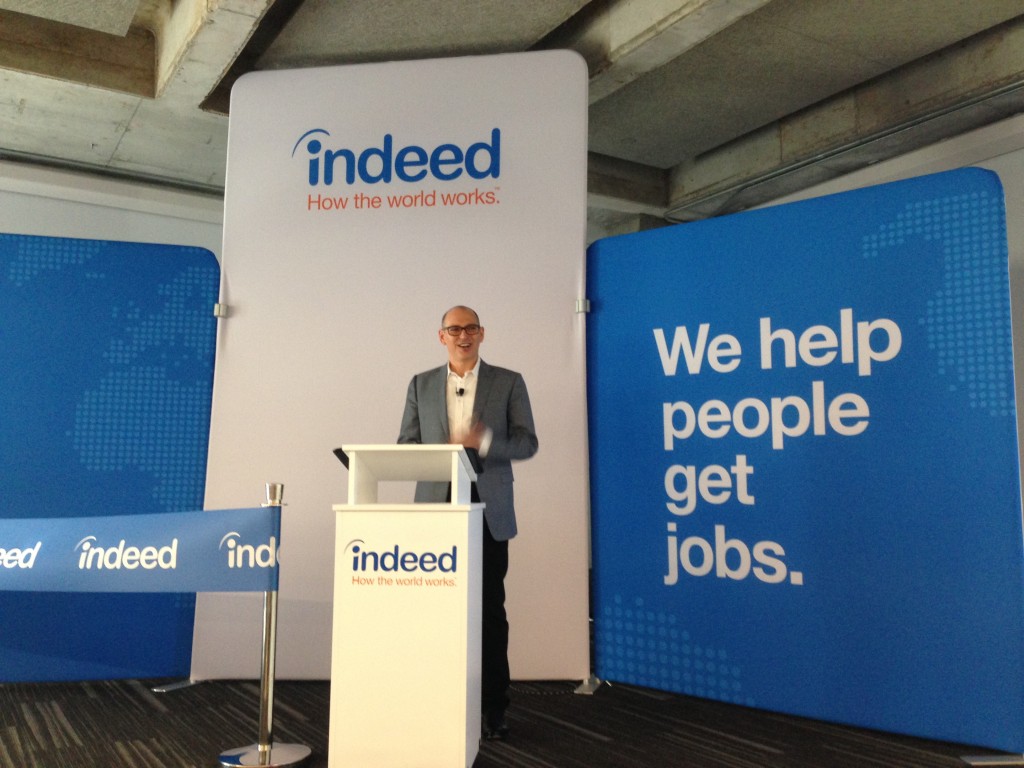
Chris Hyams, president of Indeed, the world's largest job site.

Chris Hyams, president of Indeed, the world’s largest job site.

Indeed started out in 2004 to build a better search engine for jobs.

Today, Austin-based Indeed is the world’s largest job site attracting 200 million unique monthly visitors.

Indeed is focused on how people will find jobs in the 21st century, said Chris Hyams, its president.

“More people find jobs on Indeed than anywhere else,” Hyams said.

IMG_7238
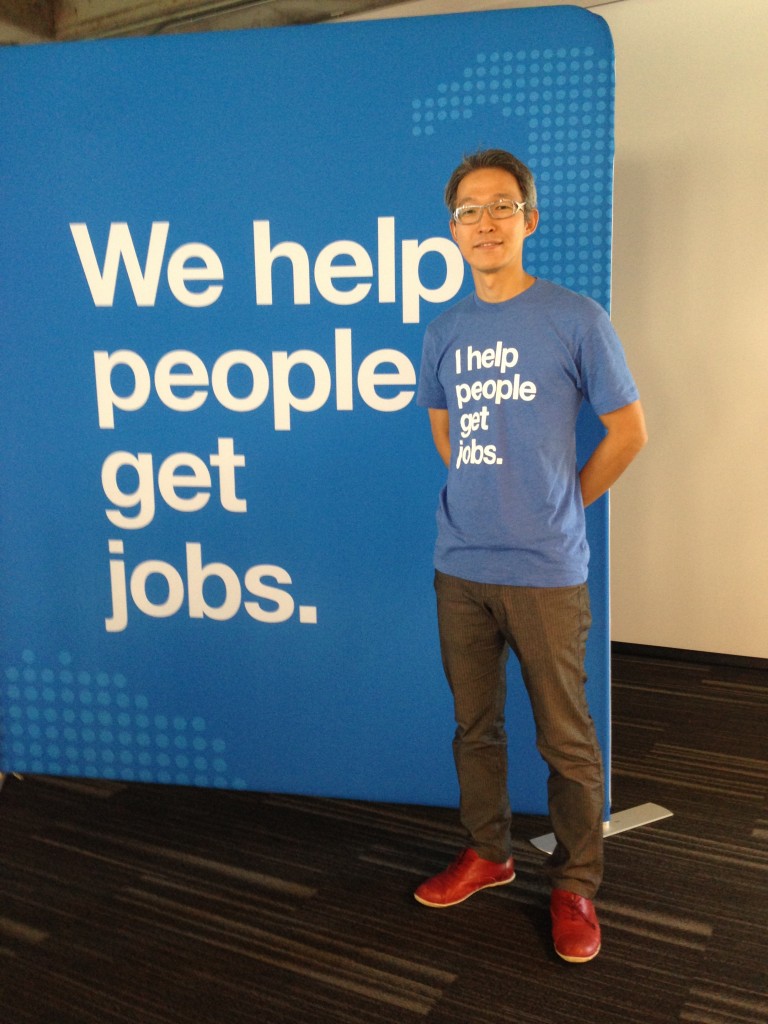
On Friday morning, the home-grown company celebrated a move into its new expansive headquarters at 6433 Champion Grandview Way. At a press conference, Indeed employees wore blue shirts with the company’s slogan “I help people get jobs.” An ice sculpture of the Austin city skyline sat on a table in the company’s new cafeteria along with another table filled with blue and white cupcakes.

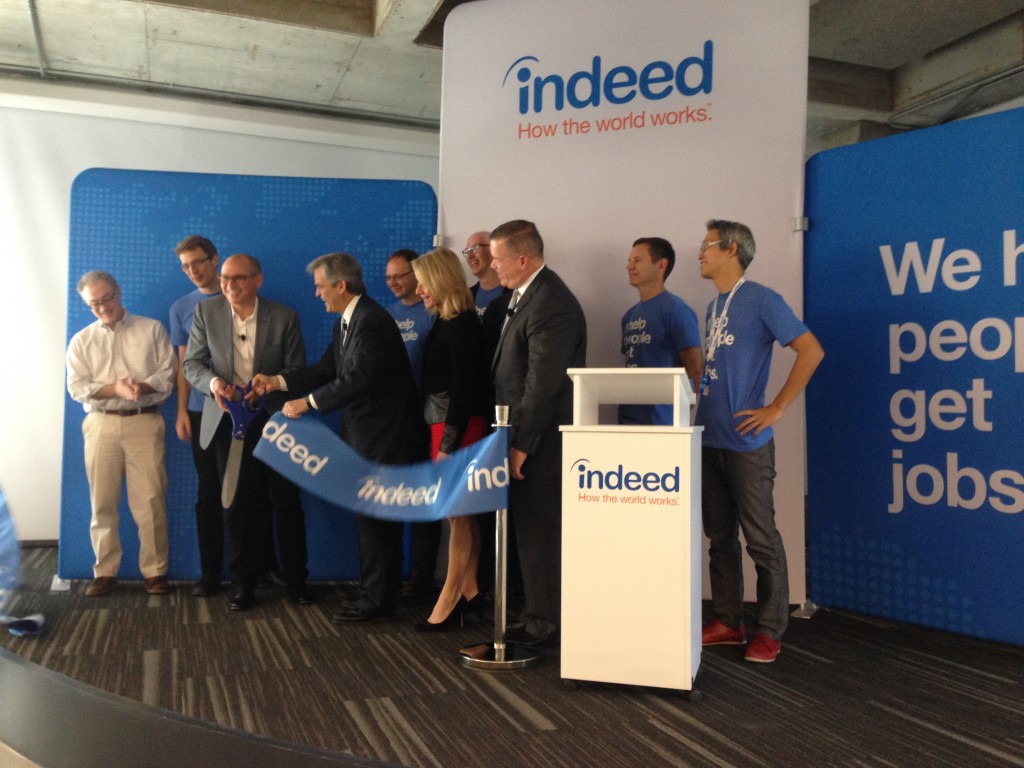
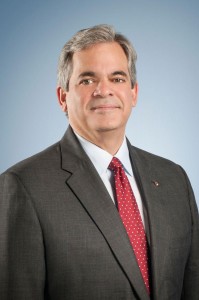
IMG_7259The event included a ribbon cutting with key Indeed employees and executives, City Councilwoman Sheri Gallo, Mayor Steve Adler and Tony Budet, chairman of the Greater Austin Chamber of Commerce.

Indeed occupies an entire building and a few floors of a second building for a total of 220,000 square feet. The company with 500 employees on site plans to hire another 1,000 employees within the next three years, said “Deko” Hisayuki Idekoba, its Chief Executive Officer.

“Deko” Hisayuki Idekoba, Indeed's Chief Executive Officer.

“Deko” Hisayuki Idekoba, Indeed’s Chief Executive Officer.

In 2012, Recruit, a Japanese human resources company, bought Indeed for an undisclosed price. At that time, the company had 350 employees globally and less than 100 in Austin. Now the company has 2,500 employees globally. Indeed operates as an independent subsidiary of Recruit. Austin is the main site for the company’s engineering and development operations. It also has an office downtown at 804 Congress with 100 employees.

The growth of Indeed mirrors the growth of the city of Austin, said Mayor Adler.

“Everyone who comes to Austin knows the Austin they came to,” Adler said. He arrived in 1978 when Austin was the nation’s 42nd largest city and it only had two tall buildings downtown. Today, those two buildings are indistinguishable from all the mammoth skyscrapers that have since been built and Austin is the nation’s 11th largest city. It is the fastest growing metropolitan area in the country for the past four years, growing 30 percent faster than its nearest competitor, Adler said. More than 100 people move to Austin every day.

“So goes Indeed.com, so goes Austin,” Adler said.

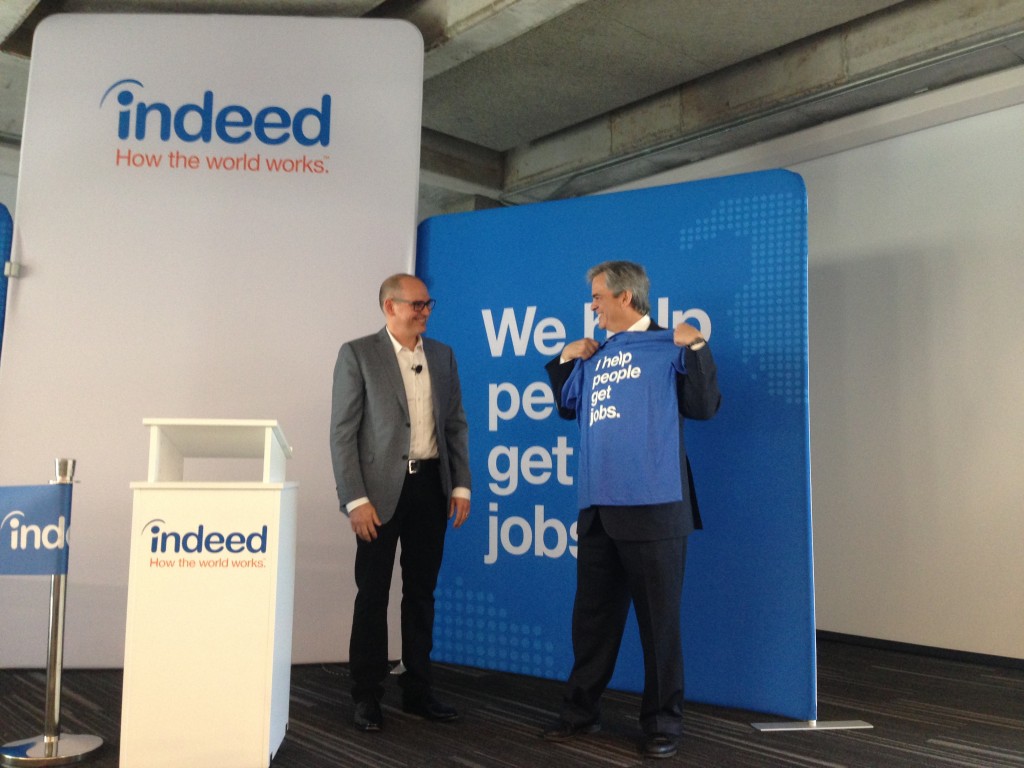
Indeed's President Chris Hyams gives Austin Mayor Steve Adler an Indeed company shirt.

Indeed’s President Chris Hyams gives Austin Mayor Steve Adler an Indeed company shirt.


Austin is innovative, young, hard driving and growing, he said.

“Austin is the music, Barton Springs, UT,” Adler said. “It’s a culture, a creative entrepreneurial spirit. It’s a city where it’s OK to fail.”

And Austin is a little bit weird and that’s good because it’s linked to creativity and innovation, Adler said.

And it’s going to continue to grow.

From Indeed’s job searching data, the company can see 50 percent of the searches for Austin jobs come from people living outside of Texas, Hyams said.

IMG_7242
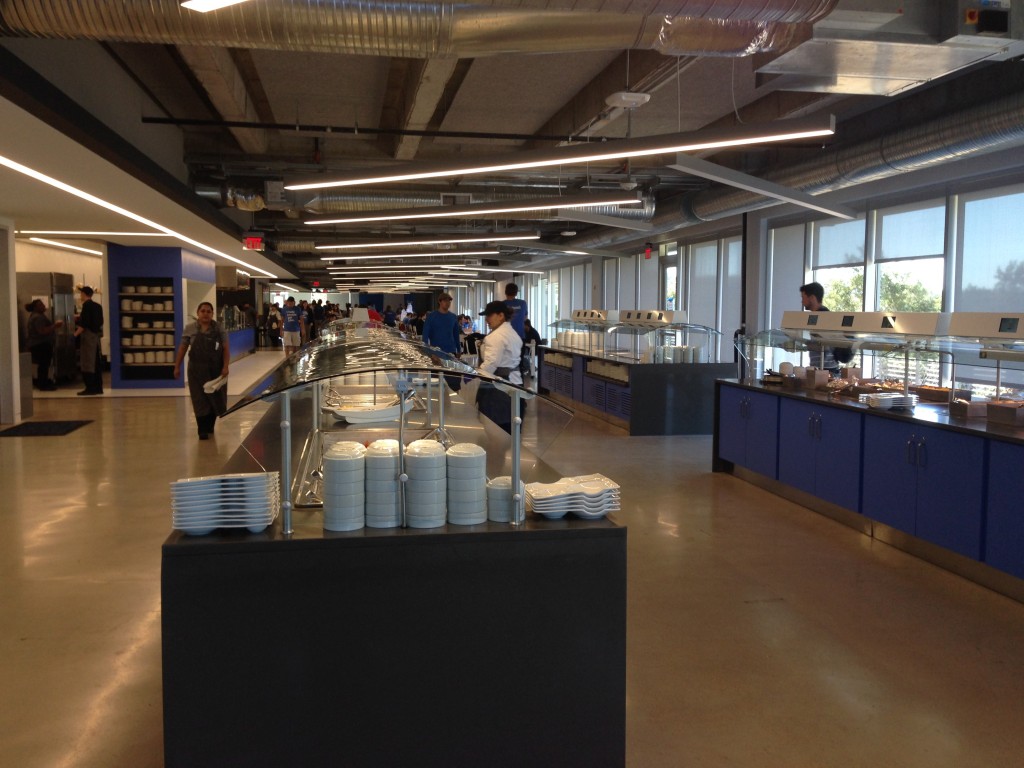
And Indeed’s new headquarters are built to accommodate that growth. Its work space features all kinds of amenities. It offers a full service cafeteria with a chef on a site to create healthy meals daily with entrees like wild boar and herb roasted orzo with lemon. It also has a sandwich bar and a salad bar. And the food staff created an app for workers that allows them to log on and order their meal for quick pick up so they can eat at their desk or on the run.

Indeed also has a fully stocked snack room with goldfish crackers, kind bars, oranges, apples, chips, nuts, pretzels and refrigerators loaded with Topo Chico, Red Bull, Perrier sparkling water, iced tea, Monster energy drinks and more.

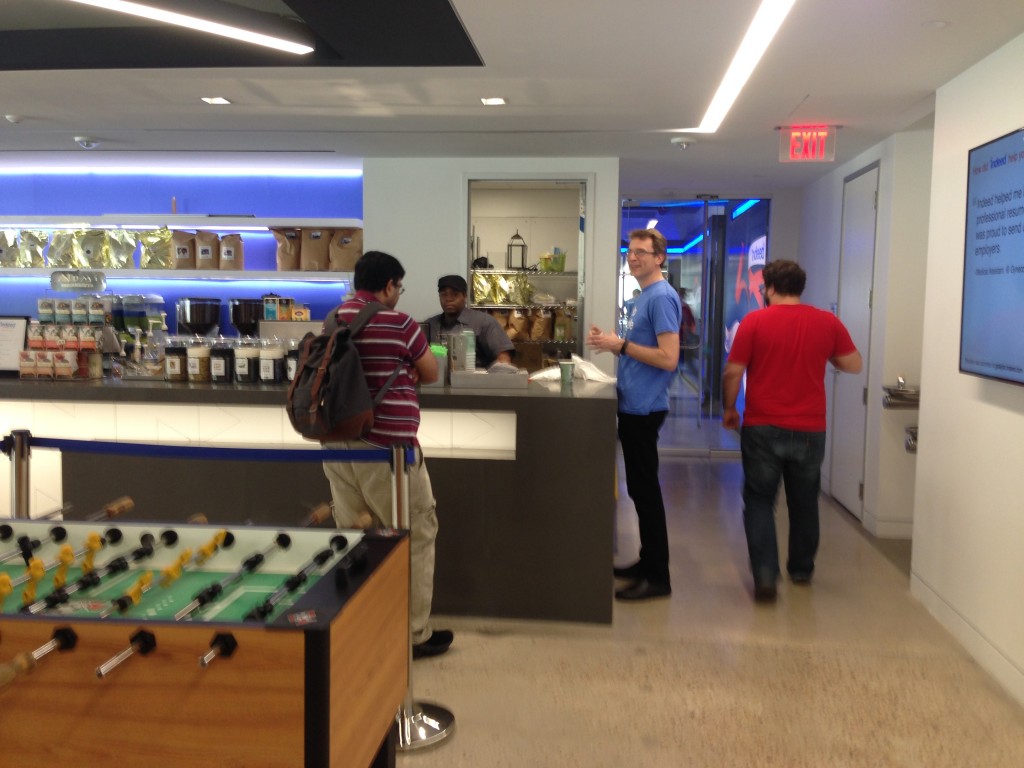
IMG_7277In addition to the cafeteria, Indeed features a game room with ping pong tables, pool tables and shuffle board and a drink bar for lattes and smoothies. They even have a gong which they bang when an engineer finishes a coding project.

And in a separate building, a studio offers classes daily including yoga, meditation, Pilates, bootcamp and more. And a full service gym is equipped with treadmills, stationary bicycles, boxing gloves and bags and weight lifting equipment.

Employee perks help from a recruiting and retention perspective, Hyams said.
“We have incredibly low turnover,” Hyams said.

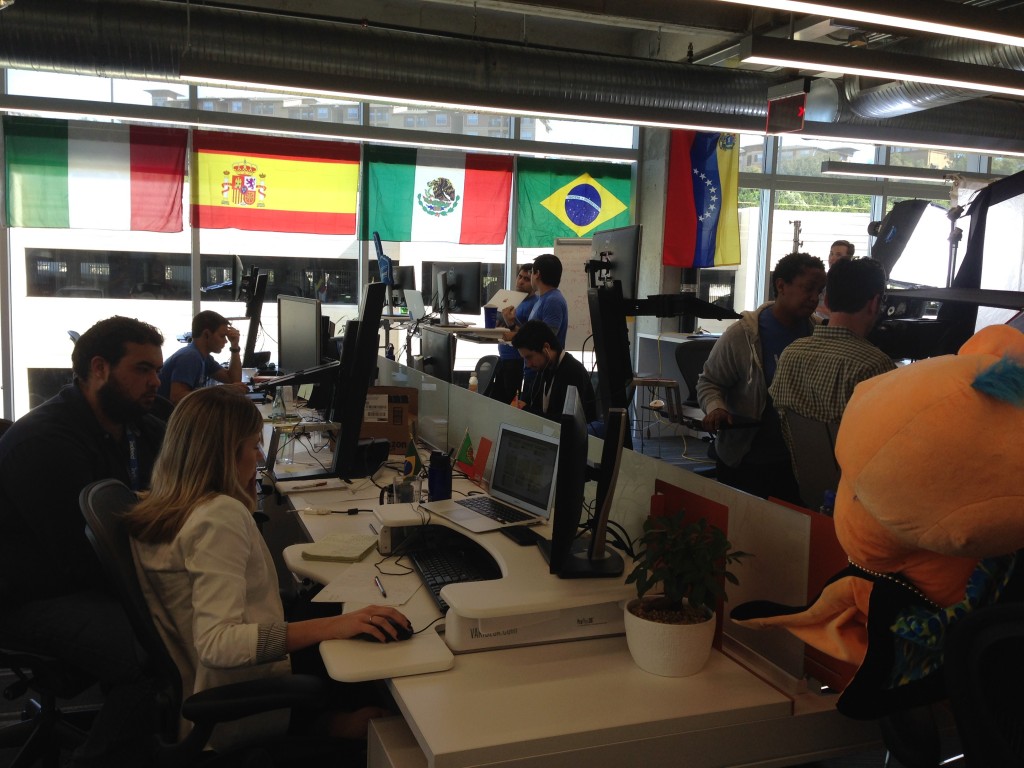
IMG_7279In Indeed’s main building, the first floor is public space along with the cafeteria and game room. The second through fourth floors are workspaces with wide open floor plans filled with standing and sitting desks along with lounge areas and conference rooms.

And no one has an office, not even the executives. They all work at desks on the open floor and everyone has a view of the oaks trees and rolling hills of the Austin hill country.

“We have a work culture that is very open and collaborative,” Hyams said.

IMG_7309
Each floor is named after a different continent and the conference rooms bear the names of the country’s capital cities. For example, the Asian floor has conference rooms in the West wing named after Islamabad, Pakistan and Kabul, Afghanistan and the East wing includes conference rooms named after Beijing, China and Seoul, South Korea. Since Indeed operates in 60 countries worldwide, the international theme fit with the company’s culture, Hyams said.

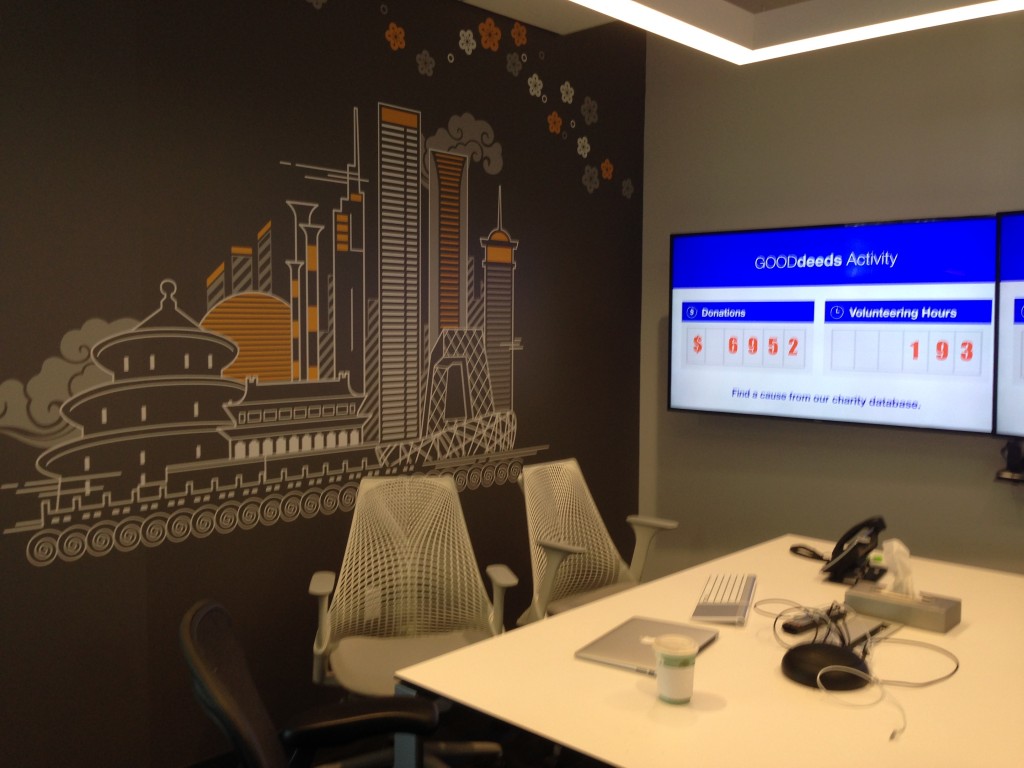
IMG_7302And each conference room has a country flag above the door and wallpaper with a special city outline with major landmarks designed by an Austin artist.

Amid all the fun, Indeed is a big business. It makes money by selling advertisements on its site to highlight particular jobs. Its customers are recruiters and companies that pay to place job ads. It has more than 300,000 clients last year and includes everyone from Joe’s Pizza to Fortune 500 companies, Hyams said. The site aggregates all kinds of job listings from existing job boards, newspaper classifieds and other sites online. It also contains a database of 60 million resumes from people worldwide.

The job seekers are “everyone from long haul truck drivers to chief financial officers,” Hyams said. It is not focused on any particular niche or industry.

Indeed’s competition isn’t another online job site, but it’s the 50 percent of jobs that are not currently listed online, Hyams said. And Indeed is working on getting those listings on line, he said. Last summer, 55 college students attended Indeed University at the company. They formed 11 startups in 12 weeks all around the hiring space. Indeed adopted one of the ideas and now it regularly contributes to the company. A group of students came up with a mobile app to take pictures of help wanted signs posted on company doors and bulletin boards. The app tags where the picture was taken and the address of the business and uploads the info to the job site.

“We really think a lot about how will people find jobs in the 21st century,” Hyams said.

IMG_7274

Short Term Rentals Fill Austin’s Housing Needs During SXSW

By SHION DEYSARKAR
Founder of Datainfiniti
Special Contributor to Silicon Hills News

Shion Deysarkar, courtesy photo

Shion Deysarkar, courtesy photo

SXSW will be upon us in less than two weeks. As everyone in Austin is well aware, the annual music-film-tech festival brings in hordes of visitors, turning downtown Austin into one long queue for everything. At this point, it’s become a well-worn cliche. Yet despite the complaints of locals, none can deny the tremendous economic impact SXSW has on Austin. The most recent estimates show that $317 million was brought in during 2015 alone.

A large portion of that revenue goes to the hospitality industry, which has fueled a boom in hotel developments in the downtown area. With all of that development going on, it’s easy to wonder why there’s still always a shortage of rooms during SXSW. Many hotels enjoy bookings a full year in advance. On top of hotel lodgings, you also have STRs (short-term rentals). Those too go quickly, and sometimes for steep prices.

All of this points to one thing – a supply shortage for available rooms. We all know it exists, but is it possible to quantify it? In other words, how many rooms (inclusive of hotels, STRs, and vacation rentals) are actually available, and how many are actually needed? How many people are left without a room during SXSW?

Real Data Is Hard to Find

Our question will need two key numbers for it to be answered. First, we’ll need to know how many visitors travel to Austin during SXSW. Second, we’ll need to know how many visitors can be housed in Austin.

Determining # of Visitors

It turns out answering the first part is very hard. SXSW publishes some great stats on official numbers, e.g., official attendees, people booking through official SXSW hotels, etc., but the data dries up when you realize a lot of people visit Austin during SXSW without any official credentials. Here’s what an official audit by Greyhill Advisors reported for 2014:


HTML Tables

Core SXSW Badgeholders 44,500
SXSWEdu 5,900
Musicians + Crew + Posse 16,100
Wristband holders 9,000
Film Pass 1,400
Paid Single Admission (Music + Film) 60,000
Butler Park Outdoor Stage Concert Series 62,500
Collateral Attendance 4,500
Carver Museum Theatre 700
SXSW Gaming Expo 45,500
Flatstock / Music Gear Expo 43,000
Digital Creative Job Market 4,000
SXSW Create 20,000
Education Expo 4,500
Renegade Craft Fair 55,000
Total 376,600


In addition to these official attendees, they estimated that over 100,000 individuals travel to Austin with no official credentials. Unfortunately, they don’t provide any detail on where this estimate comes from, so we can’t assume it’s very accurate.

Another report by SXSW hotel shows that 12,431 individual hotel reservations were made in 2015. This seems like a more useful number, until you realize there are several problems with it. Specifically:

It doesn’t say how many people are included in each reservation.

The figure only considers 69 official SXSW hotels. There are many other hotels in Austin.

It doesn’t consider use of STRs.

Despite a lot of searching, and even inquiries to SXSW, we were unable to find any hard data on how many visitors come to Austin for SXSW. So we had to take a different angle. It took some time, but we finally discovered that Austin-Bergstrom Airport reports statistics on travel in and out of Austin (or at least their airport) every month. Their data shows that a total of 504,769 people deplaned in AUS during March 2015. At this point, it becomes a little safer to make some estimates. If we assume half of those people come during the 11-day period that is SXSW, then there are 252,384 people arriving in Austin during this time. Even if they aren’t all here for SXSW, they presumably need somewhere to stay. While we wouldn’t claim this is 100% accurate, it’s probably much closer to the mark than any other estimate on number of Austin visitors during SXSW.

Determining Visitor Capacity in Austin

Like # of visitors, determining visitor capacity is fraught with potential inaccuracies. As we mentioned, SXSW reports the room capacity for 69 official hotels, but this is just a fraction of available hotels in Austin. In fact, there are closer to 198 hotels available, according to online listings. In addition to hotels, various STRs add a significant amount of capacity. A snapshot of Austin STRs across multiple sources shows approximately 223 properties available.

Thankfully, determining the exact number of rooms and people these hotels and STRs can house is fairly simple with access to a business and property database. A quick query to both generates results on number of rooms for hotels in Austin, as well as number of people that can be housed in the STRs. Since this data is aggregated from multiple sources, we can get a comprehensive picture of both hotel and STR capacity.

Here’s what those numbers show:

  • 39,787 people that can be housed in Austin through hotels (26,525 hotel rooms available and assuming an average of 1.5 people/room)
  • 34,057 people that can be housed in Austin through STRs

Remarkably, the STR capacity is almost equal to hotel capacity, which means that there is almost double the housing capacity than what is typically reported.

Bringing It All Together

Before we determine if there’s a shortage of housing capacity (and if so, how big it is), we need one last figure: what’s the average stay of a SXSW attendee? Fortunately, this is the easiest stat so far since it’s reported directly by SXSW: 4.81 nights in 2015. This stat is tied to official hotel stays, but we think it’s safe to assume it holds across other housing options.

To determine surplus/shortage, we need a measurement of how many total nights are needed. For example, if the average stay is 4.81 nights, then 10 visitors staying will need 48.1 “visitor-nights”. If we apply this measure to the numbers we calculated above, we get the following:

# of visitors during SXSW 252,384
# of nights/visitor 4.81
# of visitor-nights needed 1,213,967
Visitor capacity in hotels 39,787
Visitor capacity in STRs 34,057
Total visitor capacity 87,481
# of nights during SXSW 14
# of visitor-nights available 1,224,734
Visitor-night surplus 10,767
# of extra visitors possible 2,238

Just Enough Capacity, Thanks to STRs

So there you have it – our best calculations show that there is actually a bit of extra capacity for 2,238 people during SXSW. That’s about 1% of the estimated visitors. In all likelihood, this means that Austin is matching capacity, but here’s the thing – it has enough capacity only because of STRs. Without STRs, there would be a substantial shortage, likely around 50% of demand.

It comes as some surprise, then, that in a recent vote, the city council banned non-owner-occupied STRs. It’s unclear from our data how much of the STR supply is affected (AirBNB claims 15%), but our data makes it clear this ruling will significantly impact the city’s capacity for tourists and visitors. It won’t take full effect until 2022, which gives hotels some time to increase their own capacity. In fact, some have claimed this ruling was done because of the hotel industry’s influence within Austin’s city council.

A Battle for the Soul of Austin

In many ways, STRs are a microcosm of what’s happening in Austin. They are a critical part of the city’s event-driven economy, but at the same time, relaxed regulation on them can contribute to disruptions to peaceful neighborhoods and rising housing costs for locals. In a city that’s resisted growth for so long, it was only inevitable that STRs would become incredibly popular. In fact, Austin has the highest concentration of STRs in the US:

STRsAustinMap2

On one hand, if Austin is to support a growing event-driven economy, burst housing capacity will be needed. In addition to SXSW, other events like ACL, Formula 1, and X Games create massive surges in housing demand throughout the year. On the other hand, STRs naturally raise housing prices, typically driving out local creatives that make Austin what it is.

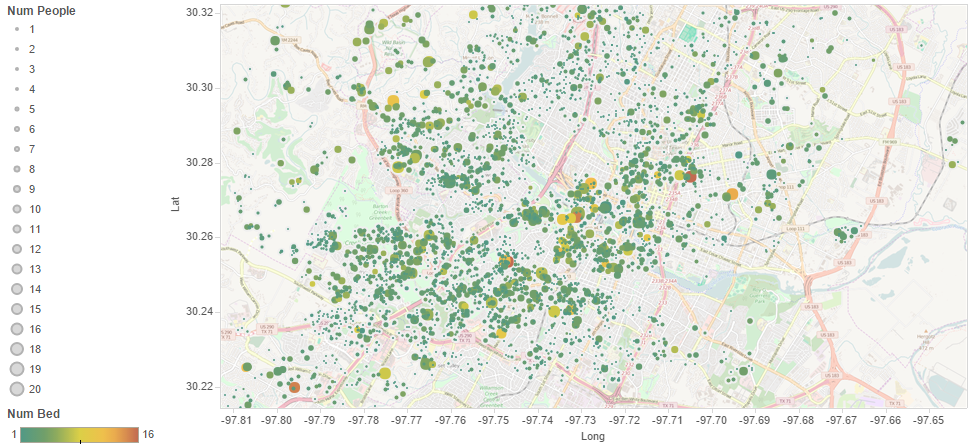
This issue isn’t contained to just downtown Austin, either. Here’s a map of all STRs in Austin:
STRsAustinMap1

As you can see, STRs show up all over Austin. STR supply (and presumably demand) exists anywhere within a 1-hour drive of downtown and even into the outskirts of Austin. You can view an interactive of this map here.

Striking the right balance on STR regulation will be of critical importance to Austin’s future. Even with an expected 28% increase in hotel capacity, Austin would not be able to support its tourism demand without STRs. With equal hotel and STR capacity, removing 15% of STR capacity, mostly offsets the upcoming increase in hotel capacity.

STRs play a critical role in supporting Austin’s festival economy. Without them, the economic impact of events like SXSW and many others would surely shrink. It’s up to Austin’s local government and its people to find a way to take advantage of this new economic force to help the city grow.

New_datafiniti-logo-2015Register for Datafiniti to Access this Data

Editor’s note: this post originally appeared on DataFiniti’s website and was reproduced here with permission.


RealMassive Settles Lawsuit with CoStar Realty for $1 Million

RealmassivelogoRealMassive, a commercial real estate data marketplace, Wednesday announced it has settled a copyright infringement lawsuit with CoStar Realty Information Inc. for $1 million.

“We are glad to have this lawsuit resolved,” Craig Hancock, Chief Executive Officer of RealMassive, said in a news release. “CoStar’s claim that we deliberately added its photos to our database was false. Our firm went to great lengths and expense to avoid acquiring CoStar’s images, but apparently a few images slipped through the cracks early on.”

In May of 2015, CoStar sued RealMassive claiming copyright infringement stemming from RealMassive’s platform using photos owned by CoStar. RealMassive denied the allegation and immediately removed the photos CoStar claimed to own.

RealMassive decided to settle the lawsuit to avoid costly litigation.

Under the agreement, the two companies agreed to work together to avoid further disputes. In addition, CoStar will mark its photographs with visible copyright notices or watermarks and RealMassive will work even harder to keep CoStar photos off its platform. CoStar also agreed to give RealMassive written notice if RealMassive violated its copyright and agreed to give RealMassive time to fix any alleged errors before filing a lawsuit.

“This settlement, although disagreeable, comes with a cost far less than prolonged litigation. More importantly, RealMassive gains critical protections that allow us to grow our platform without the risk of another sudden lawsuit by CoStar. RealMassive’s customers and partners can now be confident we are here to serve them for the long haul. It’s a big win for commercial real estate professionals looking to modernize the industry,” Hancock said.

RealMassive, which launched in 2013, provides accurate real-time data platform and analytics for the commercial real estate industry in Austin. Last May, the company closed on $8 million in Series A funding.

RealMassive has launched in 33 major markets. It provides information about nearly five billion square feet of commercial real estate properties. Its partners include many of the nation’s leading commercial real estate companies including CBRE, Brandywine, Oxford, Cushman & Wakefield and others.

Top 10 Things to do at SXSW Startup Village

By CHRIS VALENTINE
Special Contribution to Silicon Hills News

Chris Valentine, courtesy photo.

Chris Valentine, courtesy photo.

Startup enthusiasts and innovation seekers around the world are preparing themselves for the week-long whirlwind of conferences, pitch competitions, panels, and networking events that make up SXSW Interactive. With so many event opportunities for you to choose from, it’s best to prepare ahead of time and decide exactly which events are best suited to your interests as an entrepreneur or startup aficionado. To help you navigate your way through Startup Village, here is a list of the top 10 things taking place at SXSW Interactive that you and your business should consider attending.

1) SXSW Accelerator : This pitch competition features the hottest tech startups from around the world. If innovation is your jam, then this event is a must.

2) CNBC Session: “When Everyone Wants to be an Entrepreneur” : Do you binge watch business-based reality shows like Shark Tank and think to yourself, “that could be me?” At this event, high-profile TV personalities will give the inside scoop on what it’s like to compete for funding on a reality TV show.

3) International Entrepreneur Topics: It’s important to remember that SXSW is a great opportunity to learn about business culture outside of the U.S. With that in mind, three events featuring international markets that we recommend are: “Israeli Unicorns: Building a Billion Dollar Biz”, “What You Need to Know About Doing Business in Cuba”, and “The Real Wild West Is East: China’s Big 3 Markets”.

4) Startup Spotlight: If you are interested in getting up close and personal with some of the best and brightest startups in the industry, this will be the place to do just that. Live presentations and demos galore, you won’t want to miss the opportunity to see amazing gadgets, apps, and devices up close.

5) Startup Collegiate Sessions: These sessions will highlight the big changes happening within colleges on an entrepreneurial level and touch on what ground-breaking technologies are coming from higher-institutions into the marketplace.

6) Music Startup Village: Let’s not forget about another major aspect of SXSW: music. Music and tech go hand-in-hand at this event which showcases tech-minded startups in the music industry.

7) Highlighted Profiles: Keep your eyes open for high-profile speakers such as Scott Cook (Founder of Intuit Inc.), Mark Cuban (Shark Tank and Owner of Dallas Mavericks), Greg Glassman (Founder of CrossFit) and Dr. Norman Winarsky (President of SRI Ventures at SRI International & Cofounder of Siri).

8) SXAméricas Startup Summit: This summit connects startup industry experts who wish to share innovative ideas for upcoming trends in the U.S. Latino, Spanish, Central American, Caribbean and Latin American markets.

9) Participating Accelerators: Didn’t get enough from SXSW Accelerator? There are multiple other exciting pitch competitions taking place throughout the festival that you will not want to miss. Some accelerators of note are ReleaseIt, MassChallenge and Techstars.

10) SXSW Multi-Day Lounges and Venues: Take a much needed break in one of the many lounges Startup Village has to offer while utilizing the opportunity to network and spread the word about your business.

Whether you’re attending pitch competitions, connecting with high-profile leaders, or learning about new technologies, you’ll always have something new to learn from the Startup Village. These events are a must-attend for the entrepreneurial spirit within you if you want to establish yourself in the startup world and gain insight from some of the experts in the industry. Bring your peers, coworkers, and a notepad, and get ready to check out the best innovative features at SXSW Interactive.

Editor’s note: Chris Valentine is the program director for SXSW Accelerator.

President Barack Obama and First Lady Michelle Obama to Speak at SXSW

ObamaSouth by Southwest just announced Wednesday morning President Barack Obama will participate in a keynote conversation at SXSW Interactive.

The president will speak on Friday, March 11th. He will participate in a fireside chat with Evan Smith, Chief Executive Officer of the Texas Tribune.

In addition, First Lady Michelle Obama will give the opening keynote at SXSW Music on Wednesday, March 16th. She will discuss “the Let Girls Learn initiative, which aims to break barriers for the 62 million girls around the world who are not in school today, more than half of whom are adolescent,” according to SXSW.

“This marks the first time in the 30-year history of SXSW that a sitting President and the First Lady have participated in the event,” according to a post on SXSW’s website.

The talk between President Obama and Smith will focus on civic engagement.

“The President will call on the audience to apply their ideas and talents to make technology work for us – especially when it comes to tackling big challenges like increasing participation in the political process and fighting climate change,” according to SXSW. Anyone with a SXSW Interactive, Gold or Platinum badge may attend the event.

“I can’t imagine a better way to celebrate our event’s 30th year than to welcome both the President and First Lady to SXSW,” Co-founder Roland Swenson said in a news release.

SXSW plans to release more details on both events in coming days.

Mayors’ Pitch Competition at SXSW to Award $25,000

SteveAdler_portrait_1a_WEBONLYIn a post on Medium, Austin Mayor Steve Adler announced a new pitch competition at South by Southwest aimed at providing solutions for America’s biggest cities.

The competition is open to startups with products or programs that can solve tough challenges for cities, according to the post.

A panel of mayors and industry experts will choose the winners of the competition and award $25,000 in prize money. More than 20 mayors from cities nationwide are expected to attend. The competition is part of the U.S. Conference of Mayors and Code for America Tech Innovation Pitch, sponsored by Amazon Web Services.

“We need creative solutions to our most pressing challenges now more than ever,” Adler wrote in the post. “Mayors need your help to find the next generation of solutions to their biggest issues like transportation, civic engagement, housing, job creation, education, health, and many more.”

The deadline to enter is Monday, March 7th at 11 p.m. Central Standard Time.

The pitch competition takes place on Sunday, March 13th at 9 a.m. to 11 a.m. at the JW Marriott.

« Older posts Newer posts »

© 2026 SiliconHills

Theme by Anders NorenUp ↑