
Author: LauraLorek@gmail.com (Page 93 of 354)

LauraLorek@gmail.com

Oracle’s Founder Larry Ellison Says Austin Campus is Going to Grow to 10,000 Employees

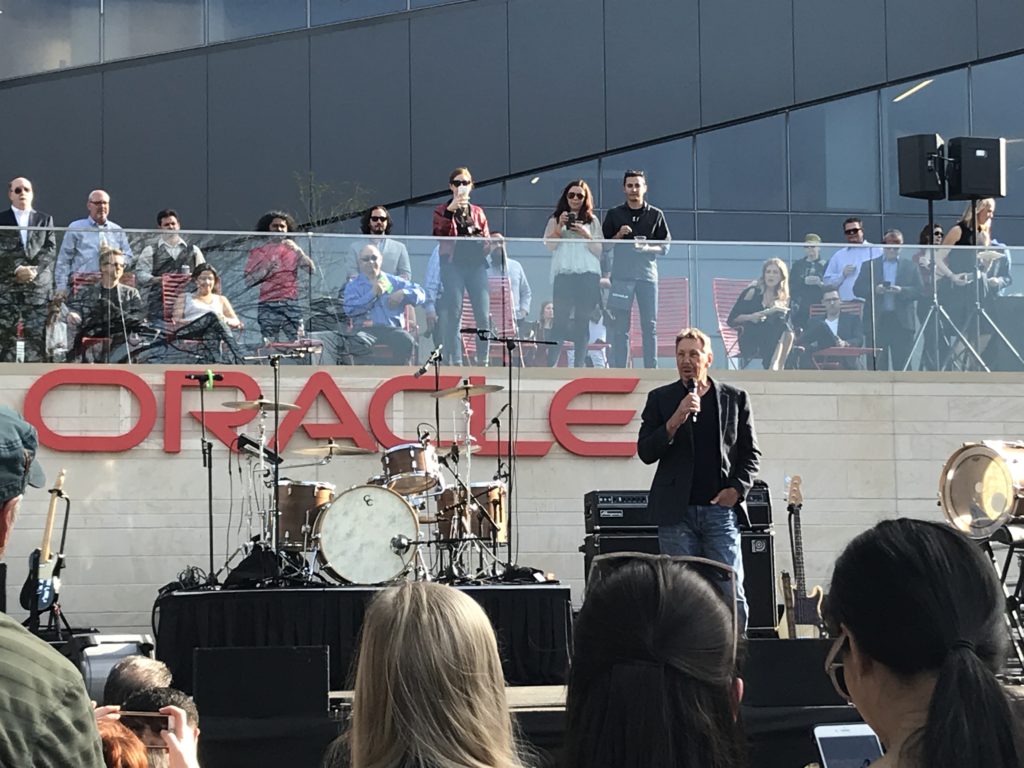
Billionaire Larry Ellison, founder of Oracle, makes a surprise visit to cut the ribbon on the company’s Austin campus.


By Laura Lorek
Publisher of Silicon Hills News

Billionaire Larry Ellison, the founder of Oracle, said he expects Austin’s Oracle campus to grow to about 10,000 employees in coming years.

“We are going to have a handful of hubs in the United States,” Ellison said. “Austin is one of the key places we want to be because that’s where we think our people want to be.”

Ellison made the remarks during a surprise visit to cut the ribbon on the new Austin Oracle campus Thursday. The first 560,000 square foot building and parking garage opened to employees in January and already has more than 2,000 employees with a capacity of 2,500 employees.

“We bought all this real estate and we’re not done yet,” Ellison said. “We think this is a phenomenal facility to house fantastic people that hopefully will come to Oracle whether they are experienced or right out of college and be able to develop their careers, learn new technologies and grow as the company grows.”

Oracle, based in Redwood Shores, Calif., is going through its biggest growth phase in its history and is hiring lots of people, Ellison said. Oracle is also building a big facility in Santa Monica. It always seeks to build near water so employees can go rafting or kayaking during their lunch hour, Ellison said.

“I think this facility is going to grow to about 10,000 people,” Ellison said. “We have big plans.”

During a real estate tour to scout for the location for the Austin campus, Ellison recounted a story about how he refused to get out of the car to look at property in Cedar Park. He told them he only wanted to look at properties in downtown Austin near the water. The real estate brokers told him there was only one property. It turned out to be the property on Lady Bird Lake that is now the home of the Oracle Waterfront Campus at 2300 Cloud Way.

At the building site, Ellison decided immediately he would take the property and the adjacent 295-unit Azul apartment complex that was under construction. It is now a housing option for employees.

“This is Texas. In California, the prices here are like free,” Ellison said. “You buy one home in California, Mark’s home, actually, it costs about the same as this.” (Mark Hurd is Oracle’s CEO who also accompanied him on the real estate tour and was at the ribbon cutting Thursday.)

Ellison bought all the commercially zoned property nearby. They ended up buying up 43 acres. Ellison said they were on the property about a half an hour and bought it all.

Oracle Austin Ribbon Cutting, photo courtesy of Oracle

“Oracle is expanding in Austin to attract, hire and train the best talent to support the unprecedented growth of our cloud business,” Oracle’s CEO Hurd said. He also has an office at the Austin campus.

At the event on Thursday, Ellison cut the ribbon on the facility with Hurd and other dignitaries. Then Oracle held a party with food trucks, beverages and games for its employees and invited guests. It featured bands Black Joe Lewis and American Authors.

Downs Deering, senior vice president of Oracle giving a tour of Oracle’s new campus with a view from the fifth floor balcony.

Earlier in the afternoon, Oracle held a VIP reception and gave tours to media and other invited guests of its new facility.

“You have so many people who live in the area that can walk or bike to work,” said Downs Deering, senior vice president of Oracle Digital Application Sales, during a media tour. He’s been in Austin off and on since 1993 and is a graduate of the University of Texas at Austin and he previously worked at Dell for 15 years.

Oracle’s cafeteria

Oracle is working to create an inviting experience for its employees with veranda views of the lake, an onsite full-service cafeteria, gym and free parking for its employees, Deering said. On-campus amenities include a food truck court, expansive business training and conference center, game rooms on every floor, terraces and outdoor collaboration areas. It also has beach volleyball and basketball courts, flag football field, B-cycle station and access to Lady Bird Lake hike and bike trail.

Oracle is creating the modern-day company town with apartments nearby for employees. The employees at the Austin campus focus on creating digital applications and sales. Also, Oracle recently announced that Oracle Startup Cloud Accelerator’s first U.S. residential program will be located in Austin.

During the tour, Oracle showed off its Cloud Solutions Hub with demonstrations of augmented reality, virtual reality applications to oversee manufacturing operations, intelligent bots and blockchain technology for healthcare applications like tracing pharmaceutical drugs.

Deering also showed off the training rooms for new hires who get up to 200 hours of training before they start their jobs at Oracle.

“They get continuous training afterward,” he said.

Oracle is also bin-free at the desk and doesn’t provide employees with garbage cans, Deering said. It is encouraging employees to recycle. They must take their waste to a central location for landfill, recycle and composting, he said. And it’s cashless at the cafeteria and the on-site Starbucks too, he said.

Oracle hires from 24 of the top universities in the country, Deering said. It hires a lot of communications, marketing, and business graduates to become sales associates, he said. At their desks, Oracle gives them a University pendant to put on their wall. In Texas, Oracle primarily hires from UT, Texas A&M, Baylor and Southern Methodist University, Deering said.

The managers don’t have offices, Deering said. They have desks on the floor with the sales representatives. They can go into offices along the wall which Deering referred to as “huddle rooms” for conferences. And each floor has a local theme that highlights “aspects of Austin’s culture including local art, music and murals.”

The balcony on the fifth floor provides expansive views of the city and Lady Bird Lake. The work area feature lots of natural light and an entire wall of glass that provide views of the lake and downtown.
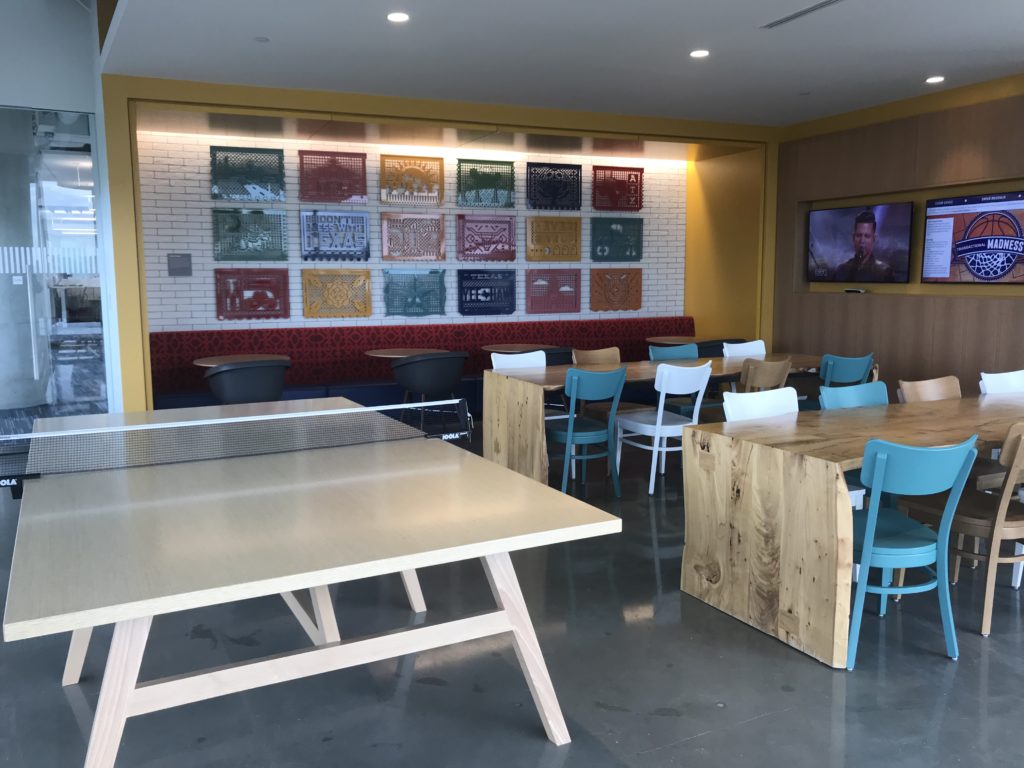
Break room on the fifth floor

Facebook Live video of Ellison speaking to the crowd at the Austin Oracle campus ribbon cutting.

Go Hunt Life’s Todd Nevins is Onto his Next Big Adventure in Mexico

Todd Nevins, courtesy photo

By Laura Lorek
Publisher of Silicon Hills News

Todd Nevins is pulling the ripcord on his life this week.

The host of the Go Hunt Life podcast in Austin and founder of CLICKplacement, an AdWords business, is moving to Mexico.

Todd and his wife, Allison, have sold most of their belongings, everything from their couch to their George Foreman grill, they have stashed some stuff with relatives, and they have packed up the rest into an SUV. They are driving on Friday with their English bulldog, Deuce, to San Miguel de Allende, located in the Central Highlands of Mexico.

The self-proclaimed digital nomads have spent the past two years in Austin but they decided to move back to Mexico to build their online businesses and to explore Mexico’s entrepreneurial ecosystem and for independence, adventure, and excitement. Nevins runs CLICKPlacement, an AdWords marketing agency he founded a decade ago and Allison founded TexMex Fun Stuff in 2016, an e-commerce store that sells Mexican imported goods on Amazon.

Todd has produced more than 90 episodes of Go Hunt Life, a podcast he started two years ago focusing on people who uproot their lives and pursue their passions. He hasn’t missed a week posting a new episode. He is also one of the founders of the Austin Podcast Community and helped created the Startup Studio, a podcasting studio, at Galvanize.

“Our guests have inspired us to pull the ripcord again and blow up our comfort bubble that we have built here in Austin and go live in Mexico,” Nevins said. “My wife’s heart has always been in Mexico.”

The Nevins moved to Austin two years ago from Merida, Mexico where they lived for 5 years. They also lived in Dallas for 18 years prior to Merida. Allison’s business has grown tremendously, and they are going to Mexico to source handmade products directly from artists and suppliers. They will live in several cities throughout the country for five to seven weeks at each place, staying in Airbnb rentals and working out of coworking spaces.

“The Go Hunt Life Podcast will certainly continue, and we are going to roll in more video,” Todd said.

He’s been working with Lyn Graft, founder of Storytelling for Entrepreneurs in Austin, on the videos.

“Todd is kind of a natural host,” Graft said. “He asks interesting questions because he’s a very curious person and he wants to know who you are, what you do and how you got to where you’re at.”

“That interest in who you are as a human leads to great content,” Graft said. That translates directly into his podcast as he explains how people decide to “make that crazy professional or personal decision to do a 180 in life.”

“Todd’s curiosity and desire to constantly be the student means he’s definitely going to be successful to be an on-camera storytelling host,” Graft said.

“He’s effectively living what his podcast is all about,” Graft said. “He’s again pulling his own ripcord. He’s woven himself into the fabric of Austin really well and has become part of what makes us special because of his energy, enthusiasm, and support for other entrepreneurs and his desire to get stories out.”

The series is called Los Nevins Go Hunt Life in Mexico and will be posted to YouTube. The first video episode is going to be the drive to Mexico, they are crossing the border at Laredo, followed by a feature on San Miguel de Allende. After that, they travel to Guanajuato and then Mexico City, followed by Puebla and Merida. Next year, they’ll travel back to Central Mexico.

“Everywhere we go has co-working spaces,” Nevins said. “Mexico City has 10 WeWorks.”

Nevins will be working out of Impact Hub in Mexico City, which is a part of the ImpactHub coworking sites in Austin.

“I learned a lot in Austin during the last two years and I’m going to share it however I can,” Nevins said. “I’m taking the pride that I felt building the Austin Podcast Community, I’m going to go down there and take my podcast experience and AdWords experience into the tech hubs in Mexico City and see if I can help or be a conduit. That’s my goal going in.”

His goal is to help as many people as he can because that’s what happened to him when he came to Austin.

“This is still a small town,” Nevins said. “There’s still accountability. There’s a community aspect to it and an accountability aspect that makes it a beautiful spot for somebody to come in and make some impact and feel like they are a part of something.”

The technology industry and startup innovation are vibrant in Mexico, Nevins said.

“I’m taking all of what I’ve been given here and sharing it,” he said. “The last two years, my wife and I joke that we feel like we’ve gotten a master’s degree on the next phase of our life.”

Out of all the episodes on Go Hunt Life, one sticks out for Nevins. It’s episode 40 about Roz Savage, an environmental activist and ocean rower who holds four world records for being the first woman to solo row across three oceans. She upended her life as a management consultant in London to row across the Atlantic Ocean in a 23-foot rowboat and she faced harrowing life-threatening challenges as a result but overcame them with hard work and courage.

“I’ve interviewed multiple people whose lives have turned into world records,” Nevins said. “I never lose sight of the fact that it’s a privilege that these people have given me their time.”

Nevins’ passion is living an unconventional life of adventure and meaning and location independence.

“It’s no secret that I yearn to do that,” he said. “I respect people who are living against the grain.”

One of the world’s biggest groups of digital nomads resides in Chang Mai, Thailand where the Internet is super fast, living is easy and relatively inexpensive, Nevins said. In the digital age, being a nomad is no longer the exception, but the norm in some communities, he said.

Nevins grew up in Illinois and four days after graduating from Southern Illinois University, he bought a one-way plane ticket from St. Louis to Dallas. Initially, he worked at Telecheck as a sales executive and sales manager for six years. He then left to launch his own business as an executive recruiter focused on the financial services and healthcare industry.

In December of 2010, Nevins left Dallas with Allison, who quit her corporate job, to move to Merida, Mexico. He continued to work from there remotely. They moved to Austin to focus on the AdWords business.

“This time it feels like we’re going back to Mexico and it’s going to be a comfortable landing,” he said.

Mexico’s central time zone makes it easy for Nevins to connect with his customers in the U.S. and Canada, he said.

Todd is going to be missed in Austin where he has been a member of Galvanize since its founding two years ago, said Bill Blackstone, general manager of Galvanize Austin.
During South by Southwest, Galvanize invited Todd and Allison as guests of Galvanize for a VIP reception with Casa Mexico where the Consulate General heard Todd’s story and gave him his personal cell phone “just in case” Blackstone said, The reception included Mexican dignitaries, leadership of Fondo de Fondos, local investors and tech leaders, and talented Mexican entrepreneurs.

“Todd represents the best of our community – he’s always willing to help other entrepreneurs, he’s serious about growing his business, and he works to make sure everyone around him feels included,” Blackstone said. “As an original member of Galvanize Austin, it’s been amazing to see his business and network grow. While we’re sad to see him leave Austin, we’re excited to see what he and his wife will accomplish in Mexico.”

Umuse Raises $5 Million for its Smart Digital Assistant to Organize Email, Text and Chat

Scott Abel, founder of Umuse

Umuse has created a digital assistant for the email inbox box that uses artificial intelligence and machine learning and becomes smarter over time.

To bring the product to market, the Austin-based startup led by Scott Abel, former Spiceworks Founder and CEO, announced Wednesday that it has raised $5 million in seed funding from Shasta Ventures, Next Coast Ventures and Floodgate Capital.

In 2006, most people just had to deal with email, Abel said. But then all these other things started to creep into the business including Basecamp and Asana and custom applications in the late 2000s like HipChat and Slack. By the time Abel left Spiceworks in 2013, he was receiving hundreds of messages a day across four different applications.

Umuse takes all those disparate message streams and brings them into one integrated feed and prioritizes them by looking at a customer’s inner circle of communication and who they talk to the most often, Abel said. Its technology is called “Inner Circle technology: to help users quickly find those messages that matter most. Through machine learning, the software builds a personal communication graph of conversations, which adapts and learns over time.”

“The algorithm weighs who you talk to, how often and how quickly you respond, and auto-opens messages from those people so that they stand out in your feed,” according to Umuse. “Users can tune and customize these settings as needed, so they have complete control.”

Umuse also makes its search engine more powerful for its customers to find information across email and chat streams, Abel said.

Employees today receive a huge volume of correspondence via email, chat, text and other messages and that has led to all kinds of problems like lower productivity, frustration, distraction and important information getting lost in the sea of communications.

That’s the problem Umuse solves by putting the information into a single, Facebook-like message feed. Umuse works with existing services like Gmail and Slack. With Umuse, customers can quickly scan, zoom, reply to and search messages across multiple channels.

“Email has gone from being a tool that works for people, to additional work they now have to do. Add in chat, text and other forms of messaging and it just exacerbates the problem, creating a drain and drag on worker productivity,” Thomas Ball, Co-founder and Managing Director at Next Coast Ventures, said in a news statement. “Companies need a better approach to bring all these communication channels together. With the Umuse team’s deep experience developing simple solutions to complex problems, I’m excited to see how they solve this one.”

UMuse, founded in 2016, already has more than 5,000 “alpha” users who have been trying out early versions of the product and providing feedback. Now the company is releasing the software to beta users who can download it from the company’s website.

The company chose the name Umuse because it was something that was evocative and captured the role of the digital assistant for the inbox.

“It’s your personal messaging muse whispering in your ear,” Abel said.

Umuse is based in the Westlake area and has 12 employees. It may add one or two more this year, Abel said.

Lots of people have tried to tackle the email inbox management problem and failed, Abel said.

“It is a tough problem,” he said. “But I think somebody’s got to keep trying. It is still a big problem.”

Umuse: The Power of One from Umuse on Vimeo.

National Tech Media’s SXSW Coverage Obscures What a True Ecosystem of Innovation Looks Like

Dave Manzer, courtesy photo

By Dave Manzer
Sponsored Post on Silicon Hills News

Here’s an opinion that won’t be popular among our friends in the technology news media: It’s coverage of SXSW risks perpetuating a very narrow and biased view of what a true startup ecosystem looks like.

Don’t believe me? You need only look at the headlines coming out of the event, which are dominated by “Big Tech” stories, celebrity founders/investors news, and a handful of “hot takes” either proclaiming SXSW to be past its prime or just not very interesting. But most of these publications only send a handful of people to SXSW, and then don’t return to Austin for at least another year.

Mind you, there are some exceptions out there, most notably Silicon Hills News, which focuses on the Austin-San Antonio tech scene and devoted over a dozen articles to this year’s event.

Among those that covered SXSW, what you aren’t seeing much of are stories about innovation from lesser-known startups and organizations that aren’t in the unicorn club (aka don’t have outrageously large funding rounds), or have the good fortune of counting celebrities like Ashton Kutcher as an investor. I worry that the tech press is losing its hard-earned reputation as an authority on startups, and instead taking us down the proverbial rabbit hole — giving us an incomplete vision of startup reality tinged by celebrity, biased by a Silicon Valley startup model, and warped by Big Tech.

In dismissing SXSW, or taking a very high-level perspective where only major brands and Elon Musk are worth their time, the major tech press outlets are not only brushing aside Austin and its robust startup ecosystem, but also the startups coming from around the globe. To be sure, Austin has its share of challenges — access to funding is the most frequently referenced. But the thing is, large VCs have been looking outside of the Valley for a while, and lately have been more vocal about it.

The problem for non-Silicon Valley- or NYC-based startup ecosystems might not be a matter of being enough like the larger markets, but rather that the national tech media isn’t there to cover and report on the innovative things happening every day. How many other cities without a SXSW anchor are going unnoticed? It’s been my most frequent thought at this year’s SXSW.

With SXSW, Austin was an easy draw for the greater technology industry and its attendant media to take notice of. With a large population and a crop of major tech companies (Dell, National Instruments, Indeed, Apple, etc.), the city has a nice pipeline of talent and is an attractive relocation spot thanks to its unique culture (breakfast tacos and BBQ y’all!). Austin also has a dozen or more incubators/accelerators in town, with Capital Factory even putting on an “ATX Startup Crawl” featuring over 100 startups or startup-adjacent organizations the first night of SXSW.

But the interactive portion of SXSW isn’t just about Austin. It brings together exciting and innovative startups from around the world. Where else are you going to see people get excited and talking about a perfect bread maker appliance, a company that could render plastic surgery as unnecessary for looking younger, a 3D-printed house, or a backpack that doubles as a motorized skateboard worthy of Back to the Future Part II? It’s a shame there aren’t more headlines from major news outlets celebrating this side of the conference.

Here’s what I do know: Where there is a strong tech media presence there is more awareness of innovation and a greater likelihood of investors and users embracing the new startups. What Silicon Valley and NYC have in common is a very strong media culture, which works in lock step with the entire startup ecosystem — from startups and tech talent to angels and VC firms. The popularity of SXSW was aided by a national tech media hungry for exciting stories of startups and their disruptive technology, and the media’s coverage of SXSW helped put Austin in front of a global audience that helped propel its growth, making it a destination for startups and established tech companies the world over.

Now, with the tech media in retreat across all media outlets — traditional news outlets like CNN and WSJ have fewer tech stories, tech blogs like Mashable have radically scaled back operations — there is a pressing need for Austin to grow its own startup media ecosystem that looks and feels like Austin. Eventually, the rest of the world won’t be able to ignore it.

Dave is the president of Manzer Communications, a marketing communications and PR agency serving technology startups and fast-growth enterprises. Dave founded PR Over Coffee, is a mentor at Startup Aggieland and launched Startup Over Coffee, a crowdsourced map for startups and startup professionals in Austin.

This is a sponsored post.

Austin-based Mythic Gets $40 Million in Funding

Mythic, an Austin-based microchip maker, announced Tuesday that it has received $40 million in venture funding.

The company, which also has an office in Redwood City, Calif., closed on its Series B funding led by SoftBank Ventures.

Mythic, which was once known as Isocline, has raised $55.2 million to date, according to its Crunchbase profile.

Mythic is making an artificial intelligence chip that will serve as the brain of a everything from smartwatches to smart vehicles. The company’s unique chip design “performs computation inside memory cells – using analog currents and flash memory to perform the arithmetic of AI inference on a massive scale” which leads to faster and better computer performance. Its chips will bring the “computer power of a datacenter” to robots, cars, phones, droves and more without going to the cloud, according to the company. Mythic claims its chips will be 100 times faster and require 100 times less power than existing chips. It expects to manufacture the chips later this year and to begin shipping its chips next year.

Mythic’s latest financing includes a strategic investment from Lockheed Martin Ventures, the venture capital arm of Lockheed Martin.

“We have entered an era in which data is a strategic asset,” Chris Moran, vice president and general manager of Lockheed Martin Ventures, said in a statement. “Mythic’s game-changing technology will allow us to provide our customers with the unmatched ability to obtain timely, actionable information from distributed, power constrained systems.”

Mythic traces its roots to 2012 and the Michigan Integrated Circuits Lab at the University of Michigan. Its cofounders are Mike Henry and Dave Rick, who specialize in AI computational science.

“The world will be very different 10 years from now,” Henry, co-founder and CEO of Mythic said in a statement. “And Mythic will play a major role in the machines, devices, and electronics that make that difference. We are excited to have SoftBank join as an investor. They are committed to building the future vision of AI, robotics, autonomous, and machines that can see and interact with the world. We fill a missing piece in their vision: incredibly powerful compute at the edge that is cost-efficient and low power enough to run on batteries.”

Geekdom Teams With Alamo Angels to Launch a Pre-Accelerator Program in San Antonio

Geekdom, the tech co-working space at the heart of San Antonio’s technology district, announced recently that it has teamed up with Alamo Angels to launch a pre-accelerator program designed to nurture new startups.

The program is focused on early-stage startups and includes mentorship from entrepreneurs, tech leaders and investors. The applications for the program opened last week with a deadline to apply on April 3rd. The program is free and no equity is taken. It culminates with a Demo Day pitch event on May 24th.

“During this program, early-stage startups will receive mentoring to prepare them for investment opportunities or applications into top-tier accelerator programs. Startups will also gain exposure in the tech community at the conclusion of the program on Demo Day,” Luke Owen, Geekdom Pre-Accelerator Co-Director, said in a news release.

Alamo Angels is providing at least $25,000 of equity investment to a selected team at the end of the program, according to Chris Burney, Geekdom Pre-Accelerator Co-Director and Executive Director of Alamo Angels.

“San Antonio’s startup community is thriving, and we need more resources to prepare high-potential companies for funding. This program will help local startups gain initial traction and become investor-ready,” Burney said in a statement.

Austin’s Outdoor Voices Raises $34 Million in Funding

Outdoor Voices, courtesy photo

Outdoor Voices, a high-tech fashionable line of athletic apparel, has raised $34 million in additional financing, according to a filing with the Securities and Exchange Commission.

The Austin-based startup received the funding from Google Ventures, according to an article by CNBC.

To date, the company has raised $57 million and plans to use the latest funding to open additional retail stores nationwide, according to CNBC.

Fast Company named Outdoor Voices, one of the most innovative companies of 2016. Tyler Haney, the CEO and founder, plans to open five new retail locations by the end of the year, according to CNBC. Outdoor Voices currently has seven shops including one in Austin and Dallas. It has two New York stores, others in Aspen, San Francisco, and Los Angeles.

Outdoor Voices sells two-tone warmup leggings in colors like dandelion, wisteria, blue quartz and hickory ranging in price from $75 to $95. It also has basic black and grey. Its lineup also includes tees, tanks, shorts, pants, sweatshirts, jackets, accessories and shoes for both men and women.

Austin’s TurnKey Vacation Rentals Lands $31 Million in Funding

TurnKey courtesy photo

TurnKey Vacation Rentals, one of the nation’s largest vacation rental management companies, recently announced it has received $31 million in funding.

The Austin-based startup received the funding from Adam Street Partners which led the Series D round along with participation from existing investors including Altos Ventures and two new institutional investors.

To date, the company has raised $72 million in funding since its founding. It reports it now provides full-service property management to more than 3,500 premier vacation rental homes in the top U.S. travel markets. At the end of 2017, Turnkey had 350 employees, including 160 Austin-based employees, up from 221 and 80 in 2016, respectively. The company also appointed Jen Ford, former HomeAway finance executive, as the chief financial officer.

“TurnKey is exceptional in that their rapid growth has been organic, as opposed to growing through acquisitions,” Jeff Diehl, managing partner and head of investments at Adams Street Partners, said in a news release. “This is a seasoned online travel management team that knows how to scale and execute with precision in the $100 billion vacation rental industry. Our additional investment demonstrates our belief in the promise of the TurnKey brand, its leadership and its model.”

TurnKey handles all of the nitty-gritty details of renting out a home to visitors using smart home technology and local employees. It has a proprietary technology management platform that uses smart locks, decibel monitors and more to automate tasks related to renting a property.

“At TurnKey, we’ve doubled our growth each year since 2013, while expanding into 55 top markets across the U.S.,” T.J. Clark, TurnKey co-founder and CEO, said in a news release.

Austin’s MasSpec Pen Wins Innovation Award at SXSW

The MasSpec Pen is a handheld probe that can non-destructively analyze human tissue samples to identify cancer. Vivian Abagiu / Univ. Of Texas At Austin

The only Austin-based startup to win an award in the 2018 SXSW Interactive Innovation Awards was MasSpec Pen by the Eberlin Lab at the University of Texas at Austin.

The MasSpec Pen provides a better way for surgeons to rapidly perform and diagnose cancer biopsies. It allows surgeons to extract molecules from tissue and test samples in real time. The sample is then analyzed through a database to see if it matches a cancer type such as thyroid, lung or ovarian cancer.

Silicon Hills News first wrote about the invention in 2016 after UT Austin Chemistry Professor Livia Eberlin presented the invention at the Innovation Center’s Startup Studio.

The MasSpec Pen won under the “Health, Med & BioTech” category.

The other award winners included:

AI & Machine Learning

Honoring digital systems which have the ability to adapt to changing data, stimuli, and circumstances; replicating learning, problem solving, and cognition: Swarm AI by Unanimous AI, San Francisco, CA

Innovation in Connecting People

Honoring the best new way to connect and communicate with others: Read To Me by The Electric Factory, Montevideo, Uruguay

Music & Audio Innovation
Honoring 2017’s best device or service that changes and improves the way we listen to and enjoy music.Hands-Free Music Project by Microsoft Corporation, Redmond, WA

New Economy
Honoring those redefining the exchange of goods and services, from the sharing economy, to virtual currency, to micro-finance, to mobile-device-payment systems, and beyond: Autonomous Operations Platform for Selfdriving Fleets by Ridecell, San Francisco, CA

Privacy & Security
Honoring 2017’s most progressive accomplishment in the way we go about securing our data and ensuring our privacy: Ghostery Privacy Ad Blocker by Ghostery, New York, NY

Responsive Design
Honoring excellent digital design, creating the best-integrated interaction in terms of content, aesthetics, and functionality: The Coca-Cola Times Square Billboard by space150, Atlanta, GA

Scifi No Longer
Honoring the coolest scientific achievement or discovery that before 2017 was only possible in science fiction: The Dermal Abyss: When Tattoos meet Biotechnology by MIT Media Lab, Harvard Medical School and UC Davis, Davis, CA

Smart Cities
Honoring innovations in eco-friendly or sustainable energy, transportation, and IoT technology, making life in the connected world a smarter, cleaner, greener, and more efficient Internet of Everything: Jacques-Cartier Bridge Interactive Illumination Concept by Moment Factory, with: Réalisations Montréal Inc., Ambiances Design Productions, ATOMIC3, Éclairage Public / Ombrages, Lucion Média and UDO Design.Project directed by Jacques Cartier and Champlain Bridges Inc., Montreal, QC

Student Innovation
Honoring the student with an exceptional interactive technology project or startup; both of which are the future: Facebook Messenger Blood Type Bots by Ryan Leckie and Jakub Straka, Miami Ad School Europe, Hamburg, Germany

Visual Media Experience
Honoring content creation and delivery that moves beyond passive viewership by providing a more immersive and engaging entertainment experience: LEGO House Fish Designer by LEGO House/Trigger Global, Los Angeles, CA

VR & AR
Honoring breakthroughs in augmented and virtual reality technology including the application of new hardware or software which truly make the virtual a reality: Maestro: Empowering VR Storytelling Through Social Collaboration by Penrose Studios, San Francisco, CA

Wearable Tech
Honoring the new hardware that revolutionizes the convenience, comfort, functionality, efficiency, and fashion of having a device literally “on you.” Jacquard™ by Google, Mountain View, CA

Special Honors

David Carr Prize: Amanda Gail

Meme of the Year: Savage Prince George

Breakout Trend of the Event: Globally Connected: we’re in this together

Speaker of the Event: Esther Perel

People’s Choice Award: The World’s First AI Financial Advisor by Pefin, New York, NY

Best of Show: Swarm AI by Unanimous AI, San Francisco, CA

Forerunner Ventures Touts Diversity as the Best Way to Make Investment Decisions

By Laura Lorek
Publisher with Silicon Hills News

In 2010, Kirsten Green founded Forerunner Ventures, an early stage venture capital firm, based in San Francisco.

She had spent her early career as a retail analyst with Banc of America Securities and others and she spent a lot of time studying retailers. She even went to the mall and counted the cars in the parking lot and visited stores to see what merchandise was popular. She also noticed the world was changing with the rise of e-commerce companies like Amazon and the Millennial generation entering the workforce. And she felt there was a lot of opportunities for startups to create innovative retail products and experiences. Her vision was to invest in the next-generation of consumer e-commerce companies focused on delivering a great experience.

“I wanted to invest in companies that were addressing this new consumer, were thinking uniquely about the model for the moment of time we were at and were leveraging technology to do that,” Green said.

Emily Chang, journalist and host of Bloomberg Technology, a daily show, interviewed Green at South by Southwest for a talk titled “Against the Odds: Charting Your Path as a Woman.” Green is one of a handful of female VCs with female leaders making up about 7 percent of the VC industry.

To date, Forerunner Ventures has raised three funds, the last one, in 2016 was for $122 million. The firm has made 104 investments and had 11 exits, according to CrunchBase. Forerunner was an early investor in Warby Parker, Jet.com, Dollar Shave Club, and Bonobos. It recently invested in Austin-based Outdoor Voices, which is an active lifestyle brand that makes technical apparel for recreation. The startup announced on Wednesday that it had raised $34 million in additional venture capital funding.

Chang asked Green if she felt like the VC industry in Silicon Valley might suffer from a backlash stemming from the #metoo movement and fight against sexual harassment.

“Change doesn’t happen overnight,” Green said.

But she is hopeful that people are having discussions around the topic. A need exists for more education especially around things known as “micro-aggressions” that are harder to recognize, Green said. Diversity will rule out in the end because it leads to greater returns for investors, she said.

“More diverse teams, more diverse groups make better decisions,” she said.

Societal norms also must change so that men and women split their work at home and that leads to greater equality in the workplace, Green said. Her husband does 50 percent plus of the housework which makes it easier for her to do her job, she said.

Green fought back on the label of Forerunner Ventures as an all-female venture capital firm. She said she didn’t hire women or men on purpose. She just hired the best person for the job. But Forerunner did eventually hire two men. The diverse staff provides balance in the conversation at the firm, she said.

“It certainly improved the conversation,” she said.

There is a coalition of women in VC working together to provide a support system for other women coming into the industry now, Green said. Austin-based True Wealth Ventures recently closed on its $19 million Venture Capital fund, led by two female entrepreneurs, founding partners Sara Brand and Kerry Rupp.

« Older posts Newer posts »

© 2026 SiliconHills

Theme by Anders Noren — Up ↑