Author: LauraLorek@gmail.com (Page 94 of 354)

LauraLorek@gmail.com

At SXSW, Norway’s Crown Prince Focuses on Tech for Sustainable Development

Norway’s Crown Prince Haakon, photo by Susan Lahey

By Susan Lahey
Reporter with Silicon Hills News

It is always ironic when the tech doesn’t work at SXSW, which happened to Norwegian Crown Prince Haakon, speaking at SXSW on Tuesday about creating innovation that solves problems. Starting his presentation with a video about the United Nations’ 17 Sustainable Development Goals he ran into technical troubles when the sound didn’t work.

“These people are saying something intelligent…” he quipped to the audience. “I could just dub it….”

When a few minutes later the audio kicked in and the video went out he waved his hands and said, “Or mime it….”

Finally, the video did work and he followed up by discussing the role of tech and innovation in solving the world’s problems and Norway’s role in that pursuit. Like other Norwegians, some of whom presented at SXSW including Kjetil Lund, Vice Mayor for Business Development and Public Ownership, Crown Prince Haakon communicates humility about his country’s reputation as a model country. They recognize that many of the notable attributes of Norwegian society—gender parity, universal healthcare, free education, strong environmental programs—are easier to implement in a country with only five million residents. Partly because of those advantages, leaders have a sense of global responsibility and encourage startup founders to focus on building companies that will address the 17 Sustainable Development Goals. These goals include ending global hunger and poverty, creating government transparency, providing gender equality and access to things like clean water and education. The UN aims to have these goals met by 2030.

“If you want to start a company, these 17 goals are a great place to start,” Crown Prince Haakon said.

Norway’s Growing Tech Sector

He introduced the audience to three such Norwegian companies:

Blueye, a company that makes underwater drones, could be sold as a toy, he noted. Instead, the company was focused on using the technology for rescue and exploration to help identify and mitigate solid waste in ocean.

No Isolation created a small, portable robot that lets children with chronic illnesses attend school and hang out with peers virtually. If the robot is accidentally damaged because a child’s friends are bringing it along on adventures, the company will provide the child with another one.

Diwala verifies the skills of refugees—some of whom are displaced for decades—to empower them to build work and economies, even receive micro loans while they are displaced.

In 2017, he said, 60,000 new Norwegian companies were founded. The city of Oslo reported a year-on-year investment growth of 160 percent. The country is working to pivot from oil—which has provided Norway with its $1 trillion Sovereign Wealth Fund—toward industries of the future powered by technology. In Norway, the government often provides seed funding for new startups and the country’s social safety net ensures that even if startup founders fail, they will be provided for. This provides incentive for Norwegian founders to focus less on making money than on solving “real problems”. It also gives them courage to try.

“It’s about daring to fail. Daring to feel uncomfortable, uncertain. Daring to try again.”

The country is seeking tech talent and investment in its startups which range from education technology to health and energy tech. In his presentation, the Crown Prince pointed out not only the quality of life issues many people are aware of in Norway, but also that Norwegians tend to be early adopters and have a high level of trust. When asked whether they felt they could trust other people, he said, 70 percent of Norwegians said they could, compared to 40 percent in the U.S.

“When you’re trying to sell a product or idea to an investor or a customer, being able to overcome a trust barrier becomes very important,” he said.

SDGs Front and Center

The 44-year-old Crown Prince, a graduate of the University of California at Berkeley, is Norway’s most prominent advocate for tech and innovation. He makes regular appearances at tech events such as Oslo Innovation Week and Finland’s Slush and in 2018 at SXSW.
He was the Nordics’ senior representative in a large coalition from Scandinavia who not only appeared on multiple panels but hosted Scandinavia House at Cafe Blue with SAS Airlines.

He made several appearances at Scandinavia House, at Capital Factory and elsewhere, focusing on the importance of applying technology to creating social and environmental change.

Crown Prince Haakon pointed out in his presentation that many people believe Norway began its work toward social and environmental progress only after oil was discovered. But, he said, it began long before that.

When his mother was born, in 1937, he said, their society in terms of infant mortality and income was where India is today. In 1973, when he was born, he said, they were approximately on par with today’s Uruguay.

“When you think about the world,” he said, “you sometimes see other countries and people as distant. You think about developing nations. But when you think about them as your country you don’t think about them that way. I don’t think about my ‘developing grandmother.’ I think about my grandmother.”

Oslo Vice Mayor Kjetil Lund also spoke on a Norway led panel about the UN’s Sustainable Development goals, pointing out that the city has a “carbon budget” with specific climate targets that is a core of its policies. Among them, to reduce emissions of CO2 in the city by 95 percent by 2030. The city also has carbon capture programs, aggressive recycling of everything from food to bio-gas, and converting most of the city’s transportation to electric vehicles. Norway gets most of its electricity from hydropower.

“Norway has always believed in our responsibility to help solve international problems, at the same time hesitant to say to other countries ‘This is what you should do,’” Lund said. “We are a small country, a very wealthy country and homogenous. We have some challenges but arguably many of the challenges are not as big in Norway.”
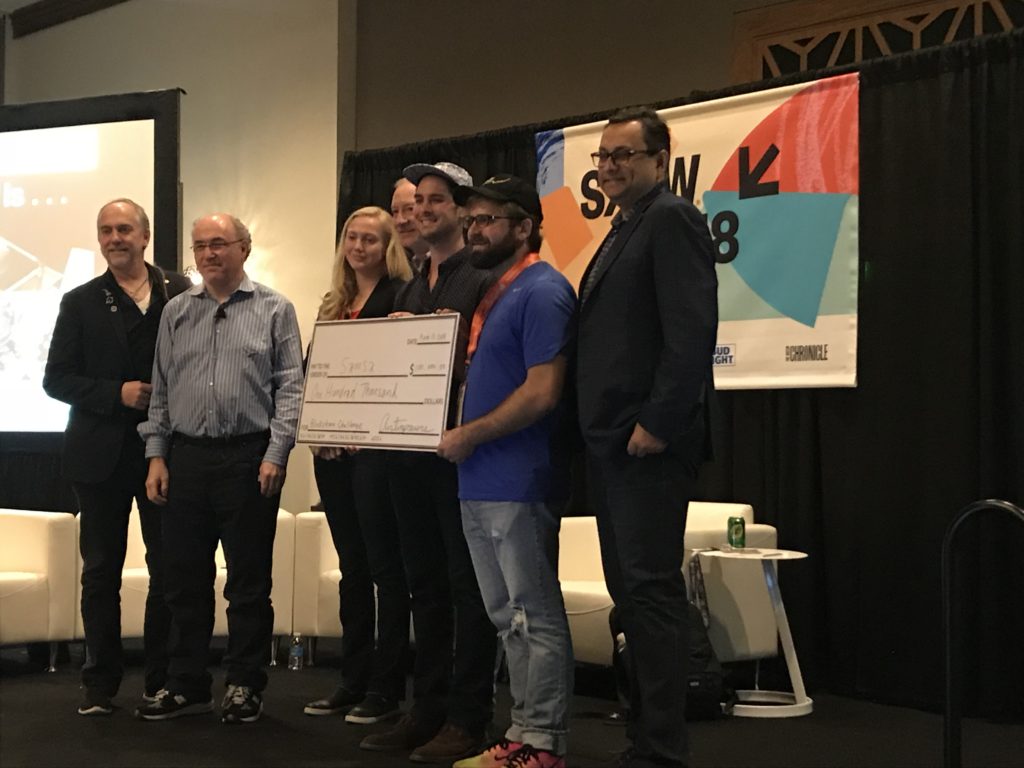

Samsa Wins Capital Factory’s 100K Blockchain Challenge at SXSW

Samsa wins 100K Blockchain Investment Challenge at SXSW


By Laura Lorek
Publisher with Silicon Hills News

Capital Factory awarded Samsa, a startup that runs a cryptocurrency index platform, $100,000 in its Blockchain Investment Challenge on Thursday at South by Southwest.

Judges selected two other runners-up: Topl, which is building a platform for international investment on blockchain technology and Vertalo, a blockchain-backed platform to secure professional credentials and verify who a person is.

Blockchain is a way to structure data on a digital ledger which is distributed on multiple computers and no one person has control of that data to manipulate it. It is the foundation for cryptocurrencies like Bitcoin and Ethereum, but it has many other applications to verify information in a global marketplace. Blockchain is one of the hottest technologies at SXSW this year.

The other finalists for the competition included Verimos, a health data startup using blockchain technology to create a marketplace for patient data and ERC dEX, a hybrid-decentralized cryptocurrency trading platform.

The judges for the competition included Stephen Wolfram, founder and CEO of Wolfram Research, Richard Garriott, entrepreneur, game developer and astronaut, Manoj Saxena, first general manager of IBM Watson and founding general partner of the Entrepreneurs Fund and Laurence Tiana, co-founder of Factom, an Austin-based blockchain company.

Capital Factory reviewed hundreds of applications for this 100K Challenge to select the finalists, said Gordon Daugherty, managing director at Capital Factory. Capital Factory ran a 100K Challenge last year at SXSW focused on Artificial Intelligence, which Austin-based New Knowledge won, and they are doing extremely well, he said.

“We are trying to shine a light on a technology and a startup that we believe is going to make a huge difference in the market and the world,” Daugherty said.

And Capital Factory has awarded other startups $100,000 in geographical and thematic focused challenges, he said. The next Challenges are in April for San Antonio startups and July it is partnering with Austin Technology Alliance for a Smart Cities 100K Challenge. Startups can apply on AngelList.

Samsa, an Austin-based startup, created an online platform that lets users create custom portfolios from a basket of indexes, said Chris Slaughter, its CEO. The indexes offered on Samsa vary in volatility and exposure, Slaughter said. The idea behind the platform is it lets investors hold multiple different types of cryptocurrency in their portfolio and offers less volatility than single coins, he said.

“Once you own Bitcoin or Ethereum, we help you trade it,” Slaughter said.

Slaughter was working on a hedge fund startup, Paladar Capital when he pivoted his company to focus on Samsa. He thinks investors in cryptocurrencies should have the same advanced strategies hedge funds use.

So far, Samsa has more than 1,000 customers using its platform. The bootstrapped startup plans to use the $100,000 to further develop an educational portal, Slaughter said.

William Baxter and Dave Hendricks, co-founders of Vertalo

Vertalo, founded in February of 2017, is in Capital Factory’s accelerator program. The startup is liked a next-generation LinkedIn platform to verify identities, including employment and educational history and achievements, using the blockchain. It has raised about $2 million from friends and family and has seven employees, said Dave Hendricks, its CEO, who moved from London to Austin last year.

Vertalo Co-founder William Baxter, who serves as the Chief Technology Officer, lived in Austin. Later this year, Vertalo plans to make its platform live. It’s been getting a tremendous amount of attention at SXSW, Hendricks said.

“We’re a blockchain for normals company,” Hendricks said. “We’re the kind of blockchain company that you can actually use as a normal human. Most people are not traders and so if you are not a trader and you are not into crypto, but you want to understand the blockchain then getting your profile certified using a platform like Vertalo is your way to get introduced into the blockchain, a crypto-wallet and to the certifications functions of the blockchain.”

Kim Raath and Chris Georgen, founders of Topl

Another runner-up Topl is building a blockchain financial platform that allows low-cost capital to reach small and medium-sized businesses and projects in developing countries, said Chris Georgen, founder, and chief architect. The startup, based in Houston, plans to sell its dual use utility and platform token with Iconiq Lab in May.

Georgen met Kim Raath, the company’s head of financial engineering, at Rice University in Houston and founded the company about a year ago. Right now, the company, with 12 employees, is based in Houston with a Dutch office in Holland, but Georgen is thinking about moving it to Austin, he said.

“Investors want access to developing markets. Developing markets want access to investors’ money. The question is how we facilitate these investments,” said Raath, who is from South Africa, and earned a dual degree with a Ph.D. in statistics and master’s in economics at Rice. “So yes, Topl has a social and economic impact…We do need to give access to capital into the developing world and there is a lot of money that wants to move into the developing world and we just give them a way to do that.”

At Capital Factory, Shep Founder Pitches Reddit CEO Steve Huffman on the Fly at SXSW

Daniel Senyard pitching Steve Hufmann at Capital Factory during SXSW, courtesy photo.


By Laura Lorek
Publisher of Silicon Hills News

Sometimes being in the right place at the right time during South by Southwest can create opportunity.

Daniel Senyard, founder of Austin-based Shep, got a text from Henry Yoshida, one of the company’s advisors, to get to Capital Factory’s first-floor auditorium because Joshua Baer, founder of Capital Factory, had just mentioned Shep on stage.

It so happened, Bear was interviewing Steve Huffman, CEO and co-founder of Reddit, who also started an airfare search engine site, Hipmunk, and Bear mentioned that Shep was based at Capital Factory.

Senyard had been squeezing in some work at his desk on the fifth floor in between attending panels, parties and other SXSW events. So when he got the text, he went to the first floor immediately to hear the talk.

Baer noticed him in the back of the room during the Q&A session and called Senyard on stage. He got to pitch Shep, his startup, to Huffman for a couple of minutes. Shep, formerly known as Compli.ai, is an online platform that provides policy guidance and reporting for business travel.

“It was a completely spontaneous opportunity,” Senyard said.

It’s those kinds of unexpected moments that can make SXSW a fruitful experience for startups looking to break through the noise and make connections, Senyard said. He’s been in Austin for 11 years and has worked at a few startups and served as Entrepreneur in Residence at Capital Factory.

“Now we have to take that opportunity and move it forward,” he said.

Here’s a Q&A Silicon Hills News did via email with Senyard recently for more information on Shep.

Q. How did you come up with the idea for Shep?

A. After three years of working for a travel tech startup targeting large corporate travel agencies in the US and India, I realized that while small to medium-sized enterprises (SME) don’t have a good way to manage their travel policy and expenses, they are hesitant to pay and feel that most travel management tools are excessive for small teams. To match millennial and SME behavior, we created Shep to focus on light-touch platform freedom (allowing you to book on your favorite sites) vs. a heavy-handed, better mousetrap.

Q. Who are your customers?

A. Our customers are “Unmanaged Companies.” This means any company that travels but doesn’t utilize the services of a corporate travel agency (like American Express Travel or Carlson Wagonlit) nor travel booking tool (like Concur). These companies typically spend less than $1 million a year on travel, so they’re usually under 200 employees. That said, we’ve come across teams of up to 3,000 who are unmanaged.

Q. Who is on your team?

A. CEO Daniel Senyard, CTO and CIO Rey Garcia are co-founders. Other roles include Product Manager, Customer Success, Software Development and Part-Time Marketing Coordinator and UX designer.

Q. Why are you the ones to do this startup?

A. Our team has worked together in various combinations and in travel tech for more than a decade. We’ve also lived the problem, both as a solution builder as well as a traveler. I recruited Rey to work for me in my last company, and after a year, we went our separate ways and then reunited, knowing that there was a better way to approach the corporate travel management problem.

Q. What challenges do you face bringing your startup into the marketplace?

A. Smaller companies often don’t realize the benefits of managing their travel spend before it becomes a problem — It just takes one person to book a business class flight because “no-one ever told me I couldn’t.”

Q. How do you acquire customers?

A. As we’re just launching our closed Beta, it’s currently through our network and word of mouth, but we’ll follow a pretty standard freemium SaaS model where we use content marketing, SEM and conferences to find customers who want to control their travel spend without forcing massive changes in employees behavior.

Q. What is the business model?

A. We currently offer a freemium model and will add a pro SaaS tier as we add advanced features and integrations that fit within existing workflows (Slack etc.) Q. How are the biggest challenges you’ve faced so far? A. Because we allow travelers to book on their favorite sites, we are beholden to websites we can’t control. For our extension to accurately guide and capture bookings on sites like Expedia, Hotels.com, Orbitz, Southwest, etc., we have to do a lot of testing. It’s a challenging but necessary evil to deal with “bugs” that we haven’t introduced – a site changes the position of a button, and we have to update our mapping of that site. But as we’re progressing, more and more of these sites like what we’re doing and are working with us as partners, so we aren’t caught off-guard.

Q. Are you bootstrapped or do you have angel or VC financing?

A. We’ve raised $1.4 million Seed funding

Q. What Austin resources have you found most helpful?

A. Capital Factory, various meetups (we run a travel tech one, called the ATX Travel Tech Meetup ourselves) and other local founders and mentors. Austin has been great as I feel the startup ecosystem has a real, “all boat rise,” mentality. When I started my first company, vivogig, another startup founder, Matt Curtin (with SocialSmack at the time), told me which books and blogs to read, which meetups to attend and he bought me coffee while doing it!

Q. What has been your biggest win so far?

A. We’re working on a pilot partnership with a huge travel company that wants to offer our solution to customers that are too small to be serviced by them. Also, we’ve been able to pull together an amazing group of connected and strategic investors who can get us in front of almost anyone in the travel industry.

Q. What is your long-term vision?

A. Our long-term vision is to get to a ‘policy of one,’ where your policy is not just a static set of rules that says that you can only spend $300 on a domestic flight. Instead, it’s taking into account the route you’re taking, who you are, who you’re visiting, the potential ROI of your trip, your past behavior, the market availability, whether prices will go up or drop. Essentially, we want to use data to create processes that increase trust and employee freedom.

Correction: An earlier version of this story referred to the company as Shep Travel, it goes by the name Shep.

Three Startups Win Food+City Challenge Prizes at SXSW

Jonathan Partlow, founder of Aggressively Organic, winner of the Food+City Challenge Prize for Session Two.


By Laura Lorek
Publisher of Silicon Hills News

For the first time, Food+City held its annual Challenge Prize competition at South by Southwest.

And judges awarded three $10,000 cash prizes to the winner of each of three sessions on Tuesday. Altogether 14 startups competed as finalists from the U.S., China, Kenya and the United Kingdom.

Taimba, based in Kenya, founded by Dom Kavuisya won the first Challenge Prize Session at the Hilton Downtown. The other finalists in that session included AgroRacks, Elevated Honey Co. Transera, and Vinder. Taimba is a mobile-based cashless platform that connects farmers to retailers.

Aggressively Organic Systems of Fishers, Indiana, founded by Jonathan Partlow, won the second Challenge Prize session. Partlow said the company will be in Austin for MassChallenge Texas from April to August. The other finalists included Afresh Technologies, Big Wheelbarrow, and Grit Grocery.

Aggressively Organic wants to establish a fresh farm in Austin, Partlow said. The company has patents on a hydroponic system, which looks like a cardboard flower pot, to grow lettuce, tomatoes, and other vegetables. It takes about 21 days to grow a plant, Partlow said. The idea is to eat off the plant or harvest it and share it with neighbors, he said.

“In a world of abundance, nobody’s hungry,” Partlow said.

And UAV.IQ won the third Challenge Prize Session. The other finalists included Corvus Robotics, GrubTubs, Seal the Season and Stowga. UAV.IO uses drones and sensors in agricultural fields globally to help farmers produce more. It has offices in Los Angeles and Puerto Rico and it has participated in three accelerator programs including Startup Chile, Parallel 18 in Puerto Rico and Thrive in Salinas, Calif.

“We’ve had our software used by drone operators on five continents,” said Andreas Neuman, the CEO, and Co-founder.

This is the fourth time Food+City has held the Challenge Prize. Robyn Metcalfe is the founder and created Food+City as a platform and catalyst for supply chain innovation. The nonprofit organization started out as the Food Lab at the University of Texas at Austin.

Whurley Says Quantum Computing is the New Space Race

By Laura Lorek
Publisher of Silicon Hills News

Quantum computing, not Artificial Intelligence, is the space race of our generation, said William Hurley, known as Whurley.

Whurley, founder and CEO of Strangeworks, gave the keynote speech Tuesday afternoon at South by Southwest on “The Endless Impossibilities of Quantum Computing.” He pledged to keep the math slides to ten and the overall slideshow to around 110 slides.

“I am on a mission to humanize quantum computing,” he said.

It’s an incredibly complex topic and even though he’s been studying it for years Whurley said he’s no expert on the subject.

“This is very cutting-edge stuff and it’s supercool,” Whurley said.

This is less of a replacement of classical computing and more of an extension of its power, he said.

Overall, the field of quantum computing has seen tremendous growth over the last few years and the U.S. leads all other nations in the number of patents filed in the field with 295 patent applications filed in 2015, according to Whurley.

“When there is more open source of this technology, that’s when it’s going to take off and we will be seeing more of that in the next few years,” Whurley said.

The University of Texas has started a program to teach quantum computing and Texas A&M also has quantum computing experts, Whurley said. Other universities focused on quantum computing include the University of Waterloo, University of Maryland, Tokyo Institute of Technology, University of Oxford, MIT, Yale, Berkley and others.

Companies heavily involved in the quantum computing technology include D:Wave, IBM, Microsoft, Intel, Google and startups like Strangeworks, the company Whurley just launched in Austin. Other startups include Regitti, 1Qbit, QCWare and others.

Whurley said he doesn’t see the other startups as competitors but collaborators. They are all working together, he said.

To explain quantum mechanics to the audience, Whurley gave a brief history of the science including quantum mechanics, computer science and quantum information with an explanation of Schrodinger’s cat, a thought experiment created by Austrian physicist Erwin Schrodinger in 1935.

In one of the only SXSW keynote presentations to delve into algorithms and math, Whurley actually did math calculations on stage and ran through a series of formulas. The next slide read: TL:DR 3X5=15.

Whurley gave the audience of list of books at the end of his presentation to read more about the subject. He has also written a book “Quantum Computing for Babies.” He gave copies of the book to people in the audience who asked the best questions at the end of this presentation.

To celebrate all things Quantum computing and the launch of Strangeworks, Whurley held a party Tuesday night at the Container Bar on Rainey Street and Wu-Tang Clan showed up. During his keynote, Whurley joked that he couldn’t decide between Wu-Tang Clan or Stephen Wolfram, Founder & CEO of Wolfram Research, to do the audio version of his children’s book.

SXSW Accelerator 2018 Award Winners Including ICON 3D and GrubTubs of Austin

At South by Southwest, some of the globe’s most innovative companies pitch every year to become the winner in their category.

At the 10th annual SXSW Accelerator Pitch event, judges selected ten winners among the 50 finalists and for the first time, they named a “Best in Show” winner, which went to “Nanowear, a New York-based connected-self technology platform for diagnostics and disease management based on proprietary cloth-based nanosensors and analytics.”

The two Austin-based winners included GrubTubs, which won the Hyper-Connected Communities category for its system that recycles food scraps from restaurants and provides them as feedstock to local farms. And ICON 3D won in the Social and Cultural category for its construction-technology that is working to build “the first up-to-code 3D printed home in the United States (using concrete as substrate).”

The other winners included:

Augmented and Virtual Reality
ARwall

Enterprise and Smart Data
DroneSeed

Entertainment and Content
Vochlea Music

Health and Wearables
Nanowear

Payment and FinTech
FutureFuel.io

Security and Privacy
PolyPort

Sports and Performance
Nix

Transportation
GoKid

Leaf also received a “Best Bootstrap” award and Roots Studio received a “Best Speed Pitch” award. Winners received $4,000 each and two badges for next year’s SXSW Interactive conference.

At SXSW, Futurist Amy Webb Declares 2018 as the Beginning of the End for Smartphones

Amy Webb at SXSW, Photo courtesy of Getty Images


By Laura Lorek
Publisher of Silicon Hills News

It’s the end of an era for smartphones and the rise of cryptocurrencies.

Those are just a few of the trends Amy Webb, founder of the Future Today Institute, sees emerging.

In a completely full ballroom on a Sunday morning, Webb took to the stage at South by Southwest to give an overview of tech trends.

In the 11th annual Tech Trends Report, Webb and her team have identified 225 emerging tech trends, 20 weak signals across 20 industries.
Among her predictions, she declares “ICOs are the new IPOs.”

Initial Coin Offerings or cryptocurrencies are the big thing. The chairman of Uber is launching his own cryptocurrency, she said. Even Kodak is launching a cryptocurrency, she said.

Toothbrushes and toilets have built-in artificial intelligence, Webb said.

“The robots are going to come and kill us all but not before they take over all of our jobs,” Webb said.

Robots are not just able to drive cars, they are able to drive trucks, she said.

“The challenge we face in 2018 is how do we distinguish something trendy from a real trend,” Webb said.

Trends share four common characteristics, she said. The first is trends are driven by basic human needs, they are timely but tend to persist over long periods of times, trends evolve as they emerge – they are not static and tech trends have dependencies and appear at first as outliers.

Emerging tech trends are easy to dismiss at first, she said. It’s important to pay attention to trends to avoid the cycle of doom which ultimately can lead to companies going out of business.

Webb and her team look at quantitative data from all kinds of different sources and they look for pattern recognition to spot emerging trends. They also build models for possible, probable and plausible trends for the future.

In her latest report, Webb declared that the first key finding is 2018 is the beginning of the end of smartphones, Webb said.

The demise stems from new technology bubbling up from the horizon like digital assistants, natural user interfaces, faceprints and voice prints, she said. The sales of smartphones are starting to drop off year over year because people are not upgrading their phones as frequently as in the past because they are just seeing incremental benefits.

Wearable devices like smart glasses, combined with earbuds, smart wristbands and watches are where the trend is heading next, Webb said.

By the year 2021, 50 percent of people in developed nations will interact with machines using their voices, Webb said. It will replace what we do with our fingers and some of our gestures, she said.

Machine reading comprehension is a big trend combined with voice prints that are evolving to become smarter.

Passwords will go away, and biometric fingerprint scans will go away in the next decade, Webb said. And they will be replaced with Faceprints, she said. A person’s face can be turned into a 3-D rendering.

Machine learning, data mining and voice prints can also be used to generate fake videos.

Pay close attention to technological developments in China, Webb said. Face++, based in China, is a leader in facial recognition technology, she said. In China, the facial recognition technology is being used for financial transactions.

“In China, you can smile to pay,” she said.

The technology is also used to catch jaywalkers and for public shaming when photos of lawbreakers are posted to social media, Webb said.
Magic Leap is another company to watch, Webb said. The company has a lot of patents and innovative technology, Webb said.

And Artificial Intelligence is not a trend.

“AI is already here,” Webb said. “It turns out we are all using AI every single day.”

People don’t recognition AI technologies as groundbreaking technologies because they are just part of our lives, Webb said. For example, cars with anti-lock brakes, Spotify playlists, airline security systems – all of that is AI, she said.

It’s not just about terrifying smart robots and HBO’s WestWorld, Webb said.

“When it comes to AI there’s a tremendous amount of misplaced optimism and fear and partially that’s because we’ve imposed biological characteristics on the ecosystem,” Webb said. “And the thing is AI is not one of the tech trends itself in our report and it hasn’t been for some time. That’s because AI represents the next era of computing.”

The first era of computing was tabulation, the second was programmable systems, the third, which we are all in the middle of right now, is artificial intelligence, Webb said.

Webb provided a link to download the full report here.

Pied Parker Launches Parking App at SXSW

Pied Parker with some of their supporters at the Entrepreneur’s Lounge MeatUp 11 at SXSW

By Laura Lorek
Publisher of Silicon Hills News

As a sophomore at the University of Texas at Austin, Mason Hunt founded a parking mobile app called ParXit designed to let people rent out their driveways to people needing parking.

ParXit officially launched in December of 2015 and gained a lot of traction in the Austin community, Hunt said.

A year ago, Hunt merged ParXit with Palo Alto-based Pied Parker, a California app working to become the Airbnb of driveway parking that was also founded in 2015.

“They are bringing Silicon Valley and Silicon Hills together,” said Barbara Kelso, an advisor to Pied Parker.

At South by Southwest, Pied Parker is making a big splash with the debut of its mobile phone app, which launches later this month. It sponsored the popular 11th Annual Entrepreneurs Lounge MeatUp 11 at Fogo de Chão along with J.P. Morgan, Atlassian, Alberta Innovates, Pillsbury, CBRE, Spry and Red Velvet Events. The MeatUp, which took place in the evenings Friday through Monday, is one of the favorite networking spots for Austin and out of town entrepreneurs, Venture Capitalists, innovators, corporate executives, and more during SXSW.

As Chief Marketing Officer for Pied Parker, Hunt saw the Entrepreneurs Lounge as the perfect opportunity to spread the word about the parking app.

“Land is an asset and so is your driveway,” Hunt said.

The Pied Parker mobile app lets landowners and others with driveways and spare parking spaces profit off their assets during events like SXSW, ACL and Texas football games, he said.

Parking at SXSW can cost as much as $80 for 24 hours to park in a dirt lot near the convention center or $100 valet parking at some hotels. And even when big events aren’t going on in Austin, affordable parking in Austin is tough to come by.

“We want to get our name out there,” said Pied Parker’s CEO and Co-Founder Gianni Maxemin. The MeatUp was the perfect opportunity to reach as many high-profile people as possible in one place during the madness of SXSW, he said.

While Pied Parker’s original mission started out as a way for people to rent out their driveways and earn extra cash, its scope has broadened, Maxemin said. Today, Pied Parker is seeking to become the one app people use to find parking anywhere, he said. The app connects people with vacant parking spaces in driveways, assigned office spots, underused parking garages and commercial spaces. The app lets people schedule parking and it has built-in artificial intelligence that can learn from user behavior to automate the parking process, he said.

“The mission of Pied Parker is to bring drivers and space owners together within a virtual marketplace to ease parking demand and promote passive revenue while reducing traffic and pollution,” Maxemin said.

Pied Parker also has 11 patents pending to protect its technology, which is a bit different than some other mobile app startups, Maxemin said. Pied Parker has five employees in Austin and is about to close on its seed round of $1 million.

Mayor of London Calls for Regulation of the Tech Industry


By Laura Lorek
Publisher with Silicon Hills News

London Mayor Sadiq Khan spoke during the afternoon keynote at South by Southwest on Monday about the need for technological advancements to benefit everyone in society.

There’s an increasing disconnect and disillusionment across London and worldwide stemming from fear of globalization, he said.

Technology is profoundly changing people’s lives, he said.

“Technology is disrupting and shifting the way we do everything,” Khan said.

“How we deal with this transformation will be a defining challenge of the 21st century,” Khan said.

The fourth industrial revolution has created a new era where exponential change can spread across the world quickly.

Today, a handful of tech companies have amassed an enormous amount of power over how information is consumed. Platforms like Facebook, Twitter and YouTube have brought tremendous benefits to society, but there are growing concerns about how some of those companies are impacting our lives, Khan said.

There has already been evidence of elections and referendums being influenced, A rise in online abuse, misogyny and religious hatred. Fake news spreading misinformation. Algorithms blinkering us from different points of view and pushing people to extremists. And terrorists and far-right groups using social media to not only conspire but to radicalize and brainwash others.

“All of this is dividing and polarizing us, rather than uniting us. I know this all too well from personal experience,” Khan said.

Then Khan read half a dozen horrific hated filled Tweets calling him names and making all kinds of threats against his life that he had received as Mayor of London. He didn’t read them to portray himself as a victim or ask for sympathy. He wanted to create awareness that this is the kind of harassment some people routinely face in online platforms.

Tech companies, innovators, must take responsibilities for how their platforms are used, Khan said. He also called on politicians and policymakers to look out for the public and pass regulation when necessary.

Khan also made a big push for gender equality and has launched the #BehindEveryGreatCity campaign to highlight and support women.

Irish Taoiseach Visits SXSW Before Meeting President Trump

Photo by Susan Lahey

By Susan Lahey
Reporter with Silicon Hills News

In a session Sunday between Evan Smith and Leo Varadkar, Prime Minister of Ireland, Smith lumped the Taoiseach with leaders like Emmanuel Macron and Justin Trudeau: young, progressive people, moving their countries forward in a world where many leaders seem to be peddling hard backward. Varadkar, at 39, is the youngest Prime Minister of Ireland and one of the few openly gay heads of state in the world. Elected only a few years after Ireland became the first country to legalize marriage equality by popular vote, he is facing a future in which relations between Ireland and the U.S. are strained by President Trump’s proposed trade restrictions, and in which Brexit threatens to create tensions again between the Republic of Ireland, and Northern Ireland, which is part of the United Kingdom.

Varadkar is a diplomat who believes the problems can only be solved by continuing to talk. Historically the Irish Prime Minister visits the U.S. president on St. Patrick’s Day as a symbol of the relationship between the two countries. Some members of Varadkar’s parliament encouraged him not to visit Trump.

“That’s an extreme view,” said Varadkar. “Those same people would encourage me not to talk to Russia or China either…half the world.”

Smith continually pressed Varadkar to say something controversial about either Trump or British Prime Minister Theresa May, but Varadkar remained restrained, saying he liked May and they had a good relationship…until he finally said, “If it wasn’t for Brexit it would be a great relationship,” and then tipped sideways, laughing as the crowd joined him.

“Other than that Mrs. Lincoln, how did you like the play?” Rejoined Smith.

Uniting Not Dividing

Relations between Ireland and England have been strained for hundreds of years, a period of violence known as “The Troubles” until the Good Friday Agreement of 1998 when the two parts of Ireland came together over peace accords. Varadkar noted that while the majority of Northern Irish were in favor of remaining with the EU in the Brexit vote, the fact that Northern Ireland would now no longer be part of the European Union and would thus have different rules about immigration—among other things—might reestablish a more firm border between the two parts of Ireland.

When both countries were part of the EU it eased a lot of the difficulties. But what’s worse than the actual border between them, Varadkar said, was people who are deliberately trying to drive wedges between people of different countries. “There’s no way we can accept that.” His solution is “to ensure that whatever the new relationship is it is so close that we don’t need to have a hard border….”

Asked if he would address President Trump regarding Vice President Pence’s reputed support for conversion therapy for homosexuals, he said he intended to. In Ireland, not only is marriage between gay people legal but transgender citizens can decide what gender they want listed on their state issued documents. During the election for marriage equality, he said, a large number of gay people came out to their friends and family, visiting them especially in the rural areas and “asking them, ‘Will you vote to treat me as an equal citizen in my own country?’” The referendum passed by 62 percent.

In speaking to President Trump, he said, he will point out that the U.S. has always been a world leader for individual freedom, including the LGBT movement and “It’s really tough to see a country built on individual freedom not being a world leader in that space anymore.”

Varadkar also said there would be a referendum in May legalizing abortion in Ireland, which is a constitutionally Catholic country.

This is a different issue than gay marriage, he said, because people “generally consider marriage a good thing, to be celebrated; and I don’t think anyone thinks abortion is a good thing or to be celebrated. But it’s something people need access to sometimes.”

A former doctor, Varadkar also said he hopes to overhaul Ireland’s health care system which, like that of the U.S., consumes an enormous amount of money and still leaves people trapped in crowded waiting rooms or waiting months for operations they need. One of the problems, he said, is that a lot of Irish health care still operates on paper, rather than digitally, which causes costly errors like people missing appointments. He was inspired, he said, by the preponderance of health tech at SXSW.

Varadkar, whose mother is Irish and whose father is Indian, said he was the only person in his neighborhood growing up who had a “perpetual tan and a funny name” but that his heritage taught him that there was a world outside not only Ireland and the UK but outside of Europe. It gave him a broader perspective. In Ireland, he said, 17 percent of the population was born outside of Ireland and “we’re all the better for it. “

Varadkar spoke to a packed audience. He stopped in at SXSW before a scheduled meeting with President Trump on St. Patrick’s Day, March 17.

« Older posts Newer posts »

© 2026 SiliconHills

Theme by Anders Noren — Up ↑