FunnelAI, a startup that uses artificial intelligence to generate leads for car dealers, announced Wednesday that it has raised a $1.5 million seed round of financing.
The San Antonio-based startup previously raised $375,000 in
pre-seed stage funding and participated in the RealCo Accelerator, based at
Geekdom.
San Antonio-based Active Capital, which last month announced it had closed on a $21.5 million fund to invest in early-stage business to business software as a service startups, led the round. Other investors included Geekdom Fund, True, based in London, and angels from San Antonio and Houston.
FunnelAI, which has eight employees in San Antonio and one
in Austin, plans to use the funds to hire additional full stack engineers,
sales and marketing and customer service employees, said Sri Kamma, CEO of FunnelAI.
RealCo, a business to business focused, long-term accelerator program,
recruited FunnelAI to San Antonio from Austin in July of 2017. The startup
participated in RealCo’s first accelerator cohort.
Active Capital got to know the founders through RealCo and invested in its pre-seed round about six months ago, said Pat Matthews, CEO and Founder of Active Capital.
“I’ve spent a lot of time with Sri over the last few months,”
Matthews said. “It just made a lot of sense for us to be the lead investor.”
FunnelAI shares offices with Active Capital in downtown San
Antonio.
“First and foremost, it’s a great founding team. I think
they’ve got a big vision. They’ve done an amazing job of staying focused to get
the business going. With a lot of entrepreneurs, it’s hard to focus. They’ve
got a platform that is beneficial to a number of industries,” Matthews said.
“I love the progress they’ve made,” Matthews said. “They’ve
made so much progress on so little capital.”
FunnelAI is a sales and marketing platform that uses artificial intelligence, machine learning, natural language processsing and data to help connect businesses to potential customers.
FunnelAI’s product works for real estate, auto-dealers,
financial services, but it’s hyper focused on the auto industry right now, Kamma said.
The startup harvests data from social media platforms like Reddit and car enthusiast forums looking for prospective customers that might want to buy a new car, used car, service or parts, auto loans, or auto insurance. It then provides the leads to sales managers.
FunnelAI has 78 customers, including BMW of Austin, Mercedes Benz of Austin, a few
dealerships in Louisiana, BMW of Los Angeles, Kamma said.
David Rubin and John Berkowtiz, co-founders of OJO Labs
OJO Labs, an artificial intelligence startup, has raised $45 million in additional funding.
The Austin-based company plans to use the
funds to accelerate its development and market expansion. It plans to hire more
employees in the areas of engineering, data science, product and design.
OJO has created a virtual assist that
helps homebuyers and sellers. Its agent uses natural conversations conducted
via mobile messages to help a person find a house. OJO’s product is available
in 12 markets in the U.S. and Toronto, Canada. OJO is rolling out the product
nationwide.
“We have utilized a unique combination of
AI technology and human operations to solve some very hard problems,” John
Berkowitz, CEO of OJO Labs, said in a news statement. “Our early investments
and willingness to be first to market with this type of product gave us a
significant head start to build our now patented technology.”
OJO has created a free assistant that lets homebuyers ask all kinds of questions about home features ranging from things like whether the house has a swimming pool, a view of downtown, a large kitchen, large lot, school district, etc. The OJO assistant then sends the homebuyer texts of potential homes with photos and listings. It learns what the person likes and what the person doesn’t like through the interaction. When the person is ready to buy, it refers them to a human agent to handle the homebuying experience.
To date, OJO Labs has raised $76 million.
Last October, the company merged with real estate data giant, WolfNet Technologies,
based in St. Paul, Minn. The combined company will
have about 290 employees. OJO also has offices in St. Paul, and on the island of
St. Lucia in the Caribbean. OJO Labs and WolfNet expect to add more than 50
jobs in the coming months.
Wearing a red cowboy hat, jeans, a button-down white shirt, a jade necklace and a necklace of crystals, Adeo Ressi doesn’t look like the typical startup founder.
And he’s not.
Ressi, who has founded and sold two $1 billion companies, now serves as CEO of Founder Institute, which runs an early-stage startup program in 200 cities worldwide, including Austin. He visited Austin during South by Southwest and gave a speech at SXSW on finding your purpose and turning that into a business.
“A startup fails when the founder gives up,” Ressi said. “So, people
always ask is it money, is it the market, or the model, or management. It’s
none of the above. It’s always the drive and passion of the founder. When the
founder is pursuing their purpose wholeheartedly by running the company, that
company can achieve really miraculous things.”
Purpose is driven from the heart, not from the mind, Ressi said.
“Your purpose is something you feel,” he said. “Your heart is driven by
love.”
It’s important for entrepreneurs to get in touch with their feelings and
emotions through guided mediation to feel what their heart is telling them, Ressi
said. Founders can also do it through journaling, he said.
Ressi also spent time at Galvanize with graduates of the Founder Institute Austin program. And he took some time to talk about entrepreneurship on this Ideas to Invoices podcast.
During the podcast, Ressi talks about a whole range of issues. Ressi has done a lot of work with psychometrics and the only thing that alters a person’s personality to create more openness is psychedelic mushrooms, he said. It can help you find your purpose, but journaling is a lot safer and less dramatic method, Ressi said.
Mediation and yoga are also good alternatives, he said.
Working with a coach or adviser can also help a person find their purpose,
Ressi said.
“I think everyone should go on that journey,” he said.
At SXSW this year, a lot of talks focused on authenticity and truth. The rise of vanity metrics has had a counter effect on authenticity in the digital age, Ressi said.
“Obviously you don’t want to post ugly photos on Instagram,” Ressi said.
“But then what happens you get to the point where you start manufacturing
photos that are not real in any way to get followers essentially and build
these vanity metrics.”
There’s almost an instinctual negative reaction that’s happening to
that, he said.
“Where there is a flight to authenticity and vulnerability,” Ressi said.
People just aren’t vulnerable and honest about their feelings, situations, and struggles, Ressi said.
“We have, as humanity, a great deal of trauma that has been passed down for generations,” he said.
Now, there are tools today to heal trauma and it’s important to use them to break inter-generational trauma cycles and build great companies that are good for humanity, Ressi said. He calls that the “neo-enlightenment.”
Fake it till you make it has been a mantra of Silicon Valley for
decades. It comes from entrepreneurs with big ideas showing rigged demos of
their products and creating fantastic revenue charts for where they want their
startups to go. But with the Theranos collapse, that way of doing business has
been called into question. Elizabeth Holmes, founder of Theranos raised $400
million to create a machine that could easily process a small finger-prick sample
of blood and test it for 200 diseases. The only problem was the machine didn’t
work and the company went bust but not before defrauding customers, investors
and employees.
Theranos is an outlier, Ressi said. Everything worked fine up until when Holmes began lying to investors, customers and everyone else, he said. Another recent social media-driven fraud case is Fyre Festival, which raised millions of dollars and promised customers an exotic musical festival in luxury tents on a private island in the Bahamas. Models and social media influencers promoted the festival through paid posts on Instagram, Twitter, and other social media platforms. The music festival turned out to be a huge fraud and didn’t deliver on its promises. Billy McFarland, its founder, is in jail. And Theranos’ Holmes is awaiting a criminal trial.
“As a founder, you run a delicate balance between having that unbridled
optimism and then also having to be genuine and honest,” Ressi said.
The examples of abuse are far less than the examples of success, Ressi
said.
For more on Ressi and his thoughts on traits for a successful entrepreneur and the rise of China and other emerging technology markets, please listen to the whole podcast.
Manoush Zomorodi, co-founder of Stable Genius and host of the podcast ZigZag interviewing Joseph Lubin, CEO of ConsenSys and co-founder of Ethereum
By LAURA LOREK, Publisher of Silicon Hills News
In 2011, Joseph Lubin, CEO of ConsenSys and co-founder of Ethereum, read Satoshi Nakamoto’s white paper on Bitcoin.
“And it clicked for me,” he said. “We can start to build
something on a new trusted infrastructure and potentially build it on a better
trust system.”
He believed the current monetary systems, laden with debt, needed
reform. He wanted to move from wall gardened systems to building a trustworthy
collaborative system.
“Centralized banks were printing money too fast and we could
build a system that didn’t have that vulnerability,” he said.
Lubin spoke at South by Southwest in a keynote talk with Manoush
Zomorodi, co-founder of Stable Genius Productions and host of the podcast
ZigZag.
Before founding ConsenSys, Lubin met Vitalk Buterin, the guy who invented Ethereum. He started ConsenSys to build developer tools that allow developers to build more easily in its ecosystem.
But Lubin also believes blockchain technology can help journalists and the news industry overall.
Civil, a blockchain platform for sustainable and ethical journalism, had the most successful failed token launch in history, Lubin said. Civil, based in New York, tried to raise $8 million last year in an Initial Coin Offering but only raised $1.4 million, according to CoinDesk, a publication that covers the Blockchain industry. ConsenSys invested $5 million in Civil, according to CoinDesk.
Civil’s token sale had about 10 times more participation than other token sales, Lubin said. But the gauntlet Civil put up that all these normal people had to brave including 43 legal steps made participating difficult, he said.
“We forced everyone to understand everything about the Civil
project,” he said.
Civil engaged many more people than normal to look at these token launches, Lubin said.
“It wasn’t these crypto-nerds,” he said. “Many approached it, but few got over the bars.”
Civil is still running. Stable Genius Productions published to the Ethereum blockchain and it got its tokens, Zomorodi said.
So far, Civil has generated 1.5 million tokens or about
$315,000 in revenue, Zomorodi said.
“It’s been a week. There is no big marketing hype,” she said.
“The Civil platform is open for business.”
Journalists can put a newsroom together and pledge via a
security bond to be ethical and adhere to the constitution and receive tokens.
These tokens enable journalists to stake a newsroom on the platform.
This is out in the world. The ability to take an article and
log it indelibly to the Ethereum platform. Stable Genius has done that,
Zomorodi said.
Automatic, publisher of WordPress, which 60 percent to 70 percent of the newsrooms around the world use as a content system for publishing, will include Civil and it will be built into most of the world’s newsrooms, Lubin said.
Zomorodi asked Lubin if token sales were passé, based on the
declaration of a recent Next Web article. She wanted to know if the article was
being short-sighted.
“2017 was pretty extreme – out of control even – lots of bad
projects – there was this notion you had to have a massive token launch –
Ethereum was responsible for that too,” Lubin said. “There was a ton of greed.”
The U.S. Securities and Exchange Commission and just
disappointment have stopped the bad projects, the fraudulent projects from
happening, Lubin said.
ConsenSys plans to do four or five token launches this year,
Lubin said.
“It’s a crypto-economic project designed to get people to
participate,” he said.
These are tokens that wouldn’t be securities, Lubin said.
ConsenSys has created Trueset – which is in a Beta right now
– asking the world – sourcing the wisdom of the crowd – to gather information
on different token projects – an Edgar like platform – people are getting paid
in this token and to correct data entries, Lubin said. There aren’t a lot of
normal people using these systems right now, he said.
“We think Civil has a shot because the news is so broken,”
Lubin said.
If we don’t have good information and reasonable and subtle
discourse, if we are getting our news from Facebook, the dopamine slot-machine,
binary news source, lots of people feel like journalism is important, Lubin
said.
Within a few months of the token fail at Civil, the price of
crypto currency plummeted. There are many
incredible rises in these tokens followed by very significant corrections,
Lubin said. But Ether, the token behind Ethereum is 5000 times more valuable today
than when Ether was initially launched, he said.
“In that context, it’s not so horrifying,” he said
“Every one of these brings attention to our ecosystem,”
Lubin said. “There is way more activity in our ecosystem now than there was a
year ago or 18 months ago.”
ConsenSys is focused on privacy and confidentiality systems
and building Ethereum 2.0., Lubin said.
ConsenSys has six or seven projects for social right now including a project at a Levi’s plant in Mexico that allows workers to give honest and frank feedback on working conditions. The project uses blockchain technology to allow workers to speak honestly about their conditions and not have management have access to or manipulate the data, Lubin said.
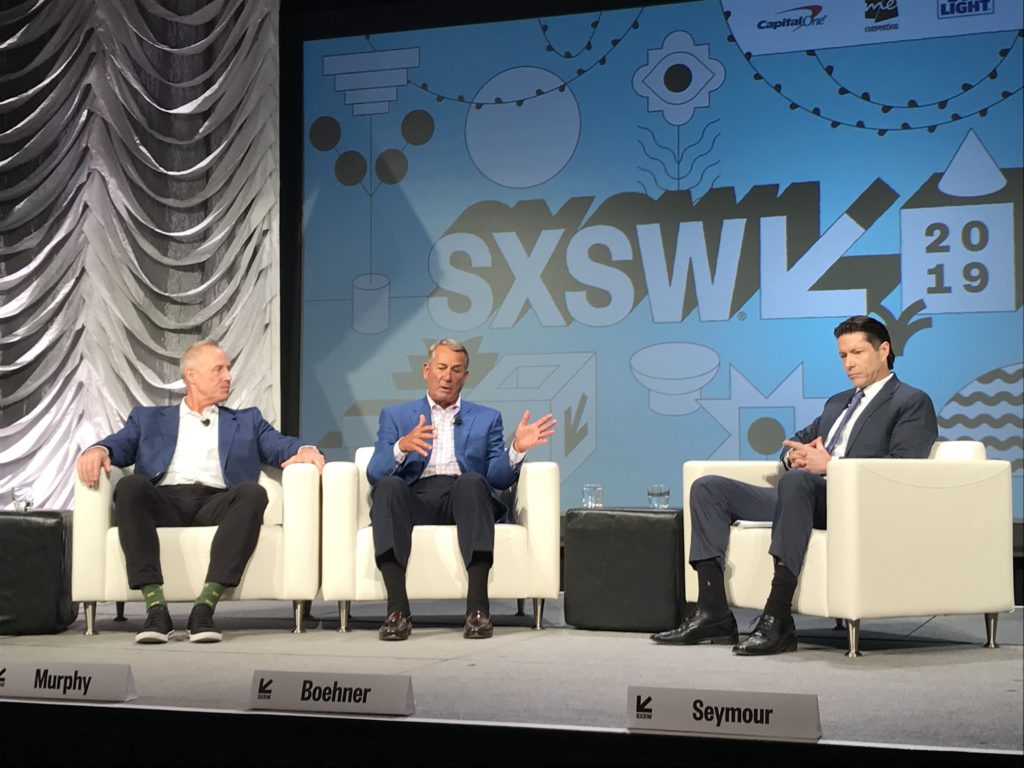
Kevin Murphy, CEO of Acreage Holdings, John Boehner, Former U.S. Speaker of the House and Tim Seymour, host of CNBC’s Fast Money at SXSW
By LAURA LOREK, Publisher of Silicon Hills News
The path to national legalization of marijuana is underway.
That’s the conclusion from cannabis experts at South
by Southwest, which hosted its first-ever Cannabusiness track this year with 60
panels.
In the U.S., 95 percent of the population believes in the medicinal value of cannabis and believes it should be available, said Kevin Murphy, Founder, and CEO of Acreage Holdings, which owns cannabis cultivation, processing and dispensary operations in 19 states. It does not operate in Texas.
And 66 percent of the population believe cannabis
should be available for adult recreational use, Murphy said. Ten states have
already approved recreational use of marijuana including Colorado, California,
Washington, Michigan, Oregon, Nevada, Alaska, Maine, Massachusetts and Vermont.
Last year, Former Speaker of the U.S. House John
Boehner joined the board of Acreage Holdings.
Boehner and Murphy spoke on a panel discussion Friday at
SXSW moderated by Tim Seymour, founder of Seymour Asset Management and host of
CNBC’s Fast Money.
Medical marijuana is now
legal in 34 states, District of Columbia, Guam, Puerto Rico and US Virgin
Islands, according to the National Conference of State Legislatures.
But it’s not an easy path
to a legal industry.
Those state laws conflict
with federal law, which still classifies marijuana as an illegal Schedule 1
substance under the Controlled Substances Act, making distribution of marijuana
a federal offense.
And Texas still has some
of the strictest laws in the country regarding cannabis. In 2015, the Texas
Legislature passed the Compassionate Use Act which allows for low-THC cannabis
for the treatment of intractable epilepsy. The state also licensed three dispensaries
to grow and distribute it.
Overall, attitudes about
marijuana are changing nationally.
“Over the last five or six years, I’ve found myself
looking at this issue differently than I used to,” Boehner said.
Boehner has heard firsthand stories from Veterans with
Post Traumatic Stress Disorder who use cannabis to treat chronic pain and to
eliminate headaches. He’s heard from an 85-year-old baggage handler at the airport
who uses cannabis to deal with chronic arthritis.
“The American people clearly are changing their views
of this product,” Boehner said. “And as they do, this industry is going to grow
exponentially over the next 10 to 20 years.”
Boehner has never used marijuana. He does smoke
cigarettes and drink red wine. And he might try it in the future, he said. He takes
an Advil PM every night before bed. He said he might like to replace that drug
with a cannabis-related sleep aid.
“We see this business at the cross section between
regulatory and commerce,” Murphy said.
The Tenth Amendment gives states the right to pass their own laws regarding cannabis, but the federal policy still makes doing business difficult, Boehner said. The federal laws classifying cannabis as a drug leads to ambiguity around financial services, he said. So federal banks will not handle cannabis money and that leads businesses to deal with suitcases full of cash, he said. Also, the Veterans Administration will not offer cannabis as an alternative to harmful opioids.
If the federal government passed the States Act, it
would give everyone a choice whether they wanted to use cannabis for medicinal
purposes or not, Murphy said. The act would make the states’ law the authority
when it comes to cannabis.
“If someone can use this plant and substitute it for opioids, we’re going to have a lot fewer deaths per day than 130,” Murphy said. The Center for Disease Control released a report last December stating 130 people die every day in the U.S. from opioid-related overdoses.
The federal government should pass the States Act in 2019 which will allow Acreage and other cannabis companies to operate more efficiently and use federal banks as well as have a fair tax code to operate under, Murphy said. It will also allow his company the privilege of being listed on the New York Stock Exchange or the NASDAQ.
“Today, we’re not welcome here in the U.S. as one of
the largest providers of cannabis in the U.S.,” Murphy said.
Canada-based cannabis companies can operate on the New
York Stock Exchange, Murphy said. Canada is one of the first countries to make
cannabis legal.
The world is changing, and the U.S. is not keeping
pace, Boehner said.
The 2018 U.S. Farm Bill, which President Trump signed into law, made growing hemp legal. Hemp does not have THC, which produces the psychotropic effects from marijuana. Hemp is derived from cannabis and is used to make Cannabidiol, known as CBD, based products. The Food and Drug Administration said it plans to heavily regulate the industry.
That’s created a lot of uncertainty in the market, Boehner
said.
All the cannabis industry wants is clarity so it can
abide by it, Murphy said. Every state right now has different regulations and
it makes doing business across state lines difficult, he said.
Acreage is part of the National Cannabis Roundtable,
which is made up of about 10 companies who are big players in the industry. It
is focused on passage of the States Act, fixing the banking problem through
financial services reform and tax equality.
Once something becomes law in the U.S. it’s extremely
difficult to change that law, Boehner said. The forces of the status quo are
immense, he said.
But cigarette, beer and alcohol sales are all down,
Boehner said. And big pharma is looking for new opportunities, he said.
These industries are looking for ways to grow their
business again and cannabis offers new opportunities, Boehner said.
But because Cannabis is a drug, they cannot get into
the market today, Boehner said.
“Once the States Act passes, once this becomes
somewhat legal, you’re going to see a flood of big players coming into this
industry,” Boehner said.
There’s also a lot of concern about criminal justice
issues related to the cannabis industry. About 15 percent of the imprisoned population
in the U.S. is due to a cannabis related offense, Murphy said. He said his
company advocates for social justice reform.
In a keynote talk before Boehner and Murphy, longtime cannabis
advocate Steve DeAngelo said cannabis reform is coming in the U.S. He believes
in an ethical and politically engaged cannabis industry that benefits everyone.
“I believe in the power of hippy dreams because I’ve
seen so many come true,” DeAngelo said.
Robots on display at LG Electronics’ exhibit at SXSW
South by Southwest Interactive, Film and Music continue to go on with fascinating keynote and panel discussions as well as film screenings and live performances.
Here are a few observations from this year’s SXSW so far:
ANALOG CARS – I’ve never heard a car referred to as analog. In the tech world, analog is an old clock, radio, telephone, a vinyl record as an analog recording, etc. But this year, at SXSW, Malcolm Gladwell referred to cars as analog. How long before our cars become relics of the past? Go see the documentary, “Autonomy,” inspired by a story in Car and Driver magazine, for more on this discussion. The documentary debuted at SXSW following a panel discussion on autonomous cars. I never thought about a world in which we don’t own cars any longer. As a person, who like Gladwell, likes to drive, I don’t want to give up the keys to my car.
ROBOT TAKEOVER – The robots aren’t coming, they are already here. At the Austin Convention Center, visitors are greeted by Briggo, the robot barista. I remember a few years ago when Austin-based Briggo brought that barista robot to SXSW as a novelty item. Now, it’s just another fixture in the convention center. And robots like that were everywhere from Kitt, the self-driving car, on display in the Expo Hall to LG Electronics’ elaborate display of robots as companions, household servants, and even entertainers and Austin-based KUKA showing off its industrial robots. And did you catch Singularity Sushi in the Japan Expo Center booth? It’s a restaurant that takes blood samples from customers (at home in a kit that is then sent to the restaurant), uses artificial intelligence to create a nutritiously balanced sushi meal and then uses robots and 3D printers to create the food in a totally automated restaurant. It’s opening next year in Tokyo.
CREATIVITY – A lot of discussions about whether creativity can continue to flourish in an automated world. So far, the consensus is yes.
AUTHENTICITY – Being authentic is the new, new thing. In a social media world where everything is so highly curated and Instagram photos must look like full-blown Vogue cover shots, it’s refreshing to see a return to authenticity.
MENTAL HEALTH – Mental Health is on everyone’s mind. From the packed mainstage talk between Tim Ferriss and Michael Pollan on the use of psychedelics to lots of panel discussions on the epidemic of loneliness created in the technological age. It goes along with the trend of being authentic. It’s now OK to be vulnerable. But mental health problems aren’t a trend in the country. It’s a crisis that demands more attention.
PROBLEMS WITH TECH – This SXSW hosted lots of discussions about the problems with technology from Roger McNamee’s discussion with Wired Editor in Chief Nicholas Thompson on McNamee’s book “Zucked: Waking Up to the Facebook Catastrophe” and the problems with Facebook’s social networking platform to the screening of the Theranos documentary: “The Inventor: Out for Blood in Silicon Valley.” Technology does not always go according to plan. It’s important to talk about what went wrong and learn from the mistakes.
PROGRAMMING – Top notch speakers, so many fascinating discussions, wonderfully executed. It’s probably the best run SXSW I’ve ever been to. They’ve got it down to a science now. If you don’t get into the main ballroom, you can still watch the speaker in the overflow room or go to dozens of sessions happening at that same moment. The real time color codes beside each session indicate from green to yellow and red and help a person figure out which sessions they can still get into. And the SXSW express passes made it easier than ever to get into things you really, really wanted to see, if you could get up and log on at 9 a.m. every day to snag one.
BLOCKCHAIN – The hype around blockchain cryptocurrencies has cooled a bit, but it seems everyone is still bullish on blockchain technology.
POT – Cannabis is the new buzzed about business on the rise in the U.S. and already legal in Canada. Texas still has some of the strictest laws regulating medicinal and recreational use in the country though.
PARTIES – Fogo de Chao and the Entrepreneur’s Lounge Meatup is still the best party to mix and mingle with locals and special guests at SXSW for 12 years running. It’s tough to get a ticket, but if you do, it’s well worth it. Best networking in town with entrepreneurs, investors, tech industry innovators and great food and drinks.
BOOKSMART – For the first time ever, I went to a movie premiere at the Paramount Theater for SXSW Film. And if you haven’t done this, I highly recommend it. It was so much fun. I stood in line for 2.5 hours now that doesn’t sound like fun, but it was. I met new people, had some fun discussions and watched people on scooters try to navigate the sidewalk crowd, homeless guys yelling at us, ambulances with sirens and so much more go by. I was ticket number 103 to get into the premiere of first-time director Olivia Wilde’s Booksmart. And it was worth the wait. The film is hilarious and so much fun. After covering so much tech, I needed to laugh and Booksmart delivered. Whoever did the casting did a fantastic job. The actors and actresses are so believable and perfect in their roles. The movie transports viewers back to a carefree high school graduation party in which everything goes awry. It’s also a celebration of friendship. It’s a coming of age movie for the digital age on par with “The Breakfast Club” or “Fast Times at Ridgemont High.”
By SUSAN LAHEY, Senior Writer with Silicon Hills News
You know that movie scene where all the people who have been
victimized realize there are more of them than there are of the bad guy? That’s
kind of what’s happening with women and marketing these days as a panel called Girl Culture pointed out
in SXSW.
The panelists were filmmaker and VR and AR pioneer Nonny de la
Pēna of Emblematic Group;
documentary film maker Lauren Greenfield; CMO of consumer beauty at Coty Inc.,
Ukonwa Ojo; and moderator Margaret Johnson, chief creative officer for Goodby
Silverstein & Partners.
Women influence roughly 80 percent of the buying decisions and yet
historically have held few positions of power in areas where they feature
heavily, such as marketing and film making. But that is beginning to change.
The #MeToo movement, for one thing, “taught women all over the world there’s
power when we get together,” De La Pēna said. While the narrative about women
was that they argue against each other and bring each other down, #MeToo
changed the narrative. But more needs to change.
Shattering Stereotypes
For example, De La Pēna said, Amazon did a study
about why they kept hiring men when they were aiming for diversity. It turned
out that their AI was biased toward people who used the words “capture” and
“execute,” phrases women seldom used. “I don’t know how all the guys know to
say ‘capture’ and ‘execute,’” she said. Another example was the fact that
Rotten Tomatoes’ algorithm did not filter out sexist trolls when rating Captain Marvel.
The bias is institutional, and each of the panelists has battled
sexism at its roots. Johnson has fought to gain more and more female
representation among Goodby Silverstein partners to the point where there are
now four men and four women.
“It has changed everthing,” she said, “the way we work internally,
the kind of work pitch, the work we put out in the world….”
Beyond that, she launched an augmented reality app, Lessons in Herstory to correct th fact that women only make up about 11 percent of the narrative in U.S. history books. Hold the app over any history book entry about a man and the app shows you an augmented reality story of a woman who lived at the same time and influenced history.
Ojo has pushed for diversity in several respects, from creating
the I Am What I Make Up Cover Girl marketing campaign that included author and
chef Ayesha Curry; Issa Rae, the creator of HBO’s Insecure; fitness guru
Massy Arias; 69-year-old model Maye Musk; and professional motorcycle racer
Shelina Moreda. She also was the first to introduce a new line of cosmetics for
all skin tones simultaneously. Historically the launch for products was for
people with predominant skin tones first, followed by those of underrepresented
groups six months or a year later. It was the most successful product launch in
history.
Greenfield, producer of Generation Wealth, The Queen of Versailles
and Thin, a record-breaking, Super Bowl ad #LikeAGirl, has created stereotype-shattering marketing videos and
documentaries that assault the vision of women that have been cultivated by
male marketers and film makers for centuries.
As the panelists pointed out, institutional sexism can seem
monolithic. But each has had huge success coming against it “as herself” with
her own dreams, creative vision, and personal passion.
Ojo recounted how she moved to the U.S. on her own at the age of 18 from Nigeria. But
she was inspired by her mother, who took the baby to London, leaving her other
children at home, and studied fashion, then came back and opened her own
boutique. This proved, she said, that where you are in life, in your journey,
“doesn’t really matter, if you have a dream.”
By SUSAN LAHEY, Senior Writer with Silicon Hills News
“People aren’t interested in push-button art. It’s much more
interesting to watch people struggle and find something to say,” said Douglas
Eck, Sr Staff Research Scientist at the Google Brain team and a self-identified
“failed musician.” The SXSW panel was on AI and the Future of Storytelling.
Panelists Eck, Charles Melcher, founder and director of Future of
StoryTelling (FoST), Heather Smith of StoryFile, and writer/director/producer
Lance Weiler, founding director of the Columbia University School of the Arts’
Digital Storytelling Lab, discussed the role of AI in the arts and whether
human creativity was doomed.
Short answer: no.
In fact, there is a new term for art that replicates art produced
by machine learning. It’s GANism. Art imitiates machines imitating art?
AI as framework
All of the participants talked about AI as “tool” for creating art—such as tossing out the bones of a story for a writer to base a poem or novel on. But they point out that AI is still very much in it’s infancy. Weiler directed an installation called Frankenstien.ai in which AI has conversations with people about what it means to be human. It even can be used at dinner parties where the participants each have earpieces for the AI to tell them what to say to their neighbor or to ask, or whether to whisper in someone’s ear. Diners don’t know whether conversations are the fruit of their fellow diners’ personalities or Frankenstein. Though sometimes it’s clear, like when Frankenstein, who is just learning about being human, asks questions like “Why do people like having sex even though they can see in color?”
While AI can absorb all the information in the world and generate
stories, music and the rest, it isn’t yet capable of discriminating between the
good and the bad, the truly human experience and the familiar jumble of words.
On the other hand, AI can be used to tell the stories or provide a framework
for the music others won’t bother with. As Melcher pointed out, AI would be
able to write the story of a Little League game that a professional journalist
would never cover.
AI as recording device
Smith’s organization was founded because fewer and fewer Holocaust
survivors are around to tell their stories—especially to children. The most impactful
encounters between survivors and audiences, she said, came during the question
and answer period. She asked for the house lights in Ballroom D—the Convention
Center’s largest venue that seats 2,408 people—to be brought up and a show of
hands for how many people had lost someone. Many raised their hands. Then she
asked how many people would want to have a conversation with that person. Fewer
raised their hands, but there was still a large showing.
StoryFile interviews people in-depth for one to five days and
creates personalized “conversations” that you can have on a smart phone or as a
hologram in a museum display among other places. Rather than just playing with
a cool technology, Smith said, she was interested in helping people—from those
who benefit from learning about the Holocaust to others who simply want a way
to reconnect with loved ones they’ve lost. Asked by an audience member if
something like StoryFile interrupted the grieving process, Smith answered “As I
shift in my chair….I don’t know.”
Panelists acknowledged the danger of AI preventing some people
from really adventurous creativity. As Eck said, the electric guitar did. But
he thinks that’s okay. You don’t really need to invent new genres all the time.
Mayor Steve Adler with ICON Cofounder Evan Loomis at ICON’s headquarters for an event to unveil its newest large-scale 3D printer, Vulcan II which can be used to create affordable homes
By LAURA LOREK, Publisher of Silicon Hills News
Austin-based ICON on Monday unveiled its new “Vulcan II” 3D printer that can print up to a 2,000 square foot house quickly at half the cost.
“It’s four times as big, it’s twice as fast, and it’s
going to start shipping to customers next month,” said Jason Ballard, CEO and Co-founder
of ICON. “This is not science fiction, it’s science fact. The world you all
have been waiting for is about to arrive.”
ICON has also created proprietary concrete/mortar material which it calls “Lavacrete” that has passed every structural test and is safe for people and resilient to the varieties of conditions it may encounter, according to the company.
“Our most significant challenge in this city is affordability, we are losing community,” said Mayor Steve Adler at an event along with a few hundred invited guests Monday at ICON’s Warehouse headquarters at 444 E. St. Elmo Road in South Austin to show off the new printer.
A median-priced home in San Francisco right now is more than $1.5 million, Adler said. A median-priced home in Boston and Seattle, and other major tech centers, are north of $800,000, he said
“Austin is a city that creates art,” Adler said. “We
create art because we are a diverse and creative community.”
Jason Ballard, Co-Founder of ICON talking about how its technology will help with the housing crisis
Creativity comes from the melding of all different
kinds of people living together in the city, Adler said. Austin doesn’t want to
become a city that just consumes art because its artists can no longer afford
to live here, he said.
ICON’s technology helps Austin solve one of its most vexing problems of how to make houses cost less, and build them quicker, Adler said.
“This is about as Austin a place as South by Southwest,” Adler said.
A global housing crisis exists, and 1.2 billion people worldwide struggle with being homeless and can’t afford shelter, Ballard said. ICON’s technology can make housing more affordable, he said.
This technology is scalable, Ballard said.
“I believe in the next couple of years, you will see a
3D printed house with a for sale sign in front of it here in Austin, Texas, for
sale for half price,” Ballard said.
And with 3D printing a house, it produces nearly zero
waste, he said.
“You print what you need to the drop and then you
stop,” he said.
ICON also announced partnerships to put its technology in action to build affordable homes for Austin and other communities.
One of its partnerships is with New Story, a four-year-old nonprofit organization that pioneers affordable housing solutions to end global homelessness. It is using ICON’s technology to create the world’s first 3D printed community beginning this summer, said Brett Hagler, CEO, and Co-Founder of New Story.
Another partnership is with Cielo Property Group.
“Our big announcement today that we’ve been holding
back, Austin that printer right there that is your printer dedicated to
affordable, sustainable, resilient and beautiful housing,” said Bobby Dillard, founder
of Cielo Property Group. Austin is the first city in the country to have its
own 3D printer focused on creating affordable housing, he said.
3Strands
Neighborhoods announced its early partnership with ICON to explore
architectural and design concepts that could be delivered by Vulcan II.
Gary O’Dell, CEO of 3 Strands Neighborhoods, said his
company builds clusters of houses with shared spaces and programming that
builds communities and relationships. It has partnered with Overland Partners,
an architecture firm based in San Antonio, to create a design competition for 3D
printed houses.
Last year, ICON won the South by Southwest Accelerator pitch competition for its construction technology that builds 3D printed homes using concrete as a substrate. ICON also generated a lot of buzz when it built a 3D printed home in East Austin in two days during SXSW using its 3D printer.
That first permitted 3D printed house cost about $10,000 in materials. The 350 square foot house was created as a proof of concept house in partnership with New Story.
ICON closed a $9 million in a seed-stage round led by Oakhouse Partners last October. It plans to begin building homes in the U.S. and in Latin America this year. Time Magazine named ICON one of the best inventions of 2018. Popular Science named ICON one of the best 100 Greatest Innovations of 2018.
Roger McNamee at his Book Signing Following his Talk at SXSW
In an ironic twist, Roger McNamee, author of Zucked: Waking up to the Facebook Catastrophe, is taking out ads on Facebook to sell his book.
“This is guerilla warfare,” McNamee said.
Facebook is a powerful social network and his book exposes
the flaws in the social network and Facebook is also a way to get his message
out there, McNamee said.
That’s one of the revelations from a Keynote discussion Sunday afternoon at South by Southwest Interactive between McNamee and Nicholas Thompson, editor in chief of Wired magazine.
McNamee, an early investor in Facebook and mentor to its
Founder and CEO Mark Zuckerberg, has since become one of the company’s biggest
critics.
His book hit store shelves last month and has already become
a New York Times bestseller.
McNamee said he warned Zuckerberg years ago about the misuse of the platform by bad actors and how the social network could be used to do harm to society. But Zuckerberg and Facebook COO Sheryl Sandberg didn’t take him seriously. They thought of his concerns as more of a public relations problem than something that was detrimental to the company or its users.
McNamee said that since Facebook has found out about people
misusing its platform to promote fake news and influence U.S. elections, the
steps the company has taken have not been enough.
“Facebook historically has behaved like it’s ok to apologize
and go back to do what it was doing before,” McNamee said.
But that game plan doesn’t work like it did for the first 15
years of the company, he said.
“The scale that they operate at makes their mistakes greater,”
McNamee said.
While few could have predicted that the Russians would
interfere in the U.S. election by planting fake news through ads on the
Facebook platform to manipulate voters, once the evidence was out, Facebook
continued its obfuscation, McNamee said. Facebook continued to deflect and deny
any responsibility, he said. Facebook claimed it was a platform and not a media
company, he said.
“Once the public loses trust, you’re screwed,” McNamee said.
McNamee said he still has Facebook and Instagram accounts.
“If you’re going to write a book about Facebook and
Instagram, you have to have an account about Facebook and Instagram,” he said.
McNamee also didn’t sell his Facebook stock.
“If the stock went down, I felt it was appropriate for me to take a hit,” McNamee said. “I’m not the perfect messenger for this message.”
But McNamee felt like he had to get the story out, he said.
The message isn’t just about Facebook.
“This is a problem that is endemic in a world where the
business model is about tracking human beings and using it for steering them,”
McNamee said.
Artificial Intelligence and machine learning are being used
to manipulate human behavior and people haven’t had discussions about how this
technology is being used and where it is going, he said.
What people do on the web is tracked by everybody, he said.
All these business models have been developed behind a
curtain and the general public didn’t know that was going on, McNamee said.
“We don’t want behavioral modification by companies to be
part of our world,” he said.
McNamee also supports Presidential Candidate and Sen.
Elizabeth Warren’s proposal to break up the large social networks like Facebook,
which owns Instagram and WhatsApp, and Google, which owns YouTube.
Warren spoke Saturday at SXSW. She also proposed breaking up Google and Amazon in addiiton to Facebook.
McNamee said he went to Google a year ago and proposed that
they spin off YouTube
“Like Facebook, they were not too interested in my idea,” he
said.
McNamee said his book is about his journey of discovery. He
said he is like the actor Jimmy Stewart in Rear Window. He just saw a crime
scene and pulls on a thread to reveal complex systems that are being used as
filter bubbles and to persuade people to think a certain thing.
Technology can be great for society, McNamee said. The industry
needs to go back to Steve Job’s vision of bicycles for the mind. Technology should
empower people, it should not manipulate them, he said.
For example, McNamee said recruiting apps, powered by
artificial intelligence and machine learning, are biased against women and
people of color. They can be programmed to comb through resumes to identify
white and Asian males between the ages of 18 and 35, he said.
Apple is not perfect, McNamee said. The company has had
supply chain problems, he said. But what Apple is doing around protecting
personal privacy is important.
McNamee doesn’t think Zuckerberg’s manifesto to make Facebook a better place and to protect people’s privacy, goes far enough. Last Thursday, Zuckerberg posted a 5,700-word letter on his Facebook page detailing his plans to make Facebook a better community. McNamee called the move a PR stunt. To really change, Facebook must change its business model, he said.
But Facebook isn’t the only big tech company that has him
worried.
“I am much more worried today about Google, Microsoft and
Amazon than Facebook,” McNamee said. “Because Facebook has been clumsy enough
to get caught, the others have not.”