RealMassive, a commercial real estate data marketplace, Wednesday announced it has settled a copyright infringement lawsuit with CoStar Realty Information Inc. for $1 million.
“We are glad to have this lawsuit resolved,” Craig Hancock, Chief Executive Officer of RealMassive, said in a news release. “CoStar’s claim that we deliberately added its photos to our database was false. Our firm went to great lengths and expense to avoid acquiring CoStar’s images, but apparently a few images slipped through the cracks early on.”
In May of 2015, CoStar sued RealMassive claiming copyright infringement stemming from RealMassive’s platform using photos owned by CoStar. RealMassive denied the allegation and immediately removed the photos CoStar claimed to own.
RealMassive decided to settle the lawsuit to avoid costly litigation.
Under the agreement, the two companies agreed to work together to avoid further disputes. In addition, CoStar will mark its photographs with visible copyright notices or watermarks and RealMassive will work even harder to keep CoStar photos off its platform. CoStar also agreed to give RealMassive written notice if RealMassive violated its copyright and agreed to give RealMassive time to fix any alleged errors before filing a lawsuit.
“This settlement, although disagreeable, comes with a cost far less than prolonged litigation. More importantly, RealMassive gains critical protections that allow us to grow our platform without the risk of another sudden lawsuit by CoStar. RealMassive’s customers and partners can now be confident we are here to serve them for the long haul. It’s a big win for commercial real estate professionals looking to modernize the industry,” Hancock said.
RealMassive, which launched in 2013, provides accurate real-time data platform and analytics for the commercial real estate industry in Austin. Last May, the company closed on $8 million in Series A funding.
RealMassive has launched in 33 major markets. It provides information about nearly five billion square feet of commercial real estate properties. Its partners include many of the nation’s leading commercial real estate companies including CBRE, Brandywine, Oxford, Cushman & Wakefield and others.
By CHRIS VALENTINE
Special Contribution to Silicon Hills News
Chris Valentine, courtesy photo.
Startup enthusiasts and innovation seekers around the world are preparing themselves for the week-long whirlwind of conferences, pitch competitions, panels, and networking events that make up SXSW Interactive. With so many event opportunities for you to choose from, it’s best to prepare ahead of time and decide exactly which events are best suited to your interests as an entrepreneur or startup aficionado. To help you navigate your way through Startup Village, here is a list of the top 10 things taking place at SXSW Interactive that you and your business should consider attending.
1) SXSW Accelerator: This pitch competition features the hottest tech startups from around the world. If innovation is your jam, then this event is a must.
2) CNBC Session: “When Everyone Wants to be an Entrepreneur” : Do you binge watch business-based reality shows like Shark Tank and think to yourself, “that could be me?” At this event, high-profile TV personalities will give the inside scoop on what it’s like to compete for funding on a reality TV show.
4) Startup Spotlight: If you are interested in getting up close and personal with some of the best and brightest startups in the industry, this will be the place to do just that. Live presentations and demos galore, you won’t want to miss the opportunity to see amazing gadgets, apps, and devices up close.
5) Startup Collegiate Sessions: These sessions will highlight the big changes happening within colleges on an entrepreneurial level and touch on what ground-breaking technologies are coming from higher-institutions into the marketplace.
6) Music Startup Village: Let’s not forget about another major aspect of SXSW: music. Music and tech go hand-in-hand at this event which showcases tech-minded startups in the music industry.
7) Highlighted Profiles:Keep your eyes open for high-profile speakers such as Scott Cook (Founder of Intuit Inc.), Mark Cuban (Shark Tank and Owner of Dallas Mavericks), Greg Glassman (Founder of CrossFit) and Dr. Norman Winarsky (President of SRI Ventures at SRI International & Cofounder of Siri).
8) SXAméricas Startup Summit: This summit connects startup industry experts who wish to share innovative ideas for upcoming trends in the U.S. Latino, Spanish, Central American, Caribbean and Latin American markets.
9) Participating Accelerators: Didn’t get enough from SXSW Accelerator? There are multiple other exciting pitch competitions taking place throughout the festival that you will not want to miss. Some accelerators of note are ReleaseIt, MassChallenge and Techstars.
10) SXSW Multi-Day Lounges and Venues: Take a much needed break in one of the many lounges Startup Village has to offer while utilizing the opportunity to network and spread the word about your business.
Whether you’re attending pitch competitions, connecting with high-profile leaders, or learning about new technologies, you’ll always have something new to learn from the Startup Village. These events are a must-attend for the entrepreneurial spirit within you if you want to establish yourself in the startup world and gain insight from some of the experts in the industry. Bring your peers, coworkers, and a notepad, and get ready to check out the best innovative features at SXSW Interactive.
Editor’s note: Chris Valentine is the program director for SXSW Accelerator.
South by Southwest just announced Wednesday morning President Barack Obama will participate in a keynote conversation at SXSW Interactive.
The president will speak on Friday, March 11th. He will participate in a fireside chat with Evan Smith, Chief Executive Officer of the Texas Tribune.
In addition, First Lady Michelle Obama will give the opening keynote at SXSW Music on Wednesday, March 16th. She will discuss “the Let Girls Learn initiative, which aims to break barriers for the 62 million girls around the world who are not in school today, more than half of whom are adolescent,” according to SXSW.
“This marks the first time in the 30-year history of SXSW that a sitting President and the First Lady have participated in the event,” according to a post on SXSW’s website.
The talk between President Obama and Smith will focus on civic engagement.
“The President will call on the audience to apply their ideas and talents to make technology work for us – especially when it comes to tackling big challenges like increasing participation in the political process and fighting climate change,” according to SXSW. Anyone with a SXSW Interactive, Gold or Platinum badge may attend the event.
“I can’t imagine a better way to celebrate our event’s 30th year than to welcome both the President and First Lady to SXSW,” Co-founder Roland Swenson said in a news release.
SXSW plans to release more details on both events in coming days.
The competition is open to startups with products or programs that can solve tough challenges for cities, according to the post.
A panel of mayors and industry experts will choose the winners of the competition and award $25,000 in prize money. More than 20 mayors from cities nationwide are expected to attend. The competition is part of the U.S. Conference of Mayors and Code for America Tech Innovation Pitch, sponsored by Amazon Web Services.
“We need creative solutions to our most pressing challenges now more than ever,” Adler wrote in the post. “Mayors need your help to find the next generation of solutions to their biggest issues like transportation, civic engagement, housing, job creation, education, health, and many more.”
The deadline to enter is Monday, March 7th at 11 p.m. Central Standard Time.
The pitch competition takes place on Sunday, March 13th at 9 a.m. to 11 a.m. at the JW Marriott.
Savara Pharmaceuticals Tuesday announced it has closed on $20 million in Series C financing.
The Austin-based company plans to use the funds to test AeroVanc, an antibiotic that can be inhaled to treat Methicillin-Resistant Staphylococcus Aureus, also known as MRSA, lung infection in people with cystic fibrosis.
“The new financing will help support the AeroVanc Phase 3 trial, and expanding our pipeline with other new drugs for serious and life-shortening rare respiratory diseases,” Rob Neville, Chief Executive Officer of Savara Pharmaceuticals, said in a news release. “Research shows that people with CF have a more rapid decline in lung function when infected with MRSA, as well as a reduction in overall survival. Our efforts will hopefully result in the FDA approval of the first inhaled antibiotic for use in MRSA infected people with CF.”
Savara plans to launch its Phase 3 clinical trial to test AeroVanc at 80 sites in the U.S. and Canada. It plans to begin enrolling patients in the study in the fourth quarter of 2016. Phase 3 trials are the last step before a drug goes to the U.S. Food and Drug Administration for review.
To date, Savara “has raised $39 million since inception from angel investors, as well as early stage life science investors and family offices,” according to the company.
Correction: This article has been updated to correct the total amount raised by the company. Information originally included from Crunchbase was incorrect.
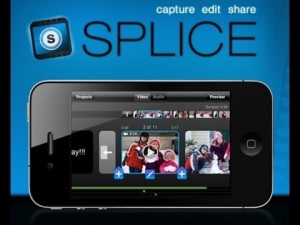
GoPro on Monday announced it has acquired Splice, a video editing app developed by Vemory, an Austin-based startup.
The San Mateo-based company also acquired Replay, another video editing app, and plans to merge them to deliver mobile editing solutions to GoPro customers and other smartphone users, according to a news release.
GoPro paid $105 million in cash and stock to acquire the two companies, according to Forbes.
Vemory, founded in 2012, acquired Splice a year ago from Path 36, which launched Splice in 2010. Splice is one of the most popular photo and video editors for iOS. Replay, developed by Stupeflix in Paris, France, is an award-winning app that allows users to quickly select video clips and photos and automatically combines them into a single video complete with transition effects, graphics, and synchronized music.
“Splice, Replay and GoPro will combine to deliver what we believe will be the fastest and most enjoyable mobile editing experience,” Nicholas Woodman, founder and CEO of GoPro, said in a news release. “We believe the accessibility, speed and efficiency of mobile will make it the predominant editing platform of the future.”
Both apps are currently available on iOS with Android releases planned for later this year. Both teams will maintain operations in their current locations, Paris and Austin.
WigWag, the maker of a platform for connecting devices in the home through the Internet, announced this week it has raised $3.175 million in seed funding.
The Austin based startup, founded in 2011, received the funding from Palo Alto-based CSC Venture Capital. It plans to use the money on product development and to hire more sales and marketing staff and to launch its platform and consumer products. The company is also hiring for software development and testing.
“According to Gartner, by 2022 the typical U.S. household will contain over 500 connected devices,” Ed Hemphill, WigWag co-founder and CEO, said in a news release. “As we enter into a Jetson-esque age of true smart environments, the world of traditional Internet protocol networking will merge with IoT technologies. That massive change, which involves more intelligence being placed at the network edge, creates a tremendous challenge for traditional network equipment manufacturers and a tremendous opportunity for us.”
In 2013, WigWag raised $454,976 from 1,694 backers on Kickstarter. The company began shipping products to its customers this month, according to its Kickstarter update.
WigWag’s platform lets consumers connect all kinds of devices in their home including lights, thermostat, security system and more.
“CSC Venture Capital invests in companies that have the capacity to radically transform new markets and where we see major trends on the cusp of significant adoption,” Veronica Wu, President of CSC Group International Corp. said in a news release. “We believe the timing is right for the Internet of Things. However, navigating the plethora of standards/protocols pose significant challenge for adoption. We believe WigWag’s technology could dramatically simplify go to market for companies wanting to deliver intelligent and secure IoT solutions to consumers.”
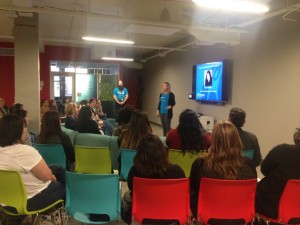
Deborah Carter, senior manager of global talent development at Rackspace, speaking at Linux for Ladies information program at the Open Cloud Academy.
Anna Eilering worked as a chef before becoming a software developer two years ago.
“I make four times the amount of money I made as a chef,” Eilering said.
She also has healthcare and other benefits as an employee at Rackspace in San Antonio. But it took her almost ten years working as a chef before she decided to go back to school and get a degree in computer science.
Today, Eilering, who sports bright pink hair, is co-organizer of SA PyLadies Meetup and loves her new career.
“We bring new, diverse ideas to the field,” Eilering said.
On Tuesday evening, Eilering spoke to a gathering of about 100 women and a few men attending an informational meeting on the Linux for Ladies program at Rackspace Open Cloud Academy at Geekdom. She was one of a handful of speakers who recounted their experiences as women working in the technology field dominated by male employees.
Rackspace, through its Linux for Ladies program, seeks to train more women for careers in the technology field. The San Antonio-based company launched Linux for Ladies two years ago and has since graduated 43 women from the program, and the majority have found careers in the technology field.
Among them, Laura McMasters got a scholarship to attend the first Linux for Ladies program in 2014. She left graduate school in physics to pursue a career as a Linux system administrator. She now works at Rackspace. She told all of the women that she was in their situation just a few years ago and she didn’t know if she would land one of the 20 spots in the class, but she worked hard, persevered and she got selected for the program. She told them she worked from 8 a.m. until 8 p.m. every day of the program. It wasn’t easy, but it was worth it, she said.
The Linux for Ladies program has changed people’s lives, said Deborah Carter, senior manager of global talent development at Rackspace. Candidates come from all stages of life, she said. Some are students, others have had a career and want to pivot into something new and some are stay at home moms re-entering the workforce, she said.
The program costs $3,500 but Rackspace, in cooperation with Project Quest, is offering scholarships to 20 women. The requirements are the women must be 18 years or older and have a high school diploma to participate. It starts May 31st and lasts eight weeks. It runs Monday through Friday from 8:00 a.m. to 5 p.m.
To qualify for the program, applicants also have to have their Comp TIA network plus certification to participate. Rackspace’s Open Cloud Academy offers a self-paced program to achieve that certification.
The Austin Chamber of Commerce Thursday began accepting nominations for the 2016 Austin A-List.
The awards, put on by the chamber and South by Southwest Interactive, seek to showcase Austin’s most innovative startup companies at three different stages of development.
• Emerging (Early/Seed Stage) – Raised under $1 million;
• Growth (Mid-Stage) – Raised $1 million to $10 million; and
• Scale (Later Stage) – Raised above $10 million.
The list is now in its sixth year. The chamber encourages any “scalable, high-impact, pre-IPO startups to apply.” Nominations will be accepted through Friday, April 8th. An invite-only ceremony will be held on May 12th to reveal the A-List winners.
To date, Austin A-List companies have collectively reached $1 billion in funding and exit proceeds to date and 19 A-List companies have seen successful exits via acquisition or initial public offering, according to the Chamber.
“We are excited to raise the profile of our region’s most innovative companies that help cultivate investment and attract the next generation of entrepreneurs and talent,” Michele Skelding, senior vice president of Global Technology and Innovation at the Austin Chamber, said in a news release. “The Austin region continues to increase its innovation pipeline through a steady stream of funding deals, nationally renowned accelerator programs, and one of the top angel networks in the country.”
One of Southwest Research Institute’s autonomous cars, know as MARTI, which stands for Mobile Autonomous Robotics Technology Initiative. Photo courtesy of SwRI.
A group gathered at bleachers in a test field just off Culebra road on Monday as a giant red cab of an eighteen wheeler drove up and stopped along with a Ford Explorer, nicknamed Marti, and a Humvee. None of them had drivers.
Most people have heard about Google testing its autonomous vehicles on the streets of Austin, just the second location outside of its Mountain View, California headquarters.
But how many people know for the past decade a group of scientists at Southwest Research Institute have been working on autonomous car research in San Antonio?
At SwRI, driverless trucks, cars and even Humvees regularly hit the road or the dirt on the SwRI campus to prefect their navigation systems and software.
On Monday, SwRI showed off a few of the more than 4,000 projects underway at the nonprofit organization that does contracted research and development for companies and government agencies. It was part of its 68th annual meeting of its advisory trustees and board of directors. In the morning, visitors listened to presentations from scientists and engineers. In the afternoon, they boarded busses to tour labs, buildings and research test sites like the autonomous vehicle field.
“We’ve been doing research and development in this area for about 10 years now for a variety of clients, foreign and domestic, military and commercial,” said Ryan D. Lamm, director of research and development in the applied sensoring department for the Automation and Data System Division at SwRI.
“The whole point of this technology is to save lives,” Lamm said.
The institute has automated more than 15 different vehicles, Lamm said. They’ve deployed them in five countries on four continents. In 2014, the institute sent two military vehicles to Afghanistan.
What purpose do the autonomous vehicles serve?
“From a military application standpoint, it’s to get the soldiers out of harm’s way,” Lamm said. “From a commercial standpoint, it’s to make cars that don’t crash.”
SwRI’s training ground for autonomous vehicles is geared around the complex problems for accelerating the realization of this technology, said Steve W. Dellenback, executive director of the Intelligent Systems Department in the Automation and Data System Division at SwRI.
The institute’s test track has an oval pattern which is about a mile in length with paved streets equipped with stoplights and railroad crossing areas. But it also tests the military vehicles on dirt roads or fields to simulate what those vehicles might encounter in a war zone. The institute also has 200 acres in a private area at the SwRI campus where it tests autonomous vehicles, Dellenback said.
In the U.S., 64 percent of the roads are paved so that leaves 36 percent that are not paved, Dellenback said. The institute has developed technology specifically for autonomous vehicles to navigate unpaved roads, he said. It has created software that runs on a hardware system with a bunch of sensors and costs about $10,000. The institute’s autonomous vehicles can operate without GPS and radar in a stealth mode, which is necessary in a war zone. At the institute, autonomous vehicles use sensors, software, cameras and perception to navigate the landscape, Lamm said.
“The technology is moving very, very fast,” Lamm said. “It’s accelerating. It’s nice to see. We’re hoping to see these systems out on the roadways. I hope my children and I get to enjoy them sometime soon.”
In addition to the autonomous car research, visitors to SwRI at a different test site watched a truck drive 60 miles per hour into a guardrail to test the safety of the guardrail. The truck, which also didn’t have a driver, was on a cable pulled by another truck in the opposite direction which helped keep it on course. The institute, which has worked on guardrail and highway safety for more than 30 years, is doing research for guard rail manufacturers, according to a spokesman.
The other on-site demonstration involved fire technology. The institute tests building materials for fire resistance by burning them in a giant kiln. It has also created an on-site pollution abatement system to capture the carbon released during the fires.
During the morning sessions, SwRI staff presented technical programs on everything from New Horizons mission to Pluto to large scale robotics development.
SwRI has a campus in Boulder, Colorado with more than 100 staff. Alex Parker, a planetary astronomer at SwRI, leads a team that work on NASA’s New Horizons mission to Pluto. He shared his insights at the SwRI meeting on capturing images of Pluto.
“New Horizons collected an unprecedented amount of data for a first flyby mission,” Parker said.
Correction: This article has been updated to correct the division name and the number of continents the autonomous vehicles have been deployed to.

 RealMassive, a commercial real estate data marketplace, Wednesday announced it has settled a copyright infringement lawsuit with CoStar Realty Information Inc. for $1 million.





 The Austin Chamber of Commerce Thursday began