
 Houston-based Idera has bought CopperEgg, an Austin-based startup that specialized in software to manage cloud-based applications.
The terms of the deal were not disclosed.
To date, CopperEgg has raised $4.1 million and it makes software that can monitor public, private and hybrid cloud configurations online. It’s available as a software as a service model to companies.
“The acquisition of CopperEgg expands our value proposition by combining Idera’s robust database monitoring and CopperEgg’s server and application performance management,” Randy Jacops, CEO of Idera, said in a news release. “With the recent acquisition of Precise Software, I’m confident that the combination of Idera, CopperEgg, and Precise will give our customers unprecedented visibility and control over their IT infrastructure.”
CopperEgg has more than 500 customers and thousands of users, said Bob Quillin, its CEO.
Idera makes application and server management software and has more than 12,000 customers.
Page 268 of 352
By SUSAN LAHEY
Reporter with Silicon Hills News
 Refresh Austin presented two wildly different, compelling and entertaining perspectives on the process of designing and bringing a product to market Tuesday night at Capital Factory.
The first talk, Creative Extinction, was about a robotic dinosaur. Pleo was the brainchild of Caleb Chung, co-creator of Furby, which sold more than 40 million toys when it was released in 1998. The secret to Furby, Chung believed and market testing confirmed, was it evoked an emotional response in kids who played with it. They bonded with it. Chung wanted to create another toy with a soul that people would connect with.
So a group of people, working out of a Boise, Idaho garage—including Refresh Austin’s speaker Casey Hunt—created Pleo. Pleo was an adorable baby dinosaur. It wandered, sniffed, explored. If you lifted it by the tail it screamed and clawed the air with its little baby dinosaur legs. One day, in fact, Hunt was holding the dinosaur by the tail in a coffee shop and a woman rushed over, grabbed Pleo protectively into her arms and said “Stop! You’re hurting him!” Pleo would curl up on your shoulder and go to sleep.
Pleo had software, a battery pack so as not to create battery waste, and skin that was pliable and whose design was informed by a dinosaur skin expert.
“Basically we were designing by exploiting human emotion,” Hunt said. “People naturally want to project emotion and intention on everything. If you walk in a room and hit your foot on the table you say ‘That table’s a dick! It hit me in the foot!’ We do that with all kinds of stuff.”
So the Pleo designers worked on several toys, seeing how they could convey emotion. One was simply an eyeball on a stem. Could they convey emotion if the lid closed and the stem drooped? Would people register the sadness? With his animated tail and head and face Pleo was beguiling. So, what went wrong?
What Went Wrong
First of all, Pleo cost about $175 to make and had a sticker price of $350…in 2009.
It did sell, all over the world, but least successfully in the U.S. where. Essentially Hunt said, the team forgot what it was designing.
“The thing that really burns is where it went wrong was with the people who were there first…they forgot the magic. The CEO, he said, was obsessed with doing an IPO. The marketing department had Pleo tethered in a plastic bubble where none of his charms could be experienced. In Italy, they had done Pleo adoption days.
“Our marketing department had no idea what we were selling: An animal that was alive with desires unto its own.” (Hunt was educated as a playwright). Hunt’s direct supervisor allowed Pleo into a battlebot arena where a wedge-shaped black car destroyed the baby dinosaur, evoking screams from the children watching.
Plus, the team that actually built Pleo was operating happily out of a garage—Hunt had a desk made of a board on milk crates—while the parent company, Ugobe, had swanky offices in Emeryville, California. Many of the people at the headquarters had impressive resumes from Apple, Pixar, Lucasarts.
“Their contribution to that company was nothing, but they all thought each other were awesome. I don’t mean to sound bitter but that was really hard for someone sitting at a door desk in Boise.”
People from the headquarters were flying all around the world setting up distribution agreements that actually had them losing money.
“We were operating like a cash positive company when in fact we were cash negative for all but one month. At one point were losing money per unit. How do you do that?”
By the time it became clear to the board of directors what was happening and they dismissed the CEO, it was too late. The CFO who stepped in was unequipped to save the business…if it could be saved. Pleo was sold to the Chinese company who had been manufacturing him.
“They promised they would keep the spirit of Pleo alive,” Hunt said, showing a picture of Pleo as they designed him. “Look, he’s happy. He could be dancing. The emotion is there. His color seems normal, in nature, you could believe maybe there was a dinosaur somewhere that looked like that.”
 Then he switched to a shot of a droopy, blue Pleo.
“What the f… is that? It’s cotton candy with legs. Look at his eyes; they’re dead inside.”
At least, he said, Pleo still exists. So many startups flame out with no evidence they were ever there.
Building a Tool for Eric Cole
The second speaker was Adrian Taylor, founder of Pushstart Creative, who explained how the company used the same design process it employs with clients to create its own product Desk Rail.
The problem, Taylor said, is that “the workspace of a modern designer lives at the intersection of analog and digital creative tools. Like any product it started with ‘Wait, this could be better. Is there something better out there? Our desk areas often become cluttered and inefficient. Artists require flexibility in their creative process and layout of workspace.”
He stopped himself and quipped “I know I sound like I’m oppressed by bad desk accessories.”
So Pushstart started in on its process which begins with four questions:
- Does this product satisfy a real end-user need or desire
- Does it enable an experience or outcome greater than the required input? In other words, does it really make people’s lives easier?
- Does it have the potential to generate profit?
- Does it support the broader company goals and brand promise
In the initial phases of answering these questions, the company looks to see if there’s already a solution out there. It also explores 20 other ways to solve the problem besides the one the client suggests—which can leave a client, in love with its idea, disgruntled.
“But there might be an even cooler way to solve the problem,” Taylor points out.
Once it’s settled on a solution it thinks is best, it does initial validation with friends or Google search. If that turns up positively, it does deep dive research.
It creates a persona and looks at every website and product that might lure that persona. In Pushstart’s case, it was Eric Cole, a good-looking, 30ish designer with rectangular glasses and a scruffle.
“We were looking at sites Eric would visit,” Taylor said. “We’d see how he’s being talked to by other brands, read reviews on Amazon about other desk holders….What does Eric aspire to have on his desk? Not what does he have but what does he aspire to have? Eric would lust after moleskin, Ray Ban frames….”
Plus they looked at analogous products, people working on similar products who weren’t their competitors: People who make cool storage solutions for tools or cooking utensils.
They created a rough prototype that they used for a year, changing the angle, of V that gripped the supplies, getting just the right springback, finding the finish that would go with Eric’s iPhone. They showed it to many designers, even put a picture of the not-yet finished product online to see how the market would respond. Some people wanted to buy it immediately. Others said “This is just all the stuff that’s laying flat on my desk now, standing up.”
“A lot of people are so scared of showing their work,” Taylor said. They go into the laboratory and build something in secret and come out with “Look what I have created! And it’s wrong, wrong, wrong.”
They used an overseas prototype which cost a third of what a U.S. company would have.
“If you care deeply about your I.P., it’s something that can be stolen, this is not a good idea,” Taylor said. “But I don’t even think they knew what this was.”
He wanted to go with an American company, he said. But the hitch wasn’t price, it was service. It was tough to get an American company to even respond to calls and emails.
Eventually, they did a Kickstarter campaign and raised more than $24,000 which Taylor saw as another positive piece of market validation.
The important thing, Taylor said, is to get over being in love with your own ideas and hiding your product until you think it’s perfect. It’s also important not to make too big a deal about the fact that the prototype you show people isn’t the finished product because they tend to treat feedback with less gravity. “Oh, it’s just the prototype. Okay, it’s fine.”
More than 125 people stayed for the two presentations Tuesday night
at Capital Factory.
On Monday night, The Tech Map and PR Over Coffee hosted a technology and media meetup at Molotov Lounge in Austin.
Ricardo Sanchez and David Manzer organized the event and dozens of startup entrepreneurs and others turned out.
The Austin Business Journal, Community Impact News and Silicon Hills News all turned out to meet and mingle. Here’s a few snapshots I took at the event with my iPhone.
 HomeAway, the online marketplace for vacation rentals, has signed an 11-year lease to expand to a fourth office in Austin.
The five-story, 114,665 square-foot office at 11800 Domain Blvd. in the Domain shopping complex can accommodate up to 750 employees. HomeAway expects to move in after July of 2014.
The office will be designed for Leadership in Energy and Environmental Design (LEED) certification and will have “fun, family vacation-themed design elements that reflect the company’s culture and mission,” according to the company.
“Our employees voiced their desire to have an office in North Austin,” Brian Sharples, co-founder and CEO, said in a news release. “With easy access to a new Whole Foods, shopping and other tech companies, The Domain provided the best answer for our growing and geographically disperse HomeAway family.”
Endeavor Real Estate Group, Kent Consulting Engineers, Lauck Group, Shorenstein Properties and Southwest Strategies Group assisted HomeAway in finding the space.
HomeAway’s 200 employees working at a temporary office at 12301 Research Blvd. will move to the new office when it opens.
HomeAway, founded in 2005 in Austin with six employees, now has more than 1,300 employees worldwide.
By SUSAN LAHEY
Reporter with Silicon Hills News

Shawn Collins, photo by David Vogelpohl, of AUSOME – Austin Online Marketing for Entrepreneurs
Shawn Collins became a successful entrepreneur. The end.
The audience, many of whom are already entrepreneurs, responded off the record with WTF? One participant, Cheryl Borrenpohl, commented: “Great story, but it left me hanging! Kind of like when your VCR just dies in the middle of a gripping movie and you never know the end.”
Escape from New York
The point of the presentation was that two intense events drove Collins, an affiliate marketer, into the world of entrepreneurship. One was 9/11 when he was working at a startup two miles from Ground Zero. He and his wife, who was home with a two-month-old and pregnant with a second child, decided he needed to come home. But his boss “forbade” him. Management had decided it was safer for everyone to stay at the company.
Collins took a moment to decide the best way to respond and chose, “Yeah, okay, bye.”
He ran outside, just in time to see the second tower fall. He made it to the train where everyone aboard cheered when it started moving, then froze when it stopped seconds later. After ten minutes the announcement came that there might be bombs in the train tunnels and everyone should evacuate. Collins followed the rest of his trip home which included boats and buses and hitching a ride. And when he finally returned to his car at the local train station he realized some of the owners of these cars might not return. In fact eight people from his town died that day. And yet his boss had insisted he stay.
“I don’t ever want to be in that situation again,” he thought.
You Die on a Today
His second story was about his father, who never chose the job that would have made him happy because he went for money and security. When a Madison Avenue job opened up that paid poorly but would have suited his creative skills, Collins’ grandfather admonished him “You’re not supposed to like your job. Go for the money.”
Their lives held a series of promised vacations to Ireland and a fantasy Cadillac in the future but the reality was motel vacations in nearby towns and a series of “beater” cars. All his dad looked forward to was retirement. Then he died at 61, months before it happened.
“A lot of people live for tomorrow. But you die on a today,” Collins said. To give his father one more “tomorrow,” he and his brother took his father’s ashes to Yankee Stadium in baggies in their socks and scattered them.
Then he went to a convention on a cruise and both he and another woman offered suggestions for changing the convention and were pooh poohed by the guy running the convention. So they decided to create their own convention and five months later put the other guy out of business.
The end.
Had he been speaking to a room full of lifelong IBM employees, it might have been more impactful, but in a room full of people already struggling to build their businesses, find customers and investors and wear a dozen hats, there was a dearth of practical advice.
Plus there was only light beer.

Bart Bohn, co-founder of AuManil
Q. Can you explain your product in the simplest language possible?
A. We help our customers take proactive actions to keep their customers and improve their customer satisfaction. All that enables them to make more money from them over their lifetime.
Q. What’s your secret sauce? What differentiates you from the competition?
A. The core of it is our algorithms and the ability to create algorithms about an individual person at scale. So what that means is that we would end up building a different one for each person so that we can measure changes in your behavior relative to yourself instead of against some generic average.
Q. When AuManil started it out, the focus was on predictive retention of customers in the video game space, but the company has since pivoted to all online retailers. Can you explain why?
A. We grew beyond just that narrow focus. Free to play games are a $15 billion industry. The U.S. online retail industry is a $350 billion to $400 billion business. We definitely grew into a much bigger opportunity.
Q. Who are your competitors?
A. With the larger companies, it’s in house data team. They hire PhDs in physics. They build their own data teams and they use tools like SPSS and SAS. There is a couple doing retail. InsightOne does a lot of work in the health industry. Windsor Circle is another one.
Q. Are you Bootstrapped, or do you have Venture Capital or Angel Investment?
A. We raised a little bit of angel money last May. We’re raising more money over the summer. We’re in the Beta Angel stage still.
Q. Who makes up your team?
A. We have two founders: myself and Philip Flesher, who led the teams responsible for rebuilding Bazaarvoice’s data platform, which is one of the top ten most trafficked websites in the world. We also have a couple of contractors and advisers.
Q. Where are you based?
A. Our offices are based mostly out of Capital Factory. We’re part of their incubator program.
Q. Who are your customers?
A. Spacetime Studios and then we’re working with a couple of local online retailers.
Q. Are there particular industries that you are targeting?
A. We like repeat purchases. When it’s food you have to eat all the time. Another one is cosmetics or healthy and beauty. Another one is entertainment. Apparel is the biggest one. Consumer electronics is also a big category.
Q. What was the biggest mistake so far since your launch?
A. I think it would be the pace at which we proved value versus built the product.
Q. What is your business model?
A. Software as a service with a monthly subscription fee.
Q. What is the biggest win you’ve had to date?
A. We won the CTAN and ATI pitch competition at SXSW. And we were on the GigaOm 10 startups to watch list.
Q. What are the most helpful Austin startup resources that you’ve used?
A. Certainly, the core team at ATI and the mentors at Capital Factory. Some of the angels from CTAN have provided great feedback. Outside of that, we spent so much time in the video game space and the community leaders in that space were very helpful, very open, receptive and encouraging.
Q. What are the advantages of being in Austin for launching your startup?
A. Team and community. Finding talent has always been a challenge. But in Austin you can find individuals who can make a big impact. And there’s enough supply of people at this early stage that you can get them. And Austin itself is just becoming the center of gravity for startups. You see that with TechStars opening here and SXSW is getting bigger every year. And now we have Startup Week. All of that is bringing a lot of attention to Austin.
Q. What are your plans for the future?
A. Raise a real seed round and build out the core team. Get a full time data scientist and then a data engineer.
Q. Anything else you’d like to add or say that I haven’t asked you about?
A. Austin is a place for creative talent. I used ATI as a platform to go create new things. That turned out to be 3-Day Startup, the UT summer accelerator. All of that is really accepted in Austin. You see something, you go create it and the whole community helps you do it.
 Fred Dinger has done it again.
The San Antonio-based biotechnology entrepreneur sold his startup ENTrigue Surgical for $45 million to ArthroCare Corp. of Austin.
Dinger previously sold OsteoBiologics for $72 million to Smith & Nephew Endoscopy in 2006.
ENTrigue designs and develops innovative implants, disposables and instruments for endoscopic sinus surgery, including balloon dilation.
ENTrigue will operate within ArthroCare’s ENT product area as a complement to the ArthroCare Coblation and Rapid Rhino product lines currently being used by ENT surgeons worldwide.
By SUSAN LAHEY
Reporter with Silicon Hills News
 According to Kyle Samani, CEO of Pristine, which is developing a surgical app for Google Glass, people need to think hard about what glass can do and what it really shouldn’t do before they begin developing apps for it.
For example, Glass has a tiny little screen that shows maybe 40-50 words at a time. It’s not a content machine and trying to use it for social media sites like Facebook and Twitter is just frustrating, he explained. Glass just came out with its first web browser which allows you to zoom in and out and scroll up and down, but who wants to do that on a screen the size of a fingernail if you’ve got your smart phone in your pocket?
In fact, there’s a very narrow range of uses for Glass. And all Glass apps have to make infinitely more sense on that device than they do on the phone to have a prayer of success, Samani said. If apps for the device can’t justify its existence and its price—which Samani believes will go from $1,500 to around $250 by December 2013—Glass will fail. Oh and by the way, Samani, who spoke for about 70 developers at a Bleeding Edge Web/Google Glass Meetup at Capital Factory Tuesday night, believes all the low-hanging fruit for Glass apps will be snatched up within two years, starting this past May. He is the founder of the Austin Google Glass meetup. Tuesday was their first meeting.
If You’re Going to Do it Anyway…
So what’s an app developer to do? Consider these perspectives Samani shared:
• Google Glass has three advantages: It’s got a heads-up display, it’s hands-free and it’s friction free (meaning it’s always there). If your app doesn’t need to be any of those things, don’t develop it for Glass.
• It can’t superimpose augmented reality over reality.
• The track pad is “a frustrating piece of shit” and only lets you see one thing at a time. A worthy Glass app must focus on what the wearer is doing right now. Looking for historical information is a pain.
• Something that relies on voice commands rather than the scrolling function will probably go over better. Short, simple commands are best.
• Its best consumer use is probably for hobbies like bicycling, knitting, cooking where you can get reference information while you’re doing your thing. It’s not good for noisy places like bars where you’d have to scream “Ok Glass!” over all the noise to get it to function.
• Text should be white on black with most important information at the bottom
• It has definite uses for enterprise including mechanics, doctors, florists, artists and others who work with their hands.
“There is a cost to wearing the device,” Samani said. “You look funny. It’s always there. You could drop it and break it….apps have to be so good that they warrant the cost, not only price of buying it but of day to day use and usability.”
Google, of course, has its own development guidelines:
1. Design for glass
2. Don’t get in the way
3. Keep it timely
4. Avoid the unexpected
An Unknown Future
But a lot is unknown about Glass’s future. Doubtless both the hardware and the software will improve. But what rules may be imposed on the device? Will it be illegal to wear while driving, for example? What about hacks like the one Samani and his partner, Patrick Kolencherry, installed on the device that allow you to take a photo by winking your right eye? Evidently the device can tell the tensionless motion of a blink from the muscle-tense wink, and responds. Does that violate privacy laws?
Plus, Samani said, you have to consider why someone would wear glass. His list of reasons:
1. To enhance a hobby.
2. Because you love (adequate) pictures.
3. Because you live in northern California.
4. Because you work for Google.
5. Because you’re a geek like that.
By ANDREW MOORE
Reporter with Silicon Hills News
 Startups aren’t easy. Even if an entrepreneur has a great idea and business plan, jumping into a full time startup just isn’t viable without some financial cushion to get the company off the ground.
This is why Geekdom of San Antonio offers the $25,000 Geekdom Fund, which can be applied for monthly by members of the cooperative workspace. The fund was established in August of 2012 and has been awarded to seven startups as of this month. It is managed by Cole Wollak and Andrea Medina. The fund is financed by a group of private investors associated closely with Rackspace Hosting. Its goal: to create and keep a community of startups in San Antonio.
 The Geekdom Fund has six voluntary board members who double as mentors for the startups who apply. Applicants are not only able, but encouraged, to meet with the members one-on-one for individual feedback before addressing the full board. The current board members are Michael Girdley, Pat Condon, Cristal Glangchai, Nick Longo, John Mosher, and Mike Troy.
To apply for the fund, Geekdom members can go to geekdom.com/funding.
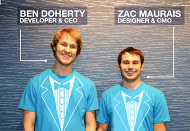 A month ago, Zac Maurais and Ben Doherty launched Favor in the Austin area to deliver food to your home or office.
Maurais and Doherty, graduated from California Polytechnic State University or Cal Poly and then went on to the Boost.VC accelerator program in January, and launched a Favor pilot program in San Luis Obispo. They completed more than 1,000 deliveries. The service has steadily grown in popularity, Maurais said. They raised a seed investment round of investment from Tim Draper of Draper Fisher Jurvetson.
Favor delivers Home Slice Pizza, East Side King, Torchy’s and all kinds of food fare from Austin’s eateries and even its food trucks.
 The service works through a free App available for IOS devices, although an Android version is in the works. The App offers a curated list of popular restaurants. But customers can ask for whatever they want. Favor doesn’t limit the places to order from as long as they are in the service area. Once a request is submitted one of Favor’s verified “Favor Runners” will pick up your food and promptly deliver it to you. The deliveries cost a $5 flat fee plus tip.
The drivers wear bright blue tuxedo shirts and drive cars outfitted with oversized blue bowties.
Favor chose to relocate to Austin because of its strong tech community and its great food, Maurais said.
Favor launched in Austin on June 8th and currently serves central Austin. It is based at the Longhorn Startup Camp at the University of Texas at Austin.
Favor is working to build strategic partnerships with restaurants, Maurais said.