Page 233 of 352

Code for America Hosts CodeAcross in San Antonio

By LAURA LOREK
Founder of Silicon Hills News

IMG_2720Think of this group as super heroes for the city of San Antonio.

They’re a brigade of citizens seeking to solve the city’s problems through technology with an empathetic twist.

Together, they seek to tackle issues around transparency, information about school closures, creating customer service portals, discovering cultural secrets of San Antonio and city council hot issues.

Those are just a few of the ideas for city web and mobile applications generated from a massive brainstorming session at Rackspace on Saturday. More than 50 people attended Code for America’s CodeAcross daylong event.

They are part of the Open San Antonio brigade, known as OpenSATX. They met in five groups with city officials and looked at San Antonio data sets and ways to use them. And they created lists of problems on yellow sticky notes the city should be addressing.

IMG_2725The event also raised awareness for the local Code for America program.
San Antonio’s Code for America fellows include Maya Benari, David Leonard and Amy Mok. They have been here for three weeks meeting with citizens and city officials. They have one more week to go. Then they’ll take their research back to San Francisco and choose a project to work on.

Benari, a web designer and developer from Los Angeles, wants to make technology more human and empathetic.

“When people think about government it’s not an easy system,” she said.

With events like CodeAcross, the goal is to start with the users and focus on solving their problems, she said. So much of government creates the solutions first, she said.
Benari signed up with Code for America to help people.

“I thought it was an incredible opportunity to have a bigger impact in influencing the things people deal with every day,” she said.

Kyle Rames, a software developer advocate at Rackspace and organizer of San Antonio’s CodeAcross brigade, said the goal of the event is to empower citizens to make change in their communities.

“I think this is an opportunity for people who have questions about how their city works and how they can get involved with it,” Rames said.

IMG_2737The Code for America fellows can’t do everything, he said. So the local brigade will choose projects citizens can work on, he said.

“I think there are a lot of exciting things going on in San Antonio right now and it’s changing right before our very eyes,’’ Rames said. Those initiatives for change include SA 20/20, the decade of downtown and Geekdom, a coworking and technology incubator and now the CodeAcross brigade, he said.

Rames would like to see more of an open data policy from the city.

“So developers can interact with it, especially with the rise of places like Rackspace and Geekdom where people can take that data and apply it very creative ways,” he said.
IMG_2722
The city has a finite budget so the ability to tap into the creativity of citizens will provide more solutions, said Hugh Miller, San Antonio’s Chief Technology Officer.

He attended the event to get fresh ideas on how to solve the city’s problems.

The event sought to get customer feedback on city services and how the city in partnership with citizens could create better applications, Miller said.

“How can we make what we’ve already done more simplified to find,” Miller said. “We have this large volume of really cool bits of data but they’re not marketed and consolidated in ways they are easy to consume.”

Collin Beck, Koedal Inc., an iPhone and iPad app company, attended the event because he wanted to help improve San Antonio, particularly its transportation industry.

“I wanted to see how I could help out with my skills to make San Antonio a better place,” he said.

IMG_2721San Antonio can do more to make the downtown area more accessible to its residents particularly by providing more parking, said Wayne Hartman, a mobile app developer.
He attended the event to donate his skills.

“I’ve been blessed with a lot of opportunities,” he said. “My ability to give back is somewhat limited. But I really like what Code for America is doing. This is a way for me to give back to the community.”

Hugh Donagher, storyteller for the Code for America San Antonio brigade, said the organization needs all kinds of skills. The group is publishing its information under the OpenSATX brand. It has a Facebook page and a Twitter account under that brand and it’s has created a OpenSATX.org website.

“I came to Code for America to check out awesome civic engagement in action,” said Joey Lopez, Convergent Media professor at Incarnate Word University.

Today’s event was about finding knowledge, he said.

“I want to learn how we can improve our roads, improve safety and improve education,” Lopez said. “Those are core issues our city is having fundamental issues with right now.”

IMG_2717

Tips for Startups on Raising Old Money and Crowdfunding

Photo of Stephanie Chandler, partner of Jackson-Walker, courtesy of the law firm.

Photo of Stephanie Chandler, partner of Jackson-Walker, courtesy of the law firm.

Old real estate and oil money in town invested in San Antonio’s Rackspace early on, said Stephanie Chandler, partner with Jackson-Walker.

It was one of the first cases of old San Antonio money backing a startup technology venture here, she said.

Now with Geekdom, a technology incubator and accelerator in downtown San Antonio, the goal is to get even more local investment into startups, Chandler said.

“Over the last ten years there’s a much more significant uptick in what families are doing,” in investing in startup deals, she said. “Five years ago, we didn’t have the Rackspace founders looking at deals.”

Five years ago, the Center for Innovation and Technology Entrepreneurship at the University of Texas at San Antonio didn’t have its bootcamps in which it introduced mentors to support young startups, she said.

Historically, a lot of the family offices in San Antonio didn’t want to look at startup investments, Chandler said. But that’s changed.

“There is a lot of buzz going on at the San Antonio country club about what’s going on in town and trends,” she said.

Chandler spoke last week at Jackson Walker’s law offices in downtown San Antonio on “Raising Capital from New Money and Old Money: Crowdfunding and Family Offices in 2014.”

Mike Laussade of Jackson-Walker also gave a presentation to about 50 entrepreneurs in attendance.

“Most startups don’t attract money from lenders,” she said.

Angel investors generally put anywhere from $25,000 to $250,000 into a deal, Chandler said.

“Clearly they are motivated by getting a return, but they are also looking for something else,” she said.

For example, a lot of the successful entrepreneurs and executives with Rackspace are now investing in early-stage tech startups to give back to the community, Chandler said.

When startups raise money, it’s important that they adhere to federal regulations.

“Every single stock offering is required to be registered with the SEC,” she said.
That requires startups to provide audited financial statements and other expenses. But if you’re not doing a public offerings, there are exemptions to these rules.

“If a deal is truly private, you don’t have to register it,” she said.

The Securities and Exchange Commission’s Rule 506 provides an exemption to companies that allows them to raise an unlimited amount of money from accredited investors, Chandler said.

An accredited investor is someone who has net assets of more than $1 million not counting their house and income of $200,000 per year, Laussade said.

The Jobs Act allows for crowdfunding that allows companies to raise small amounts of money from large numbers of non-accredited investors, but it is not yet effective, Laussade said. The rules are still being worked out and might be adopted later this year, he said.

As of Sept. 23, the SEC adopted a New Rule 506( c ) that permits companies to solicit or advertise offerings as long as all the purchasers of the securities are accredited investors.

When dealing with old money, especially from the oil industry, in San Antonio some investors will not do a deal if it involves a 506-c solicitation which requires disclosure of investors, Chandler said.

“They are choices all along the path,” she said.

Once you go 506 ( c ), you can’t turn back, Laussade said.

Equity-based crowdfunding can only be done on a registered crowdfunding portal. And companies can only raise up to $1 million a year, Laussade said.

Securities law does not apply to Kickstarter and IndieGoGo because they are perk-based crowdfunding. The people donating money on those sites to projects are not investing in the company or getting any equity in exchange for their pledges.

To do equity-based crowdfunding from non-accredited investors, companies have to file a form C and provide audited financial statements. Those can cost $50,000, Chandler said. Companies also have to provide full disclosures on what they are doing.

“If you want to go stealth on your product, how are you going to do that?” Chandler said.

Annual reports are required. These are all things that are not required with a private offering, Laussade said.

“It’s going to be an onerous process,” he said. “And the rules aren’t yet final.”
The summer would be the absolute earliest the new equity-based crowdfunding rules will be effective, Laussade said.

Sprinklr Acquires Austin-based Dachis Group

Sprinklr New LogoNew York-based Sprinklr announced Wednesday its acquisition of Austin-based Dachis Group, which specializes in social and brand analytics.

The combination creates a formidable company. Together, they “have raised more than $95 million in venture capital, acquired 11 companies, including three of the original 13 Facebook Preferred Marketing Developers and served over 50 percent of the Fortune 500,” according to a news release.

The terms of the acquisition were not disclosed.

“The addition of Dachis Group’s technology accelerates our product by at least 12 months,” Sprinklr Founder and CEO Ragy Thomas said in a news release.

“Our clients have been demanding a real-time social solution that gives them the ability to gain insights, take action anywhere within the enterprise and measure effectiveness,” Dachis Group Founder and CEO, Jeff Dachis said in a news release. “Ragy’s clear vision for how enterprises will manage social experiences at every touchpoint, along with Sprinklr’s deep enterprise experience and extensive client and analyst validation, confirms that this was the right transaction to build on our longstanding vision for the evolution of social business.”

The combined company will serve more than 400 brands and have 300 employees in its offices in New York, London, Delhi, Mumbai and Austin.

Tips on Branding for Startups

By LAURA LOREK
Founder of Silicon Hills News

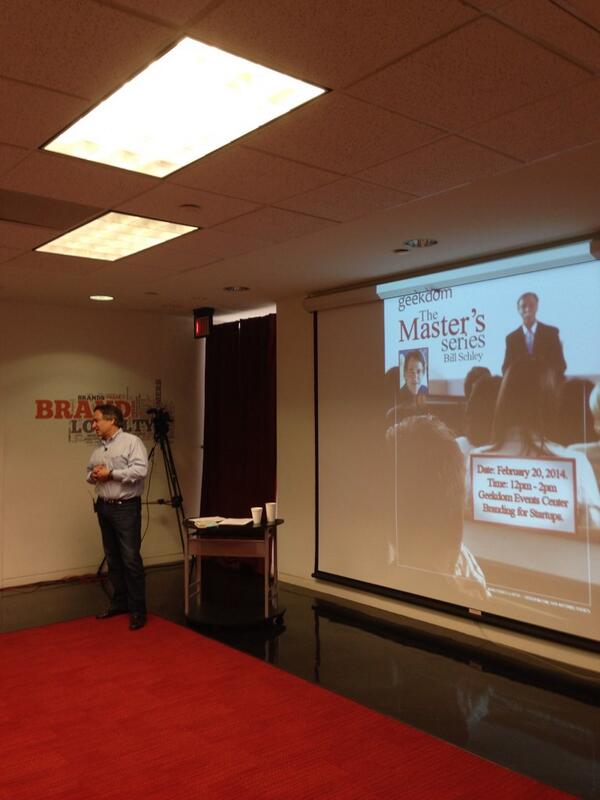
Bg7-86FCAAAAhhhWhat’s in a brand?

Billions of dollars, said Bill Schley, branding expert and co-founder of BrandTeamSix.

Rackspace’s brand “Fanatical Support” is worth one billion dollars per word, Schley said.

“They said we will answer the phone in one ring at midnight on Christmas Eve,” Schley said. And they did. And Rackspace became known in the IT industry for providing outstanding customer support, he said.

Schley spoke Thursday afternoon at Geekdom, a downtown San Antonio coworking and technology incubator, to a roomful of startup entrepreneurs and others on “Branding for Startups.”

Schley recently wrote the book “The Unstoppables” with a foreword from Graham Weston, founder of Rackspace. The book details the plight of entrepreneurs and dispels myths and shares the keys to success. Schley also wrote “The Micro-Script Rules” and “Why Johnny Can’t Brand.”

Schley spoke for an hour on branding and NowCastSA did this video of his talk.

But for those who don’t have an hour, here’s his top 12 tips.

1. The fact is your brand isn’t optional. Branding is something we do automatically, Schley said. It’s something we do unconsciously and for primitive reasons. Either you control your brand or your customers and competitors are going to brand for you. “You’re not going to like the tag line.”

2. What’s the one thing that sets you apart and sticks in your mind? That’s your brand.

3. You need to align everything you do with that idea so you perform the way you promise.

4. Find a category to be number one in. “People remember one big thing” Schley said. “They don’t remember 100 things.”

5. Create a Microscript – which tells a brand’s story in six words or less. That script can powerfully convey your brand in one idea. Examples include Rackspace’s “Fanatical Support.” M&Ms “melts in your mouth, not in your hand.”

6. Your brand needs to be superlative, important, believable, memorable and ownable.

7. You’ve got to be the best in what you do. Your brand has to be a must have and not a need to have, Schley said.

8. The No. 1 Rule is “Specific is Terrific.” For example, Rolex is the luxury watch, ESPN is the sports channel, Volvos are safe cars and Wheaties is the breakfast of champions. Even Superman has a microscript, Schley said. He stands for truth, justice and the American way.

9. When number one is already taken shift your brand to the left or to the right. For example, Subaru branded itself as SUV Wagons. People create this category by combining two categories, Schley said. The Patagonia Tooth Fish became Chilean Sea Bass and sold a lot more fish, he said.

10. You don’t have to be General Electric or Starbucks to do this, Schley said. For example, a massage business run by a Native American branded her shop as Native Palm and become known for that.

11. Branding is not optional. What this really comes down to is the ability to focus. The reason people can’t brand is for a very simple reason: it’s fear. “The narrower your focus, the wider and broader your brand goes.”

12. Your job is not to entertain. Your job is to put them in motion. Once you’ve got their attention, you’ve got to sell them something.

San Antonio on a Short List for Google Fiber High Speed Internet

By LAURA LOREK
Founder of Silicon Hills News

A Google installation van in Kansas City, photo courtesy of Google.

A Google installation van in Kansas City, photo courtesy of Google.

San Antonio is on a short list of cities that may get Google fiber high-speed Internet access to the home.

“San Antonians deserve Internet speed that is faster than the third world and now we’ll have it,” Mayor Julian Castro said at a press conference at City Hall.

Google’s fiber network provides uploading and downloading speeds 100 times faster for businesses and homes than what most broadband Internet users currently experience. It also provides TV service with hundreds of high-definition channels. With 1 Gigabit Internet access, consumers can upload a 90-minute concert in 10 second or upload 300 photos in 12 seconds.

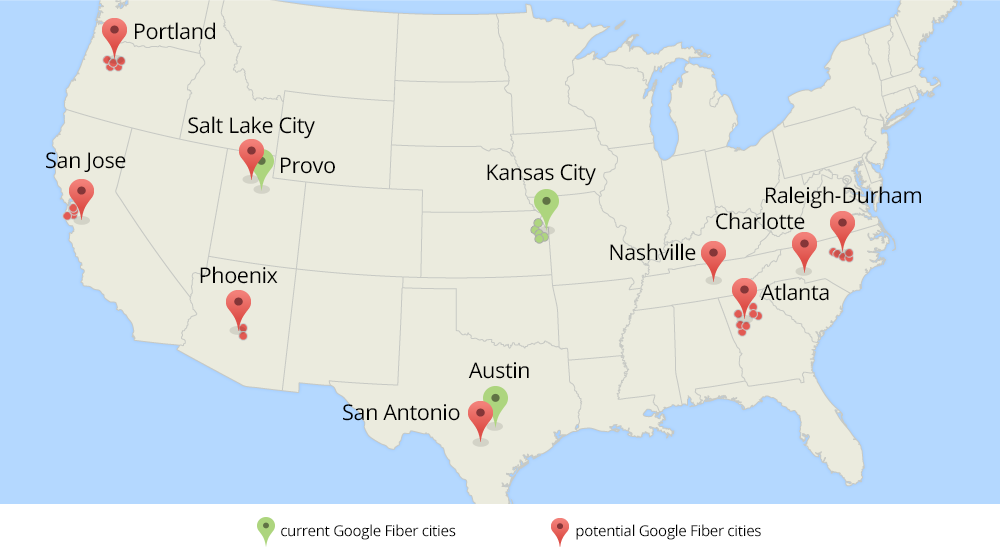
Google announced Wednesday the next step in expanding its Google Fiber network by inviting 34 cities in nine metro areas across the U.S. to work with the company to explore what it would take to build a new fiber optic network in their community.

San Antonio first applied to be a Google fiber city in 2010 along with 1,100 other cities. Since then, Google has officially launched its 1 Gigabit Internet network in Kansas City, Kansas and Kansas City, Missouri, Austin and Provo, Utah.

To get the network, San Antonio officials must provide detailed maps for utility construction, access for Google to put its fiber on existing poles or conduit and a good permitting process to get the city ready for its fiber installation.

A formal announcement will be made later this year if Google decides to begin deploying its network throughout the city, Castro said.

Since April when Google announced plans for its super fast high-speed fiber network in Austin, AT&T, Time Warner and Grande Communications have all announced 1 Gigabyte networks in the city.

Castro said he expects to see the same kind of competition to emerge in San Antonio, the nation’s seventh largest city.

“I’m convinced in short order we’ll see the same kind of competition which is good for the consumer,” Castro said.

Castro announced last June that every school in the city should have access to gigabit speeds by 2020.

The installation of Google fiber in San Antonio will help spur the city’s growing technology industry as well as attract startup companies, Castro said.

“The implications of fiber to the home are widespread,” City Manager Sheryl Sculley said.

A high-speed fiber Internet network will impact everything from educational institutions to the development of entrepreneurs looking to establish new business models, she said.

“It will provide existing and growing businesses a competitive advantage in a fast-moving digital economy.”

Google fiber will also make the city more globally competitive, Sculley said.

“Ultra high speed Internet will enhance our ability to compete economically on the world stage,” she said.

The project is not costing San Antonio any money in incentives, Sculley said.

While Google wants to bring fiber to every city, it might not work out for every city, according to the company.

“But cities who go through this process with us will be more prepared for us or any provider who wants to build a fiber network.”

Mark Strama, head of Google Fiber in Austin, said the announcement in San Antonio will not affect the rollout of Google fiber in Austin. He expects the first customers in Austin to have the service by the end of 2014.

“Google believes that a faster Internet is better for everybody,” Strama said.

The other metro areas Google announced today for its short list are Portland, San Jose, Salt Lake City, Phoenix, Nashville, Atlanta, Charlotte and Raleigh-Durham.

Map courtesy of Google

Map courtesy of Google

Both Austin and San Antonio having high speed Internet will only strengthen this region as a technology powerhouse going forward, Castro said.

“I have no doubt that this region will be recognized the way the Bay area is recognized in California,” he said.

Google’s gigabit fiber is a game changer for San Antonio’s economy and will have as big an impact as the shift from dial-up Internet to broadband did, according to city leaders.

“We’re a city of small business owners,” said Ramiro Cavazos, CEO of the San Antonio Hispanic Chamber of Commerce. “This investment in dark fiber gives us freedom to grow our economy even faster in the future.”

The New York Times did a story last December discussing how the U.S. is struggling to keep up with providing high-speed Internet and is falling behind the rest of the world and is at jeopardy of losing its competitive advantage. The article spotlighted San Antonio’s slow Internet speed and reported it’s no match for the Latvian capital of Riga on the Baltic Sea.

“Riga’s average Internet speed is at least two-and-a-half times that of San Antonio’s, according to Ookla, a research firm that measures broadband speeds around the globe. In other words, downloading a two-hour high-definition movie takes, on average, 35 minutes in San Antonio — and 13 in Riga,” according to the New York Times Story. “And the cost of Riga’s service is about one-fourth that of San Antonio.”

LiveOak Venture Partners Sees Lots of Quality Startup Deals in Austin and Texas

By LAURA LOREK
Founder of Silicon Hills News

IMG_2433Right now is the best time to be in the venture capital business in Austin.

In 2000, during the Dot Com boom, an enormous amount of money flowed into companies even though they did not have viable ideas and were also not disciplined with spending money, said Krishna Srinivasan, partner at LiveOak Venture Partners.

“Companies were burning money on products that costs tens of millions of dollars to build and to get any real traction,” he said during a recent interview at the firm’s headquarters in west Austin.

Austin Dot Com darlings included Living.com, a furniture store, Garden.com, garden supplies, and DrKoop.com, a website for medical advice. All of them went belly up.

Fast forward to today’s crop of startups in Austin. They include recently public companies like HomeAway.com, BazaarVoice and RetailMeNot. And dozens of promising startups in the software and technology industry as well as life sciences, energy, e-commerce and consumer goods.

“Maybe it’s the recent lack of capital that has forced entrepreneurs to be extra creative to make progress, or maybe it’s the natural maturation of the local ecosystem, this is clearly the highest quality of entrepreneurial activity we’ve seen in this market since 2000,” Srinivasan said. “We feel the momentum and see the quality. This place absolutely deserves a bunch of capital firms.”

And that’s why Srinivasan, who has worked at Motorola, Sematech and Austin Ventures, teamed up with two former Austin Ventures colleagues, Ben Scott and Venu Shamapant, to form a VC firm targeted at early stage investing into companies in Texas.

LiveOak Venture Partners Raises $100 million fund

LiveOak Venture Partners closed on a $100 million fund this year. However, it wasn’t easy to raise that much money. The partners spent two years on the fundraising trail. Like any other entrepreneur, they watched their expenses as they made progress on raising the fund. As a result, they have much greater empathy for entrepreneurs looking to raise money to fund their companies, Shamapant said.

The secret to their perseverance was having three members in the partnership, someone always had a more positive perspective which kept the others energized and moving forward, he said.

“We looked around at the Texas market and said how can you not have multiple funds to capitalize on this market,” Shamapant said. “That conviction really kept us going. We really believed that with our history of success combined with this market opportunity, we surely would emerge successful.”

“Capital Starved Startup Market”

Austin and Texas, in general, needed more venture capital funds to finance all of the activity going on here, Srinivasan said.

“The Texas market is the most opportunity rich capital starved startup market in the country,” he said.

While Austin Ventures does early stage investing and so do some other firms, a large untapped market opportunity still existed, Shamapant said.

“For example, if you looked at Silicon Valley, the market opportunity there allows several successful firms to exist,” he said. “Similarly, there are going to be multiple successful franchises here and we thought we could clearly build one of those ourselves.”

And the best time to enter a business is when an entrepreneur sees a compelling unmet opportunity, Scott said.

“If you are ever going to get great returns, it’s not when there’s an over-saturation of funds, it’s when there’s a shortage,” Scott said. “And so we felt like we were clearly in that situation. We felt like we were the team to take advantage of it. But we also surely picked one of the worst times in the last two decades to raise a fund.”

Ultimately with strong perseverance, a good story and a great track record, LiveOak Venture Partners did it, he said.

“And I think when you can raise money in tough times that’s an advantage,” he said.

Competition to Invest in Startups

Since LiveOak Venture Partners hung out its shingle last year, it has seen incredible deal flow, Scott said.

IMG_2431Last year, they looked at a few hundred companies and invested in five deals including Veros Systems, Written.com, StepOne Inc., NSS Labs, all in Austin, and CS Disco in Houston. Over the course of this fund, they expect to invest in 15 to 17 companies in Austin, Texas and the greater Southwest.

But they also have strong competition for deals.

Last year, Silverton Partners, an early-stage venture capital firm focused on Austin-based companies, announced the formation of a $75 million early stage follow-on fund. Silverton also struck a partnership with Mike Maples Jr.’s Floodgate to finance startups at Capital Factory. Austin Ventures, the big daddy in VC money in Austin, also invests in early stage deals.

“We’re absolutely in competition for deals,” Shamapant said. “That’s good for the entrepreneur.”

But there are a lot of high quality companies in this market to keep multiple venture firms busy, he said.

The myth still prevails that most companies are built by 20-year-old kids who drop out of college to create the next Facebook. But in reality a large majority of the startups in the Austin and Texas market getting funded are founded by experienced executives and entrepreneurs who have worked in those industries before, Srinivasan said.

But don’t discount the energy and creativity that young entrepreneurs bring to the market, Scott said. They have a “lack of baggage” and can view problems in a new light, he said.

“At the end of the day, what is crucial for success is to satisfy your customers and also figure out a scalable go to market strategy for it,” he said.

And that’s where a firm like LiveOak Venture Partners sees its sweet spot in helping entrepreneurs.

“We are very active with respect to collaborating with our entrepreneurs to help make their companies successful,” Scott said.

LiveOak Partners provides a lot of support in building a startups’ teams, he said. They also help them with strategic decisions, introduce them to key customers, partnerships and other potential investors and in the end help them with exit strategies, he said.

“Our access to talent, our access to strong executives with experience and our own long experience in investing are big assets to companies,” he said.

LiveOak understands the plight of the entrepreneur, said Kiwi Camara, CEO of CS Disco, which closed on $2 million in Series A funds from the firm in January.

The Houston-based startup makes software for lawyers to use to research cases.

“They’ve been great to work with,” Camara said.

Josh Kerr, co-founder of Austin-based Written.com, met Srinivasan at a 3-Day Startup event and then eventually met with the other partners. He and his cofounders were close to doing a deal with another firm, but decided to go with LiveOak Partners instead.

“They went from being a firm we weren’t considering to our top choice,” he said. “They seemed to really have done their homework on us.”

Last November, Written.com received $1 million in seed stage funding from LiveOak, Floodgate in California and several angel investors. The startup connects bloggers with brands interested in licensing their content.

Kerr had never created a company with VC money and he and his partners wanted to develop a good relationship with a VC firm that would also work with them and help them grow from a startup to a big company, he said.

“They’ve been great to work with,” Kerr said. “They are bringing us a ton of value.”

LiveOak finds startups through introductions and online.

“We are eager to meet entrepreneurs,” Shamapant said. “We’re as eager as the entrepreneurs are to meet us.”

It looks to invest in entrepreneurs who have a real problem that they’ve actually experienced themselves and they are trying to solve.

“A lot of people think they’ve got to have a whole business plan. It’s really not that. The first meeting all we’re trying to understand is do you have a problem to solve? Do you have a unique way to solve it that allows you to build a business on it.”

LiveOak Venture Partners investments are not limited to Texas, but that is its focus, Srinivasan said. Last year, LiveOak wrote checks ranging from $250,000 to $4 million, he said.

“We are not likely to put $100,000 into 10 companies and just sit back and see what bubbles to the top,” he said. “If we invest in a company we will spend meaningful time with the team to help them rapidly converge on their next milestones and financing.”

Robocoin to Open First Bitcoin ATM in Austin

yWVihbPskQKnvosqDQiZmezYnY2yhJ87XktxNS5bFf4The first U.S. ATMs to let users buy and sell bitcoins will be installed later this month in Austin and Seattle by Robocoin, according to a Reuters story.
The Canadian-based Robocoin installed the first kiosk in Vancouver last fall to allow people to complete transactions with bitcoins, a cryptocurrency that has gained a lot of popularity in the last year.
Bitcoin, known as a digital cryptocurrency, uses peer-to-peer technology to make payments and was launched in 2008.
Last year, Bitcoin started off around $19 a coin and soared as high as $1,200. Bitcoin currently sells for around $629, according to Coinbase.com, an international Bitcoin exchange marketplace.
Robocoin’s kiosks look like bank ATMs but they “have scanners to read government-issued identification such as a driver’s license or a passport to confirm users’ identities,” according to the Reuters story.
“The ATMs will allow people to swap bitcoin for cash, or deposit cash to buy more bitcoin by transferring funds to or from a virtual wallet on their smartphone,” Reuters reports.
Austin has an emerging bitcoin industry with some startups focused on the cryptocurrency including CoinTerra and Bit Angels. A bitcoin meetup group meets regularly to discuss the latest developments in the industry. The first Texas Bitcoin Conference will take place in early March.

Hackney House Returns to Austin for SXSW 2014

BannerHackney House, a venue that showcases the talents of East London’s creative, tech and design community, will return to South by Southwest Interactive 2014.
Last year’s event garnered millions in business leads with 1,500 people visiting.
This year, more than 30 Hackney-based businesses plans to use the space to show off their companies and to meet new contacts.
“Any business based in the borough is welcome to use the Hackney House Austin venue for free and attend all of its business and networking events,” according to a news release.
Hackney House will set up in more than 6,000 square feet of space at 721 Congress Ave.
Hackney House Austin will also be a chance for eight students from Hackney Community College to learn more about the creative tech sector. They’re taking part in the Millennial Mentoring Programme and will be attending Hackney House Austin’s events culminating in an interactive workshop with companies who are seeking their creative input into developing new products and services for young people. This is a partnership scheme with Austin Community College who have 6 students taking part in the programme.
British Airways, which is launching direct flights from London to Austin on its 787 Dreamliner on March 3rd, is one of the sponsors of Hackney House. Other partners, iCITY, Dazed and COnfused, Poke, Human After All, the Victoria and Albert Museum, all will make the trip to Austin on British Airway’s inaugural startup flights.
“Over the past year the relationship between Austin and Hackney has flourished and I am thrilled to welcome Hackney House back to the heart of downtown Austin during SXSW,” Austin Mayor Lee Leffingwell said in a news release. “There are numerous collaborations underway between students, tech companies, civic leaders and more from our respective cities and I look forward to strengthening our ties and having fun with our visitors in March.”

Spokefly Wants to Change Urban Transportation One Bike at a Time

The freedom of a bike, photo licensed from iStock

The freedom of a bike, photo licensed from iStock

By JULIA BUNCH
Reporter with Silicon Hills News

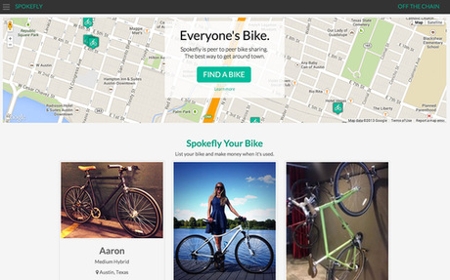
377527v1-max-250x250The website of Austin startup Spokefly lists a variety of bicycles its members may borrow.

For example, Lee has posted a picture of his large commuter bike, Brittany has a medium road bike and Shawn has a medium cruiser listed.

Nate McGuire and Dan DeFelippi founded and launched this peer-to-peer bike share in October. The business lets bike owners rent their bikes to others.

“If you have an extra bike and want to make some money off it, you can list it with us,” DeFelippi said. “If you want a more convenient way to get around you can become a member.”

Bike owners make money based on the frequency their bike is ridden. Renters browse the site, find a bike near them, use a code to unlock the bike, and ride. Membership levels start at $14.99 a month for five monthly rides, two hour time limit and one day pass included. The highest rate is $79.99 a month for unlimited rides of premium road and mountain bikes.

Spokefly currently targets the urban population downtown and University of Texas students.

“The downtown worker is not necessarily replacing their commute [with Spokefly], but it’s good for not having to move your car or pay for parking,” McGuire said. “Downtown workers are very particular about how and when they will use [Spokefly.]”

Kelly Hannifin, a web designer working in downtown, rents a bike from Spokefly about once per week.

“We ride to happy hour and have a great time,” Hannifin said. “I love that the bikes are super close to where I live and downtown. They’re not just any old bikes. They are people’s nice bikes that they really take care of.”

She primarily rents a Spokefly bike for social reasons but that may change.

“In the summer when the weather is nice, I’ll use it for transportation more then,” she said.

Spokefly’s original targeted downtown workers, but quickly expanded to include University of Texas students.

377526v1-max-450x450“We’re getting more bikes at UT and it looks like students will adopt pretty quickly,” McGuire said. “We’re looking at [Austin Community College], [St. Edward’s University], and others around town. UT was easier because I’m familiar with it.”

McGuire graduated from UT in 2008 with degrees in finance and communication studies. After working at Apple Inc. and Ernst & Young, he realized he wanted to build businesses instead.

McGuire started working on the project last summer after his car was totaled. He spent about a month using other transportation, then looked at a bike rack and got an idea.

“I thought, ‘I’m just going to take a bike home,’ but there was no way I could actually do that.”

So McGuire created a way. He put together a rough prototype, and then approached DeFelippi about working together.

“It just worked out,” McGuire said. “He has a lot more technical experience than me. What you see now is a product of him and I working together.”

The pair met the year before at Capital Factory, an incubator that helps people become entrepreneurs and network with other talents.

“Our skills complement each other pretty well,” DeFelippi said. “He’s business with some development experience. I’m development with some business experience.”

This two-man team is part of the most recent incubator class at Capital Factory. While they have lots of ideas for expansion, their current focus is on a mobile site, set to launch by South By Southwest.

“It’s going to have a new features,” DeFelippi said. “A lot of them are user requests like adding more detailed descriptions of the bikes and brands, allowing users to take photos of the bikes to check security and allowing users to interact with bike owners.”

While both founders say their biggest challenge is getting users, as is typical with startups, the pair keeps close contact with current users.

“One or the other of both of us has met all users,” DeFelippi said. “We email every user when they sign up so they can talk to us. We might take them out to lunch. We want to know how we can improve their experience.”

Besides immediate growth with a mobile platform, Spokefly hopes to expand to other cities in time. McGuire listed several cities in the running with San Francisco topping the list.

“Austin is our initial test city, because we live here,” DeFelippi said. “But the long term plan is to grow across the US. We’re looking at bike-friendly reasonable environments, but still trying to figure it out.”

Women@Austin Provides Insights on Startups and Fundraising

The steering committee behind Women@Austin, photo by Sara Peralta

The steering committee behind Women@Austin, photo by Sara Peralta


By LAURA LOREK
Founder of Silicon Hills News

The Capital Factory in downtown Austin smelled like roses and perfume on Thursday night.
Red heart balloons, roses and heart-shaped doilies decorated the tables, walls and windows of the main presentation room.
The tech accelerator and incubator hosted more than 100 women for the inaugural Women@Austin event, which kicked off with networking over wine and hors d’oeuvres. The event sold out in five days, said Jan Ryan, its founder.
“I think we hit a nerve,” she said.
A steering committee of 16 women began meeting last fall to plan for Women@Austin which aims to triple the number of women-funded companies in the next few years, provide more mentoring and increase the visibility of female entrepreneurs in the community.
“This is the debut of a new mission-driven community to really accelerate women in Austin,” Ryan said.
Josh Kerr, co-founder of Written.com, was one of the few men in attendance. He was one of the first ones to sign up, Ryan said.
Usually, Capital Factory is teeming with a lot of men working on startups. Kerr’s company is based there. But on Thursday night, the women took over except for the first speaker, Bill Wood, general partner at Silverton Partners. Laura Kilcrease, founder of Triton Ventures and founding director of the Austin Technology Incubator, introduced Wood. She said he was the first person she met when she moved to Austin in 1984. And he was the first person she consulted when she decided to become a Venture Capitalist and to establish Triton Ventures.
“He gave me insightful information,” Kilcrease said.

Advice from Bill Wood, general partner with Silverton Partners

Bill Wood, general partner of Silverton Partners, photo by Sara Peralta

Bill Wood, general partner of Silverton Partners, photo by Sara Peralta

And Wood provided insightful information about raising venture funds in his talk. Increasing the number of women-backed ventures is something he said he feels very strongly about.
“Women are under-represented and they add such a different dimension,” Wood said. Having women involved in startups leads to better outcomes, he said.
Women have “lifestyle obstacles” but those can be addressed and handled, he said.
Wood gave basic information on the different stages of how startups raise money from friends and family to angels to seed funds and then early stage funds and lastly, growth equity.
“We are a classic seed stage, early stage fund,” he said. “We’re the first institutional investor in our deals, but there are almost always angels where we invest.”
Venture capitalists look for a validation of a product’s market opportunity when they decide to invest in a startup, Wood said. Everything is driven by data and metrics today, he said.
“Business has gone from judgment and insight and wisdom to metric-based decision making.” Wood said. “That’s just the way it works…It’s all math. We’re looking for some validation in the numbers.”
The expectations also go up dramatically when a company gets venture capital, Wood said.
He also said there are lots of great businesses out there that don’t make sense for VCs.
“Don’t get your feelings hurt,” he said. “If you don’t raise VC money, that means you own more of the company. If it’s successful, good for you.”
VCs are looking for outcomes in the $100 million range, Wood said. It’s not just that the business is a really good business, but it has to be able to get to a size where it can provide a big return to investors, he said.
Silverton Partners only invests in Austin companies and most of its investments are in the software industry or consumer applications, Wood said.

Three Female Founders Give Startup Advice

From left - Jan Ryan, Patti Rogers, Heather Brunner and Erica Douglass, photo by Sara Peralta

From left – Jan Ryan, Patti Rogers, Heather Brunner and Erica Douglass, photo by Sara Peralta

Following Wood, a panel of three female founders took to the stage to share lessons they learned raising money and running companies. The panel featured Patti Rogers, founder and CEO of Rallyhood, a productivity platform for groups, Heather Brunner, CEO of WPEngine, a WordPress hosting company, and Erica Douglass of MarketVibe, a blog marketing startup.
Ryan asked them what challenges they faced launching their businesses and the lessons they learned.
“When you’re starting something new, every day is a new surprise,” Rogers said. “Having tolerance for that is super important.”
Douglass recounted how Josh Baer, co-founder of Capital Factory, told her that no one cared about her $1 million exit and that she shouldn’t mention that when she pitched investors because they think it’s too small. She cried, she said.
She did go on to raise $640,000 as part of the TechStars Austin program and she’s getting ready to raise another round soon, she said.
Women@Austin, photo by Sara Peralta

Women@Austin, photo by Sara Peralta

“Fundraising is something that takes all your time,” Douglass said. She recommended putting together a list of 125 active investors and spending a month or two just focused on fundraising. It’s important to find out if those investors have written a check in the last year, she said. Austin has a lot of people who say they are investors, but they never write checks, she said.
“You don’t want to waste your time with people who aren’t active investors,” Douglass said.
On the personal side, founders have to get used to rejection, Brunner said.
“Get used to the fact that not everyone is going to love your story,” she said. But make sure to get feedback from them, she said.
Brunner also recommended vetting venture capital firms and investors to find the right fit for a startup’s industry and for those investors who already had investments in that space. That will save time, she said.
She heard from a lot of investors who loved WPEngine’s metrics and were in love with the story, but it didn’t fit their investment metrics, she said.
Ryan also asked the panel how they coped with stress running a startup. Brunner and Rogers do Yoga a couple of times a week and Douglass plays games on her mobile phone with friends.
Lastly, Ryan asked them to give advice to other startup founders.
Rogers said it’s important to really know your story.
“And to continue to refine it and craft it and repeat it and make it better all the time,” she said. “And deliver it with clarity and confidence.”
She also recommended reading Steve Blank’s Startup Manual.
Brunner said it’s important to “know who your hero customer is and find as many of them as possible and talk to them. Make sure you really understand their psyche.”
Douglass told the founders not to opt out. She recommended reading Sheryl Sandberg’s book “Lean In.”
The crowd at the Women@Austin event by Sara Peralta

The crowd at the Women@Austin event, photo by Sara Peralta

« Older posts Newer posts »

© 2026 SiliconHills

Theme by Anders NorenUp ↑