Page 213 of 352

Freescale’s Discovery Lab Incubating Big Ideas

David Kramer, director of the Freescale Discovery Lab, photo courtesy of Freescale

David Kramer, director of the Freescale Discovery Lab, photo courtesy of Freescale

Big companies are looking at ways to make themselves more innovative.

Freescale, in Austin, has done just that.

The company launched the Freescale Discovery Lab, a hub for innovation at its headquarters in Oak Hill, a year ago. The goal was to incubate big ideas and come up with next big thing. The lab brings together Freescale’s best and brightest from around the globe to test their ideas. Projects explore alternative materials, packaging technology and architecting new systems and software.

“Every employee is encouraged to submit ideas and when accepted, that employee is assigned to the lab in Austin to work full-time on its realization,” according to a news release. “Since its opening, over 200 ideas have been submitted, and more than 20 employees are currently working on nine projects.”

Freescale plans to open a second lab soon in Toulouse, France.

Freescale’s history of innovation includes making the first automotive microcontroller to reduce emissions and get more miles to the gallon and “it also helped transmit the first words from the Moon with its radio frequency (RF) technology.”

“We couldn’t be more proud of what the Freescale Discovery Lab has accomplished in such a short period of time,” Gregg Lowe, Freescale president and chief executive officer, said in a news release. “These labs will continue to be a haven for disruptive innovation that nurtures new ideas, bringing about dramatic improvements in technology that change the face of our industry.”

Freescale hosted an event on its Austin campus at the Freescale Discover Lab last week to celebrate the lab’s successes. David Kramer is the director of the lab.

San Antonio-based Storific Wins People’s Choice Award at M2M Conference

Zachary Stovall and Kyle Cornelius, cofounders of Storific.

Zachary Stovall and Kyle Cornelius, cofounders of Storific.

Storific, the startup that relocated recently from Paris to San Antonio, won the People’s Choice Award last month at the Machine 2 Machine Evolution Conference and Expo in Las Vegas.

Storific has created a free mobile phone app that lets people order and pay for food and skip the lines at a restaurant.

The M2M Conference, sponsored by AT&T, lets startups pitch their technology to AT&T executives and audience members. More than 100 people attended the conference which featured 15 teams pitching their technology.

“As the winner of the Audience Choice Award, Storific received $5,000, a Samsung tablet and a future partnership with AT&T and Samsung,” according to a news release.

“We are in collaboration with AT&T and Samsung to help small businesses across America leverage the power of mobile,” Co-founder Zachary Stovall of Storific said in a news release. “Stores need a tablet with Internet to accept Storific mobile orders. This partnership will accomplish that by helping us equip small businesses with Internet-enabled tablets powered by AT&T and Samsung.”

Storific is based at Geekdom in downtown San Antonio.

Innovative Startups Should Apply to the SXSW Accelerator

imgres-4At South by Southwest Interactive for the past six years, innovative tech startups have clamored to get into the SXSW Accelerator to showcase their company before a tech-savvy audience.

This year, the deadline to apply to participate in the SXSW Accelerator is Nov. 7th.

But don’t procrastinate. This is a highly selective accelerator that only takes the best of the best.

The event is open to early stage companies in six categories: entertainment and content technologies, social technologies, enterprise and big data technologies, innovative world technologies, wearable technologies, digital health & life technologies. The startup get to pitch before a panel of industry experts, early adopters and those people with money in the Venture Capital and Angel investment community.

“Past judges have included Tim Draper of DFJ, John Sculley of Apple/Pepsi, Tim O’Reilly of O’Reilly Media, Paul Graham of Y Combinator, Naval Ravikant of AngelList, Guy Kawasaki of Alltop, Chris Sacca of Lowercase Capital, Chris Hughes of New Republic/Facebook, Mark Suster of Upfront Ventures, Albert Wenger of Union Square Venture, Scott Weiss of Andreessen Horowitz, and Bob Metcalfe of Ethernet/3Com to name a few,” according to Chris Valentine, organizer of the event.

The event will be held March 14th and 15th at SXSW in Austin. Apply now at SXSW.

Car2go’s Parent Company, Moovel, Acquires Austin-based RideScout

307262RideScout, an Austin-based startup that lets people find the best transportation options, just got acquired by Moovel, the parent company of Car2go.

The terms of the deal were not disclosed.

“Today, just three years after the company was founded, I am proud to announce that RideScout has been acquired by car2go North America, a Daimler brand,” Joseph Kopser, the company’s founder and CEO, wrote in an email announcing the acquisition.

Moovel, formerly known as Daimler Mobility Services, also acquired Hamburg-based mytaxi, according to a news release.

“We are very pleased to welcome RideScout and mytaxi as new members of the moovel family”, Robert Henrich, CEO at moovel GmbH, said in a news release. “The acquisition of RideScout and Intelligent Apps pushes our global strategy a significant step forward. We are investing further in the development and growth of urban mobility in North America, Germany and other parts of the world. Our mutual objectives are the expansion of our leadership role on the international market and to continue our pioneering efforts to radically simplify the future of mobility.”

“When we launched the app November of 2013, I thought that day might be the best of our company’s history, but it was only the start of things to come,” Kopser wrote. “We continued to build a superstar team and, subsequently, we launched RideScout in 69 North American cities.”

RideScout will operate as a subsidiary of Car2go North America and Kopser and Craig Cummings, Ridescout’s chief strategy officer, will continue to manage the business, according to Moovel, based in Stuttgart, Germany. The company’s mobile phone app lets consumers search and compare aggregated ground transportation options to find the best one.

The partnership with Car2go will let RideScout “realize our vision and build a better, stronger product for our users and our customers. Very soon, you can expect an improved RideScout app experience and a B2B solution that helps makes cities smarter,” Kopser wrote.

RideScout, which bills itself as “the Kayak of ground transportation” has deep roots in Austin. The company won the Austin Technology Council’s Startup Showdown in 2013. It also started out in the Austin Technology Incubator. The company has raised more than $1 million in funding. Kopser and Cummings are both U.S. Army Veterans. Kopser thought up the idea for RideScout while commuting to the Pentagon in Washington, D.C. He wanted a tool to show him his best options for getting to work. When he couldn’t find one, he decided to create it along with co-founder Cummings.

Fashion Metric’s Technology Lets Shoppers Buy Clothes Online That Fit

BY LAURA LOREK
Founder of Silicon Hills News

Morgan and Daina Linton, co-founders of Fashion Metric, photo by Laura Lorek

Morgan and Daina Linton, co-founders of Fashion Metric, photo by Laura Lorek

Fashion Metric seeks to banish ill-fitting clothes.

The startup, founded in Los Angeles, works with apparel retailers to help shoppers understand what size they are so they can order the right size clothes online, said Daina Linton, CEO and co-founder.

Linton, a former PhD candidate at UCLA, came up with idea for the company following a Lean Startup weekend. She continued to work on it at AngelHack. Then she landed angel investment from Mark Cuban. Her husband Morgan Linton, an engineer and sales expert, is also a co-founder.

They’ve been working to solve a common problem people encounter when ordering clothes online – they don’t know what size will fit them. Fashion Metric created data-driven software that solves that problem.

“We’ve built software that acts as a virtual tailor,” Daina Linton said.

Fashion Metric asks shoppers a few questions such as height, weight, size in name-brand shirts and then uses a proprietary algorithm to create custom clothes or to find the right size in off-the-shelf clothes.

Daina Linton comes from a long-line of master tailors, but her experience is in data mining. She did research at MIT and started her PhD at UCLA in informatics. She received a Master’s degree in molecular and medical pharmacology and bachelors degree in engineering from UCLA.

Morgan Linton received a bachelors and masters in computer engineering from Carnegie Mellon University. He got hired as a very early employee at Sonos. But instead of engineering, he went into sales and helped them build their U.S. and international business for 10 years.

Fashion Metric spent the past three months at Techstars in Austin. They are one of the 11 startups pitching Wednesday afternoon at Techstars Demo Day at the Austin Music Hall. Fashion Metric might move permanently to Austin, Morgan Linton said. They’ve extended their lease and they are staying through the fall, he said.

“We’ve really fallen in love with Austin,” Morgan Linton said. “We’re seriously considering moving our company to Austin. For a lot of the reasons everyone is seeing. We see ourselves as a company that is really pulling the fashion industry through the keyhole.”

The last innovation in the apparel industry was a long time ago, he said.

The U.S. Army invented the standard sizes of small, medium and large during the American Revolutionary War so that it could easily outfit soldiers, Morgan Linton said. Those sizes vary widely between brands and it makes purchasing clothes online difficult, he said.

“We see ourselves making the next innovation in the apparel industry,” Morgan Linton said. “We see Austin as being focused on innovation more than any city in the world right now.”

“One thing we’ve noticed in comparison to Los Angeles is the companies that are here are interested in helping out other companies,” he said. “It’s about being part of an ecosystem.”

Fashion Metric, which started focusing on men’s shirts and men’s wear, is expanding into women’s wear.

Today, only 14 percent of people buy clothes online, Morgan Linton said.

“It’s an industry that hasn’t been disrupted by the Internet yet,” he said. “People don’t buy clothes online because people don’t know how something is going to fit.”

Companies like Zappos allow people to buy several different sizes and return what doesn’t fit, he said. But that means a really high return rate. The return rate online is 28 percent, he said.

“The standard sizing system for the ready to wear business has not translated well online,” Daina Linton said.

Fashion Metric’s data driven system understands fit preference as well as size, she said.

Right now, people can take their body measurements three different ways: using a physical body scanner in a store, take a picture with a cell phone or provide measurement statistics, Morgan Linton said.

Fashion Metric also provides data on customers to brands so they can augment their sizing to better fit their customers needs. Fashion Metric’s questionnaire is simple to fill out and provides accurate results, he said.

“We have a massive pipeline of clients that want to use our technology and we’re letting them in as fast as we can with our small team,” Morgan Linton said. “We’re getting incredible introductions from the community to brands that want to use our technology.”

Common Form Wants to Make Tax Filing Simple

BY LAURA LOREK
Founder of Silicon Hills News

Austin Marron, Bill Hendricks and Charles Logston, co-founders of Common Form, photo by Laura Lorek

Austin Marron, Bill Hendricks and Charles Logston, co-founders of Common Form, photo by Laura Lorek

The three founders of Common Form met at Intuit in San Diego.

They worked on the popular tax filing software TurboTax, but they quit in late 2013 to form their own startup to provide a better tax filing solution for simple tax filers.

“Simple tax filers, which are two thirds of the people out there, don’t have a good solution to file their taxes,” said Bill Hendricks, CEO and co-founder of Common Form, a Techstars Austin company. The other co-founders are Charles Logston and Austin Marron.

Common Form is one of the 11 Techstars companies that will pitch at Demo Day on Wednesday afternoon at the Austin Music Hall.

Common Form’s founders all relocated to Austin for the three month long Techstars program but they plan to return to San Diego. The company’s founders have family and roots there and it’s a good place to hire employees in the online tax software industry, Hendricks said.

Logston left his wife with their toddler and infant in San Diego so he could participate in the program. It’s been a sacrifice but it’s been worth it, Logston said. He has only flown home once to visit them over Fourth of July weekend.

“It’s a privilege to be here,” Logston said. “People come from all over the world to participate in this program.”

The three built their Common Form product in 100 days and launched on Feb. 28th and began to process peoples’ taxes, Hendricks said. Then they got accepted into the Techstars program, which has allowed them to develop it further.

“We allow people with simple finances to file their taxes in five minutes from their phone or tablet,” Hendricks said.

That’s because Common Form doesn’t ask a lot of complicated questions. It focuses on people who file the 1040EZ form, the 1040 A form and even 1040 long form filers who don’t have deductions.

Common Form wants to create a native mobile app that will let a person take a picture of their W-2 form, as well as import data from social media and let people file their taxes quickly and easily, Hendricks said.

TurboTax is the number one tax software in the country, followed by Tax Act, H&R Block, Tax Slayer, Hendricks said. In the assisted space, H&R Block is the leader followed by Jackson Hewitt and Liberty, he said.

But those programs are too expensive and complicated for the simple tax filer, Hendricks said.

“This is the first significant innovation in tax software,” he said.

The company has been using Google Ad words as well as Search Engine Optimization strategies to get customers, Hendricks said. Its also marketing through social media and word of mouth referrals, he said. And it’s looking to partner with banks and other financial institutions, he said.

In its first year, Common Form provided a completely free product while the company proved its hypothesis, Hendricks said. The company plans to charge about $20 for federal tax preparation.

“We want to be the white knight of the industry,” Hendricks said. “We want to offer a fair and transparent price.”

Common Form has bootstrapped the company to get it off the ground. They got $18,000 in a pre-seed investment and a $100,000 convertible note for participating in the Techstars program in exchange for an equity stake in the company. Now it’s raising a seed stage investment round.

“We’re excited about Common Form,” Marron said. “Taxes aren’t a historically hip startup area. But there’s huge opportunity here. Doing your taxes suck. We basically want to make all of the complexity go away and take the pain out of the process.”

The Techstars program has helped Common Form a lot, Marron said.

“We had technical experience and industry experience, what we didn’t have was a lot of startup experience,” he said. “It was great to immerse ourselves into a good startup community.”

Techstars Startup Cloud 66 Plans to Move to Austin Permanently

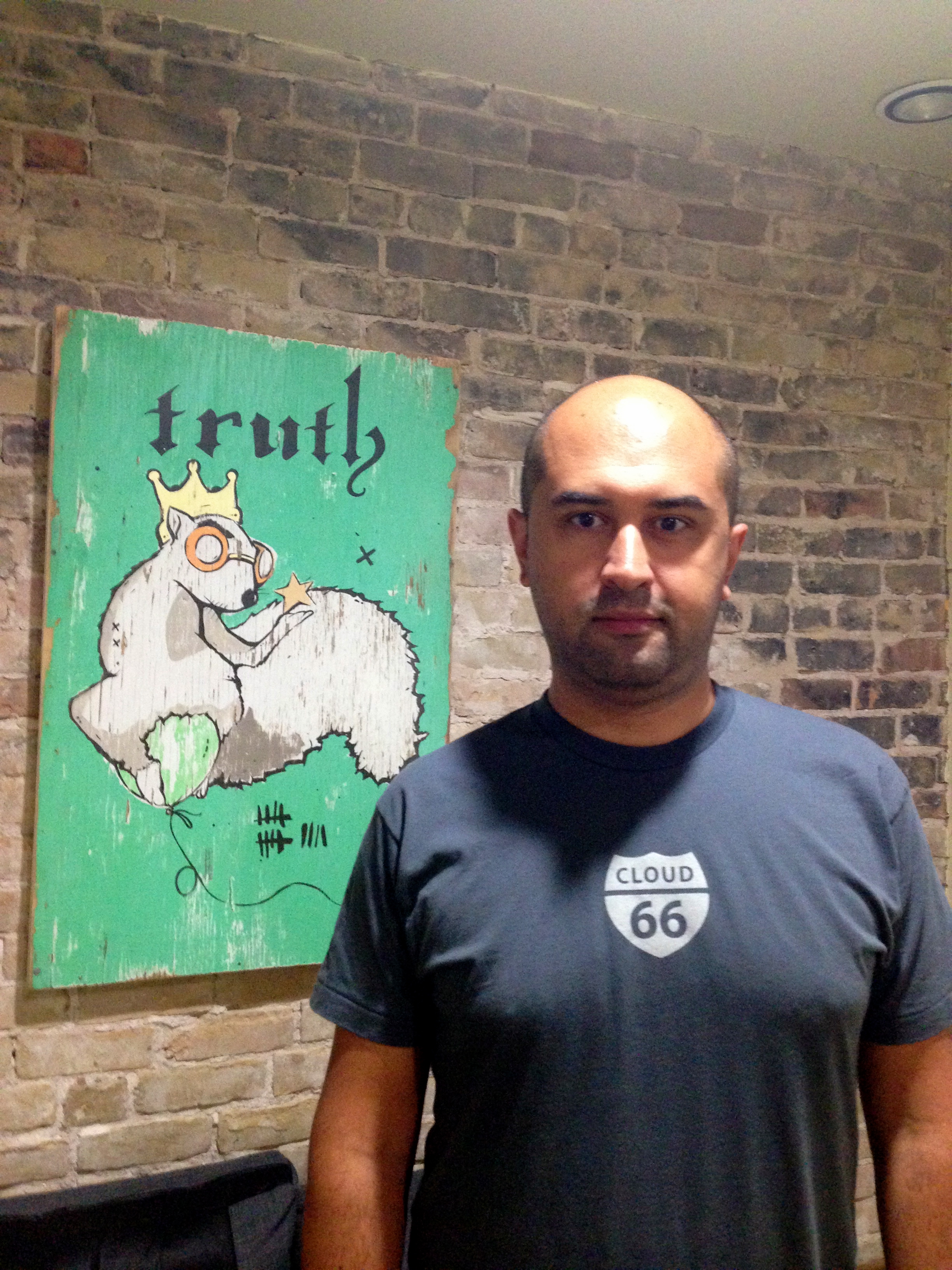
Khash Sajadi, CEO of Cloud 66, a Techstars company in Austin, photo by Laura Lorek

Khash Sajadi, CEO of Cloud 66, a Techstars company in Austin, photo by Laura Lorek

Cloud 66 moved to Austin from London two months ago to participate in Techstars and the startup plans to stay here.

For its business, the U.S. is the best place to be, said Khash Sajadi, CEO and co-founder of Cloud 66.

Cloud 66 is one of 11 companies in the latest Techstars program in Austin. All of the companies will pitch their companies Wednesday afternoon during Techstars Demo Day at the Austin Music Hall. This year, several of the startups plan to stay in Austin after the program ends Wednesday.

They’ve got financial incentives to stay too.

“I’m looking forward to seeing what the Techstars Austin class has accomplished this summer and Rony Kahan and I have committed a total of $20,000 investment for each of them that decides to stay in Austin,” Joshua Baer, founder of Capital Factory, wrote in his weekly Austin Startup Digest.

“When it comes to cloud computing, Austin is particularly important,” he said. “There are a lot of enterprises and cloud infrastructure players around here like Rackspace in San Antonio and Dell in Austin.”

Cloud 66 has seven employees and four moved to Austin.

The company, founded in 2013, helps software developers build and manage the software that powers their business. It provides IT services as a service.

“This is the engine that powers the business,” said Sajadi.

The company provides technology infrastructure for small to medium-sized software as a service companies. Cloud 66 serves 5,000 software developers in 700 companies globally. Its customers include the BBC, CareerBuilder.com, Adobe, Bugheard and Web Summit. Its competitors include Heroku, a cloud application platform.

The company has raised $730,000 including a $120,000 investment from the Techstars program.

One of the biggest benefits of participating in Techstars Austin program is being able to work with Jason Seats, the program’s managing director, because Seats comes from a cloud background, Sajadi said. Seats, co-founded Slicehost, which he later sold to Rackspace and then headed up its cloud computing operations. Seats is an investor in Cloud 66.

Stretch Recipes Wants to Help People Eat Better on a Budget

BY LAURA LOREK
Founder of Silicon Hills News

Lauren Foster, co-founder of Stretch Recipes, photo by Laura Lorek

Lauren Foster, co-founder of Stretch Recipes, photo by Laura Lorek

Lauren Foster is on a mission.

She wants everyone to eat better and save more money.

Foster, the co-founder and CEO of Stretch Recipes, an Austin-based startup, is creating a mobile phone app that lets people on tight budgets make their dollars go further while still buying nutritious food base on pre-planned recipes. The app lists ingredients and provides coupons for a discount.

The inspiration for the app came from her experiences growing up with her grandmother who was diabetic and suffered from heart disease and cancer. As a result, she was tired and didn’t cook. So Foster often ate fast food. She didn’t know a lot about nutrition.

After she moved to Austin, Foster’s brother came to live with her. She didn’t have money to feed him. He went on food stamps and he blew through an entire month’s food stamp budget on Cheetos and ground beef during one visit to the grocery store, Foster said.

That’s when she decided to launch Stretch Recipes to make information on nutritious recipes on a budget available to everyone.

In March 2013, Foster landed a few partnerships with the Sustainable Food Center and local food banks to test the application on people with tight budgets. A month later, she quit her job and began focusing on the startup full time.

In August, UnLtd USA, Austin’s first incubator for entrepreneurs solving pressing social and environmental problems, selected Stretch Recipes to be one of six startup finalists in its first cohort.

Through UnLtd USA, Stretch will receive seed funding and a year of incubation support, said Zoe Schlag, one of its founders. The incubator selected Stretch and the other five companies from a pool of more than 80 applicants.

Stretch also launched an IndieGoGo campaign this summer to complete its minimum viable product so it could begin testing its product with a group of 100 people before it launches its Beta product. The company received close to $5,000 of a $25,000 goal.

Stretch Recipes also won the Audience Choice Award at the Austin Tech Crunch Meetup. Foster won tickets to Disrupt in San Francisco Sept. 8th -10th.

Clarify Officially Launches its Audio and Video Search Platform

BY LAURA LOREK
Founder of Silicon Hills News
IMG_3724In a corrugated steel shotgun shack on the east side of Austin, Clarify launched its media search platform last week.

The compound on Pedernales street where Clarify works is a cluster of warehouses, which used to store medical supplies, and now house tech startups as well as artists, graphic designers and a bike shop.

Inside the shack, Clarify has cut skylights into the roof and windows into the walls to let in the light. To give the space a more festive atmosphere, they’ve strung red Chinese lanterns from the ceiling along with recently installed ceiling fans and strings of lights.

Giant cloth sacks cover tiles embedded onto wooden frames to act as makeshift soundproofing walls and room dividers. Stacked cement blocks and plywood boards serve as standing desks along the wall. A refurbished chicken coop will soon provide a bookshelf.

IMG_3718Every week, Clarify, which recently rebranded and renamed itself from Op3nvoice, hosts a happy hour in its offices. Clarify has six employees and is looking to hire a back-end developer.

Last week, Paul Murphy, Clarify’s CEO and co-founder, sat down with Silicon Hills News to talk about the company, which moved to Austin from London last year and has big plans to dominate the market for video search.

Clarify wants to deliver complex audio and language processing technologies via its simple application-programming interface, known as a API, which provides programming instructions for using a Web-based software application. With Clarify’s API, developers can search audio and video archives easily and quickly. The Clarify API translates the audio and video into text documents, which can then be searched using keywords.

Clarify made its media search platform available for all developers to integrate multimedia search into their applications in any common programming language.

In the U.S., Clarify is talking to developers in a wide range of industries including telecommunications and media.

Clarify has been in private beta for the past four months with nearly 300 companies testing its software, Murphy said.

“Anybody can now come and sign up,” he said.

Clarify has a lot of companies testing and evaluating its software. It begins charging customers at the end of the month, Murphy said. The company makes money by charging developers to run their data through its platform, he said. The developers send their media, Clarify does the analysis and then they can search it, he said.

“We are completely focused on the API and we don’t have any intention to build any system,” Murphy said.

One of its users, Mobento, an online education platform, makes video available to students on any device. It uses Clarify’s technology to help its users find the exact moment they are looking for in a video by using keywords.

This year, Clarify was one of six companies selected to be in the BBC Media Lab.

“What this gives us is really privileged access to people within the organization,” Murphy said.

With Clarify’s search technology for audio and video, the BBC can make their content discoverable to themselves as well as the public, Murphy said. Right now, the company’s identifying projects within the BBC and it is looking for partners to deploy its technology, he said.

“It’s a long process,” Murphy said. “Media companies don’t do things over night.”

Clarify is selling to developers in any industry, Murphy said.

The company launched out of Techstars London and wanted to be in another city with the Techstars community in the U.S., Murphy said.

“Austin has the best reputation internationally,” he said. It’s easy to recruit people to move to Austin, he said.

Clarify has quickly integrated into the Austin tech community. It recently joined the Capital Factory Incubator. And Sam Decker, one of the founders and former CEO of Mass Relevance and executive with Bazaarvoice, has joined the company’s board of directors.

“Sam is a really great addition to the company because he comes from a space none of us knows,” Murphy said. “I happen to have a background in telephony and finance.”

But a lot of things in the social space are moving to audio and video and they’re looking for tools to turn that into data, Murphy said. A searchable database of videos would make it much easier for advertisers to find content they would like to sponsor, Murphy said.

Someone has to build tools to keep track of all the audio and video content being created and Clarify has the solution, he said. In five years, searching video and audio will be easy and natural, Murphy said. But right now, it’s difficult and cumbersome and Clarify’s technology solves that problem, he said.

Projector Capital and several prominent California and Texas Angel investors fund Clarify, which is currently raising $1 million in seed funding. The company already has more than half of it committed, Murphy said.

San Antonio’s Code for America Fellows Create “Homebase” App

Code-for-America-300x123-1Since January, the Code for America fellowship team has worked with the City of San Antonio.

The team made up of Maya Benari, David Leonard and Amy Mok have met with citizens and city officials. They spent a few months here working and then went back to San Francisco to complete their project.

Now they’ve completed an early version of it and they want citizens in San Antonio to test it. They’ve created an app, Homebase, that makes it easier for homeowners to make home improvements in cooperation with the City of San Antonio. They’ve tested the app with homeowners. It streamlines the home building permit process and lets homeowners easily apply for building permits.

The Code for America team wants more people to try the Homebase app and give them feedback, according to Benari.

To participate, please fill out this form.

« Older posts Newer posts »

© 2026 SiliconHills

Theme by Anders NorenUp ↑