Page 142 of 352

Bloomfire Lands $12.8 Million in Funding

Bloomfire's Austin headquarters, photo courtesy of the company.

Bloomfire’s Austin headquarters, photo courtesy of the company.

Bloomfire, which makes a software platform for companies to share information, Thursday announced it has closed on $12.8 million in Series B funding from Austin Ventures.

Bloomfire plans to use the funds to hire more people for its sales and marketing teams and on research and development of its platform.

“This capital shows that Bloomfire is delivering on a clear need for knowledge sharing across the enterprise,” Mark Hammer, Chief Operating Officer of Bloomfire, said in a news release. “It also recognizes our opportunity to grow our business with a broad range of services that drive ever-increasing value for all of our customers — across their organizations.”

“Nearly every company has the problem Bloomfire’s knowledge sharing platform solves: providing employees with easy access to the information they need to do their jobs,” Chris Pacitti, general partner at Austin Ventures, said in a news release. “This funding will enable Bloomfire to continue to innovate its products and further develop its core services for knowledge sharing across the enterprise.”

Bloomfire just released a new sales product, called Bloomfire SE that provides analytics on the effectiveness of marketing content. The company, founded in 2010, previously raised $20 million in three rounds from investors, according to its CrunchBase profile.

Google Gives Grants to Austin Public Library Foundation for Digital Inclusion Program

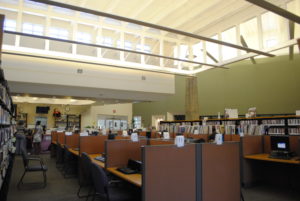
 Computers at the Carver Library branch, photo courtesy of Google.

Computers at the Carver Library branch, photo courtesy of Google.

The benefits of having Google Fiber in Austin go far beyond higher broadband speeds.

That can be seen in Google’s latest gift to the Austin Public Library Friends Foundation. This week, Google and Google Fiber awarded $145,000 to the foundation to support a new digital inclusion program. The funds will go to buy new videoconferencing technology for several libraries around the city and to teach technology skills to adults and help children with homework online, according to a news release.

Libraries are like the brains of any community and they can reach some of the people who most need to acquire new technology skills but don’t have access to the technology otherwise.

“We are thrilled that these grants will allow us to provide more digital literacy support for Austinites and bring videoconferencing capabilities to those people who don’t have ample access to technology,” Tim Staley, executive director of the Austin Public Library Foundation, said in a news release. “The library plays a critical role in bridging the digital divide as the place where people find much of their access to technology. The applications of this technology and support and what can be accomplished with them are only limited by Austinites’ imaginations.”

The Austin Public Library Foundation plans to use a $75,000 grant from Google to help adults with computer skills like creating a resume or applying online for a job and to help youth with school work at the Ruiz and Carver library branches. It also includes plans for workshops and events focusing on science, technology, engineering or math or STEM skills. It also includes classes in coding, web development and entrepreneurial skills for adults.

Another $70,000 grant will go to buying flat screen TVs and Google hangout technology cameras and microphones. It will also go to train the library staff on how to use this technology. The equipment will be installed in 12 community rooms at the Austin Central Library and seven branches including Spicewood Springs, Hampton Branch at Oak Hill, Carver, Ruiz, Little Walnut Creek, Manchaca Road and Yarborough.

“Having access to the internet today can be the difference between keeping up or falling behind,” Parisa Fatehi-Weeks, head of community impact programs and investments for Google Fiber in Austin, said in a news release. “We are lucky to have a strong public library system that wants to find new ways to open doors of opportunity for Austinites. These investments and the hard work of community partners will allow for additional one-on-one support and educational programming to help students and job-seekers new to technology use it to succeed.”

U.S. Secretary of Transportation Anthony Foxx Visits Austin, a Finalist in the Smart City Challenge

By LAURA LOREK
Reporter with Silicon Hills News

U.S. Secretary of Transportation Anthony Foxx with Mayor Steve Adler and members of the city council.

U.S. Secretary of Transportation Anthony Foxx with Mayor Steve Adler and members of the city council.

Comparing his journey this week to that of an American Idol judge, U.S. Secretary of Transportation Anthony Foxx visited Austin Tuesday morning to meet with leaders from one of seven finalists vying for a $40 million Smart City Challenge grant from the U.S. Department of Transportation.

Foxx is travelling the country to meet with city leaders of all of the finalists. But instead of picking the next singing sensation, Foxx is looking for the most innovative city when it comes to dealing with transportation issues. He visited Pittsburgh and Columbus, Ohio on Monday and Denver Tuesday afternoon for roundtable discussions. He will visit San Francisco and Portland, Oregon on Wednesday and Kansas City, Missouri on Friday.

At Austin City Hall, Foxx met with Austin Mayor Steve Adler, City Manager Marc Ott, members of the Austin City Council, city staff and community leaders during an hour-long roundtable discussion.

During a press conference following the roundtable, Foxx said that Uber and Lyft recently leaving Austin did not affect the city’s standing as a finalist in the Smart City Challenge. Austin voters recently struck down Proposition One. Uber and Lyft stopped operations in Austin because Proposition One didn’t succeed. It would have struck down stricter regulations of Transportation Network Companies including fingerprint background checks.

“I wouldn’t be here if Austin wasn’t a strong contender in the challenge,” Foxx said. “That remains true.”

Mayor Adler also said he was confident the city would come up with a solution to provide Austin citizens with more ride sharing options.

During the roundtable discussion, Foxx said smart cities are needed because the U.S. has aging infrastructure and faces enormous population growth, adding 70 million people in the next 30 years across the country. And the U.S. is seeing a 45 percent increase in demand on its freight systems and 65 percent more trucks on the road in the coming decades, Foxx said.

“This challenge comes at a very important time in our nation’s trajectory…. Our investments have been going down,” Foxx said. “Pressure on our system has been going up.”

The Smart City Challenge is designed to create a really aggressive set of ideas about the future of transportation, Foxx said. The challenge kicked off last December and had a short turnaround time intentionally, he said. They originally wanted to name five finalists but the same seven cities kept popping up to the top of the list so they named seven finalists, Foxx said.

To win the Smart City Challenge, a city can’t make stuff up, Foxx said.

“It has to be actual challenges your city faces,” he said. “You can’t have something about dog sleds providing transportation.”

Foxx also said that pie in the sky technology is not a competitive advantage.

“We’re not interested in technology for technology’s sake,” he said. “We’re not interested in finding the coolest gizmos…The question is how are we going to use the available technology. How can we shape these cities in the challenge against that back drop?”

A smart city thinks about its entire community, Foxx said. It thinks about a holistic vision of transportation. The smart city winner integrates innovative technologies like self driving cars, connected vehicles and smart sensors into its transportation network.

“We think a smart city is a city that has a good idea about where it wants to be,” he said.

It also develops strategies that are practical and creates a roadmap on how it’s going to achieve its goals, he said.

Even before the Smart City Challenge, Austin was talking about 2016 being the year of mobility for the city, said Mayor Adler.

Affordability and mobility are the two most pressing issues in Austin right now, Adler said. Those two things are intertwined, he said.

“Independent of this challenge, Austin already started doing things to address its traffic congestion and mobility issues,” Adler said.

Austin is the fastest growing city in the country for four years running and it also has one of the worst traffic problems in the country. It’s also one of the most economically segregated cities in the country, Adler said. Equity and access are issues Austin is grappling with and working to come up with solutions, he said.

“We are already moving forward with technology,” he said. “This is a city that embraces new ideas.”

Austin would love to win the challenge, Adler said. It’s a path the city is on and the challenge represents a chance for the community to come together to address some major issues.

And it’s not just an important issue for Austin, but for all of Texas, Adler said. Austin has formed a transportation research triangle with Southwest Research Institute in San Antonio, Texas A&M Transportation Institute in College Station and the Center for Transportation Research at the University of Texas at Austin along with collaboration from Huston-Tillotson University and Texas State University.

“We’re going to do this regardless,” Adler said.

As Austin moves forward, the city’s proposal has evolved, said Robert Goode, Austin’s Assistant City Manager for Transportation Service. Austin also incorporated some ideas from other city proposals into its own proposal, he said. One idea is from Kansas City for a bus rapid transit system in Austin, Goode said.

Austin also wants to have an annual smart city conference and plans to partner with SXSW to put that on, Goode said.

Overall, Austin’s proposal includes a mobility innovation center with cooperation from TXDOT and Capital Metro. It also has plans for a traffic management center and it is creating an open data portal to share transportation research information. Capital Metro also plans to do a pilot program with RideScout, now known as Moovel, to create a smart card or smart app to allow someone to schedule all the different transportation modes in one place.

The city is also launching some geographic pilots, called smart stations, Goode said. For example, one is to be located at the airport and it will work with autonomous vehicles.

Another station is planned for Pflugerville, a place where communities of color have moved to in large numbers as a result of affordability issues. The city plans a shared transit model to allow people to schedule a ride into the city for healthcare visits or groceries or other errands through a fleet of vans.

Austin is also partnering with Google to work on creating an automated last mile transportation system at the MetroRail Red line station. Google is testing a fleet of autonomous cars already on Austin streets in a pilot program. It was the second location Google chose to test its self-driving cars outside of its headquarters in Mountain View, California.

One of the goals of the Austin transportation program is to help those who haven’t had access to transportation, said Linda Watson, president and CEO of Capital Metro.

About 150,000 people work in downtown Austin, Watson said. For every dollar a person saves by moving to an outlying area, they spend 70 cents to get back downtown, she said.

Good transportation provides access to opportunity, said Colette Burnette, president of Huston-Tillotson University.

“Transportation is the biggest barrier my students have to their success,” Burnette said.

Austin is losing its creatives, its musicians and its diversity, Adler said. He asked Austin City Councilwoman Ora Houston her opinion on why black people keep moving out of the city.

Segregation in Austin goes back to a 1920 plan that forced minorities to move east of Intrastate 35, Houston said. Intrastate 35 was the dividing line between the haves and the have nots, said Houston, who grew up in Austin.

But overall, it’s a complex mix of issues that is leading black people to leave Austin, Houston said. The city needs to take the issues on collectively and holistically. It also needs to make sure it remains an inclusive place for everyone, she said.

In the press conference following the roundtable, Foxx said congestion on Intrastate 35 mirrors congestion on major highways in other parts of the country. It’s a result of under investing in our infrastructure, he said.

“Our country is not getting out of this ditch anytime soon,” he said.

Overall, Austin faces a number of challenges from its significant population growth, urban sprawl, suburban poverty and congestion.

Austin needs to figure out how it can be the best Austin it is capable of being, Foxx said.

Austin is also a hotbed of autonomous car research. Every one of the seven cities is going to play to its strengths, Foxx said.

Final applications are due May 24th and the winner will be announced in June. The winning city will also receive assistance from a group of selected partners including Paul G. Allen’s Vulcan Inc., Mobileye, Autodesk, Alphabet’s Sidewalk Labs, Amazon Web Services and NXP. Vulcan Philanthropy has pledged $10 million in additional funding to the winner.

Equity Based Crowdfunding Starts Nationwide Today

Bryan Menell HeadshotToday is an historic day for startup investing and fundraising.

Title III of The Jobs Act goes into effect four years after President Barack Obama signed the act into law.

That means companies, ranging from restaurants and bars to video game makers and software companies, can now raise funds through equity crowdfunding portals from mom and pop investors.

Anyone can invest up to $2,000 a year in equity crowdfunding companies.

Under previous regulations, only accredited investors or high net worth individuals could provide equity investments in startup ventures under the SEC rules.

And equity-based crowdfunding differs from the perk-based crowdfunding done on sites like Kickstarter and Indiegogo. On those sites, companies offer a product or service, t-shirt or other perk, in exchange for money. The person providing the funding doesn’t own any part of the company. They simply pledge to back the venture to receive a product, perk or just provide a donation.

The U.S. Securities and Exchange Commission approved the new equity-based crowdfunding rules last October. The rules allow companies to raise up to $1 million annually through online equity-based crowdfunding portals.

Investors, who make less than $100,000 a year, are limited to investing $2,000 a year, or five percent of their annual income in online crowdfunding deals. Investors who make more than $100,000 a year are allowed to invest 10 percent of their annual income up to $100,000 a year.

One of the big requirements of the Title III rules require company founders to file financial statements and to communicate on a regular basis with investors, said Bryan Menell, chief operating officer with AngelSpan, an Austin-based startup that specializes in investor communications.

In fact, AngelSpan’s founder Joe Milam travelled to Washington, D.C. to participate in the Crowdfunding Technology Demo Day at the Capitol Visitors Center Monday afternoon. It was one of 30 companies chosen to attend the event from around the country.

AngelSpan presented under the Trust and Transparency Companies category. Other presenters included crowdfunding portals, data analytics, funds management and other crowdfunding ventures.

Communication with investors can be a key component to the success of a startup, Menell said.

Yet only 18 percent of startups with investment provide monthly financial reports, key performance indicators or operational updates to investors, Menell said. That statistic comes from an AngelSpan research survey done by Jon Brumley Texas Venture Labs graduate students at the University of Texas at Austin. They surveyed 46 venture capitalists, angel investors, advisors and mentors nationwide that have worked with more than 7,600 early stage companies.

The study also found that 83 percent of investors, advisors and mentors agree startups that communicate perform better in execution and eventual exit compared to the startups that do not communicate.

AngelSpan provides monthly reports to investors staring at $99 a month for companies.

The Jobs Act Title III rules actually require more communication with investors than what is required currently, Menell said. And that increase in transparency is not only good for investors, but it can be quite helpful for companies as well, he said.

The financial reports are important to investors, but it’s the narrative that is more important, Menell said. Angel investors have a big network and lots of business relationships and they can help entrepreneurs immensely, he said.

Menell quoted Angel Investor Jason Calacanis who has told entrepreneurs that the angel didn’t give you all their money. They only gave you part. They will give you more if you communicate.

“All of these things people in your ecosystem can help you with if you communicate,” Menell said. “It’s also about the ask in the ecosystem on your behalf to make your company successful.”

Overall, it remains to be seen what’s going to happen with the impact of Title III and the new crowdfunding rules, Menell said.

“I think it will take off slowly. There are a lot of registered crowdfunding portals in the state. Not all of them are open and ready to do business,” Menell said. “There are some growing pains. It will take a while to build.”

It’s already starting to play out in Texas.

Equity-based crowdfunding has been legal in Texas since November of 2014 when the state passed its own rules in advance of the federal ones. A handful of states adopted their own crowdfunding rules.

There are 10 crowdfunding portals approved in Texas. And as of April 22, 32 issuers had filed under the Texas intrastate crowdfunding rules, according to Robert Elder, spokesman with the Texas State Securities Board.

“The aggregate maximum offering amount for the issuers is $8,561,677,” Elder wrote in an email. “The total raised so far is $1,689,637. As I said, some of the offerings are still open and accepting investments.”

“We don’t have any expectations about who is going to choose to go the federal route as opposed to doing intrastate crowdfunding,” Elder said. “We don’t have a sense of how that is going to play out.”

“There is nothing in the Title III that affects the Texas equity crowdfunding rules,” Elder said. “It’s a broader option for businesses that want to raise funds nationally.”

The True Cost of Prop 1 for Austinites: $29M, Jobs, Funding and Lives

Opinion:

Courtney Powell, courtesy photo.

Courtney Powell, courtesy photo.

By Courtney Powell
Special to Silicon Hills News

This has been a difficult week for many Austinites. The Prop 1 campaign has galvanized the community, and rightly so. There was no shortage of opinions, interests, or ego on either side of the debate. I believe it was a poorly executed campaign on both sides, but I’d like to put aside the campaign itself for a moment and discuss the implications and true cost of Prop 1 for Austin.

I took 45 trips with Uber in the last year. I voted for Prop 1, but prior to the election, I hardly paid attention to the campaign or the issues. I’m not affiliated with Uber, Lyft or the City of Austin. I’m the CEO of Austin-based, Real HQ, but these opinion are entirely my own. I’m not heavily involved in any form of politics — in fact, I voted for the very first time in the most recent presidential primary. I’m not proud of my lack of political involvement, I guess I’ve always told myself that given the current state of politics, a single vote wouldn’t make a difference. I was wrong.

Thousands of Austinites Lost a Primary or Secondary Source of Income

There are over 10,000 Uber and Lyft drivers in Austin. More than 60% of these drivers are estimated to drive less than 10 hours per week.
On average, nationwide, a part-time Uber driver earns around $19 per hour. The federal minimum wage is only $7.25 per hour. By contrast, a full-time taxi driver makes, on average, $10.19 per hour.

For thousands of Austinites, Uber and Lyft was the “perfect second job,” allowing moms to drive during the day when the kids were at school, allowing students to earn money for living expenses and tuition, or simply allowing someone a profitable, change of pace from their normal routine.

But for many Austinites, driving for Uber or Lyft was their primary source of income. In addition to increased earnings, Uber drivers are their own boss, set their own hours, and have the benefit of knowing who they will pick up, in advance. Here’s one Austinite’s personal story about driving for Lyft.

Beyond higher pay and flexibility, Uber and Lyft created opportunities for underrepresented communities. I’ve seen Austinites who are deaf, or for whom English is not their first language, drive for Uber and Lyft successfully. Imagine an entire underrepresented community offered a new opportunity to earn a living, now part of the more than 10,000 people that have lost income.

In the startup community, I think it can be easy to overlook how difficult finding a well-paying, flexible job for most people can be. I’ve even seen people refer to the Prop 1 aftermath as “first-world problems.” This issue is not just about finding a faster, cheaper way to get to the airport. It’s about the financial impact on real people. Over half of American children receive free or subsidized lunches and 22% of American children live BELOW the poverty line. According to a heartbreaking article from CultureMap Austin, Austin now has the 8th fastest-growing poverty rate in the country, with over 230,000 locals were considered to be living in poverty.

This issue is not just about finding a faster, cheaper way to get to the airport. It’s about the financial impact on real people.

Uber and Lyft offer many people a chance to earn money they desperately need to make ends meet. Note that in the requirements to become an Uber driver, although you need a safe vehicle, insurance, a clean driving record and no criminal history, there are no educational requirements. This is important. 68% of Americans do NOT have a college degree but more and more jobs now require one. Compare the Uber driver requirements with those of a Testing Assistant at Austin Community College, where you’ll need at least a high school diploma and preferably an associate’s degree. The hours are not flexible, and the pay is $10.75 per hour. For most Americans, every dollar counts.

Many have said that the resulting job loss is Uber and Lyft’s fault. I disagree. The inherent role of a business that has taken on (in this case massive) outside funding, is to produce a financial return for their shareholders. This doesn’t mean funded businesses shouldn’t operate ethically, care deeply for their employees and customers, or contribute to the communities they do business in, but at the same time, they are bound by a fiduciary responsibility to shareholders.

The City of Austin, however, has no such constraints. The Office of the Mayor and City Council is beholden to the people, and people alone. Their job is to protect the interest of the city and it’s citizens. I know of no greater interest for Austinites than enabling every opportunity for as many citizens as possible to earn a living.

Uber and Lyft Leaving May Cost Austin Over $29M Per Year

If we estimate the total wages earned by part-time Uber and Lyft drivers in 2015 using the numbers above — 10k drivers in Austin multiplied by 60% part-time drivers, multiplied by 5 hours per week (as the only data I have says 60% of drivers work less than 10 hours per week, I‘m using this as a safe estimate), multiplied by $19 per hour — that’s $29 million in part-time yearly earnings alone that will no longer be fed right back into the local economy in the form of income, spending, and taxes.

In addition, Uber and Lyft agreed to pay an additional 1% of revenue earned in Austin to the city. In Uber’s first year in Austin, they conducted 2.5 million rides. Uber’s minimum fare is $5.30. The 1% revenue fee paid to the city of Austin for Uber each year alone, would be significant.

$29 million in part-time yearly earnings alone will no longer be fed right back into the local economy in the form of income, spending, and taxes.

Many ask why if Uber and Lyft are making so much money in Austin, would they leave over something as seemingly simple as fingerprinting? Incorporating fingerprinting (and the many other requirements put in place by the city) is challenging for the Uber and Lyft model because they are operating at international scale. Ridesharing is built on quickly enabling new, part-time drivers to join the supply side. Uber has managed the background check process themselves, typically via a third-party, and it only takes a couple of days for a driver to be approved. This low barrier of entry not only contributes to quickly onboarding new drivers, but it is also crucial to offset driver turnover each year which Uber estimates is over 50% due to the part-time nature of most drivers — if their circumstances change, they move on.

Most cities are not set up to process fingerprinting-based background checks quickly or effectively. The City of Austin cannot even enforce the ordinance as it is written today.

Without Uber and Lyft, Austin’s Transportation Crisis Worsens

I’ve heard people say that Austin got along just fine before Uber and Lyft arrived. Fortunately, Uber and Lyft’s arrival in 2014 came at the same time that Austin was experiencing extraordinary population growth and increased popularity as a tourist destination. According to the Austin Chamber of Commerce, 7.1% of Austin residents in 2014, did not live here the year before. The population has grown 37% since 2010 and there are no signs of it slowing.

We are not the same city we were even two years ago, and we were not at all prepared for this level of growth. Previous attempts to pass massive transit improvements over the past few decades were voted down and the entire city is now paying the price.

Austin’s traffic and mobility crisis is to Austin what housing is to the Bay area.

Austin’s traffic and mobility crisis is to Austin what housing is to the Bay area. Poor legislation, and voters who dug in their heels in the name of dogma or a moral high ground, as opposed to pragmatism, will continue to cost its citizens dearly. Just as in the Bay area, it’s the least advantaged citizens who will pay the biggest price. The less transportation options, the less job opportunities, the greater the economic divide will become.

Damage to Austin’s Reputation as a Tech Friendly City Will Cost Jobs

Paul Graham, arguably one of the most influential people in startups and venture capital, tweeted the following about our city.

This is bad. Fundraising isn’t everything, Silicon Valley isn’t everything, and Austin is still one of the best places to launch a startup, but the ability to raise funds in order to grow a company is essential. There are very few companies in the last few decades who have reached meaningful scale without some outside funding.

Until you have years of profitability under your belt, banks don’t want to touch you — they’re not built to invest in innovation or unproven markets. Several great venture capital firms are based in Austin, as are a few angel investor syndicates, and a number of independent angel investors. However, relatively few deals beyond the seed stage — and especially beyond a Series A financing — get done without the participation of at least one investor that is not based in Austin.

Many investors are biased against startups from outside of the Bay area. It’s nothing personal, it’s statistical. In the last two years, 47% of all exits came from Bay area companies. The next highest exit concentration was in London, at 10%. Austin ranks 14th. Given the negative perception of Austin post-Prop 1, and the fact that influential investors and tech leaders are now tweeting things similar to Paul Graham’s sentiment, I fear that Austin will become a “negative signal” for investors. No matter how silly this sounds, perception is reality when asking other people to part with their money.

If the impact on fundraising isn’t bad enough, think about recruiting. Recruiting in tech startups is difficult. Tech companies are dependent on software engineers. The majority of Austin tech companies must compete with big, well-funded companies like Facebook, Dropbox and Google for the relatively small supply of engineers in Austin. Real HQ is a remote company, but I’ve already heard engineers and other tech employees say they wouldn’t move to Austin because, in a city where a car seems like a necessity, not having Uber or Lyft just seems backwards.

Will Prop 1 result in more startups in heavily-regulated industries being forced to leave Austin?

For startups aimed at disrupting existing incumbents in industries that are heavily regulated, the negative impact on fundraising will be even greater. Mike Maples has already stated publicly that Floodgate will not invest in on-demand startups in Austin, and he’s from Austin! Imagine what the rest of the investment community must think. Will Prop 1 result in more startups in heavily-regulated industries being forced to leave Austin?

Making fundraising and recruiting more difficult for Austin entrepreneurs means fewer jobs will be created for Austinites across the board. The City Council does not create jobs, they exist off of the taxes of working citizens. Check out the top 20 non-government employers in Austin right now. Dell, Home Away, BaazarVoice…nearly all of them have raised capital to get where they are now — a top employer of Austinites.

Entrepreneurs need to be able to fundraise and recruit in order to create jobs. We need a Mayor, a City Council, and community that prioritizes job creation.

Uber and Lyft Help Save Lives

The city of Austin has over 50k college students and one of the liveliest party and drinking scenes in the country. Everyone who comes to Austin knows about Sixth Street. Austin was even ranked as the 5th drunkest city in America. Sadly, some Austinites choose to drive drunk rather than wait long periods for a taxi, ask a friend to be a designated driver, or take advantage of designated driver services like Sober Monkeys.

Driving drunk should never be a solution but the reality is, it happens every single night in Austin (and other places across the country). According to this study, 20% of college-aged students have driven drunk and over 40% have ridden with a drunk driver. It is no surprise that Mothers Against Drunk Driving (MADD) endorsed Prop 1.

UberImage

In 2015, eleven Austinites were arrested for manslaughter for driving and killing someone while under the influence. During the 2015 winter holiday season alone, APD arrested 229 individuals for driving under the influence during No Refusal periods.

In 2014 and 2015, ridesharing reduced drunk driving crashes in Austin by 12%. It has been proven that Uber and Lyft can help save the lives of our loved ones. If for NO OTHER REASON, Austin needs Uber and Lyft.

We’re Not Safer. Unregulated Transportation Options are Filling the Vacuum Left By Uber and Lyft.

During the run-up and fallout from the Prop 1 election, fingerprinting-based background checks for drivers has been the linchpin of those in favor of Prop 1— even though there is no correlation between fingerprinting and increased safety for passengers. None. Zero. Check out this Atlantic article for a nuanced view of the fingerprinting and background check issues on both sides of the argument.

There is no correlation between fingerprinting and increased safety for passengers. None. Zero.

Following my last time in a cab (where the driver repeatedly asked me to move to the front-seat throughout the duration of the ride), I’ve not felt comfortable enough to get into a taxi by myself. I feel safer with Uber, where I can see the person’s rating history and make a choice, based on data, whether or not I will take the ride. If there is an issue with a driver, I can instantly provide feedback to Uber and they have the ability to immediately remove the individual from the pool of available drivers. That is simply not possible with a taxi.

Aside from the comfort, tracking, and accountability we’re now lacking with taxis, without Uber and Lyft, Austin is experiencing a tremendous ride shortage. Check out Twitter to see examples of hours long lines for taxis at Austin-Bergstrom Int’l Airport and the thousands of Austinites experiencing difficulty getting where they need to go.

Can you imagine F1, SXSW or ACL without Uber or Lyft?

I’ve heard many comment that this vacuum creates tremendous opportunity for a newcomer. Building platforms that are as easy to use, dependable, and as safe as Uber or Lyft takes years of work and BILLIONS of dollars. I’m sure that someone could put together a ridesharing platform that works in a limited function, just without enough trips to make it worth a driver’s time OR affordable rides AND none of the accountability of Uber and Lyft. Also, no sophisticated investor would commit to a ridesharing company in Austin given the current climate, especially knowing that any newcomer will be instantly marginalized if Uber or Lyft returns. The City of Austin has been encouraging people to use the Get Me app, which by all accounts, has not been going well (though I applaud them for the hustle).

Building platforms that are as easy to use, dependable, and as safe as Uber or Lyft takes years of work and BILLIONS of dollars.

Humans are inherently creative and will attempt to find a solution, even if it poses a greater risk to their safety than a traditional taxi or Uber or Lyft. Over the last couple of days, Arcade City has amassed 12k+ likes on their Austin community Facebook page. Arcade City is a movement that facilitates messaging between potential drivers and would be passengers to plan rides and handle payment. The goal is to create a non-centralized, community driven initiative. I understand and respect the right of consenting adults to do anything they please, and I think Arcade City is interesting, but this is hardly a better, safer option that Uber or Lyft.

What Can We Do to Bring Uber and Lyft Back to Austin?

Prop 1 could cost Austin millions of dollars in income, new revenue for the city itself, opportunity for entrepreneurs to create more jobs in Austin, much needed solutions to our transportation crisis, and worst of all, the very safety of citizens it purported to protect.

We must work together to make our voices heard, get educated, and engage at the local level to fight for policies that enable continued economic growth and prosperity for the city and all Austinites.

Here’s a few suggestions to make your voice heard and help bring Uber and Lyft back to Austin.

  • Educate yourself about the issues surrounding Prop 1
  • Email, tweet, write, or call and tell Mayor Adler *and* your City Council rep that you want them to do everything possible to bring Uber and Lyft back to Austin. Continuously remind them that the current state is unacceptable.
  • Ask Uber and Lyft to come back to Austin and meet with the Mayor and Austin representatives to craft a solution and move forward.
  • Join the Austin Tech Facebook group to keep abreast of policy issues that affect Austin and the greater tech community.
  • Share your position with fellow Austinites, and encourage them to make their voice heard too.
  • Treat every citizen with respect! We don’t all share the same viewpoints and that’s okay.
  • Educate yourself on how and when to register to vote and then show up!
  • If the Mayor or city council doesn’t represent you, VOTE THEM OUT!

One Final Note

I’d like to acknowledge the many people working hard both publicly and behind the scenes to bring Uber and Lyft back to Austin. Thank you.
And thanks to Shelly and A.T. for offering feedback on this post.
You can find me on Twitter.
Thanks to Shelly Leonard.
UberAustinLyft

Reprinted with permission. This post originally appeared on Medium.

Courtney Powell is the CEO of Real HQ, creator of Agent Pronto, the largest real estate agent matching service in the United States and Canada. Prior to Real HQ, Courtney founded PublikDemand, a platform that empowered consumers to get better customer service. Courtney was named by Forbes as one of the Top 30 CEO’s Under 30.

Favor Moves Into Cool New Headquarters in Downtown Austin

Favor's new office, photos courtesy of the company.

Favor’s new office, photos courtesy of the company.

Austin’s home-grown delivery service, Favor, has just moved into some cool new digs in downtown Austin.

The company, with 121 local employees, now occupies 12,000 square feet of office space at 1705 Guadalupe Street. It’s decked out with murals of Austin landmarks and favor delivery items in blue and white, Favor’s signature colors. The company’s creative team designed the office.

“It was incredibly important for us to have our employees heavily involved in the planning and design of our new space,” Jag Bath, CEO and President of Favor, said in a news release. “The end result is an office that has our culture and values stitched into the fabric of the space. Creating a strong sense of community is something that we not only value with our customers, Runners, and merchants, but it’s also something we take pride in with our employees. We’re excited to have a new beautiful space that our employees can feel proud to work in every day. A space that is designed and built by Favor, for Favor.”

New Favor HQ Photos, provided by the company.

New Favor HQ Photos, provided by the company.

Favor named its meeting rooms named after famous personal assistants such as Jeeves, Jenkins, Moneypenny, R2D2, and Siri.

Michael Johnston. also known as Truth, a local Austin Graffiti Artist, designed Favor’s signature mural.

“The inspiration behind the mural is this little happy world (Austin) where Favor also lives and brings goodness to your doorstep,” Johnston said in a news release. “I hope it brings a ray of sunshine to the folks that work there.”

Favor’s new office also has a view with a rooftop deck and views of the Austin Capitol and UT Stadium.

Favor is an on-demand delivery service. It offers its service in 23 cities in the U.S. and Canada.

New HQ Photos

New HQ Photos

Isabella Rose Taylor Named Austin A-List Rising Star

Fashion Designer Isabella Rose Taylor, courtesy photo.

Fashion Designer Isabella Rose Taylor, courtesy photo.

At the Austin A-List awards ceremony Wednesday night, the organizers chose to honor Isabella Rose Taylor as its entrepreneurial rising star.

Taylor, 15, is from Austin and is one of the world’s youngest fashion designers and artists.

“I really got into fashion through my art,” Taylor said. “I’ve been selling my art since before I can remember. I started painting when I was three. I’ve always been really creative. But I’ve always been looking for ways to turn that creativity into a business. So in that way, I would say I have been quite entrepreneurial.”

The Austin Chamber of Commerce along with South by Southwest Interactive picked Isabella Rose Taylor as its rising star for 2016 and gave her the award at the ACL Live Moody Theater before more than 750 people from the Austin technology community.

She launched her company at the age of 11. Because of her age, she said, she wanted to do something for her peers. She hosted a fashion show during Fashion Week in New York City for the past few years and in 2014 struck a deal with Nordstrom’s to carry her fashion line.

Taylor also was featured at Dell’s Women’s Entrepreneur Network, known as DWEN, in 2014 when it was held in Austin.

Taylor, who finished two years at Austin Community College for fine arts starting at age 13 transferred to Parsons School of Design in New York, to complete her degree.

“I’ve learned everything about merchandising, marketing, entrepreneurship, design, really everything about the industry,” Taylor said. She is just finishing up her first year and what she has learned has really helped her in her business and to reach her goals, she said.

“I think it’s really important my generation make a contribution to society and I think the best way to do that is through entrepreneurship,” Taylor said.

Her goal is become a big global lifestyle brand.

“Dream big,” Taylor said. “If you don’t you’re never going to be able to realize those dreams. You have to set your expectations high for yourself.”

12 Startups Named to 2016 Austin A-List

AustinAList1In a standing room only theater, a dozen Austin startups, ranging from emerging companies to bigger ventures, received awards Wednesday night as part of the Austin A-List of the Hottest Startups.

The Austin Chamber, through its Innovate Austin initiative, and South by Southwest Interactive put the event on every year at ACL Live at the Moody Theater. An estimated 750 people attended the event.

A panel of independent judges reviewed about 200 companies to pick the winners in three investment stage categories: emerging, growth and scale.

“The A-List reinforces our efforts to attract funding, talent, and companies which enhances our diverse tech and innovation community,” Michele Skelding, senior vice president of Global Technology and Innovation, Austin Chamber, said in a news release. “We are delighted to recognize an exceptional portfolio of Austin’s most innovative, scalable startup companies. Innovators are a key part of our strong economic ecosystem and will continue to drive the future of Austin. Now more than ever, Austin needs to support creativity and innovation; it is instrumental in ensuring our legacy continues.”

Past winners on the Austin A-List have raised nearly $1 billion and 19 companies have had successful exits via acquisition or initial public offering.

“The Austin tech ecosystem continues to grow in quality and quantity — and this growth is again reflected by the 2016 Austin A List winners,” Hugh Forrest, Director, South by Southwest Interactive said.

In the Emerging, early/seed stage category, four companies won. They all have received funding of less than $1 million or they have revenue under $1 million: (descriptions provided by the Austin Chamber of Commerce)

re3dEmbark Veterinary – leverages the newest DNA, tech, and biotech technologies to provide owners and veterinarians the best support and facilitates individualized pet care products and services.

Factom – brings honesty and transparency to data systems using the block chain. With their tools, you can publish a mathematical proof for any event or record.

IdealSpot – a commercial real estate application that matches tenants to their ideal locations and building owners and managers to their ideal tenants by applying machine-learning, predictive algorithms to real-time market data.

re:3D – Gigabot, re:3D’s flagship technology, enables industrial strength, large format 3D printing at an affordable price point.

Six companies won in the Growth category – each received funding between $1 million to $10 million or have revenue of between $1 million and $20 million:

ESO Solutions – builds software that helps healthcare and public safety professionals improve community health through the power of data.

FireflyFirefly Space Systems – a satellite launch company that provides low-cost, high performance space launch capability for the under-served small satellite market, where secondary payload launches are often the only option.

NSS Labs – a world leading security product testing laboratory, offering in-depth security product test reports, research, and analyst services.

OJO Labs – a world class team of engineers, data scientists, product gurus, and proven entrepreneurs who are building an artificial intelligence technology that replicates, adapts, and scales human conversations.

The Zebra – a car insurance comparison marketplace and digital agency. With just a zip code and car model, drivers can shop quotes in real time from over 200 insurance companies, learn about coverage options, and secure policies.

TrendKite – helps PR professionals build a timely, highly accurate picture of their brands’ media coverage with ease.

Two companies won in the scale category for later stage companies who have received funding of $10 million or revenue of $20 million:

CivitasCivitas Learning – provides a scalable analytics infrastructure for colleges and universities to transform disconnected data into actionable insights that help every student succeed.

Modernize – connects homeowners with the best pros specializing in four areas of exterior home improvements: solar panel installations, roofing repair and installation, window replacement and HVAC solutions.

H-E-B is Offering Grocery Delivery to San Antonio Customers

HEBH-E-B is launching grocery delivery for customers in San Antonio starting this week.

The San Antonio-based grocery giant has partnered with Shipt and Instacart to offer grocery delivery to customers in the San Antonio area. Orders will be filled by personal shoppers and delivered in an hour. Instacart will expand service into San Antonio on Thursday. Shipt will launch in San Antonio on May 25th.

Shipt and Instacart will also provide on-demand grocery delivery from Central Market.

“Partnerships with companies like Shipt and Instacart allow us to offer a shopping experience to fit the needs of our customers looking for time‑saving solutions,” Greg Souquette, Senior Vice President and General Manager of San Antonio Operations at H‑E‑B, said in a news release.
“Customers who sign up for an annual membership with Shipt prior to the May 25 launch will receive $50 in grocery credit,” according to a news release.

In addition to grocery delivery, H-E-B is also launching curbside pick-up at the H-E-B plus! at Bandera and Loop 1604 with ordering through its hebtoyou.com website.
Last year, H-E-B began offering more than 50,000 shelf stable foods, drugstore and general merchandise products for sale on its website at heb.com. It ships throughout the U.S., except California, and to military bases worldwide.

BigCommerce Lands $30 Million in Venture Capital

BCimageBigCommerce, an ecommerce platform, announced Tuesday that it has closed a $30 million round.

GGV Capital led the funding round with participation from existing investors including General Catalyst, Revolution Growth, Softbank Capital, Tenaya, Split Rock, Telstra Ventures and American Express Ventures. BigCommerce, founded in Australia in 2009, has previously raised $125 million. The company has about 350 employees with offices in Austin, San Francisco and Sydney, Australia.

BigCommerce provides software and services for merchants who run businesses online. It’s a $10 billion market, according to Morgan Stanley research. And Garner reports that the “market for cloud ecommerce enablement software and services reached $7.7 billion in 2015, and is expected to grow to $10 billion in 2018,” according to a news release.

“BigCommerce is benefitting from the retail industry shifting online, with every small, mid-sized and large merchant in the world seeking to gain a piece of the $1 trillion ecommerce market,” Brent Bellm, CEO of BigCommerce, said in a news release. “This new financing follows on the successful launch of several new products, our partnerships with major players in ecommerce like eBay and Square, and our successful expansion into the midmarket.”

As a result of the financing deal, managing partner at GGV Capital Jeff Richards will join the BigCommerce board of directors.

“We believe we are still in the early innings of a massive global shift from offline to online retail, with mobile and younger demographics driving the trend,” Richards said in a news release. “BigCommerce and its competitors have brought hundreds of thousands of merchants online in the past few years, but there are millions left to come online – and today’s shopper shops online first.”

« Older posts Newer posts »

© 2026 SiliconHills

Theme by Anders NorenUp ↑