Page 107 of 352

Vast’s John Price Talks About the Evolution of Austin’s Technology Industry on Ideas to Invoices

John Price, CEO of Vast, courtesy photo.

John Price went to the University of Texas in the early 1980s before there was a tech scene in Austin.

He left for a job at Shell and ended up in Silicon Valley. But he always wanted to return. Price spoke about the evolution of Austin’s technology industry with Silicon Hills News for its Ideas to Invoices podcast last week.

He remembers thinking “I want to get back here someday and be in a software company on the river.”

And in 1990, he joined Joe Liemandt, CEO and Co-Founder of Trilogy, a business software company, in relocating the company to Austin. There wasn’t a tech scene here at that time.

“There was almost nothing in software,” he said. “It was mostly semiconductor and hardware.”

By 1994, Liemandt and Price had grown the company’s revenues but they weren’t able to recruit talent to Austin. Liemandt thought the problem might drive the company out of business. He made Price, who was the vice president of marketing at the time shift focus and become the vice president of recruiting. Price traveled around the country working to recruit the best and brightest young engineers graduating from the top tech schools. They started Trilogy University, which brought 1,000 new graduates into Austin.

Today, the alumni network from Trilogy occupy top positions in some of Austin’s most innovative companies like WP Engine, Square Root, BazaarVoice, Capital Factory and Vast.

“We had a bunch of amazing people, “ Price said.

Price doesn’t see Austin evolving into the next Silicon Valley.

“I’m the contrarian to all that noise,” Price said. “I don’t believe Austin’s goal should be to be the next Silicon Valley.”

Austin should be building more bridges to San Francisco, but not try to be the next Silicon Valley, Price said. Austin never can be San Francisco on the basis of the sheer investment capital alone.

Austin’s secret sauce is its music scene combined with the creative tech industry and media.

“Austin has more to offer than just a booming tech scene,” Price said.

Look at the growth of South by Southwest to understand Austin’s global appeal, Price said. It is an organic movement that appeals to a creative audience, he said. SXSW defines Austin, he said.

“We are the tech, media, music and film city,” he said…”No one does it all better than Austin and that’s why we are all here.”

Today, Price leads Vast, which makes search and analytics tools for homes and autos. He brought the company, founded in 2005 in Silicon Valley, to Austin in 2011. Vast is a technology platform that uses artificial intelligence, algorithms, big data and analytics to match buyers and sellers in the automotive and real estate markets. Its two main products are CarStory and HomeStory.

Vast now is the key tenant in LZR, the former La Zona Rosa music venue in downtown Austin. Vast is a creating an inviting place for its employees to come to work, Price said. It’s also running an events business which will include live music performances, he said. Its first private venue client, Apple, rented out the facility for SXSW and brought in the Chainsmokers, Lana Del Rey and other bands and artists.

Also, March Capital Partners, a venture capital firm based in California, recently opened an office in the same building, according to the Austin American Statesman. March Capital Partners is also an investor in Vast.

Price also sees the entire workforce changing and employees are becoming more like free agents that need to take ownership of their careers. Employees should be paid above market and they should be given opportunities to do amazing things at their company, Price said. Tech companies need to work closely with UT to give students opportunities. At Vast, UT interns are creating a pop-up car lot this summer powered by Vast software, Price said.

Bob Metcalfe, professor of innovation at UT, and Josh Baer, founder of Capital Factory and instructor at Longhorn Startup, are doing outreach efforts to the local tech community, Price said. But there needs to be more collaboration, he said.

With Austin Ventures gone, Austin funding is broken, Price said. Austin needs more California venture capital firms opening offices here, Price said. March Capital is doing that and others need to follow, Price said.

It’s a bit of a chicken and an egg problem, Price said. There aren’t enough great companies here to attract capital, he said.

“Money follows great companies,” he said.

Austin has not had a lot of great companies that were started here, Price said. Dell is one, he said. But Austin needs more, he said.

For more, listen to the full Ideas to Invoices Podcast.

Austin-based Telestax Lands $4.7 Million in VC Funding

Telestax announced this week it has raised $4.7 million in funding.

Austin-based LiveOak Venture Partners led the funding round. The company plans to use the money on product development, customer support and marketing.

“We are thrilled to bring Telestax into our portfolio of promising companies. The exceptional team, high-value technology and resulting customer adoption of Telestax’s offerings made this a compelling investment for us,” Krishna Srinivasan, General Partner at LiveOak Venture Partners, said in a news release. “We look forward to helping Telestax with their market and product expansion.”

The Austin-based company makes a communications platform called RestcommOne, which blends telecommunications applications with enterprise applications to “deliver real-time communications business solutions that scale,” according to a news release.

Telestax, which launched its RestcommOne platform in 2011, has more than 170 commercial customers including Avaya, MetTel, Ping An Bank, T-Mobile, Unifonic and NTT-AT. The platform supports 900 million calls daily and 200 million messages.

“The last 12 months have been remarkable for Telestax,” Ivelin Ivanov, Telestax CEO and co-founder, said in a news release. “We launched RestcommONE, our CPaaS enablement platform, and our RestcommONE Marketplace; and today we have added another business partner with strong proven expertise in telecom and infrastructure software”.

Telestax, founded in 2011, has raised $5.9 million in two rounds to date, according to its Crunchbase profile.

Investor and Entrepreneur Michael Girdley Featured on Ideas to Invoices Podcast

Michael Girdley, managing director of the Geekdom Fund, courtesy photo.

Michael Girdley, an entrepreneur, and investor, is one of the people actively working to establish San Antonio as a technology hub.

Girdley, who earned a computer science degree with honors from Lafayette College, worked as a programmer in Silicon Valley. He is also the author of several books on Java programming with a focus on web applications.

Fifteen yearas ago, Girdley moved back to San Antonio, his hometown, because his wife wanted to live in the sunbelt.

“We liked how easy life is in San Antonio,” Girdley said. “The slowness of San Antonio sometimes has a big benefit which is it’s really easy to live a really nice life here.”

San Antonio’s leaders have worked hard to develop its downtown area and foster the presence of established tech companies like USAA along with startups like Codeup, Parlevel, Merge Virtual Reality, Filestack, Help Social, Infocyte and more.

San Antonio is a tech hub in progress. And Graham Weston, former chairman and co-founder of Rackspace, has played a huge part in that, Girdley said. Weston co-founded Geekdom, a collaborative coworking space for tech startups, with Nick Longo.

Weston realized that if you want to transform a city into a startup city, it must be led by the entrepreneurs, Girdley said.

Before becoming immersed in the tech scene, Girdley served as the CEO of his family business Alamo Fireworks. Today, he is the Chairman of Codeup, a coding bootcamp company he cofounded. And Girdley is a venture capitalist and the managing director of the $20 million Geekdom Fund and a partner at RealCo, a seed fund program.

Girdley’s entrepreneurial skills reach back to when he was a teenager working at Alamo Fireworks, which leases stands to contractors and sells fireworks. As a 16-year-old, Girdley was the CEO of his own fireworks stand and had to deal with customers, employees, inventory, sales, and more.

“Fireworks is an amazing training ground for business,” Girdley said.

He also learned how to sell to people – a skill which he says is essential for technology entrepreneurs.

Fireworks is still a business that hasn’t been disrupted by the online world because of government regulations regarding explosives. But the industry is being disrupted by laser light shows and drones and other ways to deliver entertainment to consumers, Girdley said.

At Geekdom, Girdley co-founded Codeup in 2013 with Jason Straughan and Chris Taylor to train people through a bootcamp on how to be programmers. More than 500 students have gone through the program and the placement rate for people getting a better job is in the 90 percentile, the job placement as software programmers is in the 70 percent range, Girdley said.

“We’re not an education company, we’re a life change company,” Girdley said.

One of Girdley’s favorite Codeup success stories involves a coffee barista that worked nearby Codeup’s offices downtown. He ended up joining the program. He graduated and now he’s got a six-figure job at a San Antonio corporation, Girdley said.

San Antonio’s ecosystem has grown dramatically since Geekdom’s launch in 2011. Today, the city is home to the San Antonio Angel Network, the $20 million Geekdom fund, Geekdom, Realco, and dozens of startups. It also was home to Techstars Cloud.

“We have all of these winds of change that I think are blowing in San Antonio’s favor,” Girdley said.

San Antonio is also part of a mega-region rather than separate cities, Girdley said. Austin and San Antonio are working more closely together. Girdley is also spending time in Houston and Dallas looking for investments for the Geekdom Fund.

“I’m looking less at San Antonio versus the world,” Girdley said. “Or Austin versus the world. Or Houston versus the world. And more about how do we leverage all the magic happening in this state and all the resources we do have at our disposal.”

Autonomous buses and cars will solve Texas’ transportation woes, Girdley said. He’s more concerned about the state’s education spending. The state ranks near the bottom of all the nation’s states when it comes to education performance and spending on the K-12 level.

“The underinvestment we’re making in public education in this state is a travesty,” Girdley said.

San Antonio has the CAST High School, a magnet school for tech skills, coming online in the Fall and there are other magnet schools aimed at targeted skills such as healthcare, aerospace and Science, Technology, Engineering, and Math. Yet more needs to be done to improve public school education statewide, Girdley said. Texas is importing a lot of talented workers from other states to fill critical jobs here, he said. It needs a better pipeline to create its own educated workforce, he said.

Recently, the Geekdom Fund announced it had raised $20 million to primarily invest in early-stage business to business Internet companies nationwide, with a focus on Texas, Girdley said.

“Texas is chronically underfunded,” he said. “There is not enough funding for the activity going on here.”

Geekdom Fund does one investment deal a year, but it examines eight to ten closely and it will have looked at up to 800 companies, Girdley said. The best way to approach the fund for investment is through a warm introduction from a trusted source, Girdley said.

Girdley is also involved with San Antonio’s Realco, a seed fund program based at Geekdom, that is currently accepting applications.

For more, listen to the full podcast:

Seven Austin Entrepreneurs Win Big at WeWork Creator Awards

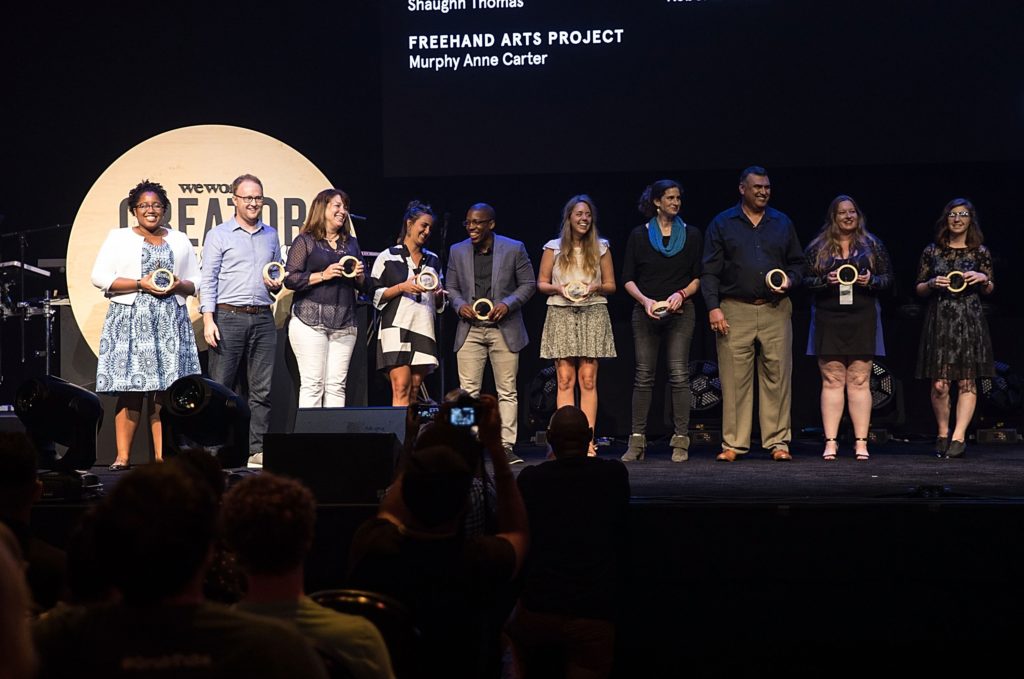
AUSTIN, TX – JUNE 27: WeWork Creator Awards Austin at ACL Live at The Moody Theater on June 27, 2017 in Austin, Texas. (Photo by Rick Kern/Getty Images for WeWork)

In the first ever Austin WeWork Creator Awards, seven Austin entrepreneurs won $845,000 in financial grants and now head to New York City fo the final event.

The biggest winner, GrubTubs, took home $360,000 in the scale category, the top prize at the event held at Austin City Limits Live at Moody Theater Tuesday night.

Other winners included re:3D Inc., CatSpring Yaupon, Kwaddle, Freehand Arts Project, Rancho Alegre Radio and Successful Smiles of Texas. In all, 34 finalists pitched before a live audience.

Winners from the scale and launch category will compete for additional financial grants at the global finals at Barclays Center in New York City on November 30.

SCALE: Businesses/nonprofits with proven success, ready for next level

Robert Olivier, GRUBTUBS – $360,000
Samantha Snabes, re:3D INC – $180,000
Abianna Falla, CATSPRING YAUPON – $180,000

LAUNCH: Businesses/nonprofits launched and still learning

Deven Hariyani, KWADDLE – $72,000

INCUBATE: Ideas/projects that need funding

Murphy Anne Carter, FREEHAND ARTS PROJECT – $18,000
Piper LeMoine, RANCHO ALEGRE RADIO – $18,000
Roberto Rivera, SUCCESSFUL SMILES OF TEXAS – $18,000

Austin-based Mood Media Completes Deal to Become a Private Company

Austin-based Mood Media Corp. announced Wednesday its acquisition by several investors including Apollo Global Management and GSO Capital Partners.

Mood Media, the parent company of Muzak, is now privately-held and its stock will no longer trade on the Toronto Stock Exchange. The investors paid 17 cents per share Canadian for Mood Media’s stock. The deal allows Mood Media to refinance its existing $650 million debt. The company paid for Chapter 15 bankruptcy protection in federal court last May, according to a Wall Street Journal story.

“The completion of this transaction will improve Mood Media’s financial position and allow us to further bring to life our long-term growth and market leadership initiatives and invest in new, strategic opportunities that strengthen our business,” Steve Richards, President and Chief Executive Officer of Mood Media said in a news release. “We look forward to working with Apollo, GSO and partners to further strengthen Mood’s position as the global leader in delivering Customer Experience solutions. This is an exciting next chapter for the Company, our clients and our partners.”

Mood Media has more than 500,000 client locations worldwide. The company provides sight, sound, scent and social mobile technology systems for restaurants, hotels, banks, retailers and small businesses.

AT&T Launches Second Trial of its Ultra-Fast 5G Network in Austin

AT&T on Tuesday announced the second trial of its ultra-fast 5G network throughout more locations in Austin.

Last year, the Dallas-based company completed the industry’s first wireless 5G business customer trial in Austin.

The company’s second trial delivers “an ultra-fast internet connection to residential, small business and enterprise customers using Ericsson’s 5G RAN and the Intel 5G Mobile Trial Platform,” according to a news release. “The trial participants can stream premium live TV via DIRECTV NOW and experience faster broadband services—all over a fixed wireless 5G signal. The trial benefits from the resources and capabilities of our 5G testbeds in Austin.”

AT&T expects the trial will deliver speeds up to 1 gigabit per second. It tested the technology earlier this year by delivering DIRECTV NOW using mmWave technology at our Middletown, New Jersey lab. It was the first time DIRECTV NOW had been delivered over a 5G connection.

AT&T plans to roll out its 5G wireless service to more customers later next year.

“The technology behind 5G is important. But it’s also about advancing social trends like mobile video streaming,” Marachel Knight, senior vice president, Wireless Network Architecture and Design, AT&T, said in a news release. “In Austin, we’re testing DIRECTV NOW over ultra-fast Internet speeds at a variety of locations. The network of the future will help redefine what connectivity means to both consumers and businesses. This trial helps show that the new reality is coming fast.”

AT&T has seen tremendous growth in data traffic on its mobile network and video now makes up over half of it. Video traffic on its smartphones grew more than 75 percent last year.

Artificial Intelligence Startup SparkCognition Closes on $32.5 Million

Austin-based SparkCognition, a startup focused on artificial intelligence, announced Monday that it has closed on $32.5 million in funding.

Verizon Ventures led the Series B funding round with participating from The Boeing Company, through its Boeing HorizonX unit.

“SparkCognition has pioneered the use of artificial intelligence to bring unparalleled advancements to many of the world’s Fortune 1000 companies,” Vijay Doradla, Director at Verizon Ventures, said in a news release. “We are thrilled to invest in SparkCognition again, and look forward to supporting the company as it continues to transform markets and the businesses of tomorrow.”

SparkCognition has created a data-driven analytics platform for Internet of Things applications with customers in energy, oil and gas, manufacturing, finance, aerospace, defense, telecommunications, and security. SparkCognition plans to use the funds to support its rapid expansion.

“Having industry stalwarts, Verizon and Boeing, support our existing investors in funding this new round of growth serves as tremendous validation of our technology and track record. There is massive demand for our category-leading AI solutions,” Amir Husain, Founder and CEO of SparkCognition said in a news release. “The world is well on its way to an AI-powered revolution – where cognitive systems will truly augment human capabilities, but at machine speed and big data scale. Our real world deployments and on the ground successes speak to the broad applicability of SparkCognition’s AI technology, and the tremendous promise of AI in general.”

Founded in 2013, SparkCognition has raised $48.5 million to date. The company previously raised more than $16 million from investors such as Michael Dell’s private equity arm, MSD Capital, The Entrepreneur’s Fund, Alameda Ventures, Verizon Ventures, CME Ventures, and Brevan Howard. Several existing investors also participated in this round.

HomeAway to Expand to a new 16-Story Office Tower in The Domain

Austin-based HomeAway announced it has signed a lease to occupy a new 16 story office tower in The Domain in the first quarter of 2019.

The vacation rentals company reports the new 315,000 square foot location will be able to accommodate more than 2,000 employees.

“As a global company headquartered in Austin and as the largest and fastest growing consumer tech company based in our hometown, we are well poised to attract the very best talent,” John Kim, HomeAway president, said in a news release. “We’re already hiring at a rapid rate across all disciplines worldwide, and our new offices will help us continue to grow, especially as we look for talented designers, engineers and data scientists.”

The new office building, located at the intersection of Domain Drive and Alterra Parkway, will house HomeAway’s growing product and design, engineering and information technology teams.

“Austin employees are critical to our global growth and success,” Kim said. “Our transition from a sales-driven advertising platform to a tech-driven e-commerce business is already paying off, as our owners and property managers generated $2.7 billion in gross bookings during the first quarter of 2017, nearly 50 percent more vacation rental gross bookings compared to the same time last year.”

HomeAway currently has various office locations in Austin including downtown, North Austin and South Austin. While the additional office at The Domain will allow for consolidation to a more centralized corporate campus, the company also plans to maintain its presence in downtown and in South Austin.

11 Austin Individuals, Companies and Nonprofit Organizations Chosen to Compete at WeWork’s Creator Awards

This week, WeWork announced 11 Austin companies have been selected as finalists for The Creator Awards South Regional Final, which will be held next week at ACL Line.

WeWork selected the finalists from more than 2,000 applications from all across the south. The event is Tuesday, June 27 at ACL Live at The Moody Theater, 310 W Willie Nelson Blvd. It kicks off at 4 p.m. Register and RSVP here.

The finalists will present their idea to compete for financial awards, ranging from $18,000 to $360,000.

“There aren’t too many awards out there for companies like ours,” Abianne Falla, cofounder CatSpring Yaupon, said in a news release. “We’re not a new startup. We haven’t created an app. We’re people who want to makes things better for our community.”

Falla’s company makes tea from yaupon. WeWork’s Creator Awards will give out $1.5 million to “recognize and reward creators.”

WeWork has held other events throughout North America, Europe, and the Middle East. Winners from each event will come together for the global finals, to be held at Barclays Center in New York City on November 30.

The Other Austin Finalists Include:

Incubate: Individuals with an idea or a project that needs funding ($18K – $36K)
Freehand Arts Project
Rancho Alegre Radio
Successful Smiles of Texas

Launch: Businesses or nonprofits that have launched but are still learning ($72K – $180K)
Weird Homes Tour
Kwaddle
Fusebox Festival

Scale: Proven record of success and are ready for the next level (Awards: $180K – $360K)
Maggie Louise Confections
Re: 3D inc
Brian Chase Productions
Grub Tubs
CatSpring Yaupon

Medici’s Founder Clinton Phillips Talks About Disrupting the Healthcare Industry on Ideas to Invoices

Clinton Phillips, founder of Medici, courtesy photo.

A Native of South Africa, Clinton Phillips, a serial entrepreneur, recently founded Medici, a HIPAA-complaint telemedicine app, in Austin and raised more than $24 million in venture capital funding.

Previously, Phillips founded and ran Aspen-based Aspen Back & Body, physical rehab clinic, that he sold to Laser Spine Institute. And Phillips founded another medical advice company called 2nd.MD in 2011 in Houston.

Phillips, a former chiropractor, sports therapist, and rugby player, started Medici because he saw a need to provide more efficient healthcare. He recently discussed his vision for the company in the Ideas to Invoices Podcast.

“Healthcare is such an inefficient, difficult and frustrating industry, there are few industries left that can really be disrupted in such a meaningful way that would help so many people, and Medici was the opportunity to restore care and efficiency for doctors so they would be able to enjoy their times with patients again and be able to able have a level of ease around their workforce that has really disappeared over the last 50 years,” Phillips said.

Medici is a healthcare business platform for doctors that allows them to be able to consult via phone, video or text all within the Medici app in compliance with healthcare laws. It also allows them to bill directly from the app.

“It’s an opportunity for physicians to rethink how they practice,” Phillips said.

For patients, it’s really the ability to text with your doctor, your dentist, you veterinarian and your therapist. Bringing all your medical providers into one place. Making healthcare vastly less expensive and more efficient.

The app is largely being adopted by referrals through doctors, healthcare providers and through word of mouth from consumers from one to another.

Medici is really trying to recreate the doctor and patient relationship, Phillips said.

Over the last six years, Phillips built 2nd.MD in Houston, which is an employer benefit app that allows companies to provide it to their workers.

Up until recently, there wasn’t a way for the doctor to get paid for consulting through text, phone calls, and video chats. It’s been a huge source of frustration for the doctors. Now, by providing a payment mechanism, there is a huge opportunity for doctors to get reimbursed and states have passed laws allows doctors to get reimburses for virtual visits, Phillips said.

“Part of it has been technology, part of it has been policy,” he said.

The Medici app is also providing more flexibility for doctors to work from home and to work non-traditional hours. The goal is for the doctors to feel empowered and not overwhelmed, Phillips said.

Phillips loves Texas and thinks it’s an incredible state to do business. He likes the talent in Austin and the startup community.

Medici has raised $24 million in funding to hire key employees and further develop and market its app.

The startup, based at WeWork on Congress, has more than 30 employees including 20 in Austin, five employees in an office in Paris, one person in Chicago, a few people in Houston and six employees in and office in South Africa.

Medici launched in the U.S. a few months ago and it recently launched in South Africa and it has been widely received and done well there, Phillips said.

The biggest challenge in scaling Medici is focusing on the right markets, Phillips said. It’s important not to try to do too many things at once, he said.

Phillips is also an athlete. He is a former rugby player and is competing in the USA National Track and Field Masters Outdoor Championship next month in Baton Rouge, Louisiana. He is training to do the pentathlon, the 200-meter run, the 1,500-meter run, the long jump, javelin, and discus.

For more on Phillips’ vision for Medici, listen to the full podcast.

« Older posts Newer posts »

© 2026 SiliconHills

Theme by Anders NorenUp ↑