Page 105 of 352

Chris Burney with the San Antonio Angel Network Discusses Angel Investing on Ideas to Invoices

By LAURA LOREK
Publisher of Silicon Hills News

Chris Burney, Executive Director of the San Antonio Angel Network, courtesy photo.

San Antonio has always had angel investors but it hasn’t had a formal network for a while, but a year ago that changed with the formation of the San Antonio Angel Network.

“A group of local investors, visionaries, entrepreneurs got together and hatched the idea that San Antonio really needed an angel network to help with all the growth we are experiencing in our startup ecosystem and beyond,” said Chris Burney, executive director of the San Antonio Angel Network.

Previously, Burney worked as a manager and senior financial analyst for Rackspace, the San Antonio-based Web hosting company.

As the head of the San Antonio Angel Network, Burney evaluates deals, recruits new members and runs the organization, which is based in the RealCo Seed Fund Program offices at Geekdom in downtown San Antonio.

On this episode of Ideas to Invoices, Burney discusses angel investing in San Antonio and the details of the deals the San Antonio Angel Network looks for when evaluating a startup.

The San Antonio Angel Network’s 75 members consist of accredited investors or wealthy individuals, ranging from large family offices, successful entrepreneurs, business owners, doctors, accountants, and lawyers.

“The diversity of our network is one of its strengths,” Burney said.

The San Antonio Angel Network, a nonprofit organization, is still accepting members but plans to cap membership at 100. Individual members pay $1,800 and corporate members pay $2,500 a year.

“Those dues just really help us be sustainable,” he said.

The San Antonio Angel Network uses a pooled investment vehicle that allows angels to invest a smaller amount in lots of deals, Burney said. That allows them to write checks in a startup for as low as $5,000, he said.

“Angel deals are inherently risky even with the best due diligence and best entrepreneurs,” he said. “We expect a high rate of failure. But we also expect a high rate of return for our investors.”

Every six to eight weeks, the San Antonio Angel Network hosts pitch events with two or three startups pitching to investors. Entrepreneurs can apply directly on the San Antonio Angel Network website. It reviews applications on a rolling basis and it doesn’t require a fee to apply, Burnet said.

“We have no geographic limitations on the companies we will fund, or invest in,” Burnet said.

The San Antonio Angel Network has invested in three San Antonio startups and one in Austin so far. Its first deal was in HelpSocial, a social media software systems startup spun out of Rackspace and founded by Matt Wilbanks. The second investment was in Parlevel Systems, which is inventing new vending machine technology, and the third one was Dauber, a dump truck logistics, and technology company. And its Austin investment is Localeur, based in Austin, which is an app that provides recommendations from locals headed up by Joah Spearman.

“Almost every major city with a thriving startup ecosystem in the state has an angel network helping support the entrepreneurs,” Burney said. “San Antonio did not have that until we came around. We know for a fact that we were missing deals and that companies were either not getting funding or moving elsewhere because of the lack of investment resources here.”

The San Antonio Angel Network is part of the Alliance of Texas Angel Networks, comprised of 13 angel groups across Texas. Last May at the Hotel Emma at the Pearl, the San Antonio Angel Network hosted the annual summit of the Alliance of Texas Angel Networks with more than 100 investors from all the groups to discuss best practices and angel investing across the state.

The San Antonio Angel Network tries to be a very friendly entrepreneurial network, Burney said. It tries to get the application and due diligence process down to weeks, instead of months and to get the entrepreneurs that meet its criteria in front of its investors as quickly as possible, he said.

The San Antonio Angel Network will look at any deal with a scalable business model that will provide a good return to its investors, Burney said.

For more on the San Antonio Angel Network, listen to the entire podcast and please subscribe, rate and review Ideas to Invoices on iTunes. And support the podcast on Patreon for exclusive content only available to subscribers.

Michael and Susan Dell Pledge $36 Million to Help Rebuild Texas Following Hurricane Harvey

Michael and Susan Dell, courtesy photo.

Michael Dell, chairman, and CEO of Dell Technologies announced in a post on Facebook Friday plans to donate $36 million to a fund to Rebuild Texas.

“We must rebuild the Texas communities devastated by Hurricane Harvey together,” Dell wrote.

On Friday, Michael and Susan Dell launched the Rebuild Texas Fund with Gov. Greg Abbott and the Michael & Susan Dell Foundation. He has pledged to match $1 for every $2 in donations until midnight on Sept. 4th.

“We are in it for the long-haul: our goal is to raise over $100 million for the recovery and rebuilding of our communities in the years to come,” Dell wrote. “Please join us by donating at www.rebuildtx.org or by texting “RebuildTX” to 91999. And please spread the word – every dollar matters!”

Dell grew up on Grape Street in the Meyerland neighborhood in Houston, which suffered extensive damage from more than 50 inches of rain hitting the city during Hurricane Harvey. On Facebook, Dell posted a picture of the flood waters that have submerged houses in his old neighborhood.

In addition to the Facebook post, Texas Gov. Greg Abbott and Michael and Susan Dell announced the RebuildTX fund on Good Morning America on Friday.

“This is our home. And we know that it will take all of us working together, over the long term, to rebuild our Texas communities,” Dell said in a statement. “The Rebuild Texas Fund will be a partnership among rally companies, community leaders and individuals to work alongside state and federal officials to provide an additional source of funding and ideas for recovery and rebuilding.”

The New York Times in an article reports the Dell Foundation donation is the largest single donation to the recovery efforts following Hurricane Harvey in Texas.

The Michael & Susan Dell Foundation is working with the OneStar Foundation, was created to support the State of Texas by strengthening the nonprofit sector, on the Rebuild Texas Fund.

Since its founding in 1999, the Michael & Susan Dell Foundation has committed more than $1.32 billion to global children’s issues and community initiatives to date. The Dell family also donated $50 million to the University of Texas at Austin to create the Dell Medical School. (Read more about the Foundation and its work in this story from Silicon Hills News from the 2014 Dell Women’s Entrepreneur Network conference in Austin.)

Peachtree Software Founder and Serial Entrepreneur Ben Dyer on Ideas to Invoices

Ben Dyer, courtesy photo.

By LAURA LOREK
Publisher of Silicon Hills News

Embrace the big idea and do a big fat startup, Ben Dyer, successful entrepreneur and mentor, advises new entrepreneurs.

In the last six and a half years, Dyer has seen at least 10,000 startup plans since he’s been in Austin. The free beer app is not a worthwhile pursuit, he said.

“It’s just as easy to work on a consequential idea as it is to work on a free beer idea,” Dyer said. “At the end of the day, you feel like you accomplished a lot of good for some people out there that are your customers.”

To new entrepreneurs, Dyer advises them to really start out working on something worthwhile and work with people they enjoy working with and being around. Dyer is featured in this episode of the Ideas to Invoices podcast recounting his experiences as a pioneer in the computer and software industry. And a big fat startup is flush with cash and plans to spend it to scale its business. Dyer prefers it to a Lean Startup.

And Dyer has a lot of experience starting and scaling tech start-ups.

In the 1970s, Dyer got introduced to four electrical engineers from Georgia Tech who had opened a computer store, Computer Systems Center, in downtown Atlanta, the third computer store in the country. They were selling the Altair 8800, a Microcomputer designed in 1974 by MITS and Ed Roberts, based in Albuquerque, New Mexico.

“They needed someone like me,” Dyer said. “None of them had any business experience at all.”

Dyer graduated from Georgia Tech with a BIE degree and went on to earn his MBA in finance from Georgia State University.

“I joined them and just had a blast inventing an industry there,” he said. “I got to deal with what I call the pioneering customers who made our industry possible.”

But it became evident that people needed something to do with the computers and that’s when the software division came into being.

“It moved from a hobbyist market to a real business opportunity,” Dyer said.

In 1978, some people in the company wanted to open more computer stores and some wanted to work on software development. So, on Labor Day, they met with lawyers and divided everything up and Dyer joined the software business as president and founder.

The name Peachtree came from an expensive PR person who came to the offices of the software business located on Peachtree Street and told them to name the company, Peachtree Software, Dyer said. There are a couple dozen Peachtree Streets in Atlanta.

“Outside of Atlanta it was a really good brand name,” Dyer said.

In the early days, Peachtree Software had one competitor and they happened to be based in Austin, BPI, Dyer said.

Peachtree Software had a very rapid rise, Dyer said. In those days, Dyer sold the software to a couple dozen computer manufacturers lined up on Ventura Blvd. in the San Fernando Valley in Southern California. They would package the software to sell with the computers. Peachtree had licensed its software to Vector Graphic, which IBM chose to reverse engineer to make the IBM PC.

At the COMDEX Computer Expo in Las Vegas in 1980, Dyer met with IBM executives and they wanted to license Peachtree Software for the new IBM PC.
Shortly after COMDEX, Dyer was in Boca Raton, Florida where a “skunk works” team inside IBM created the IBM PC. It was called the KGB project and it was under special key codes and Dyer didn’t have access to the room where the hardware was kept, he said.

Shortly before the debut of the IBM PC in August of 1981, Management Science America, based in Atlanta, heard that Peachtree Software was to be included in the launch of the IBM PC and they bought the company.

After selling Peachtree Software, Dyer founded Comsell, an early computer imaging, and interactive media company. It was a great technology for computer aided selling of real estate.

An executive from Rupert Murdoch’s News Corp. approached Dyer at a trade show and told him he had exactly what he needed.

And Dyer said, “Yes I do.”

He had no idea what the guy needed but yes was the right answer, Dyer said.

Turns out Murdoch’s News Corp. wanted the technology to sell travel services to consumers. They bought the company in 1987.

“I called them the Murdochians,” Dyer said. “My employees and I traveled the world with them.”

After the Comsell acquisition, Dyer took a “low tech” sabbatical and became the president of a bank in Georgia.

His next major venture after that was going back to digital media and the CD-ROM. He created a company called Intellimedia that developed sports education and training products using CD-ROMs to display images and videos. The company worked with Cox Media Group, based in Atlanta.

“We had a good run with that until 1995 when AOL caught on,” he said.

The last part of the 1990s the company did a lot of Internet development work. Dyer got involved in venture funding in the next decade and then did a little investment banking.

Dyer came to Austin in 1998 with his oldest child. His son enrolled at the University of Texas at Austin in the fall of 1999. And Dyer’s daughter also attended UT seven years later. His daughter graduated in 2010. Dyer decided to move to Austin in 2011.

He worked as an entrepreneur in residence at UT with Longhorn Startups and he chaired a committee for the South by Southwest accelerator. He also served as a mentor to dozens of companies.

He’s still on two Georgia Tech boards and he goes back and forth a lot. In 2014, he got involved in a life sciences startup based in Atlanta. He spent two years working on that project.

Today, Dyer serves as an advisor to Polygraph Media, a Facebook advertising and marketing partner with Facebook, founded by Chris Treadaway. He is also an Entrepreneurial Advisor at the Cockrell School of Engineering at UT.

“I actually prepped myself for this assignment by binge watching Mad Men,” Dyer said. Something comes up almost every day where he can relate today’s advertising agencies and industry with the fictional one depicted in Mad Men, he said.

Dyer also writes TechDrawl, a tech, and business blog for the past 12 years, based on his experiences. He is currently working on a new book called Startup Decision Making based on his experiences.

Listen to the full podcast and please subscribe, rate and review Ideas to Invoices on iTunes.

Bunker Labs and Irreverent Warriors in Austin and Other Veterans Mobilize to Rescue People Following Hurricane Harvey

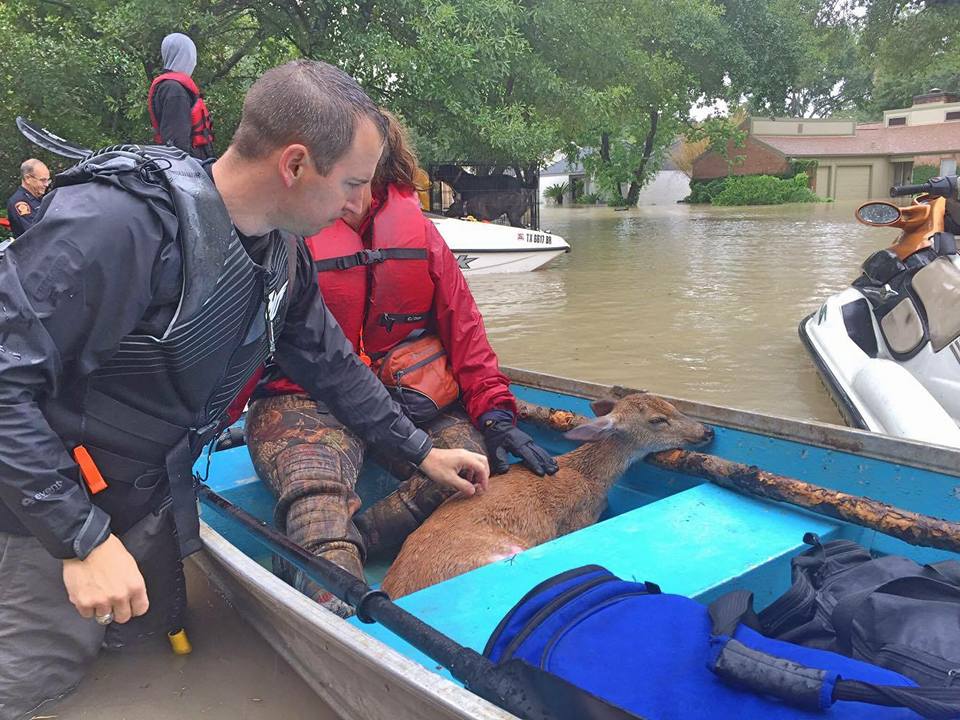
Johnathan Paul Wojtewicz with Bunker Labs helping rescue a deer from the storm, photo taken by John Litton, his brother-in-law and Army veteran.

On Monday morning following the landfall of Hurricane Harvey, Johnathan Wojtewicz headed to Houston in his truck towing a Jet Ski equipped with a boat deck capable of rescuing nine to ten people and animals.

But on the way to Houston, he ended up rescuing about 40 people stranded in their vehicles along the highway and working with the Pattison Volunteer Fire Department on the outskirts of Houston.

Later, Johnathan made it to Katy, a Houston suburb, where he connected with the Westlake Volunteer Fire Department, was issued a radio communications device and launched his boat to began rescuing individuals, families, and pets from the rising flood waters. Meanwhile, his wife, Sabrina worked radio dispatch from Austin using the Zello Walkie Talkie app and told him where to go to help people. They did all this as volunteers.

Hurricane Harvey is one of the most destructive natural events to hit Texas in its history.

Harvey dumped more than 50 inches of rain in areas of Houston leaving individuals and families stranded. That prompted businesses and individuals in the Austin, San Antonio, Dallas-Fort Worth and other communities to mobilize and provide support.

Johnathan Paul Wojtewicz with Bunker Labs high fiving a rescued boy in the aftermath of Hurrican Harvey, photo taken by John Litton, his brother-in-law and Army veteran.

Chief among them is Johnathan, a Marine veteran, and Sabrina Wojtewicz, co-founders of Bunker Labs Austin, a nonprofit organization in Austin that provides help to veteran entrepreneurs. They are working closely with Samantha Brown, Chief Operating Officer of Irreverent Warriors, a veteran suicide prevention group based in Austin. They created the Austin to Houston Relief Efforts group on Facebook and coordinated volunteer efforts to rescue people from flood waters and save lives following the storm.

Johnathan slept in his truck for the first two days of the rescue mission. He’s still down in Houston rescuing people and plans to be there until he thinks everyone is safe, Sabrina said.

Meanwhile, Sabrina worked with Samantha to collect supplies and donations to take to Houston. Bunker Labs Austin, which is based at Capital Factory, a coworking and technology accelerator downtown, held a meeting to let volunteers know what they needed. Then they filled a massive M923 five ton decommissioned military truck, owned by Bob Leonard in the Lakeway Area. The truck collected donations in the parking lot of the Lakeway Christian Church.

“It was filled to max capacity,” Sabrina said.

The truck left Wednesday and delivered more than 240 cases of water, 500 pounds of food and all kinds of household items like blankets, towels and more to 2500 Central Parkway, a private business that donated space for a makeshift relief center and is now a center of operations for more than 200 prior-military service individuals donating their time, talent and resources. Now the truck, driven by Bob and his son, Robert Leonard, is delivering food to those who have opted not to leave their homes, Sabrina said.

On Wednesday, the volunteers began to run low on fuel. That’s when Justin Gilfus, founder of Ads For the Road, and a veteran, got a second truck and a 55-gallon drum of diesel fuel and took it to VFW Post 8787 to offload their collections before hightailing it to Houston to help rescue boats and trucks refill their tanks, Sabrina said.

More than 30 members of the Irreverent Warriors are on the ground in Houston with boats also and are assisting in the rescue and relief effort, Brown said.

“They are still going on multiple rescue missions,” she said. They are heading further South to the hard-hit Beaumont and Port Arthur region today.

And Brown’s brother, also a Marine, has coordinated a donation drive in the St. Louis area where he lives and is heading down on Saturday with three trailers filled with gas, clothing, cleaning supplies, chainsaws, clean sheets and more for those in need in the Houston area.

The group has also coordinated relief efforts for other parts of Texas hit hard by the storm.

“…our good friends have already made one private jet trip and landing in Rockport with generators, fuel, and much needed debris-clearing assistance!” Sabrina posted to Facebook. “ANYONE needing IN or OUT of Rockport can contact us and we can put them in touch.”

Lots of military veterans have come together during this catastrophe to save lives and provide relief to those affected by the hurricane in the Houston area, Sabrina said.

Dan Alarik, founder, and CEO of Gruntstyle.com, an Army veteran who makes clothing and gear with military and patriotic themes, drove from San Antonio to help out. His company is selling T-shirts to help those affected by the storm. His teams are running another Facebook group, HoustonRescue, with 170 members made up of “business owners, military members, and Patriots to assist with the efforts to rescue the members of Houston Texas during Hurricane Harvey.”

Brown wants everyone to know this is a long term effort and people still need help.

“Donations of clothing and water will run out,” she said. “FEMA is not a solution. FEMA is a starting-point.”

In the coming weeks, she will work with volunteer groups in work groups to clean up and repair homes. She directs people who want to help out with donations of money to the Red Cross and Team Rubicon, a veteran-led organization focused on community give-back service and programs.

As for Sabrina and Johnathan, they celebrated their 13th wedding anniversary on Tuesday. Johnathan texted Sabrina. The celebration will have to wait, she said.

“Helping others in need is our major focus right now,” she said.

Texas Guadaloop and 512 Hyperloop Compete this Weekend at SpaceX Hyperloop Competition II

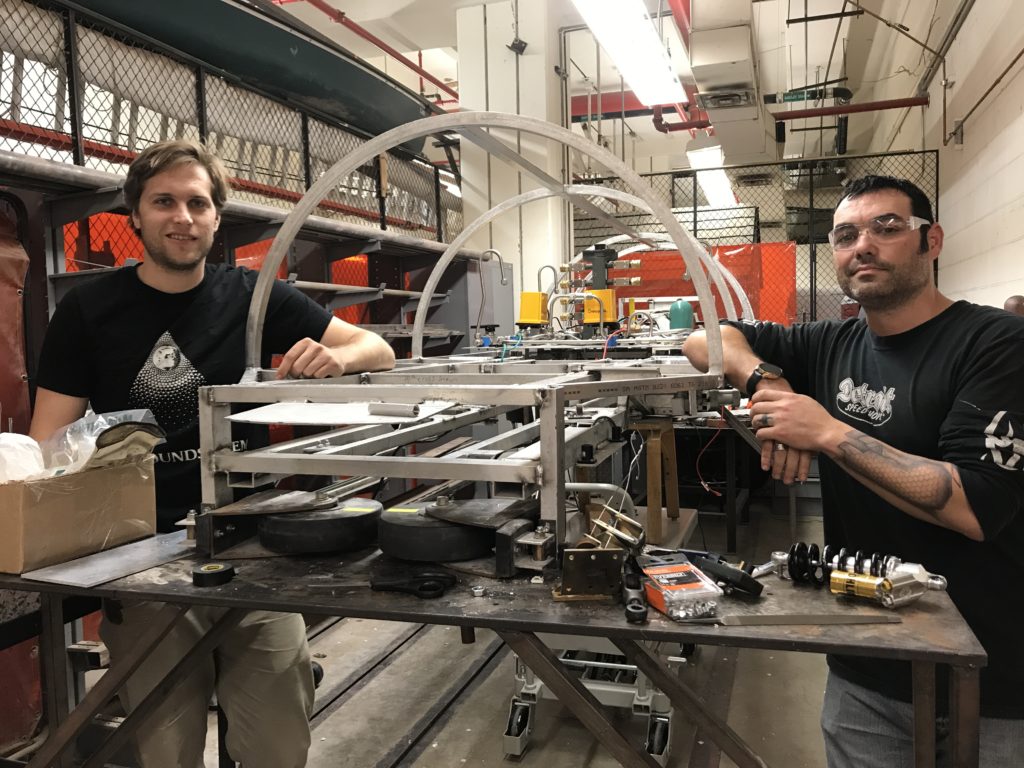
James McGinness, team lead for Texas Guadaloop with Chad Kassem, build lead. with the frame of the Guadaloop pod.

Earlier this month, in the basement of the Ernest Cockrell Jr. Hall at the University of Texas at Austin campus, James McGinness worked with his team to put the final touches on a transportation pod for Texas Guadaloop.

McGinness, team lead for Texas Guadaloop, graduated with his Masters in Mechanical Engineering from UT in May but has spent his summer along with Chad Kassem, the build lead, and other members of the 20-person team working on the pod.

Texas Guadaloop is one of two teams from UT Austin competing in SpaceX’s Hyperloop Pod Competition II. The other team is 512 Hyperloop. The teams have not collaborated, McGinness said.

Altogether, 24 teams comprised of more than 600 students from colleges and universities worldwide will compete this weekend.

The UT teams don’t get class credit for their creations. They are not paid. But they have raised some money along the way to get their creation from the basement to the track at SpaceX’s headquarters in Hawthorne, Calif. this weekend. The road to Hawthorne has been a long and windy one for Texas Guadaloop.

“When we started this, I hadn’t even started at UT yet,” McGinness said.

The hyperloop idea goes back to a paper Elon Musk, founder of SpaceX and Tesla, wrote in 2013 that came up with the idea for the high-speed ground transport in pods. In 2015, SpaceX announced plans to host a competition for teams to design and build a half-scale Hyperloop Pod.

In January 2016, Texas Guadaloop presented its design to SpaceX but it wasn’t selected to compete, McGinness said. Teams selected presented their pods at the first SpaceX Hyperloop competition in January of 2017. SpaceX liked the results so much they put on the second competition for this summer. And Guadaloop was selected to compete in the second hyperloop competition.

On Friday, the teams began testing their pods with a series of inspections for fitness and safety.

Texas Guadaloop’s pod weighs 1,200 pounds and is 14 feet long and more than three feet wide. It is one of the larger, and heavier pods said Kassem, who used to build race cars.

On Saturday, those cleared for competition “will compete with one criterion: maximum speed,” on a one-mile track with successful deceleration (which means no crashes), according to SpaceX.

Speeds on the track could exceed 200 miles per hour, McGinness said. But the Guadaloop pod team will be happy to crack the 100 miles per hour milestone, he said.

“If we hit 100 miles per hour on air bearings, no one has ever done that before so that’s kind of what our goal is,” he said. “That would at least prove the fundamentals that there is something there to the idea.”

Air bearings are pressured air that levitate the pod, McGinness said. Most teams are using magnetic levitation, which has been around. There’s even a couple of teams using wheels on their pods, McGinness said. Out of the 24 teams, less than five are using air bearings, he said. The 512 Hyperloop team is using magnetic levitation.

“We would love to win, that’s obviously a goal, especially winning on air bearings, but we really want to get on the track and show this idea works,” McGinness said.

The Texas Guadaloop team didn’t outsource any labor, they did it all in-house, McGinness said. They did all the welding and machined everything in-house, he said.

“This has felt like my full-time job for two years,” McGinness said.

Emma Takes Email Roadshow to Austin

Karen Gragg, vice president of marketing at Emma, and Christina Brady, Emma Field Marketing Manager at Impact Hub Austin.

Email is still the backbone of an effective marketing campaign, said Karen Gragg, vice president of marketing at Emma.

Marketers report email generates the most return on investment with a 47 percent return, compared to the next highest platform, social media, with a 19 percent return, according to Gragg.

Emma held an event Thursday afternoon at Impact Hub in downtown Austin to kick off its first roadshow focused on “Winning the Email Inbox.”

Austin is the first city the Nashville-based Emma visited on its roadshow. It’s also travelling to Denver, Chicago and Boston.

Emma, founded in 2002 and privately held, has more than 15,000 direct customers and reaches an overall 50,000 customers through its partnerships with marketing agencies. It targets a high-end small to medium sized business market.

And Emma, which has a smiling female face in its logo, stands for email marketing. Its founder, Clint Smith, bootstrapped the company to $20 million in revenue and recently took on $5 million in investment from Nashville Capital Network and Square 1 Bank, according to an article in Forbes.

Emma differentiates itself from competitors like Mailchimp and Constant Contact by providing a lot of customer service and personalized help, Gragg said.

“Our customers can pick up the phone and talk to someone and get help with a campaign,” Gragg said.

And Emma’s email marketing technology was not built for a technologist but for a marketer, Gragg said. So, it is easy to use, she said.

Last year, people sent more than six billion email campaigns using the Emma platform, Gragg said.

In the Austin area, Emma’s customers include Tito’s Handmade Vodka, The Daily Dot, Texas A&M and Rodeo Austin, among many others. About 50 people turned out for the roadshow event to hear presentations from Emma and its partners including Sparkfly, Torchlight, and Reviewtrackers.

At the event, Gragg and Jamie Bradley from Emma provided tips on creating an effective email strategy. Emma’s number tip is to spend time on a thoughtful design that appeals to the audience a company is trying to reach. It’s also important to use a template that is optimized for mobile devices. Half of all email is opened on a mobile device, according to Emma. It recommends a one column design that highlights just ten items, not 70 things.

Emma also recommends people use a call to action button – instead of a highlighted link, Bradley said. The optimal size is 32 pixels by 32 pixels, she said.

Making simple design changes in an email campaign to make it easier to read and act can result in a double-digit increase in engagement, Bradley said.

Emma also recommends people automate when possible. Companies can increase engagement with their customers simply by sending an automated welcome email.

“There’s so much room for improvement when it comes to email marketing,” Gragg said. “When you do it really well that’s when you see the value and the increase in business.”

Apple’s CEO Tim Cook Visits Austin and Announces New Training Program with Austin Community College

Tim Cook, Apple CEO, courtesy photo

At Capital Factory Friday morning, Apple CEO Tim Cook announced a new partnership with the Austin Community College District to offer its App Development with Swift curriculum to students.

The program, which Apple is rolling out at more than 30 community colleges nationwide, allows students to learn app development skills that will prepare them for careers in the technology industry.

“The Austin Community College District, one of the nation’s largest higher learning institutions, will begin offering the course to its 74,000 students this fall,” according to a news release.

Apple created the year long development program to teach students how to build apps using Swift, an open source programming language. The course is designed for students with no programming experience and it teaches them to build fully-functional apps of their own design.

“We’ve seen firsthand how Apple’s app ecosystem has transformed the global economy, creating entire new industries and supporting millions of jobs,” Tim Cook, Apple’s CEO, said in a news release. “We believe passionately that same opportunity should be extended to everyone, and community colleges have a powerful reach into communities where education becomes the great equalizer.”

The Austin Community College District serves students through 11 campuses in eight counties. Austin currently has more than 7,000 job openings in various tech fields and local leaders have been looking for ways to fill those jobs by providing needed skills to the local workforce.

“We’re thrilled to have Apple join our mission to make Austin more affordable for people who already live in the city,” Austin Mayor Steve Adler said in a news release. “Apple is going to be a force multiplier in the community’s ongoing efforts to lift 10,000 out of poverty and into good jobs over the next five years.”

Apple has a large seven building campus in Austin with more than 6,000 employees, according to the Austin Chamber of Commerce. Apple’s Austin operations focus on chip engineering, technology, administration and customer support. And the nearby Flextronics Factory assembles the Apple Mac Pro.

Capital Factory’s Women in Tech Summit Examined Ways to Improve Austin’s Tech Industry

The first panel discussion at Capital Factory’s Women in Tech Summit featuring Mellie Price, director of innovation at Dell, Karen Quintos, Chief Customer Officer at Dell, Tina Weyand, Chief Product Officer at HomeAway and Blake Garrett, Founder and CEO of Aceable.

By LAURA LOREK
Publisher of Silicon Hills News

The technology industry has a problem.

Its workforce isn’t diverse enough. That means not enough women and not enough people of color, but it also means not enough people of varying ages, faith, sexual orientation, disabled, military veterans and other differentiators.

Why is that important? Because studies have shown that not only do diverse workplaces make people happier, but they also provide greater financial results for companies.

On Wednesday, more than 500 people RSVPed to attend Capital Factory’s Women in Tech Summit, which featured a series of panel discussions and talks about the lack of a diversity in Austin’s technology industry, a lack of funding and some of the unique problems women face when launching a venture.

It also included some attempts to address the problem by signing the Walker Rule, a diversity pledge to interview at least one female candidate or person of color for a top executive position at an Austin technology company or venture capital firm. The pledge is named after Sarah Breedlove, known as Madam C.J. Walker, who was an African American entrepreneur who became a self-made millionaire. Stephen Straus, a co-founder of Austin Ventures, came up with the Walker Rule to address Austin’s diversity problem.

Another solution put forth by Dr. Colette Burnette, president of Huston-Tillotson University, is that companies need to be intentional about looking for diverse candidates to fill their positions. It’s a cop out to say that they don’t exist, she said. Huston-Tillotson, a private historically black university, graduates hundreds of students every year looking for jobs in the technology industry, she said.

Mellie Price, a successful female entrepreneur, Capital Factory mentor and now executive director of technology innovation at the Dell Medical School, also suggested unconscious bias training for people in the tech industry. Harvard provides free unconscious bias tests through Project Implicit, an online site. Other companies specialize in training employees to identify and deal with their unconscious bias in the workplace.

In the first panel discussion, moderated by Price, the conversation focused on what established companies like HomeAway and Dell are doing to foster diversity as well as a startup, Aceable, which started out at Capital Factory.

Diversity must be integrated into an organization and can’t be kept on an island, said Karen Quintos, executive vice president and Chief Customer Officer at Dell.

Dell has a team of 12 people that run diversity for Dell for 140,000 employees, she said.

The conversations that are happening now are more optimistic than ever because more men are joining the conversation, Quintos said.

“Listen, you’re not going to solve diversity by having a bunch of women’s events,” Quintos said. “You’ve got to have men be part of driving the progress. When more men are talking about it you’ll see more progress.”

This is hard, Price said.

“And that’s just the nature of diversity work,” she said.

Capital Factory has dedicated the month of September to women and making sure to have content tailored to them as well as including them on panels and in important events. But Price said she had mixed feelings about that. Because designating one month for women might mean that the other 11 months women aren’t a priority. Diversity needs to be integrated into the everyday fabric of the technology industry, she said.

“We started with a focus on diversity,” said Blake Garrett, CEO, and founder of Aceable, an online driver’s education and mobile education company, which has more than 45 female employees.

“When you have a diverse five people to start with it just creates more diversity along the way,” he said.

Aceable is now focused on recruiting more people of color, Garrett said.

“We need more blacks and I want more blacks at Aceable and it’s not easy to recruit,” Garrett said.

To create a diverse workforce, CEOS need to be aware of what their teams look like, Garrett said. It takes effort and purpose, he said.

In the next five years, Quintos said she would like to see leadership teams at multiple levels looking like Dell’s customer base. That means not just diversity in gender and ethnicity, it also means age, and not just millennials but older consumers, she said.

Diversity also includes military veterans, said Tina Weyand, Chief Product Officer with HomeAway.

HomeAway has a huge focus on fostering a diverse workforce, Weyand said. It is also focused on providing a safe workplace for people with diverse backgrounds, she said. HomeAway also has a big intern program to bring a variety of potential employees into its workplace, she said. Intern programs are some of the best ways to demonstrate your company is welcoming, she said.

Capital Factory is a premier incubator and changing the perception around the technology industry is extremely important, Quintos said.

Dell is doing a lot of things around feeding the pipeline for young women and minorities to get interested in the technology industry early on. Dell is supporting organizations dedicated to fostering Science, Technology, Engineering, and Math in middle school and high school so people want to get into tech, Quintos said.

Women Entrepreneurs are Key to Economic Growth in the U.S.

Stephanie Breedlove, courtesy photo.

By LAURA LOREK
Publisher of Silicon Hills News

“Entrepreneurship is essential to our standard of living and economic growth,” said Stephanie Breedlove, co-founder of Care.com Homepay.

“Entrepreneurs create new wealth and new jobs,” Breedlove told several hundred people attending Capital Factory’s Women in Tech Summit Wednesday afternoon in downtown Austin.

Yet entrepreneurship has been shrinking for the last 30 years, Breedlove said. The number of transformational entrepreneurs, someone who starts a business for reasons of aspirational growth, is also shrinking, she said.

Economists predict that U.S. growth is going to fall from three percent to two percent unless the U.S. can tap some untapped resources, Breedlove said. Many believe women are those untapped resources, she said.

Women-owned businesses have grown from 26 percent to 36 percent in the last 20 years, but there is still much more work to be done, Breedlove said.

Women currently employ 6.2 percent of the workforce and only 2 percent of women-owned companies cross the $1 million in revenue mark annually, Breedlove said.

The best way to minimize obstacles is to build businesses of value and scale and to change those statistics, she said.

Then Breedlove recounted her entrepreneurial journey which began while she was working at Accenture in Denver when she had her first son in 1991. Most women at Accenture didn’t return to the workplace after having a child. But she did. She and her husband hired a professional nanny. They wanted to pay her like a regular employer, provide benefits and withhold taxes. They thought if they treated her well, the nanny would provide great care. From that experience, Breedlove saw the need for a payroll and tax business for parents to easily pay their nannies and she launched a business to do just that in 1992. A year later, she had her second son and she eventually left Accenture to focus on Breedlove and Associates full time.

Breedlove and Associates provided families with tax preparation and filing for their nanny, payroll management, human resources and labor law guidance and unlimited access to expert support and advice.

As the business grew, Breedlove poured everything back into it and she went two and a half years without a paycheck. It was bootstrapped and ran on revenue. She never raised venture capital. But times were not easy and money was tight. She recalls how she and her husband would mail in their mortgage payment and hope the check didn’t clear before the money was in the bank.

Through her struggles, Breedlove learned that “everything worth really doing is also really, really hard and nothing is insurmountable and that there is a solution for almost every barrier.”

Breedlove and Associates turned the corner in year three with $300,000 in revenue and moved into a 700-square foot office that reeked of mold and had no running water. Her husband joined the venture full time and their only employee had a desk in the supply closet.

But it’s was a huge milestone, Breedlove said.

Around the fifth year, the company crossed the $1 million mark in annual revenue.

“The rest of the story looks like what you read about in Inc Magazine,” she said.

There were tough decisions and crossroads, but the business was on its way and it experienced a compounded annual growth rate of just under 20 percent for the duration of the business, Breedlove said. It never had a flat or down year, she said. The team of four quickly grew to 15, then 30 and started to move on to 50 employees, she said. The clients moved from a few hundred to 12,000 active clients at the time of acquisition.

About the $10 million mark that introduced a new level of scale, Breedlove said. Care.com approached the company about an acquisition and after a few discussions, Breedlove decided to sell. She stayed on with her husband for two years after the sale.

The company has doubled in less than three years since our exit, Breedlove said.

Next, Breedlove offered entrepreneurs advice.

First, create a core differentiator for your business, Breedlove said.

“What does your client perceive when they are buying your product?” she asked.

“We were not delivering payroll and tax services,” she said. “Our mission became to enhance the quality and the longevity of the household staff relationship.”

Next, maximize this differentiator by incorporating your unique talents and values into the core of the business and weave it into the fabric of your efforts, she said.

“The real secret sauce is to deliver state of the art, ease of use high-value tech, and quality of product, service, and touch,” Breedlove said.

“Every company is a tech company and every tech company is a service company at some level,” she said. “Those that can master both with efficiency will exceed market expectations and will garner the big wins.”

For example, Breedlove and Associates invested $2 million in technology and software when it had $5 million in revenue, she said. That set the company apart from its competitors.

Also, entrepreneurs need to change when they graduate from startup stage and focus on execution and growing profitability.

“How you view thinking big and working on your business matters for the trajectory of the growth of your business,” she said.

Lastly, be on a constant mission to grow your personal skills and close your skills gap, she said.

Entrepreneurs don’t have to do everything themselves but they need to be knowledgeable in many areas so they can delegate properly.

She advised entrepreneurs to focus on financial capital for funding, human capital, and social capital, a company’s network.

“Strong entrepreneurs know that they don’t know it all and they are ok with that,” Breedlove said. “And they go to work learning for a lifetime.”

“The most valuable lesson that entrepreneurship has taught me is that it really is about the passion, about the opportunity to get to develop and exercise your best talents and to get to offer something of value to the world,” Breedlove said. “The clichés are true. It’s not about an exit. Entrepreneurs should always be smartly planning for next, and an exit is on the list. But an exit is a byproduct of your success, not a mission. I can say with absolute certainty that I would do this all over again independent of a successful exit.”

The Battle of the Shopping Basket Escalates as Google Announces a Partnership with Walmart

The ability to deliver groceries to consumers’ home efficiently and economically has long been a dream of the technology industry.

The Dot Com era is littered with startups that tried to do just that and among the biggest ventures was Webvan, an idea way ahead of its time.

But now it looks like the timing is right for the technology industry and the grocery giants to team up to bring those goods to the doorsteps of consumers.

And on Tuesday, Google took a giant step with Walmart to make that happen. In a blog post, Sridhar Ramaswamy, Senior Vice President of Ads & Commerce at Google, announced a major partnership with Walmart to deliver thousands of products from Walmart to the home through voice commands with the Assistant on Google Home or on the Google Express website or app.

“Shopping isn’t always as easy as it should be,” according to the blog post. “When was the last time you needed to pick up something from the store but didn’t have the time to make the trip? Or you went to the store only to realize they didn’t have the brand you wanted? Wouldn’t it be nice if you could get what you want, however you want, from the stores where you already shop? We launched Google Express and shopping on the Google Assistant to do just that: make it faster and easier for you to shop your stores like Costco, Target and now Walmart.”

Google is letting Walmart shoppers link their account to Google to “receive personalized shopping results based on your online and in-store Walmart purchases.”

Walmart will launch on Google Express in late September. Starting today, Google is offering free delivery on Google Express for customer orders that are above each store’s minimum.

The Google and Walmart partnership comes on the heels of the Amazon and Whole Foods deal. In June, Amazon announced plans to buy Austin-based Whole Foods in a deal valued at $13.7 billion. That deal makes it easier for Amazon to provide grocery delivery service to consumers through its Alexa voice activated personal assistant.

« Older posts Newer posts »

© 2026 SiliconHills

Theme by Anders NorenUp ↑