Category: San Antonio (Page 34 of 62)

TrueAbility Launches its AbilityScreen at LinuxCon and CloudOpen

Frederick "Suizo" Mendler, Co-Founder and Luke Owen, CEO of TrueAbility

Frederick “Suizo” Mendler, Co-Founder and Luke Owen, CEO of TrueAbility

For companies needing to assess the technical aptitude of technical job candidates, TrueAbility has a solution.
The San Antonio-based company launched its AbilityScreen this week. The online platform tests the skills of Linux professionals and provides that information to companies.
TrueAbility released its flagship product at LinuxCon and CloudOpen in New Orleans on Monday. The conferences run through Wednesday. TrueAbility is also running a Linux Showdown, a competition for Linux professionals to compete for prizes. It’s the fourth contest TrueAbility has held. The contest which tests Linux professionals in a live server environment is available nationwide online for anyone to compete at TrueAbility.com.
“We make it easy for IT professionals in these cloud technologies to prove their ability,” said Luke Owen, Co-founder and CEO.
The AbilityScreen costs $499 monthly for 50 assessments and $129 for a single assessment. The tool allows employers to measure a job seeker’s abilities in the “technologies, platforms, vendor certifications and industry standards that their company uses today,” Owen said.
To date, the year old startup has raised $2.75 million from 13 investors, said Frederick “Suizo” Mendler. TrueAbility, based at Geekdom in downtown San Antonio, has 10 fulltime employees and two contractors. Its customers include Rackspace, Bazaarvoice and WPEngine.
The company is targeting hiring managers in a variety of industries. The job candidates taking the AbilityScreen assessment must solve real problems in a “live server environment, instead of the traditional technical interview process which typically includes technical trivia, multiple choice questions, or white-boarding exercises,” Owen said.

Disclosure: TrueAbility advertises with Silicon Hills News and Geekdom is a sponsor of Silicon Hills News.

Akimbo and Toopher Pitching at Finovate in New York

btn3_ovTwo Central Texas technology companies are presenting at FinovateFall 2013 in New York today and tomorrow.
FinovateFall 2013 is a two-day showcase of cutting-edge financial and banking technology innovations from startups as well as established companies.
Akimbo, based in San Antonio, presented today. Toopher, based in Austin, will present on Wednesday.
Six of the 71 companies showcasing at FinovateFall 2013 are from Texas. The others include Biometric Signature ID of Lewisville, Ignite Sales and Yseop from Dallas and Think Finance of Fort Worth.
The event at the Manhattan Center is expected to have around 1,000 banking and financial institution executives, investors, press and entrepreneurs.
imagesAkimbo, which is based at Geekdom in San Antonio and has eight employees, has created an Akimbo Card, a Visa debit card, which allows users to share money with any other Akimbo cardholders. The accounts have primary and sub-users, which makes it easy for parents to give “allowance cards” to their kids.
On Tuesday, Toopher plans to debut its “Multifactor Authentication Platform.” Its product allows someone to log on to their bank account from their smartphone to make payments, purchases or any online action handling sensitive data.
Toopher’s mission is to create the most usable, most secure authentication platform available targeted at the financial industry.
“The key to better online transaction security is not more passwords, algorithms and cryptography,” Josh Alexander, Toopher’s co-founder and CEO said in a news release. imgres-2“Effective authentication should leverage user behavior and logic to create the lowest barrier to entry to entry and the least demand to change your behavior. That’s how you get users and employees to adopt your security and enjoy your service. And that’s what Toopher does with our focus on user experience.”
Toopher offers a location-based authentication solution using a mobile phone. The company was founded in 2011 by a University of Texas PhD student and adjunct professor. It is funded by Alsop Louie and is a portfolio company of the Austin Technology Incubator.

STAR Park at Texas State University Focuses on Innovation

BTajvajCIAAs7QHTexas has 63 incubators and half of those are in the Central Texas region, said Pike Powers, partner at Fulbright & Jaworski and an advocate for technology economic development.
But incubators can’t just be a real estate play, Powers said. They’ve got to be a combination of people, places, things and great ideas, he said.
All of those ingredients are present in San Marcos at the new Science Technology and Advanced Research, known as STAR Park, a nonprofit incubator, Power said. He spoke Thursday afternoon at the STAR Park Forum in San Marcos.
The STAR Park is Texas State University’s 38-acre research park and home to STAR One, a 20,000 square foot lab to commercial research spinning out of the university. The $7 million facility opened earlier this year and is a key part of Texas’s plan to become a Tier One research university.
More than 100 people turned out to hear speakers from Texas State University, politicians and local business executives talk about San Marcos’ technology industry. The city is home to C-FAN, which makes fan blades for jet engines, Quantum Materials, Thermon, Nexus Health, and Philips. The university also gave tours of the new STAR Park following the event.
Congressman Lamar Smith, (R-TX) who now serves as chairman of the Science, Space, and Technology Committee, also spoke at the event. He praised the area for focusing on creating jobs in the Science, Technology, Engineering and Math fields and Texas State University for creating a skilled workforce to fill those jobs.
On Thursday morning, Congressman Smith also participated in the Austin Technology Council’s Forum on Cyber Security. The other panelists included Admiral Bobby R. Inman, Lyndon B. Johnson Centennial Chair in National Policy at the University of Texas LBJ School of Public Affairs and Fred Chang, newly appointed Bobby B. Lyle Endowed Centennial Distinguished Chair in Cyber Security at SMU’s Lyle School of Engineering.

A Slice of Silicon Hills hosts Educational Nonprofit Venturelab

By ANDREW MOORE
Reporter with Silicon Hills News

58da047c-6baf-4c0a-8e9e-1e5b98324c1e_540-1What is the best time for students to be exposed to entrepreneurship and tech careers? Early College? High School? San Antonio nonprofit Venturelab is giving kids hands on experience with entrepreneurship and product invention as early as age 10.
Founded earlier this year by Cristal Glangchi, Venturelab is an evolution of an earlier Geekdom nonprofit called ESTEAM. Venturelab still uses the ESTEAM framework – stressing entrepreneurship, science, technology, engineering, arts, and math. The nonprofit organization has numerous summer programs, weekend events, and after school programs for all levels of students from elementary school to high school to college and beyond. These range from the Venturelab MakerSpace camps that educate students at ages 10-14 to the 3 Day Startup Events that help young professionals build companies. All students receive training in creating business models, inventing products, and giving pitches to sell those products.
Venturelab also puts a special emphasis on inspiring women and girls to become entrepreneurs. All programs must have 30 percent of participants be women and some, such as the GirlStartup camp, are exclusively for women.
The nonprofit organization is funded by several private donors in San Antonio. It is currently looking for additional donors as well as volunteers for the 3 Day Startup in November.
If you would like to enroll yourself or your child in a Venturelab program, you can find the program list at its website.

Rackspace Appoints Taylor Rhodes as its Chief Customer Officer

taylor-rhodesTaylor Rhodes is the first Chief Customer Officer at Rackspace Hosting, based in San Antonio.
In that role, Rhodes will lead the company’s sales and support operations globally.
He formerly served as senior vice president and managing director of Rackspace International.
Now Rhodes will focus on the company’s hybrid cloud portfolio and in providing what Rackspace calls “fanatical support” to its customers worldwide. The goal is to provide top level customer service.
“We are experiencing a generational shift in IT toward hybrid cloud architectures, a shift that is enabling technology to move from a being a cost center to being a powerhouse of business innovation,” Rhodes said in a news release. “The power of Rackspace’s hybrid cloud portfolio enables our customers to choose the right combination of price and performance for any given workload, and the power of Fanatical Support lets them maximize the value of the people they employ to develop innovative new applications.”
Rhodes will move from London to Rackspace’s corporate headquarters in San Antonio. Jeff Cotten, Rackspace’s vice president of enterprise sales, will move from Texas to Zurich to become managing director of Rackspace international.
“Taylor has expanded Rackspace’s International business across the UK, Europe and the Asia Pacific regions achieving impressive results in just two and a half years. Now as our CCO, I know he will bring his first-hand knowledge of how Fanatical Support works in the new Hybrid Cloud world and an understanding of our market and customers,” Rackspace CEO Lanham Napier said in a news release.

Equity Endeavor Wants to Help Mom and Pop Shops Raise Funds

Eric Sonnier and Broderick McClinton, Co-founders of Equity Endeavor

Eric Sonnier and Broderick McClinton, Co-founders of Equity Endeavor

Equity Endeavor set out to help startup businesses raise money through its equity-based crowdfunding site.
And although that practice has been approved by Congress and signed into law by President Obama as part of the JOBS Act, equity-based crowdfunding still isn’t allowed. That’s because the U.S. Securities and Exchange Commission has not yet signed off on the practice and provided the rules to regulate equity based crowdfunding. Those rules are expected to go into effect on Sept. 23 and the SEC is currently seeking comments on them. Angellist, a site that helps tech startups find investors, thinks the new rules are too complicated and will hurt startups. Equity Endeavor decided to go a different route.
“We wanted to create a more efficient ecosystem for funding startups but we couldn’t wait for the government to come up with its regulations,” said Eric Sonnier, co-founder of Equity Endeavor.
So the startup company did a pivot.
“Out goal is to help small businesses,” said Broderick McClinton, the site’s other co-founder.
So they decided to focus on rewards-based crowdfunding for local businesses. They plan to launch this fall with five companies each in Austin and New Orleans.
McClinton and Sonnier are now both Harvard Business School students who will graduate next spring. They received a small grant from Harvard to work on their startup. They’ve split their time between Austin, where they have work out of Capital Factory and New Orleans. Sonnier graduated from the University of Texas at Austin and McClinton graduated from Tulane University in New Orleans.
Right now they are looking for businesses to try out their site in Austin and New Orleans. The businesses must be locally owned and looking to raise between $4,000 and $40,000. Although rewards-based crowdfunding sites like Kickstarter, Indiegogo, RocketHub and others already exist, Sonnier said they felt like a void existed for a crowdfunding site focused on supporting local businesses by a locally-focused crowdfunding site.
“It’s very hard on these national markets to contribute to a small business in Austin, Texas,” Sonnier said.
The whole focus is on helping local businesses reach their communities and expand their customer support.
“It should be just as easy to raise money in Austin, New Orleans and Kansas City as it is in Silicon Valley,” McClinton said.

The Open Cloud Academy in San Antonio Adds New Classes

Duane La Bom, director of learning at Rackspace and head of its Open Cloud Academy.

Duane La Bom, director of learning at Rackspace and head of its Open Cloud Academy.

Rackspace’s latest Open Cloud Academy is underway at the Weston Centre in downtown San Antonio.
The academy recently added network administration to its roster of training classes, said Duane La Bom, Rackspace’s Director of Learning and Development.
The class of 22 students kicked off on Aug. 5th and provides training for people to earn their certification as network administrators, network operators and network engineers.
“We’re putting our students through several weeks of intense training,” La Bom said.
The Open Cloud Academy also offers training in Linux system administration, software development and cyber security.
The academy graduated its first class of 17 students in June. Rackspace hired 11 of them and placed three others at local businesses and is still working to find the last two graduates jobs, La Bom said.
The demand for the classes has been strong, La Bom said.
On Aug. 6th, he met with more than 100 people interested in enrolling in the classes during an evening information session. To qualify for one of the classes, the students must first go through Phase I, a self-paced training course. The goal is for them to earn network administration certification so they can advance to the next stage, La Bom said.
“That qualifies them to move into Phase II,” he said. And in Phase II, the students get to enroll in Linux, Network Administration and other classes.
The Open Cloud Academy, based on the sixth floor of the Weston Centre, is similar to Rackspace University at Rackspace’s headquarters. The academy teaches the general public the same cloud computing and system administration skills and technology needed to work at Rackspace. The students pay around $3,500 per course.
The Open Cloud Academy holds information sessions on the first Tuesday of every month. But registration is required to attend.

CodeHS to Teach San Antonio Students Programming Skills

logo2In the past, some kids took classes in High School to learn vocational skills like repairing a car in the auto shop class or crafting some cabinets in the woodshop class.
But today’s workforce requires more high tech skills and most public schools have not kept pace with the change.
In fact, less than 5 percent of the High Schools in the country offer a Computer Science class to students, according to CodeHS.
So what’s the solution? CodeHS, founded by two Stanford University Computer Science graduates, to teach kids basic computer programming. CodeHS is a graduate of the summer 2012 Imagine K12 Incubator.
This fall, 400 students at Highlands High School in the San Antonio Independent School District will get to learn computer programming thanks to a grant from Rackspace Hosting’s Chairman Graham Weston’s 80/20 Foundation. It is sponsoring the use of Code HS, a web-based platform, in the school.
Zach Galant and Jeremy Keeshin founded CodeHS to simplify computer programming for kids by turning lessons into interactive games.
“CodeHS users write their own code, starting with a game to direct a dog named Karel through a maze, progressing into more complex projects,” according to a news release. “As opposed to traditional lectures, CodeHS provides individual, personal feedback, ensuring active student engagement and deeper learning of the material. The program includes dozens of tutorial videos, allowing visual, hands-on training for students.”
The focus of CodeHS is to expose kids early on to programming in hopes that they may pursue careers in the field.
“This project will play a role in building a generation of San Antonians who will be a step ahead of their peers when it comes to cloud computing knowledge,” 80/20 Foundation Executive Director Lorenzo Gomez said in a news statement. “Software is an integral part of today’s world, there is no job that doesn’t use at least a small amount of software. The employees who know how to use or fix the software will rise above the ones who do not. They will have competitive edge in the high-skilled, high-paying tech job market and position San Antonio as the cloud computing capital of the world.”

Full disclosure: Graham Weston is co-founder of Geekdom, which is a sponsor of Silicon Hills News.

Insight from “The Unstoppables: Tapping Your Entrepreneurial Power”

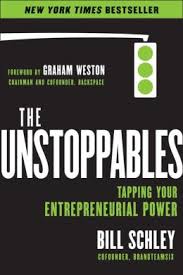
imgres-2Bill Schley wrote “The Unstoppables: Tapping Your Entrepreneurial Power” with a foreword by Rackspace Chairman Graham Weston. In the book, they dispel myths and share the keys to entrepreneurship with the goal of doubling the number of people who found companies during the next 10 years. Schley recently spent some time with Silicon Hills News and answered a few questions about startups. The interview has been edited for space.

Q. Why has there been an explosion in the interest of entrepreneurship locally, nationally and globally?

A. I think people recognize that entrepreneurs are going to make the jobs, the companies and the markets. They are going to make the innovations. They are going to make the changes that matter. Change is only accelerating. The whole world is going faster and it takes an entrepreneurial mindset and approach to function and succeed in such a dynamic new market. You need people who think like entrepreneurs who can adapt and change on the fly. You can sit on your laurels less and less and less. Entrepreneurial thinking is designed for this new world. People recognize that the old fashion jobs are going away and something has to replace them. The entrepreneurs make the new jobs with 80 percent of the new jobs created by companies that are less than five years old.

Q. What are the traits of successful entrepreneurs?

A. There’s a lot of myths about that. It’s more about what they are not, than what they are. They are not necessarily geniuses or visionaries or people who like risk, or people who are highly educated and specialized, or rich. They are entirely unremarkable people from the outside. Everybody has a dream but for most people they just remain dreams. The entrepreneur wants to turn that dream into a reality. He takes steps to do that. He gets in motion and once he gets in motion he just keeps swinging. The successful ones realize it’s an obstacle course. They keep persisting. A high number of them get to succeed. But first, they must overcome that emotional ability to get started. It’s an emotional ability to stand up to risk. They are risk mitigators more than they are risk takers. They want to get someplace so they are trying to remove as many obstacles as they can.

Q. What is the best way for an entrepreneur to get started?

A. One of the most important ways you can get started is to not be doing it alone but to have a founding team–whether it’s one, two or three more people. Find other people and share your passion and your mission. We found that the quality of the team is such a huge success multiplier. It’s the whole approach and philosophy behind the Navy Seals who only do things in three or four man teams. One thing is to see if you can find those teammates. Another thing is to find an idea that inspires you. Find an idea that inspires you to get started and find other people to go on that mission with you.

Q. Where do entrepreneurs go for help once they’ve decided to start?

A. Collaborative workspaces like Geekdom can help provide resources. There has to be some capital to start most businesses. Friends and family financing is often the first infusion of capital. Most of the companies on the Inc. 500 list started with under $10,000 of FFF–friends and family financing. And you create a very simple business plan.

Q. Why did you write The Unstoppables?

A. We wrote The Unstoppables to encourage more entrepreneurs. When people decide they want to do something badly enough they figure it out. They’ve been doing that for centuries. There weren’t books, business schools, incubators and collaborative workspaces. We think we can tap another whole tranche of entrepreneurs if we can take away the mythology people have and help them with their emotional ability to deal with fear. The book is also about what we call accelerated proficiency. It’s a process of learning a very small number of principles that help align the whole process called The Unstoppable Six. We developed the whole doctrine because we believed that the real essence of entrepreneurship isn’t being taught in business schools. But entrepreneurship can be tapped in people if you show them that essence. It’s a little bit of a manifesto of what you can do.

Q. What are some of the myths of entrepreneurship?

A. That an entrepreneur has to be this unique special person with all of these advantages. The idea is to get more people in motion.

Q. Most startups fail, so what is the biggest indicator that a company will succeed?

A. 1) If customers like your product enough to pay you more for the product than it cost you to make, and– 2) If your team has tried and failed a few times but kept at it– that proves your people have the resilience you need to keep swinging–that they are UnStoppable.

Q. Is there enough money to fuel the startups? There’s been talk about a Series A funding crunch and that companies can’t find money to take their venture to the next level.

A. There’s an awful lot of money sitting out there. If you really have a good idea you can find some resources.

Q. Are the startup ideas big enough to be transformative?

A. A lot of times I look at them and I say no. I look at what’s going on in Web development and mobile apps space and they aren’t necessarily business ideas. They are product apps. Many are what we call solutions looking for a problem. But the more ideas you have, the more chances you create. Sure, some of the ideas are silly and frivolous but out of all that comes the revolutionary stuff. You can’t always tell the difference at the beginning. The more people we have doing it, the higher the chances are that we are going find the gold. That’s why we have to get millions more people in motion. That’s what happens when more people realize they’re UnStoppable.

Full disclosure: Graham Weston is a co-founder of Geekdom, which is a sponsor of Silicon Hills News.

Five Teams Pitch at 3 Day Startup San Antonio

Simon Barnett pitches ScriptFit at 3 Day Startup San Antonio

Simon Barnett pitches ScriptFit at 3 Day Startup San Antonio

Five teams pitched Sunday night at Geekdom at the culmination of the latest 3-Day Startup San Antonio.
The teams included Menu, a software program to allow customers to easily order takeout from restaurants, MicroStoreIt.com, a matchmaking service for empty commercial warehouses and consumers, Ripcord, an iPhone app that sounds an alarm and gets help, ScriptFit, a marketplace for academic papers, and Team Me Up, a sports league organizational Facebook app.
More than 30 people participated in the weekend long event in which they brainstormed ideas, formed companies, did market research, created prototypes and business plans and then pitched in front of a public audience.
“This kind of event brings the idea of accelerated proficiency to life,” said Bill Schley, author of the Unstoppables, a bestselling book on entrepreneurship. He volunteered to mentor the teams throughout the weekend. “We can create millions of more entrepreneurs if we just move people in motion quickly. It’s all about taking that first step and overcoming fear.”
The 3-Day Startup program has already launched dozens of companies in Central Texas including Hoot.me, Famigo, Embarkly, Grapevine, Monk’s Toolbox, ParLevel Systems and more. Some of them have gone out of business, others have been acquired and some have gone on to raise money.
The experience of participating in a 3-Day Startup weekend can convince someone to ditch his or her day job and go all in on entrepreneurship.
“It was intense. It was great. We spent at least 12 hours every day working nonstop,” said James Rubino, a medical professional and python developer who led the five-person MicroStoreIt.com team. “It’s a great experience for anyone even toying with the idea of being an entrepreneur. This was a priceless experience.”
Stephen Dyer, a chief operating officer for Garrison General Contractors, pitched Menu, an online ordering system that connects to a restaurant’s point of sale software. He said the company’s idea changed throughout the weekend and after meeting with potential customers and getting feedback on their original idea of a ranking system for menu items. The team plans to continue to develop their idea and perhaps pitch it to the Geekdom Fund, a seed stage investment fund.
At the end of the weekend, 3-Day Startup San Antonio organizers give out gold cans of red bull as awards to teams and individuals who put forth the most effort. Simon Barnett, a senior at Alamo Heights High School, received a Play-Doh award because he was too young for Red Bull.
Barnett, a member of Geekdom, gave the pitch for ScriptFit.
“It pivoted a lot before we got to a final version,” Barnett said.
A few of the members of the six person team are going to continue on with the idea and plan to work with the University of Texas system to further develop it.
“This was definitely a great experience,” Barnett said.

« Older posts Newer posts »

© 2026 SiliconHills

Theme by Anders NorenUp ↑