Category: San Antonio (Page 29 of 62)

Tips for Startups on Raising Old Money and Crowdfunding

Photo of Stephanie Chandler, partner of Jackson-Walker, courtesy of the law firm.

Photo of Stephanie Chandler, partner of Jackson-Walker, courtesy of the law firm.

Old real estate and oil money in town invested in San Antonio’s Rackspace early on, said Stephanie Chandler, partner with Jackson-Walker.

It was one of the first cases of old San Antonio money backing a startup technology venture here, she said.

Now with Geekdom, a technology incubator and accelerator in downtown San Antonio, the goal is to get even more local investment into startups, Chandler said.

“Over the last ten years there’s a much more significant uptick in what families are doing,” in investing in startup deals, she said. “Five years ago, we didn’t have the Rackspace founders looking at deals.”

Five years ago, the Center for Innovation and Technology Entrepreneurship at the University of Texas at San Antonio didn’t have its bootcamps in which it introduced mentors to support young startups, she said.

Historically, a lot of the family offices in San Antonio didn’t want to look at startup investments, Chandler said. But that’s changed.

“There is a lot of buzz going on at the San Antonio country club about what’s going on in town and trends,” she said.

Chandler spoke last week at Jackson Walker’s law offices in downtown San Antonio on “Raising Capital from New Money and Old Money: Crowdfunding and Family Offices in 2014.”

Mike Laussade of Jackson-Walker also gave a presentation to about 50 entrepreneurs in attendance.

“Most startups don’t attract money from lenders,” she said.

Angel investors generally put anywhere from $25,000 to $250,000 into a deal, Chandler said.

“Clearly they are motivated by getting a return, but they are also looking for something else,” she said.

For example, a lot of the successful entrepreneurs and executives with Rackspace are now investing in early-stage tech startups to give back to the community, Chandler said.

When startups raise money, it’s important that they adhere to federal regulations.

“Every single stock offering is required to be registered with the SEC,” she said.
That requires startups to provide audited financial statements and other expenses. But if you’re not doing a public offerings, there are exemptions to these rules.

“If a deal is truly private, you don’t have to register it,” she said.

The Securities and Exchange Commission’s Rule 506 provides an exemption to companies that allows them to raise an unlimited amount of money from accredited investors, Chandler said.

An accredited investor is someone who has net assets of more than $1 million not counting their house and income of $200,000 per year, Laussade said.

The Jobs Act allows for crowdfunding that allows companies to raise small amounts of money from large numbers of non-accredited investors, but it is not yet effective, Laussade said. The rules are still being worked out and might be adopted later this year, he said.

As of Sept. 23, the SEC adopted a New Rule 506( c ) that permits companies to solicit or advertise offerings as long as all the purchasers of the securities are accredited investors.

When dealing with old money, especially from the oil industry, in San Antonio some investors will not do a deal if it involves a 506-c solicitation which requires disclosure of investors, Chandler said.

“They are choices all along the path,” she said.

Once you go 506 ( c ), you can’t turn back, Laussade said.

Equity-based crowdfunding can only be done on a registered crowdfunding portal. And companies can only raise up to $1 million a year, Laussade said.

Securities law does not apply to Kickstarter and IndieGoGo because they are perk-based crowdfunding. The people donating money on those sites to projects are not investing in the company or getting any equity in exchange for their pledges.

To do equity-based crowdfunding from non-accredited investors, companies have to file a form C and provide audited financial statements. Those can cost $50,000, Chandler said. Companies also have to provide full disclosures on what they are doing.

“If you want to go stealth on your product, how are you going to do that?” Chandler said.

Annual reports are required. These are all things that are not required with a private offering, Laussade said.

“It’s going to be an onerous process,” he said. “And the rules aren’t yet final.”
The summer would be the absolute earliest the new equity-based crowdfunding rules will be effective, Laussade said.
Tips on Branding for Startups

By LAURA LOREK
Founder of Silicon Hills News

Bg7-86FCAAAAhhhWhat’s in a brand?

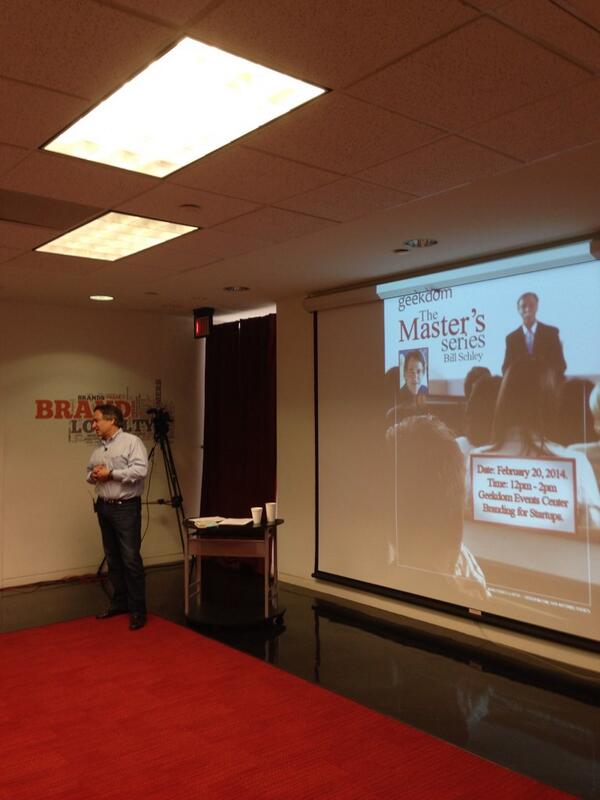
Billions of dollars, said Bill Schley, branding expert and co-founder of BrandTeamSix.

Rackspace’s brand “Fanatical Support” is worth one billion dollars per word, Schley said.

“They said we will answer the phone in one ring at midnight on Christmas Eve,” Schley said. And they did. And Rackspace became known in the IT industry for providing outstanding customer support, he said.

Schley spoke Thursday afternoon at Geekdom, a downtown San Antonio coworking and technology incubator, to a roomful of startup entrepreneurs and others on “Branding for Startups.”

Schley recently wrote the book “The Unstoppables” with a foreword from Graham Weston, founder of Rackspace. The book details the plight of entrepreneurs and dispels myths and shares the keys to success. Schley also wrote “The Micro-Script Rules” and “Why Johnny Can’t Brand.”

Schley spoke for an hour on branding and NowCastSA did this video of his talk.

But for those who don’t have an hour, here’s his top 12 tips.

1. The fact is your brand isn’t optional. Branding is something we do automatically, Schley said. It’s something we do unconsciously and for primitive reasons. Either you control your brand or your customers and competitors are going to brand for you. “You’re not going to like the tag line.”

2. What’s the one thing that sets you apart and sticks in your mind? That’s your brand.

3. You need to align everything you do with that idea so you perform the way you promise.

4. Find a category to be number one in. “People remember one big thing” Schley said. “They don’t remember 100 things.”

5. Create a Microscript – which tells a brand’s story in six words or less. That script can powerfully convey your brand in one idea. Examples include Rackspace’s “Fanatical Support.” M&Ms “melts in your mouth, not in your hand.”

6. Your brand needs to be superlative, important, believable, memorable and ownable.

7. You’ve got to be the best in what you do. Your brand has to be a must have and not a need to have, Schley said.

8. The No. 1 Rule is “Specific is Terrific.” For example, Rolex is the luxury watch, ESPN is the sports channel, Volvos are safe cars and Wheaties is the breakfast of champions. Even Superman has a microscript, Schley said. He stands for truth, justice and the American way.

9. When number one is already taken shift your brand to the left or to the right. For example, Subaru branded itself as SUV Wagons. People create this category by combining two categories, Schley said. The Patagonia Tooth Fish became Chilean Sea Bass and sold a lot more fish, he said.

10. You don’t have to be General Electric or Starbucks to do this, Schley said. For example, a massage business run by a Native American branded her shop as Native Palm and become known for that.

11. Branding is not optional. What this really comes down to is the ability to focus. The reason people can’t brand is for a very simple reason: it’s fear. “The narrower your focus, the wider and broader your brand goes.”

12. Your job is not to entertain. Your job is to put them in motion. Once you’ve got their attention, you’ve got to sell them something.

San Antonio on a Short List for Google Fiber High Speed Internet

By LAURA LOREK
Founder of Silicon Hills News

A Google installation van in Kansas City, photo courtesy of Google.

A Google installation van in Kansas City, photo courtesy of Google.

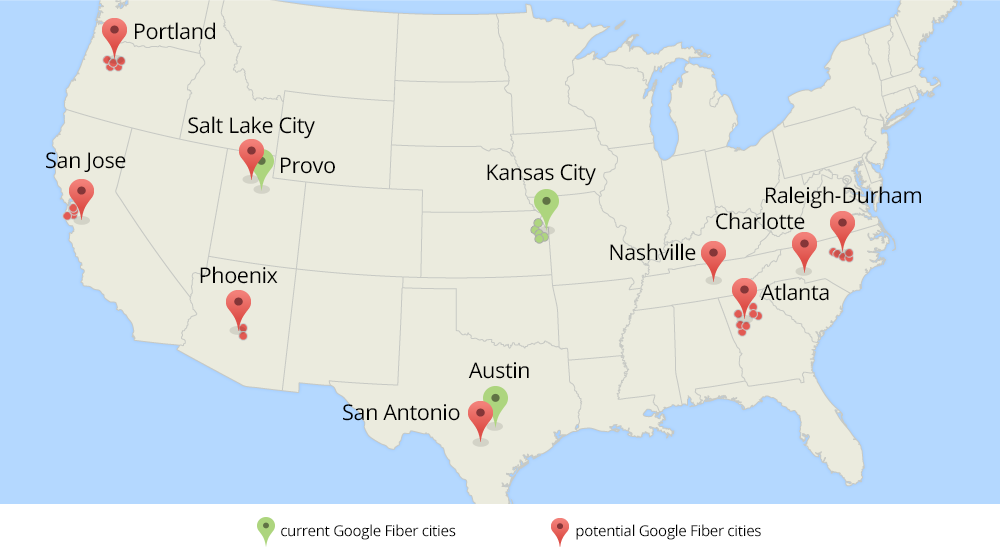
San Antonio is on a short list of cities that may get Google fiber high-speed Internet access to the home.

“San Antonians deserve Internet speed that is faster than the third world and now we’ll have it,” Mayor Julian Castro said at a press conference at City Hall.

Google’s fiber network provides uploading and downloading speeds 100 times faster for businesses and homes than what most broadband Internet users currently experience. It also provides TV service with hundreds of high-definition channels. With 1 Gigabit Internet access, consumers can upload a 90-minute concert in 10 second or upload 300 photos in 12 seconds.

Google announced Wednesday the next step in expanding its Google Fiber network by inviting 34 cities in nine metro areas across the U.S. to work with the company to explore what it would take to build a new fiber optic network in their community.

San Antonio first applied to be a Google fiber city in 2010 along with 1,100 other cities. Since then, Google has officially launched its 1 Gigabit Internet network in Kansas City, Kansas and Kansas City, Missouri, Austin and Provo, Utah.

To get the network, San Antonio officials must provide detailed maps for utility construction, access for Google to put its fiber on existing poles or conduit and a good permitting process to get the city ready for its fiber installation.

A formal announcement will be made later this year if Google decides to begin deploying its network throughout the city, Castro said.

Since April when Google announced plans for its super fast high-speed fiber network in Austin, AT&T, Time Warner and Grande Communications have all announced 1 Gigabyte networks in the city.

Castro said he expects to see the same kind of competition to emerge in San Antonio, the nation’s seventh largest city.

“I’m convinced in short order we’ll see the same kind of competition which is good for the consumer,” Castro said.

Castro announced last June that every school in the city should have access to gigabit speeds by 2020.

The installation of Google fiber in San Antonio will help spur the city’s growing technology industry as well as attract startup companies, Castro said.

“The implications of fiber to the home are widespread,” City Manager Sheryl Sculley said.

A high-speed fiber Internet network will impact everything from educational institutions to the development of entrepreneurs looking to establish new business models, she said.

“It will provide existing and growing businesses a competitive advantage in a fast-moving digital economy.”

Google fiber will also make the city more globally competitive, Sculley said.

“Ultra high speed Internet will enhance our ability to compete economically on the world stage,” she said.

The project is not costing San Antonio any money in incentives, Sculley said.

While Google wants to bring fiber to every city, it might not work out for every city, according to the company.

“But cities who go through this process with us will be more prepared for us or any provider who wants to build a fiber network.”

Mark Strama, head of Google Fiber in Austin, said the announcement in San Antonio will not affect the rollout of Google fiber in Austin. He expects the first customers in Austin to have the service by the end of 2014.

“Google believes that a faster Internet is better for everybody,” Strama said.

The other metro areas Google announced today for its short list are Portland, San Jose, Salt Lake City, Phoenix, Nashville, Atlanta, Charlotte and Raleigh-Durham.

Map courtesy of Google

Map courtesy of Google

Both Austin and San Antonio having high speed Internet will only strengthen this region as a technology powerhouse going forward, Castro said.

“I have no doubt that this region will be recognized the way the Bay area is recognized in California,” he said.

Google’s gigabit fiber is a game changer for San Antonio’s economy and will have as big an impact as the shift from dial-up Internet to broadband did, according to city leaders.

“We’re a city of small business owners,” said Ramiro Cavazos, CEO of the San Antonio Hispanic Chamber of Commerce. “This investment in dark fiber gives us freedom to grow our economy even faster in the future.”

The New York Times did a story last December discussing how the U.S. is struggling to keep up with providing high-speed Internet and is falling behind the rest of the world and is at jeopardy of losing its competitive advantage. The article spotlighted San Antonio’s slow Internet speed and reported it’s no match for the Latvian capital of Riga on the Baltic Sea.

“Riga’s average Internet speed is at least two-and-a-half times that of San Antonio’s, according to Ookla, a research firm that measures broadband speeds around the globe. In other words, downloading a two-hour high-definition movie takes, on average, 35 minutes in San Antonio — and 13 in Riga,” according to the New York Times Story. “And the cost of Riga’s service is about one-fourth that of San Antonio.”

Rackspace’s CEO Lanham Napier Retires

imgres-2Since April of 2000, Lanham Napier has worked at Rackspace Hosting.
At first, Napier served as Rackspace’s Chief Financial Officer and later President and then Chief Executive Officer. He oversaw the company grow from a startup to a publicly traded company with $1.5 billion in revenue and 200,000 customers.
On Monday, Napier announced his retirement from the company as CEO and a member of its board of directors effectively immediately.
Graham Weston, Rackspace’s co-founder and executive Chairman of the Board, is replacing Napier as CEO until a search for a new CEO is complete. He will work with Taylor Rhodes, Rackspace’s president.
Rhodes replaced Lew Moorman as president. He stepped down last year to spend more time with his family.
Napier plans to invest and work with entrepreneurs and he will continue to consult with Rackspace for the next few months.
images-4“It has been a privilege to be part of Rackspace for the past fourteen years,” Napier said in a statement. “I have enjoyed working with Rackers and our customers to bring Fanatical Support® to the fast-growing market of cloud computing. My decision to step down as CEO was a difficult one, but it’s the right choice for me and for the company. With the board and management team aligned around our 2014 strategy and financial plan, I believe now is a natural transition point to select a new leader for the next exciting phase of Rackspace’s growth. I look forward to following Rackspace’s success as I return to my entrepreneurial roots – to build new things and invest in disruptive ideas.”

Robots in the Spotlight at Rackspace

By LAURA LOREK
Founder of Silicon Hills News

From right, Ronald Reagan High School  Morganne Blaylock, junior on the Reagan Robotics Rattlers team with Chilli Kellaway, junior.

From right, Ronald Reagan High School Morganne Blaylock, junior on the Reagan Robotics Rattlers team with Chilli Kellaway, junior.

Coaches in wizard’s hats, kids in bunny ears, others donning purple and yellow vests made out of duct tape.

A student riding a bike to recharge all of the electronics from his high school team to compete in the FIRST Tech Challenge Robotics Alamo Regional Championship.

A line of mascots and kids doing a conga line to hip hop songs around groups of students hunched over displays tinkering with robots. Roped off arenas for robots to compete. Spectators cheering wildly.
The scene at Rackspace’s headquarters on Saturday looked like a Lollapalooza for high tech high school students.

Rackspace transformed its headquarters’ event center into an arena where 60 teams of more than 750 students from the southern region of Texas battled their robots in the FTC competition. Fourteen winning teams earned spots at the Super Regional competition to be held at the Henry B. Gonzalez convention center from Feb. 26 to March 1. Rackspace is the title sponsor of the competition.

“Rackspace is a strong supporter of STEM education in San Antonio,” said Daniel Sherrill, spokesman. “We just think this competition is a way for us to connect with the community. And we provide a venue for an awesome competition for students to show off their skills in science, technology and engineering. The collaboration among so many teams coming together makes this a really fun place.”

The students had to compete in two qualifying matches to make it to the competition on Saturday. Their robots, about the size of a laser printer, must perform tasks during rounds of competition with other teams in an arena. This year, the robots, which the students build and design on their own time, had to take yellow blocks and put them into baskets and then climb a bar at the end and hang from there.

Students also competed in business plan, marketing and social media competitions.

“We’ve got a lot of good competition here,” said Patrick Felty, Alamo Regional Director for FIRST. “We’re having a hard time judging.”

IMG_2660Inventor Dean Kamen founded FIRST, which means For Inspiration and Recognition of Science and Technology, 25 years ago to provide hands-on learning opportunities for students in the STEM fields. The program now serves more than 350,000 students nationwide, supported by more than 130,000 volunteers and 3,500 sponsors.
“As a business leader, these are the kids that are going to be our employees in the future,” Felty said. “They may be our bosses in the future. This program inspires them to become the technology leaders of the future.”

The kids build the robots, tackle the problems and find solutions. They compete, but they also have fun.

They also use the latest technology to help with their projects. For example, the 27-member team from Ronald Reagan High School has its own Maker Bot 3-D printer. They use it to custom make parts for their computer, said Morganne Blaylock, junior on the Reagan Robotics Rattlers team.

“It’s a lot easier for us to make our own parts,” said Chilli Kellaway, junior.

They brought the printer with them, set it up at their booth and printed different components at the competition on Saturday.

Shambots team members Alexandria Garza, junior, with Megan Isabella Rodriguez, senior, at Incarnate Word High School

Shambots team members Alexandria Garza, junior, with Megan Isabella Rodriguez, senior, at Incarnate Word High School

For three years, Megan Isabella Rodriguez, senior at Incarnate Word High School, has competed with the all-girls Shambots team. She was a founding member.

“The first year there was only three of us,” Rodriguez said. Now the team has grown to more than 20 members. Rodriguez plans to go on to study biomedical engineering in college. She loves competing in the robotics competition.

“The environment is fantastic,” she said. “Everyone here is so passionate and creative. It’s a chance to use your brain and stimulate it.”

First year Shambots competitor, Alexandria Garza, a junior at Incarnate Word, programs the robot and drives it.

“It’s so gratifying to be given a problem, create a solution, and run it and test it in actual situations,” Garza said. “It’s amazing to see other people’s brilliant ideas.”
Robotics is only the beginning of what Garza hopes will be a long career in engineering.

“I definitely want to become a programmer or a mechanical engineer,” Garza said. “I love it so much.”

For the all girls team, Toxic Green Hornets, from Flour Bluff High School in Corpus Christi just making it to the regional competition was quite an accomplishment, said
McKenzie Graham, sophomore.

“This is our first year,” she said.

IMG_2651The team of six met during their lunch hours, after school and on weekends to build their robot.

“Hopefully next year we’ll have an actual class,” she said.

Toxic Green Hornets team member Kasey Majek, a sophomore, wants to go onto study electrical and mechanical engineering.

“We’re all into science and math and this is a fun thing to do with your friends,” she said.

It’s also the first year to compete for Alamo Heights High School. Fifteen students make up the robotics team, said John Munoz, the school’s computer science teacher who started the program at the school.

“We did really, really well,” Munoz said.

The Alamo Heights Mules team qualified for the finals through two previous competitions and right after the second one, the students re-designed the robot and added on to it, Munoz said.

They had a few ups and downs at the competition on Saturday. The robot’s motor burned out during a battle.

“Immediately they came over here and fixed it up,” Munoz said. “They’ve taken apart the robot so many times. We’ve got a great programmer, Zane Witherspoon.”

IMG_2641The competition means more to the students than just robotics, Munoz said.

“They are able to open up and see themselves in a different way,” he said. “In the classroom, we only get a little sense of that.”

The competition also allows classroom work, like text-based programming, to have real-life applications, Munoz said.

“They can see a really cool design come to life,” Munoz said. “They also get to meet new people and be exposed to new ideas.”

A video made by one of the competitors.

Six Tips from MC Hammer on Entrepreneurship at Startup Grind

Bfq0r6FCIAAvOVe
By LAURA LOREK
Reporter with Silicon Hills News

Known as an entertainer, entrepreneur and humanitarian, M.C. Hammer also adopted social media tools early on.
Hammer tweeted before most celebrities knew Twitter even existed.
During meetings with Twitter’s founders Evan Williams, Biz Stone and Jack Dorsey, Hammer explored the emerging world of micro-blogging with his fans. He also began meeting with Google more than 10 years ago when the search engine had just a few thousand employees in Mountain View, Calif.
Mary Grove, now head of Google for Entrepreneurs, remembers those times. On Tuesday, Grove interviewed Hammer before several hundred people at Startup Grind 2014 held at the Computer History Museum.
Hammer lived on the cutting edge of technology and adopted new tools early, Grove said. Entrepreneurial from a young age, Hammer sold baseballs in the parking lot of the Oakland Athletics baseball team. Earlier than that, he ran a fruit stand and an ice cream business in Las Vegas, Hammer said.
A lot of similarities exist between rap, hip-hop music and startups, Hammer said.
“I brought my entrepreneurial skills into hip-hop,” he said.
Hammer noticed that the best Oakland As baseball players got the best deals. For example, Reggie Jackson got the Reggie candy bar and he also had a deal to represent Puma shoes.
Hammer decided that a baseball player only plays baseball once a day but a song comes on every hour. So with the increased visibility, he wanted more money from sponsors for his music deals.
Here are six tips for entrepreneurs gleaned from Hammer’s Startup Grind talk:

1. Never be discouraged by the naysayers.

“You just have to keep going,” Hammer said. The first time Hammer started tweeting hundreds of naysayers, primarily public relations people, told him that entertainers and artists shouldn’t do their own marketing.

2. Embrace new technology and tools.

“First thing I say to an artist today – be honest and make the music you want to make – use all new tools to get your music to the consumer,” Hammer said. He’s also a fan of Pinterest. Some naysayers say that “no men are on Pinterest,” Hammer said. “Yes they are. Smart men are on Pinterest. And if it’s all ladies, a smart man like me, should be there,” Hammer joked. But as a marketing tool Pinterest is phenomenal, he said. “The possibilities of what Pinterest can do are actually scary.” He has a page on Pinterest: XX320. He’s also excited about the possibilities of tools like Snapchat.

3. Enjoy communicating with others on social media.

“Tweeting, if you don’t approach it right, is labor,” Hammer said. “It’s never labor to me.” It’s easy to build an influential network on Twitter, he said. In real life, people spend years and pay a lot of money to make relationships with reporters and other tastemakers, Hammer said. The Twitter platform makes it possible to have direct conversations with your fans and others.

4. Give back.

Someone who has less income is as important as someone who has a billion dollars, Hammer said. Treat people well and inspire hope. Adopt Marc Benioff, founder of SalesForce.com’s 1-1-1 model, he said. Spend 1 percent of the company’s equity helping others, donate 1 percent of the employees’ time and donate 1 percent of the products and services to charity. “That model effectively allows you to create a culture for your company of giving back,” Hammer said.

5. Empower People

Previously, Hammer was a control freak. He used to micromanage. Now, he gives his employees power to create and make mistakes. “Delegate authority and allow people to do what they do. Pick great executives and a great team to do that.”

6. Work hard and hone your skill set.

“Silicon Valley, the tech world here, is like the NBA,” Hammer said. “You’ve got a lot of players who look good on the playground on the weekend. They dream of playing in the NBA, but they are not prepared or they are not good enough or they don’t have the skill set to play in the NBA.” When he sees someone who has skills he does everything he can to help them. But they have to work hard to get there. “Do I think that the doors should just fly open and everyone should come in, of course not,” Hammer said. “They have a filter and a vetting process. And what we see in the NBA is the best of the best.”

Visionary Entrepreneur Tim Jenison Searches for the Truth in Tim’s Vermeer

images-2NewTek is one of the hidden gems of a technology company in San Antonio.
Tim Jenison co-founded NewTek, a desktop video graphics software company, in a storefront in downtown Topeka, Kansas in 1985. The company made the Video Toaster.
Jenison later relocated the company to San Antonio. NewTek continued to make innovative products like Lightwave 3D software used for special effects in movies and television shows. And in 2005, NewTek released the Tricaster, which allows people to do live video streaming with the production capabilities of a full studio in a backpack-sized piece of hardware.
NewTek is a little slice of Hollywood in the Alamo City. Filmmakers from all over the world visit its headquarters to meet with Jenison and his staff.
Jenison is one of those genius entrepreneur/inventors who always seems to be thinking up the next big thing.
And that next big thing is “Tim’s Vermeer,” a documentary.
Jenison teamed up with Penn Jillette, the film’s producer, to create the documentary “Tim’s Vermeer,” which will debut in Austin and San Antonio on Feb. 28th, according to this schedule just released by Sony Pictures Classic.
In the one hour and 20 minute long documentary, Jenison “attempts to solve one of the greatest mysteries in all art: How did 17th century Dutch Master Johannes Vermeer (“Girl with a Pearl Earring”) manage to paint so photo-realistically — 150 years before the invention of photography? The epic research project Jenison embarks on to test his theory is as extraordinary as what he discovers,” according to news release.
Jenison spent eight years on the project and travelled the world to research it. In the project, he attempts to paint a Vermeer. But he’s not a painter. He’s a computer graphics guy.
The movie has been reviewed in the Los Angeles Times, Time Magazine, the New York Times and the even The Economist and has received rave reviews.

San Antonio MX Challenge Seeks to Solve Problems and Realize Dreams

By LAURA LOREK
Founder of Silicon Hills News

IMG_2424The XPRIZE Foundation organized a four-day adventure trip to visit tech companies in California last February.
XPRIZE Founder Dr. Peter Diamandis wanted to showcase space and ocean innovation to a select group of entrepreneurs.
Part of the event involved a Zero G flight in which the passengers float about weightless for several minutes. That’s where software entrepreneur Christian Cotichini literally crashed into Graham Weston, chairman and co-founder of Rackspace, during the flight.
When the flight ended, Cotichini, Diamandis and Weston met and dreamed up the idea for HeroX, a smaller, community-oriented version of the XPRIZE, which seeks to solve the world’s big challenges by creating and managing large-scale incentivized prizes focused on learning, exploration, energy & environment, global development and life sciences.
On Thursday night at an invitation-only event on the fourth floor of the Rio Plaza on the Riverwalk in downtown San Antonio, the first HeroX challenge officially launched. It’s called the San Antonio MX Challenge, a two-year $500,000 prize to foster entrepreneurship between San Antonio and Mexico.

The team behind the San Antonio MX Challenge: Tito Salas, Emily Fowler, Christian Cotichini, Lorenzo Gomez and Graham Weston

The team behind the San Antonio MX Challenge: Tito Salas, Emily Fowler, Christian Cotichini, Lorenzo Gomez and Graham Weston

“XPRIZE was a grand idea for very lofty things at an ivory tower aspiration level,” Weston said. “What I love about HeroX is it takes what we learned about offering big grand prizes and it brings it down to a city-level. We are not going to Washington, D.C. to change the world; we can change it in our city. The most important unit of economic action is the city. The HeroX prize is about bringing that innovation and technology to the city level.”
San Antonio has the opportunity to be the gateway to America for the entrepreneurs in Mexico and the San Antonio MX Challenge will serve as that catalyst to make it happen, Weston said.
San Antonio has so much of the infrastructure to offer entrepreneurs in the startup world, Weston said.
“Mexican entrepreneurs can come to America to launch their products and then go back to Mexico to build their companies,” Weston said.
San Antonio is the first city to launch a HeroX prize, but soon it will be everywhere, Weston said.
“HeroX is going to be in every city around the world from London to Lubbock,” he said.
HeroX democratizes innovation, Cotichini said, co-founder and CEO of HeroX. He sold his software company, Make Technologies, based in Vancouver, to Dell in 2011. He soon became immersed in studying the world’s problems. It almost made him become depressed until he read Diamandis’ book Abundance, which paints an optimistic view of the future. Cotichini then knew he wanted to be part of making that vision become a reality.
“This is the very first HeroX branded challenge,” Cotichini said. “The Internet is creating new models that allow us to be far more powerful as a species. These new models are going to change the world.”
Open innovation can change cities and companies. It’s a tool for anybody who needs innovation, he said.
HeroX is an online crowdsourcing platform that allows people to realize visions and live out dreams, said Emily Fowler, co-founder and vice president of possibilities for HeroX.
HeroX plans to launch hundreds of competitions worldwide.
Whereas the XPRIZE challenges offer prizes from $10 million to $30 million and last from five to eight years, the HeroX challenges offer prizes of $10,000 to millions and last from six months to a few years, Fowler said. Anyone can take on a challenge or offer one up, she said.
“We’re stimulating a new generation of entrepreneurs and it’s really interesting,” Cotichini said. “The millennial generation really gets the power of crowdsourcing and collaboration.”
One of those is Tito Salas, project manager of San Antonio MX Prize. He was born in Northern Mexico and graduated from the University of Texas with a double major in marketing and business management.
“The San Antonio MX Challenge wants to make it easy for Mexican entrepreneurs to move to San Antonio to launch their business,” Salas said. His role is to help provide Mexican entrepreneurs with Visas, mentors, business services, access to capital and more.
“We’re also looking to get together all of the entrepreneurs from Mexico in San Antonio and bring them to Geekdom to make something bigger,” Salas said.
Walter Teele, co-founder of ParLevel Systems .

Walter Teele, co-founder of ParLevel Systems .

Walter Teele and Luis Pablo Gonzalez are both from Mexico. They came to the U.S. to go to college. They graduated recently and launched ParLevel Systems, a company that connects vending machines to the Internet to monitor them remotely. ParLevel last year graduated from the Techstars incubator program. Teele and Gonzalez are building their company at Geekdom.
Teele sees the San Antonio MX Challenge as a way to fill a need that exists in helping Mexican startups.
“I think it’s going to give entrepreneurs in Mexico awareness that there are people here that want to support them and help them realize their dreams,” Teele said. “We don’t have a startup culture in Mexico. You have it here.”
Mexican entrepreneurs can benefit from the infrastructure that already exists in San Antonio, Teele said.
So far three people have expressed interest in registering for the San Antonio MX Challenge, said Lorenzo Gomez, director of Geekdom. The organization provides the criteria a company needs to meet to win the prize, but they don’t provide any seed stage capital or pre-determined solutions, Gomez said. Early registration ends on Aug. 25 and final registration is Jan. 14, 2015.
“The beauty of the prize models is it’s always the person that didn’t know they could win it that wins it,” Gomez said. “It’s probably going to be someone you never thought or maybe it’s someone that was very obvious. That’s one of the exciting parts of the prize is to see who steps up to solve it. It might just be one person with a magic Rolodex that makes it happen.“

Social Media Tips and Tools for Startups

Christie St. Martin, community manager and digital media specialist for HeroX

Christie St. Martin, community manager and digital media specialist for HeroX


By LAURA LOREK
Founder of Silicon Hills News
Geekdom, the collaborative co-working space in downtown San Antonio, kicked off a new speakers event Thursday called The Master’s Series.
“Our goal is to pummel you with amazing information,” said Lorenzo Gomez, director of Geekdom.
The first speaker, Christie St. Martin talked about social media tips and advice for startup companies.
Martin, formerly social media manager for JPMorgan Chase and L’Oreal, currently serves as community development and digital strategy manager for HeroX and is from Toronto. She’s helping to kick off HeroX’s first local prize San Antonio Mx Challenge.
It’s really important companies manage their social media presence online, St. Martin said. The job is one of the most important for companies and it should not be regulated to the social media savvy intern, she said. Tools like Hootsuite, social media management software, can help.
In the past, customers with a complaint would call or write a company, but today’s consumers often go directly to complain on Twitter or Facebook, she said.
“Real time interaction is 100 percent where you need to focus your time,” St. Martin said.
In her PowerPoint presentation, peppered with pictures of LOL Cats and dogs, St. Martin advised companies to be honest, be you, don’t panic and listen to customers.
“The stuff that is super important is you being a real human,” she said.
She advised companies to brainstorm all of the frequently asked questions from customers and to put them into a document. She tells them to use that document as a guidepost in answering queries online. But don’t just regurgitate the stock answers, she said. Personalize each answer and tailor it to the particular customer, she said.
St. Martin also advised startups to cultivate their influencers, which she defined as “someone who is active online and followed by your target audience.” These people can drive traffic to your website and ignite interest around your brand. She listed five common types of influencers:
1. The Networker (Social butterfly)
2. The Opinion Leader (Thought leader)
3. The Discoverer (Trendsetter)
4. The Sharer (Reporter)
5. The User (Everyday customer)
St. Martin also advised companies to post regularly on all of their social media channels. But she advised quality over quantity of posts. The social media checklist St. Martin shared with the audience is listed below. She also gave away copies of Rohit Bhargava’s book: likeonomics: the unexpected truth behind earning trust, influencing behavior and inspiring action.

social_media_checklist

NowCastSA livestreamed the presentation, which is embedded below.

Watch live streaming video from nowcastsa at livestream.com

Opportunities and Obstacles in America’s Visa Options

BY SUSAN LAHEY
Reporter with Silicon Hills News

H1_B_Work_Visa_Application_Large_ImageLast year, Congress introduced the Startup Visa Act to provide visas to foreign entrepreneurs who have U.S. backing and whose businesses are expected to provide certain levels of employment, revenue, or capital investment. If the legislation ever passes, it may make things a lot easier, said Sweta Khandelwal, an immigrant and Silicon Valley immigration attorney who spoke Monday at Capital Factory.

Currently, choosing the best visa options requires chess-like strategy and a lot of creativity. Some visas are tied to education and job type and others to money. Visas last various amounts of time. Some allow spouses to work and others don’t. Some lead to green cards and others are only for people who have “no immigrant intent.” Khandelwal says she’s been on all of them and there is never a cookie cutter solution. And, like so many other aspects of entrepreneurship, most require “a good story.”

Sweta Khandelwal, an immigrant and Silicon Valley immigration attorney, photo by Susan Lahey

Sweta Khandelwal, an immigrant and Silicon Valley immigration attorney, photo by Susan Lahey

“Twenty five percent of the high tech companies started in the U.S. between 1995 and 2005 had at least one immigrant cofounder,” said Khandelwal, who is chair of the Silicon Valley chapter of the American Immigration Lawyers Association. “That person must be on the right visa to ensure continuity of the company. You also need to be able to hire top global talent.”

“There are no standardized regulations, you have to get creative,” she said. “No business is replicative or duplicative of another…. You have to customize your visa application and really plan ahead.”

Visas for Students and Recent Grads

A really popular visa option is the student visa, F-1 and the Optional Practice Training as well as Curricular Practical Training. With the F-1, a student can stay in the country as long as he is in school and may remain an additional 12 months in the country on an OPT visa to get further training in the area of his education. This can be extended an additional 17 months for STEM graduates who work for verified companies. CPT allows students to do work that is integral to their field of study. They can use up to 11 months of CPT without losing the opportunity for OPT.

If a graduate wants to start a company, he can get that companies e-verified and become an employee. This period gives them time to get their companies up and running and prepare to apply for a different kind of visa.

Investor Visas

The E-2 visa is for immigrants from any of 50 or so countries that have a specific treaty with the U.S. which includes Mexico but excludes India and China. This allows a foreign national to invest in a U.S. business and live in the U.S. to direct and develop the business. Generally if more than one foreign national is involved, they have to be from the same country. The investment amount does not have to be substantial, Khandelwal said. It just has to be sufficient to support the business. Around $15,000 may be adequate. But it can’t be in the form of a loan secured by the business and the investment money must be demonstrated to go into the business for items such as purchasing equipment, leasing space and so forth. Travel to and from the U.S. to establish the business, hotel bills and the like all count as investment. But the investor has to be seeking to build a business that will create economic benefit beyond a lifestyle business. The spouse of an E2 can work. You can be on the E visa indefinitely, but if you hope to get a green card, you have to get a different visa first. This is one of the visas with “no immigrant intent.”

Employee Visas

L-1 or Intercompany Transfer visas let executives, managers or people with specialized knowledge who have worked for a company during at least one of the preceding three years, to work at a U.S. company with which the foreign company has an affiliation. This might be a subsidiary relationship or a branch office. Or they might share a group of shareholders. There are several different forms the affiliation can take but the foreign business must continue to operate. You can’t just move your company to the U.S. on the L-1. One of the great things about an L1 is there’s no minimum salary they must pay the employee and no fixed number of visas, unlike the popular H-1B. L1s don’t’ require a minimum investment. The L1 is initially approved for one year but once you get the office or subsidiary established you can get it for three years. L1s can lead to green cards, Khandelwal said. But the standards for green cards are much more stringent. So while a person who receives an L1 visa can apply the next day for a green card, it’s wiser to wait and establish the business.

The H-1B Visas

One of the most popular visas is the H-1B. These are subject to quotas and they’re issued by lottery within days after the April 1 deadline. H-1Bs go to people with specialty occupations. But this is one of those places that require creativity, Khandelwal said. For example, a CEO, for the purpose of the visa, is generally not considered a specialty occupation. So she recommends people not call themselves CEOs. Instead they might be “Business Development Directors.” The business must pay for a person to come on an H-1B visa which generally costs around $1,500 for the application. The business must also pay the going rate for that employee. If other people in that region of the country, in that position, are earning $85,000, that’s what the immigrant employee must earn. H-1Bs last six years as long as the person remains employed. But with the H-1B, unlike the L-1, employees can switch employers and remain on the visa. Some countries, like Mexico, Canada and Australia, have separate visas not subject to the H-1B quotas.

Extraordinary Ability Visas

Another type of popular visa is the O-1A, or extraordinary ability visa. For this you must demonstrate that you are one of a very few at the top of your field, whether that’s the sciences, arts, education, business or athletics. How you prove that extraordinary ability is pretty much open to interpretation, Khandelwal said. It might be that you were accepted into an exclusive incubator, or won a hackathon or some other award. The standards are high but the ability to spin your circumstances counts for a lot.

These are the visas most likely to be useful for entrepreneurs, Khandelwal said. The problem is, for many companies who are trying to figure out all the domestic issues of starting a business—from investment to intellectual property laws to HR regulations, tackling immigration issues in order to bring on even an exceptional founder or employee can look overwhelming.

Peter French, founder of San Antonio’s FreeFlow Research which creates opportunities for foreign STEM students to stay in the U.S. through education, work and research, acknowledged that the challenge to find and secure the right visas could be daunting, especially to small businesses who hire 95 percent of employees.

“It is really that issue that pushed me to look at this field in the first place,” said French, whose nonprofit organization operates out of Geekdom. “We have these huge gaps in talent. The number of U.S. born students with STEM degrees is tiny, and shrinking. So, in some fields you have 80 percent of the graduate level degrees in computer science and other really high demand fields go to non-U.S. citizens and…they’re being turned away. What you heard tonight is the general story that’s told: That hiring foreign born folks is just too much trouble…. Only large companies endeavor to hire international folks and this starts at the internship level. If you read the fine print on internship application you see “Must be U.S. citizen to apply.”

Small businesses need to understand, French said, that with F-1 programs, OPT and CPT, students can string together as much as 42 months of time working in the U.S. before an employer has to sponsor a visa for them.

“Foreign born folks are twice as likely as native born Americans citizens to start companies. But then they have all these impediments to staying,” French said. “So they’ve won startup contests and they’ve received venture capital but they’ve done it all on their student visa, so then what? They hit this wall and they have to pack up their employees, profits and intellectual property and go home? It’s the antithesis of the American dream.”

« Older posts Newer posts »

© 2026 SiliconHills

Theme by Anders NorenUp ↑