Category: Austin (Page 201 of 318)

Austin-based Comfy Lands $600K in Seed Stage Funding

rentcomfy_com - logoComfy, a startup that helps students find housing, received $600,000 in seed stage funding last week.

The Austin-based company received the money from a group of investors led by Mike Lee, partner at Dominion Ventures. The round also included prominent angel investors and Austin Ventures.

Comfy has developed a mobile and online platform that uses proprietary software to serve as a matchmaking service between college students and the off-campus housing market.

The other investors include former Brocade Communication Systems CEO and founder of Rhapsody Networks Mike Klayko, former Skull Candy CEO Jeremy Andrus, Mark Harris, Jared Stone, and others.
Comfy plans to use the money to expand into new markets and scale its product.

“We feel fortunate to have the caliber of investors we were able to attract. With their backing Comfy is disrupting a fragmented and opaque market with a mobile app and website targeted at student renters,” Comfy Co-Founder and CEO Jordan Wright said in a news release. “Due to the niche nature of off campus student housing in the multi-family industry, the student population is served complicated products that aren’t a good fit for their specific needs, which are quite different from the normal multi-family renter. We’re using trending technologies, a new business model, and a little bit of our own secret sauce to solve this problem. This seed financing gives us the opportunity to take our innovations to the next level in this large, yet underserved market.”

Rackspace to Move 570 Employees into Austin Mall

A rendering of the proposed renovation by Gensler, photo courtesy of ACC

A rendering of the proposed renovation by Gensler, photo courtesy of ACC

Rackspace Hosting is known for innovating in old malls.

The San Antonio-based hosting company moved into the former Windsor Park Mall in Windcrest in 2007. Rackspace transformed the defunct and dilapidated mall into a vibrant and dynamic space with a slide, cafeteria, wide open spaces and a conference center for its tech community.

Now the Web hosting company plans to expand its operations in Austin into another mall, the former Highland Lakes Mall, owned by the Austin Community College. Rackspace plans to relocate 570 employees by late next year to Highland and expand in the future.

Last week, the Austin Community College’s Board of Trustees approved a move to negotiate an agreement with Rackspace to allow the company to renovate the former Dillard’s department store and lease it to Rackspace.

The collaboration between ACC and Rackspace includes providing paid internships for ACC students, enhancing tech training.

The Austin-based Live Oak-Gottesman will renovate the “four-story, 194,000-square-foot Dillard’s space, funded by a portion of Rackspace’s lease payment,” according to a news release from ACC.

“Highland represents the future of higher education, and partnerships like this are a very important component of that—creating new opportunities for students and ensuring a pipeline of skilled workers for the region,” Dr. Richard Rhodes, ACC president/CEO said in a news release. “Rackspace is one of the area’s top employers and has a strong commitment to education. Live Oak-Gottesman has a three-decade track record of successful development in Central Texas. We look forward to seeing this partnership come to fruition.”

Joshua Baer Rejoins Email Marketing Firm PostUp

imgresJoshua Baer, serial entrepreneur and cofounder of Capital Factory, has joined the board of directors of PostUp, formerly known as PulseConnect, an email marketing software company.

Baer founded the Austin-based company under the name of Skylist in 1996 and later sold it.

“Although I founded the company almost 20 years ago, PostUp still offers a cutting edge and unique solution for email marketers looking for scale, optimal deliverability and deep database integration,” Baer said in a news release. “As an independent company, PostUp now has a singular focus and more resources to invest in R&D and marketing to propel us forward for the next 20 years.”

Last January, Transition Capital Partners and Petra Capital Partners, bought the company.

PostUp’s customers include ABC Mouse, HBO, NBC-Comcast, Sony, Turner, Univision and others.

“Our rebrand to PostUp positions us as a stand-alone company that allows us to sharpen our focus and innovate at a much more rapid rate around the specialized needs of our customers,” PostUp CEO Tony D’Anna said in a news release.

Got Lunch? Cater2.Me Wants to Feed the Bellies of Austin’s Startup Community

Zach Yungst and Alex Lorton, co-founders of Cater2.me

Zach Yungst and Alex Lorton, co-founders of Cater2.me

By LAURA LOREK
Founder of Silicon Hills News

Countless workers face the same problem every day when they get to their office.

What’s for lunch?

Cater2.me aims to solve that problem for companies and their employees in Austin.

The San Francisco-based startup launched last month in Austin and now has nine employees in its local office. The bootstrapped startup with 60 employees nationwide also has operations in New York, Boston, Chicago, Washington, D.C. and San Francisco.

Cater2.me expects to have between ten and 15 employees in Austin by the end of the year including sales staff, operations team and managers.

While some large companies have personal chefs and built out kitchens, many startups do not have those kinds of facilities. That’s where Cater2.me comes in. It caters lunch for startups and small to medium sized businesses.

The company, founded in 2010, built an order management system that helps gather and hold preferences for clients including budgets, menus and other attributes but its “secret sauce” is in how all of that gets mashed together.

The startup was born out of a hunger for diverse food at lunchtime.

“My business partner Zach and I were working for financial services companies,” said Alex Lorton, co-founder of Cater2.me. The company brought in lunch daily, but the food was kind of bland and boring like turkey sandwiches and mixed green salads, he said.

“I didn’t like to complain about a free lunch,” Lorton said.

But Lorton and Co-Founder Zach Yungst thought they could do a better job. They found local vendors and assessed whether they could handle a large catering order and handle the service side. They worked a lot with local mom and pop restaurants and food trucks.

“Startups and tech companies are a large segment of our customer base,” Lorton said.

Providing lunch to employees can help a company build its corporate culture by encouraging employees to bond over a good meal and it can positively impact productivity, Lorton said.

DSC_0920“That shared table is kind of the modern day fire pit,” Lorton said. “It’s where people gather and share stories.”

Cater2.me’s role is to help companies manage the whole process of having a food program. Its only requirement is a minimum of ten people.

For example, if a 75 person company wants to get lunch on Monday, Wednesday and Friday and offer different types of food along with vegetarian and gluten-free options, Cater2.me takes the hassle out of all of that. Its current Austin-based clients include Dropbox, Atlassian and Indeed. A few of the local eateries they are working with are Regal Ravioli, Hot Mamas Café, Austin Daily Press and Roll On.

“Whenever we move to a new city we look for a couple of things – a lot of growth and an active tech community,” Lorton said. “That’s something Austin has in spades. We also look for a really great food community – a lot of food trucks and food festivals. We don’t want to go to a city with all they have is chain restaurants.”

C2M_Logo_NotaglineCater2.me also has its eyes on Houston, Dallas and San Antonio for future expansion.

RTX 2014 30,000 Fans Descend on Austin Convention Center

By LESLIE ANNE JONES
Reporter with Silicon Hills News

Rooster Teeth Convention, Photos by Leslie Anne Jones

Rooster Teeth Convention, Photos by Leslie Anne Jones

Thousands formed a line that snaked through the convention center foyer Friday morning, awaiting the beginning of the three-day RTX conference that included game designers, purveyors of Internet-culture miscellany, and most importantly appearances by the well-loved Rooster Teeth crew.

RTX started in 2011 as a fan event for Rooster Teeth, the online entertainment production house made famous by Red vs. Blue, a web series that combines video game play and voice over animation. The show is now in its eleventh season, and Rooster Teeth has diversified into new web series, podcasts and branded merchandise.

The first RTX event had 600 attendees, the following year it was 4,000. Last year saw 10,000 attendees, and this year tripled that – some came from as far as England and Australia. Attendees tested out new video games and attended panels like “Top Strategies for YouTube Gaming Creators” and “VFX: Digitally Blowing Stuff Up for Fun & Profit.” Some came in costume, as storm troopers or Bat Man villain Bane and also as Ruby, the super hero with a red cape who stars in Rooster Teeth’s most popular recent creation, RWBY. Many attendees were teenagers, the convention center lobby area had a parents lounge for chaperones.
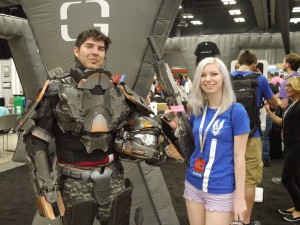
Frank Motomochi and Katie Cates from San Antonio, photo by Leslie Anne Jones

Frank Motomochi and Katie Cates from San Antonio, photo by Leslie Anne Jones

In some ways, RTX is similar to the much bigger Comic-Con events that happen around the country, but on a more personable scale. RTX booths hosted lots of indie game companies, and the designers were present at many booths. Plus, Rooster Teeth founder Burnie Burns was spotted walking through the exhibition hall on Friday, mingling with fans – a more authentic interaction than the autograph tables of Comic-Con.

In the exhibition hall, I was invited to test Chariot, a game for PlayStation 4 and Xbox One made by Frima Studios of Quebec, Canada. The main character is a princess. Player two is her fiancé. “He’s there to help,” game designer Alex Van Chestein explained. The mission is to haul a chariot carrying the coffin of the princess’ dead father to its final resting place. The dead king is a ghost, and he pipes in with banter, but the patriarch has no agency, no one will play him. It’s up to the princess and her partner to shoulder him along.

“I really wanted the female character to be a badass,” Van Chestein said. “It goes against convention, but it felt right.”
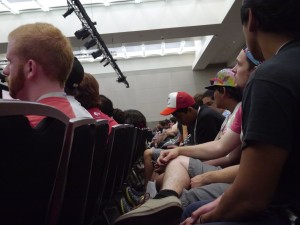
panel watchers 2The gaming industry has been roundly criticized for its boys-club culture, even though research shows about half of gamers are women. At this year’s RTX, inclusivity seemed to be on the mind of industry workers.

During a panel introducing Sunset Overdrive, an open-world shooter loaded with referential humor, presenter Brandon Winfrey noted that character choices came in male, female and gender neutral. “If you want to be a dude in a skit, that’s fine. It’s fun.”

People waited patiently for a chance to play Titanfall, a product of California-based Respond Entertainment, which was created by the makers of juggernaut-game Call of Duty – when Call of Duty: Ghosts came out in 2013, it had sales of $1 billion on its first day.

Abbie Heppe is Titan Fall’s community manager – a job title that encompasses marketing, voiceover work for the game, and a lot of playing time in order to relay feedback to the development team

Heppe, who is 32, has been gaming for almost two decades. Back in the nineties when she played Quake and Doom, a gamer who was female didn’t have to reveal her gender, whereas now with voice-chat enabled play, things are much less anonymous.

“Companies are aware of it,” Heppe said of sexism in game play. “We think about it a lot too: How can you make the gaming experience better?”

Friday evening events were cancelled due to a bomb threat, but things were rescheduled and the rest of the weekend went smoothly.

The speedy rise of RTX is no surprise to those familiar with the trajectory of Rooster Teeth.

Exhibition hall square head

Exhibition hall square head

The company recently moved into a much-bigger space at Austin Studios and also announced plans for its first feature-length, live-action comedy. According to crowd-funding website Indiegogo, Rooster Teeth met its initial funding goal ($650,000) in 10 hours. To date, more than $2.2 million has been raised for the project, making it the most-funded film ever through Indiegogo.

In its early days, Rooster Teeth’s fans were predominantly male, but that too is changing. Achievement Hunter, a comedic series where staff demonstrate game play and make jokes over it, garners a mixed audience. And RWBY, Rooster Teeth’s Americanized anime that follows four girls with super powers and big weapons who battle evil, has really tipped the scale

At RTX, Rooster Teeth announced its expansion into video game development. RWBY will be its first show to become a game. Conference goers were able to play a demo version of the game created and presented to Rooster Teeth by 19-year-old fan Jordan Scott. Scott is now working at Rooster Teeth to develop the full version.

Scott’s story echoes that of Rooster Teeth’s founders. The company is sustained by a passion for gaming culture parlayed into new products delivered to a fan base that has continued to grow.

ENTvantage Aims to Curb Antibiotics with Better Diagnostics

By LESLIE ANNE JONES
Reporter with Silicon Hills News

From left to right: Rick Hawkins, Dr. Subinoy Das, Joseph Skraba, photo by Leslie Anne Jones

From left to right: Rick Hawkins, Dr. Subinoy Das, Joseph Skraba, photo by Leslie Anne Jones

Most sinus infections are viral and don’t require antibiotics. But how can a patient and doctor be sure? Presently, a family doctor can’t quickly diagnose his patient’s sinus infection as viral or bacterial. ENTvantage Diagnostics aims to change that with an in-office nose swab that will give results to physicians and patients within 15 minutes.

Too often unnecessary drugs are prescribed to put the patient’s mind at rest, and to cover the doctor from liability on the small chance the infection is in fact bacterial. However, mistreatment can cause chronic sinus problems for patients, and antibiotic over prescription contributes to the growing threat of drug-resistant bacteria worldwide. In April, the World Health Organization released a report on antibiotic resistance. The survey found that treatment resistance for common infections was increasingly common in many regions, resulting in people remaining sick longer, with an increased likelihood of death.

ENTvantage wants to secure $1 million in funding. Once received, chief medical officer Dr. Subinoy Das estimates the venture will be able to finish engineering the diagnostic swab and be ready for clinical trials in 18-24 months.

Das, an Ohio-based researcher and one of the nation’s top sinus surgeons, has been working toward a diagnostic solution for about five years.

In some ways his scientific quest is personal: Das used to play baseball and was hit in the face with a line drive that gave him sinus problems. As a teen, he attended prestigious Thomas Jefferson High School for Science and Technology, which allowed him to intern with the Department of Defense at a laboratory developing battlefield diagnostics. This gave him experience translating existing scientific knowledge to practical use.

In his undergrad, Das was exposed to pure scientific research, after which he went on to attend medical school. “I joined a relatively unique career-path of people known as clinician-scientists,” Das said, explaining that the medical field typically produces researchers who lack clinical experience and doctors with little research background. Because of his combined education, when Das began his career as a rhinologist, he made it his goal to find a practical solution for the most pressing problem in the field, which he believed to be that doctors don’t know if their patients have bacterial or viral sinus infections.

It’s not just the systemic problem of antibiotic over-prescription that makes this a pressing issue. Improper treatment of sinus infections can lead to chronic problems that might one day require surgery. Sinus surgery is highly invasive, it involves peeling the face down and cracking open the skull, and since the sinuses are so close to the eyes and brain, there is risk of injury.

“Our diagnostics will give patients and doctors more confidence to withhold antibiotics when they aren’t needed,” Das said.

The diagnostic kit Das has been developing works by identifying bacterial proteins present in the nose that indicate the cause of infection. In the lab at Ohio State University, the test proved highly effective on chinchillas, which have immune systems similar to humans because they hail from the Andes Mountains where there’s little exposure to bacteria.

Austin-based serial entrepreneur and CEO of Lumos Pharma Rick Hawkins attended a presentation by Das at the university and was impressed. “The technology solves a really critical problem,” he said. Hawkins is part of ENTvantage’s board of directors. The venture’s president is Joseph Skraba, who has been bringing medical devices to market for 30 years. Presently, the company is finalizing a licensing deal with Ohio State University.

The company will be based in Austin, where both Hawkins and Skraba are located. Once funding is secured, ENTvantage will hire employees and also engage development partners. The company already has a prototype with some basic engineering, but it needs to be refined.

If the product makes it to market, Skraba for one is optimistic about adoption. He cited strep throat as a relevant example: Before rapid strep tests were available, antibiotics for strep throat were prescribed with much greater frequency, though only about 30 percent of people who visit doctors with sore throats have the infection.

With sinusitis, it’s only about 10 percent of cases that have a true bacterial infection. Each year, about 30 million people in the United States are diagnosed with sinusitis, so the potential for ENTvantage to cut down on the superfluous use of antibiotics is huge.

Structuring an Investor Deal is Largely About Control

By SUSAN LAHEY
Reporter with Silicon Hills News

unnamed“If you take one thing away with you, let it be this: 51 percent does not equal control.” Kevin Castillo of the Baylor Angel Network explained to an audience of about 30 entrepreneurs. “In a public company you can say ‘I own 70 percent of the company, I have control.’ But in a private company control is very much defined by the minority.”

Castillo was the first of several speakers at presentation called The Art of the Deal held Tuesday at the Austin Chamber of Commerce. The program was sponsored by the Spectrum program of the Texas State Small Business Development Center.

The cost of investment is control over your company, Castillo said. If you take investor money, you’re most likely only going to be able to repay it when you sell the company. “So if you don’t want to sell the company, don’t take investor money,” he said. Entrepreneurs often focus too narrowly when thinking about funding. For example, when it comes to term sheets, they zero in on the valuation—what the investor is trying to say their company is worth—and too little on the other terms of the deal.

“A lot of them are looking at the term sheet and only caring about the valuation. That’s dangerous. It reminds me of the story of the entrepreneur who was arguing about valuation and the investor said ‘I’ll give you any valuation you want, as long as I get to set the rest of the terms.’”

Castillo busted some myths about valuations:

  • Valuations are not objective, aren’t necessarily going to comport with other companies in the same stage, industry or area; nor can you look at what valuation your buddy got in “the same space” and expect the same.
  • It’s a waste of time and money to get a valuation from an independent accounting firm. In short, Castillo said, “We don’t care what value that firm gave you.”
  • Valuations are what the investor says your company is worth. Period.

Those Other Items on the Term Sheet

Some things investors will ask for are about economics, Castillo said. Most want preferred stocks. They’re going to ask for dividends but they’re not going to expect a business to pay quarterly dividends. They’d rather keep the cash in the company. They’ll get their dividend payments at the sale of the company. They may ask for conversion rights—to convert preferred stock into common stock.

Then there are the terms that get into control. If they ask for redemption rights, that means that at some point in the future they can make you buy out their shares at a preset price—generally only slightly above what they put in. Rarely do investors actually call in their redemption rights, Castillo said. That’s more of a control move. It’s a foot to put on the CEO’s neck and tell him to get moving. (Which is a little bit of an oxymoron.)

They will probably ask for an anti-dilution provision, known as a “down round” such that subsequent rounds of financing don’t dilute the investors share values. And they’ll definitely get control in voting rights. What those rights entail might make a big difference in whether an entrepreneur wants to go for the investment. They might cover items as broad as “You can’t increase the number of shares without my permission” or as specific as “You can’t write a check above $10,000 without my permission.”

There are a few exceptions to the rule that investors only get their money when you sell the company. Some entrepreneurs can establish revenue based financing in which the investment is paid back as a percentage of revenue. Usually the numbers are three-to-10 percent of revenue and investors expect a 2X to 5X multiple of their original investment.

Don’t Ignore Due Diligence

Before any investment, however, comes due diligence. Castillo quoted a Kauffman Foundation study that the return for investors who perform less than 20 hours of due diligence receive considerably less return on investment.

Most investors have due diligence checklists that include, as Costillo put it “Every legal form you would ever need.” Investments are often held up while entrepreneurs collect these documents from lawyers and accountants. It can speed up the process by six weeks to have copies of them on hand. There’s also a qualitative analysis in which investors talk to the team, customers and suppliers.

If entrepreneurs know they have anything in their backgrounds that could kill the deal—even an old conviction—they should let investors know up front and not hope it won’t be discovered. There’s also the Bad Actor Rule in which, if any member of the management team or shareholders fail to qualify for investment, the whole deal dies.

One factor of the due diligence process is investigating whether the company has protected its intellectual property. But on that note, Costillo said, too many companies ask him to sign non-disclosure agreements at the beginning of a discussion. Investors, he said, aren’t interested in stealing entrepreneurs’ ideas and don’t want to sign NDAs until they get to the place where they’re actually looking at the details of your technology.

Bill Hulsey, partner with Hulsey-Calhoun, spoke about the kinds of attributes investors look for. Integrity, he said, is “permission to play.” Following closely after that is passion.

Christian Forgey, owner of LightBoard Inc., which makes a technology that lights up everything from skateboards to t-shirts, concluded the presentation.

“I’m living the dream,” he joked, “and I wake up every night in a cold sweat.”

Starting with a light-up skateboard, Forgey said, he and his wife put their entire life savings into the business, cashed out their IRA and 401K, maxed out credit cards and sold his BMW to make payroll one time. Ultimately, it turned out that the most profitable business model was to dump the skateboard/longboard business and offer the light-up technology in various verticals. Focus on the technology. They’ve built a team for the company and are leveraging those connections. They’re expecting an investment from Silicon Valley of $3 million-to-$5 million.

Most entrepreneurs don’t have the background to structure these deals favorably, Costillo said. The best advice is to get a good lawyer who specializes in entrepreneurial investments. It will cost a lot, he admitted, but not as much as trying to structure the deal without one.

For entrepreneurs interested in prepping themselves, however, he suggested the book Venture Deals by Brad Feld.

Brewbot, Vaporshot and Other Tech Gadgets at Engadget Austin Live

McClellendon, CEO of Brewbot.

Chris McClellendon, CEO of Brewbot at Engadget Live Austin.

A big crowd turned out for Engadget Live Austin held last Friday to showcase some of the city’s latest tech products.

A customized beer brewing station controlled with a smartphone, a vaporized alcohol machine and a virtual reality Oculus Rift headset were a few of the devices on display at the Austin Music Hall.

Engadget, an online technology news site, is doing a series of live events around the country to showcase new gadgets, said Jeff Taylor with Engadget. More than 3,000 people got a ticket to attend the Austin event.

Other events will be held in Seattle, Boston, Los Angeles and New York.

Austin-based startups at the event included Atlas, which makes a wearable activity monitor, Chaotic Moon, maker of all kinds of software and hardware inventions, Brewbot, a robot that brews beer, Re3D, a 3D printer, Plum, a smart home lighting control device and Techjango, maker of a laptop Xbox gaming station.

The Brewbot booth attracted a steady crowd. It featured the Brewbot, a customized beer brewing device that can be controlled wirelessly with a smart phone. It’s about the size of a mini-frig and it contains everything necessary to brew homemade beer.
Brewbot moved to Austin from Belfast, Northern Ireland to participate in Techstars Austin, said Chris McClelland, its CEO.

The Brewbot costs $3,000 and they can be customized to meet the needs of the customer, McClelland said.

“It’s a robot that brews beer,” McClelland said.

Brewbot, which raised more than $194,000 from a successful Kickstarter campaign last year, is working on a venture-funding round, which the company will announce shortly.

The year old startup moved all five members of its team to Austin.

The line to sample vaporized alcohol from Vapshot was among the longest at the event.

A guy trying out Vapshot's vaporized alcohol shot at Engadget Live Austin.

A guy trying out Vapshot’s vaporized alcohol shot at Engadget Live Austin.

Victor Wong, co-founder of Vapshot, came up with the idea during a “boring weekend” last February. He got together with his friend and engineer, Larry Cotton, co-founder, and they created the Vapshot. They took the machine to a tradeshow in Las Vegas and sold $70,000 worth of the machines, which cost $4,000 each.

“We started shipping them last week,” Wong said.

The machine vaporizes alcohol into a bottle, which people then inhale with a straw. The Vapshot delivers alcohol into the lungs for an immediate buzz, which Wong estimates lasts only 15 minutes.

Vapshot is selling the machine to bars licensed to sell and distribute alcohol, Wong said. The machine can get 1,500 vaporized shots out of bottle of liquor, compared to about 20 shots in liquid form.

The Chaotic Moon booth at Engadget Live Austin

The Chaotic Moon booth at Engadget Live Austin

The line for Chaotic Moon’s demonstration stretched to the door. The company had an Oculus Rift virtual reality headset for 3D gaming interacting with an iPad app, which Chaotic Moon created. The person controlling the iPad used it to drop bombs on the person playing the Oculus Rift game.

The mash up isn’t anything Chaotic Moon plans to sell, said Chance Ivey, the company’s lead game designer.

“We look at how we can utilize it with other technologies we’ve been working with,” he said.

Capital Factory Celebrates its Sixth Anniversary Kung Fu Geek Style

Joshua Baer, founder of Capital Factory, at its sixth anniversary party. Photo by Laura Lorek

Joshua Baer, founder of Capital Factory, at its sixth anniversary party. Photo by Laura Lorek

Capital Factory celebrated its 6th anniversary Friday night with a party at Kung Fu Saloon in downtown Austin.

More than 800 people RSVP’d to attend the event and Capital Factory gave away 400 T-shirts.

Key employees and founders of Capital Factory received giant wooden Jenga blocks with their names engraved on them to commemorate the event.

Capital Factory has come along way since its founding in 2008 by Joshua Baer and a handful of Austin entrepreneurs and investors.

Up until 2012, Capital Factory served as a traditional incubator and accelerator for high-tech startups.

But in May of 2012, Capital Factory evolved into a coworking site as part of the Austin TechLive initiative with the Austin Chamber of Commerce. That’s when Capital Factory began hosting entrepreneurs, companies and others in a 22,000 square foot space on the 16th floor of the Omni building at 701 Brazos Street.

Since then Capital Factory has grown to more than 600 members, 200 companies and funded 40 companies in the last year, Baer said. Capital Factory hosted more than 600 events last year, attended by more than 25,000 people, he said.

Also, President Obama visited Capital Factory in 2013 and met with Baer and several tech startup founders.

This year, Google for Entrepreneurs designed Capital Factory as one of its entrepreneurial “hubs” a network of organizations around the country and world fostering high-tech entrepreneurship.

Capital Factory also recently launched a “device lab” where companies can demo their products and make them available to entrepreneurs and hackers. It also has a video lab that is in beta mode right now, Baer said.

Capital Factory also launched a funding program with Silverton Partners and Floodgate to provide early-stage funding to companies in its incubator program. Companies with $25,000 in support from two Capital Factory mentors will receive another $50,000 in matching funds from Capital Factory’s Fund along with $25,000 each from Silverton and Floodgate for a total of $150,000 in funding.

Capital Factory has 100 companies in its incubator right now and is adding anywhere from five to ten per month, Baer said.

Startups like WP Engine and SpareFoot started at Capital Factory, but they grew too large and moved out.

That’s the idea, Baer said. They’re still part of the network, but once a company gets to 15 employees they need their own space, he said.

“Our goal is to get them to $1 million in annual revenue,” Baer said.

« Older posts Newer posts »

© 2026 SiliconHills

Theme by Anders NorenUp ↑