The SXSW Pitch competition has selected 40 finalists for its 15th annual SXSW Pitch Competition.
“Since its inception, SXSW Pitch has been front row to some of the most ambitious startups from around the world, using creative ideas to change their industry’s future,” SXSW Pitch Event Producer Chris Valentine said in a news release.
From March 11-12, SXSW Pitch will showcase 40 tech companies from eight distinct categories for two days of live pitches in front of an audience of SXSW attendees, high-profile media, venture capital investors, and a panel of expert judges. This season’s judges include industry moguls like Stacy Feld (Johnson & Johnson), Jacqueline Jennings (Raven Indigenous Capital Partners), Mingu Lee (Cleveland Avenue), Trish Costello (Portfolia), Kay Koplovitz (USA Networks), and many more.
Participating companies come from all around the world, with finalists this year representing Norway, Germany, London, Ireland, Brazil, Taiwan, and the United Arab Emirates, to name a few.
This year, the competition includes two Austin and one San Antonio finalist and five alternates from Austin.
A new mobile phone service, REALLY, announced last week that it had received $18 million in seed-stage funding.
Adam Lyons, the founder of TheZebra.com, is the company’s founder and CEO.
“We raised this capital to create the modern telco. REALLY is a tech company. A lifestyle brand. A movement. We are building the telecommunications company that people love,” Lyons wrote in a LinkedIn post.
Polychain led the round with Floodgate founding partner Mike Maples Jr and other strategic partners.
According to Lyons, REALLY wants to be the number one online retailer for phone plans. However, he said it also plans to offer its products and services alongside others.
“REALLY is already the most comprehensive wireless comparison platform in the nation comparing over 279 plans across 50 carriers,” Lyons wrote in his post. “But we aren’t stopping there. We plan to launch our own phone service later this year for people that care about their community and privacy.”
REALLY’s mobile network and infrastructure will create a blockchain-powered telecommunications community owned by the people using it, focusing on privacy, accessibility and anonymity for a 5G network.
Among the industry experts leading the infrastructure and service build-out for REALLY are executives from AT&T, T-Mobile, GoogleFi, uShip, Indeed, Niche, and The Zebra.
“Smartphones and mobile networks have become indispensable, yet most people don’t love their service provider. We see a massive opportunity to fix this, and our mission is to create a brand in this industry that people trust and love,” Lyons said. “We are building a better, more affordable phone service allowing communities to build equity and support their neighbors by using their cell phones. Those interested in putting a mini cell tower in their home or business will also have the opportunity to earn in USD. No other network exists that truly puts the ability to create and power the network in the hands of users like this.”
REALLY Wireless is set to launch later this year.
“The ongoing and rapid adoption of Web3 and blockchain into our everyday lives has allowed for an unprecedented period of change in telecommunications,” said Maples Jr., founding partner at Floodgate, said in a news release. “Adam and the team of industry experts assembled to make REALLY a reality have proven track records of excellence in their fields. We are excited to be able to play a part in this paradigm shift in telecommunications that will redefine how the industry functions.”
DivInc, the premier startup accelerator for BIPOC and women entrepreneurs, announced the nominees for its 5th Annual Champions of Change Awards held in Austin, Texas.
The awards ceremony will occur on Thursday at Distribution Hall. This year’s theme is ‘Rise,’ a reflection of the champions who embody the organization’s mission and power initiatives that spark sincere change.
“Champions of Change is not the traditional awards recognition event. It is a celebration of the best of Austin,” explained Preston James, Co-founder, and CEO of DivInc. “The community comes together in unity to recognize awe-inspiring, unsung leaders who are creating positive change. Everyone walks away with pride knowing that we’re truly moving forward together to create a world where social and economic disparities no longer exist.”
Tickets to the event are $50 per person and are available on Eventbrite here.
Proceeds from the event will go directly to support DivInc’s efforts in bridging the gap between underrepresented entrepreneurs and the resources they need to build profitable high-growth, high-impact startups.
“Over the years, I’ve had the honor to witness Champions of Change grow with more and more individuals at the helm of meaningful action and impact. Our future relies on their leadership to provide a safe and supportive space for underrepresented communities,” said James, “These nominations recognize the trailblazers who demonstrate exceptional dedication towards advancing diversity, equity, and inclusion in Austin and beyond.”
This year’s categories include Executive of the Year, DEI Leader of the Year, Young Leader of the Year, Champion of the Year, Investor of the Year, Startup Leader of the Year, Rising Star of the Year, Spacemaker of the Year, and Non-Profit Leader of the Year.
2023 Nominees
Executive of the Year
Kana Livolsi, CEO and Co-Founder of Dos Mundos Creative
Ricardo Martinez, CEO of Equality Texas
Shaleiah Fox, Chief Advancement Officer at The Thinkery
Shuronda Robinson, CEO of Adisa Communications and Austin Woman Magazine
Wendy Howell, Co-Founder and CEO of Executive Council Network
DEI Leader of the Year
Amy Maldonado, Global Inclusion Programs Coordinator at Indeed
Brion Oaks, Vice President of DEI and Operations at Charles Butt Foundation
Dr. Elizabeth Medina, Inclusion & Accountability Director at Everly Health
Rachel Lauren Pierce, Vice President of People and Culture at Dream.Org; Founding Partner at Diversified Consulting Firm
River Holley, Global Diversity, Belonging and Inclusion Specialist at AMD
Young Leader of the Year
Alyse Gamble, Public Affairs D&I Content Specialist at HEB
Ash Hall, Founder & CEO of Justice Strategies, LLC
Azteca Sirias, Founder & Executive Director at Aztech Kidz Code
Chastiny Brown, Programs Manager of 3 Day Startup
Corey Alan, Program Associate at 3 Day Startup; Community and Youth Engagement Consultant at OutYouth
Champion of the Year
Dr. Angela Valenzuela, Professor in Educational Leadership and Policy at The University of Texas at Austin
Hailey Easley, Executive Director at Austin Asian Community Health Initiative
Maria Brown-Spence, Founder of Hearts2Heal; Director of Environmental, Social & Governance (ESG) at SThree
Judge Maya Guerra Gamble, Judge of 459th District Court
Ryn Gonzales, Director of Operations and Programs at Out Youth
Investor of the Year
Andy Ambrose, Partner at TheFund Austin
Betty Wu Adams, Managing Director of Equity Investments at The Disability Opportunity Fund
Cat Dizon, Co-founder of Active Capital
Juan Thurman, Co-founder and Managing General Partner of SWAN Impact Fund
Sanika Bhave, VC at Capital Factory
Rising Star of the Year
Alyse Gamble, Public Affairs D&I Content Specialist at HEB
Daniela Silva, Consultant at Farmshare Austin
Dante Clemons, Co-Founder Origin Studio House
Jazz Mills, Founder and Director of Operations at Free Lunch
Nicole Cardoza, CEO & Founder at Reclamation Ventures
Nonprofit Leader of the Year
Diana Anzaldua, Founder & CEO of Contigo Wellness
Kelenne Blake-Fallon, Executive Director at Black Mamas ATX
Phyllis Everette, Founder & CEO of Saffron Trust Women’s Foundation
Rockie Gonzalez, Deputy Director at Austin Justice Coalition
Timeka Walker, CEO of United Against Human Trafficking
Startup Leader of the Year
Carley Deardorff, Director of Strategic Partnerships at Capital Factory
Luis Gramajo and Hans Scheri, CMO and CEO of Wunderkeks LLC
Katrina Tolentino, Executive Director at Naturally Network
Sierra Pena, CEO & Co-founder of Shelfleet
Sugar Tennon, Founder and CEO of Pink Sugar Treats & Eats
Spacemaker of the Year
Diana Melendez, Esq., Co-Founder of Women of Color Collective; Attorney at Diana Melendez Law, PLLC
Dominique McLeggan Brown, Founder of The Sisters in Law LLC
Katrina and Eric Brooks, Owners of Black Pearl Books
Marissa Rivera, Founder & Community Curator, Ola Wellness _OFCOLOR
Natalie Sanders, Founder of House of LEPORE & the ORISHA mere project
Allison Jenkins Schickel wanted a robe with a built-in bra to provide support after she got out of the shower.
When she couldn’t find one, she created it by sewing a sports bra into a bathrobe.
Schickel took the bathrobe bra combination to Fredericksburg for a girl’s weekend wine trip and her friends fell in love with it. They called it the Brobe. The name stuck.
The following year, Schickel’s friend Wendy was diagnosed with Stage III breast cancer and The Brobe took on a whole new meaning. Wendy told Schickel about the need for a hospital robe that could support the drains women have after undergoing surgery. The existing robes were “ugly as hell, overpriced, and not made from a nice material,” Schickel said.
“They were only focused on the sickness,” Schickel said. “They were not focused on wellness.”
The women recovering from breast cancer surgery needed something to make them feel beautiful and to give them their power back, Schickel said. So, she created The Brobe, a “bra” and “robe” combination with pockets for ice packs, prosthetics, drains, and more.
“I wanted to do something that mattered,” Schickel said.
Schickel officially launched the company in 2012 and to date, “Brobe’s functional and fashionable post-surgery apparel has reached more than 50,000 customers and garnered sales of $2.7 million.”
Last week, Schickel launched an equity crowdfunding campaign on StartEngine with the goal of raising $1.2 million. So far, the company has been bootstrapped and running on revenue along with a $150,000 Small Business Association loan from PeopleFund.
Brobe sells direct to consumers online at retailers like Amazon. It also sells directly to plastic surgery centers, lingerie boutiques, and hospital systems.
Brobe started off focused on functional fashionable adaptive clothing for breast cancer survivors but has since expanded to helping people recovering from other major surgeries like open heart, organ transplant surgery, vasectomies, and more, Schickel said. Today, 70 percent of her sales are non-breast cancer related, she said.
The company also recently launched the Elliot Superhero Robe for children who are undergoing treatment at the hospital.
Schickel plans to use the funds raised from the crowdfunding campaign to buy more inventory because she’s not able to meet the demand for her product right now, she said. The Brobes are made in a factory in Shenzhen, China. She ran into supply chain problems during the pandemic and her inventory actually sat on a ship in the ocean for four months. Now that manufacturing and supply chain problems have subsided, Schickel is ready to ramp up production and inventory.
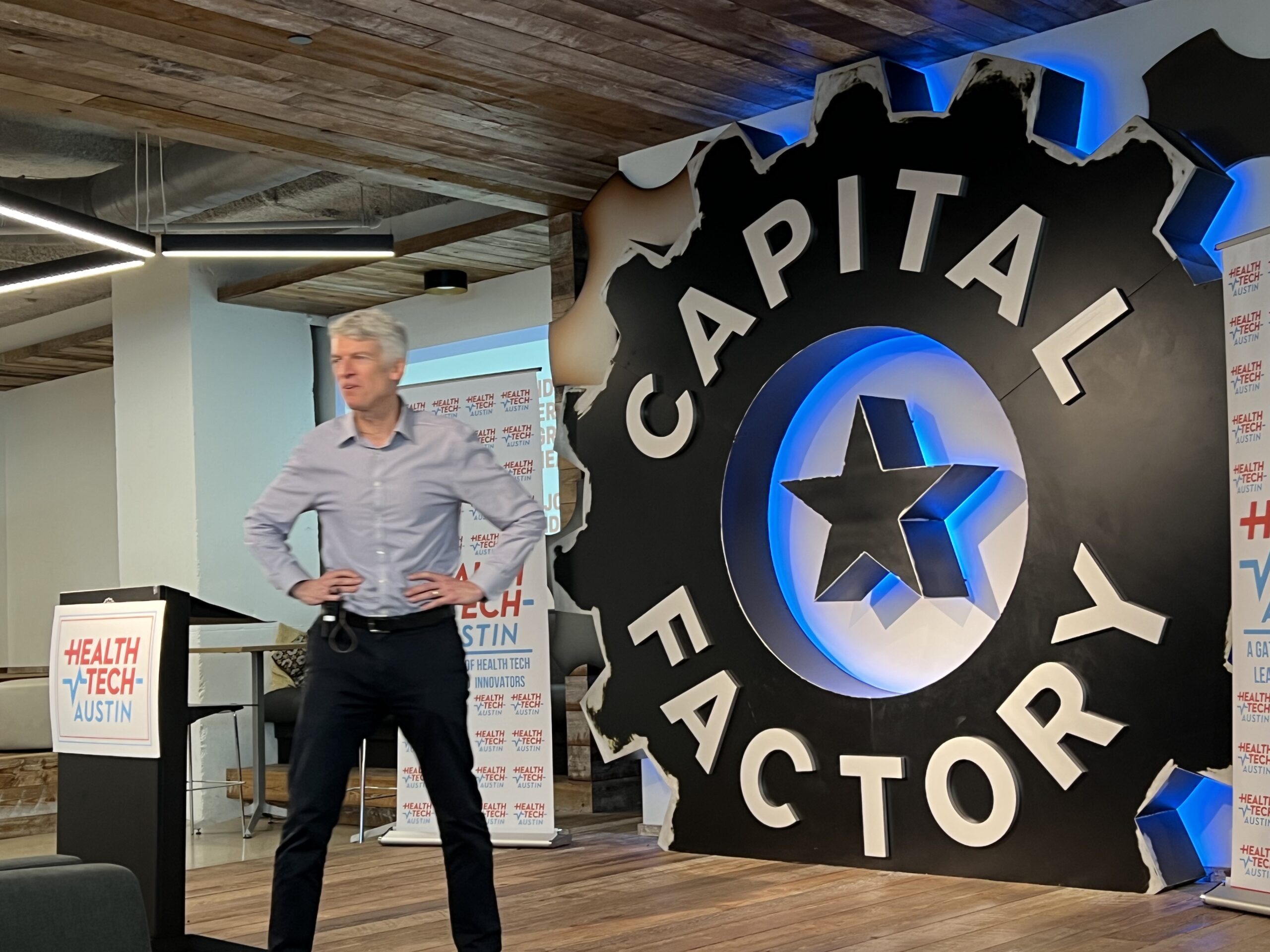
Hugh Forrest, C0-President and Chief Programming Officer at SXSW speaking at the Heath Tech Austin Summit
This year’s South by Southwest is going to be bigger than 2022, but not yet back to the pre-pandemic level, according to Hugh Forrest, Co-president and Chief Programming Officer at SXSW.
More than 51,000 people are expected to attend SXSW 2023, which runs from March 10th to March 19th.
There’s going to be a big increase in international attendance this year, Forrest said.
The SXSW conference features panels, sessions, meet-ups, workshops, networking, and more. It includes Interactive, Film, and Music segments and features 25 tracks of programming.
About a decade ago, SXSW added the Health & MedTech programming track, which runs from March 10th through March 13th, Forrest said.
SXSW added the track because SXSW is largely a reflection of what’s happening in Austin, Forrest said. And the Dell Medical School was opening, which spurred development and innovation locally in biotechnology, medical technology, and healthcare.
Forrest spoke Thursday morning at the Heath Tech Austin Future of Care Delivery Summit at Capital Factory. He said the event provided a preview of the kinds of programming that will be showcased at SXSW.
Among the sessions, there will be a discussion on how doctors are using TikTok now to reach younger audiences, Forrest said. Nick Jonas, singer, and songwriter, will be in a featured session titled “Crushing: The Burden of Diabetes on Patients” at 10 a.m. on March 13th.
Forrest also highlighted a documentary, “No Ordinary Campaign,” which will screen on March 12th at the Alamo Theater on Lamar. The film focuses on Brian Wallach, a former Obama White House staffer, who was diagnosed with ALS “on the same day he and his wife Sandra brought their second daughter home from the hospital.” The documentary focuses on Wallach’s fight against ALS and his fight for drug approval and research funding. Journalist Katie Couric is one of the film’s executive producers.
The Health & MedTech tracks have grown to be incredibly popular with SXSW attendees, according to SXSW. This year, the content includes everything from aging, data, and FemTech to organ transplants and virtual care. It also includes a new area of focus on brain-computer interfaces, featured in the sessions titled “Hello World: Brain-Computer Interfaces at Scale” as well as in “Superhuman: Meet The World’s First BCI Pioneers.”
The intent of the healthcare system isn’t aligned with improving things, said Dr. S. Claiborne “Clay” Johnston.
“It’s not about making healthcare better,” said Johnston, the inaugural deal of the Dell Medical School, who left that job in 2021 after seven years and co-founded Harbor Health in 2022.
Austin-based Harbor Health is disrupting the way patients receive healthcare.
The first time he talked about his new venture in public was Thursday morning at the Health Tech Austin’s Future of Care Delivery Summit at Capital Factory.
Tony Miller, the other co-founder of Harbor Health, is a serial healthcare founder. He formerly founded Bind Benefits in 2016 which offered on-demand healthcare and sold to United Healthcare. Before that, Miller founded Definitely Health which sold to United Healthcare for $300 million in 2004, according to the Wall Street Journal.
Harbor Health is working with employers and Medicare to redesign benefits and care to reduce costs and improve care.
“We’re wasting a ton of money,” Johnston said.
For example, only 25 percent of people with high blood pressure are being treated for it, Johnston said. If that rose to 100 percent, then 60 percent of heart attacks and strokes could be prevented, he said.
Harbor Health is a fee-based system that focuses on preventative care and providing access to doctors through telemedicine and even text-based exchanges, Johnston said. It’s also focused on finding the best specialists for the patients, he said.
Harbor Health is redesigning the care system around things that matter, Johnston said.
The new healthcare provider has three clinics in Austin, Round Rock and Kyle. The clinics provide primary care, chronic disease management, behavioral health, health and wellness services, and Medicare wellness exams. The multi-specialty clinic groups treat infants, children, adolescents, and adults.
Harbor Health has raised a $9.5 million Series A round of funding from two investors, according to Pitchbook. The company has 100 employees, Johnston said.
Curative started in 2020 as a company focused on improving outcomes for sepsis patients.
But then the Pandemic struck.
It quickly pivoted to become one of the nation’s largest testing centers for COVID-19 with 19,000 locations. Its test sites completed 36 million tests and 2.5 million vaccinations, said Fred Turner, the company’s CEO, and co-founder.
Now Curative’s headquarters are based in Austin with 400 employees and it’s pivoting again.
At the Health Tech Austin Future of Care Delivery Summit at Capital Factory Thursday morning, Turner shared more about the company’s new mission as a healthcare insurance provider. It’s creating a Netflix model for next-generation healthcare.
The startup has created a new employer-based health plan that offers $0 copays, $0 deductibles for in-network services, and preferred prescription drugs as long as the member completes a baseline visit to their primary care physician without 120 days of plan activation. If they don’t, then the member defaults to a plan with a high deductible plan.
At the baseline visit, the member is given a preventative health assessment, but they are also taught how to navigate the system, Turner said. Each member is assigned a “health navigator” who helps them understand their goals and needs and navigate the complex healthcare system.
After Curative’s COVID-19 testing business, Turner said he wanted to focus on something that would move the needle on how healthcare was delivered and make it better for everyone.
Fifty percent of the people in the U.S. get their insurance from large-group employer health plans. Curative is available to companies with more than 50 employees in Austin. It plans to move into the San Antonio market next within a few months, then Dallas and Houston later this year, Turner said.
High deductible health plans don’t work, Turner said. Those plans usually discourage people from getting preventative care like mammograms and colonoscopies or early detection of diabetes and heart disease, he said.
“By not investing in primary care and preventative care that comes back to bite you,” Turner said.
Curative’s plans offer zero cost in network and that builds trust with members, Turner said. Curative wanted to design a plan so that the member always knows what it will cost to receive care, he said.
Two percent of a healthcare plan’s members are generating 50 percent of the costs, Turner said. A dollar spent on primary care is worth way more than a dollar spent to treat a major health problem that if detected early could have been prevented, Turner said. In the long run, the plan ends up saving a lot of money and people are healthier, he said.
Curative already has 10,000 providers in the Austin area, Turner said. Its network includes major providers such as the Austin Regional Clinic, Austin Diagnostic Clinic, and all of St. David’s facilities, among others as well as 24-hour access to a local physician via telemedicine.
“We want you to go get care,” he said. “We want you to get the right care.”
Curative picked Austin for its headquarters at 900 Congress because the Curative brand is already well-known here, Turner said. In addition, Curative has a lab in Pflugerville. It also chose Texas because of its regulatory environment for new healthcare companies, he said. And Austin has a number of headquarters for large companies, he said.
To date, Curative has raised $8 million in venture funding, according to Crunchbase.
The event takes place from 8:30 a.m. until noon. The event features opening remarks from Dr. Desmar Walkes, a public health expert, family physician, and medical director for the City of Austin, and Hugh Forrest, co-president and chief programming officer for South by Southwest.
The event also features four “TED-like talks” from the following speakers: Fred Turner, chief executive officer and co-founder of Curative, Mike Geeslin, president and CEO of Central Health, the Travis County Health District, Kacie Kelly, chief innovation officer at the Meadows Institute and Dr. S. Claiborne “Clay” Johnston, co-founder and chief medical officer of Harbor Health, a vertically integrated health delivery system that launched last year in Austin.
“I thought that maybe by starting a new academic medical center we could change the health system. I was wrong,” Johnston says in a news release. “We need to design an entirely new system.”
Kelly agrees and says, “Solving the mental health crisis requires a complete paradigm shift. At the Meadows Institute, we are working with health systems, school systems, and justice systems to design and implement data-driven solutions that are available today to correct the trajectory of mental health care.”
The summit opens with breakfast at the Capital Factory, first floor of the Omni Austin Hotel Downtown, 700 San Jacinto.
Madhu Basu, the founder of Unnanu, wants to scale his startup to a billion-dollar contextual search company in the next ten years in Austin.
Already, he’s been issued a U.S. patent on selecting media using weighted keywords and he has another patent pending. He’s focused initially on applying the technology to match job seekers with jobs through Unnanu Hire.
But he sees widespread applications of the technology across all industries.
In this episode of the Ideas to Invoices podcast, Basu discusses his company’s plans for 2023 which include raising more than $3 million in seed-stage funding and hiring more than a dozen employees.
Previously, Basu founded and served as CEO of PMCS Services, which provided IT consulting, staffing, and solution services for more than 16 years. He also co-founded IntegrateUS, Prachas Technologies, and The Fresh Vegetable Package company.
“Unnanu is my fifth company,” Basu said. “I always found businesses to solve other businesses’ problems.”
Basu founded Unnanu because he saw a need to map job candidates to job descriptions contextually. He couldn’t find a way to do that. So, he built a solution and created better contextual search technology.
“It’s actually a search problem,” Basu said.
He named the company Unnanu, which means hello in his native Indian language.
“Why? Because our search is so intricate part of what we do, it’s kind of like saying hello I need this,” Basu said.
Search technology has to be refined, Basu said.
“I think we have a chance to get better at that,” he said.
Open.AI with its ChatGPT technology is exploring artificial intelligence and machine learning to provide better answers to search questions, Basu said. He mentions a recent video from Greylock’s Intelligent Future Summit featuring a discussion between Open.AI CEO Sam Altman and Reid Hoffman, a serial entrepreneur and general partner at venture capital firm Greylock Partners on the future of AI. In the talk, Altman says with the new conversational AI models, there will be a serious challenge to Google’s existing search business. It’s a massive trend and very large businesses will be built around conversational AI, Altman said.
Unnanu is targeted at becoming one of those, Basu said. A fundamental problem with AI is it is missing contextual analysis, Basu said. His pending patent is focused on contextual analysis and weighted keywords, he said.
Right now, Unnanu is bootstrapped. The company recently participated in the Founder’s Institute program in Austin. And it has since gone on to participate in Founder’s Lab, Basu said. It’s in the process now of raising funding, he said.
Unnanu used to be based at Galvanize, which abruptly shut down operations in Austin last year. The company is now located at WeWork on Congress downtown.
For more listen to the entire podcast below or wherever you get your podcasts.
Madhu Basu is the founder of Unnanu, a tech startup from Austin that helps businesses by using a patented contextual weighted keyword search. The company currently provides a simple solution for businesses to have resumes mapped to jobs contextually.
Sana, a healthcare insurance company, Tuesday announced it has laid off 19 percent of its staff.
Will Young, Sana CEO and Co-Founder, announced the layoffs in a LinkedIn Post late Tuesday afternoon. He also posted a statement on the company’s blog. He said the layoffs were painful but necessary to keep the company operating successfully in today’s environment.
Laid-off Sana employees began posting “open to work” status on LinkedIn Tuesday. Sana had around 210 employees. A source reported 40 employees were let go this week.
Sana is providing its laid off employees severance pay equal to three months of their base salary, paid medical, dental and vision insurance coverage through May 31st, the ability to keep their laptops, removal of the one year cliff for equity and three months of career services through RiseSmart, a job placement services firm.
For the past few years, Sana has focused on “accelerating growth and product development came at the cost of higher risk tolerance and greater expenses,” according to Young’s blog post. He wrote that the company is “fundamentally well-positioned to weather downturns.
“However, we need our investments to reflect the realities of the current macroeconomic environment and funding climate,” Young wrote. “This means re-orienting our company for leaner times today so we can continue delivering on our mission decades from now.”
To date, Sana, founded in 2017 by Young and Nathan Hackley, has raised $107 million. In June of 2022, Sana closed on a $60 million in Series B funding.
Sana provides health care options for small businesses. The company reports that Sana’s customers often save up to 20 percent compared to legacy insurers. It also provides telehealth care and low co-pays. Itoperates in eight states.
In January of 2022, the company opened Sana MD in Austin. It is Sana’s first primary care health center for members. In addition to in-person office visits, Sana gives employees access to virtual care with providers specializing in primary care, pediatrics, maternity and mental health.
The news of Sana’s layoffs come a week after Decent, another healthcare startup based in Austin, announced plans to wind down operations to a core team and layoff most of its 40 employees.
Nationwide, tech companies have been trimming staff. Zoom announced on Tuesday it was cutting 1,300 employees, according to the New York Times. Other tech companies in Austin laying off employees include Dell, which announced this week plans to cut 6,500 employees worldwide, according to the Times. Microsoft, Alphabet, Salesforce, Meta, Amazon and PayPal have all announced layoffs recently, the New York Times reported.