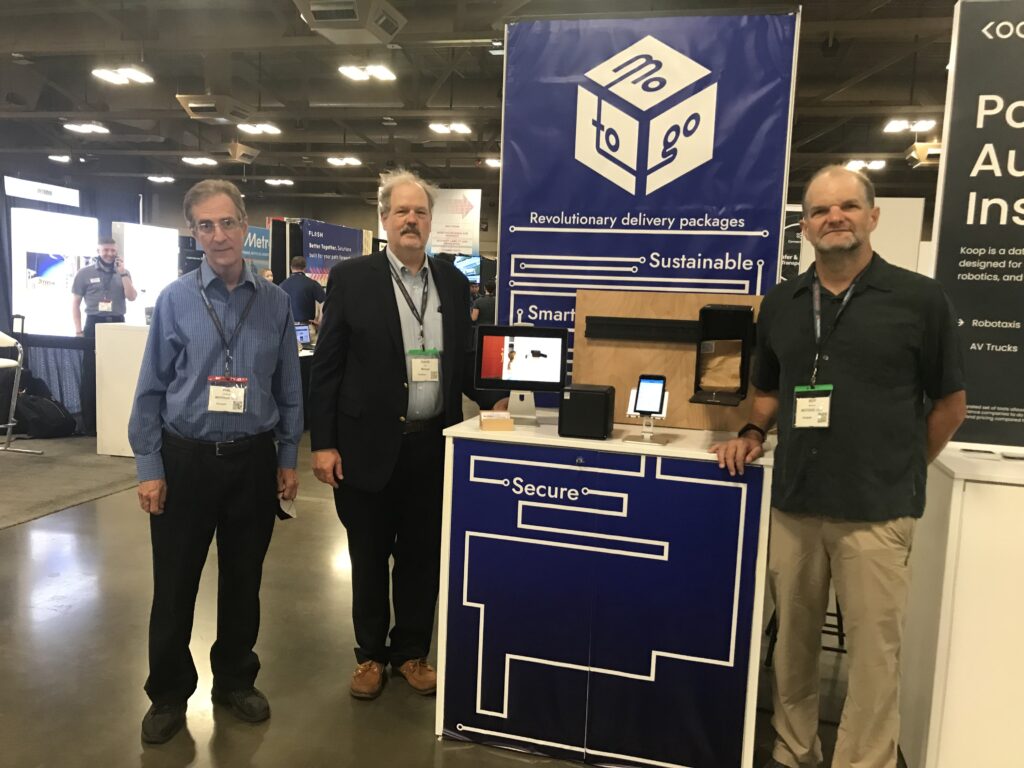
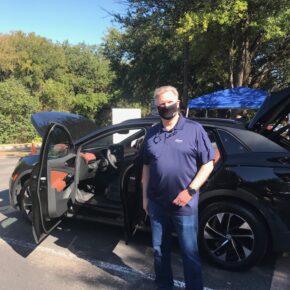
MoToGo has a vision of a future where the delivery of goods is affordable, simple, secure, equitable, and sustainable, said David Ruth, CEO and Co-Founder of MoToGo, based in Austin.
The system includes a black metal box and a metal railing that affixes to the side of the house and it’s all controlled by a smart mobile phone. The system ensures for safe and secure delivery of a variety of goods including pharmaceuticals, Ruth said.
Ruth along with Roy Stedman, the company’s Chief Technology
Officer and Phil Chidester, Chief Solutions Architect, demonstrated the MoToGo
system at their booth at the MOVE America conference held at the Palmer Events
Center in Austin.
Founded in 2016, MoToGo has seven U.S. patents that have
been issued on the hardware and software behind the delivery system.
The business model is evolving, Ruth said. But right now, a subscriber, such as a pharmacy, could have 50 boxes a month and charge its customers for secure delivery of their pharmaceuticals, he said.
The MoToGo system relies on Internet of Things sensors to track the delivery box from store to the consumer and it even records when the box has been opened. It sends notifications to the sender and the receiver at every step, Ruth said. It communicates through cellular networks, he said.
In California, where marijuana is legal, the system could be
used for secure delivery of products, since delivery of products required
locked boxes, Stedman said.
The company is bootstrapped. The founding team previously worked at Dell and IBM and other technology companies in Austin. Ruth worked for IBM for 31 years before leaving to launch MoToGo.
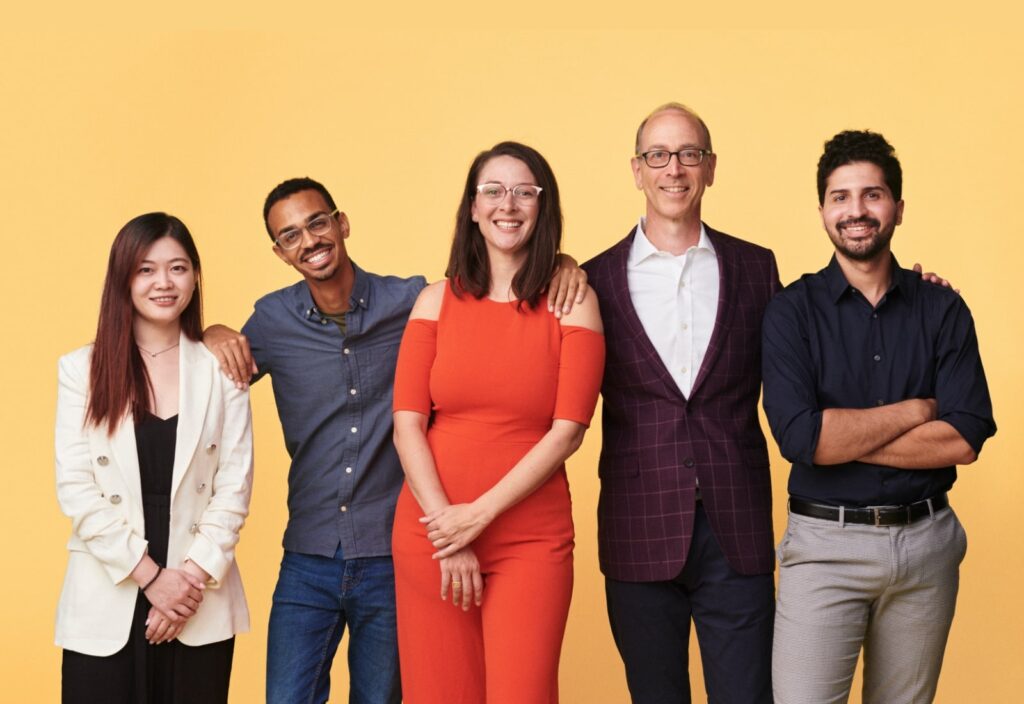
A few weeks ago, LOOP, a new car insurance company, launched in Texas.
And now, LOOP has announced it has closed on a
$21 million Series A funding round co-led by Foundry Group and 01A, the fund of
former Twitter CEO Dick Costolo and COO Adam Bain.
The round includes participation from existing investors in Freestyle VC, Blue Fog, Uprising Ventures, and Concrete Rose, and new strategic investment from New Voices Fund and Earn Your Leisure. Rap icon and avid angel investor Nas also participated.
The Series A comes just nine months after LOOP closed on a $3.25 million seed-stage round of funding led by Freestyle VC.
The support of the investors allows LOOP to “fiercely
accelerate our growth” and expand its mission, John Henry, Co-Founder and
Co-CEO said in a news release.
“We are building a completely modern
architected insurance company, “ Carey Anne Nadeau, Co-Founder and CO-CEO said
in a news release.
LOOP moved to Austin earlier this year. They have more than 30 employees and plan to be at more than 100 in the next six months and 1,000 within a year, according to a previous interview with Henry.
LOOP, a public benefit corp., known as a B-Corp., doesn’t use credit scores, occupation or education in its underwriting. Instead, the company measures how users drive, paired with crash, weather, and traffic data.
“The result has been more equitable and
competitive pricing for millennials, renters, and immigrants who are often
burdened by student loans and consumer debt and are disadvantaged by legacy
models,” according to a news release.
This financing makes it one of the largest Series A rounds raised by a female founder or founder of color. LOOP plans to expand its coverage to an additional 10 states over the next 12 months.
Kristian Russell, Chief Executive Officer and Founder of Ferry
Electric mobility should exist for everyone, said Kristian Russell, Chief Executive Officer and Founder of Ferry.
That’s why he created Ferry.
“Upgrading your car with Ferry is as easy as upgrading your phone,” Russell said.
Ferry, based in Austin, uses an app-based platform to handle all the transactions of leasing an electric vehicle for 6 to 24 months at various prices. For example, the Polestar 2 EV, with an MSRP of $45,900 before the federal tax credit, can be leased through Ferry for $899 a month. The platform even offers a lease on an electric Vespa.
Ferry, founded in July, is launching soon, Russell said. Mayra Del Bello, former head of marketing at LiveOak Venture Partners, recently joined Ferry as its director of marketing. The Ferry team had a booth at the MOVE America mobility conference at the Palmer Events on Tuesday and Wednesday. The conference shined a spotlight on all the innovation going on locally, nationally, and globally on smart mobility including autonomous vehicles, electric fleet, and bus vehicles, and EVs for consumers as well as micro-mobility solutions such as electric bikes and scooters.
To lease a vehicle with Ferry, customers must have a driver’s license, pass a credit check, and provide a bank account or a credit card. The subscription includes the car, the charger, and 1,000 miles a month, as well as vehicle tax, title, and registration, and access to roadside assistance, according to the company’s website.
The big idea is to make EV ownership more equitable and accessible to greater numbers of people, Russell said. And with more EVs on the road, the impact on the environment of carbon emissions is greatly reduced. That creates a cleaner, better mobility solution for everyone, he said. And in addition to reducing emissions, electric vehicles can save drivers money on gas and maintenance.
Ferry is also working on a deal with Austin Energy to provide discounts to its employees to lease EVs through Ferry, Russell said.
In addition, there currently are state and local incentives for EV vehicle owners. The state of Texas’ light-duty motor vehicle purchase or lease incentive program provides drivers with rebates of up to $2,500. And Austin Energy’s rebates for EV charging include special rates on plug-in locations and rebates for installing a 240-volt charger.
Electric vehicle ownership is starting to increase in the U.S. As of 2020, nearly 1.8 million EVs were registered in the U.S., which has more than doubled in recent years, according to the International Energy Agency.
About 7 percent of all adults in the U.S. said they currently have an electric or hybrid vehicle, and 39 percent said they were very or somewhat likely to seriously consider buying an electric vehicle for their next car purchase, according to a recent Pew Research Center survey.
The team behind Ferry at MOVE America at Palmer Events Center in Austin
Benish Shah, a go-to-market strategist, specializes in growing companies via brand, revenue, and product.
She’s worked across tech, media, and consumer packaged goods. A licensed lawyer, she’s been published in Forbes, Refinery29, and more. She is also the author of two children’s books.
Shah co-founded and served as CEO of a fashion tech startup. She also served as director of marketing strategy at SAY Media, VP of Marketing at Raised Real, which was acquired by Once Upon a Farm, and head of product marketing at Refinery29.
Shah recently sat down with Silicon Hills News on the Ideas to Invoices podcast to talk about the startup ventures she’s been involved in and the lessons she’s learned.
She founded a legal startup to make legal services more
affordable.
“The hourly rate felt a little antiquated,” Shah said. “It makes
getting a lawyer almost inaccessible because you never know if something is
going to cost a few hundred dollars or a few thousand dollars.”
She worked on creating a model for lawyers to do flat rate
deals, which has become more common in the last decade, she said. Shah has
never left the legal field and has found that her law degree has helped her in the
various startup ventures she’s been involved in.
She left the legal startup to co-found a fashion startup,
which used crowdfunded projects to decide how many garments to make. The company
was way ahead of its time, Shah said.
“We were way too early on that concept,” Shah said. “It did
not take off the way we wanted it to.”
There’s a market for it now, Shah said.
“You can have the best ideas but you can launch them at the
wrong time,” she said. “And they won’t work.”
Shah is good at seeing a trend when it’s forming and not when
it’s happening. And when people invest, they look at a trend that is already happening.
“You have to know the trends that are appearing and then you
launch when the market is ready for them,” she said.
Many pioneers survive because they come from some kind of
backing that allows them to continue operations without going bankrupt, Shah
said.
More funding and opportunities are becoming available to women and people of color but only because people of color are tenacious and they’ve demanded changes, Shah said. They’ve taken a chisel to the concrete ceiling and the black community has been working on this for decades, she said.
“The breakthroughs that are happening are not actually breakthroughs, they are years of labor both emotional, physical, and financial from these communities that have gotten us to where we are,” she said.
There are a ton of new VCs and seed funds focused on under-represented
founders, but we don’t know yet what that means or how that is going to come
out, she said.
The traditional markers that many investors look for in entrepreneurs
are not always present with under-represented founders. They may not have gone
to an Ivy league school or worked in a particular job or industry. They may not
have an extensive network of well-connected friends and family members.
“When those markers don’t exist and that’s not what you’re
using to make a decision, that to me is a true breakthrough if you’re able to
do,” Shah said. “And that’s what I’m watching.”
Companies, firms, and organizations that have hired people of color also need to support them and make sure they are given the resources to succeed, she said.
Most recently, Shah moved from New York to Dallas to be
closer to her family. She also co-founded COVID Tech Connect, a non-profit that
raised more than $10 million in less than 6 months to help during the COVID
2020 crisis. The nonprofit organization raised the money to put tablets into
the hands of COVID-19 patients in ICUs across the nation so they could say
their last goodbyes to family members and loved ones.
Shah also launched the first-ever product marketing course at General Assembly to help more women get into the technology and product field.
For more, listen to the entire podcast, pasted below, or wherever you get your podcasts – available on Google play store, Apple iTunes, Spotify, PlayerFM, Libsyn, and more.
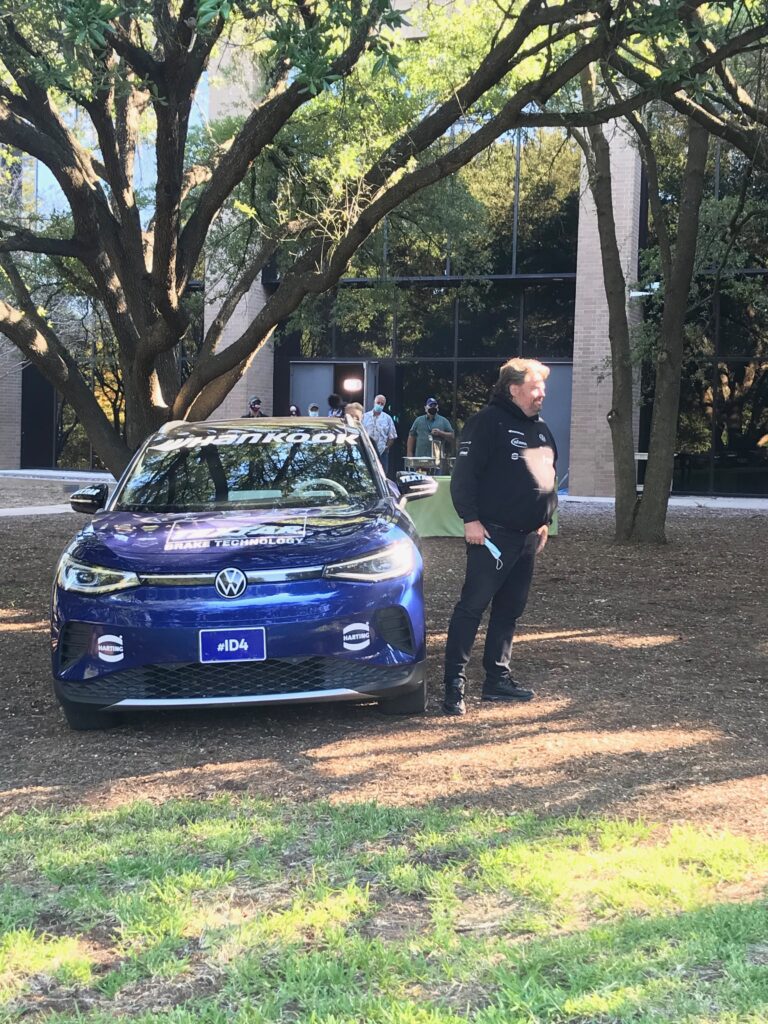
Rainer Zietlow, a professional driver with the all-electric 2021 Volkswagen ID.4 he has driven more than 30,000 miles
A
blue Volkswagen ID.4 rolled into Austin on Friday on a quest to break a Guinness
World Record for longest road trip in an electric vehicle.
“This world record should
demonstrate that an EV engine car can perform the same as a combustion engine
car,” said Rainer Zietlow, a
professional driver who holds several electric vehicle world records.
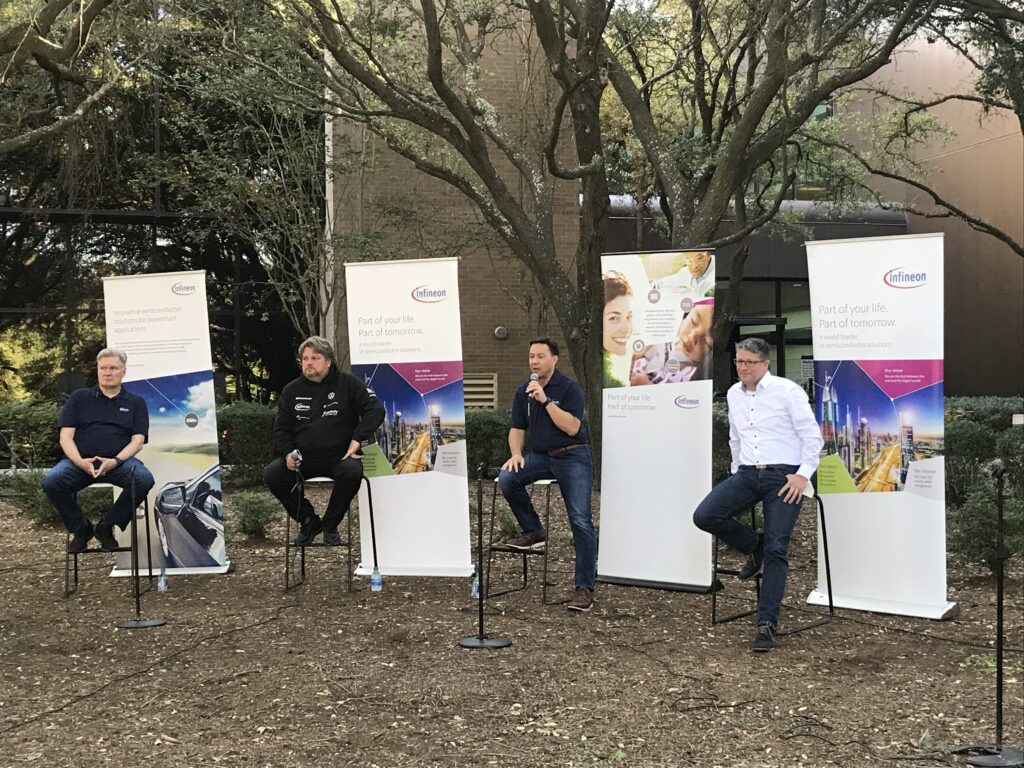
On Friday morning, Zietlow drove the 2021 Volkswagen ID.4 onto the lawn of Infineon semiconductor’s plant in Austin. It was the fourth stop on a 37,000-mile road trip through 48 states that began on July 18th in Herndon, Virginia, and ends on Oct. 18th. The stops took place at Infineon’s locations throughout the U.S. including Austin, Livonia, Michigan, San Jose, and El Segundo, California. The last stop is in Washington, D.C.
Zietlow
and his co-pilot Derek Collins of Kansas City, Mo., stopped at the Infineon fab
in Austin because it has played a key role in the operations of the Volkswagen
ID-4.
The Austin-based manufacturing plant, the largest for Infineon in North America, is making dozens of chips that perform various functions in the car including adaptive cruise control, emergency braking system, Wi-Fi, and Bluetooth communications. Infineon even makes the chips that power the drivetrain.
Zietlow
said he can’t see or feel the Infineon chips, but that’s the point. They are
the magic under the hood.
“I
have a good feeling that Infineon is on board,” Zietlow said. He already holds
the world record for with the Volkswagen ID-3, a smaller version of the car,
with Infineon on board in Germany driving 18,000 miles and visiting 850
Volkswagen dealers.
“Our
semiconductors are at the heart of vehicle electrification and the enabling
charging infrastructure,” Lars Ullrich,
vice president of automotive at Infineon Technologies Americas said in a news
release. “By increasing range, efficiency and accessibility, we are helping the
automotive industry to successfully achieve the fundamental transformation
towards electromobility – to protect the environment without compromising
drivers’ flexibility and comfort.”
The
ID.4 is Volkswagen’s first all-electric SUV and the brand’s first global EV. With
a price tag of $39,995, the vehicle can travel up to 250 miles on a fully
charged battery. Zietlow uses a mobile phone app to check for his next charging
station on the road. It takes about 35 minutes to recharge the battery to 85
percent, Zietlow said. Volkswagen partnered with Electrify America, which has 600 charging stations
in the United States with plans to add 300 more within two years, he said. Most
of the charging stations were based at Walmart stores near the highway, he
said.
Infineon
already has plans to expand the fab in Austin through the CHIPS for America
Act, which is a bill pending in Congress that was introduced by Texas Senator
John Cornyn and others, said Carl Bonfiglio, with Infineon’s automotive group
based in Michigan. The Volkswagen ID.4 has more than 50 chips just from
Infineon. The CHIPS for America Act would
invest tens of billions of dollars in semiconductor manufacturing incentives
and research initiatives over the next decade to strengthen and sustain American
leadership in chip technology.
San Jose-based Infineon Technologies entered the Austin market when it bought Cypress Semiconductor, with the sale closing in April of 2020. The Austin campus was previously an AMD site. The factory, built in 1995, produces chips using 200 mm or 8-inch diameter wafers. The Austin Infineon site has 1,000 employees and 1.5 million square feet of space of which 115,000 is cleanroom space, said Steve James, vice president of Infineon’s Wafer Fab Operations. The plan is to add 40,000 square feet of cleanroom space, he said.
Steve James, vice president of Infineon’s Wafer Fab Operations
Roughly 70 percent of the world’s cars contain chips made in Austin, James said. More than 35 electric and plug-in hybrid models with a drivetrain using power semiconductors from Infineon will be in production worldwide this year. Infineon has been in the automotive business for more than 35 years. Electric cars have a lot more semiconductors than traditional cars, Bonfiglio said. That is also putting additional strain on the semiconductor industry as more electric vehicles hit the road.
Infineon
also specializes in security. The chip that is in all U.S. passports is an
Infineon chip.
As cars connect to the Internet, there is a need to ensure communications are secure and that no hacker can get into the car. That’s top of mind at Infineon.
“Technology
you can trust is what Infineon seeks to provide,” Bonfiglio said.
The event features more than 100 sponsors and exhibitors on the expo floor and more than 100 conference sessions across 18 content stages. MOVE America features more than 300 speakers from government, tech, Tier 1/2/3, and industry verticals.
It’s a chance to gather with thousands of your industry peers and network and connect in person after 18 months of Zoom calls. There’s also a drink reception.
The speakers include:
Steve Adler,
Mayor, City of Austin
Mei Cai, Director,
Battery Cell Systems Research, General Motors
Edwin Olson,
CEO, May Mobility
Rory Harvey, VP,
Global, Cadillac
Sonia Rief, VP,
Vehicle Connected Services & Program Management, Nissan North
America
Gerardo Interiano, VP of
Government Relations, Aurora
Austin-based Sana is a healthcare startup that provides health insurance plans as an alternative to big insurance providers like Aetna, Anthem Blue Cross Blue Shield, United Healthcare, Cigna, and Humana. It competes with them by providing insurance that is, on average, 30 percent cheaper. Will Young, CEO and Co-Founder of Sana, recently answered questions about how the Pandemic has affected Sana’s operations.
Q. Has the Covid-19 Pandemic changed the way Sana Benefits works?
A. Yes and no. Yes, because we previously had an office in Austin that our sales team and others worked out of before the pandemic. Those employees and teams had to switch to a work from home model which was an adjustment. No, because most of our team was already remote before the pandemic so we already had good systems in place to hire and manage remote teams.
Q. Do you plan to adopt new ways of working as a result of the Pandemic?
A. The pandemic has deepened our commitment to remote work. If we were 90 percent committed before COVID we are now 100 percent.
A. When do you plan to return to the office?
We are figuring out our strategy now. It’s less and less likely we have a traditional office setup going forward. Having clusters of part-time opt-in coworking might be what we lean into, but all options are still on the table.
Q. Do you require employees to get vaccinated?
A. No. We strongly encourage employees to get vaccinated because we believe the science supports it, but ultimately it’s a personal health choice and we respect that boundary. As we return to in-person events we may request that people who have not been vaccinated abide by stricter mask protocols.
Q. What are you doing to promote company culture and motivate your team while they are working remotely?
A. The best thing you can do for company culture – whether remote or in-person – is to hire motivated people and give them the opportunity to do rewarding work. That’s far and away the most important thing we focus on. We also do things like virtual watercooler channels in slack, randomly assigned groups for social zoom hangouts (opt-in basis) and team happy hours.
Q. Has remote work been beneficial or detrimental to the growth of your business?
A. As a health plan that helps businesses save on costs, Sana’s messaging really resonated with employers during the pandemic. Employees’ health was top of mind and the bottom line was hurting as the economy contracted. We grew a lot last year.
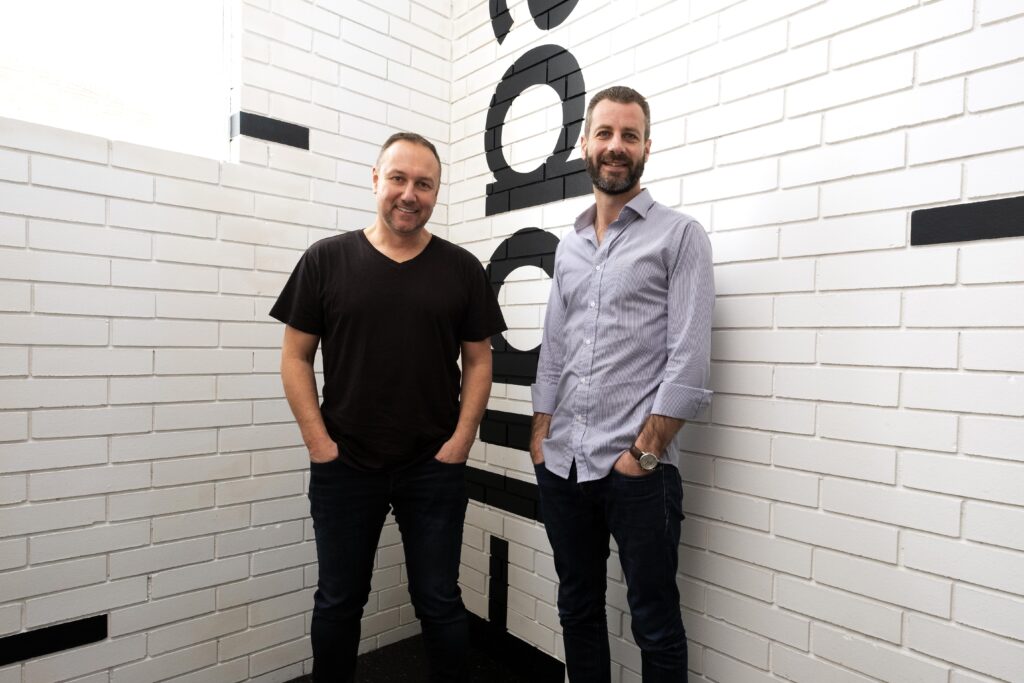
Balke Hutchinson, CEO of Flippa and Mark Harbottle, Flippa Co-Founder
The Internet has enabled all kinds of new businesses from blogs to shops to apps to flourish.
Many of those businesses pull in revenue from consumers, advertisers, affiliates, and more.
To help match business sellers with buyers, Flippa created an online marketplace for businesses and digital assets. And on Monday, the company announced it has raised $11 million.
The company, founded in
Melbourne, Australia, has its North American headquarters based in Austin.
Flippa’s Series A round was led by Sydney-based venture capital firm OneVentures. The round also included existing Flippa investor Andrew Walsh (ex-CEO Hitwise, acquired by Experian) and Co-Founders / Investors Mark Harbottle and Matt Mickiewicz – Co-founders of Flippa, as well as 99designs. Flippa’s new investors include Gabby & Hezi Leibovich (Founders of Catch.com.au), Guy King and Bevan Clarke (Founders of RetailMeNot.com), and Tim O’Neill and Tim Fouhy (Founders of Reactive Media).
Flippa sells digital
assets like mobile apps, eCommerce stores, blogs, software companies and other
online businesses.
Platforms such as Amazon, WordPress,
and Shopify enable entrepreneurs and creators to startup and scale their
projects into sustainable companies. Flippa gives them a place to sell those
businesses.
Flippa has more than 3 million
registered users to date. Flippa’s proprietary
valuation product and matching algorithm accurately values businesses and
matches them directly with qualified buyers.
“In 2009, Flippa
invented the space for buying and selling digital businesses and as a
bootstrapped startup we’ve achieved #1 status globally,” Blake Hutchison, CEO
of Flippa, said in a news release. “We’ve witnessed thousands of success
stories, where business owners use Flippa to realize value in their
extraordinary efforts. We are now growing into a market network to streamline
transactions of all sizes and we’re excited to empower the next generation of
entrepreneurs and investors.”
With the funding, Flippa,
with 50 employees, plans to hire more than 50 new employees in Melbourne, San
Francisco and Austin as well as remotely. It also plans to use the funds to
expand its platform product functionality, including scaling the company’s
business valuation tool.
Sante Ventures, an early-stage healthcare, and life sciences investment firm, announced it has raised $260 million for its Fund IV.
The Austin-based investment firm plans to invest the funds in building a portfolio of 15-25 investments across biotech, health tech, and medtech businesses that demonstrate the genuine potential to deliver better health outcomes at lower costs.
Sante secured the
capital from more than two dozen limited partners including the Pennsylvania
Public School Employees’ Retirement System and new institutional investors
in Asia and Latin America. Returning limited partners in previous Sante funds made
up nearly 90 percent of the total capital.
“The confidence and
commitment of our investors led to the quickest fundraise since inception,” Kevin
Lalande, Co-Founder and Managing Director of Santé Ventures, said in a news
release. “We are grateful for their partnership as we deploy this next fund to
capitalize on significant healthcare opportunities and nurture cutting-edge
technologies that can improve lives.”
“We have seen firsthand
how events over the last 18 months have accelerated the adoption of technology
in all facets of life, especially in healthcare,” Lalande said. “Our team’s
deep understanding of biological systems, machine learning, and health industry
economics offers a truly differentiated investment platform. Santé’s
disciplined portfolio strategy is designed to engineer the luck out of
fund-level venture capital returns by delivering superior performance
independent of vintage year and the broader macroeconomic cycle, as
demonstrated in the success of our track record over the last 15 years. We are
well-positioned to develop this next portfolio of compelling new venture
opportunities, which will be consistent with the investment strategy and
operating principles that have served the firm so well to date.”
As a first-mover in the healthcare and life science sectors, Santé typically leads or co-leads Seed or Series A fundraising rounds, often creating the new company from scratch or as an entrepreneur’s first institutional investor.
Founded in 2006, Sante
Ventures has made 76 investments and had 13 exits, according to CB Insights. It
has invested in Claret Medical (Boston
Scientific), TVA Medical (Becton Dickinson), Millipede Medical (Boston
Scientific), Molecular Templates (MTEM), AbVitro (Celgene) and Explorys (IBM
Corp).
Self Financial announced it has raised $50 million in additional funding.
The Austin-based fintech
company has raised $127 million to date, including $40 million in funding last
December.
The Series E round of
funding was led by Altos Ventures with participation from Meritech Capital and
Conductive Ventures.
The company plans to use
the funds to scale its business to make building credit accessible for the 100
million Americans that have no credit or low credit scores, according to the
company.
Self Financial created
the Credit Builder Account to allow its customers to build credit and savings
without a hard credit inquire or prior credit history. It also offers the Self
Visa Credit Card, a secured card. To date, Self has served more than two
million customers.
“We deeply support
Self’s mission of helping underserved customers to build credit and savings,
bringing them into the American financial mainstream,” Anthony Lee, Managing
Director of Altos Ventures said in a news release. “Since our original
investment, Self has helped millions of people build credit and this latest
round will enable them to scale their team and products to help millions
more.”
Self’s customer base has
more than doubled in the last 12 months, according to the company.
“We believe everyone
should have the opportunity to improve their financial future. That belief
shapes everything we do, so looking ahead, we will continue to invest in the
business and improve on our products to offer industry-leading solutions that
support consumers, particularly those who are new to credit or building their
credit,” Self founder and CEO James Garvey said in a news release.
Self now has nearly 200
employees, up 120 just this year.