Global
Partners led the round with participation from Ulu Ventures, SV LATAM Capital,
Jumpstarter Ventures, Verso Capital and Capital Factory Ventures.
Onuu,
pronounced “on you” is focused on low-income consumers. The company will
provide life insurance, savings and credit card products along with financial
literacy lessons and a personalized digital guide.
The Austin-based company runs a monthly subscription-based model.
Felix W. Ortiz III, a serial entrepreneur, and Ryan Wuerch, who formerly founded DOSH, founded Onuu.
“Far
too many Americans are rejected when they apply for financial products because
of adverse selection,” Ortiz said in a news release. “The goal of Onuu is to
bring them into the financial system fairly and give them a chance to prosper
by offering financial security as a product.”
“My
late grandparents, Felix and Candi, influenced my life so immensely and
ultimately, were the catalysts for Onuu,” Ortiz said. “To turn the financial challenges,
they faced into an opportunity to serve millions of people who are in a similar
position is not only an honor, it’s a responsibility.”
The
majority of Onuu’s VC funders are Latinx-led. It is a majority Hispanic-owned
company, with a 20-person staff, 60 percent of whom are minorities or women.
“We
believe fintech has entered a new phase of contextual financial services, where
companies like Onuu will use AI-driven approaches to provide relevant financial
services within the context of their users’ financial lives,” Roman Leal,
Managing Partner of Leap Global Partners said in a news release. “Onuu’s vision
of providing financial security for the roughly 166 million Americans
traditionally left out by financial institutions is well aligned with our
mission of challenging the status quo in fintech.”
Flash, a parking solutions provider, announced this week that it has raised $250 million in strategic investment led by Vista Equity Partners.
The Austin-based company, founded in 2011, has created a smart parking system that lets real estate owners, parking operators and cities solve problems of congestion and lack of visibility into parking supply and demand.
To date, the company has raised $314.3 million in total funding, according to Crunchbase.
Other
investors in the deal include L. Catterton, other prior investors and
management.
The
company plans to use the funds raised to expand its Flash mobility operating
system and payments platform, extend digital services, and hire more than 200 employees
this year.
Flash
also plans to focus on mobility solutions including electric vehicle charging
stations, autonomous vehicle staging, and mobility-as-a-service.
“When
FLASH was founded, the parking industry was poised for transformation and
digital mobility platforms were nascent,” Dan Sharplin, Chairman and CEO of
FLASH, said in a statement. “We are rapidly future-proofing urban mobility
infrastructure by providing an agile, cloud-based, mobile-first platform for
the myriad opportunities facing cities, citizens, asset owners, utilities, and
parking operators. We are thrilled to welcome Vista as an investor and partner
whose expertise and experience will ensure we continue innovating to advance
the connected mobility experience.”
Flash
has more than 10,000 customer locations nationwide and in Canada. It processes
more than 11 million parkers per month and more than $1 billion in annual
transactions.
“FLASH
has an incredible opportunity to continue its disruption of a massive
industry,” Marc Teillon, Co-Head of Vista’s Foundation Fund and Senior Managing
Director, said in a news release. “We are excited to partner with Dan and the
entire FLASH team as they innovate to advance the connected mobility
experience.”
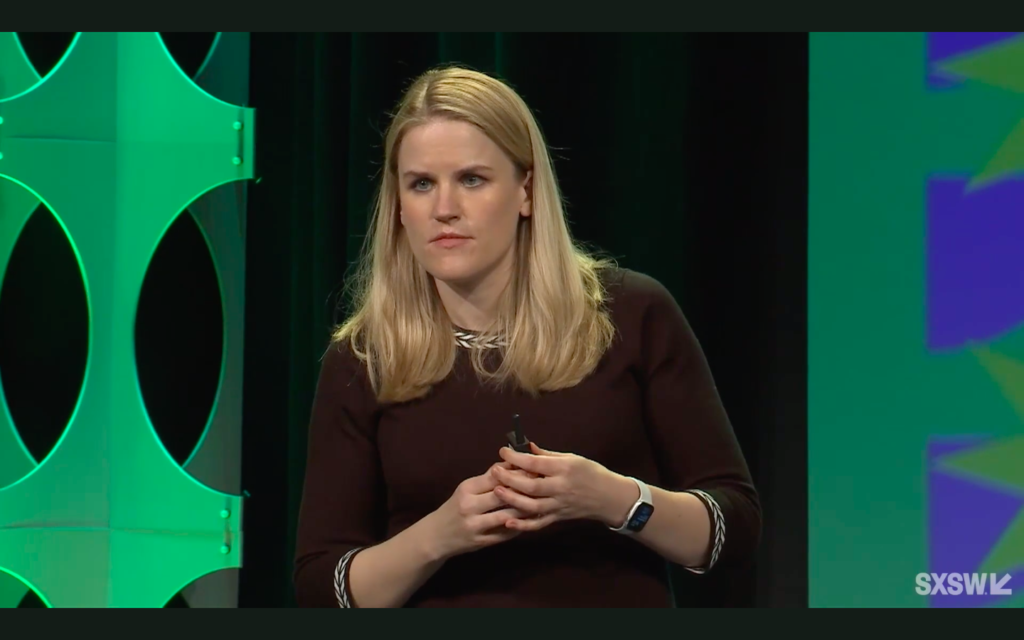
Facebook
still has a huge problem with spreading misinformation throughout the world,
said Frances Haugen, former product manager turned Facebook Whistleblower.
“The
problem at Facebook is not about bad people or bad ideas it’s about giving the
most reach to the people with the most extreme ideas,” Haugen said.
Haugen
spoke at South by Southwest on Tuesday morning. Facebook CEO and Founder Mark
Zuckerberg spoke virtually via camera, in an afternoon session but didn’t
mention any of the issues Haugen raised. Instead, he focused on the rebranding
of the company to Meta and its focus on creating tools for the emerging Augmented
Reality, Virtual Reality 3-D world known as the Metaverse.
In
her talk, Haugen said she joined Facebook in 2019 after a Facebook recruiter
reached out to her. She worked on a team focused on civic misinformation. It
was an extremely personal issue, she said. She had lost connection with a close
friend who went down a rabbit hole of misinformation.
Before joining Facebook, Haugen worked as a product manager at Google, Pinterest, and Yelp. Her job largely focused on algorithmic products and recommendation systems like the one that powers the Facebook news feed.
In her job, Haugen began to see Facebook prioritize profits over safety. She realized that the company also misrepresented how it was dealing with the problems of hate speech, violence, teenage mental health, human trafficking, and misinformation on its platform to the public, investors, and the government.
So,
in 2021, Haugen became a whistleblower and gave tens of thousands of Facebook’s
internal documents to the Securities and Exchange Commission.
“It’s
really easy to be dismissive of the severity of misinformation,” Haugen said.
Without
having the ability to have shared facts, people don’t have the ability to
discern fact from fiction.
“In
the case of the truth, there is only one truth,” Haugen said.
Zuckerberg thought AI could solve the problem of misinformation online but it only made the problem worse, Haugen said. All artificial intelligence or machine learning systems are biased, Haugen said. She called them hill climbers. They consume information and optimize for the content that gets the most reactions, she said.
“The
scary thing is that fake news is way more compelling than real news,” Haugen
said.
That’s why third-party fact-checking and AI by machines do not work, Haugen said. The systems as they are written are not designed for scale, she said.
Google and Apple are transparent on how they operate but Facebook is not, Haugen said.
“There is much less incentive for Apple to lie to us,” she said.
But Facebook is different, Haugen said. Facebook is a closed system, she said. Each one of us has a different experience on the platform, she said.
Facebook
had been warned by an activist five years prior to 2020 that Facebook had a
problem with human trafficking that was happening on the platform, Haugen said.
When she brought it up with Facebook executives, they told her over and over
again that it wasn’t real and that it was not a big deal.
“Because
no one could see inside of Facebook they got away with it,” Haugen said. “When
my disclosures came out – we had proof. The public had proof.”
Facebook
gives the most reach to the most extreme ideas, Haugen said.
“It
does that because it makes them money,” she said.
Facebook
has not been about family and friends for a long time, Haugen said. It started
to change around 2008, she said. .Facebook is a private company and they have a
fiduciary duty to its shareholders, she said.
“Every
quarter they need you to look at more and more content,” Haugen said.
That
solution to get people on Facebook to spend more time and engage more was
groups, Haugen said. These things are designed to be addictive and they are
designed to create a rabbit hole for you to fall down into, she said.
“Groups are the gasoline that is ignited by the algorithm,” Haugen said.
Facebook
also had a huge influence on the election, Haugen said. By the time we got to
the ballot box in December, Facebook got to vote first, she said.
The
QAnon, Neo-Nazi and other hate and misinformation groups flourished on
Facebook, Haugen said.
Facebook has an algorithm that rewards polarized content, she said. And government oversight and regulation are needed to make sure the public’s safety is prioritized, Haugen said.
“The main thing I always advocate for is transparency,” Haugen said. “We have to have legislative-supported transparency.”
“Facebook
knows how to keep us safe without censoring us,” Haugen said. “But the reason
why it doesn’t. It makes more money running the system the way it does today.”
Digital identity in the metaverse, robots that are smarter than humans, synthetic biology to create chicken from stem cells, and climate change are some of the major trends Futurist Amy Web discussed at South by Southwest on Sunday morning
This year, Webb’s 15th annual trend report is 668 pages long and covers 574 longitudinal tech and science trends, and is divided up into 14 reports. But the trends alone are not enough, Webb said.
“You need to use trends to help you re-perceive the future,”
Webb said. “To help you influence the future.”
The biggest problem facing the world right now is not creating Web3, the Metaverse, or AI Robots taking over the planet, Webb said. The biggest threat has to do with a climate emergency, she said.
“Already, earth has warmed by about 1 degree Celsius or 1.8 degrees Fahrenheit, since the 19th century, before industry started to boom,” according to the Environmental Defense Fund. “While we experience the effects, we’re on our way toward 1.5 degrees Celsius or 2.7 degrees Fahrenheit by as early as 2030.”
Rising temperatures are leading to extreme weather events
worldwide. And if the world hits the 2-degree Celsius benchmark, those weather
events will become even worse, Webb said.
“We’re not making enough changes,” Webb said. “We’re not
doing enough about it. We’re not taking any action.”
It’s not enough to know the data, Webb said. People need to
take actions right now to change behavior so that the future outcomes will be
better, she said.
In addition to climate change, the major trends Webb talked about focused on Artificial Intelligence, Web 3, the Metaverse, and Blockchain and Synthetic Biology.
AI advancements are moving fast, Webb said. In 2012, a neural network taught itself how to
recognize a cat. Today, those networks can generate cat clones that look identical
to the real thing in a matter of seconds.
Image recognition and generation are seamless today, she said.
AI is reaching other benchmarks like figuring out how to beat humans at complex computer games, Webb said. Google’s DeepMind created an AI Agent 57 that beats humans at classic Atari games. More recently, an AI Agent named GT Sophy beat some of the world’s best drivers of PlayStation racing simulation game, Gran Turismo Sport.
“We’re getting closer to the day when AI networks do make
their own decisions without a human in the loop,” Webb said. “And if that has
you freaked out, you are not the only one.”
“AI is starting to change how we communicate,” Webb said. “They
can determine what we mean, not just what we say.”
Webb showed an example of an AI-generated synopsis of her report. She gave the AI agent a prompt with instructions, and it wrote the summary on its own from her data.
“We are generating data that can be mined and refined by AI systems,” Webb said.
And it’s not just about facial recognition anymore. AI can
recognize people by their breathing patterns or heartbeat.
“If you don’t want to be recognized, it’s not like you can
stop breathing or have your heartbeat stop,” she said. “AI systems don’t need
your face to see you and know who you are.”
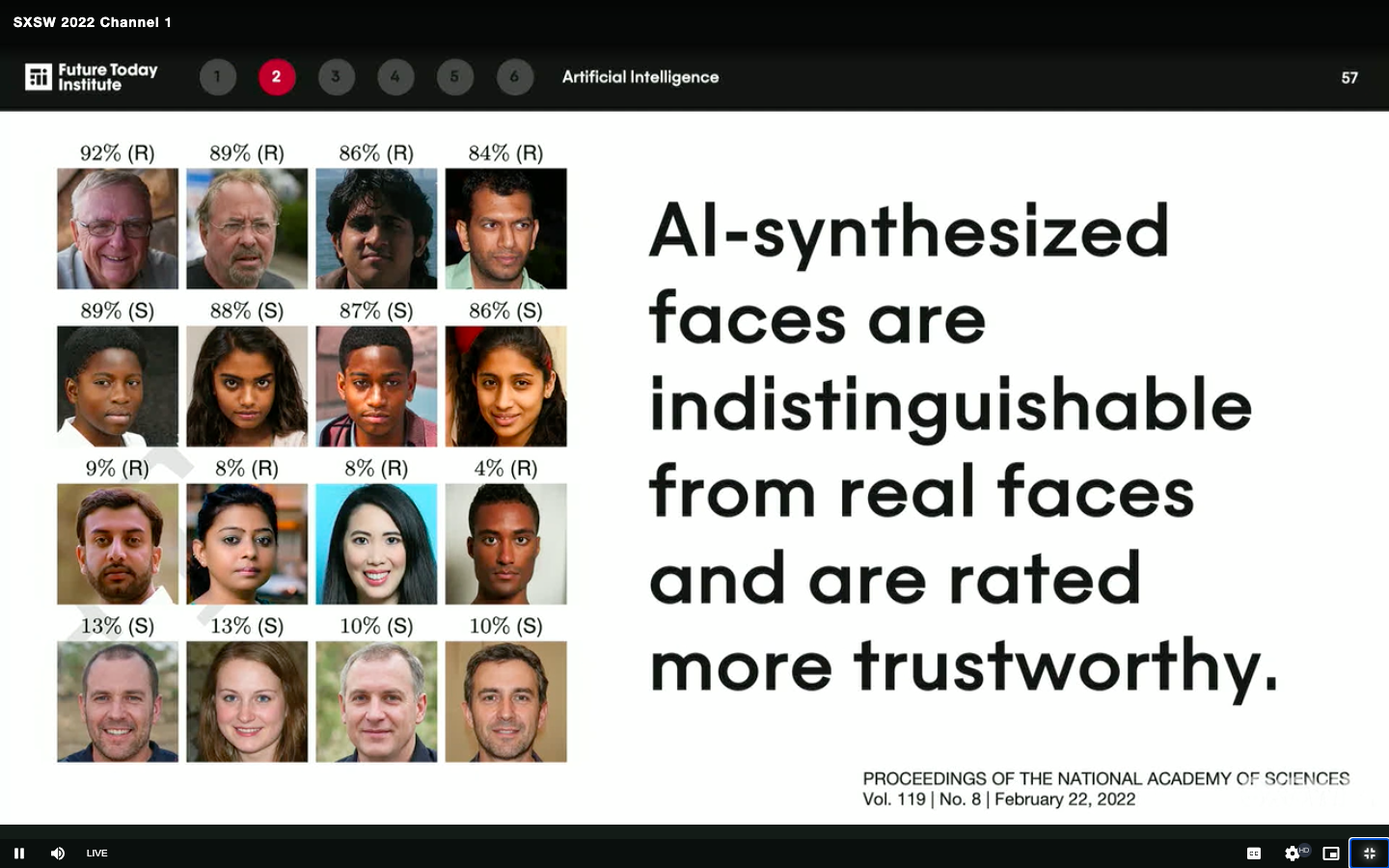
The scary thing is people trust AI-generated faces, more than they trust real faces, Webb said. AI can pull all the characteristics of trustworthiness, friendliness and create faces that don’t exist, she said.
Next, Webb talked about the next generation of the Internet called Web 3. It is real and it is very important, she said. But digital collectibles, called Non-Fungible Tokens, are not the long-term play, she said.
“The next version of the Internet will become more embodied,”
she said.
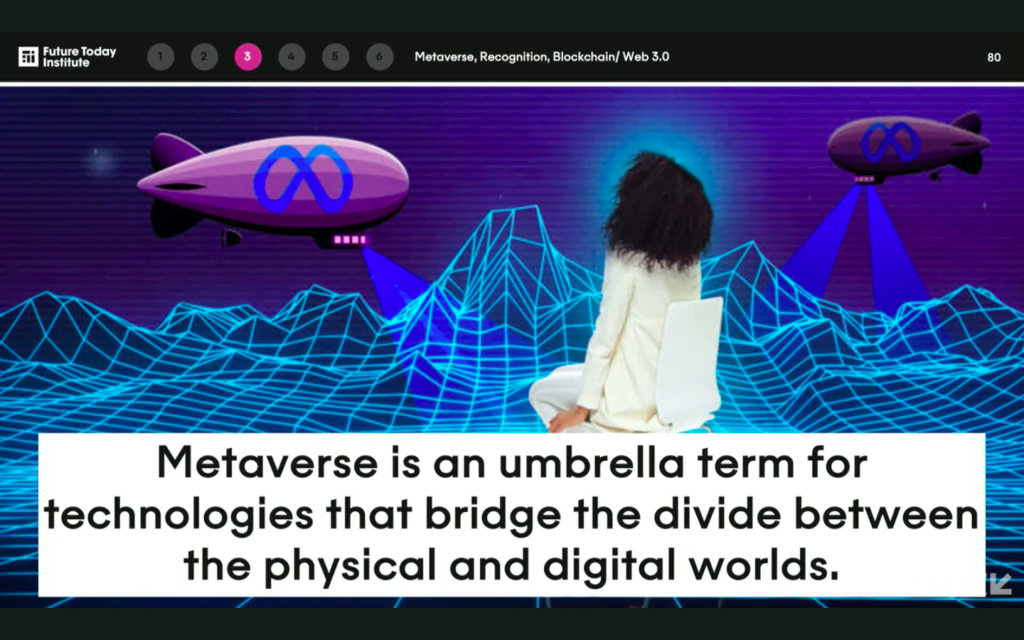
The metaverse is part of Web 3, the next version of the Internet, Webb said. The problem is there are no common protocols for the metaverse right now, she said.
“If you think managing passwords is a challenge today,
imagine having to manage different synthetic versions of yourself sprinkled all
over the metaverse,” Webb said.
Eventually, everyone will all have a digital ID, she said.
In the Metaverse, a digital ID is like a driver’s license,
but it controls your data and you’re in charge of it and you’ll be able to parcel
out different versions of your data as you see fit, Webb said.
Already, a Canadian-based company called Secure Key is creating digital IDs to protect data and information and give consumers pseudo-anonymity in the Metaverse, she said.
The buzz around NFTs will begin to fade, Webb said. Digital collectibles are valuable because of scarcity, but now the market is saturated with them, she said. But for now, the hype is real. Someone recently paid $650,000 for an NFT of a yacht in Sandbox.
“The analogy to fine art doesn’t mesh,” Webb said.
The Metaflower Super Mega Yacht sold for $650,000 in Sandbox
Webb also cautioned people to beware when they enter the Metaverse because they are much more vulnerable to influences. That is why regulation is needed, she said. Web3 is about transparency, interoperability, and trust, she said. But there need to be regulators to make sure that the virtual world develops in a healthy manner, Webb said.
Lastly, Webb talked about advances in synthetic biology like making chicken from stem cells. Lab-grown chicken is already being sold and consumed in Singapore.
The same big tech companies, Microsoft, Google, and Facebook, are working on synthetic biology applications, Webb said.
There are many products being made from DNA. Microchips are
being made with DNA that can be used to reprogram the body and for life
extension.
China owns most of
the DNA in the world. The second and third biggest owners are Ancestry.com and
23andMe, Webb said.
The key takeaways from Webb’s talk are “we’re in a period of
acceleration,” Webb said.
“Bias still persists, and we need to fix that,” she said. “Decentralization
will benefit some, but not all. We don’t have guardrails or national plans.”
And lastly, “we will need to define what is “real,” Webb
said.
At South by Southwest, Beto O’Rourke, the Democratic candidate for Texas Governor, said when he gets the job, he’s going to make marijuana legal in Texas.
“We’re going to make sure that we no longer lock up people for
possession of a substance that is legal in most of the rest of the country, and
most of the rest of the free world,” O’Rourke said.
And even though Texans of all races and ethnicities use marijuana at the same rate, black and brown people are arrested and locked up and convicted of drug crimes at a much higher rate, O’Rourke said.
It’s not enough to legalize marijuana, but Texas needs to
expunge the records of those who have been convicted of marijuana possession
and served time for their crimes so there is some justice for them, O’Rourke
said.
Evan Smith, CEO and Co-Founder of Texas Tribune, interviewed
O’Rourke at SXSW. He asked him how can he get a Texas Republican Legislative body
to pass laws for the legalization of marijuana.
“I’ll let you in on a secret,” O’Rourke said. “Republicans
like to get high just as much as Democrats like to get high.”
“That would be a secret, I’ll say that for sure,” Smith
said.
This is one of the most broadly popular issues in the state,
O’Rourke said.
In other issues, O’Rourke blasted Gov, Greg Abbott for failing to keep the lights on in the energy state of Texas during the February Winter Storm of 2021.
The storm resulted in hundreds of deaths and losses ranging from $195 billion to $295 billion, making it the single costliest natural disaster in the history of Texas. Among the victims, a Vietnam veteran froze to death in his truck, and a young boy froze to death in his bed, O’Rourke said.
Meanwhile, energy companies made more than $11 billion
during a five-day period during the storm, O’Rourke said.
Energy Transfer CEO Kelcy Warren is suing O’Rourke for
statements O’Rourke made accusing Warren of donating to Gov. Abbott’s campaign
in exchange for favoritism. Warren made a $1 million contribution to Gov.
Abbott’s re-election campaign. His company Energy Transfer allegedly made $2.4
billion from the Texas disaster.
In response to Smith’s question about how he can defend himself against the defamation lawsuit, O’Rourke said that truth is the greatest defense against defamation and that he is speaking the truth.
Every consumer will be paying an extra $45 every month on every
utility bill to the energy companies because of the profits they made during
the storm, O’Rourke said.
“We have a very clear case of a governor who stands with
high donors and corporations and not the people of the state,” O’Rourke said.
He also said Gov. Abbott is focused on all the wrong issues.
He has signed into law one of the most restrictive abortion laws. He has ordered
an investigation into how parents care for their transgender children. He has activated
10,000 members of the Texas state guard to go to the border for a year.
“It’s costing all of us billions of dollars,” O’Rourke said. “They are miserable and morale is suffering. That is not making us safer. That is more chaos and confusion.”
Meanwhile, children in Texas are suffering in foster care
and one institution for girls was just shut down in Bastrop after the
caretakers were found to be abusing the girls, O’Rourke said. He said that Gov.
Abbott had been warned for months about the institution and he did nothing.
Texas is also seeing a spike in gun violence, O’Rourke said.
Texas has had four of the worst mass shootings in the history of the country just
in the last five years, he said.
“We do have real challenges in the state of Texas,” O’Rourke
said. “When I’m governor I’m going to focus on them.”
Another problem in Texas is voter suppression efforts, In
the primaries, ballot rejections in large cities were up to 6 to 22 percent,
compared to less than 5 percent in previous elections, Smith said.
“This is not a flaw – this is a feature,” O’Rourke said.
Willie Nelson had his ballot request rejected, he said.
It’s targeted specifically in big counties to disenfranchise
voters in those areas who primarily vote Democratic, O’Rourke said.
Texas has a history of voter suppression acts and poll
taxes, O’Rourke said.
“It’s always the people in power trying to hold on to that
power by stopping the people in this state from voting,” O’Rourke said.
He said he hoped the U.S. Department of Justice would intervene.
“I wish we would make voting rights a priority in Texas,” O’Rourke
said. “It is easier now to carry a gun on the streets of Texas than it is to
vote in our polling places in Texas.”
And on Friday as the second season of the sci-fi comedy was released on Amazon Prime, Greg Daniels, the show’s creator, writer, and executive producer, did a fireside chat with futurist Amy Webb.
“If you could digitize your memories and you could be hosted
as a person somehow in a digital environment it’s an opportunity for people to
create their own heaven,” Daniels said. “It would have all the same greed and
foolishness that any society created by man has.”
In Upload, Nathan Brown, played by Robbie Amell, gets to
choose his own afterlife in a place called Lakeview, by having his
consciousness uploaded into a virtual world. In Upload Season two, Nathan is
beginning to figure out that he was murdered, and his ex-girlfriend Ingrid,
played by Actress Allegra Edwards, shows up in Lakeview but Nathan has grown
attached to his customer service angel Nora, played by Actress Andy Allo.
The show, released in 2020, has struck a chord with real-life after Facebook renamed itself Meta and began calling its portal Horizon, which is the name of the portal in Upload, Daniels said.
“The show Upload is not a dystopian look or a Uptonian look, it’s a comedy show,” Daniels said.
For example, in the second season of Upload, KFC and Twitter
have merged and Oscar-Meyer has merged with Intel to create the future of meat,
Daniels said.
In Upload, tech
companies have built out all these beautiful digital experiences based on
luxury hotels. And people only exist in them as avatars. The tech
companies in this world make money off them in every possible way that they can,
Daniels said.
Daniels, who also worked on The Office, Parks and Recreation, King of the Hill, and The Simpsons, has always liked science fiction. At one point, his dream job was to work as a reporter covering science for the New York Times, he said.
Upload allows him to explore all kinds of science fiction
ideas like hologram phones, 3D food printers, and prototype babies.
He got the idea for the show when he was working on 30 Rock in New York. He worked next to a bunch of electronics stores and they were advertising CD players as the new thing. That’s when Daniels came up with the notion of digitizing memories, which is a science fiction staple, he said, but it’s also a great satiric premise.
“You bring to heaven the ideas of fairness that would not be
there if it was created by a tech company for money,” he said.
At around the same time, Daniels also watched his daughter
playing Club Penguin, an online world aimed at children. His daughter asked him
for 99 cents to put a television set in her igloo.
And that’s when he realized what it would all be like in the virtual
world, Daniels said.
Today, people are spending millions of dollars getting real
estate rights in the metaverse and buying virtual goods as Non Fungible Tokens,
or NFTs.
Recently someone paid $650,000 for the Metaflower Super Mega
Yacht in the virtual game Sandbox, Webb said.
Upload deals with real-life issues in the afterlife of income
inequality and environmental degradation, Daniels said.
“I’m looking at the funny side of it,” Daniels said. “The intention of the show is to be entertaining. Some aspects of the content are intense. There is a love story between a living person and someone she can only relate to digitally.”
In Upload, Nora is trying to find a way to upload her dad to the afterlife, Daniels said. Her dad is dying of vape lung. Nathan, who was living an entitled life in Los Angeles, gets this second chance from being uploaded to develop a more compassionate and grounded personality with Nora, Daniels said.
Also in the second season of Upload, viewers find out that Nathan was trying to create an open-source version of the upload metaverse so someone murdered him.
“In the real world, we think about data and ownership and concentrations of power,” Webb said. “It’s so compelling that we are applying these same concepts to death.”
In the show, the interesting thing is digital life extension changes society, Daniels said. People are encouraged to save money for their digital afterlife, he said.
Upload also grapples with what it means to be a person, Daniels
said.
“One of the laws we put into the show is that Uploads can’t work,” he said. “They would unfairly compete with living people. Should they be allowed to work, vote, or testify in a lawsuit? “
One of the things Daniels learned at SXSW 2022 is something called pseudonymity which is the near-anonymous state in which a user has a consistent identifier like an avatar, Daniels said. He believes privacy is not dead. He is not on social media at all.
“I just have a writing staff and I force them to go on it,”
he said.
He said he believes surveillance capitalism does exist and he joked that he wears tin-foil underwear, and he feels naked without his tin-foil hat.
No matter how much work creators put in they are never
creating enough content to feed the beastly appetite of the Internet, according
to Conte.
Connectivity has replaced connection, Conte said. People
feel lonely and creators are feeling burned out, he said.
So, his hour-long talk focused on how to re-ignite that
creativity and find inspiration and meaning. He also told the audience that he
hates advice and that every time he yelled out advice they were supposed to respond
with “Fuck you, Jack,” which they did.
Conte began the talk recounting his experience co-founding in 2013 Patreon, a subscription platform that allows musicians, artists, writers, filmmakers and other creators to get paid by people supporting their work.
At the time of launch, Conte was philosophically opposed to a monthly subscription business model. He believed that creators should be paid per creation, and they should be paid when they publish. He admits he was wrong. He said humility is a trait in business that needs to be emphasized more.
In 2014, Patreon reluctantly agreed to a monthly
subscription model, Conte said.
“If we hadn’t added monthly, Patreon would have been put out of business by another subscription model,” he said.
Today, more than 90 percent of people on Patreon use the
monthly feature, he said.
“My original idea for Patreon wasn’t a good idea,” he said.
The key in business is to admit when you’re wrong, and adjust your course, he said.
It’s a compelling piece of advice about humility, he said.
Also, when Patreon launched, Conte created a list of 40
creators he wanted on the platform, and they all turned him down. He paid
$10.17 for the domain name, hired a designer on 99Designs.com to create Patreon’s
logo and launched with just three creators including himself, his girlfriend
and his roommate.
“I almost gave up,” Conte said.
But he didn’t. And today, Patreon has distributed more than
$3.5 billion to creators worldwide since its founding, he said. Patreon makes
money by taking a 5 percent to 12 percent fee from creators on its platform. To
date, Patreon has raised $413.3 million in 10 rounds of funding from 37 investors,
according to Crunchbase.
“Sometimes when you think you have a good idea you’ve just got to stick to your guns,” Conte said.
“A piece of advice about advice fuck advice.,” Conte said. “Advice
doesn’t work.”
Every individual is different and the only one who can
figure out what’s right for you right now is you, he said.
Conte spent the rest of his talk giving advice about customized design, inspiration, doing less and focusing on quality, being true to yourself.
Editor’s note: Silicon Hills News is on Patreon. Please visit the site to pledge just $1 a month to support the work we do at SiliconHillsNews.com. Thank you in advance for your support!
Amid some turbulent times, South by Southwest kicked off Friday morning in Austin with in-person events and some programing also available online.
It’s dubbed “URL meets IRL” URL stands for uniform resource
locator or web addresses and IRL stands for In Real Life.
The blended experience exists, but people are most excited to be back in person in Austin, Hugh Forrest, Chief Programming Officer of SXSW said in opening remarks on Friday. The nine days of programming provide inspiration to so many, he said.
SXSW features more than 160 sessions across 15 tracks of programming from March 11-20 including conference sessions, film screenings, music showcases, professional development opportunities. The speakers include former Congressman and candidate for Texas Governor Beto O’Rourke, Grammy Award-nominated singer and guitarist of Japanese Breakfast, and New York Times bestselling author of Crying in H Mart Michelle Zauner, Lizzo, Beck, Dolly Parton, and many more.
“The need and power and the value of inspiration have never been more pressing,” Forrest said. “The world outside of SXSW has never been more brutal.”
As the first SXSW in-person events kick-off for the first time since 2019, Russia’s unprovoked invasion of Ukraine is on everyone’s minds, Forrest said. In fact, SXSW will sell special merchandise to benefit Ukraine and SXSW has added extra sessions to explore the conflict, he said.
In addition to the invasion of Ukraine, some of the moves by Texas legislators on anti-transgender bills and actions are reprehensible, Forrest said. In January of 2022, a law that Texas Governor Greg Abbott signed into law went into effect requiring transgender students in K-12 public schools to participate on sports teams that match their assigned sex at birth.
And in February, Governor Abbott sent a letter to the Department
of Family and Protective Services asking the department to investigate the
parents of children who are given gender-transition procedures.
SXSW opposes these attacks on the transgender community and all forms of discrimination, Forrest said.
SXSW also features a talk by Alexis McGill Johnson, Planned Parenthood Federation of America, and the Planned Parenthood Action Fund President and CEO, as the opening keynote speaker on Friday.
In addition to the anti-transgender bills, Texas legislators have also been focused on restricting the rights of women.
Last September, one of the most restrictive laws on abortion bans took effect in Texas. The law, SB8, bans abortion after approximately six weeks of pregnancy before many people know they’re pregnant. The law also incentivizes individuals to seek monetary penalties by suing anyone who provides abortion care or assists someone in obtaining care in the state.
SXSW also features several sessions about preserving voting
rights, Forrest said.
“Do the people at SXSW have the power to change what is happening in Eastern Europe? Do the people in this room have the power to change repulsive legislation we are seeing in Texas and other states?” Forrest asked. “Yes, we do. I think the people in this room can help move the needle forward.”
SXSW shines a bright spotlight on some of the most innovative speakers in a variety of professions, Forrest said.
“We inspire each other with new ideas and new ways of thinking,” he said. “Indeed, we hope that the inspiration you receive from being at SXSW gives you need the energy to approach these difficult problems.”
SXSW is an opportunity to rediscover the power of face-to-face
interactions and to brainstorm and ideate on a slightly better world than the
world we live in today, Forrest said. He said it may sound “hippy-dippy” or “utopian”
but gathering together and coming up with new ideas provides hope for the
future and for resolutions to the world’s problems, he said.
“What does it mean to gather in March of 2022 when there is this
brutal invasion on the other side of the world. How do we resolve that with
having fun at SXSW?” Forrest asked her.
“We don’t gather just to escape. We gather to engage. We don’t
gather just to celebrate. We gather to mourn, to grieve to make sense of the
world,” Parker said. “We gather to make sense of the world’s events.”
SXSW provides an opportunity for people to make sense of what’s
happening in their communities, states, and the world and to figure out their
role in it. Parker said.
“At moments of crisis is the most important moments to come
together,” she said.
After two years of not being together, Parker said she embraces
in-person gatherings and opportunities to engage the world and not to escape from
it.
“When we finally get back to an in-person event, this invasion
happens in Ukraine and it feels like Ground’s Hog Day all over again,” Forrest
said.
Engaging means when there are people under threat people need to
come together to make sense out of what is happening, Parker said. And it’s not
just about Ukraine. Everyone needs to look at their own communities and injustices
happening all around and collectively work together to find solutions, she
said.
The moment Parker knew how big the COVID-19 Pandemic was going to be was when SXSW got canceled in March of 2020.
The City of Austin canceled SXSW on March 6th a week before Friday the 13th and that was the worst experience in the history of SXSW, Forrest said. It took 11 months of planning to put on the event that never happened.
And two days after its cancellation, SXSW laid off a third of its
staff, Forrest said.
SXSW did an online event in 2021 and learned a lot from that,
Forrest said.
“But the bread and butter of SXSW since 1987, what is really
about is bringing people together face to face,” Forrest said. “Technology is
slightly less important than having those interactions in a real-world setting.
Sharing new ideas, making new connections. It’s the power of getting together.
That is why we are so excited about getting back together.”
Colossal Biosciences, the startup focused on bringing back extinct species like woolly mammoths, has raised $60 million in funding.
Thomas Tull and At
One Ventures led the Series A round with participation from Untamed Planet,
Animoca Brands, Breyer Capital, Animal Capital, Arch Ventures co-founder Robert
Nelsen, Paris Hilton, Bold Capital, Boost VC, Jazz Ventures, Builders VC, Green
Sands Equity, Draper Associates, Charles Hoskinson, among others.
To date, the five-and-a-half-month-old
startup which launched last year has raised $75 million in total funding.
Colossal is focused
on using CRISPR gene-editing technology to create a working model to bring
animals back from extinction. Its first project focuses on the restoration of
the woolly mammoth to the Arctic Tundra.
With the funding,
Colossal plans to hire more specialists in computational biology, embryology,
stem cell biology, software engineering, advanced biology, medical device
hardware, and genomics, said Ben Lamm, Colossal Co-Founder and CEO. Colossal has
offices in Dallas, Austin and Boston and 48 employees.
“We’re hiring some
of the greatest minds in the world,” Lamm said.
“We’re making the path to
de-extinction and species preservation a reality by bringing the planet one
step closer to reversing the downward trend of ecosystem degradation and the
staggering loss of biodiversity through cutting edge genetic tools,” Lamm said.
Colossal has also added David Haussler, Ph.D., Alexander Titus, Ph.D., Erez Lieberman Aiden, Ph.D. to its scientific advisory board, and Beth Shapiro, Ph.D., who will also act as one of Colossal’s paleogenomics leads.
At SXSW, Lamm and Colossal’s head of biological sciences, Eriona Hysolli will talk about Colossal’s mission with Richard Garriott de Cayeux of The Explorers Club on Friday at 2:30 p.m. at the Austin Convention Center.
S3 Ventures announced this week that it has established a
new $250 million fund targeted at investing in Texas Startups.
The Austin-based venture
firm, founded in 2005, has $900 million in assets under management. This is the
firm’s seventh fund.
To date, S3 Ventures has
invested in more than 50 startups and has 25 active portfolio companies and
more than 20 exits. Its portfolio companies have raised nearly $2 billion in
total funding.
S3 Ventures is backed by
one limited partner, a highly philanthropic family with a multibillion-dollar
foundation focused on addressing social inequalities.
“In our first 17 years,
we have been fortunate to partner with truly visionary founders who have transformed
the way we work, live and heal,” S3 Managing Director Brian R. Smith said in a
news release. “We look forward to working with many more in the years ahead.”
S3 Ventures makes
initial investments from $500,000 to $10 million in seed, series A or series B
rounds with the capacity to invest more than $20 million throughout the life of
a company.
S3 Ventures exits include Alkami Technology, a Plano-based digital banking fintech company, that went public in 2021, Levelset, a New Orleans-based construction payment company, acquired by Procore Technologies for $500 million. Others include the $160 million acquisition of Acessa Healthy, an Austin-based developer of a minimally invasive treatment for fibroids, acquired by Hologic, and the 2020 acquisition of Live Oak Technology, an Austin-based remote financial transaction platform, by DocuSign.
“We believe that by
2030, Texas could be the second-largest technology ecosystem in the country,”
Smith said. “That growth is being driven by long-term demographic shifts and
broad-based economic strength of not just Austin, but also Dallas, Houston and
San Antonio.”
S3 Ventures’ portfolio includes 36 investments in Austin, four in Dallas, and six in Houston.
The firm’s portfolio focus underscores its vision of the Lone Star State becoming the nation’s No. 2 premier tech hub. To date, S3 has made 36 investments in Austin, four in Dallas, and six in Houston.
Smith founded the firm with a $20 million first fund 17 years ago. An electrical engineer who began his career at IBM, Smith previously founded Austin-headquartered Crossroads Systems in 1994, leading it as CEO through five rounds of VC funding, an IPO, and beyond. He now leads the firm’s team of eight investment professionals, all based in Austin.