
 Bacteria has become the bane of hospitals.
In particular, Methicillin-Resistant Staphylococcus Aureus, known as MRSA is a drug-resistant bacteria that can cause life-threatening infections in humans.
So what’s a hospital to do?
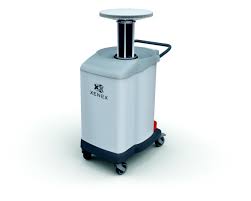
Call in the robots. A San Antonio-based company called Xenex Disinfection Services has created a germ zapping robot.
And the University Health System in San Antonio plans to install three of the $125,000 devices and use them in patient rooms, critical care areas and operating rooms throughout University Hospital. It also plans to put one in the Cystic Fibrosis Clinic at the Robert B. Green Campus downtown, where patients are particularly vulnerable to infections.
Xenex’s robots are being used in more than 200 hospitals and health facilities nationwide including UCLA, Boston Children’s Hospital and UT MD Anderson Cancer Center.
“The Xenex room disinfection system uses a powerful, pulsed-xenon ultraviolet light to kill all sorts of infectious organisms,” according to a news release. “One study showed the treatment was 20 times more effective than scrubbing with traditional chemical cleansers.”
Typically, the device is rolled into a room after housekeeping staff finishes a thorough cleaning and sanitizing. The operator then programs the machine and clears the room. Up pops the saucer-shaped light source, and for five to 10 minutes the room is bathed in powerful pulses of UV light — 25,000 times more powerful than sunlight, and capable of killing such infectious threats as Clostridium difficile, norovirus and MRSA.
Two John Hopkins-trained epidemiologists developed the technology. In 2008, Morris Miller, an early investor in Rackspace, invested in the company, now called Xenex Disinfection Services. He also became its CEO and moved its headquarters and manufacturing operations from Austin to San Antonio.
Page 248 of 352
By SUSAN LAHEY
Reporter with Silicon Hills News

Geoff McGrath, McLaren Applied Technologies’ managing director, photo by Susan Lahey
“Every day of the racing season, beginning to end, we manufacture a new part every 17 minutes,” said Ben Heatly, spokesman for McLaren. “That includes coming up with the idea, testing it in the virtual world, testing it again and adding it to the car.”
Talk about an accelerator.
Tech Transfer from racing cars to healthcare
The second annual U.S. Grand Prix for F1 racing takes place this weekend at the Circuit of the Americas in Austin.
The event emphasizes the strong ties between Austin and the United Kingdom.
“F1 has a strong British heritage – the UK is, in fact, the cradle of modern motorsport. Given that the US Grand Prix in Austin is already massively popular with the F1 teams and drivers, it’s obvious Texans share our passion for motorsport,” according to British Consul General Andrew Millar.
Technology being developed for the automotive industry also generates advancements for healthcare, energy, transportation and other industries.
Geoff McGrath, McLaren’s managing director, Naresh Chouhan, marketing director for Truphone and Edgar Farrera, director of sustainability for the Circuit of the Americas, spoke Thursday in a presentation led by tech entrepreneur and mentor Fred Schmidt about the technologies involved in making the F1 races the high performance events that they are and how those technologies are spun out to other applications.
Among the applications McLaren is trying to proliferate is expanding the biometrics it uses to help drivers improve their personal performance to predict illness, as well as optimize performance for athletes and executives.
“People don’t care how many steps they took. They don’t care how many calories they burned. Most people don’t know what a calorie is,” McGrath said. “The challenge we’re trying to address here is, when you get up in the morning, what would you have to do to get into optimum condition for that meeting?”
In addition, he said, the company is working with GSK on technology to help predict health problems in later life and to identify issues in bodies before symptoms of illness manifest. Right now, he said, the technology is not in a form most people will adopt.
McLaren worked with many athletes for the London Olympics on their physical and mental performance as well as their performance in the vehicle they competed in. For example, they built sensors into oars of Olympic rowing teams during training to help rowers understand the precise angle and force at which athletes should put their oars in the water for the best results.
 “Athletes don’t like gimmicks,” he said. “But if you can give them an edge in sport, they’ll work with you.” That includes designing a bicycle with chassis similar to a high performance car’s that not only recognizes the size and shape of the person using the bike (McGrath compared the composition of the rider to a bag of fluid) but also the terrain the bike is navigating.
In other arenas, McLaren has partnered with data center company IO in Phoenix, to reduce data center energy consumption. Part of that, McGrath said, is applying predictive and prescriptive analytics used in designing racecars to adapt to track conditions and other circumstances.
“We need to be able to measure what we want to manage,” McGrath said. “If there’s a spike in energy what’s causing it? Is it the Goldman Sachs trading floor kicking in—a real example? And if so how can we make that intervention, what will be the outcome of our intervention?”
Can You Hear Me Now?
Naresh Chouhan of Truphone spoke about his company’s revolutionary mobile phone system used by the Caterham F1 team. Truphone has a global network but also works via Wi-Fi and automatically finds the best channel through which to funnel communication, anywhere in the world.
“F1 teams actually transmit roughly 200 gigabytes of data each day for each car, then they make changes, tweaks during the night,” Chouhan said. There are more than 100 mobile users on the team and in a typical month they would transmit 4,300 texts including 3.3 GB of data. If a part wears out, for example, they need to be able to send a photo, fast. To be able to communicate quickly is crucial to improving performance. But since they travel to so many different countries, they previously had to deal with exorbitant roaming costs, changing numbers depending on what country they were in, or being unable to get on the network in places like Singapore, where the networks are flooded.
With Truphone, a user can have several international numbers on one phone that will all be routed to a single number, and the system will find the best network to use. “It’s the same in Spain as it is in Poland. I don’t have to change my behavior wherever I go.”
The phone has saved the team 30 percent on its global, mobile phone bills—money it has pumped back into development.
The final speaker was Edgar Farrera, Circuit of the America’s director of sustainability who talked about the challenges of “greening” F1.
When asked whether it was important for F1 to pioneer growth in green technologies, Farrera said, 64 percent of F1 fans surveyed said yes. When they asked if they supported green technologies that would change that F1 rumble of the engines to be like the much quieter Formula E cars, only 39 percent said yes.
There are many ways that F1 designers could continue to improve performance while making more environmentally friendly choices, and F1 has already moved toward hybrid engines that consume half the fuel their predecessors did, Farrera said. But part of the issue is evolving the Formula 1 fan base.
“We don’t believe that being green compromises performance. We’re seeing that the use of hybrid technology is producing race winning cars,” McGrath said.
The goal of F1 is to inspire through innovation. And being green is part of that. But with all these minute tweaks, is perfection attainable?
“I suppose we always aspire to perfection but in most real world examples you never get there,” he said. “ You reach what is called an asymptotic curve here’s the bar of perfection at the early days of innovation make great strides every year or with every attempt. Then as you get closer you reach what is called in laymen’s terms, the area of diminishing returns. You make marginal gains. But that’s exactly where we’re competing right now in racing, in Olympic sports–those tiny incremental gains. Now, when you talk about self care and health…we’re right at the bottom.”
And that’s what the F1 Tech Rally is all about.
 OneSpot, an advertising company, announced it has landed $5.3 million in funding during a Series A round.
The Austin-based startup reported Mohr Davidow Ventures led the investment round with participation from Mack Capital, RSL Ventures, Capital Factory and Brett Hurt, an angel investor and co-founder of Bazaarvoice.
Since launching, the company has raised $6.8 million to create its content advertising platform.
The latest funding will help the company expand its sales and marketing and further develop its product.
As part of the funding deal, Mohr Davidow Ventures General Partner Bryan Stolle will join OneSpot’s Board of Directors.
OneSpot’s customers include Johnson & Johnson, Rackspace, Domo and Remington.
“OneSpot’s offering is well-timed with the rapidly increasing demand for solutions that extend the reach of a brand’s content and drive business results,” said Stolle, General Partner with Mohr Davidow Ventures, said in a news release. “We believe the market will continue to see a shift of brand dollars to both content marketing and programmatic advertising as brands increase their reliance on content-centric programs and look to scale those efforts. OneSpot is a powerful solution for the industry and we are excited to collaborate with and support them as they work to build a great company in an exciting category.”
OneSpot has created a platform that allows companies to combine text and video into ad spots which are displayed to customers through its “proprietary content sequencing engine.” They then place those ads on websites. It also provides an analytics dashboard to track the ad’s performance.
“As an industry we’re just scratching the surface of how powerful content marketing can be when it’s combined with the massive scale offered by the global online advertising ecosystem,” OneSpot Chief Executive Officer Steve Sachs said in a news release. “Having the financial support and domain expertise of Mohr Davidow Ventures will help us execute our vision even more rapidly and broadly – and with the benefit of experience, perspective and relationships of a leading ad tech investor.”
 Under Armour announced Thursday it has acquired Austin-based MapMyFitness for $150 million.
The deal is expected to close by the end of the year.
The acquisition gives Under Armour, based in Baltimore, more digital products and solutions to help athletes train and perform.
MapMyFitness’ 100 employees will remain in Austin. The company has more than 20 million active users for its suite of websites and mobile applications under its flagship brands, MapMyRun and MapMyRide. The GPS technologies allow users to map, record and share their workouts.
“This partnership is about Under Armour enhancing our digital expertise to drive the future of performance innovation for the global athlete community,” Kevin Plank, Founder and CEO of Under Armour said in a news release. “We will build on the community of over 20 million registered users that MapMyFitness has cultivated in the connected fitness space, and together we will serve as a destination for the measurement and analytics needs of all athletes.”
“MapMyFitness has engaged and built a global community, making advanced training tools more accessible through our web and mobile platforms,” Robin Thurston, MapMyFitness Co-Founder and CEO said in a news release. “The combination of Under Armour’s powerful commitment to athletes and innovation and our connected fitness technology allows us to better serve the needs of athletes around the world.”
By LAURA LOREK
Reporter with Silicon Hills News
 Pressable is the new startup at Geekdom in San Antonio.
But it’s actually one of the oldest startups at the downtown co-working space.
Vid Luther launched ZippyKid in 2010 as a managed WordPress hosting site.
On Thursday, the company rebranded as Pressable.
With the new name, Luther, CEO, plans to align the company’s brand with its growth.
Last summer, Luther bought the domain name and Twitter handle for Pressable. He wanted the name to reflect the company’s focus on WordPress hosting for Fortune 100 companies, startups, nonprofit agencies and professional organizations worldwide.
The company is also introducing a new pricing model. It currently hosts one website for $25 a month. Starting today, customers can host up to five websites for $25 a month.
“We commoditized WordPress hosting and made it available at a price that is more accessible,” Luther said. Pressable seeks to simplify publishing online for WordPress users.
Today, an estimated one in five websites on the Internet runs on WordPress.
The rebranding is the first step in expanding Pressable’s business, Luther said. Other changes will be unveiled early next year, he said.
Pressable is privately held company and has nine employees. It has raised $800,000 in seed stage funding from Rackspace cofounders Pat Condon, Dirk Elmendorf, Automattic, the company behind WordPresscom, DuckDuckGo founder Gabriel Weinberg, Slicehost founder Jason Seats and 500 Startups.
Pressable with 1,200 customers is profitable and has revenue of more than $1 million a year, Luther said.
Geekdom is a sponsor of Silicon Hills News
By LAURA LOREK
Founder of Silicon Hills News
 Shir Even-Zohar’s parents are diabetic patients.
She knows firsthand that the main way to treat the incurable disease is to balance the body’s blood glucose levels, which requires strict glucose level monitoring. That’s not always easy to do.
That’s why Even-Zohar sees the need for a new medical device called Dario, a diabetes management platform that runs on a smartphone. LabStyle Innovations, based in Tel Aviv, Israel, developed Dario, a cloud-based, mobile health platform for diabetes and related blood glucose monitoring.
“This device will help them easily get their data on their phone and get their insights to learn how to better manage their diabetes in a very convenient way,” said Even-Zohar, a business development senior manager for LabStyle Innovations.
The market for the device is huge. Worldwide, more than 400 million people have diabetes and it’s on the rise fueled by the obesity epidemic. The main type of diabetes is type 2.
“Dario is the next generation in advanced diabetes self-management,” according to Even-Zohar. Dario helps people manage their diabetes better, she said. The software integrates with the all-in-one, pocket-sized, Dario blood glucose monitoring device. It comes with lancet, strips and a meter that connects to a smartphone, and a website application enabling patients, medical professionals and caregivers to access data with the aim of and as a result drives proactive intervention.
Next week, Even-Zohar will travel to San Antonio to introduce Dario to patients enrolled in a consumer focus study that will take place at Geekdom, a San Antonio coworking space focused on tech startups based in the Weston Centre downtown.
 Geekdom members Alan Weinkrantz and Cynthia Phelps are heading up the local focus group on Dario. They’ve enrolled several people into the paid sessions but they are still looking for a few more insulin-dependent diabetic patients to participate. They are looking for people who are between 18 to 45 years old and who use a smartphone and have type 1 or type 2 diabetes. The participants need to use an insulin pen and test their blood glucose four times a day. The two-hour sessions start Monday and run through Wednesday.
On Tuesday, Health 2.0 will hold a public meeting at Geekdom to introduce Dario and Even-Zohar will talk about Israel’s medical-technology startup economy. The event will begin at 6:30 p.m. It’s free to attend but registration is required.
“San Antonio has a very large diabetes population,” Even-Zohar said. “We think at Geekdom we can meet great people who can help us understand their needs and evaluate a product that we are about to launch. If there is anything that we can improve, we want their feedback to make the best product possible.’
The free Dario app will be available for download from the Apple App Store on Dec. 12 this year in the U.K., Australia and New Zealand. The launch of the Dario iOS App is the first step of LabStyle’s worldwide rollout of the full Dario platform. LabStyle received certification for Europe for the full Dario diabetes management platform last September. That allows LabStyle Innovation to market Dario in Europe. The company plans to file for 510 (k) Food and Drug Administration clearing to market its platform in the U.S. in the near future and anticipates regulatory clearance in 2014, Even-Zohar said. Currently the app is only available for iOS devices, but an Android compatible version is expected soon.
LabStyle Innovations, a publicly traded company founded two years ago, has partners in the United Kingdom and Italy to distribute and sell Dario.
“The app is a very nice tool to use even without our device,” Even-Zohar said. “It’s a way to introduce the product and get them hooked on our approach of diabetes management.”
In addition to San Antonio, Even-Zohar will visit Cleveland, Ohio. David Edelman with Diabetes Daily has set up some meeting for her there.
“This is a very innovative approach on how diabetes should be managed,” Even-Zohar said.
By SUSAN LAHEY
Reporter with Silicon Hills News
 When Cameron Crake of Raven and Lilly discovered that she, not the company’s founder, would be pitching at Incubation Station’s Demo Day, she was nervous. To begin with, she’s the background person, not the public face of the company. Also, she was the program’s youngest member and desperately didn’t want her youth to be what the audience remembered.
“I said ‘like’ a lot,” she recalls. “I also would get high pitched at the end of sentences…I had a tendency to cock my hip. A lot of women do that. It’s how we carry our weight. I had to practice standing with my feet planted, looking confident and unshakeable.” She also had to practice her pitch as if she were speaking to a kindergarten class, to overcome the monotone she’d adopted to sound more mature.
Her coach to recognize and overcome all these quirks was Monique Maley, founder of Articulate Persuasion, a company that helps leaders speak more confidently and effectively. A former actor and theater management veteran who worked as a production coordinator for a theater in London as well as an international talent firm, Maley understands the myriad subtle ways a tone, a posture and a gesture can communicate to an audience. But most startup founders don’t. So she’s been hired by Austin Technology Incubator and other groups to help the developers, engineers and other startup founders transform their nervous energy into effective pitches. She works with them on everything from messaging to delivery.
“Until your content is clear in your head, it will not be clear to anyone else,” she said. “You have to articulate it so clearly to me that it’s clear in my mind. It’s like somebody teaching someone to paint over the phone.”
Part of that, she said, is understanding your audience. Frequently, engineers struggle to communicate their ideas to groups of investors who lack their technical knowledge.
“A lot of times I’ll work with scientists and engineers who are going out to talk to VCs on the West Coast and they have a hard time getting it across,” Maley said. “One guy said ‘I really have to dumb it down for them,’ and I told him ‘If that’s your attitude they’re going to feel an air of condescension in everything you say.’” Sometimes, she said, it’s necessary to use jargon or technical terms. But if you’re talking over the heads of the people in your audience, don’t expect them to be moved by your pitch.
“Monique helped me with aspects of communicating more complex concepts simply,” said Stuart Rench, president of ihiji. “I tend to go very detailed, open too many doors during a conversation, leave too many people stuck behind trying to figure out what I’m talking about.”
Regardless of how polished your pitch is, Maley said, you have to connect with the audience. If someone is nervous while pitching, for example, that’s going to come across. The question is, is that person nervous because he lacks confidence in his idea or ability to carry it out? Or did he just have too much coffee?
“Nervous energy is the same as every other kind of energy,” Maley said, “it’s just about where your mind is choosing to take it. Being excited about a first date causes nervous energy but you tend toward positive thinking…it creates outgoing energy that makes a connection. But if your energy is negative because you’re worried about getting funded, that’s internal energy that’s spinning around in your head. I can’t connect with you if your thoughts are spinning around in your head.”
Maley’s life and career path have given her a broad tool set to help her clients. She grew up splitting her time between Houston, where her father was from, and Mexico City. Her mother’s family, originally from Spain, fled to Morocco after the Spanish Civil war, and then to Mexico when the U.S. invaded northern Africa during World War II. Her parents were cultured, supporters of the arts. Her father listened to opera, loved languages and taught her how to cook soufflés. They had such a different sensibility, it always left her feeling out of place among her peers. Her time in Mexico City suited her better. At the time, she said, the city was more cosmopolitan. Her cousins and many of her friends went to the French lycee where the children of the French diplomats studied.
Maley was drawn to the theater and did a summer program at the North Carolina School of the Arts. Afterward, she went to Tufts in Boston and studied English and clinical psychology. She did no acting in college but was involved in an a capella group and choir at the New England Conservatory of Music.
After graduation she moved to London to study at the Royal Academy of Dramatic Arts. That’s where she got heavy duty training in how people could use their bodies and movement to express the physical lives of their characters.
“We studied why you would move this way, based on your age, or height or humps or corsets and what does that embodiment tell the audience that the text doesn’t. The physical and visual image of you is often more telling than what you’re actually saying to me.”
That’s a crucial piece of teaching people who pitch how to convey confidence to their audiences, like making sure you take up enough space…but not too much.
Engineers often come across very soft spoken and may not take up enough room. “At the end of the day the institutional investors will eat you for lunch if they think you’re soft and mealy. So how do you sound stronger? It’s a transformation over time. As you start sounding stronger, you start feeling stronger and that’s where the power is. If you have a great idea but you can’t articulate it, investors don’t feel wholly confident in you…they have to have trust in the individual and the team.”
But the main problem with most pitches, Maley said, is lack of practice. No one would come out to see a theater performance where the actors hadn’t rehearsed. They wouldn’t go to see a football team that hadn’t practiced. So why should they be expected to watch a pitch that hadn’t been practiced over and over?
Maley returned to Houston and acted at the Alley Theater. Afterward she joined a project in a warehouse at the University of Houston. That group of actors afterward formed the Urban Theater Company. At the Urban Theater, Maley not only acted but worked as managing director which threw her into the business end of theater and put her in a position to start soliciting sponsors for the company. After she’d been at the Urban Theater for close to five years, Maley said, she decided to return to London. She had no job but just started going to theaters to check them out and decided she wanted to work for the Almeida. One day she stopped in and said “I want to work here.” There was an opening. And she was in.
At Almeida, she acted and also worked as a liaison to corporate sponsors in New York and London to plan special VIP events and negotiated contracts with agents to hire designers, actors, and guest directors. Her next role was working with International Creative Management, a talent agency.
Maley, an only child, eventually decided she was too far from her aging parents and returned to the U.S. She was ready to try something other than acting, which she calls “a young person’s game” and opened a spa, Daya, which she closed just before the nation’s economy hit the fan.
After that she ran a marketing agency and worked for a leadership firm before founding Articulate Persuasion. Initially Maley worked with attorneys to improve their performance in front of juries. But soon she got a client who was an entrepreneur and needed help doing everything she had learned in the theater industry. Acting and pitching to raise funds.
The startup world, she said, is a lot like the theater world. People are close knit and collaborative and there’s instant gratification for what you do.
Both Rench and Crake said they felt like Maley cared about them as people.
“I’m a very protective person, I don’t like sharing my faults,” Rench said. “given my personal limitations on things like that, Monique was very thoughtful in what she had to say and knows how to boil things down very quickly. That keeps me from letting the ADD get very far down the road.”
“She really knew what she was doing and had a lot of great advice to offer,” Crake said. “She really cared about me being able to do a good job. She wanted me to represent my company well and I felt like she was on my team, wanting to see us succeed. She was a big part of making us succeed.”
Working with the startups, Maley said, “is a place where I feel needed, appreciated. The work I do is rewarding. Whatever you do, that’s so important. At least it is for me.”
 Early-stage startups in Austin just got a major boost.
Silverton Partners announced Thursday the formation of a new $75 million fund that will invest in early-stage startups in Austin.
The fund received backing from prominent Austin entrepreneurs, several university endowments and its general partners. It was oversubscribed and included more than 40 Austin founders, CEOs and executives. The fund will target investments in the enterprise software and consumer Internet. Silverton plans to hire two investment professionals during the next year.
Silverton Partners has had several successful exits from its Silverton Partners III fund. Those companies include Convio, which went public, BlackLocus, acquired by The Home Depot, Crimson, acquired by The Advisory Board, Hyper9, acquired by SolarWinds and Javelin, acquired by Avago Technologies. The fund also has 18 active portfolio companies.
“We are proud to announce Silverton IV, and greatly appreciate the opportunity to collaborate with such a premier group of entrepreneurs,” Bill Wood, General Partner, Silverton Partners, said in a news release. “We’ve witnessed first-hand the tremendous growth of the Austin startup ecosystem and its gratifying to see that our strategy of focusing on local, high-growth opportunities is being rewarded. We particularly enjoy working with seed-stage companies as they mature into robust companies with product traction and customer validation. It’s a winning formula for us – and we look forward to SP IV becoming another successful fund over the years.”
 The Greater Austin Chamber of Commerce and South by Southwest Interactive Wednesday named 12 companies to its 2013 Fall Austin A-List.
The list includes companies categorized by their investment stage including emerging, growth and scale and they span a wide range of industries including big data, social, health and entertainment.
The chamber releases its A-List twice a year to highlight some of Austin’s “most fundable and innovative regional startups,” according to a news release.
So far, 19 companies from its 2013 Summer Austin A-List have received a total of $10.3 million in investment and 28 members of its 2012 A-List have received a total of $164.5 million in investment.
“The 2013 Fall Austin A-List companies shine a light on the innovative spirit of Austin and its powerful entrepreneurial ecosystem,” Michele Skelding, the chamber’s senior vice president of global technology and innovation, said in a news release. “Raising the profile of these burgeoning companies helps cultivate investment, which helps attract the next generation of game-changing innovators who in turn, help Austin to evolve and continue to grow as the top region to start and grow an innovation based business. These companies are proof-positive that Austin continues to grow as a hotbed of technology and innovation.”
“SXSW Interactive is proud to be a continued part of the rich Austin startup and investment community,” Hugh Forrest, Director of SXSW Interactive Festival, said in a news release. “Austin’s entrepreneurial ecosystem has never been stronger, and these 12 A-List companies show great potential for growth and will help keep driving the spirited ideas that make Austin so special.”
The list follows with descriptions of the companies provided by the chamber:
In the emerging category for companies with less than $1 million in funding:
Atlas is an intelligent wristband for fitness enthusiasts looking for a complete solution, not just a pedometer.
Datafiniti was founded with the ambitious goal of converting the largest source of data, the Internet itself, into structured data to make better business applications and push the boundaries of better decision-making.
Filament Labs is building a SaaS platform to power any app that goes between a patient and their care provider.
Pristine develops apps for Google Glass for healthcare environments to help treat more people at a more affordable cost.
Shelfbucks aims to level the playing field between physical and online retail, revolutionizing the brand to consumer channel through mobile.
YouEarnedIt fosters happiness at work through a simple, fun, and flexible SaaS platform that provides real-time recognition and meaningful, custom rewards for employees.
In the growth or mid-stage category for companies with $1 million to $10 million in funding:
Gazzang develops products that keep data secure, available and actionable in the cloud.
How Do You Roll leads the restaurant industry as the first fast-casual, custom sushi shop.
Uship is the world’s largest and most trusted transportation marketplace, primarily serving the freight, household goods and vehicle shipping markets.
WP Engine is the premium managed hosting platform for websites and applications built with WordPress.
In the category of scale or later stage investment of $10 million or more:
Main Street Hub offers an integrated social, web, and email marketing product designed to help merchants get more customers and keep them coming back.
Phunware is the pioneer of Mobile as a Service (MaaS) – a fully integrated services platform that enables brands to engage, manage and monetize users on mobile.
 IBM Wednesday unveiled its new product design studio in Austin, which will focus on designing software for a global audience.
The 50,000 square foot studio will serve as the center for IBM’s software efforts in Big Data, cloud, mobile, social software and cognitive solutions.
IBM designed the space to encourage collaboration and to bring together designers, developers and product managers involved in creating new software products.
“This studio is the embodiment of a new approach to software design. It is the home of IBM Design Thinking, a broad, ambitious new approach to re-imagining how we design our products and solutions,” Phil Gilbert, general manager, IBM Design, said in a news release. “Quite simply, our goal — on a scale unmatched in the industry — is to modernize enterprise software for today’s user who demands great design everywhere, at home and at work.”
IBM already hosts a one-week training camp at its studio called “Designcamp.” So far, it has held more than 60 camps.
IBM is also recruiting design experts from top design schools nationwide.
This week, IBM released its first commercial product, InfoSphere Data Explorer, using its IBM Design Thinking initiative.
In addition to the Austin Design Studio, IBM’s Austin campus also has research and development labs, SmartCloud Innovation Center, Watson Solutions, cloud and smarter infrastructure teams and IBM Security Systems.