Page 236 of 352

Financing Thunderlizards in Austin at Capital Factory

CF+floodgate+silverton150Capital Factory, Silverton Partners and Floodgate announced Monday morning they are teaming up to provide matching investments for all Capital Factory incubator companies.
Josh Baer, co-founder of Capital Factory, made the announcement via a blog post and on Twitter. TechCrunch also posted this story on it.
In total, each startup will get up to $150,000 in venture financing through the program.
Here’s how it works: “a startup founder who can find two Capital Factory mentors that invest $25,000 each into the company automatically triggers a matching venture capital investment of $50,000 from Capital Factory’s in-house fund and $25,000 each from Silverton and Floodgate,” according to a news release.

Reaction from Twitter:

Smith & Nephew Buys Austin-based ArthroCare for $1.7 Billion

imgres-2Smith & Nephew announced Monday a deal to buy ArthroCare Corp. of Austin for $1.7 billion.
The London-based company plans to pay $48.25 per share in cash for the the medical device company.
“This is a compelling opportunity to add ArthroCare’s technology and highly complementary products to further strengthen our sports medicine business,” Olivier Bohuon, Chief Executive Officer of Smith & Nephew, said in a news release. “Together, we will be able to generate significant additional revenue from the more comprehensive portfolio, combined sales force and Smith & Nephew’s global footprint. With this transaction, we are again accelerating our strategy to rebalance Smith & Nephew towards higher growth.”
The sales price is approximately 20 percent more than what ArthroCare’s shares have been trading for on the Nasdaq market for the 90 day average before the announcement. Smith & Nephew expects the transaction to close mid-year pending regulatory approval.
“ArthroCare and Smith & Nephew know each other well from our licensing and supply arrangements, and this is a natural transaction for both companies,” David Fitzgerald, president and CEO of ArthroCare, said in a news release. “The Board believes that this transaction is in the best interest of our shareholders.”
ArthroCare makes medical devices, instruments and implants. The company specializes in sports medication and ear, nose and throat procedures. It also provides products for the spine, wound care, urology and gynaecology practices.
Last year, ArthroCare bought ENTSurgical, a company founded by Fred Dinger in San Antonio, for $45 million. Dinger had previously sold another company he founded in San Antonio, OsteoBiologics for $72 million to Smith & Nephew Endoscopy in 2006.
ArthroCare has approximately 1,800 employees. It has manufacturing plants in Costa Rica and a research and development facility in Irvine, Calif. This year, the company announced that it had entered into a deferred prosecution agreement involving an ongoing investigation by the Department of Justice. The company paid a $30 million fine.
ArthroCare had total revenue for the first three quarters of 2013 of $276 million, up 2 percent from the same time period a year ago.

Visionary Entrepreneur Tim Jenison Searches for the Truth in Tim’s Vermeer

images-2NewTek is one of the hidden gems of a technology company in San Antonio.
Tim Jenison co-founded NewTek, a desktop video graphics software company, in a storefront in downtown Topeka, Kansas in 1985. The company made the Video Toaster.
Jenison later relocated the company to San Antonio. NewTek continued to make innovative products like Lightwave 3D software used for special effects in movies and television shows. And in 2005, NewTek released the Tricaster, which allows people to do live video streaming with the production capabilities of a full studio in a backpack-sized piece of hardware.
NewTek is a little slice of Hollywood in the Alamo City. Filmmakers from all over the world visit its headquarters to meet with Jenison and his staff.
Jenison is one of those genius entrepreneur/inventors who always seems to be thinking up the next big thing.
And that next big thing is “Tim’s Vermeer,” a documentary.
Jenison teamed up with Penn Jillette, the film’s producer, to create the documentary “Tim’s Vermeer,” which will debut in Austin and San Antonio on Feb. 28th, according to this schedule just released by Sony Pictures Classic.
In the one hour and 20 minute long documentary, Jenison “attempts to solve one of the greatest mysteries in all art: How did 17th century Dutch Master Johannes Vermeer (“Girl with a Pearl Earring”) manage to paint so photo-realistically — 150 years before the invention of photography? The epic research project Jenison embarks on to test his theory is as extraordinary as what he discovers,” according to news release.
Jenison spent eight years on the project and travelled the world to research it. In the project, he attempts to paint a Vermeer. But he’s not a painter. He’s a computer graphics guy.
The movie has been reviewed in the Los Angeles Times, Time Magazine, the New York Times and the even The Economist and has received rave reviews.

To Raise Funds, Entrepreneurs Need To Raise Friends First

By LAURA LOREK
Founder of Silicon Hills News
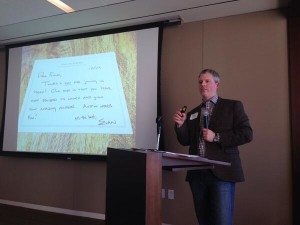
Evan Loomis, co-founder of TreeHouse in Austin

Evan Loomis, co-founder of TreeHouse in Austin

Every great business starts on the back of a napkin, said Evan Loomis, co-founder of TreeHouse, a sustainable home improvement store.
He sketched out his plans for TreeHouse during a ski trip with some friends in Boulder, Colorado. A few years later he left his investment banking job to launch TreeHouse in South Austin in October of 2011. He also raised $8.5 million from 50 angel investors and capital investment firms to turn that napkin into a reality.
Loomis, now managing partner of Quiver Capital Group, learned a lot in the process. He shared his experiences and advice on Thursday at a Spectrum event put on by the Texas State Small Business Development Center held at Norton Rose Fulbright’s downtown Austin office.
Loomis spoke with a panel of experts on fundraising for entrepreneurs. The other speakers included Michele Skelding, senior vice president global technology and innovation for the Austin Chamber, J. Richard Johnson, a certified business advisor with Texas State’s SBDC, Ann Benolken, a partner with Norton Rose Fulbright, Chris Shonk, managing director of Liahona Ventures and Morgan Flager, partner with Silverton Partners.
Michele Skelding, senior vice president global technology & innovation for the Austin Chamber of Commerce

Michele Skelding, senior vice president global technology & innovation for the Austin Chamber of Commerce

Loomis advised entrepreneurs to create a “bad-ass pitch deck.”
“It’s going to be really hard to raise money if you’re not inspiring someone,” he said.
The first time Loomis pitched his company his pitch deck did not impress his audience and neither did his clothes. He pitched his idea to a former Miss Oklahoma, the inventor of the marshmallow canon and the inventor of Musinex. One investor wrote him a $3,000 check and told him to go to Nordstrom to buy some new clothes. They did not invest in his business.
He advised entrepreneurs to get their idea on paper, create a pitch deck and start getting feedback on it.
Loomis also bought a list of the 6,000 richest people in the U.S. complete with addresses and phone numbers. It didn’t help him raise money, though. It’s easy to find high net worth individuals but it’s hard to build a relationship with them.
“Raising money is a little like getting married,” he said. “You don’t ask someone to marry you on the first date.”
The vast majority of companies seeking funding don’t get it, Loomis said.
“I needed to learn how to raise friends, not cash,” he said.
Out of 100 potential investors, 25 would show interest and maybe 10 would invest, Loomis said.
He recalled how he got invited to a billionaire’s house on Park Ave in New York. He wore his new Nordstrom clothes. When he walked into the house, Loomis asked the man about his artwork and if it was from a local artist. The paintings were original Rembrandts. Loomis got nervous and embarrassed. So he dove into his PowerPoint presentation and began to pitch his company. He looked up and noticed the guy wasn’t interested at all. He shut everything down and said to him, why don’t we just talk. The guy said good because I was about to throw you out of my house.
It’s important to know when to ditch the prepared remarks, he said.
Loomis also sent his potential investors hand written notes. With one investor, he sent him a note on his anniversary. The guy was so impressed with his thoughtfulness, he wrote him a $250,000 check.
“Delight them with something unexpected,” Loomis said.
Getting venture capital is tough.
Venture capitalists look for high margin businesses that are growing quickly, said Morgan Flager, partner with Silverton Partners. The company runs two $75 million funds in Austin, which make between 30 to 35 investments each over the fund’s lifetime which lasts from ten to twelve years.
“We have to have outcomes that give us $20 million to $30 million in proceeds,” Flager said. “A lot of people don’t necessarily understand how that economic model works.”
Silverton Partners has made 25 investments in Austin ranging from two guys and a dog to a $75 million company, Flager said. He advised companies to go as long as possible before raising venture funding.
Benolken with Norton Rose Fulbright also advised startups to get their records in order before seeking financing.
“Get dressed for the party before you go,” Benolken said. “Don’t go with one shoe on.”
If a company doesn’t have written contracts and other records then it could kill a deal, she said. She also advised startups to review any offers with a lawyer before signing if they claim to be non-binding. Even emails with employees promising equity can be binding, she said.

The Visionary Who Shaped Austin’s Technology Industry

By LAURA LOREK
Founder of Silicon Hills News

Michael Dell and George Kozmetsky, photo courtesy of the University of Texas

Michael Dell and George Kozmetsky, photo courtesy of the University of Texas

At 4:30 a.m., George Kozmetsky began his 18-hour days taking meetings in his office at the University of Texas at Austin.
Entrepreneurs like Michael Dell, who was just starting a PC company, or James Truchard, co-founder of National Instruments, might drop by for a breakfast of orange juice and cornflakes.
Kozmetsky kept a white board by his desk and he was known to sketch out problems and solutions for his visitors.
His door was open for everyone from students to heads of state, said Pike Powers, a lawyer, former state legislator, economic developer and close friend and collaborator of Kozmetsky.
“George was the godfather of high technology for the region,” said Laura Kilcrease, managing director of Triton Ventures and also a close friend and the founding director of the Austin Technology Incubator. “The godfathers are untouchable. They’ve got a track record of getting things done and getting them done right. George was old enough and wise enough and generous enough to think about what was best for the greater good of the community.”
Kozmetsky came to Austin in 1966 after he successfully co-founded Teledyne, a computer electronics company in Silicon Valley. He served for 16 years as the UT dean of business. He believed strongly in collaboration among government agencies, educational institutions and entrepreneurs. He launched the IC2 Institute in 1977 and the Austin Technology Incubator in 1989. President Clinton awarded Kozmetsky the National Medal of Technology in 1993. Kozmetsky worked tirelessly to promote Austin’s technology industry until his death in 2003 at the age of 85.
His son, Greg Kozmetsky would often prepare the coffee and juice for his dad’s early morning meetings.
“Dad had a philosophy that you don’t need sleep,” Greg said. “You just need to rest.”
Kozmetsky would take 20 minute to 30 minute rest breaks throughout the day.
“He would wake up at 3 a.m. and start thinking about things,” Greg said. “By 4 a.m. he was headed to the office.”
When he got older and he could no longer drive, his assistants, Pattie Roe and Ophelia Mallare, would drive him.
His wife, Ronya, also actively supported her husband. They even taught a class together at UT on marriage and entrepreneurship. She wrote a book “Making It Together: A Survival Manual for the Executive Family.” Ronya, who died in 2011 at the age of 90, was a licensed pilot and she ran the RGK Foundation.
Greg, also a pilot, would fly his dad around the country and world.
“I knew he was different,” Greg said. “I didn’t know how different he was.”
When Greg was a kid his dad would gather his children and the neighborhood kids together and sketch out ideas for them on a whiteboard in their house. He thought if he could explain his ideas so that kids could understand them then others would too, Greg said.
“He was first and foremost an academic,” Greg said.

ATI Founder George Kozmetsky, photo courtesy of the University of Texas

ATI Founder George Kozmetsky, photo courtesy of the University of Texas

Kozmetsky, born in Seattle to Russian immigrant parents, grew up poor and even worked at the fish docks as a kid. He understood the value of an education. He earned his bachelor’s degree from the University of Washington at the age of 20. He then served in the Army Medical Corp. in World War II. When he returned, he earned his MBA and doctorate degrees from Harvard University. And he went on to found Teledyne, a conglomerate of companies which made everything from airline parts to batteries and precision instruments.
This year, Kozmetsky’s brainchild, ATI, turns 25 years old. It is one of the oldest continuously running incubators in the country.
ATI has graduated 142 companies, which have created thousands of jobs and had an economic impact of more than $1 billion on Central Texas’ economy.
Yet many people who make up the bustling technology ecosystem in Austin today don’t know the critical and crucial role Kozmetsky played in its vision and development.
“George was such a compassionate, thoughtful and intellectual leader,” Powers said. “He didn’t want to be adulated and praised. He wanted to do things that made a difference. And he did.”
When ATI launched in 1989, Austin was in dire straits economically.
The city had one of the highest commercial real estate vacancy rates in the country as a result of the Savings and Loan crisis.
Austin had a skyline of so-called “see-through buildings,” because they were just shells built during the real estate boom that hadn’t been finished out, Kilcrease said.
Banks foreclosed on about 1,000 homes every month.
Austin needed ATI to jump-start its economy, Kilcrease said.
Kozmetsky recruited Kilcrease to run ATI. Kilcrease had been in town running a high tech company. She did a fair amount of community service.
“One day, out of the blue, George called me,” Kilcrease said.
His wife, Ronya, gave a taped session of a women’s management group in which Kilcrease had spoken, to her husband.

George Kozmetsky, photo courtesy of the University of Texas

George Kozmetsky, photo courtesy of the University of Texas

“He said my name is George Kozmetsky and I have an idea and I’d like to talk to you about it,” Kilcrease said. “Initially George asked me would I volunteer, which I did for quite some time.”
In 1980, only 12 incubators existed, according to the National Incubator Board. By the time ATI launched that number grew to 40. Today, there are more than 1,300.
Without an incubator like ATI, Kilcrease thought she might not be living in Austin for long. Austin’s economy depended on the government and the university. It needed to diversify.
Austin’s technology makeover began when the city landed the Microelectronics and Computer Technology Corporation (MCC) in 1983, followed by SEMATECH in 1987. Both ventures involved government, university and business collaboration, which set the tone for ATI. It received support from the chamber and business leaders, Powers said.
Its goal was to nurture high tech startups with high growth potential, Powers said.
“We needed to build our own future and create our own well-being,” Kilcrease said.
“It wasn’t a job. It was a mission.”
After launching ATI, Kozmetsky then launched the Capital Network, the first angel network in Austin, which ran from 1989 until 2004 and was the forerunner of the Central Texas Angel Network.
In addition, Kozmetsky created the Austin Software Council, which is now known as the Austin Technology Council. The networking organization allowed tech entrepreneurs to collaborate with each other.
“People would look at ATI like it was the one thing – in fact it wasn’t – it was the start of a much bigger, dynamic goal and plan of what we wanted to put together,” Kilcrease said.
The cornerstone institutions that support technology entrepreneurship in Central Texas today are all the products of Kozmetsky’s vision, said Isaac Barchas, director of ATI.
The impact of ATI stretched way beyond Texas, said David Gibson, associate director and senior research scientist of the IC2 Institute. He worked with Kozmetsky for 20 years.
He traveled with Kozmetsky to Russia, China, Taiwan, Korea, Brazil, and other places.
“We trained the first incubator director for Shanghai in the early 1990s and the first director of an incubator in Moscow,” Gibson said.
Kozmetsky helped to found the Cross Border Institute for Regional Development at the University of Texas at Brownsville to encourage collaboration between the U.S. and Mexican entrepreneurs.
“George, even in his 80s, was a visionary,” Gibson said. “He saw things way out there.”
He understood the importance of collaboration and how communities work together to become stronger.
“Austin did collaboration better than most cities and still does and that’s why it’s been so successful,” Gibson said.
He had the vision for the Austin “technopolis” in 1986 and he set that vision in place, Gibson said.
But when ATI launched, people were skeptical.
“I remember very vividly they looked at me with my accent and they thought incubators involved chicken and eggs,” said Kilcrease, who is originally from England. It was tough at first to convey the concept, she said.
Austin had an incubator before ATI that went out of business after three years and burned through $8 million or $9 million and had no surviving businesses, she said.
ATI launched with a budget of $125,000 for the first and second year and by the end of the third year, ATI had turned a profit, Kilcrease said.
Kilcrease and Kozmetsky promised that ATI would create 200 jobs in three years from new companies.
And within 10 years, these new technology companies would occupy all of the vacant square footage in Austin.
They exceeded those goals.
“A big audacious goal we had was not just to incubate companies,” Kilcrease said. “It was to diversify the economy and create an ecosystem that could work on its own and ATI was going to be the catalyst to make that happen…. You fast forward and you look at Austin now that dream was fulfilled in about 12 years.”
By the end of the 1990s, Austin became one of the major tech centers in the country.
“At the time, it was very pioneering groundwork,” Kilcrease said. “George was always very much a future thinker.’’
He had a brilliant mind and a 50-year vision plan for Austin, Kilcrease said.
His vision is still being realized today, said Barchas, director of ATI.
”The Austin we are living in, we are living in because of George Kozmetsky. He sacrificed to do it,” Barchas said. “He showed us that if we are smart and dedicated, and if we are willing to bring others into the process and give them credit, we can change the world, and we can change Austin. It wasn’t George bullying his vision through other people. He was able to form enduring alliances that meant his visions would last beyond him.”
And they did.

Athenahealth Picks Austin for R&D Center and Plans to Create 600 Jobs

imgres-4Athenahealth announced plans to put a research and development center in Austin with plans to create 600 new jobs.
The company, founded in 1997, provides cloud-based health information services for electronic medical records and other medical documents.
It plans to occupy 110,000 square feet of the Seaholm Power Plant redevelopment project in downtown Austin and invest $13 million.
During the next 10 years, the company plans to hire 607 employees in addition to its current workforce of 36 employees in Austin.
“We are thrilled that athenahealth has chosen to expand their operations here in Austin,” Pete Winstead, Shareholder at Winstead PC and Chairman of Opportunity Austin, said in a news release. “The region’s competitive cost environment, coupled with its position as a center of technological innovation will provide the Company with continued growth opportunities, particularly as we look to the future and the opening of the Dell Medical School and innovation district.”
Opportunity Austin is the Austin Chamber of Commerce’s economic development initiative.
The City of Austin approved a 10-year incentive package worth $679,000. The State of Texas also gave the company a $5 million Texas Enterprise Fund grant.
“We’re thrilled to be growing our presence in Austin, a City with a culture and vibe that perfectly aligns with our own,” Jonathan Bush, chairman and CEO of athenahealth said in a news statement. “athenahealth is growing all across the country as we work to fulfill our vision of becoming a national information backbone to make health care work as it should. Austin’s dynamic talent pool, combined with the fantastic support from Governor Rick Perry and his team, as well as from the City of Austin, has made us already feel at home. We’re inspired to make Austin a hub for the important work we do to advance connectivity in health care.”

The Importance of ATI to Austin’s Tech Industry

Isaac Barchas, director of the Austin Technology Incubator, at its 25th anniversary celebration and graduation.

Isaac Barchas, director of the Austin Technology Incubator, at its 25th-anniversary celebration and graduation.

The Austin Technology Incubator started off as a lab at the University of Texas at Austin 25 years ago.
No one knew what an incubator was in 1989 but they understood labs so George Kozmetsky, dean of the business school and ATI’s founder, called it a lab for students to learn about entrepreneurship and technology transfer.
Today, that lab is one of the oldest and most successful incubators in the country. ATI has graduated 142 companies and six of them went public, 40 more merged or were acquired with larger firms and another 50 are still operating, according to a new report “The Economic Impact of Austin Technology Incubator Alumni Companies on Travis County.”
The report found that just in the last 10 years, ATI companies have had an $880 million economic impact on Central Texas and they have created 6,524 direct and indirect jobs.
“ATI has had a tremendous economic impact on Austin,” said Juan Sanchez, vice president for research at the University of Texas at Austin. “It’s not too bad for a 25-year-old.”
On Wednesday night, ATI graduated 25 companies, which have raised $60 million so far in venture funding. Two of those companies, Black Locus and Hoot.me have already been acquired. Home Depot bought Black Locus in 2012 and Civitas Learning acquired Hoot.me last summer.
“In a very real sense, ATI was the only game in town 25 years ago,” said Isaac Barchas, ATI’s director. “Today, ATI is not the only incubator.”
Austin has Capital Factory, DreamIt Ventures, Techstars, Incubation Station, Tech Ranch Austin and more.
“Now Austin is the incubator,” Barchas said.
At the event, Josh Alexander, co-founder of Toopher, gave a humorous graduation speech. Toopher, founded in 2011, now has 23 employees and plans to expand in 2014, he said. Toopher has created software to detect identity theft and fraud online. The company, which created two-factor authentication security software, received $2 million in Series A funding last year.
ATI also handed out awards.
Manoj Saxena, founder of Webify and now general manager of Watson Solutions for IBM Software Group in Austin, won the Laura J. Kilcrease Civic Entrepreneurship Award.
“I want Austin to become the hub for cognitive computing in the country,” Saxena said, upon accepting his award.
The inaugural John Butler Distinguished Alumni Award went to Michael E. Webber, former ATI intern and now Deputy Director of the Energy Institute at the University of Texas at Austin.
More than 400 RSVPed to attend the graduation event. Greg Kozmetsky, son of the late George Kozmetsky, attended along with Pike Powers, a longtime economic development proponent for the technology industry who worked closely with Kozmetsky. Others attending included Laura Kilcrease, the founding executive director of ATI, Robert Peterson, director of the IC2 Institute, Gregory Fenves, UT executive vice president and provost, Bob Metcalfe, UT Professor of Innovation and many more.

Austin Technology Incubator Celebrates 25 Years and Graduates 25 Companies

imgres-3The Austin Technology Incubator celebrates its 25 anniversary and plans to graduate its latest crop of 25 companies during an event Wednesday night at the AT&T Executive Education and Conference Center.
The ATI, part of IC2 Institute at the University of Texas, will also announce the winners of the Laura J. Kilcrease Civic Entrepreneurship Award and the new John S. Butler Distinguished Alumni Award.
George Kozmetsky founded ATI in 1989 and Kilcrease served as its first director. The incubator has graduated 150 companies, which have created 5,500 jobs and have had nearly $1 billion economic impact on the central Texas economy.
ATI’s latest class have raised more than $60 million in capital. The companies are (descriptions provided by ATI):

Amatra: emergency notification program management tools for federal, local, municipal governments and corporate campuses.

Aunt Bertha: enterprise platform for the social services sector.

BeHome247: remote premises management and monitoring systems.

Black Locus: automated and optimized pricing tools for mid-market and large online retailers.

Datical: database schema automation software for IT Systems Management.

Decision Grid: big data analytics targeting military and security markets.

Evocalize: (formerly Dish Opinion) enables businesses to collect consumer feedback with intelligence to increase customer acquisition, retention and satisfaction.

Favor: offers anything you want from your favorite restaurants and stores. Delivered.

FlowBelow: aerodynamic products designed for 18-wheel tractor trailer trucks for increased fuel savings.

Hoot.me: Facebook application that makes it easy for students to collaborate with classmates, teachers and tutors online, targeting the MOOC and tutoring markets.

Ideation Systems: dedicated to the promotion of learning and advancement of science through accessible and affordable technology.

Ihiji: cloud based Network Management as a Service (NMaaS) platform for remote monitoring and maintenance of IP-enabled devices.

Izpitec: develops non-intrusive plasma measurement technology for use in semiconductor manufacturing.

Limelite Technologies: commercial and consumer electroluminescent lighting products.

Loop & Tie: makes it easy to send unique, handpicked gifts to large groups.

M87: delivers the full potential of machine to machine connectivity in the mobile age by moving network routing to the edge.

Nuve M2M: device management platform, initially targeting transportation market. First applications are fuel theft reduction, cement theft and cargo theft.

Omni Water Solutions: specializes in developing and deploying mobile water treatment platforms for reuse initially focusing on the large hydrofracturing market.

Ordoro: shipping and inventory management for e-commerce.

SalesVu: full suite mobile payment platform offering POS-integration, subscription billing, invoicing, e-commerce solutions and report analytics.

Set.fm: iTunes for Live music. Enabling real time commerce and sharing of high quality concert audio.

Terra Pave International: ozone-friendly asphalt substitute for roadways.

Toopher: Invisible Multifactor Authentication prevents online fraud and identity theft by using the location awareness of your phone.

Xeris Pharmaceuticals: drug stabilization platform. First application: diabetes.

Yan Engines: novel D-cycle engine retrofit which improves fuel efficiency by 60%, increases torque by over 200%, and reduces emissions.

A Field Trip for UT Tech Companies to Silicon Valley: UTinSV

logoheader-2Next week, the Silicon Hills will meet the Silicon Valley.
A group from the University of Texas at Austin’s Cockrell School of Engineering will showcase some of its best and brightest startups to Silicon Valley investors, entrepreneurs and press at an event dubbed UTinSV.
“Silicon Valley holds the highest concentration of UT engineering graduates outside of Texas,” with 2,197 alumni located there, according to a news release. “Ninety two companies have offices in both Austin and Silicon Valley. The top five employers of UT engineers include Intel, Chevron, Applied Materials, AMD and Cisco.”
It’s the second annual event. Last March, the UT engineering school hosted the first UTinSV event at AMD headquarters in Sunnyvale, Calif.
This year, nine UT technology-based startups will attend including Lynx Labs, maker of wireless 3D cameras, RideScout, a commuting and car share application and M87, a platform that boosts smartphone connection speed.
The event kicks off Thursday afternoon at the Sharon Heights Golf and Country Club in Menlo Park. Bob Metcalfe, UT’s Professor of Innovation and Ethernet inventor is one of the featured speakers. Greg Horowitt, T2 Venture Capital Co-Founder and Managing Director, is also a featured speaker. The event is moderated by Bill Gurley, Benchmark Capital’s general partner.

Tableau Software Expands and is Hiring in Austin

Tableau's CEO Christian Chabot, photo courtesy of Tableau

Tableau’s CEO Christian Chabot, photo courtesy of Tableau

In recent years, a number of tech companies have expanded to Austin.
Among them, Tableau Software Inc. set up shop in September of 2012 and expanded its offices to Congress Avenue six months ago. The company has grown rapidly in Austin, said Elissa Fink, its chief marketing officer.
She was in town recently for an open house Tableau held at The Belmont featuring a speech by its CEO and Co-founder Christian Chabot, 42.
Tableau Software Open House in Austin, photo courtesy of the company

Tableau Software Open House in Austin, photo courtesy of the company

The Seattle-based company, founded in 2003, had one of the biggest tech initial public offerings in 2013. It went public on the Nasdaq stock market last May with an initial stock price offering of $31 a share and raised $254.2 million. The company’s stock closed at $50.75, up 64 percent on its first day. Tableau sells data analytics and visualization software. Its stock closed at $75.60 on Tuesday.
And the company, with 1,039 employees, is expanding in Austin, Fink said. But the company doesn’t provide figures on how many Austin employees it has or how many it expects to hire this year, she said.
Elissa Fink, Tableau Software's chief marketing officer, photo courtesy of the company.

Elissa Fink, Tableau Software’s chief marketing officer, photo courtesy of the company.

The company’s customers range from Fortune 500 companies like eBay and Target to startups like Tesla. It also sells to solo-entrepreneurs, game designers, scientists and high school principals.
Its Austin-based customers include the University of Texas at Austin, Zilliant, SolarWinds, Michael & Susan Dell Foundation, Texas Department of State Health Services, Freescale Semiconductor and Wargaming America.
“We love the energy, we love the talent pool and we love the attitude of Austin,” Fink said. “It has all the qualities we espouse in our brand.”
Tableau is looking to hire great sales people, technical and support people, engineers and software developers as well as marketing and operations employees, Fink said.
“Our mission is to help people see and understand their data,” Fink said. “Tableau builds software that makes it really easy for people to access a database through visualizations.”

« Older posts Newer posts »

© 2026 SiliconHills

Theme by Anders NorenUp ↑