Page 152 of 352

Savara Pharmaceuticals Closes on $20 Million in Venture Capital

SavaraSavara Pharmaceuticals Tuesday announced it has closed on $20 million in Series C financing.

The Austin-based company plans to use the funds to test AeroVanc, an antibiotic that can be inhaled to treat Methicillin-Resistant Staphylococcus Aureus, also known as MRSA, lung infection in people with cystic fibrosis.

“The new financing will help support the AeroVanc Phase 3 trial, and expanding our pipeline with other new drugs for serious and life-shortening rare respiratory diseases,” Rob Neville, Chief Executive Officer of Savara Pharmaceuticals, said in a news release. “Research shows that people with CF have a more rapid decline in lung function when infected with MRSA, as well as a reduction in overall survival. Our efforts will hopefully result in the FDA approval of the first inhaled antibiotic for use in MRSA infected people with CF.”

Savara plans to launch its Phase 3 clinical trial to test AeroVanc at 80 sites in the U.S. and Canada. It plans to begin enrolling patients in the study in the fourth quarter of 2016. Phase 3 trials are the last step before a drug goes to the U.S. Food and Drug Administration for review.

To date, Savara “has raised $39 million since inception from angel investors, as well as early stage life science investors and family offices,” according to the company.

Correction: This article has been updated to correct the total amount raised by the company. Information originally included from Crunchbase was incorrect.

GoPro Buys Austin-based Vemory and its Video Editing App Splice

SpliceGoPro on Monday announced it has acquired Splice, a video editing app developed by Vemory, an Austin-based startup.

The San Mateo-based company also acquired Replay, another video editing app, and plans to merge them to deliver mobile editing solutions to GoPro customers and other smartphone users, according to a news release.
GoPro paid $105 million in cash and stock to acquire the two companies, according to Forbes.

Vemory, founded in 2012, acquired Splice a year ago from Path 36, which launched Splice in 2010. Splice is one of the most popular photo and video editors for iOS. Replay, developed by Stupeflix in Paris, France, is an award-winning app that allows users to quickly select video clips and photos and automatically combines them into a single video complete with transition effects, graphics, and synchronized music.

“Splice, Replay and GoPro will combine to deliver what we believe will be the fastest and most enjoyable mobile editing experience,” Nicholas Woodman, founder and CEO of GoPro, said in a news release. “We believe the accessibility, speed and efficiency of mobile will make it the predominant editing platform of the future.”

Both apps are currently available on iOS with Android releases planned for later this year. Both teams will maintain operations in their current locations, Paris and Austin.

WigWag Gets $3.17 Million in Funding

wigwagWigWag, the maker of a platform for connecting devices in the home through the Internet, announced this week it has raised $3.175 million in seed funding.

The Austin based startup, founded in 2011, received the funding from Palo Alto-based CSC Venture Capital. It plans to use the money on product development and to hire more sales and marketing staff and to launch its platform and consumer products. The company is also hiring for software development and testing.

“According to Gartner, by 2022 the typical U.S. household will contain over 500 connected devices,” Ed Hemphill, WigWag co-founder and CEO, said in a news release. “As we enter into a Jetson-esque age of true smart environments, the world of traditional Internet protocol networking will merge with IoT technologies. That massive change, which involves more intelligence being placed at the network edge, creates a tremendous challenge for traditional network equipment manufacturers and a tremendous opportunity for us.”

In 2013, WigWag raised $454,976 from 1,694 backers on Kickstarter. The company began shipping products to its customers this month, according to its Kickstarter update.

WigWag’s platform lets consumers connect all kinds of devices in their home including lights, thermostat, security system and more.

“CSC Venture Capital invests in companies that have the capacity to radically transform new markets and where we see major trends on the cusp of significant adoption,” Veronica Wu, President of CSC Group International Corp. said in a news release. “We believe the timing is right for the Internet of Things. However, navigating the plethora of standards/protocols pose significant challenge for adoption. We believe WigWag’s technology could dramatically simplify go to market for companies wanting to deliver intelligent and secure IoT solutions to consumers.”

Linux for Ladies Program Seeks to Train More Women in the Technology Field

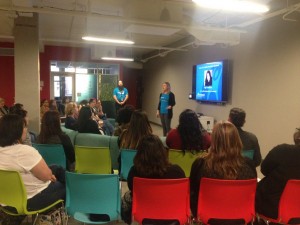
Deborah Carter, senior manager of global talent development at Rackspace, speaking at Linux for Ladies information program at the Open Cloud Academy.

Deborah Carter, senior manager of global talent development at Rackspace, speaking at Linux for Ladies information program at the Open Cloud Academy.

Anna Eilering worked as a chef before becoming a software developer two years ago.

“I make four times the amount of money I made as a chef,” Eilering said.

She also has healthcare and other benefits as an employee at Rackspace in San Antonio. But it took her almost ten years working as a chef before she decided to go back to school and get a degree in computer science.

Today, Eilering, who sports bright pink hair, is co-organizer of SA PyLadies Meetup and loves her new career.

“We bring new, diverse ideas to the field,” Eilering said.

On Tuesday evening, Eilering spoke to a gathering of about 100 women and a few men attending an informational meeting on the Linux for Ladies program at Rackspace Open Cloud Academy at Geekdom. She was one of a handful of speakers who recounted their experiences as women working in the technology field dominated by male employees.

Rackspace, through its Linux for Ladies program, seeks to train more women for careers in the technology field. The San Antonio-based company launched Linux for Ladies two years ago and has since graduated 43 women from the program, and the majority have found careers in the technology field.

Among them, Laura McMasters got a scholarship to attend the first Linux for Ladies program in 2014. She left graduate school in physics to pursue a career as a Linux system administrator. She now works at Rackspace. She told all of the women that she was in their situation just a few years ago and she didn’t know if she would land one of the 20 spots in the class, but she worked hard, persevered and she got selected for the program. She told them she worked from 8 a.m. until 8 p.m. every day of the program. It wasn’t easy, but it was worth it, she said.

The Linux for Ladies program has changed people’s lives, said Deborah Carter, senior manager of global talent development at Rackspace. Candidates come from all stages of life, she said. Some are students, others have had a career and want to pivot into something new and some are stay at home moms re-entering the workforce, she said.

The program costs $3,500 but Rackspace, in cooperation with Project Quest, is offering scholarships to 20 women. The requirements are the women must be 18 years or older and have a high school diploma to participate. It starts May 31st and lasts eight weeks. It runs Monday through Friday from 8:00 a.m. to 5 p.m.

To qualify for the program, applicants also have to have their Comp TIA network plus certification to participate. Rackspace’s Open Cloud Academy offers a self-paced program to achieve that certification.

Time for Startups to Apply for the Austin Chamber of Commerce’s 2016 A-List

austin_alistThe Austin Chamber of Commerce Thursday began accepting nominations for the 2016 Austin A-List.

The awards, put on by the chamber and South by Southwest Interactive, seek to showcase Austin’s most innovative startup companies at three different stages of development.

• Emerging (Early/Seed Stage) – Raised under $1 million;
• Growth (Mid-Stage) – Raised $1 million to $10 million; and
• Scale (Later Stage) – Raised above $10 million.

The list is now in its sixth year. The chamber encourages any “scalable, high-impact, pre-IPO startups to apply.” Nominations will be accepted through Friday, April 8th. An invite-only ceremony will be held on May 12th to reveal the A-List winners.

To date, Austin A-List companies have collectively reached $1 billion in funding and exit proceeds to date and 19 A-List companies have seen successful exits via acquisition or initial public offering, according to the Chamber.

“We are excited to raise the profile of our region’s most innovative companies that help cultivate investment and attract the next generation of entrepreneurs and talent,” Michele Skelding, senior vice president of Global Technology and Innovation at the Austin Chamber, said in a news release. “The Austin region continues to increase its innovation pipeline through a steady stream of funding deals, nationally renowned accelerator programs, and one of the top angel networks in the country.”

Driverless Vehicles and Other Projects Being Developed at Southwest Research Institute

By LAURA LOREK
Reporter with Silicon Hills News

One of Southwest Research Institute's autonomous cars, know as MARTI, which stands for Mobile Autonomous Robotics Technology Initiative. Photo courtesy of SwRI.

One of Southwest Research Institute’s autonomous cars, know as MARTI, which stands for Mobile Autonomous Robotics Technology Initiative.
Photo courtesy of SwRI.

A group gathered at bleachers in a test field just off Culebra road on Monday as a giant red cab of an eighteen wheeler drove up and stopped along with a Ford Explorer, nicknamed Marti, and a Humvee. None of them had drivers.

Most people have heard about Google testing its autonomous vehicles on the streets of Austin, just the second location outside of its Mountain View, California headquarters.

But how many people know for the past decade a group of scientists at Southwest Research Institute have been working on autonomous car research in San Antonio?

At SwRI, driverless trucks, cars and even Humvees regularly hit the road or the dirt on the SwRI campus to prefect their navigation systems and software.
On Monday, SwRI showed off a few of the more than 4,000 projects underway at the nonprofit organization that does contracted research and development for companies and government agencies. It was part of its 68th annual meeting of its advisory trustees and board of directors. In the morning, visitors listened to presentations from scientists and engineers. In the afternoon, they boarded busses to tour labs, buildings and research test sites like the autonomous vehicle field.

“We’ve been doing research and development in this area for about 10 years now for a variety of clients, foreign and domestic, military and commercial,” said Ryan D. Lamm, director of research and development in the applied sensoring department for the Automation and Data System Division at SwRI.

“The whole point of this technology is to save lives,” Lamm said.

The institute has automated more than 15 different vehicles, Lamm said. They’ve deployed them in five countries on four continents. In 2014, the institute sent two military vehicles to Afghanistan.

What purpose do the autonomous vehicles serve?

“From a military application standpoint, it’s to get the soldiers out of harm’s way,” Lamm said. “From a commercial standpoint, it’s to make cars that don’t crash.”

SwRI’s training ground for autonomous vehicles is geared around the complex problems for accelerating the realization of this technology, said Steve W. Dellenback, executive director of the Intelligent Systems Department in the Automation and Data System Division at SwRI.

The institute’s test track has an oval pattern which is about a mile in length with paved streets equipped with stoplights and railroad crossing areas. But it also tests the military vehicles on dirt roads or fields to simulate what those vehicles might encounter in a war zone. The institute also has 200 acres in a private area at the SwRI campus where it tests autonomous vehicles, Dellenback said.

In the U.S., 64 percent of the roads are paved so that leaves 36 percent that are not paved, Dellenback said. The institute has developed technology specifically for autonomous vehicles to navigate unpaved roads, he said. It has created software that runs on a hardware system with a bunch of sensors and costs about $10,000. The institute’s autonomous vehicles can operate without GPS and radar in a stealth mode, which is necessary in a war zone. At the institute, autonomous vehicles use sensors, software, cameras and perception to navigate the landscape, Lamm said.

“The technology is moving very, very fast,” Lamm said. “It’s accelerating. It’s nice to see. We’re hoping to see these systems out on the roadways. I hope my children and I get to enjoy them sometime soon.”

In addition to the autonomous car research, visitors to SwRI at a different test site watched a truck drive 60 miles per hour into a guardrail to test the safety of the guardrail. The truck, which also didn’t have a driver, was on a cable pulled by another truck in the opposite direction which helped keep it on course. The institute, which has worked on guardrail and highway safety for more than 30 years, is doing research for guard rail manufacturers, according to a spokesman.

The other on-site demonstration involved fire technology. The institute tests building materials for fire resistance by burning them in a giant kiln. It has also created an on-site pollution abatement system to capture the carbon released during the fires.

During the morning sessions, SwRI staff presented technical programs on everything from New Horizons mission to Pluto to large scale robotics development.
SwRI has a campus in Boulder, Colorado with more than 100 staff. Alex Parker, a planetary astronomer at SwRI, leads a team that work on NASA’s New Horizons mission to Pluto. He shared his insights at the SwRI meeting on capturing images of Pluto.

“New Horizons collected an unprecedented amount of data for a first flyby mission,” Parker said.

Correction: This article has been updated to correct the division name and the number of continents the autonomous vehicles have been deployed to.

Healthcare Robots and Software Showcased at stARTup Studio

By HOJUN CHOI
Reporter with Silicon Hills News

Bob Metcalfe, professor of innovation at UT Austin talks with Andrea Thomaz, who teaches computer engineering and founded Diligent Droids, a healthcare robotics company.

Bob Metcalfe, professor of innovation at UT Austin talks with Andrea Thomaz, who teaches computer engineering and founded Diligent Droids, a healthcare robotics company. Photo by Hojun Choi

Entrepreneurs from around Austin gathered at WeWork downtown for the second stARTup Studio of 2016, and had a chance to hear about innovations being developed at The University of Texas at Austin.

The event, which began in 2013, is co-sponsored by WeWork, the Austin Chamber of Commerce and the Office of Technology Commercialization at UT Austin.

The meeting is meant to mimic an artist studio, where people can bring their work for others to critique, said Bob Metcalfe, professor of innovation at the Cockrell School of Engineering. He also serves as faculty director of the Innovation Center, which puts on the monthly stARTup Studio events.

On Tuesday evening, Andrea Thomaz, who teaches computer engineering, presented Diligent Droids, a company that seeks to provide aid to healthcare providers through robotic technologies.

“Being new to the Austin community, I was really looking to connect with potential strategic partners as well as people who can help advance the technology,” Thomaz said.

Thomaz said she hopes to apply her research in the field of artificial intelligence to help healthcare providers with their service.

“My work falls broadly into the world of artificial intelligence, but I’m interested in a really particular area,” Thomaz said. “I’m interested in social intelligence and how machines can fit appropriately into a human environment.”

Before joining the electrical and computer engineering department at UT Austin in January, Thomaz spent eight years researching and developing a robot that could learn from its surroundings.

“Social intelligence refers to the ability to react dynamically to the situation that humans are creating,” Thomaz said.

Recognizing the potential behind machines that can be taught to adapt to situations, Thomaz began researching how she could take the technology to market.

Thomaz said market research, which focused on healthcare providers, showed that nurses were often forced to spend a large portion of their time running around performing what Thomaz described as “hunting and gathering” tasks.

By providing hospitals with robots that can learn simple jobs, such as fetching warm towels or bringing supplies for procedures, Thomaz said nurses could spend more of their time tending to patients, and improving the quality of care.

Because every hospital functions differently, Thomaz said the machines would require time to “shadow” nurses to correctly learn their tasks properly.

“There is a lot going on in a hospital floor, and we need to have the robot adapt to how humans are currently getting a good job done,” Thomaz said.

The second presenter, Robert Crawford, professor of mechanical engineering, showcased his company, nVariate, with Ben Urick, a UT graduate student at the Cockrell School of Engineering. They said their service will help those who require computer-aided design, or CAD, for their businesses.

Crawford said computer-aided design currently faces many challenges in the realm of “surface-to-surface intersections” in which even the smallest gap or miscalculation can cause a huge design flaw.

For example, a design of a teapot may look good enough on a computer screen to have the design manufactured or created with a 3D printer. However, the teapot may have gaps that cause leaks due to the surfaces of the design not meeting at the seams correctly.

Urick, who also spoke to attendees at the event, said about 80 percent of the work that he performed as an engineer in the field required fixing these miscalculations, or “trim problems” by approximation and human calculation.

Rather than having to deal with human error and tedious calculations, Crawford and Urick said their process creates a “map” that can recognize flaws and fixes them in a way that does not require the manipulation of the design file itself.

“Our process identifies where these holes are, and it simply tells the graphic card simply not to show these parts,” Urick said. “Essentially, our technology identifies the math in the model, and does the rebuilding for you.”

Because each industry uses a different program to perform computer-aided design, Urick said nVariate’s process allows for designs to be fixed across these different platforms.

“A lot of times when you’re developing these technologies, you go down this ‘wormhole’ and you think everyone understands your industry, so it is really refreshing to hear from people who were not aware of these specific problems,” Urick said.


Shopgate moves U.S. Headquarters to Austin and Plans to Hire 50

shopgate_logoShopgate, a German-based mobile ecommerce company, announced Wednesday it is moving its U.S. headquarters to Austin from Palo Alto and plans to hire 50 local employees.

Shopgate also announced Marc Biel as its Chief Executive Officer to lead its expansion into the U.S. market. Biel previously served as chief financial officer and chief operations officer since 2014.

The company, which raised $15 million in Series C funds in January, reviewed several U.S. cities before choosing Austin, according to the company.

“Austin is home to an incredibly robust eCommerce ecosystem, including some of our strategic partners like BigCommerce and Volusion,” Biel said in a news release.

A big factor in influencing its decision to locate in Austin is access to veteran talent in areas such a business to business sales and strategic marketing. The company recently hired Hass Johnson, vice president of sales, previously with BigCommerce and Casey Gannon, vice president of marketing, previously with Volusion.

Shopgate has more than 650 customers in the U.S. already including Gameday Merchandising, a sports and event merchandising company which sells brands such as the Golden State Warriors and the Oklahoma City Thunder.

“We plan to roll out cutting-edge technology in 2016, including one that we think will make a big splash during our first-ever SXSWi in March,” Biel said.

Two UT Professors Get Startup Grants from the Innovation Center

Luis Sentis, assistant professor of mechanical engineering at UT Austin

Luis Sentis, assistant professor of mechanical engineering at UT Austin

The focus of the Innovation Center in the Cockrell School of Engineering at the University of Texas at Austin is to help professor led startups.

To that end, the Innovation Center formed a grant fund and Wednesday announced its first two grant recipients. The center awarded grants to Professor Luis Sentis, who runs a robotics startup Apptronik and Professor Richard Crawford, who runs nVariate, a software design startup. Both are in the Department of Mechanical Engineering.

The Innovation Grants, which range from $10,000 to $100,000, are open to all UT Austin faculty members with early stage startups. More grants will be awarded throughout the year, according to the center.

Richard Crawford,  professor of mechanical engineering at the University of Texas at Austin

Richard Crawford, professor of mechanical engineering at the University of Texas at Austin

Sentis will receive a $40,000 grant to commercialize robotics technology and Crawford will receive $20,000 to make better Computer Aided Design software, according to Professor Bob Metcalfe, faculty director of the Innovation Center and professor of innovation at the Cockrell School.

“The Innovation Center encourages and supports faculty and students in using startups to change the world with their research,” Metcalfe said in a news statement. “The center provides entrepreneurial tools, expert advice, entrepreneurship courses, mentorship and other commercialization resources.”

Raising funds to support the Innovation Grants is a major focus of Louise Epstein, entrepreneur and managing director of the Innovation Center.

“One of our key objectives in the Innovation Center is to identify and support the faculty who are eager to commercialize their research,” Epstein said in a news release. “We envision that promising research will progress into a startup, move off campus to recruit staff and leadership, raise additional capital, scale up and impact society.”

UT Austin Startup Atom Mines Wins Texas Energy Pitch Competition

By LAURA LOREK
Reporter with Silicon Hills News

Oil field photo licensed from iStockPhotos.com

Oil field photo licensed from iStockPhotos.com

A new startup, Atom Mines won first place in the Texas Energy pitch competition at the University of Texas at Austin during UT Energy Week.

The Austin-based startup, founded this year, is creating a more efficient type of light bulb that uses less energy and lasts longer.

“Atom Mines will produce tailored mercury isotopic mixtures to replace the natural mercury mixtures used in billions of linear fluorescent bulbs, offering 22 percent efficiency gains,” according to Kirk Dorius, the company’s CEO. “Tens of cents in tailored isotopics will save tens of dollars in electricity per bulb.”

Light bulbs are just the first application Atom Mines is tackling, Dorius said. It plans to produce separated stable istopes for all kinds of industrial applications.

“The same tailored isotopics can be used in UV lamps to address chlorine resistant pathogens in water supplies,” he wrote, via email. “Other separated stable isotopes have applications in advanced nuclear reactor designs.”

Mark G. Raizen Ph.D., professor of physics at UT Austin, is the company’s chief technology officer. He is the co-inventor of MAGIS isotope separation and optimized isotopics for fluorescent and UV lighting. Its CEO Dorius is an intellectual property attorney, mechanical engineer and entrepreneur in nuclear medicine and energy.

The competition showcases companies run by students, faculty and others with ideas focused on the energy industry, said Darcia Datshkovsky Sáenz, a graduate student in public affairs and energy. She is the president of the Longhorn Energy Club, which puts on the competition.

This is the second year for the Texas Energy pitch competition. Last year, they gave away $100,000 in prizes. This year, because of the big dip in oil prices, the competition gave $8,000 to the first place winner and $4,500 to the second place winner. Both winners came from UT.

“The competition shows that what starts here really changes the world,” Datchkovsky Sáenz said, quoting the university’s motto.

Texas Guadalupe earned second place.

Texas Guadaloop is made up of a team of 40 engineers, computer scientists and business students at the UT Austin who are building the Hyperloop transportation pod. SpaceX selected their team to design and build a working model of its Hyperloop transportation pod. They are currently raising funds and building their prototype. They are scheduled to showcase their final pod to Elon Musk this summer.

In all, 15 companies competed in the Texas Energy Pitch. They gave 20 minute pitches throughout the day last Thursday before a panel of judges. The winners were announced during a happy hour event that evening.

The other companies included:

AeroClay – A division of Compadre in Austin, AeroClay takes clay and polymers and makes it into a “lightweight material that can be used as a structural material, coating or liner.” It can be used as insulation material or to clean up hazardous waste, according to the company.

EBIK – A startup based at the University of Texas at Austin that lets students rent electronic bicycles to get around campus. The idea is fashioned after the business model of Car2Go.

ExpertKnowledge – This Houston-based company, formerly known as In-Acuity, creates training courses for employees in the oil and gas industry based on knowledge from current and past employees.

GNOSYS – A Houston-based Software as a Service startup offers software tools for creating electronic procedures in the oil and gas industry via augmented reality.

Infinitoom – A San Antonio-based startup that specializes in licensing new technology, partnering and consulting in the electricity industry.

Nexushaus – A group of UT students partnered with Technische Universitaet Muenchen in Germany to create an energy efficient 784 square foot solar house. They placed fourth in the U.S. Department of Energy’s Solar Decathlon in 2015. The house also collects most of its own water and has a vegetable and fish system that relies on closed-loop aquaponics.

Onboard Dynamics – This startup, based in Bend, Oregon, is “integrating natural gas compressor technology into automotive engines, reducing the cost of CNG compression,” according to the company.

Recollect Energy – A startup founded out of the University of Houston manufactures thermoelectric generators that convert heat into electricity for commercial trucks on the road today.

Seismos – Based in Austin, with offices in Houston, this startup improves real-time fluid flow monitoring for enhanced oil recovery, according to the company.

Simplify Solar – the company created a platform to assess the costs of buying and installing solar panels for homes.

VERT Solar Finance -a Houston-based investment company with experience in structured finance, private equity and renewable energy development.

Water Lens – this Houston-based startup does real time testing of water and other fluids at an oil well site.

Xyber Technologies -this Austin-based startup has created energy efficient cooling systems for servers in data centers. Its technology reduces energy consumption by up to 30 percent and cooling requirements by up to 40 percent per server.

Correction: an earlier version of this article did not correctly explain the light bulb process Atom Mines plans to use.

« Older posts Newer posts »

© 2026 SiliconHills

Theme by Anders NorenUp ↑