
 San Antonio-based Xenex Disinfection Services announced Thursday that is has received $11.3 million in funding.
The funding comes from Battery Ventures, Targeted Technology Fund II and continued investment from existing investors including RK Ventures.
The company will use the funding for product development, international expansion and increasing its U.S. sales force.
An estimated two million people get infected with antibiotic resistant bacteria every year and 23,000 die as a result of their infection, according to the Centers for Disease Control and Prevention. To help prevent infection, Xenex makes a portable robot that can disinfect a room using ultraviolet light to destroy viruses, bacteria, mold, fungus and bacteria spores.
 “Healthcare associated infections are a global health crisis. In the United States alone, 278 people lose their lives every day from an infection they unnecessarily acquired during their hospital visit. The Xenex technology is proven and is rapidly gaining acceptance. Xenex is the only company whose customers have published peer reviewed outcome studies showing a reduction in infection rates after implementing Xenex’s disinfection technology,” Morris Miller, CEO of Xenex, said in a news release. “We want to get our devices into hospitals as quickly as possible to help solve this enormous problem.”
Nearly 200 hospitals and medical centers currently use Xenex’s room disinfection system.
Category: San Antonio (Page 32 of 62)
By ANDREW MOORE
Reporter with Silicon Hills News
 On Geekdom’s projector screen, a buffalo and crab were prepared to move around a purple race track. SparkFun’s Jeff Branson gave the students the final programming directions for moving their animated characters.
“We have to be able to rotate to drive the buffalo, or in your case the flying pancake or whatever you’ve created,” Branson said. “I have to use my slider to drive my buffalo.”
This wasn’t Branson’s first digital rodeo. The SparkFun National Tour has already visited 70 cities on the way to San Antonio while teaching kids about programming, soldering, and building circuits. The SparkFun tour is an educational outreach mission of the larger SparkFun Electronics Company — based in Boulder, Colo. — which makes components for a wide range of prototype electronic devices as well as components for students, teachers, and inventors.
 The San Antonio stop, which taught programming, was organized and funded by San Antonio nonprofit SASTEMIC – an educational organization working to organize and grow the local Science, Technology, Engineering and Math, known as STEM, community. SASTEMIC signed up for the event a year ago when they contributed $1,500 to the SparkFun Kickstarter campaign. Geekdom hosted the event.
Thirty-five students, ages 8-14, attended the event. While using Scratch, a drag-and-drop programming software, the students learned to program if-then statements and manipulate variables so that their animated character, called a sprite, could maneuver around a race track while avoiding another sprite. By the end of the day the students would have a simple game, which even included programming sprite collisions and creating a scoring system.
“When the crab runs into the buffalo, what do we want to happen?,” SparkFun Curriculum Curator Derek Runberg asked. “How about we lose one coin? What do we do when we want to subtract coins?”
 To control their game, the students used a PicoBoard– a SparkFun-created multifunctional circuit board that has buttons, sliders, and sensors and can be programmed to work with Scratch. The kids had to program their software to work with their hardware. In this case, they used the slider to steer their sprite and a button as an accelerator. Once their character moved, they collected coins around their racetrack.
While the kids might not have noticed, the exercise required substantial problem solving as well as some intermediate math.
“It’s a very concrete way of teaching variables to kids at this age. In their standard math class, they just see a variable as a letter. In this they get to see that value change over time depending on what they are doing on the board,” Runberg said. “It makes a really good mental connection between something abstract and reality.”
Programming a racing buffalo or pancake might be more fun than work, but it’s the first part of a much bigger picture for SparkFun. The ultimate goal, according to Education Outreach Coordinator Jeff Branson, is to speed up the educational process for the next generation of programming talent.
 “We feel like it’s the key to the future of innovation in this country,” Branson said. “It takes about 15 years to produce a significantly advanced engineer or computer programmer who is able to work at the levels of technology that are common in our society. If we start kids really young in these drag-and drop programming environments, by the time they get to the [Coding] languages, the vocabulary and the techniques are something they’ve already got. So it makes it that much easier, they learn that much faster, and we can push them into advanced territory that much sooner. ”
Parents such as Jay Tkachuk agree. While Tkachuk is Vice President of Online Services for Security Service Federal Credit Union, he has never been code-savvy and wants his kids to have that ability.
“To put it mildly, people who know how to code have special powers. I want our kids to not only be savvy how to use technology but to understand it on a fundamental level,” Tkachuk said. “We are trying to move away from the paradigm of just being users. I want them to be able to create or, if necessary, fix things.”
Both of Tkachuk’s 8-year-old kids, Kai and Michael, participated in the event.
“We were doing Scratch the cat, and we were making racetracks so they could race each other and see who would win,” Kai said. “I put the cat on the buffalo and I drew a Mario horse.”
The SparkFun National Tour will continue on to Houston Sunday and then will end in Victoria on Monday.
SASTEMIC plans to continue creating STEM programs, starting with a high school outreach program in January led by STEM Director Mark Burnett. The nonprofit organization purchased Geekdom’s Geekbus last summer, and will begin a high school pilot program next year using the resources of the SA Maker Space.
SASTEMIC founder and Chairman Scott Gray, who is also the President of Elevate Systems, says the programs are important to the San Antonio economy.
“The goal is to get the K through 12 kids excited about all of the STEM pathways so that they can progress and go to college and get degrees so we can hire them here in San Antonio,” Gray said.
Geekdom is a sponsor of Silicon Hills News
San Antonio-based Diligent Consulting announced on Friday that it has received a $5.2 million contract with the military.
The company got a contract for Cryptologic Mission System Software Services to support its Air Force Lifecycle Management Center Cryptologic and Cyber Systems Division in San Antonio.
The contract supports modernizing and integrating the cryptographic units in various United States Air Force applications.
“Diligent understands the criticality of ensuring these crypto systems function correctly, keeping information secure in support of multiple worldwide missions,” Rich Riney, the company’s Chief Operating Officer, said in a news statement.
Founded in 2001, Diligent a Service Disabled Veteran Owned Small Business.
 Bacteria has become the bane of hospitals.
In particular, Methicillin-Resistant Staphylococcus Aureus, known as MRSA is a drug-resistant bacteria that can cause life-threatening infections in humans.
So what’s a hospital to do?
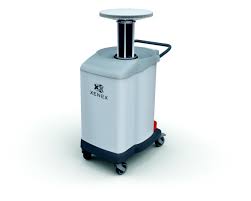
Call in the robots. A San Antonio-based company called Xenex Disinfection Services has created a germ zapping robot.
And the University Health System in San Antonio plans to install three of the $125,000 devices and use them in patient rooms, critical care areas and operating rooms throughout University Hospital. It also plans to put one in the Cystic Fibrosis Clinic at the Robert B. Green Campus downtown, where patients are particularly vulnerable to infections.
Xenex’s robots are being used in more than 200 hospitals and health facilities nationwide including UCLA, Boston Children’s Hospital and UT MD Anderson Cancer Center.
“The Xenex room disinfection system uses a powerful, pulsed-xenon ultraviolet light to kill all sorts of infectious organisms,” according to a news release. “One study showed the treatment was 20 times more effective than scrubbing with traditional chemical cleansers.”
Typically, the device is rolled into a room after housekeeping staff finishes a thorough cleaning and sanitizing. The operator then programs the machine and clears the room. Up pops the saucer-shaped light source, and for five to 10 minutes the room is bathed in powerful pulses of UV light — 25,000 times more powerful than sunlight, and capable of killing such infectious threats as Clostridium difficile, norovirus and MRSA.
Two John Hopkins-trained epidemiologists developed the technology. In 2008, Morris Miller, an early investor in Rackspace, invested in the company, now called Xenex Disinfection Services. He also became its CEO and moved its headquarters and manufacturing operations from Austin to San Antonio.
By LAURA LOREK
Reporter with Silicon Hills News
 Pressable is the new startup at Geekdom in San Antonio.
But it’s actually one of the oldest startups at the downtown co-working space.
Vid Luther launched ZippyKid in 2010 as a managed WordPress hosting site.
On Thursday, the company rebranded as Pressable.
With the new name, Luther, CEO, plans to align the company’s brand with its growth.
Last summer, Luther bought the domain name and Twitter handle for Pressable. He wanted the name to reflect the company’s focus on WordPress hosting for Fortune 100 companies, startups, nonprofit agencies and professional organizations worldwide.
The company is also introducing a new pricing model. It currently hosts one website for $25 a month. Starting today, customers can host up to five websites for $25 a month.
“We commoditized WordPress hosting and made it available at a price that is more accessible,” Luther said. Pressable seeks to simplify publishing online for WordPress users.
Today, an estimated one in five websites on the Internet runs on WordPress.
The rebranding is the first step in expanding Pressable’s business, Luther said. Other changes will be unveiled early next year, he said.
Pressable is privately held company and has nine employees. It has raised $800,000 in seed stage funding from Rackspace cofounders Pat Condon, Dirk Elmendorf, Automattic, the company behind WordPresscom, DuckDuckGo founder Gabriel Weinberg, Slicehost founder Jason Seats and 500 Startups.
Pressable with 1,200 customers is profitable and has revenue of more than $1 million a year, Luther said.
Geekdom is a sponsor of Silicon Hills News
By LAURA LOREK
Founder of Silicon Hills News
 Shir Even-Zohar’s parents are diabetic patients.
She knows firsthand that the main way to treat the incurable disease is to balance the body’s blood glucose levels, which requires strict glucose level monitoring. That’s not always easy to do.
That’s why Even-Zohar sees the need for a new medical device called Dario, a diabetes management platform that runs on a smartphone. LabStyle Innovations, based in Tel Aviv, Israel, developed Dario, a cloud-based, mobile health platform for diabetes and related blood glucose monitoring.
“This device will help them easily get their data on their phone and get their insights to learn how to better manage their diabetes in a very convenient way,” said Even-Zohar, a business development senior manager for LabStyle Innovations.
The market for the device is huge. Worldwide, more than 400 million people have diabetes and it’s on the rise fueled by the obesity epidemic. The main type of diabetes is type 2.
“Dario is the next generation in advanced diabetes self-management,” according to Even-Zohar. Dario helps people manage their diabetes better, she said. The software integrates with the all-in-one, pocket-sized, Dario blood glucose monitoring device. It comes with lancet, strips and a meter that connects to a smartphone, and a website application enabling patients, medical professionals and caregivers to access data with the aim of and as a result drives proactive intervention.
Next week, Even-Zohar will travel to San Antonio to introduce Dario to patients enrolled in a consumer focus study that will take place at Geekdom, a San Antonio coworking space focused on tech startups based in the Weston Centre downtown.
 Geekdom members Alan Weinkrantz and Cynthia Phelps are heading up the local focus group on Dario. They’ve enrolled several people into the paid sessions but they are still looking for a few more insulin-dependent diabetic patients to participate. They are looking for people who are between 18 to 45 years old and who use a smartphone and have type 1 or type 2 diabetes. The participants need to use an insulin pen and test their blood glucose four times a day. The two-hour sessions start Monday and run through Wednesday.
On Tuesday, Health 2.0 will hold a public meeting at Geekdom to introduce Dario and Even-Zohar will talk about Israel’s medical-technology startup economy. The event will begin at 6:30 p.m. It’s free to attend but registration is required.
“San Antonio has a very large diabetes population,” Even-Zohar said. “We think at Geekdom we can meet great people who can help us understand their needs and evaluate a product that we are about to launch. If there is anything that we can improve, we want their feedback to make the best product possible.’
The free Dario app will be available for download from the Apple App Store on Dec. 12 this year in the U.K., Australia and New Zealand. The launch of the Dario iOS App is the first step of LabStyle’s worldwide rollout of the full Dario platform. LabStyle received certification for Europe for the full Dario diabetes management platform last September. That allows LabStyle Innovation to market Dario in Europe. The company plans to file for 510 (k) Food and Drug Administration clearing to market its platform in the U.S. in the near future and anticipates regulatory clearance in 2014, Even-Zohar said. Currently the app is only available for iOS devices, but an Android compatible version is expected soon.
LabStyle Innovations, a publicly traded company founded two years ago, has partners in the United Kingdom and Italy to distribute and sell Dario.
“The app is a very nice tool to use even without our device,” Even-Zohar said. “It’s a way to introduce the product and get them hooked on our approach of diabetes management.”
In addition to San Antonio, Even-Zohar will visit Cleveland, Ohio. David Edelman with Diabetes Daily has set up some meeting for her there.
“This is a very innovative approach on how diabetes should be managed,” Even-Zohar said.
By ANDREW MOORE
Reporter with Silicon Hills News
 The University of Texas at San Antonio held its inaugural 3 Day Startup event last weekend.
Friday afternoon, 35 students began working to create startups with viable business models within a 52 hour deadline.
At the final presentation Sunday evening, the students pitched six startups to a panel of judges, including Flashscan3D CEO Mike Troy, CEO and President of Liquid Networx Don Douglas, and Harvey Najim Center for Business Innovation and Social Responsibility Director Suz Burroughs.
“What we have done today here is begin to introduce entrepreneurship across the campus,” UTSA CITE Assistant  Director and 3DS mentor Anita Leffel said. “All of you are in one way or another entrepreneurial. You will be more willing to take these risks, to stand up and fight and work for what you believe in and for improving our city.”
Leffel led the 3DS mentoring team along with entrepreneur and angel investor Michael Girdley. The mentoring team also included Cole Wollak of SA New Tech, Nathan Roach of RAM Law Firm and Greenhouse, Ev Kunetsov of Rackspace, Richard Ortega of TrueAbility, Andrew Trickett of the UTSA Texas Sustainability Research Institute, Jerry Wassum and others. UTSA’s CEO student organization helped organize and recruit for the event. The 80/20 Foundation sponsored the 3 Day Startup.
While it’s the first 3 Day Startup at UTSA, it’s not the first one in San Antonio. Rackspace hosted the first two 3 Day Startup programs at its headquarters a few years ago. Since then, Geekdom has hosted several 3 Day Startup programs. The program originated at the University of Texas at Austin and has since gone global as a way to easily teach entrepreneurship in a weekend.
Out of the 35 original students at UTSA, 28 made it to the final presentation. The others dropped out. The program is not easy. It’s demanding. And few of the participants sleep. Throughout the weekend, the students worked on creating business models with the lean canvas approach. They learned verbal strategies to explain their ideas concisely and court potential customers. They did primary research – talking to San Antonio businesses about their ideas and changing them if no one was interested. They practiced pitching over and over while getting constant input from mentors.
At the final presentation, some of the business models were completely different from the original idea, which is quite common in the 3 Day Startup process.
One of the startups, Smart Bar Technologies created a bottle-weighing pad that helped bar owners keep track of their most expensive spirits. They plan to design an app for the pads that will allow bar owners to monitor the bar in real time and find out if their bartenders are over pouring or giving away drinks. While the team knew they wanted to do something to help bars, their idea constantly changed throughout the weekend.
“We pivoted nine times,” said Luis Sauceda, the Smart Bar Technologies’ presenter. “We went from a machine that would pour drinks for you, to an application that will show you how to bartend, then we were going to do solar panels, and then we came back to this.”
Another team changed their idea completely. The resulting startup, Gift Gram, is a mobile app that sends personalized video messages along with a digital gift card. The app generates revenue by taking a portion of its gift card sales — possible because they can get a discount buying cards in bulk — and by selling premium video message templates.
Schedutary, which also had changes, is a mobile calendar app that – after some initial data input and use – can guess what appointments a user might have in the future and will reschedule existing appointments by notifying the user of free time in the future. The app will also be able to sync with existing calendar applications such as Google Calendar. The team also wants to tie the app to Facebook, so friends can find out if the user is busy and why.
Several original startup ideas withstood the three days of testing. Emergensleep designed an enclosed, rectangle-shaped sleeping pod, inspired by Japanese capsule motels, that can be quickly deployed when needed or stacked to gather like red solo cups when not in use. Nick Villarreal, who had the idea ready for 3DS, envisions the pods being used in disaster relief situations in place of traditional cots because pods are faster to set up and stackable as bunks.
“Ninety two million people are how many people were displaced worldwide by disasters last year. What do you do when that many people have no place to sleep?” Villarreal asked. “It takes a lot of time to set up a whole bunch of cots. You have to figure them out and put them in a spot. This one you can just pull out and place in that spot.”
Engineer-aiding startup Listo also got their idea through unscathed. Listo is a web application that combines parts catalogs for different construction industries into one list on one website, simplifying the process of finding and buying specific parts for engineers. Eventually, the Listo team wants to make the lists searchable by industry, part availability, price, and so on. The startup will make money from both ads and premium listing options from manufacturers.
The most popular idea at Fridays pitch meeting, Kommingle, also made it through to the final presentation. Created by Anton Moczygemba, Kommingle is a web based app that allows restaurants to push out special coupons at strategic times to get more traffic. The application is designed with a map so users can see what deals are available at what times. Additionally, however, the app helps friends organize group discounts at specific restaurants were the discounted rate increases with the size of the group. Kommingle will charge participating restaurants a one-time activation fee as well as a monthly fee.
While some presentations were rockier than others, panelist Susan Burroughs was impressed with many of the business concepts.
“I think a lot of them were very, very strong. In the first idea, I really enjoyed seeing somebody presenting from storytelling and from their heart rather than being an actor and having everything memorized,” Burroughs said. “I also felt like the last presentation was incredibly strong (Emergensleep – stackable sleeping pods.) I absolutely love social enterprise and the idea that you can do significant good in the world while still making a profit and paying your rent.”
Both Burroughs and fellow panelist Mike Troy have participated in several 3DS events. Troy believes 3DS is invaluable in showing students how the real world works.
“There is so much in school about being right. The real world operates on, ‘do the best job you can in a certain amount of time that you are given,’” Troy said. “Be okay with that, you know, and then come back and revisit it later if you really need to.”
By ANDREW MOORE
Reporter with Silicon Hills News
 “Learn to Program. Get a Job Offer. Guaranteed.”
This is the not-so-humble sales pitch of Codeup – a for-profit code education startup founded by San Antonio entrepreneur and angel investor Michael Girdley. The startup offers a nine week programming boot camp located at Geekdom of San Antonio which will teach the programming skills currently sought for in the workforce. The startup’s first boot camp, starting Feb. 3, will focus on web development and will cover Linux, Apache, MySQL, PHP, and JavaScript. The camp price tag is $7,430, and if the student does not receive a job offer within six months of completing the course they get half their tuition back. Enrollment has already begun.
Girdley justifies his guarantee with his business approach. Before launch, he collaborated with both small startups and larger companies in need of developers to find out exactly what skill-set they want to hire.
“We went and talked to them and got feedback on what they are looking for. We added a whole set of methodologies in terms of how to work as a team of programmers to the course after meeting with certain employers,” Girdley said. “Ultimately we have two customers. One is the student and the other is the employers. We have really worked hard to have them meet in the middle for everyone to be happy.”
Codeup’s classroom experience is designed to be as intensive and hands-on as possible. Students will learn concepts quickly in 15 minute intervals and then immediately implement them with exercises lasting 20 minutes. Each class will hold 20 students. Girdley will be teaching the classes along with Jason Straughn, Samantha Atkins, and Chris Turner. During exercises, all four instructors will be present to answer any questions. Classes will be eight hours a day and five days week.
To ensure that graduating students get hired, Codeup has formed agreements with 18 startups and recruiting companies who have agreed to consider hiring the graduates upon completion of the course. A few of the employers Girdley has talked to – whom he can’t name at this time – have such difficulty finding developers that they are willing to hire immediately after graduation.
Despite its growing tech talent, finding full time developers in San Antonio is a difficult task — both for large companies like Labatt Food Service and smaller startups such as Geekdom’s TrueAbility. Founder and COO Frederick “Suizo” Mendler welcomes an easier way to find developer talent.
“For us, it is a constant challenge to find folks that can operate at a fairly high level when it comes to the dev stuff. If they produce a good candidate then, yea, we’ll take a look at them,” Mendler said. “All the other developers we hire, we have to go out and hunt them down, go find them in weird places.”
Codeup will start out with only one class of 20, and that class is already starting to fill up. Codeup has received seven applicants since they went public a week ago and have already confirmed two spots. Texas State University Communications Graduate Leslie Tolbert was the first to sign up. She developed a love of programming in her last semester of college but was having trouble learning it all on her own.
“I really feel it’s an investment to myself to make this bigger commitment. It’s really hard to teach yourself how to program through all the other resources out there,” Tolbert said. “It was really appealing to me to have the option that Codeup presents to work with a team of peers…in a collaborative space with expert instructors available to answer questions.”
Tolbert was also able to take advantage of one of the three women’s scholarships Codeup offers, which will pay for half of the tuition. Two are still available.
As a for-profit company, Codeup will raise revenue by charging tuition and by charging a placement fee to the employer when they hire a graduate. The employer’s fee will be equal to 10 percent of the graduates annual salary. Codeup currently has no competitors in San Antonio, but would be competing with MakerSquare in Austin. While the model is similar to Rackspace Hosting’s Open Cloud Academy, the two will not directly compete because they are teaching different skills. In another similarity to the Open Cloud Academy, Girdley says applicants do not need any prior coding experience to be admitted.
“If you are a smart person and you are willing to work hard, you don’t need to know anything. Show up, we will take care of you.” Girdley said.
Geekdom was a sponsor of Silicon Hills News. TrueAbility is an advertiser with Silicon Hills News.

Photo licensed from Getty Images
The Securities and Exchange Commission on Wednesday released its long-awaited proposed rules governing the practice of equity-based crowdfunding that allows startups to sell securities directly to the public.
Legislation from the JOBS Act, signed into law by President Obama in January of 2012, directed the SEC to propose the rules by last October. But that date passed without any action. So nearly a year later, the SEC has published its proposed rules, which now await a 90 day comment period from the public before they become adopted.
For years, artists, game developers, filmmakers, authors, entrepreneurs and others have been using Kickstarter, Rockethub, IndieGoGo and other crowdfund raising platforms to support their projects.
The difference is that those platforms allow for perk-based crowdfunding. People give money to the various projects in exchange for a good or service or some other kind of perk. They do not take an ownership stake in the company.
Online sites like Angellist.com already allow companies to raise money from accredited investors or high networth individuals.
But under the JOBS Act, a section called “Title III” allows startups and small businesses to offer and sell securities on equity-based crowdfunding portals to anyone. And the SEC is tasked with regulating the practice.
The SEC has delayed releasing its rules to make sure that they can protect the interest of investors in these news opportunities.
“There is a great deal of excitement in the marketplace about the crowdfunding exemption, and I’m pleased that we’re in a position to seek public comment on a proposal to permit crowdfunding,” SEC Chair Mary Jo White said in a news statement. “We want this market to thrive in a safe manner for investors.”
The legislation has also created a “new entity – a funding portal – to allow Internet-based platforms or intermediaries to facilitate the offer and sale of securities without having to register with the SEC as brokers.”
The proposed rules allow a company to raise a maximum of $1 million through crowdfunding in 12 months from investors who can spend $2,000 or up to 5 percent of their annual income or net worth. “During the 12-month period, these investors would not be able to purchase more than $100,000 of securities through crowdfunding,” according to the SEC.
The following are not allowed to use equity-based crowdfunding: non-U.S. companies, companies that already report to the SEC, “certain investment companies, companies that are disqualified under the proposed disqualification rules, companies that have failed to comply with the annual reporting requirements in the proposed rules, and companies that have no specific business plan or have indicated their business plan is to engage in a merger or acquisition with an unidentified company or companies.”
And any securities bought through a crowdfunding portal cannot be resold for a year.
Businesses looking to crowdfund would be required to file information with the SEC and provide it to potential investors. The companies would be required to disclose information about officers and director and others that own 20 percent or more of a company.
They are also required to provide a description of the company’s business and what they plan to spend the money on. The price for the securities being offered and the deadline to meet its goals and whether it will accept investments in excess of the target offering amount.
The companies also have to provide financial statements and other information on the financial condition of the company along with tax returns and an audit by a public accountant or auditor. Companies would also be required to amend the documents to reflect any changes in its business.
“Companies relying on the crowdfunding exemption to offer and sell securities would be required to file an annual report with the SEC and provide it to investors.”
The proposed rules also cover the crowdfunding platforms, the new entity set up online to sell the securities to the public. These portals would be required to provide investors with educational materials and take measures to reduce fraud.
The portals cannot offer investment advice or make recommendations. They cannot solicit “purchases, sales or offers to buy securities offered or displayed on its website.”
By ANDREW MOORE
Reporter with Silicon Hills News
 The City of San Antonio is now one of only 10 U.S. city governments chosen for the national Code for America program. Its status as a fellowship city was announced last week at the annual Code for America Summit.
A national nonprofit organization, Code for America works to create better citizen-government interactions and improve city services though a technologist volunteer program similar in structure to the Peace Corp. Each year the organization chooses 10 cities and around 30 technologist fellows to work in those cities. This January, three of those fellows will travel to San Antonio to begin work on one of several proposed initiatives to improve the citizens of San Antonio’s relationship with their local government.
“We are excited to partner with Code for America and welcome the fellows to San Antonio,” Mayor Julian Castro said in a city press release. “I look forward to the work that the fellows will produce to improve on the quality of services the city provides. This partnership will strengthen the city’s competitiveness as a technology and innovation hub.”
Code for America will announce San Antonio’s assigned technology volunteers in November. The fellows will work closely with San Antonio Chief Technology Officer Hugh Miller and Assistant IT Director Kevin Goodwin – going through a research phase in January and choosing their project by February. Two proposals are currently being considered.
The first initiative is to create a database on every address in the city that will display all relevant services or events that occurred at that point. This would include city services performed at the location – such as road work, solid waste disposal stats, and water services – as well as all the permits requested and crimes committed at the address. This will enable citizens to make informed decisions on whether to buy a house, locate a business, develop a property, or do anything else at any address in the city.
The second initiative will create a website that ties together all the volunteer opportunities in San Antonio so that citizens would be able to log on at one place and become more involved in the city. A database connected to the site will allow the city to monitor and better use volunteer resources by ensuring that the right number of volunteers are working on each project and that they have all the resources they need to complete their job.
Miller had already been communicating with Code for America in the 10 months leading up to the announcement and said that Code for America had been considering San Antonio for a long time. He sees it as a great way to get new talented technologists into government – an area they typically avoid.
“How do you make government appealing to talent? That’s one of the things this program does is you take this talent, you engage them into civic opportunities, and let them get a feel for what it takes to run and manage government and citizen services,” Miller said.
To be considered, every applying city must both pay $180,000 and receive a matching amount from the community. San Antonio’s 80/20 Foundation is financing the other $180,000 and will continue to support the project by connecting the fellows with additional partners and resources The money will pay the fellows’ living expenses and go towards the chosen initiative for the city. The 80/20 Foundation’s Executive Director Lorenzo Gomez believes that acceptance into the program is a huge step for the city.
“I think that being accepted into Code for America changes the brand of our city,” Gomez said. “It says we are an innovative city, that we are looking for new ways to run government business, and it portrays the image we want to the rest of the world which is: We embrace the new talent economy and embrace using new innovative technologies to change city government. It is yet another reason that San Antonio is a city on the rise.”