Category: San Antonio (Page 26 of 62)

Biovideo and 9W Search Selected as Finalists in IBM’s Watson Mobile Developer Challenge

By LAURA LOREK
Founder of Silicon Hills News

Watson display at the Computer History Museum, photo by Laura Lorek

Watson display at the Computer History Museum, photo by Laura Lorek

IBM wants to make us all smarter through our smart phones by tapping into its Watson super computer database.

To do that, IBM issued a challenge back in February to app developers worldwide encouraging them to submit apps for its IBM Watson Mobile Developer Challenge. The apps needed to use “Watson’s cognitive computing capabilities to analyze, discover insights and learn from Big Data.” IBM developed Watson as a cognitive technology that processes information more like a human and understands natural language.

Some might consider IBM’s mobile Watson, the sage grandfather of Siri, Apple’s personal assistant available on its iPhones.

Last week, the IBM Watson team announced it has picked 25 finalists in its competition including San Antonio-based Biovideo and Austin-based 9WSearch.

Several hundred companies submitted apps in the IBM Watson Mobile Developer Challenge. The apps that made the cut span several categories including finance, healthcare services, news, business, fashion, education, cities and nutrition.

In the finance category, 9W Search, founded by Susan Strausberg, one of the founders of Edgar Online, submitted its app, which mines financial information online combined with Watson’s cognitive capabilities to answer complex financial questions. Its first application is in the energy industry.

IMG_2570“The ability to incorporate vast amounts of structured and unstructured primary source materials into the 9W/Watson cloud lets users ask and answer billions of complex questions through a simple, familiar interface,” according to 9W Search’s submission.
Biovideo, founded by Carlos Villasenor, made the finalists in the Health Services category. The company submitted an app that provides “the best help for new and expectant mothers at their fingertips.”

Biovideo, which operates out of San Antonio’s Geekdom, works with hospitals in Texas and Mexico to create a movie capturing the birth of a child for free for parents.

“The Biovideo App incorporates the Baby 101 searchable database for the first time and becomes the ultimate parenting tool,” according to the company. “It also eliminates geographic limitation, as the app and the Baby 101 program are available to anyone, anywhere. Providing the power of Watson to the Baby 101 program provides unlimited information, insight and reach to new parents.”

The finalists must submit prototypes to IBM, which will select five teams to present their proposals. And then IBM will choose three winners. “The three winners are awarded 90 days of access to the Watson APIs and consulting from IBM Interactive design services.”

Got Cargo? British Airways Wants to Fly it to London

By LAURA LOREK
Founder of Silicon Hills News

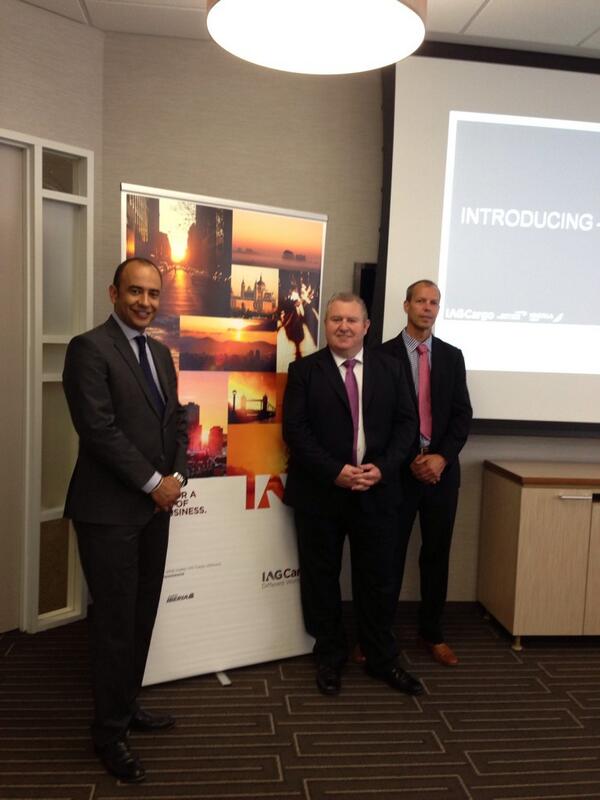
IAG Cargo's team: (LtoR) Camilo Garcia, head of Global Key Accounts, David Shepherd, president of commercial business and Joseph LeBeau, vice president of commercial, the Americas.

IAG Cargo’s team: (LtoR) Camilo Garcia, head of Global Key Accounts, David Shepherd, president of commercial business and Joseph LeBeau, vice president of commercial, the Americas.

On any given day, IAG Cargo might be transporting computer components, chocolates, spare parts for machinery or fruits and vegetables through Austin to London.

And it might be flying in salmon, automotive and other parts into Austin Bergstrom International Airport from its hub at the Heathrow Airport.

“A market like this is great because it’s so diversified,” said David Shepherd, head of commercial business for IAG Cargo.

IAG Cargo wants to make sure Austin companies can deliver products worldwide as fast as possible, Shepherd said. They are particularly targeting the growing high-tech industry in the region.

Shepherd spoke at a press conference Friday morning at the Austin Chamber of Commerce offices in downtown Austin. Four British journalists flew to Austin to learn more about the company’s operations here. They were going to go on a tour of the city and visit Freescale Semiconductor and then have a special dinner at Salt Lick.

IAG Cargo formed in 2011, after the merger of British Airways with Iberia. The company has $1.5 billion in revenue annually and is the seventh largest cargo company in the world. It has more than 2,700 employees worldwide.

“We’re not the biggest but we believe we’re the best,” Shepherd said.

In March, IAG Cargo began offering services out of Austin when British Airlines launched its direct flights between Austin and London. The company has 380 aircraft and connects to 350 destinations worldwide through its hubs at Heathrow and Madrid.

It’s not just geeks flying from Tech City London to Austin’s bustling startup scene. It’s a lot of cargo too.

IAG Cargo transports general cargo, live animals; secure products, gold, airmail, dangerous goods, human remains and courier services.

IAG Cargo has 20 gateways in the U.S. and operates more than 45 flights per day. It already operates out of Dallas and Houston and Austin was the next logical expansion, said Joseph LeBeau, IAG Cargo’s vice president of commercial, the Americas.

“It’s been in the works for about two years,” he said.

“Texas has been very kind to IAG Cargo,” he said. “Between Dallas and Houston, for as long as I can remember, we have been 100 percent full every day.’’

The cargo flights on the Austin to London route were 88 percent full after just three weeks and now operate at 90 percent to 95 percent capacity, LeBeau said.

“It’s not all Austin. It’s being fed into by San Antonio and Laredo,” he said. “This route eases the capacity crunch at Houston and Dallas.’’

Austin is shipping high tech products from the “Silicon Hills” as well as aviation and oilfield spare parts and equipment and pharmaceuticals.

IAG Cargo has a fully functional warehouse at the Austin airport and is expected to get its constant climate accreditation shortly for its refrigerated cargo. Its transatlantic service began daily service as of May 1st and is serviced by a Boeing 787 Dreamliner that can transport up to 44,000 pounds of cargo per night.

Joseph LeBeau providing an overview of IAG Cargo's Austin and North American operations.

Joseph LeBeau providing an overview of IAG Cargo’s Austin and North American operations.

Biosciences and Medical Industry is Booming in Central Texas

Photo licensed from iStock Photos.

Photo licensed from iStock Photos.

Austin’s biotechnology industry is booming, according to a report released Thursday from the Austin Technology Council.

The life sciences sector has 206 companies, 6,052 employees and generates more than $1 billion in economic activity to the region.

The five sectors that make up the industry include pharmaceutical manufacturing, research and development in physical, engineering and life sciences, research and development in biotechnology, surgical appliance and supplies manufacturing and biological product manufacturing.

The industry also pays high wages with the average salary in the life sciences sector of $75,209, compared to $49,557 for the regional economy as a whole.

The sector did suffer a job loss following the dot com bust and during the financial meltdown in mid-2000. But it’s been on the mend and with the groundbreaking of the Dell Medical School at the University of Texas at Austin, the industry is expected to expand even more.

Austin’s life sciences industry is still much smaller than San Antonio’s bioscience and healthcare industry. BioMedSA reported that more than one in every six jobs in San Antonio are in that industry which had an overall economic impact of more than $29 billion in 2011.

Research organizations, private sector companies and the U.S. military drive the bioscience industry growth, according to BioMedSA. The University of Texas Health Science Center at San Antonio is one of the main contributors to the industry along with the University of Texas at San Antonio, the Texas Biomedical Research Institute, Southwest Research Institute, South texas Accelerated Research Therapeutics and the National Trauma Institute.

3 Day Startup Green Tech in San Antonio Sprouts Startups

By LAURA LOREK
Founder of Silicon Hills News

Rohit Saxena and Eric Nordstrom with xxx, want to make biodegradable bowls and plates from leaves.

Rohit Saxena and Eric Nordstrom with Sukhiware, biodegradable bowls and plates from leaves.

Growing up in India, Rohit Saxena often used biodegradable bowls and plates made from leaves.

When he moved to the U.S., he couldn’t believe how many disposable paper and plastic dishes get tossed into the trash and landfills every day.

Saxena’s team at 3 Day Startup Green Tech in San Antonio last weekend, came up with a solution: Sukhiware, biodegradable plates and bowls made from a variety of leaves, like banana leaves.

Sukhiware and three other green tech startups pitched ideas Sunday night along with three nonprofit organizations to a panel of judges, investors and others at Geekdom at the Weston Centre. Sukhiware even created samples and brought them to show at their presentation. For market research, they met with local restaurateurs to find out if they would use the products. They came away with a pre-order for 50 bowls.

“The need is so obvious,” Saxena said. He showed a picture in his presentation of the streets of San Antonio littered with trash following the Fiesta Battle of the Flowers parade.

The first 3 Day Startup Green Tech began Friday night with individuals forming teams around ideas and the nonprofit organizations working on entrepreneurial projects. During the program, some of the teams brought sleeping bags and tents and camped out. It’s like an entrepreneurial bootcamp. They met, shared meals and snacks, pivoted, did market research, built prototypes and pitched their ventures all in one weekend.

“I’m surprised the green tech tribe is as big as it is,” said Lorenzo Gomez, executive director of the 80/20 Foundation, which funded the program and plans to finance a series of thematic 3 Day Startups targeted at particular industries. It did a 3DS on the performing arts industry in February and four of the six teams are still pursuing their ideas, Gomez said. The next 3 Day Startup is in May on Cyber security.

“You get super passionate people participating,” he said.

As a result, more targeted and better ideas come out of the industry-specific 3 Day Startups, he said. The goal is for these teams to take their ideas and run with them, Gomez said. The 80/20 Foundation plans to give scholarships to some teams to enter the CleanTech Open, a national accelerator that runs the world’s largest business competition for clean tech entrepreneurs.

Jeremiah Donohue, project manager for 3 Day Startup Green

Jeremiah Donohue, project manager for 3 Day Startup Green Tech

Thirty people participated in 3 Day Startup Green Tech, most came from San Antonio but a few people drove in from Austin, said Jeremiah Donohue, its project manager. Four successful entrepreneurs also volunteered as mentors to help the startups throughout the weekend.

“This was the first time we brought nonprofits and individuals together,” Donohue said. “A lot of the nonprofits had a lot of experience. So there was this great collaboration and cross pollination going on.”

The nonprofit organizations want to find sustainable sources of new revenue for their organizations, Donohue said. The program helps them to think like entrepreneurs.

Lanny Sinkin, executive director of Solar San Antonio, presenting SolarBus SA

Lanny Sinkin, executive director of Solar San Antonio, presenting SolarBus SA

That was the takeaway for Lanny Sinkin, executive director of Solar San Antonio.

“This is a wonderful service for nonprofits,” Sinkin said. “It’s addressing a critical need.”

When Sinkin arrived at 3 Day Startup Green Tech on Friday, he attended a special session geared to nonprofit organizations. He came away with 17 ideas. He took those back to his staff and they ended up with 26 ideas. They eventually narrowed it down to one idea, the SolarBus SA, geared after the Geekbus, an educational bus focused on teaching Science, Technology, Engineering and Math applications to students.

The SolarBus SA is an education and marketing vehicle for Solar San Antonio. The bus will run on biodiesel or will be an electric bus that can hook into a solar charger, he said.

Solar San Antonio needs to raise $100,000 to make the project a reality.

And the opportunity for solar in San Antonio is enormous, he said.

Bexar County has 600,000 residential rooftops. Forty percent of those can install solar panels. At a cost of $10,000 per rooftop, that’s a $2.4 billion business, according to Sinkin.

Green Spaces Alliance pitching its cookbook and app tied to locally grown food

Green Spaces Alliance pitching its cookbook and app tied to locally grown food

Another nonprofit organization, Green Spaces Alliance, pitched a cookbook with an affordable collection of seasonal recipes with ties to locally produced food from community gardens. It also wants to create an app for consumers.

During its market research, Green Spaces Alliance found almost everyone they interviewed had some issue with getting fresh local produce to his or her plate.

“Some people love to garden but they don’t know how to cook,” said Nadia Gaona with Green Spaces Alliance. “Others love to eat, but they don’t know how to grow their own food or where to get fresh local produce from.’’

The Green Spaces Alliance cookbook would also include stories about local gardens and gardeners, Gaona said. The organization works with 38 community gardens and 200 gardeners in San Antonio. The book would also include seed paper inserts to pull out and allow people to plant in their own gardens. The app would include seasonal guides on what to plant and when.

The third nonprofit organization to present, San Antonio 2030 District, which launched in January, focuses on getting property owners to use its palette of services to reduce energy costs. It has 11 property owners signed up so far, said Pegy Brimhall.

Its goal is to launch the District Games, a program with gaming strategies and competition among property owners in the downtown areas, to reduce energy costs and improve efficiency. Right now, 1,100 property owners are in the district and the goal is to get them all signed up to participate in the District Games, Brimhall said.

“We want this to be scalable,” she said.

After successfully building the platform in one district, the goal is to roll out the program citywide, she said.

The team behind District2030

The team behind 2030 District

The 2030 District participated in the 3 Day Startup to diversify its funding support into more entrepreneurial activities, Brimhall said.

“I’m an entrepreneur,” she said. “I wanted to get the nonprofit to start thinking that way. Just because we’re a nonprofit doesn’t mean we can’t generate revenue for ourselves.”

One of the startups, Green Nexus pitched an online matchmaking service for green tech startups and investors.

“The number one problem that green tech startups have is finding funding,” said Kelley McGill with Green Nexus.

Existing sites such as AngelList don’t provide enough information to investors for them to assess the risk level of the startups, McGill said. More than 1,000 startups are currently listed as green tech startups on AngelList, she said.

The team behind Green Nexus

The team behind Green Nexus

The Green Nexus team of Umair Khakoo, UT Austin, Miles Lilly, St. Mary’s University and McGill of Trinity University all met at 3 Day Startup. They want to make it easy for investors to find the best green tech investments by providing an assessment of each startup by experts. That assessment will create an overall view of the risk level of the startup, McGill said. The team also plans to apply for the CleanTech Open.

JSA Energy proposed a real time energy analytics dashboard to monitor buildings to save energy and money.

Shihlin Lu with JSA Energy with her "Gold Red Bull Award" for Good Citizenship

Shihlin Lu with JSA Energy with her team’s “Gold Red Bull Award” for Good Citizenship

Buildings constitute 40 percent of U.S. energy consumption.

Its energy dashboard and smart meters could help a commercial building owner save $1,700 a year in energy costs and cut carbon emissions by two-thirds, said Shihlin Lu, University of Texas at San Antonio junior studying environmental science.

It’s also applying for the CleanTech Open.

“This is the second 3 Day Startup I’ve participated in but I was really excited that it was focused on clean energy and sustainability,” she said. “I don’t think I would have accomplished this much if it wasn’t so focused.”

The team behind gaiah met at 3 Day Startup Green Tech and came up with an idea for a gamification app to reward consumers for buying green products and doing good deeds to benefit the environment. It makes money from direct ads to green consumers, product analytics and through the sponsorship of micro challenges to motivate people to do good things for the environment.

The gaiah team of Alex Maingot, Nic Jones, Michelle Kafir, Eduardo Bravo plans to apply for the CleanTech Open and to continue to pursue the idea.

The green products market is a $500 billion market, Maingot said. Today, 108 million Americans identify themselves as buying green products. The startup is looking for a $100,000 investment and a mentor to bring their app to the marketplace, Maingot said.

During the program, the gaiah team went to the Farmer’s Market to talk to people about their idea. And they talked with a chef who owns two restaurants and buys ingredients locally. They got a lot of positive feedback.

Alex Maingot pitching gaiah

Alex Maingot pitching gaiah

Suz Burroughs, director of the Harvey Najim Center for Business Innovation and Social Responsibility at St. Mary’s University, served as a judge for the pitching competition.

The teams pitched some great ideas, she said.

“I love challenging the teams to think bigger and to not ignore their blind spots,” Burroughs said.
One of the issues a lot of nonprofits have is an aging supporter base so the more entrepreneurial they can become, the better able they are to be self-sustaining, she said. But some of the teams underestimate how much it’s going to cost to bring their ideas to market, she said.

“I’m always really fascinated by how inexpensive people think it is to develop big platform technologies. They are like oh yeah, it costs $10,000 or $50,000 and I’m like where are you shopping? There are always these gaps.”

High Tech on Tap at Pearl with Peer 1

By LAURA LOREK
Founder of Silicon Hills News

Photos by Laura Lorek

Photos by Laura Lorek

In a place once known for making beer, something new is brewing.

And it’s high tech.

Peer 1 now has one of the hippest tech sites in town.

The web hosting company recently moved into 25,000 square feet of space at Pearl, a 22-acre historic downtown development, dating to 1881, which once served as the bustling Pearl Brewery.

Now Pearl features shops, restaurants, bars, offices and apartments and Peer 1, a global web hosting company with more than 100 employees.

“We’ve created a live, work, play environment for employees,” said Robert Miggins, Peer 1’s senior vice president of business development.

That movement appeals, particularly, to younger workers who like to bike or walk to work and home and enjoy the coffee houses, bars and restaurants nearby.

Peer 1’s new workplace features an open workspace with twenty foot ceilings, chalk walls, whiteboards and an even a van that once served as a Pearl beer delivery vehicle that has been refurbished into a meeting room.

Peer 1 also installed a full kitchen so its employees can make breakfast tacos, lunch, dinner and other snacks. The former hair dying station for the former tenant, Aveda Institute, now serves as a bar. And Peer 1 installed a cantina lunch area decorated with Papel picado emblazoned with the Peer 1 logo hanging from the ceiling, booths, and colorful festive tables with red, green and silver metal chairs. The new headquarters also has a game room for employees to blow off steam playing Ping-Pong, foosball and Pac-Mac. Peer 1 also established a workout room with weight machines, treadmills, elliptical trainers and locker rooms with showers.

IMG_2797The garage from the Pearl Brewery dates back to 1939. The building retains its historic features but it has been updated for a hip, young tech workforce.

The Peer 1 office has conference meeting rooms named after Texas brewed beers like Alamo, Santo, Lone Star and Pearl.

Pearl is at total capacity right now for office space, said Elizabeth Fauerso, its chief marketing officer.

In addition to Peer 1, San Antonio Area Foundation, Bank of San Antonio, CE Group and the KGBTexas have all set up shop there, she said.

“It’s a creative environment,” she said. “Peer 1 is the only explicitly tech company here.”

Peer 1’s knowledge-based workforce and clean technology industry and its focus on sustainability make it a good fit for Pearl, she said.

“We’re very excited to have Peer 1 here,” she said. “The technology industry is a fast growing industry in San Antonio.”

Peer 1 has been on the Northeast side of San Antonio for six years, Miggins said.

“We’ve gradually been growing our staff and building up our data center,” he said. “The data center is not quite full, but the office part of it – we were bursting at the seams. We began an office search in earnest a little over a year ago.”

Peer 1 narrowed its search down to three locations, none of which were at Pearl, Miggins said.
“They were one story buildings kind of in the middle of nowhere,” he said. “Nothing inspiring.”

Then Dax Moreno, director of North American sales, went to Peer 1 UK in South Hampton to visit its three-story bar and restaurant and reimagined it into a tech office.

“We got inspired to look for a more creative workspace,” Moreno said.

At that time, the Aveda Institute announced they were leaving Pearl. The space opened up and Peer 1 snatched it up. They worked with Texas Wilson to outfit the office in funky and functional Steelcase furniture. They even created a space which can be used for public meetings and conferences when a garage door is lowered to shut if off from the rest of the office.

“It just worked out really, really well,” Miggins said. “Several of our people have moved apartments and now walk to work.”

Peer 1 is also hiring developers, sales people, leadership, managers, supply chain, operations folks, Miggins said.

“We are hiring across the entire company,” he said.

The new location also raises the profile of Peer 1 in San Antonio. Many people know about Rackspace Hosting, a larger web hosting company here but they may not have heard of Peer 1.

Yet Peer 1 has its roots at Rackspace.

Richard Yoo, one of the founders of Rackspace, launched ServerBeach in 2002 in downtown San Antonio at what now serves at the CityNap building. They flew a pirate’s flag from the top of the building to signify its break from the main company. He grew the business within Rackspace and the company sold it in 2004 to Peer 1 for $7.5 million. Miggins stayed with Peer 1 and has been heading up its local operations ever since. Peer 1 competes with Rackspace for hosting customers, but it sees its competitive advantage as being a smaller organization.

“We’re smaller,” said Moreno. “We’re more nimble, more flexible.

Peer 1, based in Vancouver, Canada, provides web hosting at 19 data centers in four countries. It has more than $200 million in annual revenue and 500 employees worldwide.

“Our story is about offering customers lots of choice,’’ Miggins said. Its customers include WordPress.com, Virgin Gaming, Plenty of Fish, Softpedia and Wooz World.

Moreno also joined Peer 1 from Rackspace. He likes the size of the organization and it’s ability to react quickly to its customers and the marketplace.

“We don’t want to be the biggest, we want to be the best,’’ Moreno said.

IMG_2801Peer 1 has struggled in the past with creating awareness about its business in San Antonio, Miggins said. But now the site at Pearl has already increased its visibility in the community and it’s attracting employees from outside the city too.

“This will increase the pace of new hires here,” Miggins said. “We can now attract people who are drawn by the lifestyle.”

San Antonio recently tied with New Orleans for the number one city gaining the most college graduates, according to a Forbes article. It reported San Antonio attracted 76,331 college graduates between 2007 and 2012 for a percentage gain of 20 percent.

AT&T Plans to Expand its GigaPower Fiber Internet to San Antonio

Photo courtesy of AT&T

Photo courtesy of AT&T

AT&T announced Monday plans to roll out its ultra-fast fiber network and AT&T U-Verse TV service to San Antonio and 20 other major metropolitan areas.
The company already delivers its 1 Gigabit per second broadband Internet network to Austin. It began to offer service there after Google announced plans for a 1 Gigabit network in Austin.
Google also announced earlier this year that San Antonio is on a short list of cities which may receive its Google fiber high speed network.
Why is this a big deal for Central Texas’ technology industry? Because Austin already has a Google Fiber network underway and AT&T is offering the service there. San Marcos-based Grande Communications has also announced plans for a 1 Gigabit network in Austin. And Time Warner announced plans to increase its speeds to 300 mbps up from 50 mbps in June.
Competition is good for the consumer. It means lower prices and better products.
But the benefit doesn’t stop there.
Startup companies and established companies with access to high-speed networks can dream up the innovative products that will drive our economy forward. They will be able to compete on a global scale with other countries that have much faster networks in place already.
In addition, the ability to get high speed Internet to all areas of the city benefits everyone because an educated population is a productive population.
“Similar to previously announced metro area selections in Austin and Dallas and advanced discussions in Raleigh-Durham and Winston-Salem, communities that have suitable network facilities, and show the strongest investment cases based on anticipated demand and the most receptive policies will influence these future selections and coverage maps within selected areas,” according to a news release.
In addition to San Antonio, the other metropolitan areas includes: Atlanta, Augusta, Charlotte, Chicago, Cleveland, Fort Worth, Fort Lauderdale, Greensboro, Houston, Jacksonville, Kansas City, Los Angeles, Miami, Nashville, Oakland, Orlando, San Diego, St. Louis, San Francisco, and San Jose.”
AT&T U-verse with GigaPower services are available in Austin and some surrounding communities, and are expected to roll out in parts of Dallas this summer. AT&T is also expanding its coverage in the Austin area.

Geekdom Moves Into its New Headquarters at the Rand

By LAURA LOREK
Founder of Silicon Hills News

IMG_2861The geeks might inherit the earth eventually, but for now, they’ve got their own building in downtown San Antonio.

On Monday, two Geekdom flags flew from the top of the historic Rand Building at 100 E. Houston St., signifying the move in of Geekdom members. It’s their new headquarters.

On the seventh floor, Lorenzo Gomez, director of Geekdom, thanked everyone involved in the yearlong renovation of the space and move to the new 12,400 square foot space. (Eventually Geekdom will takeover the entire building, but for now it’s occupying one floor) He thanked Geekdom Staffers Kara Gomez, Julie Campbell, Ryan Salts and Zac Harris as well as Nick Longo, co-founder of Geekdom, the place where startups are born. Geekdom tailored the space to meet the needs of its community members.

“Here we have more useable space for the community,” Longo said. “We doubled the size of the space for community members.”

IMG_2878Geekdom members toasted with mimosas served in red solo cups and celebrated the new space with sweet rolls and macaroons from Bakery Lorraine.

A year ago, Graham Weston, chairman and CEO of Rackspace, through his Weston Urban LLC., bought the Rand Building from Frost Bank with plans to create a permanent home for Geekdom, a thriving community of technology workers in San Antonio. The space serves as the epicenter of the city’s technology community, Gomez said.

Alamo Architects‘ Irby Hightower and his team worked with Geekdom and its members to tailor a space specifically to their needs, Gomez said. It features a large community space for members with an open kitchen and bar stools nestled around a long table. The office is functional and looks cool with exposed pipes in the main room and a wooden ceiling by the kitchen, funky light fixtures, red and black carpeting to muffle the noise, murals, whiteboards and writeable walls. The signs to the conference rooms pay homage to video games of the past.

IMG_2810The space also features bike racks and showers. And it has 23 offices and several conference rooms and a telephone room for private phone calls. It even has a mother’s lounge for new moms who need a private space for pumping breast milk.

IMG_2843Geekdom’s community space also has multi-level workstations for people who like to stand while they work as well as desks for sitting.

The new Geekdom office also has lots of windows and offers spectacular views of downtown San Antonio.

Eventually, Geekdom will take over the entire Rand building. For now, it has moved into the seventh floor, but in a few months, the larger companies like TrueAbility, ParLevel Systems, Codeup, Pressable, Promoter.io, FlashScan3D and Sammis & Ochoa will move to the sixth floor.

“We have a Champagne problem,” Gomez said. “We have more demand then there is supply for. We have more startups that want space than we have space for. Next year this time, when the rest of Frost moves out it’s going to be a really big question we’ll have to figure out the answer for whether it’s more offices, more community space. We don’t know the answer yet.” It could be one big company with 100 employees moves in to an entire floor, he said.

IMG_2848For the past two and a half years, Geekdom has been housed on the 11th and 10th floors of the Weston Centre, about a block away from the Rand. But the technology incubator and coworking space has grown dramatically with more than 750 members and needed a building of its own, Gomez said.

Later this summer, Geekdom will also open an events center on the first floor of the Rand Building. But for now, it’s hosting its events at the Weston Centre until the space can be finished out.

Geekdom’s new building is designed to launch, nurture and expand San Antonio’s technology industry through startups, Gomez said.

Laura Thompson, a public relations expert, joined Geekdom about a year ago. She plans to launch a startup called The African American Network, a broadcast company.

“I hope to be one of the companies that grows into a bigger space here,” she said.

The new space got rave reviews from Geekdom members.

“It’s cozy and warm,” said Jorge Amodio, a hardware developer and Geekdom member for more than a year.

The glass doors on the conference rooms are more inviting for collaborating and coworking, Amodio said. The natural light is also a bonus, he said. But the real draw is the people, he said.

“Geekdom is about being part of a smart, vibrant community,” Amodio said.

Geekdom is a sponsor of Silicon Hills News

Microsoft Expands its Data Center Operations in San Antonio

microsoftIn 2008, Microsoft opened a $550 million, 470,000 square foot data center in the Westover Hills area of San Antonio.
At the time, a Microsoft executive said that was just the beginning of Microsoft’s investment in San Antonio.
She was right.
This week, Microsoft announced a $1 million donation to the University of Texas at San Antonio and its Texas Sustainable Energy Research Institute. The company is also entering into a three year partnership with UTSA focused on creating generators that consume less energy to power massive data centers.
“As Microsoft embraces a more thoughtful approach to powering the cloud, we’re looking at how we can reinvent the datacenter to be more efficient and use more sustainable energy sources,” Brian Janous, director of energy strategy at Microsoft, wrote in a blog post. “Very few cities have embraced the clean energy economy like San Antonio and its mayor, Julian Castro.”
Microsoft is also investing $250,000 to expand its existing data center in San Antonio by more than 250,000 square feet.
For more on the partnership, read UTSA’s post.

The video below, by UTSA, is from the event held at UTSA on Wednesday.

Agile Immersionists Meetup Offers “Hands-On” Experience at Geekdom

By ZACH REED
Reporter with Silicon Hills News

Agile8After work, Punit Sheth taught himself how to build mobile apps.

“It all started when I realized how much we rely on mobile applications; in almost any industry, you can see how mobile apps have helped streamline and optimize the processes they’ve been using for many years.”

He put his plans for dental school on hold, and invited others to join him in forming a startup team. He needed help.

Agile2That’s when he discovered the Agile Immersionists Meetup held at Geekdom, a collaborative coworking space and tech incubator in downtown San Antonio. AIM, as it’s called, welcomes techies from organizations of all sizes to work on projects collaboratively using its Agile methodology. It’s a clear give-get: visitors such as Sheth get a taste of Agile methods, while AIM members get practical, hands-on experience applying those methods to a variety of “real-world” scenarios.

Raje Kailasam, an Agile coach, is the group leader. Kailasam is scheduled to speak at the upcoming Scrum Gathering conference in New Orleans in May, and at Agile 2014 in Orlando in late July. She founded AIM to evangelize Agile methods, writing a curriculum meant to appeal to members who wanted both the Agile framework as well as immersion into its practical application. Agile’s “start small; iterate fast”
emphasis on producing a viable product in rapid “sprints” has led to a surge in popularity. By creating a continuous feedback loop between product and customer, Agile increases the likelihood that the offering will evolve in tune with marketplace changes.

Photos courtesy of Raje Kailasam

Photos courtesy of Raje

Typically, meetup attendees include a handful of developers, a technical writer, several veteran architects, a project manager just returned from an Agile role in the Netherlands, and two or three people with product marketing or “Big 5” consulting backgrounds. Each member has the opportunity to participate as a facilitator, a learner or a sponsor. Those with a strong technical foundation tend to be interested in understanding the Scrum-master, or process-owner, role. Others are drawn towards becoming a product owner who will define user scenarios. All of them see the meetup as having direct relevance to their day jobs. It’s an example of an organic, self-organizing outgrowth of the Geekdom tech community.

“It’s an example of an organic, self-organizing outgrowth of the Geekdom tech community. “If you’re doing cool things in technology, we’re your tribe. We want you to feel at home here,” said Lorenzo Gomez, Director at Geekdom. It’s doubtful that a program like Agile Immersionists would have existed prior to the incubator’s inception two years ago, because there was no galvanizing force behind San Antonio’s tech community. “If you’re an IT manager at Rackspace, USAA, or military research and operations, we want you to feel that you can send your people here” to experience the dynamism of the broader tech ecosystem. “It can all happen here.”

When Sheth joined the Agile Immersionists Meetup, he didn’t know what to expect. “All I knew was that I was meeting with a group of really passionate people who have a vision to utilize the Agile process on my idea…I definitely walked out with a gold mine of valuable knowledge. Raje and rest of the group did a wonderful job walking me all the way through” the Scrum process.

At the meeting, one member volunteered to be Scrum-master, the developers queried Sheth about his development tasks, and Kailasam periodically stepped in to ground everyone in the Agile framework. The group methodically defined scenarios and user stories, prioritized the product backlog of development tasks, and mapped out the first sprint cycle.

“The part where it all came together for me was when we developed the Scrum board at the end” said Sheth. “I could see all the moving parts finally fit in together and it opened up a whole new way I look at the development process now.” He went home and continued to map out his development planning calendar.

Kailasam said for many larger organizations, Agile is not just about learning a project management methodology, but embarking on cultural change. Agile requires active listening, information-sharing, and collaboration. A functioning, healthy team is prioritized over adherence to specific rules or processes.

Sheth agreed: “Whether you’re a start-up, established small business, or large corporation, I believe this process can help out anyone.”

Editor’s note: The author Zach Reed is a member of the Agile Immersionist group and has participated in their meetups. Also, Geekdom is a sponsor of Silicon Hills News

FreeFlow Research Works to Recruit More Tech Talent to the U.S.

By JONATHAN GUTIERREZ
Reporter with Silicon Hills News

Photo courtesy of FreeFlow Research

Photo courtesy of FreeFlow Research and Geekdom

A growing skills gap exists in the Science, Technology, Engineering and Mathematics fields for workers in the U.S.

One reason for this is because there is a lack of U.S. born students pursuing STEM degrees. Peter French believes something needs to be done to fill this gap.

French is the founder of a nonprofit organization called FreeFlow Research. FreeFlow is based at Geekdom in San Antonio, the largest co-working space in Texas. The purpose of FreeFlow is to build a strong network of researchers and entrepreneurs who are engaged in basic and/or applied scientific research in areas of cloud computing, software and technology development, mobile applications, clean energy technology, and other STEM-related industries.

FreeFlow, founded in October of 2012, last year merged with the Technology Connexus Association, which formally designated FreeFlow as a 501(c)(3) and exempted it from being federally taxed. That nonprofit designation helps FreeFlow pursue its mission to recruit top international talent to the U.S.

“The secret is out that having the smartest people, no matter where they’re from, is the way that your economy is going to move forward quickly and exponentially,” French said. “The U.S., from a policy standpoint, has just been slow in responding. My original vision in pursuit with FreeFlow is let’s find a tool that doesn’t require changes in the law that we can use right now to help retain smart talent.”

The name for FreeFlow Research clicked when French thought about how ideas, like email, can move freely across borders. Patents and intellectual property can be bought, sold, and moved around the world freely. Individuals who develop those ideas can not move from place to place so easily.

freeflow-square (1)One of the main goals FreeFlow has is to strengthen the relationship between San Antonio and Mexico at the tech sector level. The other goal is to reverse flow. FreeFlow wants to bring Mexican companies and investment into San Antonio to help make them stronger and more robust companies, but also wants to help U.S. companies who want to access the Mexican and Latin American market and get a better cultural understanding of what’s happening down there.

The idea with FreeFlow is to symbolize the freedom of movement of people, as well as ideas, French said.
“People should be able to live wherever they want,” he said. “If we want to have globally competitive companies, we should be able to have a global workforce. It should be an on-demand capability. (FreeFlow) wants to help facilitate that on-demand flow of people.”

In 2000, the U.S. congress passed the American Competitiveness in the Twenty-First Century Act. Before this passed, there was a sudden deficiency in talented researchers and Ph.D holders at U.S. universities and research organizations. Even federally funded programs like NASA and the Pentagon were lacking the talent they needed. The reason for this is because of the cap on H-1B visas that could be given to foreign individuals. Many of the qualified individuals who could fill positions at these places were foreign-born.

Congress thought they should make an exemption for certain organizations. That exemption is what enables FreeFlow to conduct research partnerships with for-profit entities or even other not-for-profit entities.
The Brooklyn Law School in New York has been a tremendous help and resource for FreeFlow, French said.

“They have people there that have a deep understanding of the legal issues both on the IRS side and on the immigration side, but have the willingness, desire, and drive to understand how to interpret all of these regulations to produce the outcome that we want. We’re continuing to look for people who share our vision and see the value in creating these talent communities.”

Jared Brenner, a second-year law student at Brooklyn Law and student clinician at the Brooklyn Law Incubator & Policy clinic, said French is what he would call a “social entrepreneur.”

“He’s somebody who’s sensitive to the public interest, but at the same time is not averse to helping companies large and small turn a profit,” Brenner said. “I think it’s becoming increasingly important to find ways for entities to do that to kind of bridge the gap between for-profit and non-profit ventures.”

Brenner said French is an open-minded individual and he’s willing to try new ways to get the tech talent the U.S. needs.

“FreeFlow is really all about protecting the information economy and fostering innovation by allowing companies to use new innovative ways to bring over highly-skilled workers that they need, and to keep students here to develop specialized projects,” Brenner said.

There are a lot of foreign entities out there such as European startups who would love to get an American foothold, but who struggle with visa questions, Brenner said.

“I really think we should be making it as easy as possible for these people to come over here and create,” he said. “I don’t see any reason why they should be stopped by an arbitrary cap on visas for highly-skilled workers. That’s what Peter and I agree on, and that’s why we work well together.”

Luis Martinez, Ph.D, is the director of the Center for Innovation and Entrepreneurship at Trinity University in San Antonio. He said there has always been the challenge with regards to international students in STEM, specifically at the graduate level and undergraduate level.

“They come to the United States, get trained in science, technology, or math and then are expected or required to give back,” Martinez said. “The challenge and the difficulty with that is we train these individuals up to be amazing scientists or fantastic engineers and then we ship them back home so they can become direct competitors to the industries we’re trying to grow here in the United States.”

For our country’s economic competitiveness, it’s important that we have a broad pool of talent to be able to further fuel that engine, Martinez said.

“One of the things that makes innovation and entrepreneurship in the United States really fantastic is that you have the opportunity for a diverse pool of talent, experience levels, and knowledge base,” he said. “It’s in that diversity that we will have strength when it comes to developing the next generation of trend-setting, world-changing companies and startups.”

Freeflow has launched an outreach campaign which targets international students enrolled in STEM programs at Texas universities. French and his team is designing a skills and needs assessment tool that will provide individuals with access to immigration and entrepreneurship resources, as well as offer them a chance to explore FreeFlow’s marketplace of opportunities for research projects, internships, apprenticeships and jobs.

FreeFlow has received a grant from the 80/20 Foundation. A big push for 2014 is to pursue other grants and private funding. FreeFlow also welcomes volunteers who want to help the organization. To share a personal immigration story, fill out a fellowship application, donate money, or volunteer visit FreeFlow’s website.

Geekdom is a sponsor of Silicon Hills News

« Older posts Newer posts »

© 2026 SiliconHills

Theme by Anders NorenUp ↑