
 President Barack Obama named 12 researchers as recipients of the National Medal of Science on Friday including two University of Texas professors.
Allen Bard, a professor of chemistry, and John Goodenough, professor of mechanical engineering at the University of Texas received the nation’s highest honor for scientists. Professor Goodenough developed materials that led to the first lithium-ion batteries. He’s also worked extensively on fuel cells. Professor Bard invented the scanning electrochemical microscope, “now used worldwide in investigations of electro-catalytic mechanism, in identification of cancerous cells, in mapping transport paths in the paths in the skin for trans-dermal drug delivery, and for lithographic patterning of surfaces” according to the Wolf Prize in Chemistry, which Bard won in 2008.
 In addition, President Obama gave 11 inventors the National Medal of Technology and Innovation. They will receive their awards at a White House ceremony in early 2013.
“I am proud to honor these inspiring American innovators,” President Obama said in a statement. “They represent the ingenuity and imagination that has long made this Nation great—and they remind us of the enormous impact a few good ideas can have when these creative qualities are unleashed in an entrepreneurial environment.”
The full list of winners is available here.
Category: Austin (Page 273 of 318)
 The largest railroad network in the United States, Union Pacific Railroad has picked Austin for its new technology innovation center.
Union Pacific has opened an Information Technology Center at 807 Las Cimas Parkway in northwest Austin. The railroad plans to develop software and do engineering research and development at the site. The office can support up to 40 programmers and engineers.
A few months ago, General Motors and Visa have both announced plans to put innovation centers in Austin. And earlier this year, Apple announced plans to hire up to 3,600 employees at its Americas Operation Center in Austin during the next 10 years.
Union Pacific, one of the oldest companies in the U.S. founded 150 years ago, operates 6,300 miles of railroad tracks in Texas, more than any other state. It also has more employees here than any state except Nebraska, where it is based in Omaha, according to a news release.
 “We continue to pursue aggressive recruiting efforts within the Texas university systems and found many of the candidates prefer to live and work in Austin,” Lynden Tennison, Union Pacific senior vice president and chief information officer, said in a news release. “Having an office in the heart of Austin will help us bring exciting new opportunities to the exceptional talent being developed in Texas.”
Union Pacific coordinates recruiting and outreach programs with the University of Texas at Austin, Texas A&M University, and the University of Texas at San Antonio, among others.
Union Pacific has its own telecommunications networks, which supports the company’s 10,000 customers and 32,000-mile rail network across 23 states.
 Dell announced plans to acquire Credant Technologies, a data security firm.
Financial details of the transaction were not disclosed.
Founded in 2001, Credant Technologies, based in Addison, adds strength to Dell’s computing solutions products. During the last three years, Dell has expanded its security products to offer clients.
“In today’s work environment data is always in-flight – from work being done on a local PC, being sent via email, stored on a USB drive and saved in the cloud. Each one of those experiences represents a potential security risk. As a result, businesses need a data protection strategy that is comprehensive, flexible and easy to deploy,” Jeff Clarke, president, End User Computing Solutions at Dell, said in a news release. “The Credant assets will complement and extend current Dell device security features to make Dell Latitude, OptiPlex and Precision PCs some of the world’s most secure. And when combined with the change in compute behaviors and data in-flight, Dell can now offer a differentiated security proposition based on its own Intellectual Property.”
Credant protects and encrypts information whether stored on a mobile device or in the cloud. The technology also supports a variety of mobile operating systems.
“Protecting critical information has only become more important as organizations globally struggle to protect their data in an ever more complex world,” Bob Heard, chief executive officer and founder of Credant, said in a news release. “This combination allows Credant to bring its deep capabilities in data security to Dell’s robust solution set and customer base. Together we will continue to focus on innovation and building value that results in beneficial outcomes for our customers.”
 IBM announced plans to acquire StoredIQ Inc., a privately-held data analysis and management firm in Austin.
The companies did not disclose the financial terms of the deal.
StoredIQ will help IBM’s clients manage their data to know what to keep and what to throw away and how to use that data in its operations.
In addition to StoredIQ, IBM offers a solution called Information Lifecycle Governance to deal with data. StoredIQ will further enhance IBM’s ability to help clients manage data effectively.
IBM’s focus in helping clients manage data is to help them run their businesses more efficiently and to lower costs for storing data and to adhere to regulations on how long to keep information such as email.
“When StoredIQ was founded in 2001, the size of the digital universe was 6,500 petabytes. Back then, our mission was to help companies understand their digital content, and help them turn data into information they could use and act on,” according to this posting on the company’s site. “This year, the digital universe is expected to reach 1.2 million petabytes, and it’s growing by tenfold every year. Every year! To give you some perspective, thats 7.6 million Libraries of Congress.”
This Slideshare presentation shows how IBM is using big data to help its clients understand their businesses better.
 uShip.com has closed on a $18 million Series C financing round with Kleiner Perkins Caufield & Byers.
The Austin-based startup plans to use the money for development, sales and marketing and to expand globally, according to a news release. Since its founding in 2004, uShip has raised $28 million including this round. Other investors include Benchmark Capital and DAG Ventures.
As part of the deal, Maritza Liaw, partner at KPCB, will join uShip’s board.
“Kleiner Perkins funding and resources will propel uShip’s next phase of growth. Commercial freight is trending toward complete automation and greater efficiency, meaning uShip’s PRO platform has the opportunity to impact the entire industry, from enterprise shippers to freight brokers to carriers,” Matt Chasen, CEO and founder of uShip, said in a news release. “We’ve already built an online shipping marketplace of over 1.6 million shipping customers and 325,000 registered carriers, a key distinction between our efforts and those of our competitors. KPCB’s funding and support will allow us to continue our global expansions plans and further develop our innovative shipping platform.”
uShip is a disruptive player in the transportation industry and KPCB sees a “huge opportunity for growth in the commercial sector,” Liaw with KPCB said in a news release.
uShip targets both business shippers and freight brokers as well as consumers. Its platform helps connect truckers and other people with extra space to transport products with people who need to move goods.
uShip is available in 18 countries and plans to expand further in Latin America and Europe.
In addition, the third season of Shipping Wars, an A&E real-life series that features uShip, premiered on Dec. 12.
“The show follows six independent truck drivers who use uShip to competitively bid to transport oversized loads found on the marketplace. Seasons 1 and 2 attracted 2-3 million viewers per episode, placing it among cable’s top 10 shows (Nielsen).”
 Austin-based startup BlackLocus, a software data mining firm, announced Monday that the company has been acquired by The Home Depot.
The terms of the deal were not disclosed.
In a blog post, the company’s co-founders Rodrigo Carvalho and Lukas Bouvrie said that BlackLocus will become the innovation lab for The Home Depot.
“Our passion for data-driven decision making led us to start BlackLocus a few years ago,” they wrote. “We wanted to create the next version of business intelligence software for retailers. We wanted to mix internal data with public data. We wanted to turn large and complex data sets into simple and intuitive interfaces. We wanted to make it all actionable! Our vision has always been to allow retailers to extract value out of the vast, and ever growing, amount of information that exists today.”
But the co-founders reported that they had trouble bringing their vision to a product and that its engineering team faced a “multitude of very difficult technical challenges, and over the last year we created some disruptive innovations that enabled our business to soar. Solving those problems through technical and research innovation was part of the fun.”
The merger with Home Depot lets the company continue to pursue its vision with the backing of one of the world’s largest retailers.
“The company, which arrived in Austin in July 2011, has been named one of Inc.’s “Startups to Watch in 2012” as well as one of CNET’s Best Startup Ideas from 2011. The founders were classmates at Carnegie Mellon University and started their business at Pittsburgh’s AlphaLab Accelerator,” according to this profile Susan Lahey wrote on BlackLocus earlier this year.
BlackLocus had raised a $2.5 million first round of venture capital from DFJ Mercury and Silverton Partners.
By ANDREW MOORE
Reporter with Silicon Hills News
Austin startup Rockify hosted its first inaugural TechTainment retreat last Friday in the West Lake Hills area of Austin. The event was a fundraiser sponsored by Arthur Edstrom and Kathleen Blackwell of XYZ2Y Ventures and was held in the couple’s new home. Deep Eddy Vodka was also a sponsor.
The retreat featured an interview with music legend Gregg Rolie — co-founder of both Santana and Journey – and an intimate living room performance with notable musicians Ron Wikso, Alan Haynes, and Evan “Sticky” Arredondo.
Rockify is currently in the seed round of fundraising and needs to raise $250,000 by the end of the year. They will need another $3 million by the summer of 2013 to hire additional staff and improve their product.
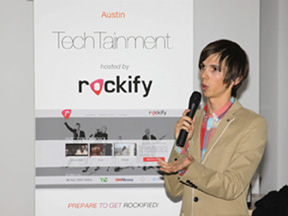
Rockify CEO Joel Korpi, Photos by Samantha Davis
“YouTube serves more music than Spotify, Pandora, and all other music companies combined,” Korpi said. “The problem is, YouTube is not a music platform … the user experience is just not designed for it.”
Taking advantage of this gap in online entertainment, Korpi invented Rockify — a music video discovery platform that looks like old-school MTV but works like Pandora. The platform curates music videos from sources around the web – YouTube, Vimeo, Daily Motion, etc – and displays them in a constant stream that is tailored to the user’s music taste.
The key feature of Rockify is Korpi’s decision making algorithm that discovers not only what users like but what they will like in the future. Users log in with either their Facebook or Twitter account and the algorithm uses their social information and interaction to discover and predict what content the user will be interested in.
“We use the entire social graph,” Korpi said. “What your best friend likes. What your girlfriend, your wife likes. We use that statistically for better accuracy.”
Korpi said that the algorithm can learn a user’s patterns over time and – after about 100 hours of use – can reliably find new music that a user will like. Users will also be able to like or dislike videos shown to further refine the video discovery process.
The Rockify website launched in May and has already acquired 25,000 users by word of mouth alone. Korpi said that the site’s analytics show users spending an average of 23 minutes on the site. Ten percent of those have already switched to the paid premium content offered by Rockify, which currently has an indexed web library of 250,000 music videos.
Several companies and investors have already taken notice of the huge potential for entertainment, advertizing revenue, and direct sales that Rockify’s content platform and decision making algorithms provide. The startup has already entered a business partnership with Austin City Limits, which will use the Rockify platform on their ACL iPad app to display performances in full HD.
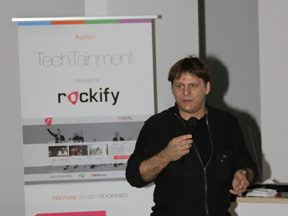
Whoohoo! Media Group CEO David Skye
“The key is taking these older archives from bands and re-mastering them along with the Rockify platform to get them out there in a digital format – streaming, downloading – and really bringing the fans what they want,” Skye said.
Umbel is another of Rockify’s partners. An audience analytics company — Umbel utilizes different sources of data, including social media, to help businesses better target their customer base. Korpi envisions working with Umbel to help artists and bands maximize their fan base, publicity and sales by using Rockify’s discovery algorithms. Umbel will also play a key role in helping Rockify understand their consumer base.
While potential investors attending the TechTainment event were eager to hear how Rockify will make money, CEO Korpi currently has no plans for monetization. Instead, Korpi is focused on growing an industry-changing member base that will gain value and recognition as it grows – much the same way that Facebook began.
“Like Facebook or Twitter or Google we’re worried about building a kick-ass product first and growing an audience,” Korpi said. “We are not necessarily worried about how we are going to monetize it because if you have people then you can monetize them.”
Korpi said he will use established revenue models – such as the ads and commercials found on other sites – once Rockify builds a large enough user base. Rockify’s platform is currently limited to music videos, but Korpi said that his discovery platform and decision making algorithms could be adapted to any form of digital media – providing a wide range of producers and advertisers a platform which can easily target their most likely consumers.
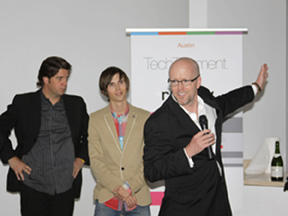
From left: Austin Technology Incubator Director Kyle Cox, Rockify CEO Joel Korpi, Arthur Edstrom of XYZ2Y Ventures
Arthur Edstrom, who served as the MC for the event, said that investing in companies like Rockify is essential if Austin wants to keep their entertainment technology market.
“If we don’t step up and really get behind companies like Rockify, then they have to go someplace else,” Edstrom said. “And it would be a shame because Austin has everything that Rockify needs.”

Music Legend Gregg Rolie
“I’m telling you, it’s all the same,” Rolie said. “You don’t have a good product, you have a problem. You don’t have good people, you have a problem. You can’t get along, you really have a problem. So there are a lot of similarities.”
The night ended with Rolie playing a set in Edstrom’s living room. He was joined by guitarist Alan Haynes who has played with Stevie Ray Vaughan, drummer and close friend Ron Wikso who was part of Foreigner, and bass player Evan “Sticky” Arredondo who has toured with the late Sonny Bono as well as other notable stars. The band played several alternate versions of Santana and Journey songs – including Black Magic Woman – as well as favorites from other groups.
Edstrom hopes to continue creating events that brings together Austin’s technology and entertainment industries. Korpi said that Rockify will host another TechTainment event no later than Austin’s next South by Southwest festival.
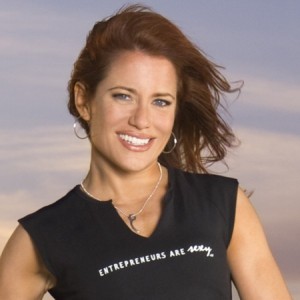
Ingrid Vanderveldt, leader of Dell’s Center for Entrepreneurship
The Austin-based startup, launched last summer, does social media monitoring and currently has 20 employees. It is hiring web developers, administration and sales people, said Eric Klasson, its founder and CEO. The company raised more than $500,000 from investors in August, according to an SEC filing. Klasson attended Dell’s Austin Think Tank for Entrepreneurs on Friday. His company belongs to Dell’s Founders Club, designed to assist a hand-picked group of startups.
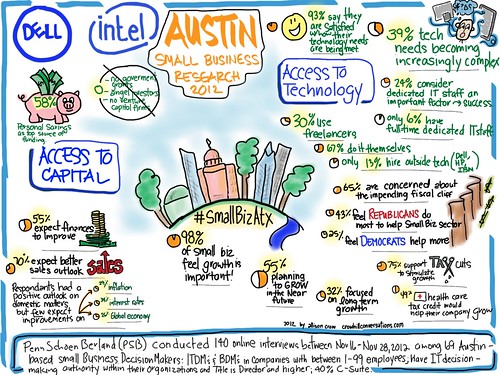
Access to talent is one of the big challenges facing small business in Austin today, according to many of the 30 people attending the think tank event. And more than half of them expect to add employees next year.
Gene Marks, a nationally recognized small business columnist and speaker, led the discussion along with Ingrid Vanderveldt, Dell’s entrepreneur in residence and Drew Scheberle, senior vice president with the Greater Austin Chamber of Commerce.
Dell invited the entrepreneurs, which ranged from a furniture storeowner to a web design firm. The meeting is part of Dell’s big push to help startups and small businesses. It was its sixth think tank, but the first one in Austin. Dell held others in Miami, Atlanta, Chicago, Los Angeles and the Bay Area.
The focus for small and mid-sized companies in the next year is on increasing productivity, growing revenue and reducing costs, according to Dell’s research.
This week at Dell World, Michael Dell announced the launch of its new Center for Entrepreneurs. Vanderveldt leads the center, which offers access to technology, expertise and capital through programs like the Dell Innovators Credit Fund, Dell Financial Services and Dell Ventures.
At the event, the entrepreneurs talked about ways to hire new talent in an increasingly competition marketplace. They suggested networking at events like Door 64’s job fairs and happy hours, hiring interns and working with local universities. But some business owners complained that they could find talent but they couldn’t find people with a strong work ethic and passion. Some had to hire offshore to meet their staffing needs. They said passion and motivation often trump experience.
A skilled workforce exists here, said Scheberle with the Austin Chamber.
“People see Austin as a place of opportunity,” he said.
The workforce attracts big companies like Visa, General Motors and Union Pacific, which all recently announced plans to establish new innovation centers in Austin. But small business can still find people to hire here, he said. He estimates 100,000 people in Austin are underemployed. Retraining programs could put them to work in better jobs, he said.
“We can’t be complacent,” Scheberle said. “We have to work really hard to make sure we’re developing talent.”
In addition to attracting new talent, Austin’s small businesses face big hurdles finding capital to expand.
In 2013, 55 percent of Austin small businesses expect finances to improve and 70 percent expect a better sales outlook, according to Dell research. And 58 percent of small businesses tap into their savings as the top source to fund their ventures.
Tim Porter, CEO of Appddiction Studio in San Antonio, said he hasn’t been able to find bank financing despite having $600,000 in revenue in the last year.
The lenders want to see three years of financial statements before they’re willing to take a risk, he said. He’s financed his startup by tapping into his 401K retirement account.
David Davis, CEO of Provencal Home, said the bank for the furniture store cut off credit lines and called loans following the 2008 financial crisis.
The group brainstormed creative ways to finance businesses through crowdfunding, seeking angel investment from the Central Texas Angels Network and even using credit cards.
In addition, Dell will host a Technology Innovators Day on January 24th at its headquarters in Round Rock in which small business owners and startups can pitch to the top business executives at Dell to do business with the company or seek investment, Vanderveldt said. Companies need to apply at its website beforehand and Dell will select who gets to pitch, she said. Dell will evaluate the companies for acquisition, partnership or as potential investors, she said.
“Dell is basically doing everything and anything in our power to help entrepreneurs gain access to the capital they need,” Vandervelt said. “I’ve never seen a Fortune 50 company do anything as extensive as this. Dell is really reaching out to the entrepreneurial community.”
Creative Networks of Collaboration Key to Solving the World’s Problems Says Former President Clinton
 Nearly 20 years ago, President Bill Clinton took over as leader of the United States.
In 1993, an average cell phone weighed five pounds.
Only 50 websites made up the Internet.
And Clinton sent a total of two emails as president.
“It’s all different now,” Clinton told more than 5,000 people gathered for Dell World in Austin. He gave the afternoon keynote address on Wednesday.
“In a world that seems to be full of zero sum games and conflict models that try to hold on to the past, the future belongs to network collaborators,” Clinton said.
Today, the world is more interdependent than at any time in the history of humanity, Clinton said.
“We cannot shut each other out,” Clinton said.
In this interconnected world, defense budgets still matter and so does security, but not as much as they used to, Clinton said. To solve the world’s problems, people need to build inclusive communities and focus on non-zero sum games, he said.
“We like zero sum games,” Clinton said. “But non-zero sum games are making sure you win by making sure everyone else wins. If we want the world to work we have to have more non-zero sum games.”
 Non-zero sum games ultimately benefit everyone, Clinton said. For example, during his presidency, Clinton spent $3 billion of taxpayer money to support research to develop the Human Genome. That has led to remarkable new treatments for children’s cancer and an open sharing of information. A genome test now costs $5,000 and will decrease to $1,500 next year, Clinton said.
“Networks of creative collaboration,” have made the advancements in finding cures for cancer possible, Clinton said.
The Hubble telescope and space exploration technology led to the identification of more than ten planets in the solar system that are able to support life, Clinton said.
Clinton said he’s an optimist and he sees “a lot of good things about this world.”
But the world has three huge problems.
“First of all it’s too unequal,” he said.
Nearly half the world’s population lives on less than $2 a day, nearly 1 billion people are illiterate and 1 billion do not have safe water, according to United Nations statistics. And 100 million kids don’t go to school.
“Within America and around the world, we have to create ways to share prosperity and reduce inequality,” Clinton said.
 Some inequality and some instability are good for the economy, he said. But extremes shut things down and make people entirely too risk averse, he said. The economy needs sufficient instability with the chance to fail as well as the chance to succeed, he said.
Another problem is the world is unsustainable because of the way we consume energy, Clinton said. Climate change is real and the U.S. must consume less energy and do things differently, he said. People need to deal with the problem and not debate whether it exists, he said.
Twenty years ago, Sweden imposed a carbon tax on its business. Swedes are inherently responsible, Clinton said. The government gave the tax money back and told the companies they just wanted them to know how their actions would impact the future. The companies invested more money on reducing energy consumption by putting in more efficient lighting and cooling systems and other infrastructure changes. Between 1997 and 2010, Sweden’s economy grew by 50 percent and it reduced its greenhouse gases by 7 percent mostly through efficiencies, Clinton said.
“That’s the sort of debate we ought to be having,” he said.
Lastly, Clinton is focused on fighting childhood obesity through the “Alliance for a Healthier Generation.”
“Poor, overweight kids were getting more than half their calories from sodas,” Clinton said.
If that trend continued, the soda manufacturers wouldn’t have any customers because they would die an early death from diseases like diabetes. And the children would have their lives cut short. Instead, Clinton worked with the soda manufacturers to create a different future in which everyone makes money in a different way. And in the last five years, there has been a 90 percent reduction in total calories sold to students in 98 percent of schools, Clinton said. Through “a creative network of collaboration” they were able to solve a huge problem, he said. Michael and Susan Dell’s son, Zach, serves on the board of the Alliance for a Healthier Nation, Clinton said. Some of the best ideas they get are from kids, he said.
People also need to become more tolerant of our differences and learn to live together regardless of political or other beliefs.
“If we can get back into the tomorrow business and do it together we’ll be just fine,” he said.
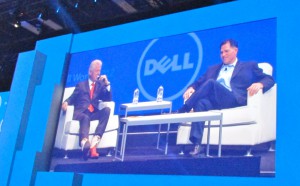
Following his keynote address, Clinton, who wore orange and white Texas Longhorn cowboy boots, sat down with Michael Dell to answer a few questions about the economy. He said the government needs to spend more on research and development and that will help the U.S. remain competitive globally. He pointed out that countries like Singapore are spending $5 billion to become the world’s biotechnology leader. The U.S. faces stiff competition and the government should never let research and development spending fall below three percent of the nation’s gross domestic product. It’s currently in jeopardy of doing so, he said.
 In a packed Austin Convention Center ballroom, the lights dim and a video plays.
“In 1984, Dell was one guy with a dream,” says the narrator.
In the last 28 years, Dell has evolved into a $58 billion company with 109,000 employees worldwide. And in the last four years, Dell has pushed to transform itself from a PC maker into a software, services, solutions and hardware company. In the process, it has diversified into new areas like data centers.
“While much has changed in that transformation, much has stayed the same,” the video announcer proclaims.
Michael Dell enters the stage. He’s been actively involved in Dell since he founded the company in his dorm room at the University of Texas. He has articulated the company’s vision and worked to change its culture through organic growth and acquisitions. He’s fired executives, hired new ones, acquired new businesses and shifted the company’s focus from PCs to solutions.
“This is an incredibly powerful moment for me,” Dell tells the audience of more than 5,000 customers, partners, employees, analysts and media. He is delivering the keynote address at the second annual Dell World event. “I’m so proud of what you’ve accomplished with Dell at your side.”
Then Dell shows a video of a rover landing on Mars, exploration at the South Pole, Genomics research and more. Dell’s customers have used its products to solve some of the universe’s most vexing problems.
“From the beginning Dell has been out to power your dreams,” Dell said.
Some of its customers achievements are on display at the Dell World Expo. The showcase has examples of Dell’s customers using its products in a variety of industries. Dell is working on cloud, data center and security solutions for customers and much more.
“We’re working to democratize and simplify these innovations,” Dell said.
A major focus is securing all the devices in a “Bring Your Own Device” environment at companies. It’s all part of Dell’s focus to become the industry’s leading provider of end to end solutions. The company spent $5 billion in the last year to build out its solutions portfolio. But the PC business, or what it refers to as the “client” business, continues to contribute to its bottom line.
“We strongly believe PCs are important,” Dell said. “Overwhelmingly PCs are still how business gets done today.”
Microsoft’s new operating system, Windows 8, also brings together PCs with touch screen technology creating more dynamic computing devices. Dell’s Latitude 10 tablets run Windows 8 along with Dell’s XPS 12 Notebook, which transforms from a laptop into a tablet. In addition, Dell just introduced an all in one portable workstation and entertainment center that also runs on Windows 8.
“The possibilities are limitless,” Dell said.
Windows 8 gives the 1.5 billion installed base of PCs worldwide a reason to get a new PC, Dell said.
Dell is also pushing big into the data center industry. It has been in the server business for more than two decades. Dell is number one in North America and Asia in the server market and is only 64,000 servers away from being number one in the world, Dell said.
Dell’s open standards have made it easy to integrate its products into existing data centers. Its software really helps to secure and manage customers’ environments, he said.
“The consistency of our vision and strategy is paying off big time,” Dell said.
The final piece of Dell’s strategy is the services industry, which now employs 47,000 of its workers.
“We’re ready to help you achieve your objectives,” Dell said.
The company manages 32 billion in security incidences every day.
“We know about what’s going on in the world of cyber security more than anyone,” Dell said.
In the healthcare industry, Dell manages 114 million mission critical devices. Dell also prides itself on its customer support and gives a response time of two to four hours, Dell said.