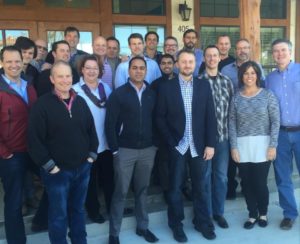
The Austin-based startup, founded in March of 2013, previously raised $1.2 million, according to its Crunchbase profile. Silicon Hills News did this profile of the company in 2013. Localeur is now in 30 cities and is available as a mobile phone app.
Joah Spearman, Co-Founder and CEO, formerly worked at Bazaarvoice with Co-Founder and President Chase White. They saw an unmet need for a travel site with recommendations by locals. A void left by travel and recommendation services like need Yelp and Trip Advisor.
Spearman has been vocal in the Austin startup community about difficulty in finding funding and at one point talked about moving his startup to California.
Localeur didn’t send out an announcement after it raised the funding last week, which Spearman wrote took “forever to raise,” in a post on Hacker Noon’s Medium Site, a San Francisco-based blog for Hackers. Instead, in that same post, he listed seven reasons why startup fundings are overrated.
The number one reason Spearman listed: “people think raising money is success rather than fulfilling your mission.”
He also said he sold his 2011 Toyota FJ Cruiser, also known Uncle Phil, in August to make payroll and that stuff like that never gets covered unless he writes about it on Medium. And he complained in his post about inaccuracies in media reports.
In a separate post on the Localeur blog, Spearman reports Localeur is hiring and it’s soon going to have an all hand’s on meeting in San Francisco to plot its strategy. It’s aiming to have next year’s meeting in London.
Google confirmed plans on Wednesday to continue to roll out its high speed Internet network in San Antonio and Austin despite retracting in other markets.
Google Fiber first announced plans to come to Austin in April of 2013. The service is currently live there and continues to roll out to different parts of town.
“Google Fiber isn’t leaving Austin. We’re still thrilled to be your neighbor and continue to offer superfast Internet to residents,” according to a statement from a Google Fiber spokesperson.
In August of 2015, Google announced plans to provide its “Gigabit” Internet network to San Antonio. Google’s network is about 100 times faster than what most broadband users currently experience in the city.
“Google Fiber will continue in San Antonio. We can’t wait to deliver high-speed connectivity to San Antonio residents, and are even looking at innovative new ways to deploy, as enabled by One Touch Make Ready and a new construction method we’ll be piloting called Microtrenching. In Austin we’ve already seen a 10x improvement in digging speed (i.e., laying Fiber) with no strikes to utility lines using microtrenching,” according to a statement from a Google Fiber spokesperson.
But overall, Google Fiber is winding down plans for some of its new markets.
“In terms of our existing footprint, in the cities where we’ve launched or are under construction, our work will continue,” according to a blog post form Craig Barratt, SVP, Alphabet and CEO of Access. He also announced plans to step down as CEO of the Google Fiber operations.
Google plans to pause operations in its “potential Fiber cities,” those cities where its been in exploratory discussions, according to Barratt.
“In this handful of cities that are still in an exploratory stage, and in certain related areas of our supporting operations, we’ll be reducing our employee base,” he wrote in the blog post.
Bright minds that look at things in innovative ways are going to be the future of the healthcare industry, according to Dr. Vonda Wright, Orthopaedic surgeon and keynote speaker at MedTechTX 2016. But it’s not just about inventing a cool gadget and thinking the healthcare system will automatically embrace it. Healthcare startups have unique challenges they face in getting their product to market. A recent conference, MedTechTX 2016, in downtown Austin, addressed a lot of the challenges entrepreneurs face in the marketplace today. Here’s a few of the takeaways from the two-day event.
It’s Not All About Making Money – Remember you are saving lives with your gadgets and platforms and it’s not about making money that is the message you need to translate your product into – the why to improve patient outcomes, said Dr. Vonda Wright, Orthopaedic surgeon, UPMC Center for Sports Medicine, Medical Director, UPMC Lemieux Sports Complex, founder, Women’s Health Conversations Conference, director of Performance & Research Initiative for Masters Athletes.
Startups Need a Warm Introduction to Get in the Door – The best way to get in is to get a warm introduction to healthcare providers from someone they know, said Dr. Frank Mazza, Chief Medical Officer of Quantros.
Claudia Perez, BSN, MHI, business development with Seton Healthcare Family, only makes calls to introduce startups to doctors after she has vetted the startups for passion, solid product, good team, business plan and customers.
Startups Must Find a Champion within the Healthcare System to help pitch their product and startup – Once you find your champion, you got to make sure they have skin in the game as well, said Dr. Frank Mazza. Don’t give everything away for free. Make them commit to providing you with data or access to data. Also make them commit to a certain amount of time every week to meet with you and the right people.
Criticism equals opportunity – Controversies are opportunities for innovation, but beware of selective hearing, according to Jonathan Coe of Prescient Surgical.
Focus on the Patient Experience – You’ve got to come in with a ROI (Return on Investment) story, said Dr. William Rice with St. David’s Healthcare. But you also need the patient experience ROI. It’s not just a financial story. It’s multi-dimensional.
Make Sure You Can Make a Profit – It may cost $200 to make a widget and you’re going to get reimbursed $210 – sometimes it’s better to fail early than to waste a lot of time and a lot of money, Dr. Dan Peterson with Alafair Biosciences. It’s important to know how much customers are willing to pay for your product.
Do Your Homework – Don’t ask your potential client to do your homework for you, said Chris Thierfelder, director of research and development of Halyard Health. Please do your homework in advance.
Pitch Via Email – Dr. Norman Chenven, CEO of Austin Regional Clinic doesn’t want to get pitched via a slidedeck. He wants an email with bulletin points that shows why a startup’s product or service is good for their organization. No slides. No pictures. Then he’ll call together a white board group or team when they are looking at a device to see how it fits in the organization. I try to do a lot of pre-screening. We do get pitched by a lot of folks.
Start Small -Katrina Daniel, RN, Chief Health Care Officer of the Texas Teacher Retirement System, advised startups to start small and get experience and then expand. A program the size of ours is not going to take too many chances.
Play by the Rules – Play by the rules in whatever organization you’re trying to get into, said Kevin Cook, CEO of Hospital System of Mississippi. The quickest way to get shut down is to try to do an end run around those rules, he said. His organization is bureaucratic, complex and difficult and they have to play within those roles. His organization is a state entity and has regulatory requirements to comply with, he said.
Focus on Sustainable, Patient-Centric Valuation – To understand if your product is going to create value, you need to focus on credible data – cost and outcomes – ask patients if they got better, said Dr. Kevin J. Bozic, MBA, professor and chairman of the department of surgery and peri operative care at Dell Medical School at the University of Texas at Austin and a keynote luncheon speaker.
Disclosure: MedTechTX is put on by the Texas State Small Business Development Center, which is a sponsor of Silicon Hills News and sponsored a two-day live blog of the conference.
Amazon is opening a game development office in Austin focused on Lumberyard, a free game engine deeply integrated with Amazon Web Services and Twitch.
Amazon opened a corporate office in Austin in the Domain at 11501 Alterra Parkway about a year ago, according to a report from KXAN.
In a blog post, Amazon called Austin “one of the long-standing centers of gravity for great game development talent, and innovation in community-driven games.”
“We believe Austin is a perfect location for us to continue our quest to help game developers build the community-driven games that push both engine and cloud technology,” according to the blog post. “From the early days of Ultima Online, to some of today’s most beloved MMOs, Austin game teams have helped lead the industry in large-scale, multiplayer experiences.”
Richard Garriott de Cayeux created Ultima Online in 1997 as part of Origin Games, which was acquired by NCsoft. He currently runs an Austin-based gaming company called Portalarium.
Lumberyard and AWS seek to offer game developers a scalable infrastructure to build their operations without worrying about their backend technologies.
“Not only is Austin a great location for experts who have passion and deep experience building some of our favorite MMOs, multiplayer, and community-driven games, it’s also home to one of our new Twitch teams who just set up shop there in July,” according to Amazon. “The Twitch team in Austin is focused on helping developers use Twitch in creative ways to grow community and make money, and we’re excited to work closely together (and have made sure that our desks are well within Nerf distance).”
VentureBeat reports the Amazon Lumberyard expansion comes a few weeks after San Francisco-based “MaxPlay, the maker of a competing game engine, confirmed that it had laid off almost all of its employees at its San Francisco and Austin locations.”
Disclosure: Silicon Hills News is an affiliate partner with Amazon.
Girls Who Code having fun at the Dell Campus, courtesy photo.
Dell Technologies has partnered with Girls Who Code to support after school computer science programs for about 15,000 girls in under-served communities across the U.S.
Dell has pledged $400,000 in a cash donation to support the program. It also appointed five women technology leaders as program ambassadors to serve as mentors to the girls in grades 6-12. Girls Who Code is a national non-profit organization working to close the gender gap in technology.
The money will go to buy materials and supplies for the after school program as well as provide funds for field trips to take the girls to tech companies. Programs will be concentrated in communities across the Great Plains and Rockies, the Southeast, the Northeast and San Francisco.
Previously, Dell supported Girls Who Code locally. It has also partnered with the Girl Scouts of the USA to support Digital Cookie 2.0 to foster entrepreneurship and an interest in the science, technology, engineering and math fields. In addition, Dell supports GirlStart, which also teaches girls about STEM opportunities and technology skills.
And at the recent Dell EMC World held in Austin, Michael Dell recognized the executive directors of the youth learning groups during his keynote address. Dell also hosted them as part of the Women in IT track at Dell EMC World.
“Never before in history has technology been so core to our economy and our society at large,” Karen Quintos, Executive Vice President and Chief Customer Officer of Dell said in a news release. “We have an incredible opportunity to truly drive human progress through technology, and we can’t realize the full potential of that without our girls. I’m so excited to partner with Girls Who Code to prepare the next generation of female leaders to grow and thrive in a connected world. When we engage and empower our girls, there is no limit to what we can achieve as a global community.”
SpareFoot, the Austin-based storage marketplace, has launched a campaign to raise money for Austin rescue organizations and to encourage people to adopt pets.
The campaign kicked off last week and has so far raised nearly $2,800 of a $5,000 goal.
SpareFoot, founded in 2008, has been a dog-friendly company since its start. In addition to the Public Service Announcement, SpareFoot launched a new video campaign, lovingly called “SparePups,” which features a dog couple trying to figure out how to make more room for their coming litter.
The SparePups campaign builds on the success of SpareFoot’s “We Can Store That” video series that launched earlier this year — the most popular of which featured Merpeople and garnered over 3.5 million views.
As part of the campaign, SpareFoot features tips for moving with dogs, organizing your household for multiple pets, a list of the best cities for dogs, how to turn your pet into a star, craziest things people buy for dogs, most interesting dog houses, adoption education information on its blog.
When a drone can deliver a burrito to a hungry college student, it’s no longer just a novel technology but a major innovation for businesses.
Still, the commercial drone business in the United States is in its infancy with rules and regulations just being worked out. This summer, the Department of Transportation’s Federal Aviation Administration finalized rules for the commercial use of drones.
That’s a major boost for Austin-based software company, Hangar Technology which just announced $6.5 million in seed financing to develop its data capturing software focused on drone technology.
Hangar Technology will give companies aerial data using its software and drone technology.
Colin Guinn, former CRO of 3D Robotics (3DR) and CEO of DJI North America and Jeffrey DeCoux, founder and CEO of eCustomers and SMART technologies, founded Hangar.
“We’ve spent the last six years deeply involved in the major transformative hardware innovations of the consumer and professional drone industry, and it’s exciting to take the opportunities we’ve seen for the future and form a company with an entirely new vision for the industry,” Guinn, president of Hangar said in a news release. “I’ve watched drone technology advance at a breakneck pace like no other product before it. These consumer-friendly products now have multiple computers, an autopilot, 4k cameras, long-range video links, sensors and more and only costs $500-$999. Harnessing that technology is an unparalleled opportunity across industry. ‘Consumer’ drones have become so advanced that no human can fully maximize and capitalize on their capabilities – it’s time for software to automate and optimize data capture from these devices.”
Lux Capital, which counts a number of well-known companies in satellite, drone and robotics technology in its portfolio that complement Hangar, led the financing. Bilal Zuberi, partner at Lux Capital, will join Hangar’s Board of Directors as a part of this financing.
Fontinalis Partners, which specializes in investing in technologies related to next-generation mobility, also participated in the round, along with Haystack Partners and several prominent angel investors.
Hangar also invited DJI, 3DR and Yuneec drone owners to sign up for Hangar’s private beta. It’s available to select users now and open to the broader public later this year.
Michael Dell delivers the keynote address at DellEMC World at the Austin Convention Center.
By LAURA LOREK
Reporter with Silicon Hills News
Everything in the technology world improves about ten times every five years, Michael Dell, CEO of Dell Technologies said at the first Dell EMC World Wednesday morning.
“That means 15 years from now, we’ll have another 1,000 times improvement in power, speed, efficiency, capacity compared to what we have today,” Dell said.
Those improvements will lead to smart cities full of driver-less cars, nanobots that can cure cancer and repair cell damage and drone delivery of goods, Dell said.
“These plus hundreds of thousands of other incredible innovations, large and small, that we can’t predict or really even conceive today,” Dell said. “This is the Internet of everything.”
Just six weeks after the close of its $67 billion merger with EMC, Dell Technologies is poised to be a big player in the Internet of everything and the transformation of businesses to the digital world, Dell said. And that’s because privately-held Dell Technologies’ unique structure lets the company “be nimble and innovative like a startup but have the scale of a global powerhouse,” Dell said.
During his keynote address at the Austin Convention Center, where Dell EMC World continues through Thursday afternoon, Dell painted a picture of extreme upheaval, digital transformation and fast paced change. And he put forth the case that Dell Technologies can help other businesses adapt and change during turbulent digital times.
“It’s been called the next industrial revolution,” Dell said. “The next quantum leap in human progress. Virtually reality, augmented reality will redefine work, learning and play. And whole new ways of living and doing business will literally open up before our eyes.”
Machine learning, artificial intelligence, data and analysis will help “amplify human creativity,” Dell said.
“It will unleash a torrent of innovation and progress,” Dell said. “And the ability to solve some of the world’s greatest challenges. It’s the sunrise of a new era. The digital dawn.”
Michael Dell answering questions at a press conference following his keynote speech at Dell EMC World.
Dell sees tremendous opportunity in this digital age. But a lot of organizations fear it, he said.
Dell Technologies recently took a poll of 4,000 executives around the world and asked them how prepared they were to take on this digital future. The poll showed 45 percent of businesses believe they may be obsolete in just four to five years and 48 percent don’t know what their industry will look like in three years, Dell said.
“And 78 percent consider digital startups as a threat either now or in the future to their businesses,” Dell said. “It’s digital fear. Because they know this future is coming very rapidly and the future doesn’t care if you’re ready. But we do.”
That’s where Dell Technologies comes in. Its family of businesses are the leader in servers, support, virtualization, security, cloud software, cloud infrastructure, software defined datacenters and more.
And Dell Technologies is spending roughly $4.5 billion in research and development, roughly twice that of its nearest competitor, Dell said.
Dell’s vision for the new company is be “the trusted provider of essential infrastructure for the next industrial revolution,” Dell said.
And six weeks after the closing of the EMC deal, Dell also announced a lot of new products and solutions. Dell also touted its expertise in the hybrid cloud, which is a combination of a private and public cloud to host data.
Dell also said the PC business remains core to its mission and its strategy. For 15 quarters in a row, Dell has increased its share of the PC market, Dell said.
“This last quarter, we outgrew our competition,” Dell said. “Year to date, all of our PC competitors have declined and Dell is growing.”
PCs continue to be integral in the digital world and that is particularly true in the Internet of Things world, Dell said.
With the explosion in the number of devices and digitization of the world’s critical infrastructure, malicious attacks have grown significantly, Dell said.
“As everything becomes digital it becomes vulnerable to attack,” Dell said.
The cost of the cyber-crime is projected to rise to $2.1 trillion annually in the next five years, he said.
Today, a single data breach can cost $150 million, Dell said.
Dell’s managed security services see 200 billion network events each day that the company analyzes for malicious activity and delivers security countermeasures, Dell said.
“We are seeing more of it than anyone else and we know what to do about it,” he said.
And it named a Georgetown-based software company, AgileCraft as the number one best place to work out of 50 small businesses in the country.
Three other Austin-based companies made the list including AcademicWorks at the number three spot, BP3 Global, at the eighth spot, Square Root at the 16th spot.
And Cirrus Logic ranked No. 54 on the list of 100 best medium sized companies to work for in the U.S. Companies with fewer than 100 employees compete for placement on the 50 Best Small Workplaces list, and companies between 100 and 999 employees compete for placement on the 100 Best Medium Workplaces list.
The companies landed on the list, not because of perks, but because of “a sense of mission, trust from managers, autonomy for workers and a culture of teamwork and communication,” according to Fortune.
“That’s what emerges from 52,000 surveys of employees at small and medium-size companies, conducted by our partner, Great Place to Work,” according to Fortune.
AgileCraft, founded in 2007, earned the top spot when all of its 20 employees surveyed reported 100 percent positive feedback on the company. The software company helps large companies simplify software at scale. Its customers include Southwest Airlines, Principal Financial and AT&T.
University of Texas at Austin Professor James Sulzer presents ShrugNoMore at the StARTup Studio.
By LAURA LOREK
Reporter with Silicon Hills News
The University of Texas ranks as the fourth most innovative university in the country, according to a recent report by Reuters.
It’s in good company with Stanford taking the top spot, followed by the Massachusetts Institute of Technology and Harvard University.
And Pitchbook, a venture capital research firm, recently crunched a bunch of data looking at founders of companies that received a first round of VC funding since 2006 and found the University of Texas ranks in the top 10 schools nationwide. UT ranked eighth with 561 founders creating 511 companies and raising $4.7 billion in venture capital.
And one of the drivers behind all of the innovation going on at UT Austin is the Innovation Center at the Cockrell School of Engineering. It is run by Bob Metcalfe, professor of innovation and inventor of Ethernet, Louise Epstein, executive director and serial entrepreneur, Ben Dyer, serial entrepreneur and Entrepreneur in Residence and Steve Nichols, professor and Advanced Manufacturing Center Director.
Every month during the school year, they put on the StARTup Studio to showcase innovation spinning out of classrooms and laboratories at UT Austin. The Greater Austin Chamber of Commerce, WeWork Austin and the Office of Technology Commercialization at UT sponsor the events.
Last week, three professors presented their early-stage startups to a few dozen invited guests in a conference room in the Ernest Cockrell Jr. Hall at UT.
First up, James Sulzer, assistant professor of mechanical engineering, presented ShrugNoMore, a physical therapy device that detects should hiking. The device solves a problem for therapists and improves treatment and shortens therapy time for patients, Sulzer said.
Spinal cord injuries and other injuries in which patients shrug their shoulders when they exercise leads to shoulder impingement and can result in further treatment, Sulzer said. The simple ShrugNoMore device can detect shoulder hiking and warn patients when they are elevating their shoulders, he said. The device, shaped like a barbell but as thin as a bandage, attaches to the back near the shoulder and clicks whenever the patient elevates their shoulder. Sulzer and his students created a prototype which they are evaluating right now.
They are also potentially marketing the device to people who have rotator cuff (a group of tendons and muscles which connect the shoulder joint to the arm) issues with five million doctor’s visits a year and 250,000 people getting surgery every year, Sulzer said. The ShrugNoMore device costs $30.
UT Austin Professor Lili Qiu presents CAT, a mobile tracking user interface device to replace a mouse.
Next up, Lili Qiu, professor of Computer Science, developed a motion tracking technology called CAT, an alternative to a mouse device to track hand movement. Qiu’s technology can accurately track hand movement and gestures in the air using existing mobile devices based on echolocation or sound, much like how a bat detects objects.
The CAT technology sends inaudible sound signals to track in real time hand movement to communicate with the microphone of a smart phone or smart watch or another device, Qiu said.
The CAT technology provides a user interface alternative to the mouse that allows consumers to communicate with all kinds of smart devices in their home including TVs, laptops, watches, game consoles and more, she said.
UT Austin Professor Simon Humphrey presents NanoAlloyCatalysts
Lastly, Simon Humphrey, assistant professor of chemistry, presented NanoAlloyCatalysts, a technology that uses microwave synthesis to create catalysts for petrochemical and other companies.
Ninety percent or more of all chemical processes require a catalyst at some stage, Humphrey said. A catalyst helps speed up a chemical reaction, but is not consumed by it.
“The opportunities in this market are very clear,” Humphrey said. “The petrochemical market in just the sales of catalysts annually is about $1.5 billion and it’s growing. And the sales for catalysts in cars is about $5.8 billion. And these types of catalysts are finding new applications in fuel cells.”
Oil refining companies are looking for better catalysts to make their operating systems more efficient and that’s where Humphrey sees a big opportunity.
Humphrey’s solution is to make very small “nano” size catalysts that allow companies to get a “lot of bang for their buck.”
NanoAlloyCatalysts is in the seed stage of development. Its intellectual property is licensed from UT and Humphrey is interested in partnerships and collaboration to do pilot scale testing.

 Localeur, a travel recommendation service aimed at millennials, has raised nearly $4.2 million of a $4.6 million offering from 43 investors, according to papers filed with the Securities and Exchange Commission.
 Google confirmed plans on Wednesday to continue to roll out its high speed Internet network in San Antonio and Austin despite retracting in other markets.
 Bright minds that look at things in innovative ways are going to be the future of the healthcare industry, according to Dr. Vonda Wright, Orthopaedic surgeon and keynote speaker at


 When a